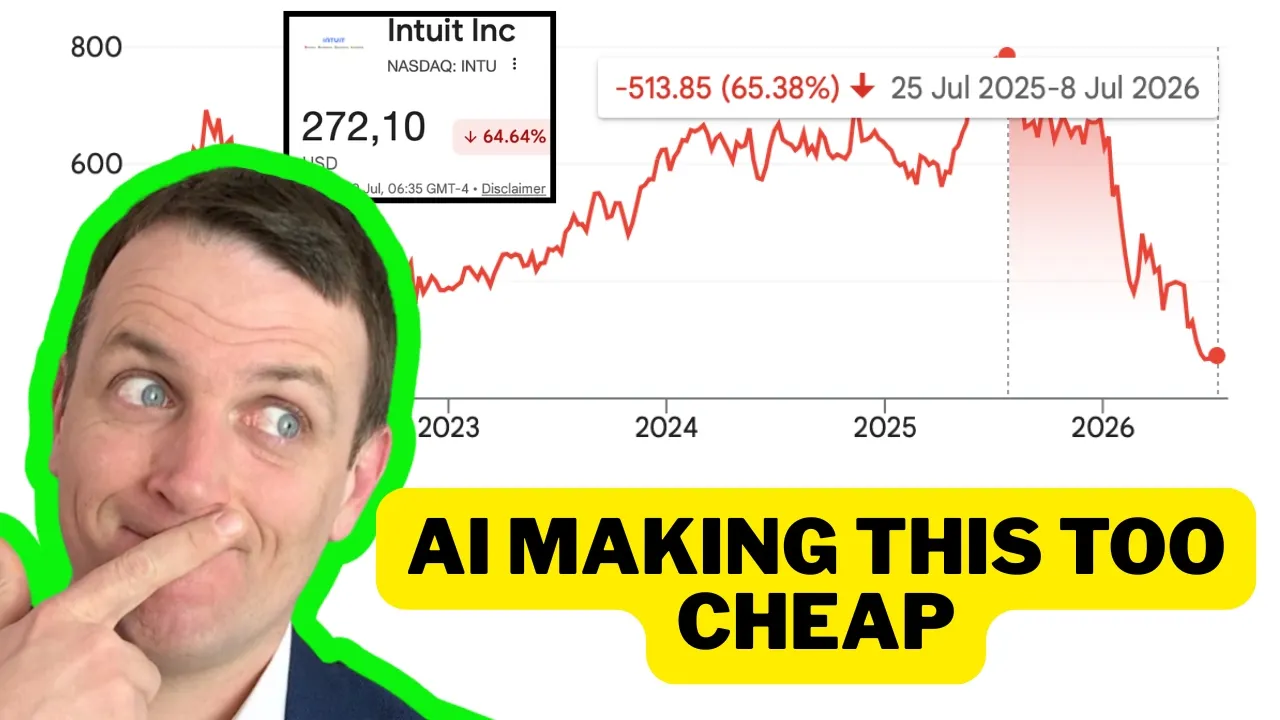
INTUIT INTU - DEEP VALUE OR VALUE TRAP?

- Video return
- —
- Calls
- 0
- Buy / Sell
- 0 0
- Published
Recommendations
No buy/sell recommendations found in this video.
Full Transcript
Good day, fellow investors. Highly requested stocks, Intuit, and let's get into it. Now, 65% down over a year, that's a crazy situation. However, the P/E ratio is now 16, dividend yield 1.76%. The company is still growing. Perhaps a better chart to show what's going on is this. If the trend just continues, you get a good return. Perhaps this was just exuberance. Is it now deep value or a value trap? I've never looked at Intuit, but I have my reasons for looking into it now. Now, the business model, we'll do a valuation, we'll see what is the risk and reward, and what kind investment this is. If you like this analysis, please smash that like button. I've looked a little bit at the investor day. They are prepared for artificial intelligence, so they say at least. And now we have to see whether they will take advantage of it or they will be pressured by it. They are still growing. They did grow at 8% accelerated and now reached 16%. Last quarter revenue did just 10% deceleration, which also scared the market. But they say they have a huge opportunity still to grow over the long term. Small businesses mid-market consumer large market growth opportunities there. On the businesses, they can put all the finances in one app. And their bold 2030 goals is for accelerating revenue growth to 20% per year. If they can do that with AI, 20% growth, 25, 30% earnings growth, and then this is crazy cheap at a P/E ratio of 16. Now, they have 86 million consumers, employees, everything. They know everything. They know the data and they have certainly an advantage also getting into AI. Not questioning the advantage, but the question is will they be able to charge more, less? Will they be able to charge? And that is the key question when it comes to assessing these AI opportunity or threat investment ideas. Because with AI, everything is getting better, but also for competitors. And there is still a lot big market. So, a lot of companies might enter deeper into these opportunities with better coding situations, etc. However, Intuit for now is growing very fast. TurboTax is the key situation. Still growing. A little bit deceleration and pricing pressures there from cheaper competitors in the lower pricing range for those that have salaries less than 50,000, but okay. Now, rewarding shareholders, dividends, but mostly the focus is on share repurchases. And we'll discuss that a little bit later because when it comes to share repurchases, if the stock prices is low, it is okay. If not, it's not that okay. Nevertheless, guidance 12 to 13% growth, EPS 15% dividend growth per share. That is what they guided at their investor day and they are confident they will deliver on that situations. However, last quarter just 10% just 10%. This is not 20 and not 15. So, that is what certainly scared the market. And if there is a deceleration, you might have to adjust things. And there I asked here my assistant to give me the bear and bull case from analysts. Goldman Sachs lost on price tax season, lost market share among budget-conscious do-it-yourself tax filers, aggressive pricing pressure. With AI, with the data, this is the key issue. The key question is will they be able to hold the moat strong and charge more? Some legal issues, missteps, okay, that can be dealt with. And growth targets revisions, that will be lower from the 20%. Bull case, phenomenal cash generation, AI integration, they have are firing a lot of people, so they will do things differently, and evaluation disconnect. Now, when it comes to these do-it-yourself competitors or things like that, I'm not worried about them. I'm worried about Google or other companies seeing, "Okay, there is money, 300 billion total addressable market. Can we enter there? We have the people, we have the data, we have the everything." Is what Mark Zuckerberg is talking, "We'll build the AI power, and then we'll see how we'll use it." That's what they have been doing, that's their strategy. We'll see whether they will make money on it, but they can make a very difficult business environment from companies like Intuit. So, analysts still see it as a moderate buy, but there is a big discrepancy with valuations. And when I look at the crash, at the 60% crash, guys, the P/E ratio was 57 just a year ago. The P/E ratio now is 16, because earnings keep on growing, but 57 is a lot. So, the key question now is will the deceleration in earnings, revenues continue? If it continues, the stock will go lower. If it stabilizes, and earnings, okay, grow at 10 15%, then the P ratio is cheap. P ratio goes back to 25 and you make 50% return. Possible. However, it's also the question, if not, it goes lower. How lower we will discuss. Perhaps a good example is PayPal. The P ratio just went down to eight, seven. You can see the destruction there. And that is where things when are they are not growing where they stabilize. Speaking of buybacks, when it comes to buybacks, people don't understand and everyone is saying, "Sven, buybacks are the new things, no dividends, et cetera." When it comes to buyback, buybacks assume that when done at whatever price, that nothing bad will happen to the business. So, this company spent on buybacks billions and billions, and there is no value now that the stock price is 66% lower. That is something to keep in mind. Another thing to keep in mind is the boom in volume, especially over the last few months. This means that the shareholders have been recycled, the old ones that have capitulated here in the growth, and these could be value shareholders now, and therefore, we might have been hit a bottom. But, it will depend on the next quarter. Analysts are still positive, very positive year-over-year growth, double digits, and this double-digit compared to the 16 P ratio is definitely a buy. If they hit double-digit growth, because TurboTax, the issue is the key driver of revenues and everything. So, the question is, will Intuit lead AI? Yes, they will, because they have the data. So, they will be able to give the most value. But, the key question is at what price and what will be the growth rate going forward? 20%? 15%? 10%? Perhaps a bad year with 0% depending on what the competition will do. And given the tech power, on one side I say AI is the bubble because all these hyperscalers are investing in hardware. AI will do great things, but as the hyperscalers did, not investing in the internet, using the internet. So, someone can build tool, taxes, this and that we using AI and offer it way cheaper than Intuit. That's the key risk. And if you look at the numbers, great gross margins, everything great, huge growth over the last 10 years, a little bit slow down, but then again booming in this, let's call it short recession there. So, the question is where will this company go next? They had a great time. Now, revenues are slowing down and you can see here that revenues were slower a little bit also in the early 2010s. If we go and make an analysis valuation of Intuit, I have inserted the data. So, we have the dividend. We have the expected growth rate of the dividend of 16% 10% discount rate, which is my expected return. A terminal multiple of 30 on the dividend implies down the road, 10 years down the road, a 3.3% dividend. As the key question at the beginning was about dividend investors here. And yes, if the dividend keeps on growing at 16%, even if it goes down from the current 1.7 to 3.3, the intrinsic value is 276, which is exactly where the stock price is. So, to justify the current stock price, Intuit needs to grow 16% per year. Perhaps they will increase the dividend or something, but this is their, let's say, standard business model, and that's priced in and giving you a 10% return. If they can grow 20% per year, which is their target, then we are looking at perhaps a higher multiple if they keep on growing at 20%. A 2% dividend yield expected from the market, and yes, then we go to the last year prices double almost from where we are now, and that would justify, let's say, a higher stock price, and the stock price in 10 years would be above 1,000 for you to have a 4 5x. However, if the dividend growth rate declines to 10% and then 7% down the road, the market starts requiring a 5% yield for a slower growth, then the present value is just 124 for a 10% return, and even the stock price doesn't go much higher than the current stock price. However, all in all, if we put equal probabilities to this situation, it is undervalued, but it will all depend on the next key question. So, the question is, is there a moat? Is there a long-term durable moat? If yes, buy this company growing at 15-20% at a P/E ratio of 16, it's a crazy bargain. If no, if there is no moat, sell, because the business will keep on deteriorating. Can I give you an answer on whether it has a moat? Unfortunately, no. This is the first time I look at this, and I didn't analysis to see, okay, do I want to become a specialist into this business? And then I say, is it simple? No, for me too hard pile as 99% of businesses should be. Simply put it on a too hard pile and look for something else. It could go anywhere. It could do 3x. It could crash another 50%. We'll see. So, on that note, you have to see does it fit my portfolio? Do you have better compounders? I have better compounders, less risk, not under AI pressure, not that someone can simply build an AI tool to compete. That's it. If you don't have better, bet on this. If not, keep value investing.
Comments 0
Sign in to join the discussion.
Sign inNo comments yet. Be the first to share your thoughts!