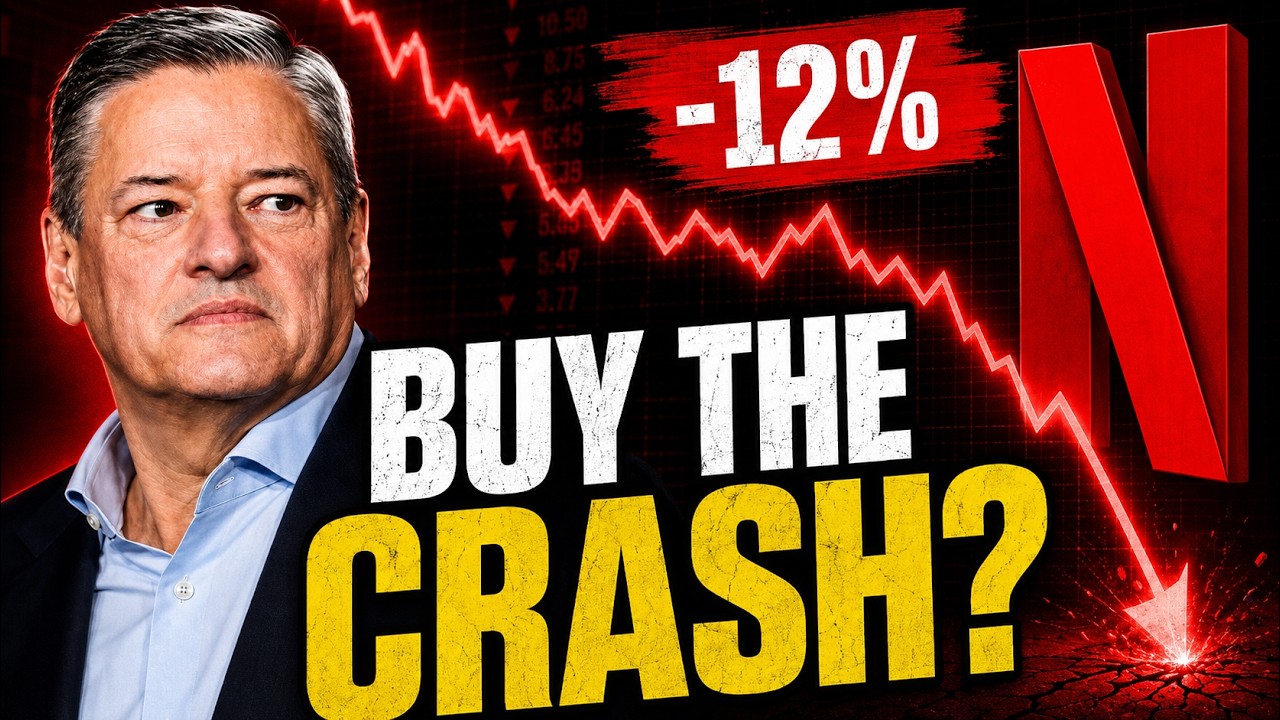
Netflix Is Down Nearly 50% — The Real Problem Isn’t Earnings

- Video return
- +6.87%
- Calls
- 1
- Buy / Sell
- 1 0
- Published
Recommendations
Entry is the asset's closing price on the publication date. Current is the last close on record.
-
Entry $68.95 17 Jul 2026Current $74.13 07 Aug 2026Result +$5.18
I would be comfortable beginning to buy Netflix gradually at the current price.
Context “I would be comfortable beginning to buy Netflix gradually at the current price. I would not immediately build a full position.”
Full Transcript
Netflix's just fallen another 10% after earnings and this is only 2 weeks after I covered the stock trading near its 52-week lows, but the question is now changed. This is no longer simply about whether Netflix looks cheap after a large decline. The market's now asking whether Netflix has stopped being a premium growth company and started becoming something far less valuable, a mature legacy media business. And it sounds dramatic considering Netflix just reported double-digit growth, rising earnings, operating margins above 33% and maintained a full-year free cash flow forecast of approximately 12 and 1/2 billion. Yet investors are selling the stock aggressively. We can see in the pre-market as of recording, Netflix is down around 10%. So in this episode we need to answer three questions. First, what did Netflix actually report and why did a seemingly acceptable quarter trigger such a violent reaction? Second, is the slowdown in engagement genuinely threatening Netflix's future or is the market placing too much importance on one metric? And finally, after rebuilding my discounted cash flow model with three different scenarios, is Netflix now cheap enough to buy or could the shares fall considerably further because the valuation range is now extremely wide? Under my pessimistic case, Netflix may still be overvalued. Under my central case, the shares offer attractive upside and if advertising develops into the growth engine management expects, this decline could eventually look like a major opportunity. But there's one number in the quarter that Netflix must prove is temporary. So let's start with what exactly happened. Now Netflix entered the earnings report already under significant pressure. I mean it was trading around $74 before earnings and now we can see in the pre-market down around 10% sitting at these $66 $67 mark. It leaves Netflix pretty much very close to the lowest price it's traded in the last 12 months. In fact, when we take a look 52-week highs $127 is going to now open at a new 52-week low. And I mean look, over the last 12 months Netflix has fallen by around 41% during the same period the S&P 500's gained roughly 20% while the Nasdaq 100 has risen by around 27%. Netflix therefore has underperformed the Nasdaq by almost 70 percentage points in just 1 year. And now look, everyone knows that this was not a stock price for perfection heading into earnings. Investors were already concerned about slowing engagement, increasing competition from YouTube, uncertainty around Netflix next growth engine, and a sequence of analyst price target cuts. The expectation bar was already relatively low, but the report still failed to clear it. And when we look at the actual numbers, well Netflix reported EPS of 80 cent, 1 cent ahead of expectations. Revenue came in 12.56 billion compared with an estimate of 12.58. So Netflix missed revenue expectations by an extremely small amount while slightly beating EPS. That alone does not explain a 10% decline. And we can note the revenue was up around 13% year-over-year to around 12.6 billion. The business generated 4.2 billion of operating profit, net income around 3.4 billion, and earnings per share was up 11% from the same quarter. Now when we take a look at this, these are not the results of a company collapsing operationally. The problem here is the direction of travel. And before looking at the guidance, listen to how one analyst described what investors now believe Netflix has become. And this clip we're going to show matters because it summarizes the entire market debate in less than 1 minute. And as we're going to hear, the issue is no longer whether Netflix can generate profits today. The concern is whether engagement and revenue growth are now slowing towards a level that would permanently reduce what investors are willing to pay for the business. >> Look, Melissa, this is fundamentally investors believing that Netflix has gone ex-growth. Like I think they are just projecting out and saying engagement isn't really growing much. You know, it's up 2% over the first half of the year year-over-year. And I think they're going, "God, it's up 2%. This thing's going to start to slow even more. Revenue growth, which was, you know, going to be 12% for the year ex-currency, they're going, "That's going to be single digits pretty soon." And so, they're literally just looking at this company as like this is base I two people have already texted me saying, "This is now a legacy media company." And like good luck streaming instead of the old good luck bundle. I mean, people are just this is I would I feels like peak bearishness. People just don't believe that there is growth left in streaming, which I think is fundamentally incorrect when you look at this, especially on the advertising side and how fast that ad business is growing, how early it is. But honestly, Melissa, there's no way to disprove it other than just time. And investors right now have no patience for this company, and they're just puking it. >> That is the debate. Netflix is still growing, but investors are attempting to work out whether double-digit growth is about to disappear. If revenue growth falls into the single digits, Netflix probably no longer deserves the premium valuation it had historically received. And the third quarter forecast gave investors another reason to believe that the slowdown may already be happening. We can see that for the third quarter, Netflix expects revenue of around 12.86 billion. That would represent around 11.7% year-over-year growth. Now, consensus expectations were slightly above around 13%. On the surface, the difference between 11.7 and 13% may not seem enormous, but investors have focused on the sequence. When we take a look, revenue growth was 17.6% during the fourth quarter of 2025. It slowed to 16.2% in Q1, and then it fell again in Q2 to 13.4, and now the third quarter forecast was 11.7. Look, the business is still growing, but the rate of growth is clearly decelerating. And you can note it here when we look, in fact, at longer-term revenue estimates, it tells a very similar story. Annual revenue growth is expected to move from the mid-teens to around 13.7%, then to 11.6%, and eventually to around 10%. Now, this is not necessarily disastrous. A company growing revenue at 10% with strong margins and aggressive share repurchase can still produce attractive earnings per share growth, but Netflix has historically been valued as something more than a mature 10% grower. That is the expectation now being removed from the share price. Before moving into engagement, this next analyst explains precisely what Wall Street wanted from the quarter and why the guidance failed to prove it. Now, bear in mind, investors were not necessarily expecting a spectacular quarter, but they wanted Netflix to raise either its revenue expectations or its margin outlook and provide confidence that the recent slowdown was temporary. Unfortunately, it did neither. >> We're kind of looking for some kind of, you know, guidance raise is either the revenue numbers or the operating margin. They really didn't do either of that, and then, of course, the all-important number was the third quarter guidance, which, as you pointed out, came in way below consensus. So, 11.7% is what they're guiding to. Consensus was expecting just a touch above 13%. Uh so, again, not a lot to get excited about, and really kind of feeds into that whole bearish argument about all of the things that you highlighted, you know, especially plateauing engagement. >> Well, let's talk about plateauing engagement cuz we did hear from the company that the amount of time that people spend on Netflix grew 2% in the first half of 2026. The company highlighting uh that they had competition from the World Cup, the Winter Olympics, among other things. That 2% figure, uh how do you feel about that? >> Um yeah, so I mean we've kind of I mean this is part uh you know, partly because of the law of large numbers and in you know, to kind of to be expected, I think. Uh but you know, we've been used to seeing in the past, Katie, uh engagement growth going growing in the mid-teens. So, when you kind of see this uh really dramatic slowdown to the low single digits, obviously, it does spook investors. >> That is the number driving much of the reaction. Netflix financial results remain strong, but investors are fearing that engagement is slowing much faster than revenue, and that revenue eventually has to follow. So, we need to look carefully at what the engagement figure actually tells us. And Netflix members watched more than 97 billion hours during the first half of 2026. This was an increase of around 2% approximately year-over-year. And Netflix, well, they point out here, in fact, that is slightly faster than the 1.5% growth achieved during 2025. That is despite competition from the Winter Olympics and the World Cup. So, management, they're describing this engagement as healthy, but the market sees the same number, in fact, very differently. Now, overall, Netflix previously reported engagement growth in the mid-teens. Now, it's growing in the low single digits, and the company's reached a much larger scale, so slower growth is naturally expected. But the question is whether 2% represents normal maturity or the beginning of a more serious loss of overall attention. And then on top of that, Netflix increased investor concerns by announcing that its detailed what we watch report will move from being published twice per year to once per year. Now, management there saying it wants earning reports to remain focused on revenue and operating profit. The explanation, reasonable. Revenue and profit ultimately determine shareholder returns, but when a company reduces disclosure around a metric that is already slowing, investors almost always become suspicious. And that is exactly what the next analyst highlighted. Netflix says the reporting change is designed to focus attention on the financial metrics that matter most. But Wall Street interprets reduced disclosure differently, especially when the metric being disclosed is already under pressure. >> Well, anytime companies cut back on disclosure, it's never a good thing. A year and a half ago, I think it was, uh, the Netflix 2 years ago they announced they were going to cut back on, um, on subscriber disclosures. That wasn't a good thing. And now they're cutting back a little bit on, uh, engagement disclosures. So, that's never a good thing. Uh, and then, uh, I think the big risk that's kind of peering up in the markets looking at is the, kind of the, not the attack, but the, uh, increasing competition from short-form video content. And then from other kind of, uh, bigger services out there, whether it's Amazon, uh, and especially YouTube. That's what the market's focused on. >> Now, reducing the engagement disclosure does not prove Netflix is hiding deterioration, but it increases the burden of proof. Without frequent engagement updates, investors will look more closely at revenue growth, pricing power retention advertising performance, and subscriber behavior. And the competitive threat is no longer limited to traditional streaming platforms. Bear in mind, Netflix is not only competing with Disney, Amazon, and Paramount, it's competing with YouTube, Instagram TikTok podcasts gaming and every other platform seeking a share of the same limited attention. Everyone has the same 24 hours in a day. The first phase of streaming was largely about moving television viewing from cable to Netflix. The next phase is much more different. Netflix now has to convince viewers to spend more time on its platform instead of switching to an entirely different type of entertainment. But there's an important reason the 2% engagement figure may not tell the complete story. Netflix, in fact, argues that the engagement should not be reduced to one measure of total time watched. Management, they're effectively saying here that quality, variety, as well as quantity, all of these, in fact, do matter. Some content, well, it attracts new members, and different types of content perform different roles. Some improve retention, some create advertising inventory, and some make the service feel important enough that customers are less likely to cancel. The shareholder letter gives a particularly interesting example. Netflix expects live programming to represent just over 5% of its content spend during 2026. Yet the live content, well, it contributes to around 1% of viewing hours. At a first glance, that does look inefficient. Netflix is spending proportionally more on live programming than the hours it generates, but live events accounted for six of Netflix's 10 largest new member sign-up days during the last 5 years, and Netflix has only been offering live events since 2023. It means 1 hour of the right live event can be considerably more valuable than 1 hour of ordinary catalog viewing. In fact, a major NFL game, boxing match, or global live event can create urgency, it can attract new subscribers, it can produce premium advertising inventory, and it can make Netflix feel more essential even if the event represents a relatively small percentage of total viewing time. So, Netflix's argument is not entirely an attempt to distract investors from weak engagement. There is genuine commercial logic behind the idea that not all hours are equally valuable. The next discussion explains why Netflix's measured approach to sports may be more sensible than attempting to compete directly with ESPN. Netflix, in fact, is adding more live sports, but management has avoided spending tens of billions of dollars to acquire complete sports right packages. The company's trying to select events where the value of new subscriptions and advertising can justify the cost. >> Well, yes and no. Like, they certainly have made a lot of progress with live sports with some, you know, positive results and some negative results. I I don't think that they want to or it makes sense for them to spend, you know, tens of billions of dollars buying sports rights. ESPN's already done that. And so, I I like their approach to sports because they're trying to measure the cost to the return, but, you know, we're kind of getting sort of random sports on on Netflix. But, we will be getting more NFL games in the future. But, I don't see that as sort of the end-all, be-all for them because it costs so much for sports rights. >> That discipline is important. Netflix does not need to become ESPN. It needs selected events that improve member acquisition, retention, and advertising economics without destroying margins. And Netflix overall is expanding its NFL slate. It has MLB events. It continues to stream WWE. And in fact, it also plans to host the Tyson Fury versus Anthony Joshua fight. Those events can increase the value of the platform even without contributing enormous quantities of viewing hours. The same principle applies to Netflix's other experiments. Netflix, in fact, says that roughly half of its total viewing occurs during the evening, but its recently introduced video podcasts over-index during the daytime and on mobile devices. Is important because it suggests a podcast viewing may be incremental. Instead of taking hours away from existing Netflix series, the new content may allow Netflix to enter periods of the day where the app was previously underused. And Netflix is also adding digital-first creators and content from publishers, we can see here several different names. These are in fact creators who already have established audience on open platforms. It's a small first step towards competing more directly with YouTube. It's not enough to solve the engagement problem today, but it demonstrates that management understands where the attention is moving. And then you've also in fact here got cloud gaming. It's another potential source of incremental engagement. Netflix says its children's games apps has experienced three times growth in daily plays since in fact it has launched. Children's mobile gaming engagement, that's also dramatically increased from a very small base. So, look, gaming remains too small to materially affect their current valuation, but the company does not require every single experiment to become a multi-billion dollar business. A combination of video, podcast, creator content, live events, and gaming could collectively produce meaningful additional engagement. And remember, Netflix also has a global distribution advantage that very few entertainment companies can match. Quarterly revenue has risen across every major region. The US and Canada, that generated around 5.4 billion during the quarter. EMEA surpassed 4 billion. Latin America around 1.6, and APAC around 1.5 billion. And we can see that the US and Canadian business, well, that's maturing. Revenue growth is slowing to around 10%, but Latin America, that grew around 21%. APAC around 16%, and EMEA we can see around 14% on a reported basis. Netflix therefore still has geographic expansion opportunities, even if growth in its most mature regions continue to slow. But the largest potential growth engine is the advertising. In fact, they say here that they expect advertising revenue to double to approximately 3 billion during 2026. Now, it sounds significant, but advertising still represents a relatively small percentage of their projected annual revenue of more than 51 billion. And that is exactly why the opportunity may still be early. Netflix already owns the content platform. It already owns the customer relationship. It already controls the viewing data. The company now needs to improve how effectively it monetize the audience that it already has. But before examining the opportunity, listen to how one analyst framed the scale of the advertising business today compared with what it could eventually become. Remember, the advertising business is already doubling, but its current size remains small compared with Netflix's enormous amount of viewing time. Creates a significant room for monetization even without dramatic engagement growth. >> You know, this is an ad business that's growing 50 or sorry, growing 100% year-over-year, basically doubling from 1 and 1/2 to 3 billion. But the 3 billion it is still a tiny number. Like when you look at the amount of time spent on Netflix by the ad tier members, that 3 billion I think even if they never grew engagement, you know, something they don't talk about. If they never grew engagement again, that 3 billion could be multiple times higher than where it is today. >> That may be the strongest part of the bull case. Netflix is not necessarily required viewing hours to grow at 15 or 20% to grow advertising revenue. It can generate more revenue from each existing hour through improved targeting, higher ad pricing, more programmatic demand, and additional premium live inventory. I mean, they say here that during Q2 they expanded their AI-powered tools across campaign planning, creative production, management, optimization, and reporting. It's also extending programmatic access to pause ads and live event inventory. Programmatic access makes it easier for a large number of advertisers to purchase Netflix inventory without relying on manual negotiations. It can increase demand and improve the value Netflix generates from its existing audience. And unlike several traditional media businesses, Netflix does not need advertising to rescue an unprofitable streaming service. The subscription platform is already highly profitable. Advertising is an additional monetization layer on top of a successful global business. And that is why describing Netflix as an ordinary legacy media company, it ignores the quality of the financial performance. I mean, we can see that Netflix gets an A+ profitability grade. The trailing EBITDA margin that comes in at 30%. Bottom line net income that comes in around 29. And return on equity close to 49%. I mean, the cash they generate from operations around 12.65 billion. These are not financial characteristics of a deteriorating legacy media company. Traditional media companies, they often struggle with declining linear television revenue, heavy debt, expensive sport rights, and loss-making streaming operations. Netflix does not have those same structural problems. It's got one global platform, one major subscription service, and increasingly strong operating leverage. And over the last several years, Netflix has grown revenue while expanding its operating margin from below 17% to almost 30 on a trailing basis. The latest quarterly operating margin was even higher, 33.4%. It means Netflix is retaining roughly 1/3 of its revenue as operating profit before interest and tax. And during the second quarter, they produced around 4.2 billion of operating income, 3.4 billion net income. And operating income, well, that was up 11% year-over-year. And management continues to expect a full year operating margin of 31.5% compared with 29.5 in 2025. And for the third quarter, Netflix expects around 33.2% operating margin. It compares with around 28.2 from the same period last year. So, even though revenue growth is slowing, operating income can still increase considerably through margin expansion. Management's full year outlook implies operating income growth of more than 20%. It's important revenue growth may be moving towards the low teens, but earnings does not necessarily have to slow at the same rate. Netflix has margins, advertising growth, and share repurchase supporting earnings per share. Now, the quarter wasn't perfect. However, one of the weakest figures was in fact free cash flow. It generated 1.53 billion in Q2, down from around 2.27 during the same quarter last year, and it was much lower than the exceptional 5.1 billion produced during the first quarter. And we can see that operating cash flow, well, that decreased from around 2.4 billion to around 1.7 billion year-over-year, is one of the areas where investors have legitimate reason to remain cautious. Netflix says that the quarter included higher cash tax payments, partly because of the Warner Brothers termination fee, and management has maintained its full year free cash flow guidance. In fact, Netflix says that they still expect around 12.5 billion of free cash flow during 2026. It means management believes the second half will remain strong enough to offset the weaker second quarter, but it creates a clear test for the next two reports. If full year free cash flow begins moving below the 12 and 1/2 billion forecast, my valuation would need to be reduced, and in my model, I've used 12 billion for 2026 rather than the full 12 and 1/2 billion forecast. That introduces some conservatism, but the stock would become less attractive if free cash flow settled materially below that level. So, despite all on engagement, free cash flow may be the most important financial number to monetize over the next 6 months. And Netflix repurchased around 4.7 billion of its own shares during the quarter. That was the company's largest quarterly repurchase to date. It also has around 27.1 billion of remaining repurchase capacity. At the current share price, the authorization could retire a meaningful percentage of the entire company. I mean, we can see diluted shares decline from around 4.35 billion one year ago to now sitting around 4.26. That's a reduction around 2%. As the share price falls, every dollar Netflix spends on repurchase retires more shares. It supports earnings per share even if company-wide earnings growth moderates. Of course, share repurchase only create value when management buys below intrinsic price. So, the real question is whether Netflix is now genuinely undervalued. Wall Street, they're reducing expectations, but most analysts have not abandoned the stock. We've got Morgan Stanley, they've reduced their price target to $90 due to engagement concerns. We've got KeyBanc, they've lowered it to around $92. Goldman Sachs, they've reduced it to 94 on valuation concerns. And Bernstein, they lowered targets to around $95 due to revenue concerns. The direction here is clear. Expectations are falling, but several of these firms maintain positive ratings despite lowering their targets. They don't necessarily believe the business is broken. They believe the path back towards the previous valuation has become much more difficult. And we can see the current average Wall Street target remains around $106 from a price near 67. That would imply significant upside. We're talking more than 50%. This is based, in fact, on the price before the earnings. But look, the average should be treated cautiously. Targets are still being updated following the quarter. So, the average may continue moving lower. The range though, that is enormous. We can see the highest estimate $151, the lowest at 70. This tells us there's very little agreement about what Netflix should be worth. And we can see from up here that analysts' targets have already trended lower for most of the past year. So, rather than relying on Wall Street's average, we need to compare the company's realistic earnings and cash flow potential. Before showing my model, this investor makes a long-term bull case. The bullish argument here is not that Netflix will immediately return to its previous high, it's that the current valuation may already reflect much of the slowdown while ignoring the durability of the business. >> But when you look at the the stock down here, you know, let's say at 70 bucks, you know, you're paying less than 20 times forward for for Netflix. Netflix isn't going anywhere and I I have to you know, reiterate this. We're going to be watching Netflix, our kids are going to be watching Netflix. So, for investors, this is a wonderful opportunity. Whenever there's uncertainty over Netflix's future, they always seem to figure this out and and we value the company substantially higher than the current price today. >> Now, that doesn't mean Netflix can't fall further, but it highlights the difference between uncertainty and permanent impairment. Netflix may be entering a slower growth phase. That's the different from saying the service is disappearing or that the company has lost its competitive position. Now, we need to determine how much of the uncertainty is already reflected in the price. And before the earnings decline, will Netflix traded around 20 to 21 times forward earnings. Using the pre-market price, well, the forward multiple now sits closer to 19 times. It's considerably lower than the valuation Netflix has historically received and we can see the consensus P falls around 21 times, we're talking 2026 earnings, all the way down to 14 based on 2029. Now, the latest estimates, obviously, they're going to carry great uncertainty, but they demonstrate why the current price could look attractive if Netflix continues to grow their earnings. And Netflix's forward EV to EBITDA, well, that sits around 1/3 below its historical average. You want to look at something like the EV to EBIT, well, we can see that is in fact 36% low its own 5-year level. But what we can also see here is the stock remains expensive compared with the median communications companies. But Netflix deserves some premium due to its stronger growth, margins, return on capital, and competitive position. The question is how large the premium should be, and Netflix still receives a B+ growth grade forward revenue that's close to around 14% forward EBITDA as well as forward EBIT. They're sitting above 20%, and long-term earnings per share expectations around 21. If these estimates are broadly correct, a forward multiple near 19 times is not unreasonable, but the valuation becomes much less attractive if revenue growth falls into the single digits and margin expansion stops. Paire's wife tested three different free cash flow scenarios. In 2025, Netflix approximately generated 9.1 billion in free cash flow. For 2026, as I said, I'm using 12 billion. It's slightly below Mandarin's forecast around 12 and 1/2 billion. And then the model, we've actually used three different tests from what we previously looked at. We're looking at 5%, 10%, and 15% to be a little bit more conservative. And under the pessimistic scenario, we can note here Netflix grows free cash flow by only 5% annually. It produces an intrinsic value of $61 per share. At market price near 67, that would still be around 9% overvalued under the scenario. That's the risk. If advertising disappoints, engagement weakens further, and free cash flow grows only modestly, the stock could reasonably fall into the low 60s. Under my central scenario, Netflix grows free cash flow by around 10% annually. It produces an intrinsic price of $83 per share. For where it sits today, that's 24% upside. The scenario does not require Netflix to return to hypergrowth. It requires steady double-digit cash flow growth supported by advertising, price, margin expansion, and buybacks. And under the most optimistic scenario, free cash flow grows by 15% annually, $113. That would represent close to 70% upside. For this outcome to become realistic, Netflix would probably need advertising to scale strongly, engagement stabilize, and earnings growth to remain near 20%. I wouldn't use this as the base case, but it demonstrates the upside if markets legacy media narrative proves to be too pessimistic. And the reverse DCF, that's particularly interesting. At around $67, the share price implies long-term growth of only 6.7%. Netflix's historical growth has been considerably higher. But we also need to recognize that past free cash flow growth benefited from the company's transition from heavy content investment towards mature profitability. The transition cannot be repeated forever. The business must now generate growth through advertising, pricing, operating leverage, and new content formats. So, my central intrinsic value, $83, it does give Netflix a meaningful, but not massive margin of safety. And Morningstar's fair value estimate is slightly lower at around $80. So, two independent valuation approaches place fair value in the low 80s. Is it just Netflix's move from expensive to reasonably undervalued? But the downside case remains close enough that I would not describe current price as a once-in-a-generation opportunity. So, the base case is clear. Revenue growth is slowing. Third quarter guidance missed expectations. Engagement grew by only 2%. Netflix is reducing the frequency of detailed engagement reports. YouTube and short-form platforms are gaining attention. And second quarter free cash flow declined substantially year over year. It's now down more than 10% in the pre-market. And the stock, well, it's already spent a year underperforming. The decline could indicate that investors are correctly adjusting Netflix towards a low mature company valuation. Netflix may never regain the multiple it commanded during the fastest phase of streaming adoption. And if annual revenue growth eventually falls below 10%, advertising fails to compensate, and operating margins stop expanding, Netflix may still be expensive even after this decline. That is the central risk. But the bull case, well, it's equally compelling. Netflix still produces double-digit revenue growth. Operating margins exceed 30%. Management expects annual operating income to grow more than 20%. Advertising revenue is approximately doubling. Full year free cash flow expected to be 12 and 1/2 billion. And Netflix is aggressively reducing the share count. And look, this is not a poor quality business trading at a low price. It is a high quality business being repriced because investors no longer trust the next phase of its growth story. Those situations can create attractive opportunities when the expectations become sufficiently pessimistic. And sentiment towards Netflix is now extremely negative. And my valuation range for Netflix is wide. Pessimistic case $61, central case $83, and optimistic $113. The range reflects the uncertainty surrounding engagement and advertising. And sitting in the premarket around $66, Netflix is now trading inside the range where I believe the risk reward becomes attractive. The stock is below my central valuation. It's below Morningstar's fair value estimate. Trades around 19 times forward earnings. So, the answer the question about Netflix, whether the crash is now buyable, I think yes, but with an important qualification. And that is I would be comfortable beginning to buy Netflix gradually at the current price. I would not immediately build a full position. The company is now a show-me story. It must prove that advertising is scaling. It must in fact deliver the full year free cash flow forecast. And it must show that engagement weakness is not damaging subscriber growth, retention, or pricing power. And remember, Netflix does in fact have several different powerful levers. Advertising revenue expected to reach 3 billion. Platform is close to 1 billion people within its audience reach. Netflix is global pricing power. It owns the customer relationship. And it has more than 27 billion of remaining share repurchase capacity. The company does not in fact require every experiment to succeed. It needs a combination of advertising, live programming, creator content, gaming, pricing, and operating leverage to produce enough incremental growth to exceed the 6.7% long-term cash flow growth currently implied by the share price. I believe Netflix can exceed that relatively low hurdle, but I would remain disciplined between 70 to 83 Netflix looks moderately undervalued. Between 61 and 70, the risk reward becomes attractive, and below 61, the shares would trade beneath even my low growth valuation provided the business fundamentals has not materially deteriorated. So, Netflix hasn't fallen because its current business is failing. It's falling because investors no longer trust the future growth story. The next 12 months will determine whether that distrust created an opportunity or correctly identified Netflix transition into a slower growth media company. And at around $66 to $67, I believe the potential reward now outweighs the risk, but only by enough to begin buying gradually, not by enough to ignore the warning signs. Let me know what you think in the comments. Has Netflix finally become cheap enough to buy, or is it simply the beginning of a permanent valuation reset? And don't forget to sign up to the weekly newsletter. We drop one every single week covering severely undervalued stocks as well as what's going on in the market over the last few days. Most importantly, have a great day. I'll see you all on the next one.
Comments 0
Sign in to join the discussion.
Sign inNo comments yet. Be the first to share your thoughts!