Why Netflix's "Bad" Quarter Might Be Good News

- Video return
- +16.32%
- Calls
- 1
- Buy / Sell
- 1 0
- Published
Recommendations
Entry is the asset's closing price on the publication date. Current is the last close on record.
-
Entry $68.89 23 Jul 2026Current $80.13 28 Aug 2026Result +$11.24
Perhaps this is a good opportunity to now dip your toe in the water. ... this might be a decent time, again, to start nibbling.
Context "Perhaps this is a good opportunity to now dip your toe in the water. ... If you think Netflix can continue growing revenue at a low- to mid-teens rate and, at the very least, its operating profit margin remains stable, this might be a decent time, again, to start nibbling."
Full Transcript
Hey, everybody, hope
you had a good weekend. Kicking this week off
with an update on Netflix. Kasey will do one on Intuitive Surgical
here in a bit, covering two Chip Stock investor universe companies that have been
hit pretty hard after Q2 2026 earnings. But Netflix, let's talk about this. The market was mighty displeased with the
company, and I think there's a healthier way of looking at this than just, wow,
the outlook is terrible, growth is decelerating, they're getting rid of some
of the engagement data metrics once again. Let's break this down because I think
it's much simpler than that, and potential opportunity has presented
itself with this one after what's been a pretty wild 2026 for Netflix. Now, before we continue, shout out
to our friends over at fiscal.ai, the sponsor of today's video. We'll be taking a look at a
number of charts on Netflix. There are some fantastic tools at
fiscal.ai to help you analyze a business as well as compare it to
other companies in its peer group. So here for this chart, I used
Fiscal's KPIs to show Netflix's paying subscriber count, paid members count, at least as of
last report at the end of twenty twenty-five, they said it was over
three hundred and twenty-five million. Comparing that to Walt Disney, there
in the upper right, which of course no longer reports Geo Hotstar since that
was divested a couple of years ago. Also excluding ESPN Plus at
about six million subscribers the last time they reported that. So how does that stack up to Netflix? Two hundred million, roughly, let's
say, paying subscribers compared to the three hundred and twenty-five
million at Netflix's last count. Bottom left, Warner Brothers
Discovery undergoing, potentially a merger with Paramount Plus. Paramount Plus had about
80 million paid subs. So if they do merge with Warner Brothers
Discovery at 150 million, that would make them probably the number two
standalone paid streaming platform. And on the bottom right, kind of the weird
one, Amazon Prime Video, which doesn't really get its own standalone metric. They kind of report this within
their overall subscription services as Amazon Prime Video is kind of an
add-on to Amazon Prime, but estimated at 200, maybe a few more million
monthly viewers on Amazon Prime Video. Not shown here, of course, mentioned
Paramount Plus already at 80 million. Comcast's NBC Peacock at about
46 million paid subscribers. So on a standalone basis, Netflix,
the number one paid streaming service worldwide and still growing. Make sure you check out fiscal.ai/csi
where you can get 15% off any paid plan and start making financial visuals like
that one we just showed you right there. Of course, Netflix, I said, is the
leading paid streaming service, but the really big ones as far as actual face
time, screen time, eyeballs glued to a digital screen is, of course, Alphabet,
YouTube, north of two and a half billion global viewers is the estimate. So in red is YouTube ad revenue. They also have, of course, YouTube
subscriptions that they lumped in to that big yellow segment that you can
see there on the bottom of this chart. In total, those two segments combined,
YouTube ads and the various subscriptions, platforms, device revenue, pushing
towards $100 billion in annualized sales. And then the other big one, of
course, would be Facebook, Meta, which comprises Facebook, Instagram,
and WhatsApp, and so they have the short-term video content there. TikTok, also a non-paid,
FaceTime, screen service, lots of video content consumed on it. So we're of course excluding
that from this particular segment and just looking at the paid
subscription services specifically. That's who Netflix stacks
up against primarily. But we of course know Netflix is battling
for those eyeballs as well against big tech, and that's why they have begun
to introduce that ad-supported tier. So let's take a look at this next slide. This is just the revenue going
through Q2 2026, which just wrapped up at the end of June. There's why investors, pretty unhappy. The slowest growth rate in revenue
since roughly the middle of last year. So there is obviously some seasonality
here, but the outlook for Q3 and Q4 this year is roughly 12%, so even less
growth rate than what they just reported. So at a high level, that's what
is weighing down the stock. Again, though, there is
some seasonality here. Netflix does have these little
spurts of growth when there's a new series that comes out, a popular
new TV show or a new movie, so a bit of seasonality that is at play. But I think the big disappointment at
this point is that the ad server that they've been building for the last
few years, Netflix's own ad server, data center assets basically, servers
installed in data centers that help manage that ad-supported tier, has not
contributed to a re-acceleration in revenue growth yet, at least not yet. Now, important to point out here,
you talked about the, the paying members, a bit of a mystery right now. We know it's north of three
hundred and twenty-five million. That does represent probably about
a billion eyeballs worldwide. And so that ad platform probably has
a long runway of growth, probably only reaching about a quarter of those total
individual users housed within the paying subscribers, paying households every year. So there is potentially, a long ramp
up for Netflix where, let's say low to mid-teens revenue growth could
possibly continue for quite a few years before they continue to decelerate
more towards the media and paid TV average, which is not so great,
lagging behind internet-connected TV. We do think that's a good thing,
but overall, what's happening here is the market is coming to terms
with the fact that Netflix is no longer a high-growth business. This is still probably outperforming its
media peers on a revenue basis and will continue possibly for quite some time, but
it's not a high-growth business anymore. It's much more steady growth. And this is an important chart I'm
showing you here now, because if we are at that stage where the growth has
slowed and is steadier, that's totally fine if profitability is high, is
robust, and it is most definitely that. Even as they have ramped up that ad
server, we haven't seen too significant of a dip in the operating profit margin. It came in at thirty-three
percent in Q2 2026. That's a pretty good operating profit
margin for a mature media business. As you probably know, if you follow some
of those others we mentioned earlier, their profitability overall, not that
great, which is why there has been so much interest in continuing to consolidate
this industry to boost profit margins in the internet streaming business. But overall, both on a GAAP net income
basis, there in green, and free cash flow, Netflix is doing pretty well. GAAP net income three point four
billion in Q2, and free cash flow at one point five billion in Q2. Again, a little bit of cyclicality,
seasonality there in the free cash flow due to timing of payments for content now
that Netflix is vertically integrated. No surprise there. They, of course, had the big influx
of free cash flow last quarter because Paramount and Warner Brothers paid them
a couple billion bucks to terminate the merger that Netflix had proposed
with Warner Brothers Discovery. So let's move on here to valuation. I'm sure first gonna show you the trailing
12-month valuation, both for price to earnings, that's the blue line, and
price to free cash flow, the orange line. Mid to low 20X as of this recording. About 25, 26X price to free cash
flow, 21, 22X price to earnings on a trailing 12-month basis. More meaningful than that, though, on a
forward-looking basis, the forward price to earnings drops to just below 20X and
price to free cash flow just below 23X. So at least as of right now, analyst
consensus is in spite of the big influx of free cash flow from the terminated
Warner Brothers Discovery acquisition, Wall Street thinks Netflix's profitability
over the course of the next 12 months will actually continue to grow, and we can
see that priced in there accordingly with the lower expected valuation multiple. So that is pretty good news. Looking at this further, if you
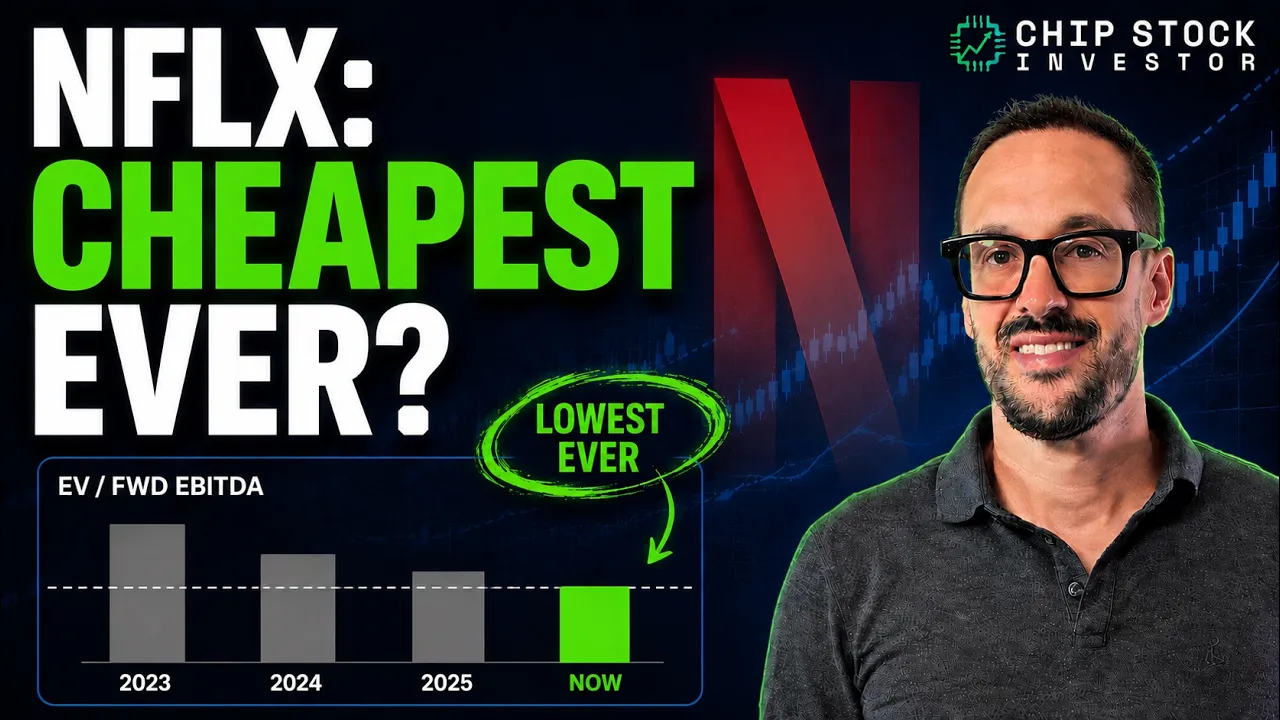
compare, Netflix's valuation for the duration of this bull market the
last three or four years, this is actually the cheapest it has been. It had dipped early this year because
of the uncertainty represented in what was at the time, the pending
acquisition of Warner Brothers Discovery. The valuation quickly rallied back
higher after that got called off. Here we are again now plumbing new lows. So if you've been waiting for an entry
point in Netflix because you believe this is essentially just now a value
stock, not a high-growth stock, and if it's a value stock, buying at the right
valuation is much, much more critical. Perhaps this is a good opportunity
to now dip your toe in the water. The stock price is below seventy
dollars per share as of this recording. Basically, what that price is into
forward expectations is something like, about eight to ten percent GAAP
earnings per share growth for the next five years, and then a terminal growth
rate of about four percent thereafter. So the bar has definitely been lowered. If you think Netflix can continue growing
revenue at a low- to mid-teens rate and, at the very least, its operating profit
margin remains stable, this might be a decent time, again, to start nibbling. I don't think this is, the deal of
the decade or anything, but that's essentially what's happening. The market is repricing this
as a more of a value stock. And if you get a re-acceleration in
growth, that would be a bonus that the market might decide to, at least perhaps
in the future, temporarily anyways, award a higher valuation multiple as a result. That'll do it for this
brief look at Netflix. It's been a crazy twenty twenty-six for
all things software, Netflix included, especially with the pretty wild M&A
talk with Warner Brothers Discovery walking away, getting a cash out. The business is in pretty good position. We're happy to have a small position in
this one here at Chip Stock Investor. Remember to check out
fiscal.ai/csi for that discount. And until next time, make sure you
check out this video that we did on another digital advertising software
company that we like, AppLovin.
Comments 0
Sign in to join the discussion.
Sign inNo comments yet. Be the first to share your thoughts!