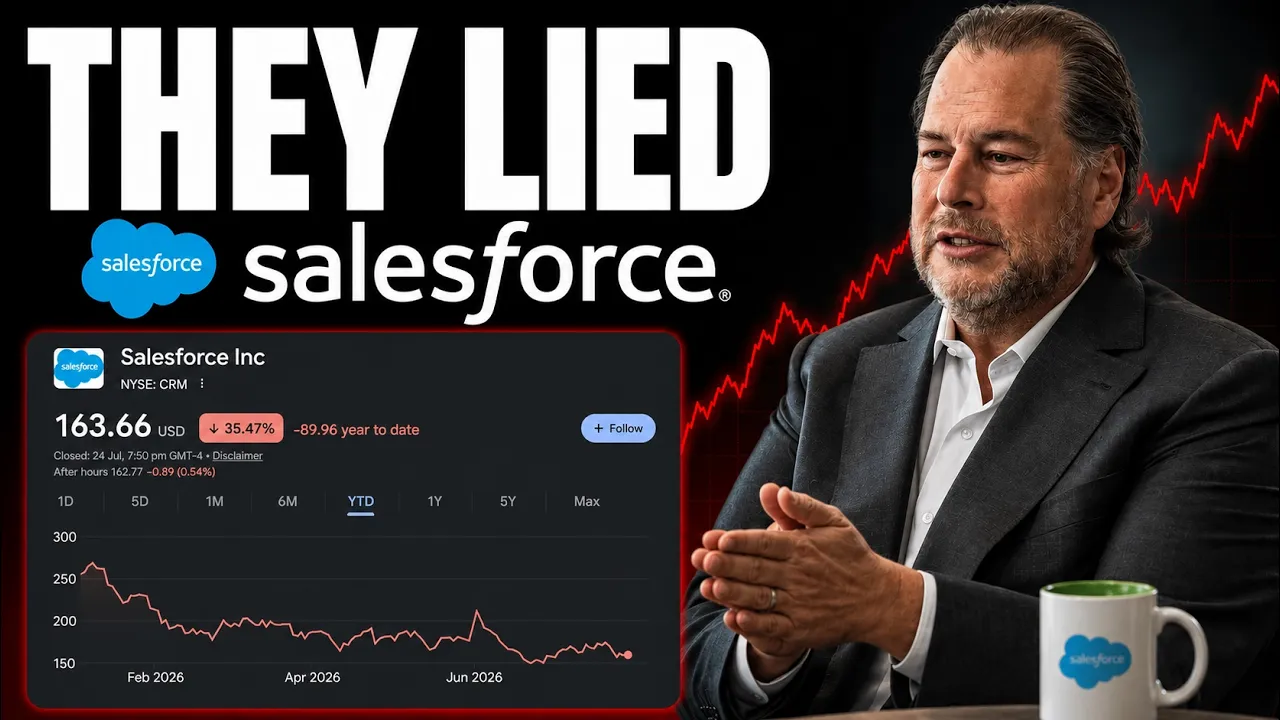
Salesforce Stock Just Got $1.6B AI Lifeline... But Jack Dorsey Just Built a Its Biggest Competition!

- Video return
- +14.12%
- Calls
- 1
- Buy / Sell
- 1 0
- Published
Recommendations
Entry is the asset's closing price on the publication date. Current is the last close on record.
-
Entry $163.66 26 Jul 2026Current $192.40 07 Aug 2026Result +$28.74
Wall Street Consensus analysts maintain a buy rating on the stock with an average 12-month price target of $242 per share
Context Wall Street Consensus analysts maintain a buy rating on the stock with an average 12-month price target of $242 per share, implying roughly 50% upside potential.
Full Transcript
Salesforce stock experienced a noticeable bounce, rising over 4% following news of a major government victory. The United States Department of Veterans Affairs awarded the enterprise software giant a three-year contract valued at $1.6 billion. Through this agreement, Salesforce will deploy its Agentic artificial intelligence platform across hundreds of medical centers to modernize care and administrative workflows for millions of veterans. However, this bullish momentum comes against the backdrop of deep year-to-ate underperformance with the stock still down more than 30% in 2026. At the same time, new competitive pressure is emerging from an unexpected direction. Twitter co-founder Jack Dorsey and his company Block just launched Buzz, an open-source artificial intelligence native workspace designed specifically to replace Slack. Salesforce originally acquired Slack for nearly $28 billion, making this new open-source protocol a direct threat to one of its flagship enterprise assets. In this analysis, we're going to examine whether the new government contract signals a sustainable turnaround for Salesforce or if open-source alternatives like Buzz threaten its long-term enterprise software mode. To understand the recent price action, we need to analyze the specific mechanics of the Department of Veterans Affairs contract. The agreement is structured as a three-year Agentic Enterprise license agreement valued at $1.6 billion through the company's distribution network. Under this agreement, the department will deploy Salesforce's Mission Force platform, including Agent Force Public Sector and Agent Force Health, across its entire national infrastructure. The Department of Veterans Affairs serves over 17 million veterans and handles more than 82 million appointments annually across 170 medical centers and,00 outpatient clinics. The primary operational goal of this massive deployment is to eliminate administrative friction and drastically reduce scheduling wait times for patients. Currently, scheduling a healthcare appointment takes an average of 28 days, but the full implementation of autonomous artificial intelligence agents is targeted to bring that scheduling duration down to mere minutes. Furthermore, the agreement embeds Slack as the core collaboration interface across more than 150 department sites, while Mulesoft, Data 360, and Tableau handle underlying data integration and executive analytics. This deal highlights two important operational factors for investors tracking the stock. First, public sector revenue represents a sticky, highly resilient growth vector for Salesforce. The company recently revealed that its public sector annual recurring revenue crossed $2 billion for the first time, expanding by 23% year-over-year. Second, it demonstrates that large government entities are actively adopting agentic artificial intelligence at an enterprise scale. While financial analysts at firms like DADavidson have pointed out that a single contract does not single-handedly resolve broader enterprise software spending deceleration, it solidifies Salesforce's dominant footprint in public sector technology infrastructure. While the government contract provides positive headline momentum, investors are watching a potential long-term disruption brewing on the horizon. Jack Dorsey, the co-founder of Twitter and current chief executive of Block, recently announced the launch of Buzz. Buzz is a free open-source workplace platform designed explicitly to integrate team communication, software development, and artificial intelligence agents into a unified workspace. Built on the decentralized Nosta protocol and released under an Apache open-source license, Buzz presents a direct alternative to both Slack and GitHub. What makes Buzz particularly interesting is how it natively treats artificial intelligence agents. Instead of treating artificial intelligence as an optional add-on assistant or external chat plug-in, Buzz gives agents their own cryptographic identities, channel memberships, and repository permissions. Agents participate directly alongside human employees as full team members. Jack Dorsey openly stated that Block built Buzz to reduce internal reliance on proprietary platforms like Slack and GitHub and that the company is sharing the code so other organizations can do the same. This development is strategic because Salesforce spent nearly $28 billion to acquire Slack in 2021. Slack was positioned as the central productivity layer for Salesforce's entire software ecosystem. If open-source self-hosted agentnative tools gain widespread adoption among software developers and technology startups, it could erode enterprise demand for traditional per seat SAS licensing models. The broader context here is the emergence of VIPE coding and custom open-source tooling. Many technology teams are questioning whether paying high monthly subscription fees for proprietary communication software remains necessary when open-source alternatives offer similar features with greater data privacy and customization. However, replacing enterprise Slack installations inside giant corporations is far from simple. Salesforce has embedded Slack deeply into corporate workflows, compliance frameworks, and enterprise security layers. While open- source protocols pose an intriguing architectural challenge, enterprise switching costs remain exceptionally high for Fortune 500 corporations. Now, let's examine the fundamental financial performance behind Salesforce. In full fiscal year 2026, Salesforce generated total revenue of 41.5 billion, representing a year-over-year growth rate of 10%. Looking at the most recent Q1 fiscal 2027 financial results reported in late May, revenue came in at 11.13 billion, which was up 13.3% compared to the prior year. This topline performance comfortably exceeded Wall Street consensus estimates of 11.05 billion. A key metric that enterprise software analysts monitor closely is remaining performance obligation or RPO. RPO represents contractually committed revenue that has not yet been recognized on the income statement. Salesforce reported total RPO of 72.4 billion which represents a 14% increase year-over-year. Current RPO, which measures contract revenue expected to be recognized over the next 12 months, reached $ 35.1 billion, growing 16% year-over-year. The main growth engine inside the business right now is Agent Force and Data 360. Annual recurring revenue for Agent Force alone surpassed $1.2 billion, growing over 200% year-over-year. When combined with data 360, total artificial intelligence and data annual recurring revenue reached approximately $3.4 billion. The company also reported processing over 28 trillion tokens across its platform and delivering nearly 4 billion agentic work units. For fullear fiscal 2027, management raised its revenue guidance to a range between $45.9 billion and $46.2 2 billion implying overall growth of approximately 11%. This demonstrates that despite broad macroeconomic headwinds and concerns over software seats, the topline continues to expand at a steady double-digit rate. Beyond revenue growth, Salesforce's profitability profile has undergone a massive transformation over the past few years. Historically criticized by institutional investors for low operating margins and excessive stock-based compensation, executive leadership has executed a strict margin expansion initiative. In fiscal year 2026, Salesforce achieved a gap operating margin of 20.1% and a non-GAAP operating margin of 34.1%. In Q1 fiscal 2027, non-GAAP operating margin expanded further to 34.8%, representing a 250 basis point increase year-over-year. The single most impressive aspect of Salesforce's business model is its cash flow generation. Over the trailing 12 months, Salesforce generated $15 billion in operating cash flow, representing a 15% increase year-over-year. Free cash flow reached 14.4 billion, up 16% compared to the prior year. At current share prices trading near $160, Salesforce offers an extraordinary free cash flow yield of nearly 10%. To put that figure in context, the median S&P 500 company trades at a free cash flow yield of around 4.1%. This massive cash flow generation allows management to aggressively buy back shares and pay dividends. Salesforce completed a $25 billion accelerated share repurchase program, reducing its diluted share count by 10% year-over-year, and authorized an additional $50 billion share repurchase program. Management also pays a quarterly dividend of 44 cents per share, which was recently increased by nearly 6%. The combination of 34% operating margins, record cash flow, and aggressive share buybacks creates a formidable financial fortress. When we evaluate Salesforce's valuation metrics, there is a clear disconnect between market sentiment and underlying financial reality. Despite beating consensus earnings estimates for five consecutive quarters, Salesforce stock has dropped by over 30% in 2026. The broader sell-off across application software was driven by investor fears that enterprise clients might reduce per seat software licenses to redirect corporate budgets toward artificial intelligence chips and infrastructure. However, this sectorwide dating has driven Salesforce's valuation down to historically low multiples. Trading near $160 per share, Salesforce is valued at approximately 15 to 16 times forward earnings and under 10 times operating cash flow. These multiples are near all-time historical lows for the company. Wall Street Consensus analysts maintain a buy rating on the stock with an average 12-month price target of $242 per share, implying roughly 50% upside potential. Analysts at Wedbush maintain targets as high as $475, arguing that Agent Force monetization will spark a multi-year enterprise upgrade cycle. While open-source platforms like Jack Dorsey's Buzz illustrate the evolving dynamics of workplace collaboration, deep enterprise security integrations and massive data modes through data cloud provide Salesforce with substantial defense. The $1.6 6 billion Department of Veterans Affairs contract proves that major government and enterprise institutions continue to trust Salesforce's platform for missionritical operations. I calculate that if Salesforce continues expanding revenue at 10 to 11% while sustaining 34% non-GAAP operating margins, the stock appears significantly undervalued relative to its cash generating ability. Hey, thanks for watching. I truly respect every viewer who takes the time to seek objective datadriven analysis.
Comments 0
Sign in to join the discussion.
Sign inNo comments yet. Be the first to share your thoughts!