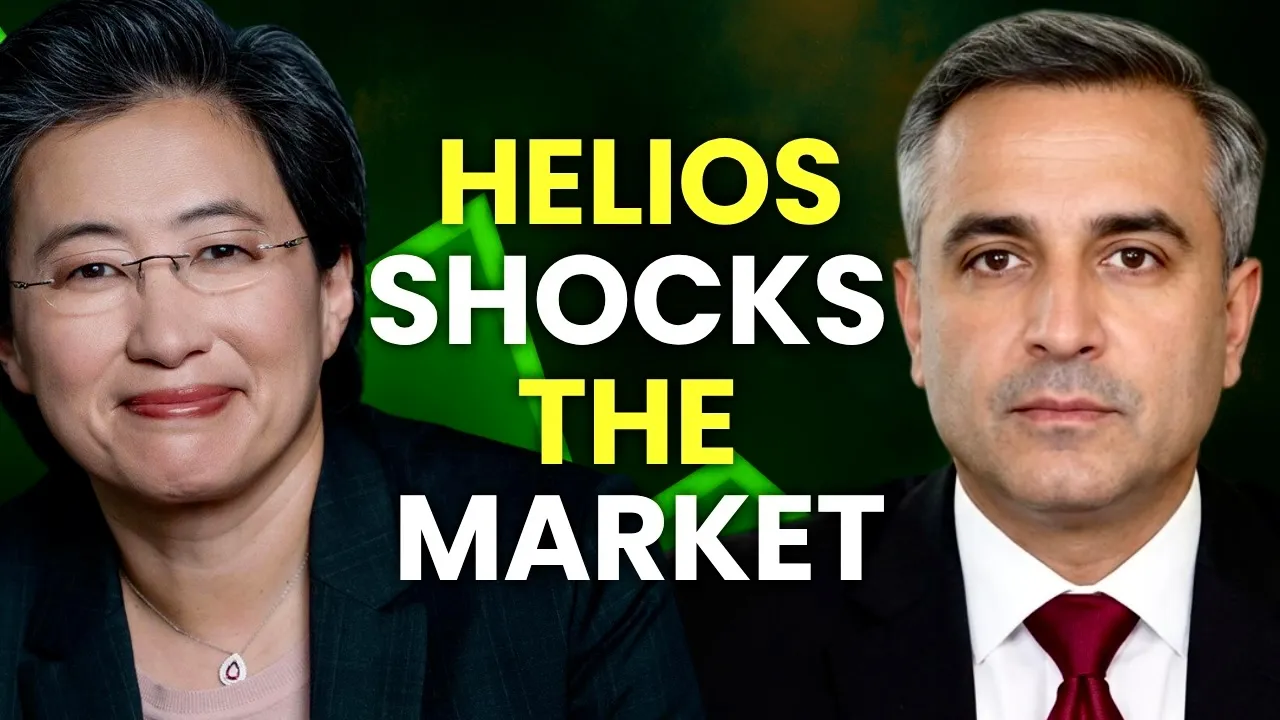
AMD CEO Lisa Su: "Why AMD’s New Helios System is Panicking the Competition" (3 Top AI Stocks To BUY)

- Video return
- +1.75%
- Calls
- 3
- Buy / Sell
- 3 0
- Published
Recommendations
Entry is the asset's closing price on the publication date. Current is the last close on record.
-
Entry $403.41 26 Jul 2026Current $415.95 07 Aug 2026Result +$12.54
The second stock on our list is Taiwan Semiconductor Manufacturing, ticker symbol TSM.
-
Entry $920.95 26 Jul 2026Current $858.03 07 Aug 2026Result −$62.92
The third and final stock on our list is Micron Technology, ticker symbol MU.
-
Entry $206.84 26 Jul 2026Current $223.78 07 Aug 2026Result +$16.94
Then we'll wrap things up with an in-depth analysis of three top AI stocks to buy now that could benefit from the continued growth of artificial intelligence. The first stock on our list is Nvidia, ticker symbol NVDA.
Full Transcript
AMD CEO Lisa Su says the AI opportunity is much bigger than most investors realize and in this interview she explains why AMD's new Helios AI system could reshape the competitive landscape and position the company for the next wave of AI infrastructure spending. In a moment I'll play you Lisa Su's interview on CNBC. After that I'll break down the biggest takeaways, share my own reaction to what she said and explain what it could mean for AMD, the AI industry and investors going forward. Then we'll wrap things up with an in-depth analysis of three top AI stocks to buy now that could benefit from the continued growth of artificial intelligence. Let's hear what Lisa Su has to say. >> John, thanks. I am here in San Francisco at AMD's Advancing AI event with AMD CEO Lisa Su. Lisa, thanks for having us here. >> John, great to be here. Thank you for being here. >> Well, I got to set the stage a little bit. Intel's got earnings that they're announcing in just a few minutes. We've had massive signals this week on AI infrastructure demand from Google just last night and then massive panic attacks from the market over Kim I K3 and what that might be doing to um just demand for premium across the board in AI whether it's on the software or the hardware side. So, with that as a backdrop, tell me about the significance of this moment for Helios and AMD. >> Yeah, so first of all, John, all of those things are true. But what we see is actually, you know, something that's much, much broader. I mean, this is like an incredible moment for AI. You know, we look at our, you know, market, spend time with our customers all the time and, you know, from what we see today, you know, the market for high performance in AI computing over the next, you know, four or five years is going to reach $2 trillion of TAM in market opportunity. So, it's really huge and tremendous and I'm very happy to announce this morning we announced that our Helios rack-scale system is in full production as well as our new you know Venice processors are in full production and this is like a huge step up in terms of AI capability. I mean we're seeing incredible numbers like you know over 30 times more performance with our newest systems Helios systems compared to our previous generation and we're talking about you know from a customer standpoint just tremendous interest and excitement. You know we had Anthropic with us open AI you know meta AT&T Cisco just a number of our customers you know coming together. >> You've literally been building toward this Pensando I think about our conversations Austin San Jose etc. You announce these major customers for Helios out of the gate. How much of that is dedicated volume how much of it is pilot test? >> Well I think what you can say is with a system as complex as Helios you know people don't do this type of work for quote unquote pilots because it it's a lot of work when you have you know major foundational model companies needing to put their resources optimize their latest models to our hardware. So certainly you know open AI and meta we've talked about multi gigawatt scale for MI450 deployments just this week we announced Anthropic which will do you know up to 2 gigawatts of MI450 in Helios starting in the first half of 2027. So these are large scale deployments and you know we're working hand in hand with the engineering teams of our customers both hardware software data center. I can say it's a ton of work but it's going extremely well. So it's a it's a happy day for us. >> I don't know that you've announced pricing but I've seen some estimates guesses out there this is going to be 5 million plus for a Helios rack that your pricing on the premium end. How much of that is because TSMC is charging more to just deliver chips? How much of that would just be because of the constrained environment and supply in general? >> Well, the most important thing that I would say, John, is to focus on tokens per dollar. I mean, that's what the entire industry is talking about. It's talking about tokens per dollar. And from our standpoint, you know, we actually win on both sides. Our Helios systems have more performance than our competition. And so, you know, let's call it anywhere from, you know, 10 to 15% plus more performance. And we also have lower tokens per dollar. So, you know, up to a 30% benefit for our customers in terms of tokens per dollar. That's huge. I mean, when you're talking about inference, you know, everyone is looking for the opportunity to use AI in more and more applications. And it is such in such a place where, you know, everyone's token budgets are ramping up. You know, including our own, by the way, every month our token budgets are going up. But we're also seeing just tremendous productivity come out of that. And so, you know, this is an opportunity to optimize. Like new tech is there so that you can adopt more AI compute and you get a a better performance point, a lower cost point. And and frankly, it's a it's a very multiplying, you know, effect. >> Right from the beginning of the interview, the host sets up what was already a very emotional week for the market. Investors were dealing with multiple headlines all at once. Intel earnings were approaching. Google had just reinforced how aggressively it plans to spend on AI infrastructure. At the same time, the market was worried about whether newer AI models might reduce demand for expensive computing hardware. That combination created the perfect opportunity for Lisa Su to either play defense or completely change the narrative. Instead of getting pulled into short-term fears, she immediately zoomed out and focused on the bigger picture. Personally, I think that was exactly the right approach because markets often become obsessed with weekly headlines while missing long-term structural trends. Lisa Su's main argument was simple. Yes, there are always going to be concerns about competition. Yes, there will always be questions about pricing. Yes, every few months there will be another AI model that causes investors to panic. But none of those things change what she believes is happening underneath the surface. According to AMD's conversations with customers, the demand for high-performance AI computing is becoming dramatically larger than most people currently appreciate. One number she mentioned immediately stood out. She believes the addressable market for high-performance AI computing could reach an astonishing $2 trillion over the next four or five years. Think about that for a second. A $2 trillion opportunity is almost difficult to comprehend. Whether investors agree with that exact figure or not, the message is obvious. AMD believes we are still in the very early innings of AI infrastructure spending. Personally, I think this is one of the biggest misconceptions among investors today. Many people still talk as though the AI boom has already happened because companies like Nvidia have become some of the most valuable businesses in the world. But from the perspective of companies actually building AI systems, they're telling us the opposite. They're saying this build-out is only beginning. That distinction matters because markets often price stocks based on what they believe is coming next, not what has already happened. Lisa Su then shifted the discussion toward AMD's newest announcements. She revealed that the company's Helios rack-scale systems are now officially in full production alongside its new Venice processors. This is important because AMD is no longer just talking about future products. These systems are moving into production. That is a huge milestone. One thing that really stood out to me during this part of the interview was how much AMD has evolved over the years. Several years ago, most investors simply viewed AMD as a company competing against Intel in CPUs. Today, Lisa Su is talking about complete AI systems, integrated racks, networking processors software optimization, and partnerships with some of the largest AI companies in the world. That transformation has been remarkable. She also highlighted an eye-opening performance improvement. According to Lisa Su, the newest Helios systems deliver more than 30 times the performance of AMD's previous generation. Whenever companies announce numbers like this, investors should naturally remain cautious until products are widely deployed. But, assuming those improvements translate into real-world workloads, this represents an enormous leap in capability. The AI industry is advancing at an extraordinary pace. Each generation is not just slightly faster than the previous one. Many of these improvements are exponential rather than incremental. That helps explain why cloud providers continue ordering larger and larger quantities of hardware. They're not simply replacing old systems. They're unlocking entirely new capabilities. Another fascinating part of the interview was the customer list Lisa Su referenced. She mentioned OpenAI, Anthropic Meta AT&T Cisco. These are not small experimental companies. These are some of the biggest organizations driving AI development globally, and I think that's one of the strongest signals investors can look for. Technology companies can make impressive product announcements every year, but customer adoption is ultimately what determines success. Seeing leading AI companies actively working alongside AMD suggests the company has become a serious player in this market. The interviewer then asked what I thought was a very smart question. Are these customers simply testing AMD's technology, or are they making meaningful long-term commitments? Lisa Su's answer revealed just how different AI infrastructure has become compared to traditional technology purchases. She explained that deploying systems like Helios is simply too complex to treat as a casual pilot program. Foundational AI companies must optimize their latest models specifically for AMD's hardware. That process requires significant engineering effort across hardware, software, networking, and data center operations. Companies simply do not dedicate those kinds of resources unless they expect meaningful deployments. That point deserves more attention because it highlights one of the biggest competitive advantages in AI today, switching costs. Once an AI company optimizes its models, software stack, infrastructure, and operations around a particular platform, changing vendors becomes far more complicated than simply swapping out hardware. It becomes an ecosystem decision. That's one reason why winning these early deployments can have lasting strategic value. Lisa Su then provided another important detail. She mentioned that OpenAI and Meta are planning multi-gigawatt scale deployments using AMD's upcoming MI450 platform. She also announced that Anthropic plans to deploy up to 2 gigawatts of MI450-powered Helio systems beginning in the first half of 2027. These numbers may sound highly technical, but they tell investors something very simple. These customers are not thinking small. Gigawatt scale infrastructure represents an enormous commitment. Building AI clusters at that scale requires billions of dollars in investment. Companies do not make those commitments unless they believe AI demand will continue growing for many years. Personally, I think this also challenges one of the biggest bearish arguments we've heard recently. Some investors worry that improvements in AI efficiency will reduce hardware demand. There is certainly some truth to models becoming more efficient, but history often shows that lower costs actually increase total usage. We saw this with cloud computing. We saw it with internet bandwidth. We saw it with storage. As technology becomes cheaper and more capable, people simply use more of it. Lisa Su actually hinted at this exact dynamic later in the interview. She explained that token budgets continue increasing every month, including inside AMD itself. That statement caught my attention because it reflects something many businesses are experiencing today. Companies are not trying to spend less on AI. They're finding more ways to use AI. Every new application creates additional demand. Every new workflow consumes more computing. Every new AI agent generates more inference requests. That's why overall infrastructure demand can continue growing even if individual models become more efficient. The interviewer then shifted toward pricing. Reports suggested Helios systems could cost more than $5 million per rack. Naturally, investors want to know whether these premium prices are sustainable. Lisa Su gave an answer that I thought reflected how the AI industry has fundamentally changed. She said the most important metric is no longer simply the purchase price. Instead, customers are focused on tokens per dollar. If you're unfamiliar with that concept, it's essentially measuring how much useful AI work a system can produce relative to its overall cost. This is a much more practical way of evaluating AI infrastructure. Buying cheaper hardware means very little if it generates fewer useful AI outputs. Likewise, paying more up front may actually save money over time if performance is significantly higher. This reminds me of how businesses evaluate productivity investments generally. The cheapest solution is not always the most economical solution. Companies care about total return on investment. Lisa Su claims AMD performs well on both sides of that equation. According to her, Helios delivers roughly 10 to 15% higher performance than competing systems while also improving tokens per dollar by as much as 30%. If those figures prove accurate in real-world deployments, that would represent a very compelling value proposition. Notice that she never framed this strictly as being cheaper. Instead, she framed it as delivering better economics. That distinction matters because enterprise customers purchasing AI infrastructure at this scale are focused on long-term operating efficiency, not simply minimizing upfront spending. One thing I also appreciated was how she repeatedly connected these performance improvements back to customer productivity, rather than just technical specifications. Too often technology companies overwhelm audiences with benchmark numbers that have little practical meaning. Lisa Su instead emphasized that better economics allow customers to deploy AI across more applications. That is ultimately what matters. If companies can lower the cost of inference, they can justify using AI in more products, more services, and more business processes. That creates a positive feedback loop. Lower costs encourage greater adoption. Greater adoption drives higher infrastructure demand. Higher demand supports additional innovation, and the cycle continues. From an investor's perspective, I think that's one of the most exciting themes emerging across the semiconductor industry. For years, discussions centered almost entirely on training massive AI models. Today, inference is becoming equally important. Every time someone asks an AI assistant a question, generates an image, summarizes a document, or interacts with an AI agent, inference hardware is doing the work. As billions of people begin using AI daily, inference demand could become enormous. That is exactly why companies like AMD are investing so aggressively in this segment. Another thing that impressed me throughout the interview was Lisa Su's confidence. She never sounded defensive. She acknowledged that the industry remains highly competitive, but she consistently returned to execution, customer relationships, engineering collaboration, and long-term demand. That's often a characteristic I like seeing from strong leaders. Rather than becoming distracted by short-term market sentiment, they focus on what they can actually control. Now, of course, investors should also maintain balance. AMD still faces intense competition across the AI market. Execution remains critical. Delivering products on schedule, maintaining software compatibility, securing manufacturing capacity, and supporting customers at scale will all determine whether these ambitious plans succeed. The AI race is far from over, but after listening to this interview, it's clear that AMD believes it has moved well beyond simply participating. The company wants to become one of the foundational infrastructure providers powering the next generation of artificial intelligence. Whether that vision ultimately plays out exactly as Lisa Su expects remains to be seen, but one thing is becoming increasingly difficult to ignore. The world's largest AI companies continue committing extraordinary amounts of capital toward expanding computing infrastructure. That alone suggests the AI revolution still has significant room to grow. And if Lisa Su is right about the size of this opportunity, we may still be much closer to the beginning of this story than the end. Now, let's dive in and talk about the three top AI bargain stocks that still look surprisingly undervalued despite sitting at the center of one of the biggest technology revolutions in history. The first stock on our list is Nvidia, ticker symbol NVDA. It's almost strange to call Nvidia a bargain stock. After all, this is the company that has become the face of the AI revolution. It has powered one of the greatest stock market runs in recent history and has transformed itself into one of the most valuable companies in the world. For many investors, Nvidia is the first name that comes to mind whenever artificial intelligence is mentioned. So, naturally, many people assume they have already missed the opportunity. But investing isn't just about looking at the stock price. It's about understanding what you're paying for relative to the company's future earnings power. That's exactly where Nvidia becomes interesting again. Despite its incredible rise over the past several years, Nvidia currently trades at only about 16 times analyst projected fiscal 2028 earnings. For a company still growing at an extraordinary pace while dominating one of the fastest growing industries in the world, that valuation starts looking surprisingly reasonable. This is one of those situations where a stock can appear expensive simply because the share price is high while actually becoming cheaper because the company's earnings continue growing even faster. That distinction is incredibly important. One of the biggest mistakes investors make is focusing only on today's stock price instead of asking whether the underlying business has become even stronger. And when you look at Nvidia today, the business may actually be more powerful than ever. The first reason is its dominance in AI training. Training large language models requires enormous computing power, and Nvidia has built an ecosystem that competitors continue struggling to match. Its biggest advantage isn't simply the hardware, it's CUDA. CUDA has become the software foundation that countless AI developers have built around over many years. Much of today's foundational AI software has been optimized specifically for Nvidia GPUs. That creates a powerful competitive moat. When developers spend years building software around a particular platform, switching becomes difficult. Companies would have to retrain engineers, rewrite software, validate performance, and potentially slow down development. Those switching costs help reinforce Nvidia's leadership position, and that leadership continues attracting even more developers, creating a powerful network effect that strengthens over time. Personally, I think this is one area many investors underestimate. People often compare semiconductor companies based only on chip specifications, but software ecosystems can become even more valuable than the hardware itself. History has shown this repeatedly across technology. Once developers commit to a platform, it becomes increasingly difficult for competitors to convince them to leave. Nvidia appears to understand that better than anyone. But what's even more exciting is that Nvidia isn't standing still. The AI market itself is changing. During the early years of generative AI, training massive models dominated infrastructure spending. Today, another opportunity is emerging, inference. Inference is what happens after an AI model has already been trained. Every time someone asks an AI assistant a question, every time an image gets generated, every time an AI agent completes a task, inference hardware is doing the work. And here's the important part. Inference may eventually become an even larger market than training because it happens continuously, every single day, across millions and eventually billions of users. Nvidia clearly saw this trend coming. Earlier this year, the company made a major strategic move by acquiring Groq in a deal valued at roughly $20 billion. Groq specializes in language processing units, or LPUs. These chips are specifically designed to accelerate the decoding stage of inference, helping AI systems generate responses much faster. Instead of treating Groq as a separate business, Nvidia integrated those capabilities directly into its CUDA ecosystem. That means Nvidia can now offer complete AI systems tailored for different workloads. Some systems are optimized for training, others focus on inference, others are designed specifically for agentic AI. And the company also provides CPUs, networking equipment, storage solutions, and complete server architectures. This evolution is incredibly important. Nvidia is no longer simply selling chips. It's becoming an end-to-end AI infrastructure company. That's a much larger opportunity. When customers purchase complete systems instead of individual components, Nvidia captures a larger share of every AI infrastructure dollar being spent. It also makes customers more deeply integrated into Nvidia's ecosystem. That strengthens customer relationships while making switching even harder. Think about what enterprise customers really want. They're not looking to assemble complicated hardware themselves. They want complete solutions that work together efficiently. Nvidia understands this, and by delivering integrated AI platforms rather than isolated products, it's positioning itself to remain indispensable as AI adoption accelerates. Another reason Nvidia continues looking attractive is the sheer size of the market opportunity ahead. Artificial intelligence is still expanding into industries that are only beginning their transformation. Healthcare manufacturing financial services transportation education energy retail government virtually every major industry is exploring ways to improve productivity through AI. Every one of those deployments requires computing infrastructure. That infrastructure requires advanced semiconductors. As more organizations move from experimenting with AI to deploying it across their businesses, demand for high-performance computing should continue expanding. This isn't simply a one-time upgrade cycle. It's the beginning of a long investment cycle that could last many years. One thing I particularly like about Nvidia is management's willingness to keep investing ahead of demand. Instead of protecting today's profits, the company continues spending aggressively on research software networking and system-level innovation. That's exactly what dominant technology companies should be doing. Markets evolve quickly. Companies that stop innovating eventually lose leadership. Nvidia has shown little sign of becoming complacent. Another factor supporting Nvidia's long-term outlook is how rapidly AI workloads continue evolving. The next generation of AI isn't just about chatbots answering questions. We're seeing autonomous AI agents, scientific discovery, drug development, advanced robotics, real-time industrial automation, video generation, personal AI assistants. Each new breakthrough requires more sophisticated infrastructure. That creates additional demand for exactly the kinds of systems Nvidia is building today. Some investors worry that improvements in AI efficiency could eventually reduce hardware demand. While that sounds logical on the surface, technology history often tells a different story. When computing becomes cheaper, people typically consume far more of it. Cloud computing became cheaper and businesses migrated more workloads. Internet bandwidth improved and streaming exploded. Storage costs declined and companies stored exponentially more data. AI may follow the same pattern. As costs decline, usage increases even faster. That means infrastructure demand can continue rising even while individual workloads become more efficient. I think that's an important perspective investors should keep in mind. Sometimes efficiency doesn't reduce demand. It unlocks entirely new markets. Financially, Nvidia also continues generating enormous cash flow that gives management tremendous flexibility. The company can continue investing in innovation, expanding production, strengthening partnerships, and returning value to shareholders without placing stress on its balance sheet. That financial strength becomes another competitive advantage. When industries experience rapid change, companies with the strongest balance sheets usually emerge even stronger. Of course, no investment comes without risks. Competition across AI infrastructure continues intensifying. Customers constantly evaluate performance improvements. Technology cycles move quickly. Execution remains critical. But Nvidia has repeatedly demonstrated its ability to stay ahead of major industry shifts. Rather than reacting to trends, it often creates them. When I step back and look at the overall picture, what stands out most isn't simply Nvidia's dominance today. It's the company's ability to evolve alongside the AI industry itself. First, it dominated AI training. Now it's positioning itself to dominate inference. It's expanding into complete infrastructure platforms. It's strengthening its software ecosystem. And it's deepening relationships with the world's largest AI customers. That's why calling Nvidia a bargain stock might actually make more sense than many investors initially realize. Not because the stock is cheap in absolute terms, but because the business may continue compounding earnings much faster than its current valuation suggests over the next several years. If this resonates with you, you're exactly who this channel is for. Please, hit the like button, share the video, and leave your thoughts in the comments. Subscribe to the channel so you don't miss out on the next important financial investing update. Remember to do your own research before you invest in any stock. The second stock on our list is Taiwan Semiconductor Manufacturing, ticker symbol TSM. If Nvidia represents the brains behind the AI revolution, then Taiwan Semiconductor Manufacturing represents the factory that makes the entire revolution possible. This is one of those businesses that most people rarely think about, yet almost every major AI breakthrough depends on it. Whenever companies design the world's most advanced processors, those chips eventually have to be manufactured somewhere. And when it comes to producing cutting-edge logic chips at massive scale with consistently high yields, Taiwan Semiconductor Manufacturing has established itself as the industry's clear leader. That leadership didn't happen overnight. It was built over decades through relentless investment, manufacturing expertise, and technological execution that very few companies have been able to replicate. One of the most fascinating things about this business is that it doesn't need to compete with its customers. Instead, it enables innovation. It manufactures advanced chips designed by some of the biggest technology companies in the world while continuously pushing manufacturing technology forward. That business model has allowed Taiwan Semiconductor Manufacturing to become one of the most strategically important companies in the global economy. When demand for AI accelerates, demand for advanced chip manufacturing accelerates right alongside it. That puts Taiwan Semiconductor Manufacturing directly in the middle of one of the strongest technology spending cycles we've seen in decades. What makes this position even more attractive is how difficult it would be for another company to replicate. Building a modern semiconductor fabrication facility isn't simply expensive. It requires years of engineering expertise, highly specialized talent, incredibly complex manufacturing processes, and an ecosystem that has been refined through decades of experience. Even companies with enormous financial resources have struggled to achieve the same production yields on advanced chips. Yield is one of those terms investors hear frequently, but it's worth understanding why it matters so much. When manufacturers produce chips, not every chip comes out perfectly. The higher the yield, the greater the percentage of usable chips that can be sold. Small improvements in yield translate into enormous improvements in profitability and customer confidence. Taiwan Semiconductor Manufacturing has consistently demonstrated industry-leading yields on advanced manufacturing nodes, making it the preferred manufacturing partner for many of the world's most demanding chip designers. That reputation creates another powerful competitive advantage. Customers developing next-generation AI processors simply cannot afford manufacturing mistakes. Every delay can cost billions of dollars in lost opportunity. Working with a proven manufacturing leader reduces that risk significantly. That's one reason why Taiwan Semiconductor Manufacturing has developed such deep relationships across the semiconductor ecosystem. Another reason I find this company so compelling is its pricing power. Normally, manufacturing businesses compete aggressively on price. But advanced semiconductor manufacturing is different. When only one company can reliably manufacture the most advanced chips at scale, customers become much less focused on saving a few dollars. Instead, they prioritize reliability, production capacity, and execution. That gives Taiwan Semiconductor Manufacturing considerable leverage during periods of strong demand. As AI infrastructure spending continues expanding, customers need guaranteed access to manufacturing capacity. And capacity has become one of the most valuable assets in the entire semiconductor industry. The company also continues investing aggressively to expand that capacity. Management understands that AI demand is unlikely to disappear anytime soon. Instead of waiting until demand exceeds supply, Taiwan Semiconductor Manufacturing is spending heavily on new facilities, advanced equipment, and future production technologies. Personally, I actually like seeing this kind of investment. Some investors worry whenever capital expenditures increase dramatically. But in industries experiencing long-term structural growth, expanding capacity before demand peaks can become one of the smartest strategic decisions management can make. Waiting too long could mean losing valuable market share. Building ahead of demand positions the company to capture future growth instead of watching competitors benefit from it. Another point that often gets overlooked is that Taiwan Semiconductor Manufacturing isn't benefiting from just one AI trend. It's benefiting from nearly every major semiconductor category. Graphics processors require advanced manufacturing. AI-specific application chips require advanced manufacturing. High-performance central processors require advanced manufacturing. Custom silicon designed for hyperscale data centers requires advanced manufacturing. As AI adoption broadens across industries, demand for all of these chip categories continues increasing. That creates multiple growth drivers rather than dependence on a single product category. Diversification like that makes the business even more resilient. One of the strongest arguments in favor of Taiwan Semiconductor Manufacturing is that the company doesn't necessarily need to predict which AI application wins. It simply benefits from increased semiconductor demand across the entire ecosystem. Whether companies build larger training clusters, expand inference capacity, develop specialized enterprise AI hardware, or create entirely new categories of AI processors, someone still needs to manufacture those chips. That creates an incredibly attractive business model. Financially, the valuation also remains surprisingly reasonable considering the company's strategic importance. Despite sitting at the center of one of the biggest technology investment cycles in history, Taiwan Semiconductor Manufacturing currently trades at a forward price to earnings ratio below 20 times analysts estimated 2027 earnings. For a company with its market position, competitive advantages, pricing power, and long-term growth potential, that multiple appears surprisingly attractive. Personally, I think investors sometimes underestimate companies that quietly enable entire industries. The businesses grabbing headlines often receive the most attention, but sometimes the companies supplying the critical infrastructure behind those headlines quietly generate enormous shareholder value over many years. Taiwan Semiconductor Manufacturing fits that description almost perfectly. The more I study this business, the more I appreciate how difficult its competitive position would be to challenge. It's not just about spending billions of dollars. It's about decades of accumulated manufacturing knowledge, engineering talent, supplier relationships, customer trust, and operational excellence. Those advantages compound over time. That's exactly the type of moat long-term investors should look for. If AI spending continues expanding throughout this decade as many analysts expect, Taiwan Semiconductor Manufacturing appears positioned to remain one of the biggest beneficiaries regardless of which individual AI applications ultimately become dominant. That's an incredibly powerful position to occupy. This video is brought to you by Value Stocks Investing Master Course. If you're looking to grow your wealth by investing in solid undervalued stocks, but not sure where to start, I created the Value Stocks Investing Master Course to teach you how to identify great companies, make smart investment decisions, and build a portfolio that lasts. Click the link in the description and pinned comments to get the course today and take control of your financial future. The third and final stock on our list is Micron Technology, ticker symbol MU. If you've been paying attention to the AI semiconductor space over the past year, you've probably noticed something interesting. A lot of the conversation has centered around graphics processors, but there's another component that every advanced AI system depends on, and without it, even the fastest processors in the world cannot reach their full potential. That component is memory. Artificial intelligence consumes enormous amounts of data every second. Models need to access vast amounts of information almost instantly. The larger the model becomes, the more important memory performance becomes. That's exactly where Micron Technology enters the picture. Micron is one of the world's leading memory manufacturers, and today the company finds itself in one of the strongest positions it has enjoyed in many years. Historically, memory has been one of the most cyclical segments of the semiconductor industry. Periods of shortages would eventually be followed by over supply. Prices would rise dramatically before eventually falling back down. That cycle repeated itself over and over again for decades. Because of that history, investors have often assigned memory companies relatively low valuation multiples. But what makes today's environment different is that artificial intelligence is fundamentally changing the demand equation. Instead of relying primarily on consumer electronics, smartphones, and personal computers, memory demand is increasingly being driven by AI infrastructure. And AI systems require a very different type of memory. One of the biggest growth drivers for Micron today is something called high bandwidth memory, often referred to as HBM. This isn't ordinary memory. HBM is specifically designed to deliver the extremely high data transfer speeds required by today's most advanced AI processors. Every time AI chips process enormous amounts of information simultaneously, high bandwidth memory plays a critical role in keeping those processors fed with data. Without enough high-performance memory, even the most advanced AI processors would spend valuable time waiting instead of computing. That's why HBM has become such an important component across modern AI infrastructure. Demand for this technology continues growing rapidly. What's particularly interesting is that supply cannot simply expand overnight. Manufacturing HBM is far more complicated than producing traditional memory. In fact, HBM requires substantially more wafer capacity than conventional DRAM. Industry estimates suggest it can require more than three times the wafer capacity. That dramatically limits how quickly supply can increase. At the same time, advanced memory production relies on extremely sophisticated manufacturing equipment. Those manufacturing constraints create an environment where supply remains relatively tight while demand continues accelerating. Whenever demand rises faster than supply, pricing power usually improves. That's exactly why many analysts believe the current DRAM cycle could remain much stronger than previous cycles. Personally, I think this is one of the most overlooked stories in artificial intelligence investing. Everyone gets excited about processors because they're easy to understand, but memory is equally essential. If AI infrastructure continues expanding across cloud computing, enterprise software, autonomous systems, robotics, and scientific research, memory demand should continue rising alongside processor demand. [clears throat] You simply cannot have one without the other. Another encouraging development for Micron is that management has been securing more long-term customer agreements. This may sound like a small detail, but it actually has significant implications. Long-term agreements improve revenue visibility. They reduce uncertainty. They allow customers to secure future supply while giving Micron greater confidence when planning capacity investments. That creates a more predictable business model than investors have traditionally associated with memory manufacturers. Financially, Micron's numbers have been especially impressive. The company's revenue has more than quadrupled while gross margin expanded dramatically from approximately 37.7% to 84.6%. Those are extraordinary improvements. Normally, when investors see that kind of operational performance, they expect a premium valuation. Instead, Micron currently trades at just over six times analysts' estimated fiscal 2027 earnings. That's an incredibly low multiple for a company producing this level of earnings growth. The primary reason is that investors continue worrying that today's strong memory pricing will eventually reverse. That concern isn't unreasonable because memory has historically been cyclical. However, AI introduces an entirely different dynamic. Unlike previous technology cycles that depended heavily on consumer upgrades, AI infrastructure spending appears supported by long-term enterprise investment. Cloud providers continue expanding data centers. Businesses continue integrating AI into everyday operations. Governments continue investing in national AI capabilities. Research organizations continue building larger computing clusters. All of these trends require advanced memory. If demand continues out pacing supply, Micron could remain in a favorable pricing environment much longer than many investors currently expect. One thing I always try to ask myself when evaluating companies is this: Has the business fundamentally changed or is the market simply assuming the future will look exactly like the past? In Micron's case, I think that's one of the biggest questions investors need to answer. If artificial intelligence has permanently increased demand for advanced memory while manufacturing constraints limit supply growth, then today's valuation could prove far too conservative. That doesn't eliminate risk. Technology markets always change. Competition remains intense. Supply conditions can eventually improve. But when I compare Micron's valuation with its earnings growth potential, the opportunity certainly looks compelling. Stepping back and looking at all three companies together, something becomes very clear. Each one occupies a completely different layer of the AI ecosystem. Nvidia provides the computing platform powering advanced artificial intelligence. Taiwan Semiconductor Manufacturing produces the cutting-edge chips that make modern AI possible. Micron supplies the advanced memory required to keep those systems operating at maximum performance. They're not simply participating in the AI revolution, they're helping build its foundation. And what makes this combination particularly interesting today is that all three continue trading at valuation levels that appear surprisingly attractive relative to their long-term growth opportunities. Markets often become distracted by short-term headlines. One quarter disappoints, another company launches a competing product, investors begin worrying about tariffs, interest rates, or economic slowdowns. Those concerns create volatility. But long-term wealth is often created by identifying exceptional businesses during periods when the market temporarily underestimates their future earnings power. Personally, I believe artificial intelligence is still in the early stages of a much larger transformation. The companies enabling that transformation will likely continue benefiting as AI expands into more industries, more applications, and more aspects of everyday life. That doesn't mean every stock will move higher every year. There will certainly be volatility. There always is. But for patient investors focused on owning outstanding businesses rather than chasing short-term market moves, these three companies deserve serious attention. If you want exclusive stock tips, in-depth analysis, real-time trade alerts, and free investing guides, join the Stocks Galore Patreon today and take your investing game to the next level. Our members get full in-depth analysis on most of the stocks mentioned here. Head over to patreon.com/stocksgalore and become part of our growing community of smart investors. Link is in the description. Before we wrap up, I'd love to hear your opinion. Which company do you believe has the strongest long-term competitive advantage within the AI ecosystem? Nvidia, Taiwan Semiconductor Manufacturing, or Micron Technology? Let me know your answer and your reasoning down in the comments because I'd love to see which business you believe offers the best opportunity over the next decade. Do not forget to like the video, share your thoughts in the comments, and subscribe so you do not miss the next important investing update. Thanks for watching, and I will see you in the next one.
Comments 0
Sign in to join the discussion.
Sign inNo comments yet. Be the first to share your thoughts!