
- Video return
- -8.14%
- Calls
- 1
- Buy / Sell
- 1 0
- Published
Recommendations
Entry is the asset's closing price on the publication date. Current is the last close on record.
-
Entry $340.08 28 Jul 2026Current $312.41 06 Aug 2026Result −$27.67
As you know, Charlie Apple is my stock pick of the year.
Full Transcript
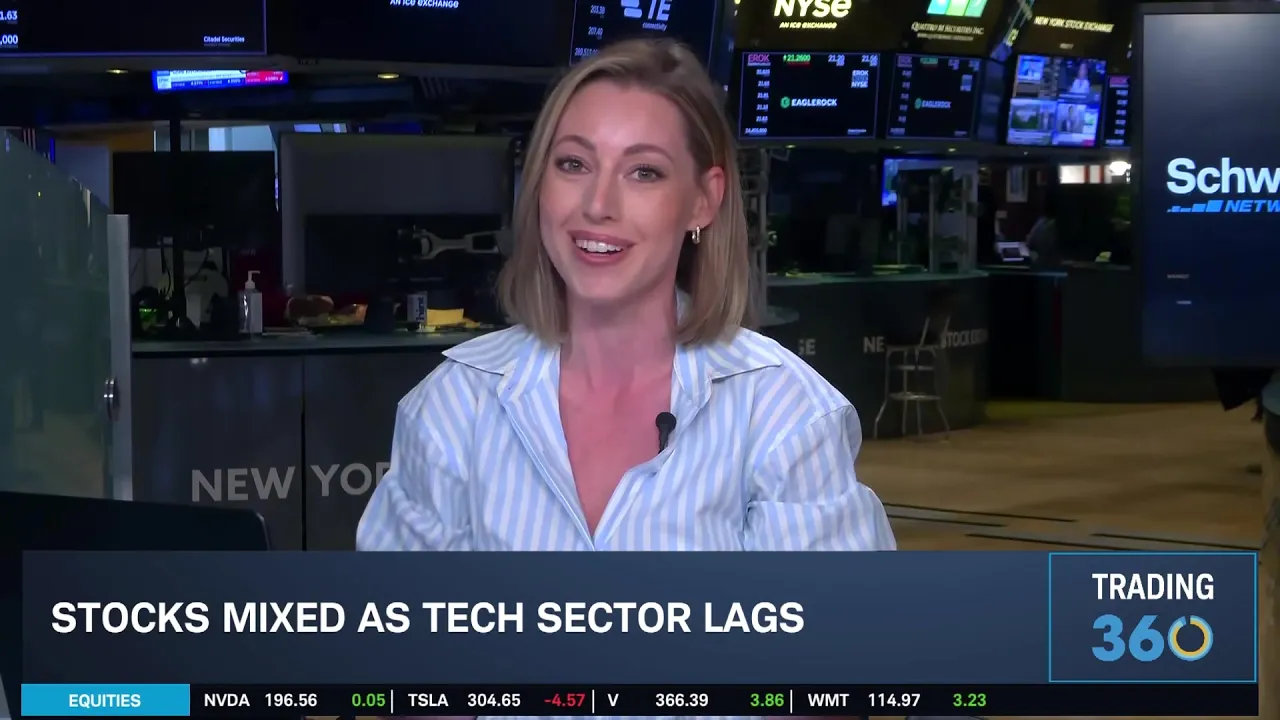
get your podcasts. Welcome back to trading 360. I'm Marley Kayden. It's time for the big three. We've got three stocks three charts and some trades for you as well. Ben Watson taking us through the charts here to take us through her picks today. Jessica Inskip director of Investor Research over@stockbrokers.com. Great to have you both with us, Jessica. I mean, what a week here. We've got the Dow moving higher on some strong earnings. We've got the Nasdaq pulling back quite a bit as the chips continue to sell off here in advance of hearing from some big names tomorrow and Thursday. Also some other big names today here. How are you looking at the market action we're seeing right now. Well I think it's very difficult for the markets to go higher due with the current interest rate environment. We are having another wonderful quarter of record earnings. A lot of that's attributed to Google. That's 34% EPS growth rate growth rate as of Friday's close take out. Google we're at 24%. We've had 1.9 times of forward guidance ratio increases. So even next quarter is looking really, really well. But I think it's difficult for technology specifically artificial intelligence, to go higher because of the interest rate environment that we're in. The two year is still elevated even though it's coming back. But that tells me we have headline risk because of the Strait of Hormuz. There is this uncertainty that's hanging over with perhaps Kevin Warsh. And so I don't see even with wonderful wonderful wonderful fundamentals, the market going higher with rates this high. It's a it's a push and a pull. And once we see that retract, then I think we can move forward. But perhaps these earnings will be incredible and be the catalyst we need to look past that. You never know with these markets. All right. Well it's an interesting setup for two of the three picks that you've got here today then because we've got earnings from those names this week. Your first one I've sort of been carving out of some of my broader conversations. It's Apple because a lot of the conversation has been about the CapEx spend and the increased CapEx spend and so many questions swirling around it. Apple sort of outside of that category because their CapEx is so much lower. So how are you looking at Apple as we come into those earnings on Thursday? Well, I'm thinking about the overall artificial intelligence picture and what I would like to keep in my portfolio. As you know, Charlie Apple is my stock pick of the year. And you are right. It's that free cash flow story that's certainly boding well within this environment. And that's the key here. It's the macro environment that's driving the market altogether. So this bodes really well for that environment. On top of that Apple has something that we cannot forget which is distribution. We're all very interconnected within the Apple products. And they're slowly ramping up to their artificial intelligence leak, if you will. And that, I think, will bode so well for the consumer because they've already amped it up with shortcuts and the increase of usage there. You could already integrate open AI onto that process. The use of shortcuts allowed Apple to collect data on what their users are utilizing automation for. And then ultimately, we could have a ramp up of Siri, keep that into a talking type of mechanism, like the echo works from a consumer type of product. And it'd be interesting to see how Apple is going to translate that over. And so that's really what my, my bet is on making Apple the stock pick of the year. But the environment just really reiterates that thesis that I do think it's going to do well because of the environment, because of the distribution channels, because of the free cash flow. And then on the earnings call, we just need to understand what is that AI story look like? What is that road to profitability with artificial intelligence? And how are we going to bring that across the Apple ecosystem? All right, Ben, so as we look at Apple's setup coming into this earnings report last, I looked the best performer in the mag seven so far this year. But I mean, Jessica just highlighted some of the reasons that this one has the possibility to sort of defy the reactions that we've seen to earnings so far this season. What are you seeing in the technicals. Well you know Jessica makes a great point about what their forward look is on the output side. The question I think remains is what it looks like for Apple. Now on the input cost side because they're facing something that they've really never faced before. And that's competition for subcomponents and assemblies and memory chips and things like that. Because of the demand elsewhere. Now they're having to come to the table with more cash out of that big stockpile that they have. So interest rates become more of an issue if in fact, they have to start borrowing to provide that spend. Now, from a technical perspective, though, you know, it's hard to deny the trend is still moving strongly higher here. In fact, today we've got a little bit of a breakout above this 3334 level as a resistance. But the key is going into this earnings announcement. It's doing that. It's breaking out of that previous resistance with a little bit lower momentum. So we've got this slightly hidden bearish divergence. Now the ultimate presumption is that this has got a higher trend. And so this may simply just be a pause indication as opposed to a reversal. But you've got high implied volatility going into the earnings which is expected. But you've got lower momentum. So this is somewhat coasting higher. I think waiting to see what's going to happen not only with earnings announcement but with the fed as a driver of interest rates going in the middle of this week. Marley. Yeah, certainly no shortage of things that we have to watch through through this week. On the earnings front, the FOMC front, the data front. But we also have earnings from your second pick in the big three today too. We've got Metta that will come just after we get that rate decision from Kevin Warsh and the fed. How are you looking at Metta here? Because Metta was one of the ones that was met with the biggest downward reaction following its CapEx spend last quarter. So how are you looking at Metta now coming into the earnings event tomorrow? Jessica. So I brought you a trade. So this is trading and investing are completely separate. This is a trade based purely on the implied move of earnings. So the way that I like to play that is via a short iron condor. And I'm happy to give you the methodology in the setup here. So methodology how do we start this one. We have to understand the implied move. There's actually a great tool on thinkorswim on Charles Schwab's platform where you can look at all the implied moves, and it'll do the math for you. If you'd like to do the math yourself, you just look at the at the money nearest expiration long call and put to give you that implied move. That's about $50 from there. This morning I pulled where my safety zone is, and that's where I'm going to choose my short call and my short put. So we're creating a short strangle, if you will. And that's going to be at 570 and 620. So that's where I need Metta to be post earnings. It needs to stay in between 570 and 620. And then what makes it a short iron condor from that short strangle is we're just mitigating our risk in case it goes too far, too fast to the upside or to the downside. I want to make sure I don't have unlimited or substantial risk exposure. So I added an additional 20 points on both ends. So for the long put I did a 550 and for the long haul I did a short 640 together. That is your iron condor. The I'm collecting 1133 all together for that. That's my maximum profit potential. I did choose the expiration for three days. So this is capitalizing on the amplified implied volatility that we have around meta earnings, inclusive of the uncertainty that's created around interest rates and the fed decision. So a perfect scenario for an option's premium seller like myself. The goal again is for it to stay within my short strikes. If that happens then I will close that out. Try not to hold it until expiration. I want to close it out right after earnings. Once we get that volatility crush, and then we move on to the next trade. And before we jump to Ben, I want to say thank you to you for explaining the concept behind your trade. It is so important when people are watching understanding the difference between investing and trading, but also understanding the trades that you're executing. Yes, we bring you a lot of trades, but Jessica did a great job there, breaking down exactly how that trade functions and why she chose the levels she chose. So Ben, when we then look at the technical setup here, are you looking at a similar range? 570 to 620 I think was what Jessica highlighted there. We're right in the middle right now for meta at about 5.93 as the technical showing that we might remain in that range. Obviously, of course you don't have a crystal ball with earnings coming, but what are you seeing in the charts? Well absolutely. And I think the chart bears out this idea that meta has been displaying this sideways tendency. And it's been doing it for the majority of the year. Now that range that we've been finding resistance and support is a little bit wider here. Now, when you start to bring it down into a shorter time frame that expressed or expected move based on implied volatility is one of those things that a lot of options traders may use to determine where they put their short strikes on a trade that, you know, like what Jessica describes, and I love the way that she talks about this. Now, one of the great things about that type of trade is that we know at expiration, the price of the stock can't be in two places at once. It can't be both above and below. So we've got this resistance up around 687 and support down around 584. And it's got that range in which it could potentially move. It's sitting towards the downside of that area, but that 50 point up or 50 point down expected move. Now Jessica is about the only person that I know that I've seen that can be in two places at once because I've seen her do it, but the stock can't be in that place. And we've got decreasing momentum and falling implied volatility, which both benefit that particular type of trade. This short iron condor that Jessica put together here. Marley. All right, Jessica, I'm excited to talk about your last one here because it's a name that I think has fallen off a little bit, certainly not in size or scope, but just in conversation, as it's also traded a bit sideways of late, but I would argue probably has the biggest question mark on it in terms of what the reaction is going to be. We're talking about Nvidia. We have to wait until the end of August for earnings here. But how are you looking at Nvidia. Because I'm looking at the chart and we're pretty sideways since April. It's underperforming the markets here. What's your thesis on Nvidia right now. Well I think Nvidia is something we should still hold in our portfolios. But I do believe it's sideways. And that's in sympathy with the market. And a lot of the price action that is leading semiconductors has a lot to do with Nvidia specifically CDs or credit default swaps. So a lot of the news yesterday was around the credit market. And I think it's really interesting here. So if we look at their credit default swap, it hit a record of 82 basis points, which is the biggest one day jump jump since the contract began actively trading back in November of 2025. So it's the bond market or the credit market really signaling that they're concerned with the future of Nvidia's debt. And I wanted to have a key word there on the future of this circular capital. If we want to understand circular capital, if it really is an issue, a way we can look at it is through the credit markets, specifically Nvidia. I'm honing in on the credit default swaps. What I think is interesting, if we look at Nvidia's own financial statements though, they're really strong. They have almost no debt over 100 billion in cash investments. They generated about 119 billion of free cash flow over the last 12 months. But the trigger is this 750 billion AI infrastructure deal. A part of that was 250 billion with the open AI guarantee, which triggered the credit default swaps to increase so many basis points. And so the reason for bringing that up to you today, this isn't an active trade on the big three. It's a you're exposed to Nvidia within your portfolio. If you have an index fund and a lot of ways within the market, you already have that type of exposure. It's important to understand why things are moving, and then that will help us to take something from Ben's from Ben's language, he says the market is an. If this, then that statement. So understanding that if we are concerned about CapEx spend and circular capital being a big hindrance or a headwind to the AI infrastructure build out, which is causing the markets to go into a trading range and not go any higher. In order to see that come back, we might need to see that reversed. So I want to hone in to where we're actually seeing that activity. Where can I look for that activity to reverse then to understand if the market, how it really feels about CapEx spend and circular capital. And so I'm honing in on credit default swaps. So another, I guess, educational piece for you today, but it's a hold for me on Nvidia. I think once we get the earnings from these hyperscalers that are coming later on this week, we are going to hear an increase in CapEx spend. We may not necessarily from Apple, but if we do it could trigger more of this type of activity. But that also goes in line with what's happening in the credit market with the two year note very specifically. And then if we want to focus in on the micro picture, we can look at credit default swaps as well. All right. So Ben, as we look at the technicals on Nvidia here, knowing that we're going to probably see some movement once we hear from those hyperscaler names in advance of their earnings, they like to wait till the very end of earnings season to keep us all waiting with bated breath. But what are you seeing when you look at the chart here? Well Nvidia is one of those names. Obviously that's been that driver of the market. But realistically this has been going a whole lot of nowhere in the last year in terms of an overall move. Really one or maybe one and a half standard deviation moves around this midpoint that it's been oscillating since the December time frame. This 196 level of support that I've drawn in there. And we've just seen a break below that with a bit of a hammer candle today in this gap down rally. Now that suggests again, with about a month to go almost to the earnings announcement that there is some potential for movement, one standard deviation to the upside is going to put it right around that resistance at the 212. One standard deviation to the downside is going to put it down around that 171 80 level. Both of those are symmetrical moves. Given the kind of lumpy head and shoulders pattern that you see up in the upper range above that 196 momentum falling off a little bit. There is some potential for downside here, but at the same time, there is so much dip buying activity that seems to happen below this 196 that that could keep prices higher. Doesn't guarantee it. But from a technical perspective that 196 has been tested multiple and you've got implied volatility rising into the earnings announcement here Marley. All right. We're just barely above that 196 right now as well. We're at 19715 for Nvidia trading up a third of a percent higher bucking the trend of the broader market today for Nvidia a rare day where it's not moving with the market. Jessica and Ben really appreciate you both being with us for the big
Comments 0
Sign in to join the discussion.
Sign inNo comments yet. Be the first to share your thoughts!