At 20 times forward earnings, Microsoft offers a historically attractive valuation multiple relative to its high-margin recurring cloud revenue. Azure's 43% growth rate demonstrates that enterprise cloud migration remains in its early acceleration phase. With annual cloud revenue exceeding 214 billion dollars and operating margins holding steady above 40%, Microsoft's price-to-operating cash flow multiple stands at roughly 16 times, providing a solid cushion for long-term investors.
Context
At 20 times forward earnings, Microsoft offers a historically attractive valuation multiple relative to its high-margin recurring cloud revenue. Azure's 43% growth rate demonstrates that enterprise cloud migration remains in its early acceleration phase. ... providing a solid cushion for long-term investors.
With free cash flow falling below 1 billion dollars in the second quarter and capital expenditures scheduled to reach up to $145 billion for the full year. Meta's forward price to free cash flow multiple has expanded sharply. While Meta's ad engine remains highly profitable with 28% top-line growth, the stock is currently undergoing valuation re-rating. Investors are requiring a higher risk premium until Meta demonstrates that its massive infrastructure investments can stabilize operating margins above 40%.
Context
With free cash flow falling below 1 billion dollars in the second quarter and capital expenditures scheduled to reach up to $145 billion for the full year. Meta's forward price to free cash flow multiple has expanded sharply. ... Investors are requiring a higher risk premium until Meta demonstrates that its massive infrastructure investments can stabilize operating margins above 40%.
Full Transcript
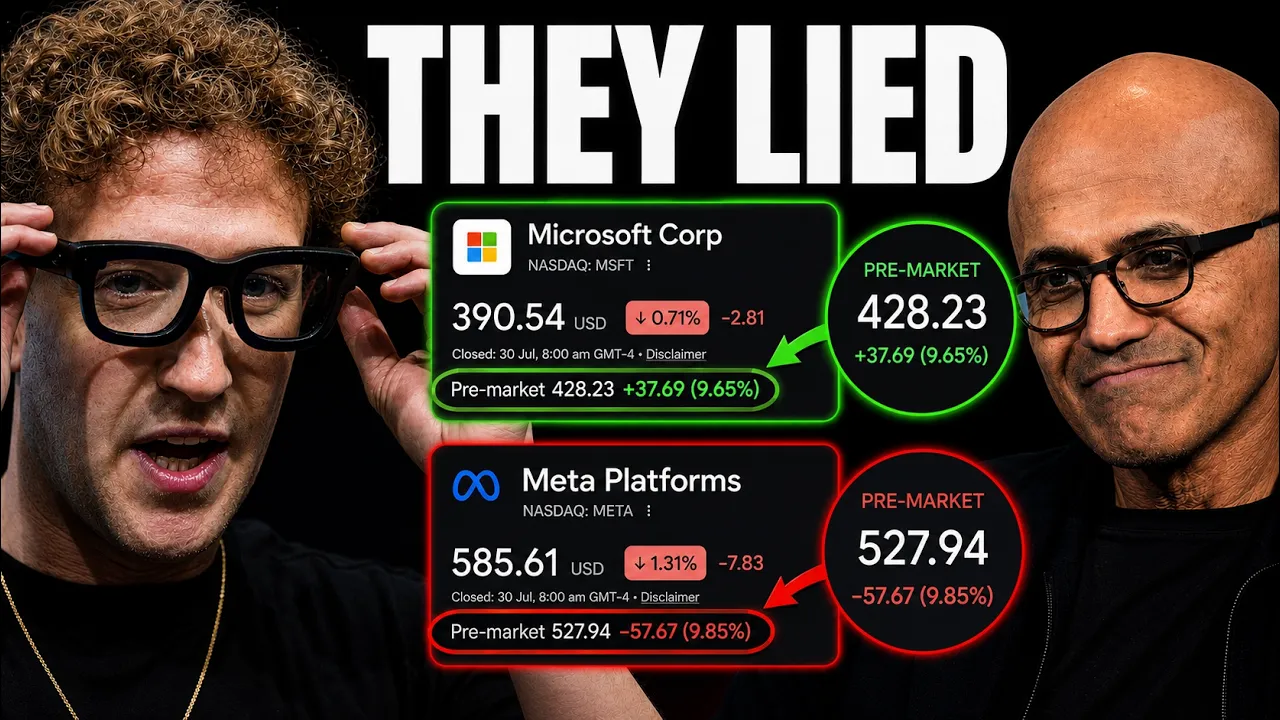
Good day to you everyone. Welcome back to the channel. Today, we will talk about the massive pre-market divergence across big tech after Microsoft stock surged over 8% while Meta fell 8% following their latest earnings reports. While the rest of the Magnificent Seven Club has been hit hard by fears over runaway artificial intelligence capital spending, Microsoft delivered the exact proof of demand Wall Street has been waiting for. In fiscal 2026, tech investors became increasingly skeptical of companies spending tens of billions of dollars on data centers without showing direct cash returns. Alphabet's recent capex hike to over $200 billion pushed its free cash flow into negative territory, sparking a widespread technology sell-off. Semiconductor names and software providers experienced sharp pullbacks as analysts questioned whether massive server investments would ever generate adequate returns. However, Microsoft completely broke that pessimistic narrative by reporting accelerating cloud growth alongside spending discipline. Azure revenue accelerated to 43% growth, pushing annual cloud revenue above $214 billion. At the same time, management kept their calendar 2026 capital expenditure forecast unchanged and projected positive free cash flow for fiscal 2027. In this video, we are going to dive deep into the earnings data for both Microsoft and Meta to evaluate why the market rewarded one enterprise giant while punishing the other. Let's analyze the quarterly revenue and top-line expansion for both companies in detail. For the fiscal fourth quarter ending June 30th, 2026, Microsoft generated total revenue of $90 billion. This represents an 18% increase compared to the same period last fiscal year, easily topping the Wall Street consensus estimate of $87.6 billion. Full year revenue for Microsoft reached a record $331 billion, up 18% year-over-year. Operating income for the fourth quarter hit $40.6 billion, rising 18% as operational leverage expanded across enterprise software. Adjusted diluted earnings per share landed at $4.74, representing a 23% increase over the prior year quarter and crushing analysts' expectations of $4.24. It is worth noting that this per share figure included a discrete benefit of 27 cents per share, primarily driven by a $3.2 billion investment gain in Anthropic, along with lower retirement program expenses. Even after stripping out those non-operational items, core earnings per share reached $4.47, beating consensus by nearly 6%. >> The cornerstone of Microsoft's revenue beat came from its intelligent cloud segment. Azure and other cloud services grew 43% year-over-year in constant currency. This marks a notable acceleration from the prior quarter's 40% growth rate. For the full fiscal year, Azure passed $100 billion in total revenue for the first time in company history. Total Microsoft cloud annual revenue reached $214 billion, representing representing 27% full year growth. Management also highlighted that nearly 90% of cloud revenue stems from non-AI enterprise clients, disproving concerns about circular revenue models. Additionally, productivity and business processes revenue rose 17% to $35 billion, driven by Office 365 commercial growth of 19% In stark contrast Meta's second quarter revenue of $60.8 billion grew 28% year-over-year beating Wall Street expectations of $60 billion. Advertising volume across Meta's family of apps remained healthy with total ad impressions up 14% and average ad pricing up 12%. However Meta's bottom line revealed significant profitability compression. Net income fell 14% year-over-year to $15.85 billion while diluted earnings per share dropped to $6.18 from $7.14 a year ago missing consensus estimates of $7.20. Before we break down capital expenditure numbers, quick pause everyone. If you have not realized this person you're seeing right now is a digital clone of me. I'm creating these videos to bring fresh perspective and objective economic analysis to your stock research. If you find this breakdown helpful, consider giving me a follow as it really helps bring these videos to more investors in our community. Now putting these earnings into broader industry context the Magnificent Seven tech giants have faced intense investor scrutiny over their massive artificial intelligence build-outs. Across 2026, capital expenditures across big tech hyperscalers surged to historic levels triggering market anxiety regarding return on invested capital. Alphabet set off widespread selling across the technology sector last week when management raised full-year CapEx guidance to over $200 billion while recording negative quarterly free cash flow for the first time. Similarly, Tesla and Amazon experienced sharp stock pullbacks heading into earnings as memory and chip hardware costs escalated. Microsoft's results provided a critical turning point for market sentiment because they demonstrated concrete artificial intelligence software monetization. CEO Satya Nadella reported that Microsoft 365 Copilot surpassed 30 million paid seats during the quarter, reflecting rapid adoption across corporate enterprises. Additionally, GitHub Copilot reached 50 million active users. Enterprise clients are actively utilizing AI infrastructure to drive measurable productivity gains, which directly translates into higher average revenue per user for Microsoft's cloud platform. Meanwhile, Meta's industry position highlights the operational challenge of consumer-facing artificial intelligence investments. While Meta's Advantage Plus advertising tools reached a $75 billion annual revenue run rate, consumer AI assistants and open-source Llama model developments do not immediately generate direct software license revenue. Meta must absorb massive hardware server costs today to support free consumer tools. Whereas Microsoft immediately monetizes its data center capacity through monthly enterprise subscriptions. To understand the dramatic stock price divergence, we must examine cash flow dynamics, capital spending discipline, and operating margins. During the fourth quarter, Microsoft reported capital expenditures of $41 billion, up 70% year-over-year as data center build-outs accelerated. Roughly 2/3 of this outlay went toward short-lived assets, including central processing units and graphics processing units. While the remainder funded long-lived physical property and data center facilities. Microsoft added 31 new data centers across five continents during the quarter, remaining on track to double overall cloud infrastructure capacity within 2 years. Despite this heavy spending, Microsoft managed to calm Wall Street's biggest fear regarding runaway CapEx. Management maintained its calendar 2026 capital expenditure forecast at approximately $175 billion, accounting for lease reclassifications without raising the total underlying budget. Furthermore, CFO Amy Hood stated that Microsoft expects to maintain positive free cash flow throughout fiscal 2027. Operating cash flow for the quarter remained robust at $55.4 billion, allowing free cash flow to reach $19.6 billion. Meta's cash flow metrics painted a very different picture. Second quarter capital expenditures reached $31.1 billion as Meta aggressively expanded AI server farms. This heavy outlay caused Meta's quarterly free cash flow to collapse to $784 million, down from $8.55 billion in the same period last year. Operating margin shrank from 43% down to 31% as infrastructure depreciation and employee expenses outpaced revenue gains. To make matters worse for Meta investors, management raised the lower bound of its full year 2026 capital expenditure guidance from $125 billion dollars to 130 billion dollars, bringing the updated forecast range to between 130 billion and 145 billion dollars. The market punished Meta because spending continues to escalate while operating margins collapse, creating a stark contrast to Microsoft's disciplined operational leverage. Now, let me evaluate valuation metrics and forward cash flow expectations for both companies to determine how the market is pricing these divergent cash flow outlooks. Heading into this earning sprint, Microsoft had underperformed the broader technology market significantly. Year-to-date, Microsoft stock was down over 17% making it the second worst performer among the Magnificent Seven. The pullback compressed Microsoft's forward price-to-earnings multiple from over 30 times down to approximately 20 times forward earnings, hovering near 1-year lows. At 20 times forward earnings, Microsoft offers a historically attractive valuation multiple relative to its high-margin recurring cloud revenue. Azure's 43% growth rate demonstrates that enterprise cloud migration remains in its early acceleration phase. With annual cloud revenue exceeding 214 billion dollars and operating margins holding steady above 40%, Microsoft's price-to-operating cash flow multiple stands at roughly 16 times, providing a solid cushion for long-term investors. Meta, on the other hand, entered earnings with its stock up 4% over the past month, trading around 22 times forward earnings. However, Meta's valuation becomes more complex when factoring in cash flow degradation. With free cash flow falling below 1 billion dollars in the second quarter and capital expenditures scheduled to reach up to $145 billion for the full year. Meta's forward price to free cash flow multiple has expanded sharply. While Meta's ad engine remains highly profitable with 28% top-line growth, the stock is currently undergoing valuation re-rating. Investors are requiring a higher risk premium until Meta demonstrates that its massive infrastructure investments can stabilize operating margins above 40%. In summary, Wednesday night's earnings reports highlighted that the Magnificent Seven is no longer a uniform trade. Microsoft delivered the operational proof Wall Street demanded. By accelerating Azure growth to 43%, demonstrating strong enterprise co-pilot adoption, and maintaining capital spending discipline, Microsoft restored confidence in the artificial intelligence trade. An 8% jump in pre-market trading reflects market relief that hyperscale cloud investments can yield immediate profitable growth while keeping cash flows positive. Meta demonstrated robust top-line ad growth but failed to reassure investors on expense control. Plunging free cash flow, margin contraction to 31%, and a higher capex floor triggered an 8% sell-off. The key takeaway for tech investors is that capital expenditure alone is no longer enough to drive stock appreciation. Visible revenue conversion and cash flow protection are now the absolute requirements. Hey, thanks for watching. I truly respect every viewer who takes the time to seek objective, data-driven analysis.

Comments 0
Sign in to join the discussion.
Sign inNo comments yet. Be the first to share your thoughts!