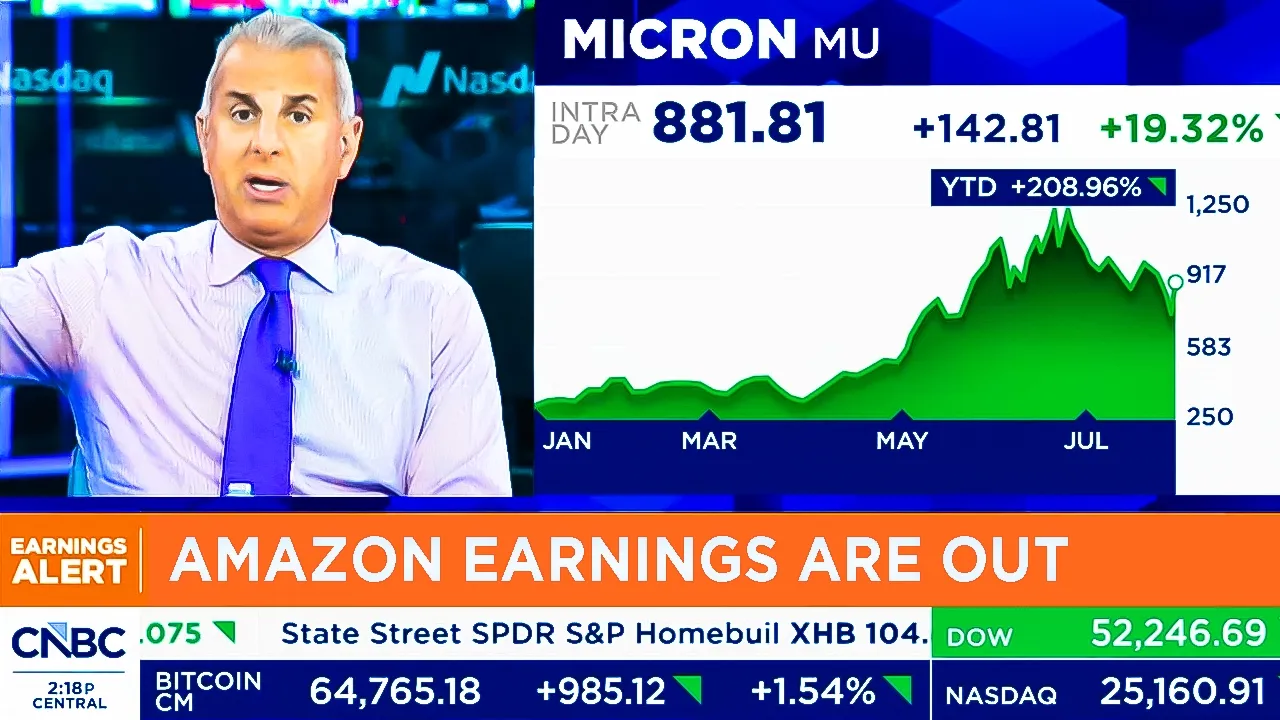
CNBC Today On NVIDIA Stock, Micron Stock, SK Hynix Stock, Amazon Earnings - NVDA Update

- Video return
- +9.28%
- Calls
- 4
- Buy / Sell
- 4 0
- Published
Recommendations
Entry is the asset's closing price on the publication date. Current is the last close on record.
-
Entry $874.66 30 Jul 2026Current $858.03 07 Aug 2026Result −$16.63
I wish I own Micron today I'd like buy
Context I wish I own Micron today I'd like buy >> Micron last week you had had IT WITH CHIPS
-
Entry $235.50 30 Jul 2026Current $276.14 07 Aug 2026Result +$40.64
He has an outperform rating on the stock.
Context Joining us now is Mark Mahaney, head of internet research at Evercore. He has an outperform rating on the stock.
-
Entry $387.84 30 Jul 2026Current $423.05 07 Aug 2026Result +$35.21
I have no problem buying more of Broadcom and Nvidia because they have less beta.
-
Entry $195.04 30 Jul 2026Current $223.78 07 Aug 2026Result +$28.74
I have no problem buying more of Broadcom and Nvidia because they have less beta.
Full Transcript
I have always believed that when you clear out the people who have to sell like this gentleman, you get a bot. This is when you blow everybody out who's been hot money. You go over the companies that have done really well that whose stocks have come down because of this. I'm going to use as representative a Micron. I mean Micron may be selling at the bottom yesterday three times 28 earnings that when you this is a clearing event. This is not because you said something really interesting. He's not the only one. This was the game plan. All I ever heard about what is situational doing? What is situation doing? There are so many people margined in these same stocks that Carl this I think >> short this has been historically how you reach a buy. >> And by the way he has a huge following amongst the retail community particularly young people given his cohort as well. Uh not to mention as you said a number of other hedge funds that have followed a very similar strategy and they've been right to do so but they've taken a lot of risk and when things change they change hard >> sometimes you have to learn that lesson the hard way when you're in your early 20s >> right and when you give up margin >> and everybody does >> that's how you bottom >> I wish I own Micron today I'd like buy >> Micron last week you had had IT WITH CHIPS >> WELL BECAUSE >> YOU WERE ALL ABOUT J&J AND 3M >> I didn't know what was happening I didn't know there There's one of the greatest blowups of all time happening. >> You need situational awareness? >> No. >> I got to I got >> situational. You going to step off the desk to one of those? Are you going to do one of those? >> Yeah, I'm going to do that. But look, I got to make a I got to make a call here. >> So, you're you're back in the chip game. >> Micron goes to a thousand. Yes. Because now I couldn't figure out why all the good chip stocks were getting crushed. >> And now you know. >> Now I know. It was a guy you was like someone was doing. Look at that. >> That's a lot to put on a It is. Now, even a cash back in friends. I don't know what his public book was and he was levered obviously it is a lot of buying power but that is to Carl's POINT no you have 20 billion you have open I know that's not >> you have open AI saying good things at the same time as you have Renee Hos saying really good things at the same time as you know that Sanjay Marot said great things you have lamb research which makes the equipment for all those saying great things and all the stocks were going down >> you know what people are going to say they're gonna be like Jim like a moth to a flame Back to chips. >> No, I'm not back to I did I didn't really leave him. I just don't feel so stupid. I mean, Nvidia's hurt me every day. David tends to comment on it. I walk away feeling really >> turn the knife a little more. >> Yeah, you do. >> I do. >> Yeah. And I enjoy that. I really enjoy that. Um, no, Nvidia's been very disappointed, but the biggest one been disappointment is one I don't think he's in cuz Intel >> Well, I tell you what, >> I thought Intel was going to turn. What helped overnight was some of these Samsung figures, >> they were great >> 250fold. >> They were better than SK Highness. SK Hy Jinks really kind of threw a real monkey wrench in the works. >> But I think you know more about that broader AI trade that you know that this market debate around is this capex too much. Can they be monetized? I think Microsoft helped answer that question. I think we had the update in terms of the the town hall that you know Sarah Frier at OpenAI did in terms of accelerating revenue there in July. I think all of that's going to help you know assage some of these fears where again that's maybe narrative around just what some of the stocks were doing particularly in infrastructure in semis uh through July but again I think that's just going to help us just move forward in this debate we can finance this this capex is reasonable it is being monetized and we still think we're fairly early innings in a generational technology shift >> if it's being monetized why do you think uh Nvidia has underperformed as of late I see it's one of your top holdings and I also think back to that partnership it announced with Palunteer the open source model. Curious how you think uh that open source model is able to gain traction from enterprise customers. >> Yeah. Yeah. So I think a little bit to do with that that second derivative and and again you this reminds me of you know back you know back in the day you know with Apple you know Apple had that phenomenal growth after launching the iPhone and then it ended up at a massive discount to the S&P because you know everyone thought it was the next Motorola and Nokia and actually Tim Cook came in and the first thing he did was do a massive new shareholder return program and you know Jensen and Nvidia have just just done that and ultimately they proved that their growth was you know more sustainable than people thought their margins were more sustainable than they thought. the competition wasn't going to take as much share as people thought and ultimately that stock rerated and you know Apple today trades at a significant premium um to the S&P. So it just just takes time and as we've seen for various reasons um you know the market's just not particularly patient. So again you know as long-term active investors we're trying to think about the long-term uh sort of fortunes of these companies and again we're very happy to to be patient. >> I'd love to get your thoughts on Korea because that's one of the things that we look at the first thing we do when we get in the office. What did the Cosby do overnight? Uh there have been some some uh desk notes this week suggesting that the AUM on some of the leverage ETFs has been pretty well drained and I just wonder if you think we're sort of past uh the biggest worries on that front. Certainly the regulators have gotten religion >> and certainly the regulators are getting quite a lot of political pressure but but yeah I mean it's just been extraordinary what we've seen and obviously you had one of the opposition parties saying you know they've turned you know the country into a casino unfortunately you know putting huge amounts of leverage onto cyclical stocks and such a concentrated stock market is a recipe for disaster and unfortunately many people said that before the these products were launched and and now we've seen the outcome of that you know that creates some great opportunities again as active managers we can step into that you know if you've got memory stocks trading on two times earning I mean, Samsung just reported over $60 billion of operating profit in the quarter. I mean, you know, that's probably the highest, you know, quarterly profit we've ever seen. Um, and, you know, these companies going to, you know, announce significant shareholder return programs, buy back, you know, tons of stock, maybe able to buy back 30% of the company. And we also had the SK group, you know, chairman buying stock PA personally, um, in SKH Highix today, which I think is the first time I believe that that that's ever happened. So, you know, I think there is a dislocation there in that that market and again, you know, that creates opportunities for for for fundamental investors. >> I just wonder whether or not you have to be selective or if you can buy in bulk. I mean, the the the famous phrase now is that it it the Cosby trades at five times forward. >> Exactly. I mean, we're not the greatest fan of geographic investing as as you said, you know, the two largest stocks there are memory companies. You know, the two largest stocks in in the S&P 500 were Micron and SanDisk. you know, a the returns would look a bit different, but also the volatility would look a bit different. So, you know, it's ultimately about picking the end stock, you know, are you playing, you know, great companies that have got great exposure to some of these ma, you know, major trends, you know, whether it be AI, whether it be geopolitics, what we're seeing in the world, what's happening in the Middle East, you know, and can you buy it at a reasonable valuation and with unexpected earnings growth? That's the same in Korea is to to anywhere in the world. you ultimately we'll we'll do the homework for our clients and again that gives us the the gravity the foundation that allows us to hold these stocks through what is you know the extreme volatility we've seen in the last you know even year to date but certainly in the last couple of months >> you are playing this momentum trade in some ways >> I kind of am >> right you kind of are don't you own Micron >> I do own Micron I do own but Nvidia is not necessarily mo I wasn't talking about that one >> well I'm kind of a balance I'm a barbell so you know if you think the momentum trade is over, then you think the capex cycle is over. And we just spent 20 minutes talking about how it's not even close to being over. I mean, 800 billion this year in capex likely going to 1, my mind $1.6 trillion. That benefits the entire food chain. But in the semi world, I was looking for the lagards and Broadcom and Nvidia have underperformed the group by 53% year-to date. And the valuations are super interesting to me. These are the leaders in the industry, the juggernauts if you will, and they've already had their pullback. They've already had their lagging um uh performance. So, my con on the other hand is definitely Mo, but I was thinking down 30% when you have a hundred billion of of of capex that is guaranteed between now and 2030 and cash in hand of $22 billion. I mean, like, they got pricing power, they've got visibility, stocks aren't expensive. some never going to be the size of Nvidia or Broadcom. Small, but I want to I think we're short memory and compute for many years to come. >> What would make you I think Samsung said as much overnight. Um what would make you want to buy more of these names? >> Well, I have no problem buying more of Broadcom and Nvidia because they have less beta. I know I was talking about Micron. I think it's all about position sizing because they are they're up and down. Micron's up 10% one day, down 15% the next. So, I just want to keep it a little bit more balanced. Okay. I mean, Amazon earnings are out. The stock is up by a little more than 6%. Kate Rooney's been combing through those numbers. Kate, >> so Melissa was a beat for revenue, a beat here on the top line and an AWS beat when you look at the growth rate. Revenue was about $200 billion for the quarter. Net sales up 20%. That was stronger than expected. The reported EPS number, we are not going to compare, is $5.75. There is an impact here from some of the paper gains from Amazon's stake in Anthropic. So no comparable number there. And then on the AWS growth rate 37% for the quarter. The number to beat the analyst estimate was 31%. So stronger than expected there. AWS revenue overall also beat $42 billion there. And North America revenue that is the e-commerce business for you. Stronger than expected in the quarter $116 billion in revenue for that segment. Also a quote from CEO Andy Jasse. He says AWS is booming in his words talked about that year-over-year growth. Called it the fastest growth for AWS in 18 quarters. Also calling out advertising with another strong quarter that was up 26% year-over-year. You can see the stock reacting up more than 6% on that news. Mel and Mike. >> All right, Kate, thank you. Let's dig deeper into Amazon's quarter. Joining us now is Mark Mahaney, head of internet research at Evercore. He has an outperform rating on the stock. So Mark, I guess acceleration in AWS, that's been kind of the coin of the realm for for these companies. What are you looking at? >> Well, that's what people wanted to see and that's what they got. Uh you had the highest growth rate whatever in 18 quarters. I think the number to really focus on is that sequentially they grew about 4 a.5 billion. That's the same as GCP grew sequentially faster than Azure grew sequentially. And so the you know the the market I think the bull call here is that you're going to be exiting the year with a 4040 setup 40% AWS growth and shockingly close to 40% operating margins. Operating margins this quarter for AWS were 39%. I mean that's normally their mar the margins are down sequentially. So not only is the revenue growth uh dramatic but the but the profitability is rising. Sort of same thing happened with Azure and with Google cloud. It looks like the cloud hyperscalers are showing you both growth and profitability and so I you know Amazon's been a bit of a lagard. I think this is just the breakout that the stock needed. >> Yeah, we should note that Q3 revenue guidance is um a little bit lighter than uh expected. The top end of the range 202 is below uh the consensus estimate of 204 uh mark. But but the AWS number at 37 versus 31 expected. Does that give them leeway to raise capex or to frame capex as it is worth it here and investors will give them the pass? >> Well, there was this one issue by the way, Melissa, with that Q3 uh guidance, which is there was just mismodeling on the on the streets part and I was part of that too. I corrected it about a month ago, but you know, with prime day shifting from Q3 to Q2, you know, you normally have a sequentially down Q3. So, the street was a little bit offsides on that number. That's that's good. That's important context. And then in terms of the capex, I actually haven't seen yet what they've announced about capex. Um I you know, yeah, I think they get leeway. You ended you end this year with a 4040 setup. 40% revenue growth, 40% operating margins or close to it. And I think you get leeway. These companies are all leaning aggressively into capex, but they're showing you these returns. I haven't seen the backlog number yet, but if that jumped up reasonably well from last quarter, then yeah, you're showing accelerating growth in your most profitable part of the business. And it just step back one last point on the stock. The last time Amazon had AWS revenue growth in this zip code kind of high30s, the multiple was practically twice what it is today. So that's uh you know again I think this is kind of your unlock quarter on Amazon shares. Stock is up right around the 250 mark. It's been an area where it's uh kind of had some congestion in the past. You mentioned it's been a lagard mark. Uh top top of the list of reasons why you think Amazon in particular has uh has been a struggle. Well, two reasons. One is that AWS growth has not done nothing but decelerate for two years. I mean, three or four years ago, this was a 30 40% revenue grower and it got as low as low double digits. That'll give you a D-rating uh catalyst. And then the second thing is correctly the market's been very nervous about the scale of the investment. I mean, we're these are unprecedented levels of capex across, you know, these three or four hyperscaler companies. And so the market really wanted to see like show me this RO AI like give me that give me that real dramatic reaceleration and growth. Microsoft gave it to you and now Amazon just gave it to you too and Google did too uh you know a week ago. So if you're if you're getting if you're getting these kind of revenue returns and the profitability margins are reaching record high levels I think you get a pass on aggressive capex investments. >> Mark hang on we want to go back to Kate Rooney's got more from the quarter. Kate, so Melissa, I want to build on something Mark was just talking about the AI revenue for the return on investment. They are pointing out here Amazon says exceeded $25 billion in annual run rate for AWS's AI business, growing tripledigit percentages year-over-year. So that does speak to the return on some of the investment for Amazon. Also, just quick note on guidance. It looks like Q3 revenue guidance is actually a little bit light at the midpoint as well as Q3 operating income guidance. So slightly under expectations there. And then last thing here, there is a note about investment gain. So Q2 net income, it does include a markup here about $53 billion of a gain primarily due to their investment in Anthropic. So of course a private company, they need to do some accounting for that. That is the reason why we're not going to be comparing earnings, but a massive stake in anthropic that is at least paying off on paper, guys. >> Right? So, it's 53 billion uh of the 62.6 billion in net income reported in the quarter is actually the >> primarily from Anthropics. So, Anthropics included in that. There could be others. They're also an investor in OpenAI, which I don't see called out here specifically, but they are talking about their investment stake, and it makes the accounting a little bit messier for a lot of these companies that are now invested in anthropic and other AI labs. Yeah, I mean a good mess. I guess you're marking them up, not down. But Kate, thanks. Mark, um, you know, Amazon obviously has been among the companies raising a bunch of debt. They did a deal earlier in July and kind of said that's probably it for the year. Um, do you expect them to offer any guidance as to what it looks like for next year? Is that a relevant swing factor here? >> I I knowing Amazon, I don't think they'll talk about uh next year. I know Google has already talked about capex for next year. Meta declined. Um, Microsoft gave you some forward financial uh, you know, free cash flow guidance. That's not Amazon's that's not what they normally do. So, I wouldn't expect them to talk about it for next year. And then in terms of um, uh, financing, they have enough financing to get through this uh, you know, this this their biggest investment cycle ever. They have they have enough without having to tap the equity markets. I know there was this urban myth that they would do that. I strongly disagree. The last time Amazon did an equity offering, it's IPO. So, they they just don't do that. But but a debt offering possibly, but you know, they'll only if they feel like it's uh it's helpful to their to to the to the balance sheet like there's no necessity on their part to raise debt if they want to and if they if they wanted to, they absolutely have the ability to raise it, but I don't think I don't expect them to. >> Anything else that we've missed so far, Mark? I know it's early on. The conference call hasn't happened and you got the release, but anything else stand out to you? >> Well, I it sounds like we had acceleration across the board, advertising, retail, and AWS. My my sense is I haven't looked at the retail margins yet, but my the probably gapping up. Now I want to find out some things. Let's talk to us about Project LEO. So, are we blasting off, pardon the pun? Are we going to go commercially live in the fourth quarter? I think we will, but I'd like to hear that. And then we've got new business initiatives like this uh um logistics and shipping initiative. So, you know, how's it's only been out for a month or two, but what kind of early traction are we getting for that? Those are the two most interesting new business areas. This is when during the earnings call they usually riff a little bit on some of their newer initiatives. I want to hear those. >> Now let's get to Amazon trade that shares jumping after revenues came in ahead of expectations. AWS sales seeing their best growth in 18 quarters. That conference call also just started. CNBC's Kate Rooney's [music] got those numbers. Hey Kate. Hey Melissa. So Amazon really was able to show momentum on AI revenue and that is giving them a hall pass for some of the higher spending around AI. You mentioned AWS cloud revenue a clear beat in the quarter 37% growth year-over-year. The number to top was 31% for estimates. CEO Andy Jasse saying AWS's AI business also topped 25 billion in annual revenue in terms of the run rate growing triple digits there. Triple digit digit percentages year-over-year. Amazon's total revenue was up 20% on the year. Also beat estimates. We didn't compare the earnings number because they did report an investment gain of about $53 billion at least on paper. That is primarily from their investment in Anthropic. CEO Andy Jasse says, quote, "AWS is booming." He also called out fastest growth there in 18 quarters, pointing to advertising as well. Said that had another strong quarter, 26% year-over-year growth. Ad revenue did top expectations. And then its homegrown semiconductor business. This one's surprised to the upside. 25 billion in annual revenue run rate as well. The chips business also growing tripledigit percentages. North America revenue, that's e-commerce, grew about 16% year-over-year, partially thanks to Prime Day in the quarter. And then capex, this has been the big tech story, higher than expected in the corner in the quarter. We may get more details on that around the call. And then Q3 revenue guidance and operating income did come up a little bit light, but still stock up as you mentioned Mel more than 6%. It was up as much as 9% after that. Kate, thanks Kate Rooney. And again, it all has to do with the setup because this is one of the lagards uh in the Mag 7 going in. >> Yes, exactly. Definitely a decent setup for it, but a very good quarter. I mean, those AWS numbers >> way higher than the Whisper number, which is even a little higher than I think Model in the Street, but that was just an extraordinary quarter and it sounds like, you know, full steam ahead, which is why the capex then comes in. We'll see the full reaction to that. I want to hear more about it. like you know I listened to the meta call last night it was very squishy on what the uh return on would would be right no nowhere even remotely close to any kind of number that's something we're I guess we don't who knows when we'll ever see what that is but this was I I think really a great quarter some other little things and you know advertising nice uh that was a little bit of a beat that's great um the other thing is guidance I never care what Amazon guides they're not particularly good at it I don't think they really care either when they give guidance. So, I I give zero weight to that. The setup was the most important thing. >> Capex trend continues to roll. I mean, 68% year-over-year at capex. I think they're up to what 54 billion. But remember, there was a time when we used to do this show where the operating margins for Amazon were low single digits. I mean, here they are coming in at 13.7%. I mean, it was 11.4% this quarter last year, and it was better than the street was looking for, which is a big function of, as Karen just said, AWS. Good for them. It's a good quarter. But is this going to be that same type of situation we might see with Microsoft? The setup was really good for earnings. You saw what Microsoft did today, but is this going to be sort of like a last gas before the rollover? I my instincts say that Amazon's got a little room to run here. I think the Microsoft move today might have exhausted itself. >> Yeah. 3 years ago AWS growth bottomed out at 12%. Right. So you think about that and they had more market share than they do right now. They're expected to have like I think about 30% uh market share. they're growing 37% and we know that Azure you know is probably 24% um of the cloud and you know that was growing um you know at a pretty good clip I think it was somewhere in the 30s is that right or 43% right year-over-year um so you know you have a bit of a two- horse race here now it's not really AWS running um away from it and you know when you think about Microsoft and what they have um on their cloud as far as models um I don't think it's nearly as interesting possibly as what GCP and Amazon have so um you know the Microsoft thing might start to moderate to some degree and you might see GCP kind of picking up a little bit of steam there. >> Well, GCP I I don't think it's only two- horse race. I mean, it's smaller 13%. >> I know it's smaller, but the growth there was really really extraordinary and the margins on AWS at 39 plus 399 that is really extraordinary. So, I mean if you can lever that business and just get bigger and bigger that's that's that's a really profitable thing to do. Obviously, >> Jim, if Amazon ratchets up uh its capex number, does it get a free pass at this point given the the results of the rest of the businesses? >> I I mean within reason, no one's getting a free pass right now. But but I you know, we're getting if we want to argue, you know, who's best positioned in cloud, let's talk about the fact that Amazon is so well positioned in like four businesses that have massive TAM growth. So, it's not just cloud, it's advertising, it's hardware, chips, and we we're not even talking about retail. So yeah, the the the the AWS the rate of change on the change. In other words, this is a trend that's getting a lot better, not just a little better and and gets you back to some of those growth rates of a couple years ago. But I I just think that this is a company that has more levers to pull than others at a time when, you know, compare it again to to Meta where we we understand there's new businesses and we understand there's new forms of revenue, but we don't really know a whole lot about them. These we really do know a whole lot about. By the way, you know, the 26% for uh ad growth is is you know, Meta was 28%. I mean, it's good news for everybody. Bottom line is these two these two guys are growing massively in advertising and it it seems like it's I mean Google's there too, but um this is really impressive. We were talking to uh Mark Mahaney Mahes on closing bell overtime and he said you know there are all these there's also these other two businesses project Leo and the logistics business and those could be large businesses as well on top of the trainium and gravitron businesses >> which is enormous on its own >> right exactly so it's staggering outside of of the things that they break out right now the other items that could be added I mean there was a time when we were concerned about valuation I think that time has passed I mean you can actually make a pretty cogent argument for Amazon on valuation. The problem is you know it's a pretty gets a little sloppy in terms of stock performance. We see a lot of volatility in the name. I think overall though this quarter suggests there's another leg higher. Can I ask >> can we switch to Amazon for a minute? What do you think of capex and do they do you think it's received well? >> Yeah. So they had a a very difficult bar coming in. Uh Microsoft set the bar. Uh not only did uh Kathy Hood say we're going to be FCF positive in 2027, Azure hit and also Copilot hit, but I think Amazon completely delivered. I mean, we haven't seen AWS acceleration like this in I think 18 months. And um the uh in in a macro environment where memory costs and silicon costs are are through the roof. Uh, but I think they're on the call going to have to deal with this negative7.6 billion dollars of FCF and their long-term debt doubled to $129 billion. I think at least with this print, they shows that they can monetize that capex, but they're going to have to give uh some confidence uh to the street that they can keep this going. >> All right. Um Patrick, thanks. We got to go. So the stock is secular like higher up to after our session highs right now almost up 10%. Update on Amazon capex just came out. Kate Rooney's got those details. Kate Melissa. So Amazon is lifting its capex guidance. Andy Jasse on the earnings call saying right now we believe we will spend approximately $220 billion in cash capex for 2026. Remember they had forecasted $200 billion. So this is higher. He talks about the higher cost of memory pushing this number up from their prior estimate of about $200 billion. Said as far as the AWS and AI demand, he said that's booming right now. And said quote, "We're enthusiastic about the ROIC equation even with heavy capex over the next few years. Stock reacting not much. It was up higher after the print, but investors seem to be willing to give Andy Jasse the benefit of the doubt here on that spending increase." smell. >> Is there any capex number for 27? >> This is current year 2026. Not yet. We haven't gotten that any sort of update there, but this is effective higher higher memory cost. So the the current year number lifting here, Bill. >> Right. Okay, Kate, thanks. Keep us posted. Uh Kate Rooney, capex goes to 220 again for the full year 26. Full year 27 was estimated to be 226. So pretty close to two years out. It's hard to say why some companies get rewarded for it, others get punished for it. I have no idea. What I'll tell you, and you know, as you've come to realize, I don't know a lot of things about a lot of things, but I guarantee you SanDisk, which had a day today, is probably up in the after hours on the back of this, as is probably Micron and Nvidia should as well because it speaks to this capex just not going away. >> Why do you think it breaks this breaks the mold of higher capex and the stock goes down? Higher capex, stock goes up. >> Well, they didn't use the word significantly. And that was something that [laughter] I think really that when you think about that and it obviously hurt um Google too. I I think it is worth noting as we're all kind of fawning over this quarter that Anthropic and Open AI are AWS's two largest customers, right? And we spent a lot of time talking about the risk of their ability to kind of fund these projects. So, you know, at the end of the day, this falls right into the circular sort of financing conversation. I know that was something we had a really serious conversation about late last week, early this week. And it seems like when you have a quarter like this or Microsoft yesterday, it's easy to forget those sorts of serious conversations. But I think we're going to get over this and uh start talking about that or focusing on that again in the next few weeks. >> I'm sort of surprised the stock took a little leg higher on that capex. $20 billion. That's a lot of money. I mean, Amazon has the balance sheet. They can still it's fine and they did that big debt raise and they have liquidity. But um had you know had Meta come out with a $20 billion raise that would have been even more disastrous than the we're just tight tightening up the bottom end. And then Google the reaction to their capex increase >> was also not good. So I'm I don't know if there's anything else there or just Amazon Jasse is you know he has said over and over again this is the most enormous opportunity he's >> right. Well, you go back to that letter that Jasse had um Tim and he was very clear on where he saw the opportunity and and the run rates of the various businesses and um that just the path for just a clearer direction, a clear path in terms of how we get there by spending this. Do you think that has made a difference that he's able to articulate uh the vision of Amazon in a way that Mark Zuckerberg has not yet been able to do? >> He he's he's been less than conservative. I mean, he's he's been very aggressive in pointing out how optimistic he is and how strong he is. And and also today, I mean, they they gave you a $25 billion annualized run rate on their, you know, their return on that investment capital. So, you know, it still pales into the number we just got here, but it it, you know, on a on a again, we're talking about growth rates off of where they were. This is part of what's giving them the story. I again I I just think it's the fact that investors one that you know Amazon had underperformed the S&P by by you know almost 25 points going into this print. Um but the other dynamic is you've got these multiple business lines that all seem to be going pretty well and and uh you know we we are not talking about retail. I realize it's not sexy. I realize it's low margin but it is part of of that that of the platform the flywheel. And I think it's also very strong. Here's her from the conference call. Andy Jasse sees a clear line of sight to strong financial returns on AI and AWS spending. >> Speaking right a return on invested capital, which is a conversation we've been having. >> All right, I hope you're all doing well today and staying calm in this market. Today was a mixed day in a market, but it was green at the index level powered by notable gains in many of the AI tech hardware names that have been hammered over the past month. Yesterday, we got earnings and commentary that were positive for the AI infrastructure supply chain for Meta and especially from Microsoft as Azure revenue growth accelerated. and they said they expect to remain free cash flow positive in fiscal 2027. CNBC also reported Wednesday evening that OpenAI CFO said that ARR in July exceeded all of Q2. I assume OpenAI's CFO meant that net new ARR added in July exceeded all of Q2. That would make much more sense. Keep in mind that CNBC reported based on a partial transcript, so perhaps that's where the confusion is coming from. But regardless of that, the point is that OpenAI's revenue appears to be accelerating, which also helped lift AI infrastructure stocks on Thursday. I'm going to cover Amazon earnings in a moment, but first let me cover some important news. Overnight in South Korea, Samsung reported very strong earnings. We got Samsung's preliminary earnings guidance earlier this month, but overnight they released the official earnings report and it was very strong. Samsung also announced that they've signed supply agreements with the five largest global data center firms and they are nearing deals with five other major companies that they did not name. The agreements generally run for at least 5 years, include upfront customer payments, include minimum floor pricing, and could eventually cover 2/3 of Samsung's memory output. That is very important as memory makers work to reduce the cyclicality of their businesses. Also, Samsung's HBM4 ramp is accelerating with HBM4 revenue expected to more than triple sequentially in Q3. Overall, Samsung's report and commentary about long-term agreements was very positive. Very briefly, I want to mention something that Tim Cook said on the Apple earnings call Thursday evening about memory prices. He said, "We paid more for memory in the March quarter than the December quarter. We expected to pay significantly more in the June quarter than the March quarter, and that is what happened for September. we expect to pay even higher memory costs. If you look beyond September, we see the market pricing for memory continuing to increase. That is positive for the memory makers. And now let's cover Amazon earnings. Let me just start by saying that this earnings report and earnings call were very positive for companies like Nvidia, Micron, SK, Highix, and the rest of the AI hardware supply chain. I'm just going to rapid fire important points from the earnings report and earnings call as it relates to AWS and Capex. AWS revenue growth accelerated, increasing 37% year-over-year. That is massive for AWS. Keep in mind that AWS is the largest of the clouds. So for AWS to be growing at that rate at their scale is very impressive. I'll share this graphic that CNBC put together of AWS growth rate in recent quarters because I think it really helps put that 37% growth rate into perspective. AWS now has an annualized revenue run rate of $169 billion. Amazon's cash capex was $53.1 billion in Q2. Most of that relates to AWS and Generative AI. On the earnings call, CEO Andy Jasse reiterated that AWS is able to monetize new capacity as soon as it comes online. Amazon reported AWS operating margin of more than 39% which is solidly higher than consensus expectations of roughly 34%. Amazon raised 2026 capex guidance to $220 billion which is up from $200 billion previously. On the earnings call, Jasse said, quote, "We now believe we will spend approximately $220 billion in cash capex in 2026. the higher cost of memory pushing this number up from our prior estimate of about 200 billion. But even at that amount, we will still not have enough capacity to meet all the demand we have in 2026. And I believe this dynamic will also be true in 2027 too. In fact, the demand we already have for 2028 is striking. Jasse spoke about Amazon having a clear line of sight to strong financial returns from capex. Jasse mentioned that they have strong demand visibility and Amazon typically purchases things like servers and networking a few months before AWS puts them into service. If the demand isn't there, they won't spend the capital for the equipment. Jasse said that most of AWS AI capacity is being contracted for at least 5-year terms. Leadership also spoke about robotics and automation by saying they're expanding their deployment of robotics and automation and they expect to more than double their fleet of robotic arms like Cardinal and Sparrow in 2026. That is positive for conventional memory demand. Jasse also spoke on the earnings call about the fact that Amazon and AWS can have a wildly successful business even without having their own Frontier AI model. Amazon has a wide selection of leading models inside Bedrock. Amazon doesn't need to compete in the frontier model race to have successful business. That said, Amazon is still developing its own frontier model for various reasons. I would say that's overall positive as it relates to market sentiment and worries about return on invested capital. Amazon doesn't need a frontier model to have a successful business, but at the same time, they're pursuing a frontier model for various reasons. Amazon's business can succeed regardless of which frontier model leads at any given moment. Amazon also shared that their custom chip business exceeded a $2 billion annual revenue run rate and they struck multi-year multi-gawatt commitments for tranium with anthropic and open AI. It's important to remember that this is not zero sum. There is simply not enough available supply of compute to satisfy the demand. Developers choose the platforms they build on. The vast majority of developers want to build on Nvidia's platform. Nvidia brings customers to AWS. So tranium success does not mean the demise of Nvidia. Not at all. Both can succeed simultaneously. The world is already compute constrained which means there is enough room in the market for multiple chip makers to succeed. And the total addressable market is growing double digits percentage annually. So there's already enough room in the market for multiple chip makers and the pie is growing at a strong clip. On top of that, this is not zero sum and this is not the time for Nvidia investors to worry about market share. Amazon's earnings report and earnings call were very positive for companies like Nvidia, Micron, SKH and the broader AI supply chain. We've now heard from each of the four major hypers scale companies this earning season. All of them either raised or maintained their capex guidance. I know Microsoft's headline capex number for 2026 is technically lower now. But as I explained in Wednesday night's video, that's because of an accounting change, but their underlying investment plans remain unchanged. Moving forward, more of Microsoft's data center leases will be operating leases instead of finance leases. Operating leases are not included in capex, and so Microsoft had to remove that from their headline capex number even though they still plan on spending the money. I just want to clarify that in case anyone hasn't been following along. Microsoft calendar 2026 capex is now technically $175 billion instead of the original $190 billion, but that's because of an accounting change. They still plan on spending the money. Anyway, with that disclaimer out of the way, each of the four major hypers scale companies either raised or maintained their investment guidance. The three hyperscalers, Alphabet, Microsoft, and Amazon, all reported acceleration in cloud revenue growth. Microsoft said they expect to remain free cash flow positive in fiscal 2027 as market participants have been worrying about hyperscalers cash flows. Microsoft said they were able to bring online more capacity during the quarter than what they originally expected and they were able to monetize that additional capacity quickly. Amazon reported AWS operating margin notably above consensus expectations. Alphabet leadership told us to expect significantly greater capex in 2027 than in 2026. And Meta clarified that they do not have excess compute. They expect to use the majority of their compute for their own uses. But they also realize that they can charge a substantial premium by renting out a portion of their compute to large customers. And so they are preparing to do that as well since they can charge a notable premium due to the shortages throughout the industry. Each of the three major CSPs told us that customer demand continues to exceed supply and they are monetizing new capacity as soon as it comes online. And so despite all of the hysteria and sensationalized headlines that we've seen over the past month and despite the abysmal price action in many of the AI hardware stocks over the past month, the fundamentals remain firmly in place. That is the bottom line takeaway from this earning season. I don't know what's going to happen in the short term, but from a long-term perspective, I am very confident that Nvidia will be worth much more in future years than it is today. When Jensen was on the Lex Freedman podcast not that long ago, he was very seriously raising the possibility of Nvidia becoming a $3 trillion revenue company in the near future. If that happens in the coming years, then it is very plausible that Nvidia could one day be worth tens of trillions of dollars in market cap. That might sound crazy, but that's what Jensen is implying when he raises the possibility of Nvidia becoming a $3 trillion revenue company. I guess the question at that point is what multiple the street will be willing to give Nvidia. I don't know the answer to that question, but I truly do think that Nvidia will be worth much more in future years than it is today based purely on the fundamental growth of the business. Based on everything I'm seeing, the world is still computed and I expect that to continue at least through the first half of calendar 2028. In a computed environment, developers will use whatever viable compute they can get their hands on. Today, there are no GPUs that are sitting dark due to a lack of demand. Like there was fiber sitting dark due to a lack of demand at the height of the dotcom bubble. Back then, companies were laying fiber in the hopes that use cases and demand would eventually show up. Today, we are seeing the complete opposite. As I've said many times, when market participants compare this AI revolution to the do-com bubble, they ignore the fact that the internet is already here this time. This means that mass adoption of the technology and new use case development at scale are immediately possible. We don't have to wait years for it to show up. It's already here. The world is compute constrained which means there is not enough supply to satisfy demand. New capacity is utilized as soon as it comes online. The hyperscalers are monetizing capacity as soon as it comes online. Each of the hyperscalers spoke about being supply constrained on their most recent earnings calls. Additionally, many of the clouds are building out into contracted demand. They're not blindly building in the hopes that demand will eventually show up. No, they're building out because they have signed contracts and in some cases significant prepayments from their paying customers. This AI revolution is fundamentally different from the dotcom bubble and 2026 will be a pivotal year for the AI industry. Thanks to the rapid adoption of Agentic AI and the proliferation of Agentic systems in the world's leading enterprises. The leading AI labs revenues are surging right now. Aentic coding and the implementation of Agentic systems in large enterprises are new use cases that are increasing inference demand significantly that subsequently is increasing compute demand. The rapid adoption of Agenic AI is why we're seeing an inflection in inference demand. It's why we're seeing the leading AI labs revenue surge. I wish both Anthropic and Open AI were public so the public could see the ramp in their revenues. Anthropics ARR has surpassed 47 billion, up from $9 billion just at the end of 2025. Open AAI is growing rapidly as well. I think the leading labs surging revenues may be the initial proof point that grabs market participants attention and causes them to realize that there will be a clear ROI on AI infrastructure. I think the leading labs surging revenues will also help assure investors of the longevity of Nvidia's growth since these labs revenues are directly tied to compute. If they had more compute, they would have greater revenues. It really is that simple. Demand is not the problem. The problem is a lack of supply to meet the demand. As I've said previously, I expect the world to be compute constrained at least through the first half of 2028, possibly longer. And so regardless of what happens in the short term, it's important for long-term investors to remain focused on the fundamentals, maintain a long-term perspective, and remember that we are only in the early stages of aenic systems being adopted at scale. This will increase compute demand significantly. And after that, the next surge in compute demand will likely be fueled by physical AI. We're no longer talking about digital agents performing digital tasks. With physical AI, we're talking about physical AI agents performing physical tasks in the real world. NVIDIA CFO has called physical AI, quote, a multi-trillion dollar opportunity. and the next leg of growth for Nvidia. This industry will fundamentally transform society and Nvidia has positioned themselves to benefit massively. Nvidia sells the hardware for the data centers where the models are trained. They offer omniverse where the models are taught and tested. And Nvidia also sells the hardware that allows ondevice real-time inference through Nvidia AGX allowing robots to have intelligent interactions with the real world even when they are not connected to a data center. Notice that Nvidia is taking a holistic platform approach to physical AI and they're embedding themselves as the underlying foundation supporting all of it. Over 2 million developers are already building on the Nvidia robotic stack and this is not getting enough attention. As for production ramps, Blackwell Ultra has ramped quickly and remains in high demand. Reuben is on track to launch in 2026. Then we're expecting Nvidia Gro 3 LPX in the second half of 2026. Later on, we're expecting the launch of Reuben Ultra in 2027 and Fineman after that in 2028. We have a clear data center product roadmap stretching into 2028 and Jensen believes that AI infrastructure spinning will reach 3 to4 trillion annually by the end of the decade. That means Jensen is expecting growing AI demand and an expanding total addressable market underpinning all of this. I don't think we are anywhere near any type of bubble bursting type of event. With all of this in mind, I seriously think that Nvidia still has plenty of runway ahead of it. And I think this company will be worth substantially more in future years than it is today. At least that's my view of the situation. Quick note before I wrap up. All of the compilations on this channel are edited by Finn Vid with original structure and commentary. Occasionally the same edits appear elsewhere on YouTube. If you're looking for the original version, it's always here on this channel. Thanks for watching. watching Finn Vid. I appreciate your support. Remember to stay calm in this market. Remember to maintain a long-term perspective and do not make any hasty or irrational decisions. With all of that being said, I hope you all have a great rest of the day. And I'm curious to hear your thoughts about Nvidia in the comments below. Please leave a like on this video so more people will see it. And while you're down there, please consider subscribing. It's free and you can always change your mind. Thanks for watching and hopefully I'll see you in the next
Comments 0
Sign in to join the discussion.
Sign inNo comments yet. Be the first to share your thoughts!