
- Video return
- +3.21%
- Calls
- 2
- Buy / Sell
- 2 0
- Published
Recommendations
Entry is the asset's closing price on the publication date. Current is the last close on record.
-
Entry $556.71 31 Jul 2026Current $592.90 07 Aug 2026Result +$36.19
I just bought an additional $4,000 of this company. So, I'm actively buying Meta at this price,
Context "So, I'm down 22% on my Meta position, $38,000 into the red, and I just bought an additional $4,000 of this company. So, I'm actively buying Meta at this price,"
-
Entry $356.13 31 Jul 2026Current $354.59 07 Aug 2026Result −$1.54
I argued for Google for over a year that this company was worth owning on the back of its earnings reports that were repeatedly excellent earnings reports.
Full Transcript
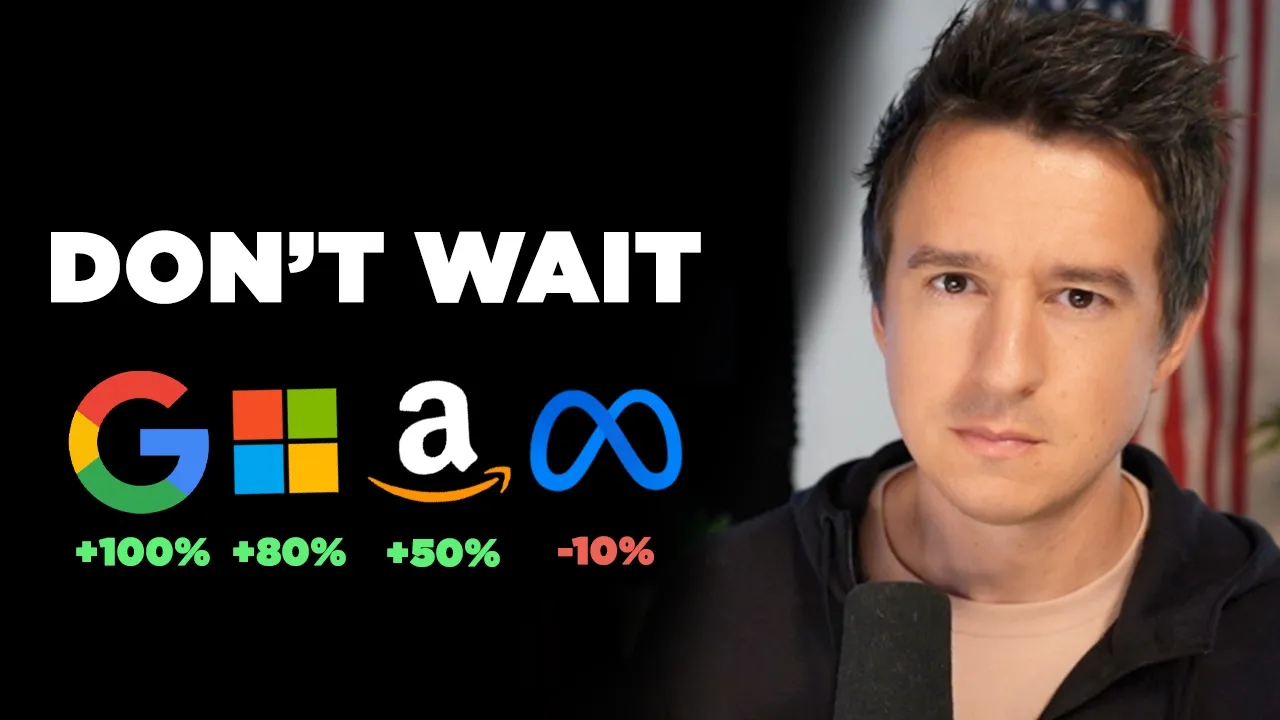
Welcome back everyone. Today on the Joseph Carlson show, we have a massive episode because this has been a huge earnings week. On Wednesday, we had Microsoft and Meta report their earnings. For Microsoft, it looked really good. Microsoft is up 15.5% on the day. It basically erased all of the losses for the year. A lot of positive momentum for Microsoft. The stock is now back above $450. So, huge earnings day for Microsoft. We'll go over the reasons why later. We have Meta, which didn't have as a favorable of an outcome. The market did not like it. Meta sold down 8% on the day, and investors seem a little confused about this one. I'll be going over in depth what's going on with Meta as well. Then, of course, we have on Thursday, Amazon reporting earnings. Not only did it run up 4% on the day, but now it's ran up another 9% following the earnings. Amazon raced back up from the 230s to $257. incredible run by Amazon. So, we have two big companies, Microsoft and Amazon moving up. And then, of course, we have Apple. This is the only of the group that I don't own. Uh, this one looks like it's it's down a bit after earnings. Apple's down 6 12%. Now, with these four massive companies, there's always a lot of opinions on these stocks and the direction they should trade, but I believe a lot of investors are missing out on the bigger picture. And we're going to outline the trend that I see with these big capex spending companies. We also have a viral interview. This is from someone named Ed who goes on to CNBC and shares his opinion which is a bearish take on Meta. And right from the beginning of the interview, he seems to be disgusted with all the questions and even somewhat upset that he's on CNBC to begin with. So I'll be reacting to many of the bearish points that he brings up in this interview. And then in today's fail of the week, we have Leopold Ashen Brener, who is the young prodigy running a $20 billion hedge fund. Well, he was until it all came unraveling. We'll be going over the demise of his hedge fund in the fail of the week. Now, to start things off, we'll be going over the biggest companies that reported earnings this week. Of course, we had Meta and Microsoft start things off, and then we just had Amazon and Apple report earnings as well. I own all of these companies, but Apple. So, I'm big time into Meta, into Amazon, and into Microsoft. In fact, if we look at my portfolio, we can take a look at these positions. Here's a passive income portfolio of which I have Meta as a large position. Now, Meta is down on the day. It was down 8%. It was the only one to really have a big drop. So, I'm down 22% on my Meta position, $38,000 into the red, and I just bought an additional $4,000 of this company. So, I'm actively buying Meta at this price, and I'll be going over why I'm buying more of it. But I also am a big investor in Microsoft. Microsoft is in the passive income portfolio, a $73,000 position with $31,000 in the green. I own even more Microsoft in the Story Fund. Another $22,000 with another $10,000 in the green. So, my combined Microsoft positions about 90 grand with over $40,000 in gains. It is a fairly large position and it's had a nice boost today. But, I'm also big into Amazon. It's a $170,000 position and when the market opens, this will move up another $16,000 in the green. The other company that I should mention, even though it didn't report earnings, is Google. Google's a company that I have in both the passive income account and the story fund. In the story fund, it's $80,000, 50,000 in gains. In the passive income portfolio, it's a bigger position, $120,000 with $54,000 in gains. So, it's around a $200,000 position with $110,000 in gains. Google is also a massive position. It's my biggest one today. Now, the reason that I mention Google and lump it in with these companies is because these are the big capex vendors. Google, Microsoft, Meta, and Amazon. These are the companies spending on all the AI data center. They're the one fueling all of this AI wave. And for weeks now, I have been saying that I think the market will eventually realize the value of this capex spend. I've also been arguing that while it's important to have a leg into the semiconductor category, I own ASML. I believe it's risky to have your portfolio concentrated into that category because a lot of those companies are more commodity-like and they're more scarcitydriven. A lot of the volume they're getting is one-time scarcitydriven volume and the companies supplying this volume and all of the demand for them are these big capex vendors. But the market has been very skeptical of these big tech companies. When you tune in to the pundits on CNBC, you'll hear them say, "Ah, I don't know how much they're going to raise their capex like it's a big problem." Well, while other investors have looked at this as a big problem, I've continued to see it as a huge opportunity. These companies are spending so much on capex so that they can control a massive market, an entire infrastructure layer, of which they'll be the demand aggregators for. And we've seen the outcome of this over time. I argued for Google for over a year that this company was worth owning on the back of its earnings reports that were repeatedly excellent earnings reports. It was all in the numbers. Google was just an incredible company that the market was undervaluing. And as we saw the earnings reports get released quarter after quarter where they put up astounding numbers where all of the bears slowly got their concerns dismissed and beaten down by the data, we saw Google's stock starting to rise. Even the biggest skeptics of Google's capex spend were more increasingly convinced that it may not be so bad. And then over time it went from not being so bad to actually being good. Google's capex spend is growing a massive profitable business with massive distribution. The market raced up with Google valuing the company from a 15 PE to a 25. The stock went up over 100%. It has been an incredible winner. So Google was the first of these capex spenders to have its value realized by the market. Then just this week we had two more follow suit. We have Microsoft which for this entire year investors have been looking at it extremely skeptically worried about how much it's going to spend on capex. Worried if these bets are going to pay off, worried if it's going to be profitable. Microsoft fell 17% year to date. The stock was going down while the rest of the market's going up. And then in a single day with this report, investors have changed their mind. We look at Microsoft's report and their earnings per share grew way above expectations. They beat their EPS estimate by 13%. They beat their revenue estimate. Microsoft also did more than that. They prove that their capex spend is yielding positive results with the rest of their business lines, that they're monetizing AI well, that they have an incredible amount of demand, that it's helping all their other products, that it's making them sell their bundle easier. They're actually gaining a lot of AI users in their bundle, using their products throughout the Fortune 500 companies. Microsoft just proved to investors that this capex spend is a good thing. Now, that investors seemingly changed their mind overnight by an earnings report. They've priced the stock up 15 and a.5% in a single day. Now, to give that some perspective, Microsoft is a 3.4 trillion company, and it's moving like it's a penny stock. 15% swings in a single day after an earnings report that showed investors something that they should have already known, that this capex is going to yield positive returns. And then we had Amazon the very next day. Again, investors in Amazon have been skeptical of the capex the entire way. They go, "Oh, well, there's there's reason to believe that they can monetize it. They've done that previously with AWS, but the amount that they're spending on capex is a lot. And I don't know when Amazon's ever going to print any money. That's the claim that Bears have been making on Amazon for some time." And then Amazon reports their earnings. Now, we can't really look at the EPS number. A lot of that is equity stakes. So, that's something that we'll ignore for now. But Amazon organically beat on their earnings per share. More importantly, they beat on their revenue. And AWS, that whole cloud thing, the thing they're spending all that capex money on, it grew by 37%. That's $42 billion in a quarter, not in the trilling 12 months. AWS is a behemoth. Not only did it grow above expectations, far above expectations, but it grew while becoming more profitable. Margins are moving up for AWS. And Amazon signal that they have so much demand that demand keeps continuing to increase. In fact, even looking out as far as 2028, they already have order fulfillment that increases in demand two years out. This is Amazon signaling to the market that they've struck gold, that they have one of the best businesses in the world, and they're restating that once again with numbers that are almost incomprehensible. And like you'd expect, the market suddenly changed its mind. Seemingly overnight, investors got real bullish on Amazon. We have the stock up 4% on the day and then another 10% after hours. Investors are once again looking at this and going, "Huh, maybe all that capex spend isn't so bad after all." So, if we're keeping track of the score here, we have four major capex spenders, of which I'm invested in all. The first one was Google with the market confused about Google, but suddenly coming around to it over the past year. Then, we had Microsoft. The market was iffy about that one and all the capex they're spending. Now, the market's really coming around to it. Then, of course, we had Amazon. The market again was questioning the big capex spend. Now, the market's coming around to it. And the last one, the biggest hold out today is Meta. And I believe it's only a matter of time until Meta gets its turn. In fact, when I look at Meta's uh results so far in the way this stock is trading, I'm in the red on this company, but I've not been the slightest bit discouraged. I don't feel any negative sentiment or shift in my opinion on Meta at all. In fact, I believe that the earnings results this week were quite good. I think they're deserving of a more valuable company. I believe investors should be viewing Meta more valuable today than it was a week ago or months ago. I do understand that Meta has some differences than the other three companies. The other three companies have a public cloud hosting business. So, they host websites of other companies and other apps. Meta doesn't really do that. So the market is taking its time to get around to meta and I understand that and I believe it will take more time. But I think the market is going to eventually get to a place where once again just like Google, just like Microsoft, just like Amazon, it comes around to believing fully in Meta's capex spend. I think we'll get there eventually. The reason why is because when we look at Meta's results, they missed on their earnings per share big time. This was a 14% miss, but they beat slightly on their revenue. Now, in some cases, earnings per share misses like Metas are a sign of a declining or troubled business. The business is going down, and the earnings per share reflect that. But there's also cases where that's that's not what's happening. And I believe that's the case today with Meta. It is true that Meta missed on their earnings per share. But if we look at the actual reason that Meta missed its earnings per share, it gives a far more favorable view of the picture. The big reason that Meta missed on its EPS was right here in their earnings report. They say cost and expenses. The total costs were 42 billion, a 55 yearover-year increase. Much of this was priced in, but what was not priced in with these earnings per share estimates was a $2.4 billion charges related to legal proceedings. They basically paid out a lawsuit. So, they got a lawsuit payout off of their books. That was $2.4 billion. That's a significant portion of the EPS miss. Then we look at another portion of it. $1.18 billion of severance expenses in connection with the May 2026 headcount reduction. So because they laid off roughly 10% of their workforce, they have to pay out severance. That was another thing that hit their earnings per share dramatically this year that was not previously modeled in. The other part that hit their earnings per share was their capex spend. Capex is being depreciated all the time and they increased the schedule of the depreciation faster than comparable companies like Amazon. Now you can guess of why they did that or Meta could just be a bit more conservative in their depreciation of assets. But when these three factors are taken out, their earnings per share were in line. The earnings per share were fine. Then when we look at the other aspects of the business, every part of Meta is growing. For example, the revenue grew to $60.8 billion. That's a 28% increase year-over-year. That means they went from like 45 46 billion to 60. That's an insane amount of revenue, especially for a company this size. We also have the fact that last quarter Meta reported a reduction in their family of daily active users, which means there's just fewer people using their apps. Like they're going into decline. Remember all the articles saying that Meta was in decline, that fewer people are using it. We saw these articles plastered all over the web. I remember, in fact, I remember a lot of news stories written about the peak of social media, how it's now on a decline. We had it from A16Z's blog, Peak Social Media. This was passed all around social media giving people the impression that Meta's business was in decline. Here's another first. Meta's daily active users declined for the first time. Many people extrapolated this decline to say, "Oh, it's social media just, you know, it's it's over. All of it's going to go down." Many other blogs, many news outlets with seething rage for Meta posted articles like this. From the Verge, they say right in the headline, "Meta lost 20 million users last quarter." They also went on to accuse Meta of obfiscating their data, saying, "Oh, this is all an attempt to trick investors, to obscure what's really going on with the leading social media platform." Really, what Meta did was incredibly transparent. They said their numbers declined temporarily because of outages in Iran and Russia. They said that it would likely go up next quarter. Well, the numbers declined and then the next quarter, the numbers went back up, exactly like Meta said. Exactly like the management said in this earnings report. Meta's daily active users reached 3.6 billion users, which is not only more than it was last quarter after the decline, but it's more than the previous all-time high of 3.58 billion. So, Meta reached an allnew high. I guess we're not at the peak of social media, and I guess management wasn't being so deceptive or obscure. Now, we're going to see the verge to a follow-up article saying, "Hey, we were wrong. Actually, Meta Management was quite truthful and transparent." Well, I won't hold my breath. So, to really break down Meta's results, this is how bad things are. This is the reason the stock sold down 8%. They grew their revenue by 27%. The revenue was healthy growth. Engagement increased. The amount of users hit an all-time high. The engagement on virtually every application is at an all-time high. Even ones as old as Facebook are having 10% increases in the amount of people watching video footage on it. That's faster than most streaming programs are increasing engagement. Meta is leveraging every part of their ecosystem and implementing AI. Their earnings call is just statement after statement about how they they have more people using it, more businesses using it. They're uploading more ad campaigns. They're getting a higher ROI. They're helping people use their features easier and easier. Meta wants to make it so that you can actually create a business within the Meta ecosystem without even using anything else. They're making that platform that well-rounded. Meta added on more ad revenue than any single company on planet Earth, including Google, in the last quarter. That's how fast it's growing. the earnings per share fell short because of one-time tax hits and one-time employee expenses. These are non-commonly reoccurring things. So, Meta is one of the best companies in the world and one of the best situations in the world that gave one of the best reports in the world that fell 8%. Right now, the market has qualms about Meta's goal to build super intelligence to continue on their voyage of building AI. There's a lot of people that are actually very skeptical of if that AI is even helping their business in its current form. One of those people that just went on to CNBC to share his bearishness on Meta is Ed Zitron. We can already see that Ed's not pleased with what's going on with Meta here. Let's go ahead and listen to some of this. >> I think it all exists to distract from the fact that Meta will not disclose its AI revenues or show any kind of return on investment for its AI. Mark Zuckerberg wants us to talk about Meta in terms of super intelligence so that we don't think about the fact that he's making boring also rand large language bubbles that do basically the same things as everyone else. >> I don't think so, too. >> I'm not sure. you know, when you say break out specifically their revenues, I'm curious as to what you mean by that. We do know that their core business seems to have been powered to a certain extent to a new level of profitability, though they're spending so much you're not seeing that um as a result of AI being added so often to their various products. What would you look for when you say, I want AI broken out as its own revenue source? Well, you are conflating the idea that their revenues continue to grow and they're also spending money on AI and those two things being related. Meta has not said that. They have buried in two blogs that they've seen incremental singledigit percentage engagement increases, but they will not speak in direct dollar terms about what AI has done for them. >> Did I just hear that right? I I just want to rewind one part of this to make sure I heard Ed right here. Well, you are conflating the idea that their revenues continue to grow and they're also spending money on AI and those two things being related. Meta has not said that. >> So, he claims outright that Meta has not said that AI is helping out their growth. He just said that which is a demonstrably false statement. It's completely completely false from their last earnings report. And I'll read this verbatim. This is a direct quote from the earnings report from Mark Zuckerberg. In dollar terms, our advertising business is reporting year-over-year revenue growth faster than any other company's advertising segment. Therefore, these AI investments are already paying off. Uh he he literally just tied those two things together in the report saying the reason their advertising is growing so fast is a direct result of their AI. The CFO of the company also went on extensively in the earnings report to outline that all the AIdriven improvements they've done to their service is directly resulting in more revenue. So I don't know what you're talking about Ed. They have tied these things together directly many times. It's very clear AI is driving growth for Meta. The only thing they haven't done is attached an exact dollar amount to that value created. >> Engagement increases, but they will not speak in direct dollar terms about what AI has done for them. Well, AI is helping, but they won't say exactly how much AI is helping. Well, part of the problem here is it would be nearly impossible to realistically break out the exact dollar figure that AI is enhancing Meta as a company. You could try to segment every single AI feature and attach a dollar amount to that. But a lot of these features simply just improve the product. For example, take YouTube as a product that AI has enhanced. YouTube has an ask button that you can summarize videos. How much is that increasing YouTube's revenue? We don't really know. YouTube's not breaking that out. Some analysts say that it actually may reduce revenue. Some may actually may make the moat better for YouTube and people like the product more. There's also AI assistance in the upload features, makes it a little bit easier to upload videos. How do you attach an exact dollar amount to that? A lot of these features have indirect effects over long periods of time that would be very difficult to break out in any realistic way. Now, the other aspect that I would point out here is that Ed's argument is self-defeating on the surface as a bare case for meta. Because if it was hypothetically true, which it's not, but let's pretend it was true, that the AI spend was not related to the revenue growth of Meta, the Meta's revenue was just growing all on its own without any of this AI spend. All that would prove is that Meta has the most spectacular core business in the history of humankind, that the revenue is growing 28% all on its own without any of this extra spend. And it would prove that all this extra spend is completely optional and discretionary that they could discontinue at any time and still have the growth of the core business. That should be more exciting for investors. That should be more of a reason to get behind the stock. If it's required that they spend some on AI to accomplish this growth, that's actually a less attractive situation. So even in your worst case scenario for Meta that you're asserting these things aren't related, that actually paints a better picture for the company. Now, aside from the specific points that people like Ed and the other skeptics of Meta bring up, the point here is that they're still not convinced and many people are still uncomfortable with the sheer scale of the capex spend that Meta is doing when they don't have their own cloud hosting business like the other three big hyperscalers. And that's fine. I think it will take time. I can be patient with Meta. I can afford to be patient with this company. I don't have any leverage and I have a lot of time to wait. But I strongly believe that this one, like the rest, will have its day. It'll have its time where it goes up significantly in a single day because suddenly they proved that there's a strong ROI on their capex spend. Investors will get behind it just like they did with Google, just like they're doing with Microsoft and Amazon. Eventually, it will be Meta's turn. And that's why I invested another $4,000 into the stock today. So, as we wait our turn with Meta, we can look intrinsically on what's going on with the business operations of these companies. Every one of them, as far as I can tell, looking through the earnings reports, listening to the calls, they're all becoming worth more intrinsically, it's very clear to anybody looking at the actual numbers, these companies are gaining customers. They're growing revenue organically. Operating margins are moving up. They're expanding. They have backlogs. Customers in line, and they sit in the most centrally important part of the entire ecosystem. They're the entire distribution layer of all of AI. Investors should be far happier this week after these earnings report than before it. Now, outside of that, we have Apple, which sits in a different category. Apple has not invested into the capex. It's fine sitting there in the distribution layer. Apple reported a beat on both accounts, but there's a small disappointment with the earnings. The stock is down 6%. Investors were concerned about soft guidance, some supply chain issues. These are run-of-the-mill issues. Nothing that I see intrinsically concerning about Apple. I think the company's fine. So, I don't own Apple right now, but this would not concern me at all to see this earnings report. Overall, Apple's report was fine. Now, moving on, we get to the fail of the week, which in this case is Leopold Ashen Brener, the prodigy, the one that foresaw the AI revolution perhaps before anyone else. Now, this is a story like you would expect many of these people that are talked up to be uh basically profit figures like they can see the future. uh this one in particular, Leopold, he elevated himself in this category by his messianic tone. He talked about things like he could foresee the future and only a few would follow him. Only a few were aware. Now, part of the problem we see with young, successful, intelligent people like Leopold is with all that intelligence. With all that success comes a great deal of pride and a great deal of pretentiousness and in this case, an extreme amount of hubris. Liupold wrote in ways that just screamed that he knew something that no one else did. He he he acted as though again he was a prophetic figure. Here's something that he wrote back in 2024 called situational awareness the decade ahead. And as you go through this, it's not just the tone of what he writes, but it's also the the exact writing itself. His fund that he ran is called situational awareness, which is an interesting name, and he references the name of it all the time. Let's look at one such reference. He says, "Before long, the world will wake up, but right now there are perhaps a few hundred people, most of them in San Francisco, the AI labs, they have situational awareness, and that's italicized. Just make sure that you're aware that that's actually the name of his fund and the name of this article." It's like that thing where people say the title of a movie in the movie itself. You're seeing that here in his article. So, you have to have situational awareness. And according to Leopold, there's only a couple people on planet Earth that have this. Through whatever peculiar forces of fate, I have found myself amongst them. The peculiar forces of fate he finds himself amongst these few chosen elite people. A few years ago, these people were decrieded as crazy, but they trusted the trend lines, which allowed them to correctly predict the AI advances for the past few years. Whether these people were also right about the next few years remains to be seen. But these are very smart people, the smartest people I have ever met. Now, keep in mind, he was 22 years old when he wrote this. So, he's saying, "These are the the smart people, the smartest people I have ever met. In all 22 years of my life, these are the smartest people I've ever met, and they're the ones building this technology." Perhaps they'll be an odd footnote in history. Or perhaps they will go down in history as Seard and Oppenheimer and Teller. So just to be clear here, he just compared a group of West Coast software developers with theoretical physicists that broke the atom in half and created a nuclear bomb. That's what is what he just did here. Okay. So you get you get this sense from that. But this is not just some weird excerpt either. like we can look all throughout his writings of how he views himself and the people that he's around. In another part of this, he goes on about how nobody's pricing this in accurately with all of his market experience of being 22 years old. Apparently, he knows how to price in once in a-lifetime changes into the market with an appropriate portfolio. We'll have more on that later, but he said in this in 2022, quote, "Even now, barely anyone is pricing all this in, but situational awareness on AI isn't actually all that hard." See, it's not that hard. Barely anybody knows how to price all this in, but Leopold does. Uh, well, it turns out that he didn't. Um, it was a bit harder to accurately price all this in because what Leopold ended up doing was taking his fund, growing it to a massive extent, levering up with a concentrated bet on a few bottleneck companies, uh, AI companies. This worked until it didn't. The fund that he ran held discussions with existing investors and lenders in recent days seeking to raise new capital. This marks a powerful reversal for situational awareness which posted meteoric returns in the first half of the year. Several people familiar with the matter said that situational awareness had used borrowing to magnify its returns. Oh no, they levered up on a lot of stocks that went south fast. It's a popular hedge fund strategy that also amplifies the losses in a downturn. Now, that's odd because the normal people like you and I, we don't have god-like abilities. We're not uh prophets that can see the future like Leopold here. We mere mortals. Most of us had the situational awareness to understand that concentrating your portfolio into a couple companies and then using a huge amount of leverage was incredibly dangerous and often leads to things imploding. Even us mere mortals had the situational awareness for that. But apparently, the great Leopold did not. The once high-flying AI focused hedge fund sold the bulk of its stock portfolio to Ken Griffin after suffering deep losses and it marks the sudden downfall for situational. So there we have a story that we've seen a million times over. It's the same thing that's played out in so many cases, but we see it once again with situational awareness. Pride comes before the fall. People that exhibit great hubris in their strategies, believing that they can make no wrong and that they can see the future and nobody else has the same insights that they do, leads them to do incredibly dumb things, like taking risks they don't need to take. Concentrating into a few positions of high-flying companies based off of scarcity and then using leverage to enhance their gains. This is investing 101. All of us know it, but we see one more example today. That's it for this episode. Hope you enjoyed. See you in the next one.
Comments 0
Sign in to join the discussion.
Sign inNo comments yet. Be the first to share your thoughts!