
- Video return
- -1.63%
- Calls
- 2
- Buy / Sell
- 2 0
- Published
Recommendations
Entry is the asset's closing price on the publication date. Current is the last close on record.
-
Entry $63.13 04 Aug 2026Current $62.99 07 Aug 2026Result −$0.15
I think AIQ is the winner
Context "I think AIQ is the winner, but you can't lose going with the others."
-
Entry $30.27 04 Aug 2026Current $30.19 07 Aug 2026Result −$0.09
you can say I want to own either one. You can use AIQ, which is one I like the most, chat or AIPO
Context "you can say I want to own either one. You can use AIQ, which is one I like the most, chat or AIPO."
Full Transcript
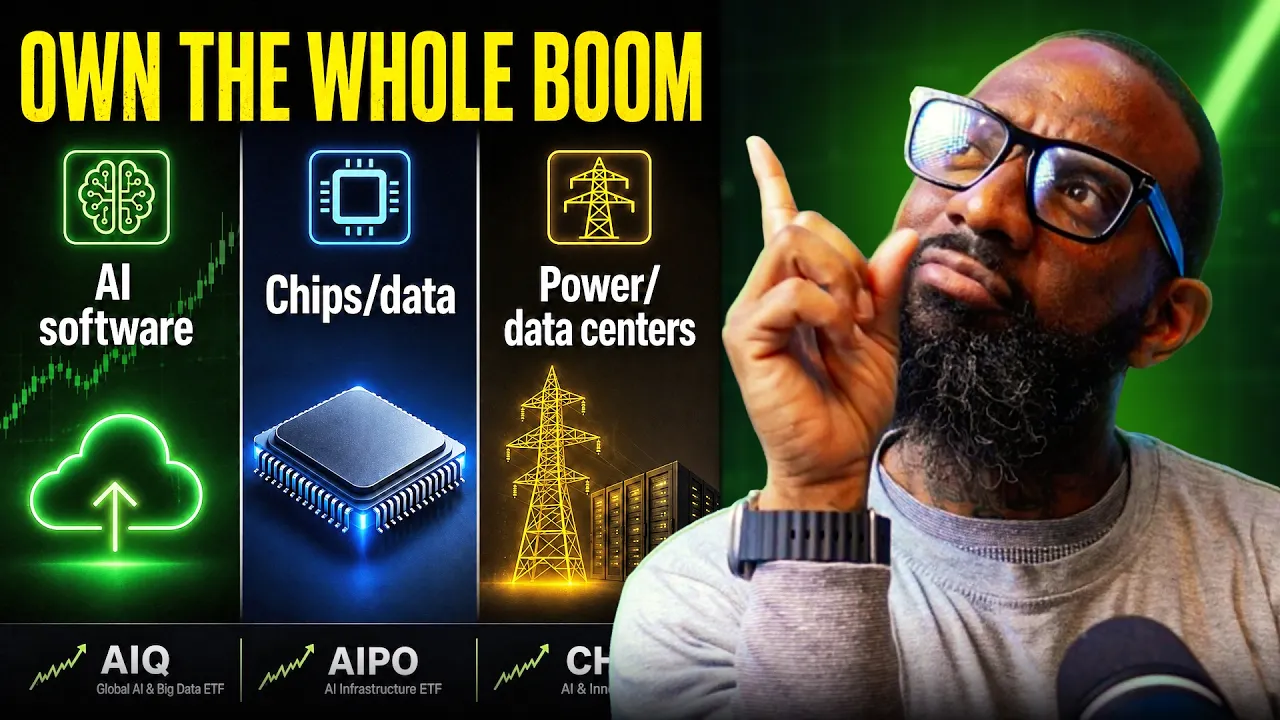
You type one question in chat GPT and maybe you ask it to write an email, summarize a report, create an image, analyze a company, or help you build a business. A few seconds later, the answer appears and it be happens so quickly that most people never think about everything that has to happen behind the scenes for that answer to come. First, somebody has to build an artificial intelligence model. The software has to understand your question and advanced chips has to process it. Memory had to move enormous amounts of data to go back and forth to get it. Network equipment had to connect thousands of servers. Servers and storage system had to preserve the data. Cooling equipment had to cool the machines down. And somewhere behind it all, a power plant had to generate enough electricity to keep the entire system together. That means artificial intelligence is not one stock, not one company, not one industry, it's an entire economy. And so today, what I want to do is break down three companies, matter of fact, three ETFs that I think you should look at that help us look at the whole AI stack. And they're all separated. They all different. On the surface, they may look the same, but as we dig into it, it'll definitely help you, you know, get access to different layers of the AI stack, especially what I believe with AI is back on the rise. So, it's your boy the Wall Street Trap, but make sure you like, subscribe, and share this content out. Help us get to 2,000 likes, y'all. Could that help this video really, really, really get into the algorithm and help this page grow? Let's go. Now, the three ETFs we're going to talk about look the same on the surface, but I promise you they're all different. So, one actively identifies the biggest winners in generative AI and then another one act identifies the electricity in the AI. And so, we'll talk about the last one, but they give you a lazy conversation. So the real question is which part of artificial intelligence economy that you want to own because one firm may perform better and when semiconductors are leading another may do better when um software is leading and another may thrive when power and data centers are leading. And so by the end of this video, you will truly understand exactly which ETF is and how they come down and what are the fees you paying because we're also going to see where the funds overlap because the risk comes with each one of them and they you don't understand them, right? And you just think you owning AI. It's like buying part of a building without knowing whether you purchase the penthouse or the general room, the electrical system, the land underneath. type. Let's start with you the first one which is AIQ which is one of my favorite ones. So this is a broad AI economy ETF. So AIQ is under global artificial intelligence ETF, right? And the easy way to think about AIQ is you're not trying to predict one. You're trying to buy the whole expansion of artificial intelligence and big data. And so the fund tracks the big data centers who make the rules, right? And so I think as of August of this year, which is to, you know, early this year, they had like 9.7 like billion dollars under management with the expense ratio of 0.68, which means for every $10,000 you invest, you only pay $60 and $68 in fees. And you'll make that up inside of the fund. Now, it's common when more specialized thematic ETFs. Now, here's what makes AIQ like good. They not just Nvidia. It's not just semiconductor. It's not just software. AIQ owns every business involved in the AI cloud computing, the data analytics, the cyber security, the internet platforms, the semiconductors, the enterprise software, consumer applications, and the hallway required to process large amounts of data. That makes it the broadest AI interpretation of the three funds. And so they have large positions at Microsoft, Amazon, Oracle, Alphabet, Cisco, and Netflix, right? A lot of the kum assuming discretionary. And some of you may think that I'm saying trap, why does Netflix have to do with artificial intelligence? And that's exactly where understanding the fund matters. Right? So AIQ is not only looking for companies selling AI products, it's also own companies using AI to build data analysis, an important part of the operation. So think about Netflix uses data for you know machine learning for content purposes. Amazon uses for am for retail. Tesla uses for software and Cisco provides network and technology required to move information through data centers and enterprise systems. So AIQ's definition of artificial intelligence is it can be strength but it also can be weakness. So here's the strength. You're not dependent on one single area of AI to win. If the chips go down but the enterprise software accelerates, AIQ could benefit. Check. If one company loses leadership but another couple rises, the index rebalance. Check. And if AI growth expands outside of the United States, AIQ has the freedom to own companies in other countries. Check. So it's official like the materials specifically describe the strategy of this AI ETF and the international exposure really matters because AI economy is not limited to Silicon Valley. South Korea, Taiwan, China all have different levels and the Netherlands has companies connected. Japan plays an important role across all equipment and automation electronics. So when you buy AIQ, you're buying broader global thesis as well. You're saying I believe in artificial intelligence would expand across multiple industries and countries. And I don't know who the winner is today, but I know it's going to win. And it may give you, you know, exposure not to one company, but to the whole thing. And because its largest holdings are in the NASDAQ and S&P and other technology funds, you can accidentally own more of the same companies than you realize. So let's say you own QQQ, then you buy AIQ. You own now Amazon, Alphabet, Palanteer. And you may think the full separate investments, but understand on the surface like it's the same. And so this is not necessarily wrong, but it is intentional. And so now AIQ's recent performance has been strong in 2026, probably up 49%. But the fund warns that past performance doesn't equate to future performance. So when investors see 49% and 50% or 100% returns, they're often going to assume they've discovered an investment that will continue to do the same thing year after year. And that's really not how the market works. And so I just want you to understand when it comes to AIQ, it can be one of those viewed as a shortcut to guarantee returns, but it's not. It should be viewed as a diversified vehicle to help you as an investor get more access and exposure to AI. And so AIQ is for the investor that believes I do not have to pick the right stock. I just need to be in the industry. So that's good. Then the second one is uh a ETF called chat ch. This is the generative AI stock picker ch it is around heel which is a fun generative AI and technology ETF. And the biggest difference between chat and AIQ is not the companies, it's the strategy. Now AIQ tracks the index. Chat is actively managed, right? That means the investment committee makes decisions about which companies belong in the portfolio and how much of each company that you own and when to reduce a position and when new opportunity raises capital or needs capital. Then chat will make that investment. The ETF started in 2023 has a 0.75 expense ratio. So that means you'll pay about $75 for every $10,000 invested. But the fee reduces the return that ultimately makes investors rich. Now why would somebody pay more for actively managed ETF? Well, because the entire artificial intelligence is moving fast. And think about how quickly the conversation changed. One year everybody focused on language model LLM. The next everybody's focused on tower. Um they focus on interface and then aentic AI then AI infrastructure then memory then custom chips then power and then robotics and then they keep saying you know all the autonomous vehicles and the leaders in AI change fast and that argument behind every active management is can you change the times a portfolio manager can respond sooner and they can increase company where businesses are becoming stronger they can also reduce exposure when the thesis starts deteriorate. They can move toward a new part of AI when others aren't. That flexibility can be valuable, but a actively managed ETF also introduce you to new risk. The manager can be wrong. The index does not have an ego. The index follows the rules and the active manager can become too confident in the stock and sell a winner too early or hold a loser too long and misunderstand which technology is about to be dominant and which one is about to be dominant. So when you buy chat CHT, you're not only betting on AI, you're betting that the investment committee can get it right. And as of August this year, they got Nebulus, Seagate, Astri Labs, Nvidia, and more. And that tells you immediately that chat is more than the concentrated like AI Q is broad. Chat is trying to be intentional. And looking at the holdings with Nvidia gives you a GPUs. SK Highness and Micron gives you memory. Alphabet gives you cloud model search and AI applications and AMD gives you CPUs and AI accelerator. Broadcom gives you networking and custom silicon. Astria Labs helps you connect companies inside high performance. Samsung gives you memory and semiconductors. So this portfolio is designed around companies much closer to the core of generative AI buildout. So when chat works, it can work aggressively. No, as of July 2026, it was up 108%. So, not mad at that. And if 108% gets attention, it makes people feel late. You know, they create fear of missing out and then they wind up becoming a new investor that believes in AI, but when you chase it, it kind of don't double. Now, the same concentration can help the fundraiser can actually hurt them. So, chat owns companies connected to one of the most exciting areas of the market. and also one of the most fragile. So because their earnings, you know, can be strong or not strong, then the business can grow and disappoint and it just get a lot of noise. So I'm truly not mad at you for owning CHAT, but I do like AIQ better, but you can't deny 108% return. I mean, it kind of offers more direct generative AI exposure if that's what you're looking for. When I think about it, I say chat is for the investor who says I don't simply want to be broad technology exposure. I want to own companies directly connected to generative AI. And so that may appeal to somebody who believes that a winning portfolio must change as technology changes. But it is probably not the best fit for somebody who can tolerate short downturns. And now we have to discuss the broadbased economy. We have to discuss generative AI and the companies building the intelligence. Now, artificial intelligence cannot run on intelligence alone. It needs electricity. And that brings up AIO. That's right. The power behind AI. Now, AIPO is the defiance of AI and power infrastructure ETF. And the fund is making a very different bet. It's betting that the greatest companies in the world, artificial intelligence, they're not shown. They're not even chips. It's physical electricity. that's required power, cooling, electrical equipment, grid infrastructure, data center construction, energy generation, and lastly, networking. Let's break this down. In 2026, the company had 83 companies inside of it with nine uh 919 million in assets and re under management. And so, pretty freaking good, right? Because the company does not have an operating history, but you cannot see what it did during 2008. You cannot see what it did during the pandemic and you can't really could see how it performed during a long-term trend. You cannot see how it performed, you know, during the infrastructure. Boom. It more like strategy investing. So now look at the biggest holders inside of it. Eaton and you have GE Vernova. You have quant service which is PWR, Vertive, Broadcom, Bloom Energy, and Nvidia. These make up the top with also CEG at Constellation Energy. And so runners up are AMD and Camco, which is CCJ. This is not the standard technology ETF. It has a combination of technology, power, industrial equipment, construction, energy, and data center infrastructure. all of these surrounded in it. So I won't kind of make this one a little simple like imagine AI as a new restaurant and then the AI model here's the chef the chips are cooking equipment the software becomes the recipe but AIO owns more than the kitchen around the chef it own electricity the refrigeration the plumbing like the ventilation the construction the backup systems like even the building itself like because the best chef on earth cannot serve one meal without infrastructure. So let's break down a few of the holdings. So Eaton makes the electrical um management equipment as data center exposure. They need systems to distribute power. GV vernova they provide power generation in the grid like quant services. They build out and maintain electrical and energy infrastructure. And then you have verdictive for the cooling and power. And you have constellation energy which gives exposure to nuclear power. Camco which provides exposure and uranium. And then Bloom Energy which is fuel cell systems. Nvidia and AMD give the portfolio direct semiconductor exposure and Broadcom brings up networking and custom chips. So it's not betting on one AI it's betting that the physical strain of AI is betting on computing data center electricity and electricity means more equipment. And so this is the chain and this fund is attempting to own companies that benefit from the chain. Now here's the strength in AIP. You don't need to predict whether chat Gemini claw another platform becomes dominant. Regardless of which one wins, the industry still needs what? Power. Regardless of which chip company gains market share, data center still needs what? Cooling. And regardless of which cloud provider becomes number one, the building still need what? Electrical equipment. And so AIPO lets investors go beneath the software and invest in the physical thing. But there are risks because Wall Street identifies bottlenecks. And investors can rush into companies trying to solve it. And a great business can still become a bad investment if the price becomes too expensive. And second is capital spending. AIPO benefits when the hypers scale is up spending up a lot of money. And to me I think the third risk is none other than interest rates. So large infrastructure can need buying financing and the more you finance that dips into the margin. So that can kind of expose what's going on here. So even though the fund owns 83 companies the top ones carry the weight. So eaten GEVO 89% quant Vera. So AIPO is for the vest investor who says I believe power and physical infrastructure can become the most important bottleneck in artificial intelligence. It's not about the technology fund. It's a pix and shovel fund during a gold rush. Sometimes the companies selling the tools make more consistent money than a company selling for gold. And so I want you to look at these companies because you don't have to own all three of them. You can say I want to own either one. You can use AIQ, which is one I like the most, chat or AIPO. And that depends on one question you're trying to solve. And that question is, how do I get broad exposure to artificial intelligence without choosing one winner? And I think AIQ is the winner, but you can't lose going with the others. So, it's your boy, the Wall Street Trapper. I hope this video helped you. And let me know in the chat which one of these companies you think is the best for your portfolio. Let us know, man. Salute.
Comments 0
Sign in to join the discussion.
Sign inNo comments yet. Be the first to share your thoughts!