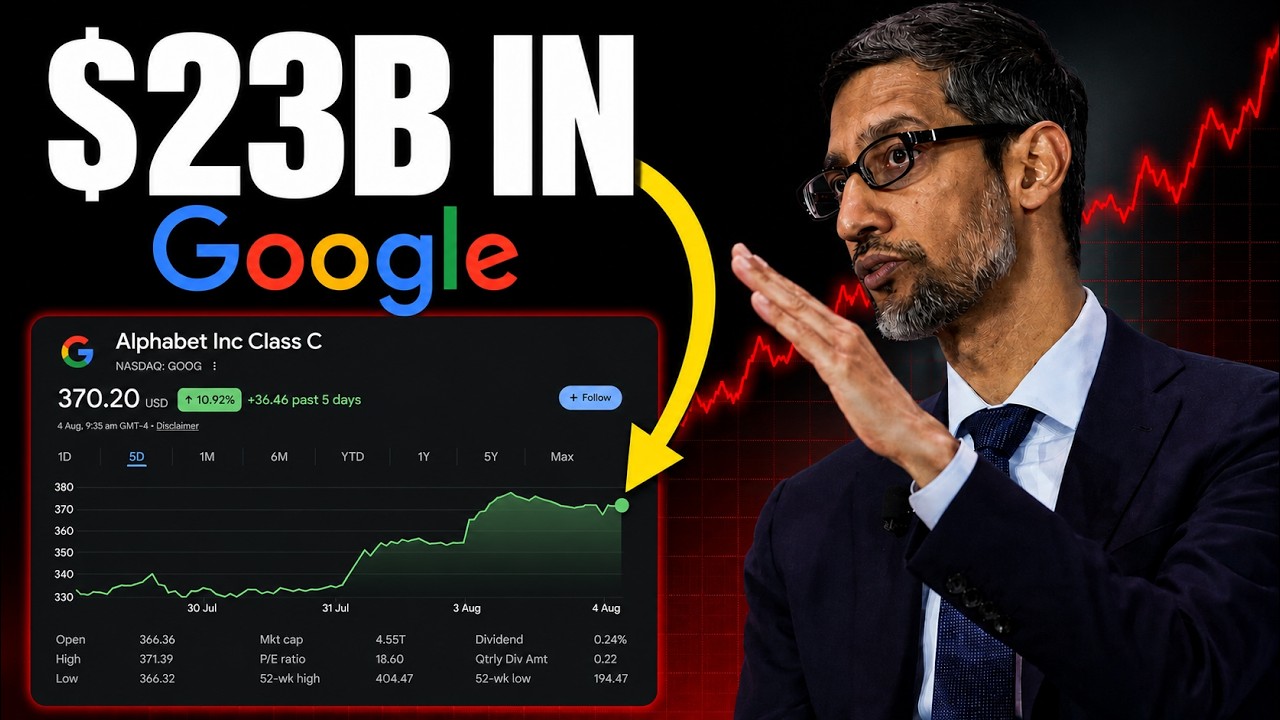
Is It Too Late To Buy Google Stock At $370 ? (Google Stock Analysis)

- Video return
- -1.29%
- Calls
- 1
- Buy / Sell
- 1 0
- Published
Recommendations
Entry is the asset's closing price on the publication date. Current is the last close on record.
-
Entry $362.43 05 Aug 2026Current $354.59 07 Aug 2026Result −$7.84
Alphabet appears remarkably inexpensive compared to its big tech peers, even at $370 per share.
Context When evaluating valuation metrics, Alphabet appears remarkably inexpensive compared to its big tech peers, even at $370 per share.
Full Transcript
Good day to you everyone. Welcome back to the channel. Today we will talk about whether it is too late to buy Google stock at $370 after its rapid rise from $320 just a week ago and why Greg Ael poured $23 billion of Berkshire Hathaway's cash into Alphabet stock. When a $4 trillion technology powerhouse moves $50 in a matter of days, retail investors naturally wonder whether the rally has run out of steam or if a broader structural rerating is underway. To evaluate whether the momentum can continue, we have to look closely at what institutional heavyweights are doing behind the scenes. Under the leadership of Greg Ael, who officially assumed the chief executive officer position at Berkshire Hathaway at the start of 2026, the Omaha based conglomerate executed its largest single technology commitment since its transformational purchase of Apple. What began as a modest $4.3 billion initial position initiated under Warren Buffett in the third quarter of 2025 quickly turned into an aggressive buying spree. Berkshire accumulated approximately $13 billion worth of class A and class C stock on the open market during the first quarter of 2026. That was followed by a negotiated $10 billion private placement deal in June where AEL secured 28.6 million shares at an average price of around $350 per share representing a 6.5% discount. This total capital deployment brought Bergkshire's total Alphabet stake to approximately $31.5 billion, making it the fifth largest holding in Bergkshire's equity portfolio at nearly 9% of total assets. Understanding why one of the most disciplined value investing institutions in financial history is deploying tens of billions of dollars into Alphabet requires looking past short-term price momentum and examining the concrete fundamental data. Hey guys, quick pause. If you have not realized, this person you are seeing here is a digital clone of me. I am making these videos in hope to bring new perspective and analysis on stocks and markets in general. So, if you like what you are hearing, do consider giving me a follow as it helps bring this video to more people. Examining Alphabet's topline performance reveals an enterprise that is expanding its historical advertising monopoly while simultaneously scaling a massive cloud infrastructure business. In recent quarterly filings, consolidated revenues reached over $96 billion, representing a 14% year-over-year increase and putting the business on a run rate toward $400 billion annually. The core engine remains Google search and related properties, which produced over $56 billion in revenue, growing at nearly 10% year-over-year despite ongoing debate surrounding artificial intelligence queries. YouTube advertising added another $9.5 billion in quarterly revenue, benefiting from strong advertiser demand across connected televisions and growing engagement on YouTube shorts. However, the standout driver of topline expansion is Google Cloud. Google Cloud revenue surged 82% year-over-year, reaching 14.8 billion for the quarter. This rapid growth demonstrates that corporate clients are rapidly deploying generative artificial intelligence applications on Google Cloud Platform utilizing proprietary Gemini models and custom tensor processing units. When comparing this growth rate to historical industry data, Google Cloud is expanding faster than both Microsoft Azure and Amazon Web Services at equivalent scale. Wall Street Consensus estimates project Alphabet's consolidated revenue to grow between 12 and 14% annually over the next 3 years, supported by enterprise cloud adoption and digital ad spending expansion. To evaluate whether $370 is an attractive entry point, we must analyze the broader industry context across digital advertising and cloud computing. Global digital advertising expenditures are projected to reach $720 billion in 2026 with Alphabet capturing a leading 38% market share. While digital ad market growth has moderated to a steady 8% annual pace, Alphabet's ecosystem across search, YouTube, Android, and maps provides a unique competitive moat that cannot easily be replicated. In the cloud infrastructure sector, total global spending is expanding at over 22% per year as enterprises modernize legacy software architectures for generative artificial intelligence workflows. While Microsoft Azure and Amazon Web Services built early advantages in general cloud migration, Alphabet's end-to-end integration from custom AI chips to foundation models has allowed it to gain market share continuously. Initial market concerns suggested that conversational AI search tools would cannibalize traditional Google search ad revenue. However, operational data indicates that AI overviews integrated into search results are increasing user search frequency and boosting advertiser conversions. To support this expanding workload, Alphabet has outlined a capital expenditure budget of 75 to $85 billion for 2026. This spending is dedicated to constructing next generation data centers, acquiring custom AI silicon, and securing long-term clean energy power purchase agreements. While high capital expenditure often concerns short-term traders, value investors view these investments as high return capital allocations that strengthen Alphabet's long-term competitive moat. A critical element of the institutional thesis is Alphabet's incredible cash conversion efficiency and expanding profit margins. Over the trailing 12 months, Alphabet generated $112 billion in operating cash flow, translating to an operating cash flow margin of 29% relative to revenue. Operating margins across the consolidated business expanded to 32% in recent quarters, reflecting operational discipline and powerful operating leverage. The most significant margin story is taking place inside Google Cloud. For years, Google Cloud operated with negative operating margins as it invested heavily in physical infrastructure and sales teams. Today, Google Cloud operating margin has expanded to 15%, generating over $2.2 billion in quarterly operating profit. This transformation converts Google Cloud from a profit drag into a major profit accelerator. Let us perform a direct calculation to illustrate the strength of Alphabet's cash flow engine. If we multiply Alphabet's projected full year 2026 revenue of $395 billion by its 29% operating cash flow margin, the result of this calculation is $114.5 billion in annual operating cash flow. This immense cash generation allows Alphabet to fully finance its $80 billion infrastructure budget out of operating cash flow while still generating tens of billions in free cash flow. Alphabet uses this excess free cash flow to execute share repurchases and pay a growing dividend. Furthermore, Alphabet's balance sheet holds over $125 billion in cash and liquid securities against modest debt, providing extraordinary balance sheet resilience. When evaluating valuation metrics, Alphabet appears remarkably inexpensive compared to its big tech peers, even at $370 per share. Alphabet currently trades at a forward price to earnings multiple of 23 times expected 2026 earnings. In comparison, Microsoft trades at a forward price to earnings multiple of 32 times. Apple trades at 29 times and Amazon trades at 31 times forward earnings. Looking at forward price to operating cash flow, Alphabet trades at 16 times forward operating cash flow. Microsoft trades at 22 times forward operating cash flow while Amazon trades at 19 times forward operating cash flow. This valuation gap exists despite Alphabet maintaining faster cloud revenue growth and higher operating margins than several of its direct competitors. Alphabet's current forward price to earnings multiple of 23 times is virtually equal to its 10-year historical median valuation of 22.5 times. If Alphabet were to trade at Microsoft's forward valuation multiple of 32 times earnings, its stock price would calculate to over $510 per share. This valuation discount explains why Greg Ael acted decisively to participate in Alphabet's $10 billion private placement at $350 per share, securing an immediate 6.5% discount to open market prices. From a fundamental valuation standpoint, Alphabet offers superior capital return metrics, pristine balance sheet safety, and dominant market positioning at a discounted multiple relative to peer technology mega caps. In conclusion, Alphabet's movement to $370 per share reflects solid operational underlying strength rather than an overextended rally. With Google Cloud revenue accelerating at 82%, annual operating cash flow exceeding $110 billion and a forward price to earnings ratio of 23 times compared to Microsoft at 32 times. The fundamental data remains extremely robust. Greg Abel's $23 billion capital allocation into Alphabet highlights institutional confidence in the company's durable mode and capital efficiency. We will continue monitoring enterprise AI spending, cloud operating margins, and regulatory developments to see how this long-term investment thesis develops. Thank you for joining me for this objective fundamental analysis today and I look forward to bringing you our next market breakdown very soon.
Comments 0
Sign in to join the discussion.
Sign inNo comments yet. Be the first to share your thoughts!