I'm still buying literally every day at this price point, but I'm still keeping my bum orders.
Full Transcript
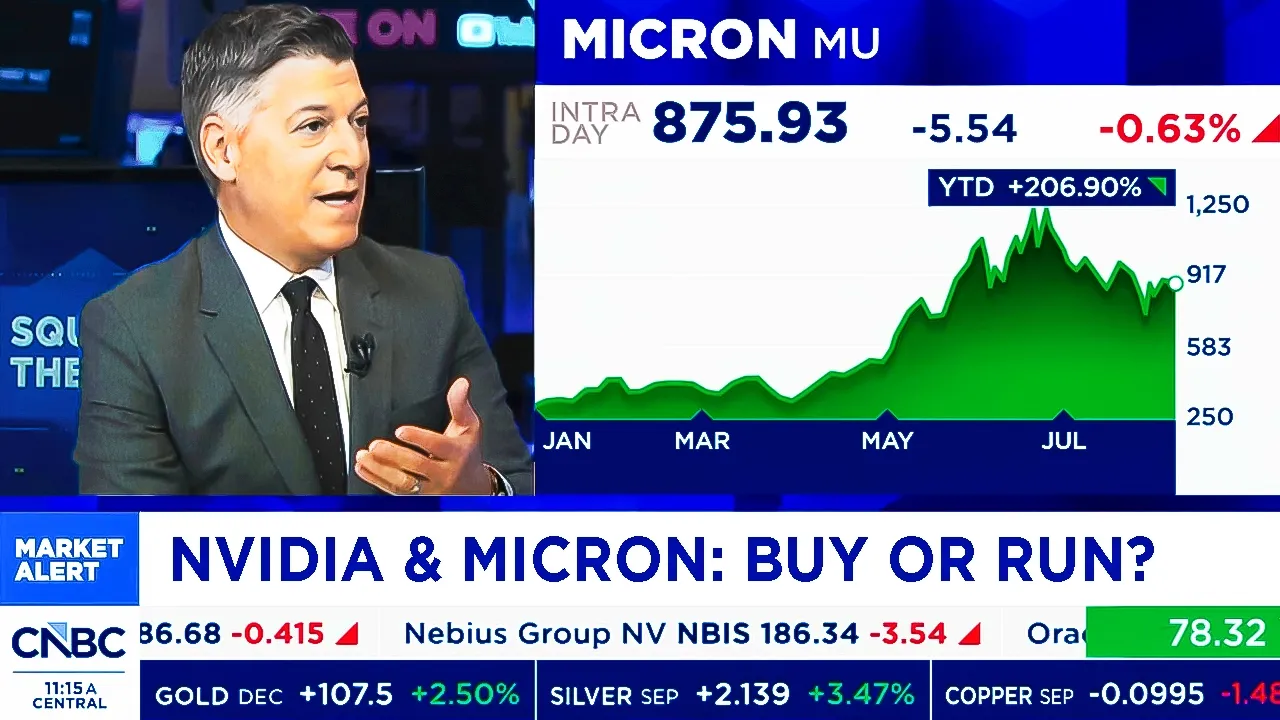
like the volatility has been such a challenge that I keep coming back to the same points which is I have to run more diversified than normal. Uh if I get to own AI semis which I think you need to um I've got to balance it with either healthcare or energy or some of the fast growing software you guys were just talking about. So to me that's the name of the game it you know how much AI semis do I own and then how do I diversify from it? Can you talk at all about, you know, the the degree of deleveraging that we we've had correlating with this bounce back in the tech trade and the AI trade and whether you think that was the moment and that was enough to really give this sector now a new lift. >> Look, I I think we're going to end up 12 months from now meaningfully higher on things like Micron and Nvidia and and the Compu trade. But there's some data that I was looking at last week and it just sometimes you look at it and you're like, "Wow." You know, um, so in 2023 there were 75 levered or inverted ETFs and there's currently 540 um 540 levered or inverted ETFs, right? >> Um, so double long Heinix or triple long Nvidia, those kind of things. And then um you know right now on the options market about 64% of all options are zero day. So you just think about those like facts about what's going on. So you know guys walking around on their phone with one day options calls on on sometimes on these same ETFs. So like that's the kind of stuff that really fuels um let's call it 100 billion plus moves in stocks um at a rate you've really never seen before. So, you know, I think some of that's behind us. Um, and maybe we'll lever and ramp at the same rate, but maybe that's healthy. Maybe we grind higher on Mike Ron and we don't rip higher and maybe that's, you know, better for um, you know, broader participation. >> Well, I mean, you did, I think, tell me the other day on on one of the programs that you think Micron's going to double from here, right? >> Yeah, I I do by the end of the cycle. Look, I mean, you know, you know, you wake up and you you see HX is going to add a lot of capacity. But like if they add a bunch in 28 and it's already a lot accounted for. Look, what's in the price is something like four times peak and 10 to 11 times normalized earnings for Micron. I think people also assume a pretty big decay in the earnings once it peaks. And what if what if it lasts longer? What if the uh decay isn't, you know, maybe it's an erosion, not an implosion? One of the things I I've been thinking about a lot recently, Scott, is is that people just only focus on the income statement. Like I just mentioned, normalize the peak earnings and not the balance sheet. Like if you're a paper boy, so you have a a bad balance a bad income statement, but you win the lottery. Uh you have a good balance sheet, right? Like the amount of money these guys are making in the next what did Micron guide this quarter like 50% uh sorry 50 billion in revenue at 86% gross margin. Like they're going to generate close to 300 billion of free cash flow in the next couple years. like the balance sheet improvements pretty good, right? So, I think they're maybe not getting credit for that part as much as people think, you know? >> And then Nvidia finally, I know it's a new position for Steph, but finally getting some love in the market. I think when Elon said they're going all when they're going when Elon says >> their massive capex at SpaceX is going all in on Nvidia, if you don't own Nvidia after that, then you're like missing the boat. So, it's nice to see the Microsofts, the Nvidias, other software type companies starting to get some love. And I think the markets like peak open AI valuations and maybe software NVIDIA are going to start ramping up and getting more attention where I think as we evolve into this AI space. I still think the LLMs ultimately get commoditized and smart software companies are where the money's made. >> Yeah, been a week to say the least for uh Nvidia. We just showed it obviously this this multi-day run better than 11% now on the week. Good enough that you bought more. >> Yeah. Like the teaser this morning. >> Oh yeah. Yeah. So Kevin's it Kevin's the one. He's the one who bought more Nvidia. I did tease it on uh on on the nine with everyone thought it was >> with CQ. So tell me why it was you. >> Everybody knew. They looked at who was on it. They're like a process of elimination but like our first one first one with the Sharpie. No. >> All right. Why? Well, they are paying a dividend now, so I think it's worth consideration. But this is the OG and it is the one stock that has continued to just >> make more and more and more money every single day, but not have the love from a share price perspective. So I made the analogy I was like in the old days from technology everyone needed electricity, you needed the internet and now it's a question where how much AI does every company need? How much are they spending? and they just go up and down the stack where they are the primary player in this space. This is not a trade. This is an investment. I could go through all of the the financials as to why we love the stock, but we bought more at 218. We're going to own it for a long time. I think the numbers are going to be great, but I wanted to get into it before earnings Scott real quickly because they tend to report so late that you get a lot of the action from all of the other players beforehand. >> We're still away, I think. Right. Aren't we the week of it's like the 26th, something like that. >> Yeah. So, your point's well taken. Just try I mean that's they are the last of the the the biggest stocks in the market to report. >> And I think the report's going to be awesome, but I think the move is going to happen beforehand. >> What do you think about the move? >> Well, I like it because obviously I just bought it for the first time ever. Um, but I will say I I own Broadcom, so I've been very pleased with that. Uh, I bought it really because of valuation. You know, it's trading at a valuation that they haven't seen since 2019 at 18 times. It's actually cheaper than Colgate or Hershey or any of the Staples companies that are getting like 3% organic growth. This company just posted 85% total revenue growth year-over-year. And I think the visibility is outstanding given the backlog that they have. >> Right. You hope you hope that the earnings you hope the earnings optimism holds up, right? >> I don't think it's hope. I think you look at their backlog and I think you look at their customer base and you listen to Elon Musk and what he's going to do. They haven't even started. And then at the same time, you've got gross margins that are in the mid70s which are which is really phenomenal. Their free cash flow is going to double next year and that's why they're financing all these other companies and they're getting involved and they're benefiting from investing in some of these other companies. So I think they're really in the sweet spot and the valuation to me given the visibility was just too compelling to to ignore. >> Yeah. You overlay that to the bounce back in momentum >> and they they they track each other pretty well. Momentum is having its best week since mid June. We're up 8% from the July 29th low. So what was a historic uh runup and a pretty historic and swift unwind has been a really nice bounce. That's helped the market too. And don't don't discount that fact. semis both the socks and the SMH best week for both since midJune as well. So that's a nice tracker. Your Broadcom's up 9% this week alone. Marll, what you have too is up 14%. Gains are pretty nice across the board. Micron's a 5% winner week to date as well. >> Yeah. I mean, I didn't know how much momentum I actually had in my portfolio because I'm kind of a GARP investor, but the fundamentals are phenomenal. Well, no, I still am. I know, but still. I mean, Broadcom is actually I know. But you know what Broadcom and Nvidia both have underperformed the sectors the sector by 53% year-to- date. That was the other reason why it was so interesting to me. They were such lagards and I thought they could play catch-up. Both have earnings power of $20 a share uh over time. Their a Broadcom's AI semiconductor pipeline is a hundred billion dollars. So I mean there's a lot of visibility. They're doing a lot of great things. Um Micron is a fairly new position. It's a volatile one for sure. So it's it's a smaller position. Um, but I just think the visibility is phenomenal that they have a hundred billion dollars in bookings between now and the end of the year take or pay contracts. So, that's a lot of visibility. Um, and and and I think they're really in the sweet spot in terms of this whole AI memory shortage. I mean, we're short everything in this world and they're right there. >> Wow. >> Elon and and Jensen and Nvidia. So, you know, he he he gave the nod, right? Typically, it's Jensen who's the king maker, but it was this week Elon crowning Nvidia like we're giving them everything. We're doing it all with them. The stock has exploded. It come is coming out of its rut. You've liked it for a long time. Is this what takes it through to new highs? Maybe. Is this the kind of >> hopefully hopefully we've been hoping for it to go up because it was becoming a little bit boring. People were like, "Oh, Nvidia like old news, but it's becoming sexy again." So, I'm taking a ride. Didn't sell. So, I'm we're hoping that this is going to be the ride that is going to take us to the new highs. >> Another Let's talk now memory. Memory uh under some pressure. And I know you've got a strategy that you you know, you talk about. Let's talk about the key players. First of all, Micron, uh, you know, again, putting everything in perspective, this is only a six-month chart, folks. We know this is one of the biggest winners of the year, but it is under the 50-day. Where do you start to buy? Last time you were on, you were talking about this stock maybe going to 450. People went crazy on social media. They went after you. >> I They did. I was so happy about it. So, here's the thing. I will take ownership. So, that is the price that I would like to see. That's what I said. I would like to see that. And of course, the lower that it gets, 450 was the top. You remember that old that is a very strong psych psychological level and Micron has traditionally be cyclical but I like Micron too much not to buy my way down. So I have been buying on the way down and 71 was the um lowest that I caught. >> So you have bought you did buy some already and 7-Eleven you bought some. Uh let's say it turns around it breaks this trend here gets above 970. Do you still do you change your approach? You say okay this is a breakout I want to own more. Um, I mean at this point I have enough again. So I have a lot of MU. So I've been buying it since for like two, three, four years at this point. So I have a lot of MU. So I might not buy. >> So we can take you out of witness protection folks. She said it's not going to 450, right? We take out >> it might it might I I STILL HAVE MY VALID ORDER THERE. IT MIGHT. >> OKAY. Sandisk is another name obviously just same same scenario. Yes. Make this huge move pulling back a little bit. Some profit taking some anxiety. uh you know will SK you know they're going to put 39 billion into investments out there at some point with a model change again back to historic DRAM kind of stuff where there's no pricing power >> right so again SanDisk is another one of these that I don't think it's going to go anywhere I was looking forward to this crash and we actually talked about this and it reached that biomed order I am hoping right now the bearish movement it actually has dropped already 56% which is pretty high that's huge for a cyclical stock even. So, I'm thinking if it's I'm still in the wait and see mode. I'm still buying literally every day at this price point, but I'm still keeping my bum orders. If I get lucky, I would love to see 77. It is. Yes. 777. All right. Back on back on with the trolls. Let's talk about it. >> You're back on witness protection. Here we go off and now you're back on. We'll give you a mask on your way out. Okay. >> So, let's go deeper on Nvidia in our tech spotlight. Joining me for that, John Belton, portfolio manager, Gabelli Funds. It's great to see you and what a vote of confidence from Elon Musk to say that Ver Rubin of Nvidia. They talked about the architecture, the processors just being the very best and that's why they want to work Elon Musk SpaceX wants to work exclusively with Nvidia. What did you think of that? Because that certainly helped to boost Nvidia's weekly performance up 10 and a half percent this week. >> Yeah, thanks Nicole. I mean, I think in addition to that being a a key vote of confidence for Nvidia, um, you know, I think there's clear implications for numbers as well. SpaceX, another thing they talked about this week is they're planning on adding somewhere between, call it 4 and 8 gawatt of compute next year. That basically means they're going to be expanding their AI infrastructure at a pace that looks like the biggest hyperscalers. So there could be real dollars or there will be real dollars coming into the market for AI infrastructure from SpaceX from SpaceX next year and seems like that's a lot of that's going to acrue to Nvidia. >> Understood. Uh we're going to talk about AMD in a little while but let's stay on Nvidia for the moment. We're also anticipating earnings. We've heard from a lot of the hyperscalers and the capex spend and um Nvidia will be reporting in a couple of weeks on the 28th of August. What are your thoughts on Nvidia's upcoming news and earnings report? Will you be watching for some details there? Tell me more. >> Going to be another great quarter. I mean, what did we learn from hypers scale earnings this cycle? We learned a every hyperscaler is still supply constrained. too much demand to satisfy. B hyperscaler capex outlooks are still being revised higher. We've also seen intraquarter several encouraging demand signals like H100 rental prices still increasing at a really healthy clip. Token consumption still exploding higher. So all these things point to a very robust demand environment for Nvidia. Should be another strong quarter. And the the other thing beyond the numbers we'll be looking to hear about is early indications on the Vera Rubin product roll out which starts in the the next quarter in the October quarter. >> It's also been somewhat of a lagard when you look at the semigroup as you would as you noted historically low valuation here though. Uh do you then say now you know there are a lot of folks who look at the PE you talked about the valuation that it's more attractive now than it's been in a long time. Would you agree with that? >> Yeah, I mean I think given the fundamental profile, the robust demand they're seeing, the growth they're still putting up, combined with the low valuation, it feels like pretty good riskreward here still, particularly if this AI infrastructure investment cycle has legs beyond 2027, which at this point it feels like it does. When you mentioned AMD in your notes too, uh we heard from AMD, they also had the AI conference. Um what are your thoughts when you compare the two? AMD often viewed as sort of the little brother to Nvidia. Um is AMD on good footing in your opinion? >> Yeah, I mean I think these these are two separate companies with different strengths. I mean AMD clearly benefiting from an inflection in CPU demand from Agentic AI. That market seems to really be taking off. AMD's been a long-term share gainer in that market. Seems like that's going to continue. I think the outlook that they talked about over the coming years for their server CPU business is very strong and I think you know that that is the core of what propels AMD's earnings. Now, in addition to that, AMD has been trying to break in as kind of a second merchant GPU supplier to compete more directly with Nvidia. They also have a new product series launching later this year. I think definitionally they're going to be taking share in that market from Nvidia, which is, you know, the starting point for Nvidia is like 100%. So, that's definitional, but we'll see. Yeah, I think AMD's signed up some pretty big customers and and it seems like they are starting to get that product kind of going in the right direction. >> We also talk about um sovereign AI governments and many of them over 90% of them were training on Nvidia chips. That's another testament to Nvidia, right? >> I think that's been another nice growth opportunity for Nvidia. Still seems like a lot of legs there. I think as of a couple years ago that was like a $10 billion revenue business for Nvidia. I think it then grew to $20 billion last year. Still clearly plenty of opportunity to continue to grow that area and those are clearly long-term customers interested in you know the best in infrastructure probably less price sensitive. So those are good customers for Nvidia. Um, when we look at the earnings which are due out on the 26th, I misspoke when I said the 28th, August 26th, um, sometimes you might see a stock run up into the earnings or sell off. Um, are you expecting a lot of volatility in Nvidia in the near term, but for the long term, you like it? >> Well, I think Nvidia, there has been some volatility over the last couple weeks. It's just been good volatility. Um, I think we're coming off Nvidia's the stocks best week in a year, something like that. Um, I think Nvidia earnings have been less volatile over the last few quarters as the markets come to realize that it really is supply that constrains the growth more than demand. So, the numbers have become actually quite predictable. Um, I think that's going to continue to be the case this quarter. So, um, no, I don't really view at this point Nvidia as likely to be a particularly volatile stock, um, leading up to or around earnings days. >> Well, Nvidia has not been weak and in fact, I I think it punctuated the move in semiconductors. It outperformed the SMH by 4% this week, but it's outperformed semiconductors as a group by, you know, almost 15% over the last month. It's very much underperformed over six months, and that's been the story here. So this breakout this week to me is is some combination of I think the conditions changing but ultimately a market multiple on arguably the most important company in the world. I think you stay there. >> All right. I hope you're all doing well today and staying calm in this market. Friday was a positive day throughout much of the market after we got a weaker than expected non-farm payrolls number Friday morning. A cooler labor market ultimately means that we're less likely to see a Fed rate hike later this year. And of course that's positive for stocks. We also saw oil and treasury yields move slightly lower on Friday. On Thursday, I mentioned a story from the information claiming that Nvidia is evaluating at least three variants of Reuben Ultra, including configurations with less memory than market participants had originally expected. There have been various memory downgrade rumors surrounding Nvidia recently, as mentioned in Thursday night's video, even if Nvidia is considering less HBM content per GPU. That does not automatically mean that memory makers will have weaker pricing power or that they will see a reduction in total bit shipments. It's not that simple. And then on Friday, WCCF obtained a statement from Nvidia regarding the recent rumors. In that statement, Nvidia said, quote, "Nvidia continually optimizes compute, networking, and memory to deliver the best performance and efficiency for customers. Vera's modular SOCAM architecture allows up to 1.5 TB of memory to optimize the memory subsystem for performance and scale. Keep in mind that there have been multiple rumors about memory content in Nvidia's upcoming products. And so, this statement is not just referring to the information story from Thursday. Also bear in mind that Nvidia's statement echoes what they told Morgan Stanley back in July when they said that compute, networking, and memory are all interconnected and that the other two could be optimized for a shortage of a third. While that may be true, in that same meeting with Morgan Stanley, Nvidia executives said they expect the memory shortage to persist for several years. Nvidia has some of the best supply chain management in the world. If Nvidia thinks the shortage will last several years, then it's probably going to last for at least several years. Now, it's interesting because Nvidia's statement to WCCF Tech says up to 1.5 tab. WCCF Tech points out that that would imply multiple variants with differing memory capacity for different customer types rather than an outright downgrade or reduction in memory content. That would also make a lot of sense when we're talking about HBM considering the constraints on DRAM. Perhaps Nvidia is working on multiple variants of Reuben Ultra that are best suited for different customer segments. That way, some variants could contain less memory content than the absolute bleeding edge variant of Ruben Ultra. While at the same time, the main frontier variant of Reuben Ultra could contain the full amount of memory that Nvidia previously outlined. that in combination with optimizations across compute and networking could be an interesting way for Nvidia to navigate the memory shortage. WCCF points out that AMD and Nvidia build flexible GPU designs that can feature a different number of compute and memory diese. With that in mind, Nvidia offering multiple variants of Ruben Ultra that satisfy the unique needs of different customer segments is a reasonable possibility, especially with the memory constraints throughout the industry. Just to be abundantly clear, if Nvidia offers additional variants of Reuben Ultra with less memory content than the standard version of Ruben Ultra, that is not the same thing as Nvidia downgrading the memory capacity that they originally outlined for Ruben Ultra. We're talking about additional variants that would be in addition to the standard version of Reuben Ultra. Also, as I mentioned in Thursday night's video, I would be careful about assuming that less memory per GPU automatically means less memory demand because it's not that simple. If memory is the limiting factor and Nvidia were to offer variants with less memory per GPU, then Nvidia could potentially ship more GPUs in total. If that is the case and HBM remains in short supply throughout the industry, then that could result in a situation where in the memory makers total bit shipments do not decrease and total HBM revenue actually increases even with there being less memory per GPU. Hopefully, we'll get more specifics from Nvidia in the future, but I will be careful about assuming that these rumors are automatically bad news from memory makers pricing power because it's not that simple. Also on Friday, semi-analysis published a very interesting piece that I encourage you to read after you watch this video. Out of respect for semi analysis, I'm only going to share details from the free section of the article. I'll cover some points from that section that stuck out to me. This is all very relevant for Nvidia Micron SKH and the rest of Nvidia's ecosystem. Semi analysis believes that SpaceX, which just announced they will be building exclusively on Nvidia's architecture, is on track to build 10 gawatt by year end 2027, driving $300 billion in ARR for the company. They also pointed out that serving inference tokens is extremely profitable and that OpenAI and Anthropic can generate over $100 billion of revenue per gigawatt per year when selling API inference on a GB300 cluster. That is significantly more than the cost of renting a GB 300 cluster for one year at current NeoCloud prices. Semi analysis also laid out why they think Microsoft Azure has the potential to accelerate revenue growth from 42% to more than 100% by next year. A once in a generation opportunity that SpaceX is well positioned to serve. While Microsoft signing 3 gawatt with SpaceX may sound crazy, Semi analysis outlines why they think it is realistic. And regarding SpaceX's options for how they will be able to afford such massive capex. Semi-nalysis expects two things. First, they expect support from Nvidia in the form of vendor financing. They mentioned that that is likely why Elon decided to announce that SpaceX would build exclusively on Nvidia going forward. And second, semi-analysis points out SpaceX's ability to sell large-scale compute with a three to fivemonth lead time. That is incredibly fast. But SpaceX has proven that bringing large-scale capacity online quickly is one of their strengths. And because of that, SpaceX is able to charge 30 to $50 million per megawatt per year. At that price, that is enough to pay back capex in less than one year. The implications are a path for SpaceX to achieve $300 billion in ARR by year end 2027. Semi-analysis says that assumes only 50% of their 2027 incremental compute is monetized with the remainder being for Grock and cursor teams for training with no inference revenue model from that capacity. It's crazy to think about. That's all very positive for Nvidia Micron SKH and the rest of Nvidia's ecosystem partners. With SpaceX committing to build exclusively on Nvidia's architecture, we're now looking at a new hypers scale customer for Nvidia that specializes in bringing large-scale capacity online quickly. And in contrast to the other hypers scale companies, SpaceX would be building exclusively on Nvidia's architecture. This is a very big deal for Nvidia investors. Elon has a track record of making bold projections with ambitious timelines. Because of that, after SpaceX's recent earnings call, there was a lot of hesitancy and skepticism among market participants regarding SpaceX's buildout plans. That said, hearing semi-analysis say that they think 10 gawatt and 300 billion in ARR by year end 2027 is both reasonable and attainable. That is very noteworthy. And now let's cover the news that I think led to Micron and SKH Heinix trading lower Friday morning. SK Heinix announced that their board approved an investment of roughly $39 billion to build two new fabs. The Y2 FAB is for HBM and Advanced DRM. And the M17 FAB is for NAND. The first clean room of the Y2 Fab is scheduled to open in June 2029. That's the one for HBM and DRAM. And the M17 FAB's first clean room is expected to open in December 2028. That's the one for NAD. As I've said many times, right now, market participants are extra sensitive to any news or rumor about additional memory capacity coming online because they perceive that as being a threat to the memory makaker's pricing power, even if that new capacity doesn't come online for multiple years. In other news, SKH said that is actively reviewing additional shareholder return measures with details expected in the third quarter. As a reminder, Reuters recently obtained statement from both Samsung and SKH Heinix in which they both indicated that they are reviewing options for additional shareholder returns. The timing of this is very important because starting this December, Micron's restrictions on share buybacks related to the chips act will begin to ease. After that, Micron will be able to return a substantial amount of cash to shareholders. Considering that that's on the horizon, it makes sense that both Samsung and SKH would also be preparing plans to return additional cash to shareholders. All of that is positive for shareholders of the big three memory makers. In other news, it's been reported this week that Apple has roughly $1 billion worth of processors awaiting packaging at TSMC because Apple doesn't have enough secure DRAM for its upcoming lineup. If that is correct, Apple trying to convince the administration to allow them to purchase memory from China CXM makes a lot of sense. As a reminder, Micron executives have also lobbyed the administration to prevent Apple from purchasing memory from China, saying that it would put pressure on the domestic memory industry in the US. Speaking of Micron, it's been reported that Deutsche Bank held an in-depth meeting with Micron executives on Thursday at FMS. Micron reportedly told them that memory has gone from roughly 10% of system value historically to nearly 50% in AI systems. Deutsche Bank highlighted that both DRAM and NAND are supply short relative to demand and they expect Micron's SCAS will eventually cover about 40% of its memory volume. Deutsche Bank concluded that memory is no longer a typical cyclical industry and that is undergoing a structural change away from the historical boom bus cycle. As I've said previously, I do think there are fundamental differences between this current moment and the typical memory cycles of the past. I think this moment is going to last longer than the memory cycles of the past, and we're likely to see memory makers maintain strong pricing power for years. The majority of new capacity doesn't come online for years, and by that time, there's likely going to be even more demand than there is today. Historically, memory demand was heavily dependent upon consumer in demand. Today, in demand is primarily coming from large companies. Hyperscalers, AI Labs, Neoclouds, Enterprises, and sovereigns provide much more durable demand than consumers. That said, many market participants are not even willing to consider the fundamental differences between this current moment and the cycles of the past. They just assume it's the same because memory has been cyclical for decades. Because of that, market participants are extra sensitive to any news or rumor that is perceived as being a threat to the memory makers pricing power. As a result, these stocks are very volatile. Therefore, these stocks are not suitable for everyone to own, and that's okay. It's also very important to maintain proper position sizing when holding these stocks given the high levels of volatility. You never want to own too much of a single stock or sector that you get scared during sell-offs and end up making irrational decisions. That's a recipe for disaster. Proper position sizing is incredibly important. You also don't need leverage to make money. I will say it's been encouraging to see the price action in Micron this past week. I'm not just talking about the fact that the stock was up on the week. I'm specifically talking about how well the stock held up relative to how we've seen it trade in recent weeks. Of course, it's still volatile relative to other parts of the market, don't get me wrong, but overall the volatility seems somewhat muted relative to what we've seen in recent weeks. Perhaps that's partially due to the leverage unwind we've seen both in the US and in South Korea. Looking ahead, we have Nvidia earnings later this month on Wednesday, August 26th. Now, in case you're new to the channel, I want to make sure that you have at least a basic understanding of the underlying long-term thesis. So, let's cover that. Now, I don't know what's going to happen in the short term, but from a long-term perspective, I am very confident that Nvidia will be worth much more in future years than it is today. When Jensen was on the Lex Freedman podcast not that long ago, he was very seriously raising the possibility of Nvidia becoming a $3 trillion revenue company in the near future. If that happens in the coming years, then it is very plausible that Nvidia could one day be worth tens of trillions of dollars in market cap. That might sound crazy, but that's what Jensen is implying when he raises the possibility of Nvidia becoming a $3 trillion revenue company. I guess the question at that point is what multiple the street will be willing to give Nvidia. I don't know the answer to that question, but I truly do think that Nvidia will be worth much more in future years than it is today based purely on the fundamental growth of the business. Based on everything I'm seeing, the world is still computed, and I expect that to continue at least through the first half of calendar 2028. In a computed environment, developers will use whatever viable compute they can get their hands on. Today, there are no GPUs that are sitting dark due to a lack of demand. Like there was fiber sitting dark due to a lack of demand at the height of the.com bubble. Back then, companies were laying fiber in the hopes that use cases and demand would eventually show up. Today, we are seeing the complete opposite. As I've said many times, when market participants compare this AI revolution to the dotcom bubble, they ignore the fact that the internet is already here this time. This means that mass adoption of the technology and new use case development at scale are immediately possible. We don't have to wait years for it to show up. It's already here. The world is compute constrained, which means there is not enough supply to satisfy demand. New capacity is utilized as soon as it comes online. The hyperscalers are monetizing capacity as soon as it comes online. Each of the hyperscalers spoke about being supply constrained on their most recent earnings calls. Additionally, many of the clouds are building out into contracted demand. They're not blindly building in the hopes that demand will eventually show up. No, they're building out because they have signed contracts and in some cases significant prepayments from their paying customers. This AI revolution is fundamentally different from the dotcom bubble. And 2026 will be a pivotal year for the AI industry thanks to the rapid adoption of agentic AI and the proliferation of agentic systems in the world's leading enterprises. The leading AI labs revenues are surging right now. Agent coding and the implementation of agentic systems in large enterprises are new use cases that are increasing inference demand significantly that subsequently is increasing compute demand. The rapid adoption of agentic AI is why we're seeing an inflection in inference demand. It's why we're seeing the leading AI labs revenue surge. I wish both Anthropic and Open AAI were public so the public could see the ramp in their revenues. Anthropics ARR has surpassed 47 billion up from $9 billion just at the end of 2025. Open AI is growing rapidly as well. I think the leading labs surging revenues may be the initial proof point that grabs market participants attention and causes them to realize that there will be a clear ROI on AI infrastructure. I think the leading labs surging revenues will also help assure investors of the longevity of Nvidia's growth since these labs revenues are directly tied to compute. If they had more compute, they would have greater revenues. It really is that simple. Demand is not the problem. The problem is a lack of supply to meet the demand. As I've said previously, I expect the world to be compute constrained at least through the first half of 2028, possibly longer. And so regardless of what happens in the short term, it's important for long-term investors to remain focused on the fundamentals, maintain a long-term perspective, and remember that we are only in the early stages of aic systems being adopted at scale. This will increase compute demand significantly. And after that, the next surge in compute demand will likely be fueled by physical AI. We're no longer talking about digital agents performing digital tasks. With physical AI, we're talking about physical AI agents performing physical tasks in the real world. Nvidia CFO has called physical AI quote a multi-t trillion dollar opportunity and the next leg of growth for Nvidia. This industry will fundamentally transform society and Nvidia has positioned themselves to benefit massively. Nvidia sells the hardware for the data centers where the models are trained. They offer omniverse where the models are taught and tested and Nvidia also sells the hardware that allows ondevice real-time inference through Nvidia AGX allowing robots to have intelligent interactions with the real world even when they are not connected to a data center. Notice that Nvidia is taking a holistic platform approach to physical AI and they're embedding themselves as the underlying foundation supporting all of it. Over 2 million developers are already building on the Nvidia robotic stack and this is not getting enough attention. As for production ramps, Blackwell Ultra has ramped quickly and remains in high demand. Reuben is on track to launch in 2026. Then we're expecting Nvidia Gro 3 LPX in the second half of 2026. Later on, we're expecting the launch of Reuben Ultra in 2027 and Fineman after that in 2028. We have a clear data center product roadmap stretching into 2028. And Jensen believes that AI infrastructure spending will reach three to$4 trillion annually by the end of the decade. That means Jensen is expecting growing AI demand and an expanding total addressable market underpinning all of this. I don't think we are anywhere near any type of bubble bursting type of event. With all of this in mind, I seriously think that Nvidia still has plenty of runway ahead of it and I think this company will be worth substantially more in future years than it is today. At least that's my view of the situation. Quick note before I wrap up. All of the compilations on this channel are edited by Finn Vid with original structure and commentary. Occasionally, the same edits appear elsewhere on YouTube. If you're looking for the original version, it's always here on this channel. Thanks for watching, Finn Vid. I appreciate your support. Remember to stay calm in this market. Remember to maintain a long-term perspective and do not make any hasty or irrational decisions. With all of that being said, I hope you all have a great rest of the day. And I'm curious to hear your thoughts about Nvidia in the comments below. Please leave a like on this video so more people will see it. And while you're down there, please consider subscribing. It's free and you can always change your mind.

Comments 0
Sign in to join the discussion.
Sign inNo comments yet. Be the first to share your thoughts!