I seriously think that Nvidia still has plenty of runway ahead of it, and I think this company will be worth substantially more in future years than it is today.
Context
Looking ahead, we have Nvidia earnings later this month on Wednesday, August 26th... I seriously think that Nvidia still has plenty of runway ahead of it, and I think this company will be worth substantially more in future years than it is today.
I think right in here is a great opportunity to buy it.
Context
So, in terms of the pullback, we see MU pull back a little bit. I think right in here is a great opportunity to buy it.
Full Transcript
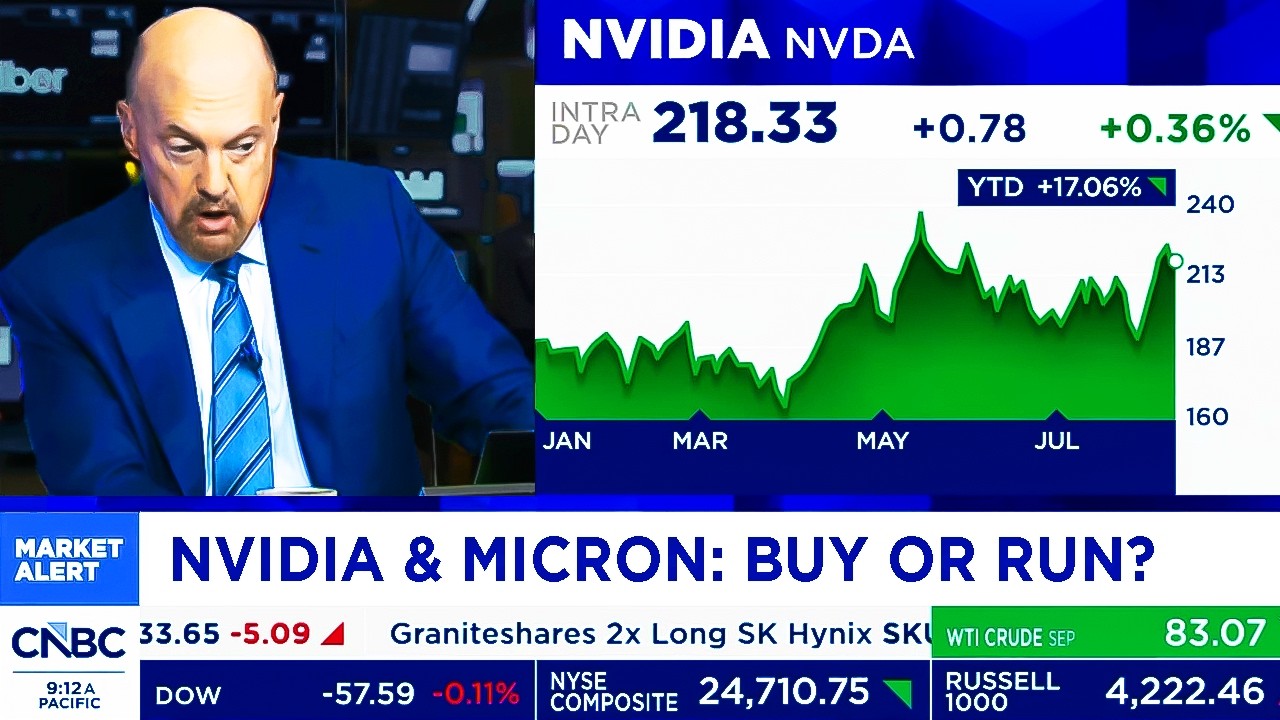
Let's get right to Nvidia this morning, teaming up, as you might know, with six large asset managers on a new push to finance more than 500 billion in AI infrastructure. This is Jensen Wong last night on this new partnership. These partnerships are going to pull together independent long-term capital to fund and support AI infrastructure buildout. This is an extraordinary time as you know because this is the first time in some 60 years that the computing industry is going through a fundamental platform shift >> Jim a lot of talk about securization. Um but this people are still trying to get their arms around what's essentially anou at this moment. Yes. >> Yeah. Look I have to say I go back to when I was uh in sales and tra well I guess private wealth management at Goldman 1985. We had this presentation uh by senior investment bankers including one that ended up running the firm saying look we're going to securitize autos and I remember uh speaking to other senior people well come on autos don't last that long and the guy who ran it said Jim listen to me this is going to work it's going to be one of the greatest securitation you ought to get in there and it offered a higher yield than anything else I offered so I sold the hell out of it well it turned out that auto securization is a you know almost the trillion dollar market. I think this is like that. I think these companies like Black Rockck, you remember it has that, you know, it has the infrastructure fund, the GMP, they can slot this right in, offer you some higher yield paper. That's what I think is happen. >> I mean, Jensen Wong in a in a in a sort of a Q&A almost written uh a bit after the announcement. I I took this out actually because he's going exactly what you're talking about, Jim. These are the characteristics of an investable infrastructure asset. It produces revenue, serves a broad market, improves in performance over time, and can be redeployed. One of the key questions, of course, is the fact that GPUs depreciate, but he did spend a good amount of time discussing the fact that, well, right now they're not really depreciating very much. Their residual value is significant um in terms of even the H100s that are still being used. see the numbers here for rate for rental getting rental prices above where they were certainly >> uh not that long ago. So that said, to Carl's point, it's anouou. Um, it's not clear that anybody has agreed to anything, certainly not in writing. They are, it's great optically. It's got, it's a great announcement from the optics. I can imagine all these firms are now going out with DEX that they're putting Nvidia stamp on and going to raise funds maybe against it. But does it really change the trajectory of the spend? That's a great question because I think a lot of people feel uh that there's alchemy involved uh that that there really is in the end uh an Nvidia backs stop for 25%. I look at it totally the opposite. I go back to the conference call uh Microsoft where Amy Hood said now before I moved to Outlook effective at the start of fiscal year 2027 we are extending the estimated useful life of our data centers and office buildings from 15 to 25 years. No one even questioned it. Even though you have to say, well, hold wait a second. They don't even they haven't existed for five years. How did she extend it? But no one questioned that. And Microsoft's had the best run since. And I would argue that that's the key state. So interesting. Do we get to a point where there are going to be almost >> securitized assets that are tradable in some way because they've been standardized? >> Well, they need to have a deep market, I would think, with all these different people. with David Solomon out there. I mean, this reminds me of when when Goldman said to me, "Listen, sell it." And I'm saying, you listen, I can get you seven. Right now, treasuries are five, it's 200. Oh, you know, hey, listen, this is going to be good paper. Now, did I feel like it was a sham? I felt like I was ordered to do it and I did it cuz I was a soldier and it worked. We should have Dave Ter was making some of that mark. >> Uh, yeah. Uh, Larry Frink talked about how it reminded him of NBS in the 70s. >> Yes. when that was brand new. Uh we got some uh sound floated from that pretty interesting conversation at maybe unprecedented at that table. Take a listen. >> We used to build chips that we sell and and these are technology components that people buy and use. But now Nvidia's AI factory platform is really an investable asset, an infrastructure asset. What we're doing is we're trying to find different ways to raise or to participate in raising the enormous amount of capital that's necessary to fund this infrastructure buildout. And you're starting to see in a sense, you know, assetbased financing against this infrastructure buildout. And that's not surprising because these are real assets. They have real value. You can put a tangible value on it. And there's a lot of capital out there. Markets are going to recognize the opportunity if the scale gets very very big, which it is. Pricing could widen out. But I think in the fullness of time, the recognition of the supply demand imbalance and the value of the compute is going to draw capital in. >> I do believe this is going to be representing a fantastic investment. In fact, I think it's going to be such a large investment over time, you're going to see more and more allocation in in into this asset class. >> The uh US global markets in aggregate is the envy of the world. And Vidi is one of the envys of the world what they've created and what you're seeing here this consortium of partners and yes we do compete but we finance a tremendous amount together as well and in the end of the day this will this will benefit the US economy as a competitive tool for the advancement for the next decade. >> That last point's interesting because Apollo today to got a chart looking at how the world gets displaced by AI. the globe gets displaced, but the US actually benefits from the buildout itself. >> Look, some of this stuff, I mean, American exceptionalism was brought up, which again is basically saying to me, listen, China, they don't have ASMLF. They don't have any of the the great uh software that we have. They don't have the Nvidia B. They're building their own stuff. We're the ones that have, >> but what we really have is capital markets that are superior to theirs and the ability to actually raise money around things. >> But there's this They don't because it has to come from the government in their case. Whereas with us, it actually comes from those who believe there's going to be a a return generator. >> But the PLA is running that country. We never talk about that. And I think that they're saying, "Listen, we can build our own and we can build our own because if you have an embargo on us cuz we're taking over Taiwan, we don't have to worry." >> And they are. And this doesn't change the fact that we're in a race with China, a significant race, >> uh, or that the open source models, many of which are coming out of China, not all. And obviously we've seen Meta now with a very important >> entrance ignored. I thought it was important >> kind of ignored but not fully ignored. We talked about it yesterday. But my point is that they are going to be a player in this no matter what. Even if this $500 billion effort is is successful and again it's not as though the money is not being spent. It is on a piece by piece basis. Maybe this offers some form of standardization. Again it is a memorandum of understanding. It's not like anybody's committed to saying we're in for 100 billion and they're in for 100 billion. We'll see. >> But it does at least put a spotlight on this and certainly from an optical perspect, you know, from the optics perspective, it's a grand announcement of great potential importance. >> Yes. I mean, we have corewave tonight and coreweave is going what from 13% uh money to 9%. Corewave paper is getting better, the more investable. >> Well, they closed the loan facility this morning. >> Yes. And that's going to be kind of dispositive for this. And what are the the H100 compute? What what is H100 worth? Now I mean if you go through it, it's very clear the rental rates are very good and very stable to uh so I get it. But you know Cor I want to go back to rates are better today. I want to come back to something that I find is just a constant theme and the theme is will Nvidia have to discount its chips because why is Nvidia selling for such a low multiple and that's because there's belief that they're that somehow they're going to have to cut the the price in order to compete with the uh tranium compete with with with Google's TPUs, right? And I think this solidifies the idea that they won't and that's why that stock is running. >> Although it did did it fall after hours. >> There was concern around this for them some from those who believe it was circular financing. >> Right. There's also >> now Jensen comes out specifically and says very it is not circular. >> Well, don't forget there were people selling this in order to be able to be in the Intel cuz the Intel is is already screaming. >> He says it's independent long-term institutional capital into the AI infrastructure market. You did bring this up though, Jim. There is a residual value support mechanism for up to 25% of an opportunity and that's each opportunity is assessed separately. So who's the user of the GPU, who's the buyer, who's the D, you know, all of that. But care they obviously he says they assess that carefully on a project by project basis. >> I didn't like that. But look, >> are you surprised the stock is not up more? Isn't this creating a potential endless source of funds to buy GPUs? I'd go back to theou. I think that maybe it's it's not commericable because there are institutions that want to do this, but I think there's a lot of people who are skeptical of pretty much anything Nvidia does. And even though these were the masters of the universe, and they are kind of >> I mean, it's 20 bucks off the alltime high. It's not It's not that far off the alltime high. >> No, but again, I mean, there is there's a belief that his stuff is too expensive. I think that's ridiculous is the backbone. There's a belief that CUDA is not a strong software platform. I think these are people who are just trying to drive the price of Nvidia chips down. It's not going to happen. >> Yeah, >> there's don't you want it kind of to happen? You know what the sake of the hyperscalers? >> No, because by by char owns it. That would be >> that would be suboptimal situation at least about suboptimal. >> Yeah. What's the multiple right now though on I mean Nvidia may be near an all-time high, but it's multiple is not. >> No. That's because of what I just described is 24 times earnings. >> Okay. >> Um, you know, that's that's not >> anything to be taken from who wasn't at the table yesterday. >> Well, Solomon crowds out everybody really, >> I guess. I mean, >> you're not It's not like you saw Jamie Diamond there. Mr. He's Mr. Sustain, you know, like No. >> Well, Jamie Diamond is a name that you I mean, that's there's a lot of >> Well, you want to see Blue Al? >> No, I'm just trying to think. Morgan Stanley, JP Morgan, >> what? Someone with a big balance. I guess then you get a level down. >> How about Citadel? >> How about Citadel? >> How about Citadel? I would have liked to seen Citadel. >> Yeah, but they're not as big in the private credit game. This is a lot of this is private credit. Who do you want? >> Goldman Sachs also has a huge private credit book. So >> Oh, absolutely. But who do you want in that? I mean, I think I'm just saying I'm just provocative. You're being provocative. >> Thank you. Yes, that's all. >> Just like you were being provocative. I'm bringing up the Nvidia 25%. I bring up that Larry Frink probably would take all this. >> What do you mean? Well, I'm just saying that >> you wish it was just Jensen and Black Rock up to a half a trillion dollar commitment. >> This paper's going to yield a lot. >> Well, that's so that's the other issue, Jim, that spreads are widening. Investors want to be paid for the risk that these spenders aren't the eventual winners. >> It's true. Nvidia's credit is not as good as other companies, its class, so to speak. But I would change I would say now I want to know what Nvidia is getting borrowed. Someone you look Nvidia is a huge balance sheet. It's true. But I just say if this he thanks they went down a little. >> Yeah, it did. >> Hey, look at that. >> Yeah. Well, because >> that's just positive, too. >> This is third party financing for most of it. >> Um, I'd love to get your reaction to this idea of creating a new really asset class is the ambition here. It's only a memorandum of understanding. There's no contracts here that say they have to raise this money. But they do have that idea of that you know at some point we could have securitized basically GPU markets I guess that are traded because there's some standardization dream or potential reality. >> I think this is a great maturation of the ecosystem. Let's first remind people of macro numbers. $1 trillion is going to be spent by the big five this year in data center capex buildout. That's more than the entire US Department of Defense budget at about 960 billion. It's more than the peak US defense budget even in wartimes inflation adjusted. It's the biggest buildout in uh private markets history. And so another half trillion dollars is a statement about the intention for the build. And it's smart for Nvidia for two reasons. One is it it counters the criticism of the balance sheet insider deals. The roundtpping the open AAI gives them the deal. They invest in OpenAI and to move that off. So it's a clear standalone business case. The second is for their ecosystem locket. They've done a great job with their software development in the ecosystem there. Investing in the the companies now to have a financing advantage and a structural advantage for using Nvidia GPUs is a financial weapon that they can use to pull in more ecosystem build on their stack and I think it's incredibly smart and I think that these assets will be investable. >> Yeah. Uh Jensen Wong also sort of coming out against that that criticism that says well what about residual value? How quickly do you have to depreciate a GPU? pointing to the prices per hour actually having gone up for even older chips. Are you a believer that that will sustain over time because that could be an important part of the equation here in terms of what this financing look like? >> So they are an investable asset. U the demand is going to sustain but these things always end hard with a hard landing. We we know how these buildouts play out and so there's a there's a timing question and if I'm an investor looking at this I'm looking at the class A credit. I'm looking at long duration take or pay contracts and I want that tier one partnership structure to go with it because at some point the marginal providers are going to get hit hard. We're starting to see leverage come into the market where people are trying to put debt on these things to juice returns as the as the model returns are coming down. That's only going to compound the risk and the marginal providers are going to get hit first as there's some inevitable pullback. I mean, does it raise credit risk like that future demand is going to be more sensitive now to to credit conditions and credit volatility? Uh >> that feels like a big risk. No, >> at multiple layers it is. And so starting with the debt side, which obviously um has has some backs stop uh protection, but if you think about the equity tiers, part of why Nvidia wants to move this off their balance sheet is for more clarity. They've been, I think, appropriately taking the criticism that they will be tied then to the fate of those who they fund. If you can move it off, have third parties justify it. They're still committing to a quarter of the capital up to 125 billion, but that's a discreet amount and an investment. If you have the the folks like KAR and Black Rockck that are that are financing these and valuing them on a standalone basis, people can look at those independent of the GPU business for Nvidia and their core um ecosystem businesses. >> Um demand still seems to be parabolic. Do you agree? And do you and do you see that being sustained for years to come? Uh right now it's absolutely insatiable and I think that's what investors should take comfort in. The criticism of these insider deals for instance were misplaced because they weren't to prop anything up. We were having a chip shortage. It was really to um to align interests with their participants. The enterprise business right now cannot get enough uh tokens provision. They cannot get enough capacity. anthropic open AAI uh the hyperscalers themselves have openly said they would have grown even faster if they had more supply of chips of compute of capacity and so that's not where the shock's going to come from we have um massive demand that I see many quarters out where it may come from is technological innovation where you find some unlocks where they can deliver those uh capabilities where the model performance can go up you see these technological breakthroughs that happen in history um with each architectural advancement. That's what I think will actually cause an inevitable shock through the system. Whether that's the next chip uh iteration architecturally or whether it's a software innovation. Um eventually that will happen where performance and cost performance is massively disrupted. >> It could be a really bad day or a period of time. I mean you think about again back to your point all the capital being used here and that is at risk and look and obviously expects a decent return. I don't know when that happens or if it happens, but if it does, >> yeah, the the anxiety around the open source models being the disruptor, I think, is entirely misplaced. >> Why do why do you think that? >> So, we know how open source plays out, and I think it's going to be very similar this time as well, which is there's an important place in the ecosystem for those models. The shot across the bow with Kimmy and Deepseek years ago has opened up the US uh open source community and has revitalized uh the Western European and Indian and Canadian open source enterprises. we will see st strong offerings there. But US enterprise businesses, the Fortune 2000 are not going to try to optimize pennies to use Chinese models to host their data um with uh un um with businesses that do not guarantee uh the or insure the business. So a hyperscaler right now, if you use those models, you have you're taking on independent risk. They want trust. They want an enterprise behind it. And so you're going to see layers. I I did quote, you know, it's funny you mentioned that cuz I I I used a quote earlier from Bill Redd who's the CEO of Pinterest on their earnings call last week where he said any CEO that's not taking advantage of open source models is wasting a lot of their shareholders money and it's especially true now that you have hyperscalers making it really easy to take advantage of open source in a secure environment. You clearly disagree. >> Uh no I uh Bill's a actually a Bessmer portfolio CEO. He's a great guy, very smart on this and and I agree with him. And the point is you're layering it. And so there's a role for open source models. Enterprises, I think, are going to increasingly embrace open source models from allied countries, especially when you get into healthcare, defense, critical industries, but what you're going to see is tiers. So Anthropic is going to stay at the frontier. The top enterprises are going to want the frontier models for the most complex use cases. They are also going to have their lighterw weight models at much more compelling price performance levels for cheaper token um per output levels. What you'll also see is them layering in open- source models for test use cases for development use cases for um emerging products at the fringe and they all coexist in a wonderful way just like you've seen with the history of open source software uh in the prior in the cloud. I mean, didn't we get more evidence of that yesterday afternoon in that extraordinary event on this network with Jensen Wong and then the the the heads of those six firms that are going to partner with Nvidia to raise $500 billion in third party capital. Just to get you up to speed, everybody on what exactly this is about, take a look at at what we put together just so you clearly understand what this is. So they're going to partner with financial firms to raise $500 billion in thirdparty capital. They've signed with Goldman Apollo Blackstone Brookfield KKR and Black Rockck. The deal is going to help Nvidia's customers finance the cost of compute. The financial terms not disclosed, but the street seems to be more positive than not on it. uh on the idea of what what is both revenue sharing uh alleviating circularity concerns. I'm quoting from some of the notes that are out there today that are reiterating this stock at an overweight. Uh it it seems as though that this has taken a little bit of the risk out of the equation. However you judge it, you have the stock. What do you think? Well, uh, I think Jen, so of all the people in this world that you could choose to contra and bet against, you want to bet against Jensen Wang? Okay. I I don't. You definitely are are are welcome to because he looks at his stock price. It goes nowhere for a year, right? Um, he's got the best performing stock of the prior decade. Why isn't the stock going up? Why are we multiple contracting? Well, sir, there's talk on the other coast in in New York and Boston. They're worried about circular financing. They think you're Cisco um basically giving money to all the competitive local exchange carriers in 1999 to buy Cisco routers with your money and then you get to book it as revenue and they think that you're running the same playbook. He says, "Oh, okay. But we also know the world is structurally short compute and probably will be for at least the next 5 years. What if we can socialize that risk and that upside a little bit and bring in third party people who just want to bet on the compute demand itself having a value? Can we do that? And of course um we know that there's trillions of dollars in dry powder between um private credit, private equity. There's a whole wealth management uh world of which I'm the avatar. Everybody's looking for new products to bring their clients that have a yield attached to them. Let's let's uh build a bridge between what Wall Street is looking for, which is more stuff to invest in with a yield that we feel good about, and with what Silicon Valley needs, which is um spreading out the risk a little bit and not having to have Amazon and Google do a debt offering every month. This is like the best of both worlds. I don't know that it takes the circular risk talk off the table, but it should at least push it back further from the conversation. If we think that there's a lot of demand directly to invest in compute, well, it's a new it's a new story now. And that story is, >> wow, the ecosystem might have another 10 million new check writers all of a sudden. And I think it's brilliant. Um, I'm not saying I'll invest myself, but I think it's a brilliant move by Nvidia to engage the people that actually represent the investor class. >> And you you agree that that I agree and takes a little bit of the risk >> 100%. They they off their balance sheet. >> They cap their own exposure at 25%. How does that not derisk the name? In addition, they've kind of said to the market, compute is now an investable infrastructure asset. it it's securing financing beyond your wildest imagination there especially with the partners that are in this group which you know many critics would say they're talking their own book right they need to they need to do this however I do think it sets the table for a broadened customer base too with customers that might have had some financial concerns as it relates to the financing of their AI buildout this a win >> I think it's a win-win for both I think for Nvidia you no longer longer have to question if they are going to have to cut pricing on GPU. That's that's no longer an issue. And for the consortium, it's a home run. They're getting the computers, the collateral for the debt. Why wouldn't you want that? I think this accelerates what ultimately will happen which will be in the next 5 years one of the largest futures market in the world will be oil and it will be compute. you will price of commute compute though if it commoditizes that's obviously one of the fears that that is out there the decreasing price of compute if you're buying an annuity stream I'm not saying that's happening Joe I'm just saying that that is a risk >> I disagree with you I actually think if you see a futures market and you have the transparency I think that creates an even better environment for everyone in particular the consortium themselves which will have the hedging ability against the compute that they are getting as collateral against the debt. I think it's ultimately a good thing. I agree with you just overall 30,000 ft. This is a win-win for all. Well, Nvidia's AI factory compute will now become an investable asset just like that cheese. I guess the plan seems brilliant, but compute is it really an asset class? I want to bring out Niles investment management founder Dan Niles. Then does a scheme compute, pun intended, or or does it just add validity to the notion that Nvidia has become sort of a modern-day GE Capital or even worse than Enron? >> Well, I mean, I think so if you go back and you kind of think about AI infrastructure or anything, right, you just I loved your segment you just did on cheese, right? You can make any asset class into a cheese. I mean, into an asset, right? You can make Tootsie Rolls if you wanted, right? So, you can go wherever you want with this. And the question is, does it make sense? Now, is AI data centers an asset class? Absolutely. Is there a lot of money being spent? 100%. Um, does this make it easier to get financing for these companies because you're bundling all of these guys together much like you do with auto loans or um, you know, home mortgages, which has been done for a long time. You bundled them together and then you can sell them to investors that are looking for a better yield than what you can get from treasuries but with more risk. And so you're turning this into an asset class. You know, it's not surprising. Does this mean that you're going to have more money to fund all these investments? Absolutely. What I find interesting is the fact that Nvidia's stock is basically flat. >> And so investors aren't necessarily looking at this and saying this is all good. Even though the purpose was to get away from this notion that it's all circular financing because these are third parties that are going to be financing these buildouts, not Nvidia, but Nvidia stocks actually not up that much. So, it's kind of interesting to see. >> Yeah. And in the meantime, I know that A100 pricing has held up nicely. There's all kinds of debate about depreciation and things like that. To your point though, uh, and raising this money, Goldman says, "Listen, we need to raise trillions of dollars in the coming years." And uh you know again at least from an investor's point of view you would argue that maybe it gives us visibility or or is it just maybe more Wall Street hype than anything else? Well, you got to remember, Charles, like every great industrial revolution, there's always hype involved because if you realize that this is a big thing that's going to change the worldwide economy, and we're talking canals in the 1800s or railroads in the 1900s or fracking or the internet back in the 1990s or today AI infrastructure, if you realize it's going to be huge, then everybody wants in. So by definition a big revolution is going to lead to overinvestment. Now the question is where are you in that? So if you go back to 1999 NASDAQ was up 86%. It was the best year by almost 2x the next prior year. But that was right before the bubble burst. And by the way in the early part of 2000 the NASDAQ went up another I think it was 26% or 24% before it actually blew up. So I think we've got at least another year in this bubble building out and I think the returns are going to be very very good and because Agentic is a brand new thing and you and I have talked about this before that just kind of showed up with Claudebot on January 30th. So I doubt in 6 months we've seen all of the benefits from Magenta. So I think we got about another year in this buildout and then at some point you're going to get a bust and all these new and innovative financing schemes. They're going to have issues but for right now I think you know you still got a lot more room to go >> and and we should if you are and we are going to make the correlation back then that 99 to 2000 was a monster. I mean like the more money was made that one year before the bust. Uh on July 29th, you uh you called for a short-term bottom uh in part because of the uh the situational awareness thing led by hyperscalers. They've done extraordinarily well. Feels like Wall Street's changed their mind on them. I know you like Microsoft, Amazon, and Google. But again, now all of a sudden creeping up are things that they've committed to maybe offbalance sheet things. Uh is that going to be a problem for now? You think? Not now, but just like our conversation on, you know, turning data centers into an asset class, it will be a problem. I just don't think it's in the near term because you're exactly right. There's over $1 trillion in offbalance sheet financing just looking at the six biggest guys out there. And so that just keeps building and building because, you know, these companies don't want you to really focus on that, right? >> And I understand why, right? A trillion dollars is a lot of money, I think. So but in the near term I think what to focus on on the positive side is this last quarter when you look at the big hyperscalers they all saw revenue growth accelerate and if you look at Google revenue growth accelerated from 63% to 82%. But the more important part was profitability improved for Amazon Web Services, Microsoft's Azure as well as Google Cloud where margins expanded by about 3% from March to June. So the good news is revenue growth is accelerating, profit growth is also going up on a margin basis and so that should keep this trade going for a while longer. >> Yeah, I love when margins expand. Hey, uh Elon Musk last week uh commented and committed to Nvidia, the best uh calling it the best out there. That put a little bit of spark in the stock and you I think in your note I read you said it's both a value and a growth play here. >> Yeah. Well, I mean, if you look at it, Nvidia's revenue growth in the July quarter of last year was 56%. People are thinking that's going to be closer to 96% in the quarter they're about to report. So, and then accelerate from there. But, as I just said earlier, it makes sense because if you look at the cap X for these big hyperscalers, the March quarter saw the fastest year-over-year growth in this entire almost four years we're approaching now buildout. And that growth is expected to accelerate in June. Um or it did accelerate in June and expect expected to accelerate even further in the September quarter almost 100% year-over-year growth. So that would support Nvidia where you've got a PE multiple just a little bit above the S&P 500 but growing revenues at over 90%. >> My next guest actually says that the bottleneck has moved from chips to capital. I want to bring a stockbrokers.com director of investor research Jessica Insk. Jessica, you know, it seems like uh like this Nvidia announcement uh uh with these big banks, I it seems reading your note, I think you like this deal. >> I I certainly do because it weakens the bare case for the AI narrative. So the the bull case has been compute and data center demand continuously outpacing supply and to Dan's point the growth with the hyperscalers are is there but the bare case for this AI narrative has been circular capital plus capital constraints which is eating into free cash flow and this new structure is a pivot away really from that bare case the it it's does remind me of mortgage back securities but then that started in the 70s and accelerated we're in the early end innings of that so this is really a somewhat of an innovation, but it extends the cycle's length and it changes more of the character. So, it's going beyond the mega caps. It's widening out. And I think that's really important because instead of internal cash flow, it adds more it does add more leverage and opacity, which is going to be a risk, but it's bullish for the AI buildout's duration. And now it's more of a stock picker market and we can broaden more. And I think that's really important for those non-investment grade buyers because the data center demand is absolutely still there, >> right? And to your point, you talk about obviously hyperscalers, which you know, they've used up all their free cash flow, they've gone to the bond market, they're doing secondaries, they they need cash, but so do other folks who may not uh and Jensen brought this up as well, have necessarily the pedigree to get the best bond offering. So AI labs, NeoCloud, sovereigns uh and then within this area, you're saying, "Hey, you've got opportunities. Now you just have to find the best names. >> Exactly. And I'm happy to take it off of Nvidia's balance sheet, taking away that circular capital and putting it on people who are professionals and underwriting it. I think that's positive for the overall AI narrative. It does raise some risk with sensitivity more to the interest rate market and and capex. So I what you need to watch for now is deals accelerating while customer demand deacelerates and that in customer demand but there's still early innings there needs to be more transparency around this before we understand that but overall it's good for the AI narrative and to Dan's point we need it's interesting that Nvidia is flat right now I still think it's something we need in our portfolio please be cognizant of being overexposed to it but it's definitely going to be a telltale when we understand Nvidia's earnings now Now we are listening for something else and introduced a new risk in the market but also a new opportunity. >> Let's talk about in April you were here you had a lot of winners man I want to ask you about um this though. So earlier this year about two months ago this came out. This is the next Nvidia you know rack and memory up 400%. Right. So they've said they're saying now you know we got to find a way to use less memory. That's put a little pressure on Micron which has been one of your grand slam winners. is does this matter more or does this these high bandwidth memory chips that are coming out matter more for a micron holder? >> Well, so listen, I I think it's I think it's I don't think it's one or the other. I think it's connection, right? Because Nvidia is talking about putting less memory because the memory is so expensive at the moment. So, they're going to put less memory. But if they put less memory and they sell more of those more of those units, then ultimately they've actually increased it. But I think HBM is right at the top of the game for uh MU. They're right at the top of the stack. So, in terms of the pullback, we see MU pull back a little bit. I think right in here is a great opportunity to buy it. It's got I think there's I think there's 1350 price targets on it for the street. Um, but I think we've seen this nice pullback. I think this Nvidia story is just temporary. I think that you're missing >> and in April when you gave it to us. I mean, it made a monster like a gargantuan move. So, this move was not this sort of consolidation is not unusual. >> No, it's not unusual at all. And it looked and it's come right back and it's found this it found this low kind of right in here. it held and now it looks like it might want to test it again. But uh I think I think MU is a great name. We'd still own it. I'd still own it. All right. >> How's Nvidia? How's the stock of Nvidia doing? I asked that for a host of reasons. Not just because it's the largest company on earth. I asked it because it's a huge percent of the market is now dependent upon the fortress of Nvidia, the fortress of AI, the fortress of the data center. Nvidia is unchanged when I called and that's okay. Status quo. Let me tell you how large Nvidia looms. Yesterday, Nvidia helped put together what amounts to a coalition of big asset managers in Goldman Sachs that might securitize the wonder of compute. That term didn't even exist a few years ago. That's now the currency of the realm. I'll detail what I think is really going on is a tad gauzy for my taste later in the show. Uh but the news came out after the close. I don't think people realize how important this data center theme has become. Sure, all of the Magnificent Sevens Fortress tied the data center, but each day we find companies that have data center exposure that we didn't know. I mean today one that was just struck me it's a PHILADELPHIA'S OWN AS WILD WAS ARAMARK THE FOOD services company report an excellent quarter one of the reasons they're providing hospitality solutions to the data center including Texas now that's just a plain vanilla company figured out how to create wealth by being affiliated with the data center being affiliated with Nvidia or take tonight we have Cisco not the networking company which is all in the data center anyway but the food service company which says that artificial intelligence made them more nimble more responsive to customers more profitable you may or may not believe it maybe you think it is I don't know AI washing but Cisco clearly believes it. Maybe that's what matters though it look Nvidia has become the brahman for what might be as much as a third some would say a half of the economy. I'm not kidding. We often think that there has to be a top brewing in the data center concept. I I still don't see it. Maybe core can influence Nvidia tomorrow as it did report on an amazing quarter tonight and send the stock up and then I'd have to rethink all my thinking. Well, not really. I'm just talking about shortorthhand. See, I can't ask you about the CPI like we have tomorrow. I can't say, "Okay, how's Amazon? How's Apple? What's going on with Alphabet?" No one's going to listen to that litany. I would say if Nvidia's doing fine, then the day's okay. And I can forget about it and GO BACK TO FISHING and we have some other forms of leadership. The financials are acting better, healthcare's more positive. But the bottom line, my three questions tell me what I need to know, which is that yesterday it was just fine and dandy to go back to fishing for tarpon. And that's exactly what I do. All right, I hope you're all doing well today and staying calm in this market. By this point, I'm sure many of you have heard about Nvidia's $500 billion arrangement. But I've also heard a lot of misunderstandings and bad takes on the topic both online and in the financial press today. There were many segments in the financial media today, some bullish and some bearish, that I did not include in this video because there were just too many incorrect details in those segments. And so with that context in mind, let me briefly recap what's going on so that hopefully we're all on the same page. And then I'll cover Tuesday's news after that. Nvidia announced they've partnered with Apollo, Black Rockck Blackstone Brookfield Goldman Sachs, and KKR to establish AI compute infrastructure financing platforms to mobilize over $500 billion of thirdparty capital. These new financing platforms turn Nvidia compute and full stack infrastructure into an investable asset class for global capital. As a brief side note, as I've said many times, now is not the time for Nvidia investors to worry about market share. There's plenty of room for multiple chip makers to succeed. At the same time, Nvidia is in a league of its own, far ahead of the competition. And now Nvidia's compute is an investable asset, providing the lowest token cost, highest revenue, and longest useful life with the largest install base and rich ecosystem built upon Nvidia's CUDA platform. have been signed with the six financial institutions to create partnerships aimed at establishing the first compute financing platforms of their kind at global scale. Nvidia will work with these institutions to create dedicated pools of capital at significant scale at attractive rates for Nvidia customers. Let me briefly simplify things in case anyone isn't following so far. These are new platforms that are intended to mobilize more than $500 billion of thirdparty capital for AI infrastructure over time. The idea is to create large pools of financing that Nvidia customers can use to build Nvidia based AI factories. Importantly, Nvidia is not committing the $500 billion itself. These are third party financing platforms. Nvidia hasn't disclosed capital commitments or deployment timetable. I think this news concerns some market participants given all the talk about circular financing over recent months. That said, this will likely turn out to be very positive for Nvidia. We're talking about hundreds of billions of dollars worth of thirdparty capital being mobilized over time to help fund the buildout of Nvidia based AI factories. That's positive for Nvidia. I want to reiterate that this is not money Nvidia is putting up itself. We're talking about third party independent capital that will be used to help fund the buildout of AI factories. Again, third party independent capital. Jensen posted an article on his exac account talking about the news. And in that article, he directly addressed the circular financing concerns. Jensen says that the $500 billion arrangement is designed to address that concern. and he reiterated that the demand is real. In other words, this is not a situation of using circular financing to create the illusion of demand. Rather, the demand from AI labs, AI native startups, enterprises, cloud providers, and sovereigns is real and it is very strong. So strong that many companies simply cannot afford to buy as much as they would like to. The capital providers independently underwrite each project. Nvidia provides the platform. The investors make independent financing decisions. In that same article, Jensen writes, quote, "In some cases, Nvidia may provide a residual value support mechanism for up to 25% of an opportunity assessed carefully on a projectby- project basis. That support is limited, residual value based, and designed to complement, not replace, independent underwriting. This is substantially lower than other compute financing arrangements. NVIDIA can provide support because NVIDIA compute is unique. It is fungeable, universally adopted, software upgradable, and redeployable across a large ecosystem of customers. Our role is to help unlock a very large pool of independent capital while maintaining disciplined risk exposure. Put simply, I think many of the concerns about circular financing are largely overblown. Additionally, I'm going to mention something that seems random, but again, I've heard many incorrect takes today. So, I think it needs to be mentioned. Lower token costs are not bad for Nvidia. They actually catalyze additional usage throughout the ecosystem, which ultimately leads to more compute demand, not less. I've heard some people today complain that you can't depreciate GPUs over a 5-year time frame because the cost of compute is going to come down dramatically. That is incorrect. Nvidia has addressed this multiple times in the past. As token costs come down, usage increases. That results in greater compute demand. If compute demand increases as a result of lower token costs that is positive for hourly GPU rental prices, not negative. So yes, as crazy as it may sound, lower token costs are actually a positive development for the companies renting out GPUs, not a negative one. There's a fundamental reason why Nvidia is driving down token costs by X factors with each new generation architecture. Both Nvidia and the companies renting out Nvidia GPUs stand to benefit greatly from lower token costs. I also want to remind you of something Jensen said Monday afternoon on CNBC. He said, quote, "AI tokens are incredibly profitable." And when speaking about AI labs, Jensen said, quote, I believe that within months, you're going to realize that these companies are extremely profitable and the tokens they're generating are incredibly profitable. That is very exciting to hear because I've been saying it for many months now. I think the leading labs surging revenues as well as their profitability may be the initial proof point that grabs market participants attention and causes them to realize that there will be a clear ROI on AI infrastructure. I really wish OpenAI and Anthropic were public right now so market participants could see it. That's something to look forward to as it's on the horizon. As a reminder, at the end of last week in a piece about SpaceX's AI buildout, Semi analysis pointed out that serving inference tokens is unbelievably profitable for the Frontier model companies saying that Open AI and Anthropic can generate over $100 billion of revenue per gigawatt per year when selling API inference on a GB300 cluster. That is significantly more than the cost of renting a GB 300 cluster for one year at current cloud prices. Once market participants realize that there is an incredible return on investments in AI infrastructure, I think we're going to see a very positive response in the shares of stocks like Nvidia, Micron, SKH, and the rest of Nvidia's ecosystem partners. That is something for investors to look forward to, and Jensen believes it will happen within months. Now, let's cover some of Tuesday's news. On Tuesday, Nvidia announced the launch of Neatron 3.5 Lightning and Nemo Switchyard. This is a new lightweight open model and routing library. Nemo 3.5 Lightning is a 30 billion parameter mixture of experts model that helps create smarter and more efficient agentic applications and Nemo switchyard is an open- source library for smart routing inside popular agent tools. Enterprises can use it to build a router based on their specific needs. Nemo switchyard can direct each request to the most capable and suitable model for each job across developers own mix of open proprietary and Nvidia models without developers having to rewrite their applications. As a reminder, open models are great for AI infrastructure companies like Nvidia because they help drive greater consumption throughout the ecosystem, which ultimately leads to more compute demand, not less. We also have some memory news. Monday night, UBS pointed out that if Nvidia were to reduce the amount of HBM per Ruben Ultra GPU, as was rumored late last week, then that could actually lead to Nvidia shipping more GPUs, which could result in greater total HBM demand, not less, even though there would be less HBM per GPU. That's exactly what I've been saying in recent videos. UBS also now sees HBM4 and HBM4 E supply tighter and pricing stronger than previously expected, raising its forecast for HBM ASP growth to roughly 79% year-over-year versus 67% previously. Also on Tuesday, we learned that SKH High Solid is restarting its second NAN fab in Dalian, China, and increasing Dian capacity by about 50%. Mass production is targeted for the first half of 2027. So this is an incremental 2027 nan supply increase. The new line is expected to bring SKH Highix Dalian plan up from roughly 100,000 wafer starts per month to 150,000. So that's not positive for Nan supply tightness, but it also doesn't alleviate the shortage. Now, briefly, I want to mention something I've been thinking about recently. As I've said many times in recent videos, I do think this current moment is fundamentally different from the typical memory cycles of the past. And I think this current moment is likely to last longer than the memory cycles of the past. In the past, memory demand was heavily dependent upon in demand from consumers. But today the surge in memory demand is primarily being fueled by large companies. Hyperscalers AI labs, neoclouds, enterprises and sovereigns all provide much more durable demand than consumers. Now with the understanding that AI demand is the primary driver of the surge in memory demand. I want you to understand this. AI is better with more memory. Think about that for a second because this is much more profound than it appears at first glance. More capable models require more memory content, not less. I want you to really grasp this because this is such a major fundamental difference compared to the memory cycles of the past. In the past, memory content per consumer device didn't really make a major difference in demand. Let's be real, most people don't really care how much memory content is in their iPhone. The amount of memory in a consumer device has little impact on the consumer's experience relative to the effect that memory content has on the quality of AI. Therefore, memory content per consumer device has little impact on memory demand. But contrast that with AI. Again, AI is improved with more memory. More capable models require more memory. As models become more productive, more valuable, and contribute more meaningfully in real world applications, there will be even more demand to train even better models. Better models require more memory. Do you see the difference in this current technology shift versus consumer-driven cycles of the past? More memory is not optional when it comes to training better models. It is absolutely essential to the development of better models. That was not true of the consumer devices that drove memory demand during past cycles. We have to remember this that AI is improved with more memory. when considering the question of how long the supply demand imbalance and the memory makers pricing power will persist. As I've said previously, I think the world is likely to be compute constrained for the first half of calendar 2028 and I think it's reasonable to be bullish on memory makers like Micron and SKH through most of 2027. I will eventually have to adjust those time frames as we gradually gain additional information. The only reason I haven't already extended those time horizons is because I don't know for certain when physical AI will begin ramping its scale. I think it's likely to happen sometime around 2028 to 2030. The question in my mind is, will the current drivers of demand keep demand strong enough for long enough before that handoff to physical AI as the main demand driver takes place? I do think that is a likely scenario, but I'm waiting until I have more information before extending the time horizons for how long. I expect the world to be compute constrained and how long I think it's reasonable to be bullish on memory makers like Micron and SKH. That said, if this buildout is going to continue for multiple years, which I think it is, and if AI gets better with more memory, which it does, then I think it's reasonable to be bullish on companies like Nvidia Micron and SKH at least through most of 2027, possibly longer depending on what happens. And I also think it's reasonable to be bullish on those same stocks when physical AI begins ramping at scale, which will likely happen sometime around 2028 to 2030. The only question in my mind is the timing of that handoff from current demand drivers to physical AI as the next major demand driver. Looking ahead, we have Nvidia earnings later this month on Wednesday, August 26th. Now, in case you're new to the channel, I want to make sure that you have at least a basic understanding of the underlying long-term thesis. So, let's cover that. Now, I don't know what's going to happen in the short term, but from a long-term perspective, I am very confident that Nvidia will be worth much more in future years than it is today. When Jensen was on the Lex Freedman podcast not that long ago, he was very seriously raising the possibility of Nvidia becoming a $3 trillion revenue company in the near future. If that happens in the coming years, then it is very plausible that Nvidia could one day be worth tens of trillions of dollars in market cap. That might sound crazy, but that's what Jensen is implying when he raises the possibility of Nvidia becoming a $3 trillion revenue company. I guess the question at that point is what multiple the street will be willing to give Nvidia. I don't know the answer to that question, but I truly do think that Nvidia will be worth much more in future years than it is today based purely on the fundamental growth of the business. Based on everything I'm seeing, the world is still compute constrained and I expect that to continue at least through the first half of calendar 2028. In a computed environment, developers will use whatever viable compute they can get their hands on. Today, there are no GPUs that are sitting dark due to a lack of demand, like there was fiber sitting dark due to a lack of demand at the height of the dotcom bubble. Back then, companies were laying fiber in the hopes that use cases and demand would eventually show up. Today, we are seeing the complete opposite. As I've said many times, when market participants compare this AI revolution to the dotcom bubble, they ignore the fact that the internet is already here this time. This means that mass adoption of the technology and new use case development at scale are immediately possible. We don't have to wait years for it to show up. It's already here. The world is compute constrained, which means there is not enough supply to satisfy demand. New capacity is utilized as soon as it comes online. The hyperscalers are monetizing capacity as soon as it comes online. Each of the hyperscalers spoke about being supply constrained on their most recent earnings calls. Additionally, many of the clouds are building out into contracted demand. They're not blindly building in the hopes that demand will eventually show up. No, they're building out because they have signed contracts and in some cases significant prepayments from their paying customers. This AI revolution is fundamentally different from the do-com bubble. And 2026 will be a pivotal year for the AI industry thanks to the rapid adoption of Agentic AI and the proliferation of Agentic systems in the world's leading enterprises. The leading AI labs revenues are surging right now. Agentic coding and the implementation of Agentic systems in large enterprises are new use cases that are increasing inference demand significantly. That subsequently is increasing compute demand. The rapid adoption of Agentic AI is why we're seeing an inflection in inference demand. It's why we're seeing the leading AI labs revenue surge. I wish both Anthropic and Open AI were public so the public could see the ramp in their revenues. Anthropics ARR has surpassed $47 billion, up from $9 billion just at the end of 2025. Open AI is growing rapidly as well. I think the leading labs surging revenues may be the initial proof point that grabs market participants attention and causes them to realize that there will be a clear ROI on AI infrastructure. I think the leading labs surging revenues will also help assure investors of the longevity of Nvidia's growth since these labs revenues are directly tied to compute. If they had more compute, they would have greater revenues. It really is that simple. Demand is not the problem. The problem is a lack of supply to meet the demand. As I've said previously, I expect the world to be compute constrained at least through the first half of 2028, possibly longer. And so, regardless of what happens in the short term, it's important for long-term investors to remain focused on the fundamentals, maintain a long-term perspective, and remember that we are only in the early stages of aic systems being adopted at scale. This will increase compute demand significantly, and after that, the next surge in compute demand will likely be fueled by physical AI. We're no longer talking about digital agents performing digital tasks. With physical AI, we're talking about physical AI agents performing physical tasks in the real world. NVIDIA CFO has called physical AI quote a multi-t trillion dollar opportunity and the next leg of growth for NVIDIA. This industry will fundamentally transform society and Nvidia has positioned themselves to benefit massively. Nvidia sells the hardware for the data centers where the models are trained. They offer omniverse where the models are taught and tested. And NVIDIA also sells the hardware that allows ondevice real-time inference through NVIDIA AGX, allowing robots to have intelligent interactions with the real world, even when they are not connected to a data center. Notice that NVIDIA is taking a holistic platform approach to physical AI, and they're embedding themselves as the underlying foundation supporting all of it. Over 2 million developers are already building on the NVIDIA robotic stack, and this is not getting enough attention. As for production ramps, Blackwell Ultra has ramped quickly and remains in high demand. Reuben is on track to launch in 2026. Then we're expecting Nvidia Gro 3 LPX in the second half of 2026. Later on, we're expecting the launch of Reuben Ultra in 2027 and Fineman after that in 2028. We have a clear data center product roadmap stretching into 2028. And Jensen believes that AI infrastructure spending will reach three to$4 trillion annually by the end of the decade. That means Jensen is expecting growing AI demand and an expanding total addressable market underpinning all of this. I don't think we are anywhere near any type of bubble bursting type of event. With all of this in mind, I seriously think that Nvidia still has plenty of runway ahead of it, and I think this company will be worth substantially more in future years than it is today. At least that's my view of the situation. Quick note before I wrap up, all of the compilations on this channel are edited by Finn Vid with original structure and commentary. Occasionally, the same edits appear elsewhere on YouTube. If you're looking for the original version, it's always here on this channel. Thanks for watching, Finn Vid. I appreciate your support. Remember to stay calm in this market. Remember to maintain a long-term perspective and do not make any hasty or irrational decisions. With all of that being said, I hope you all have a great rest of the day and I'm curious to hear your thoughts about Nvidia in the comments below. Please leave a like on this video so more people will see it. And while you're down there, please consider subscribing. It's free and you can always change your mind. Thanks for watching and hopefully I'll see you in the next

Comments 0
Sign in to join the discussion.
Sign inNo comments yet. Be the first to share your thoughts!