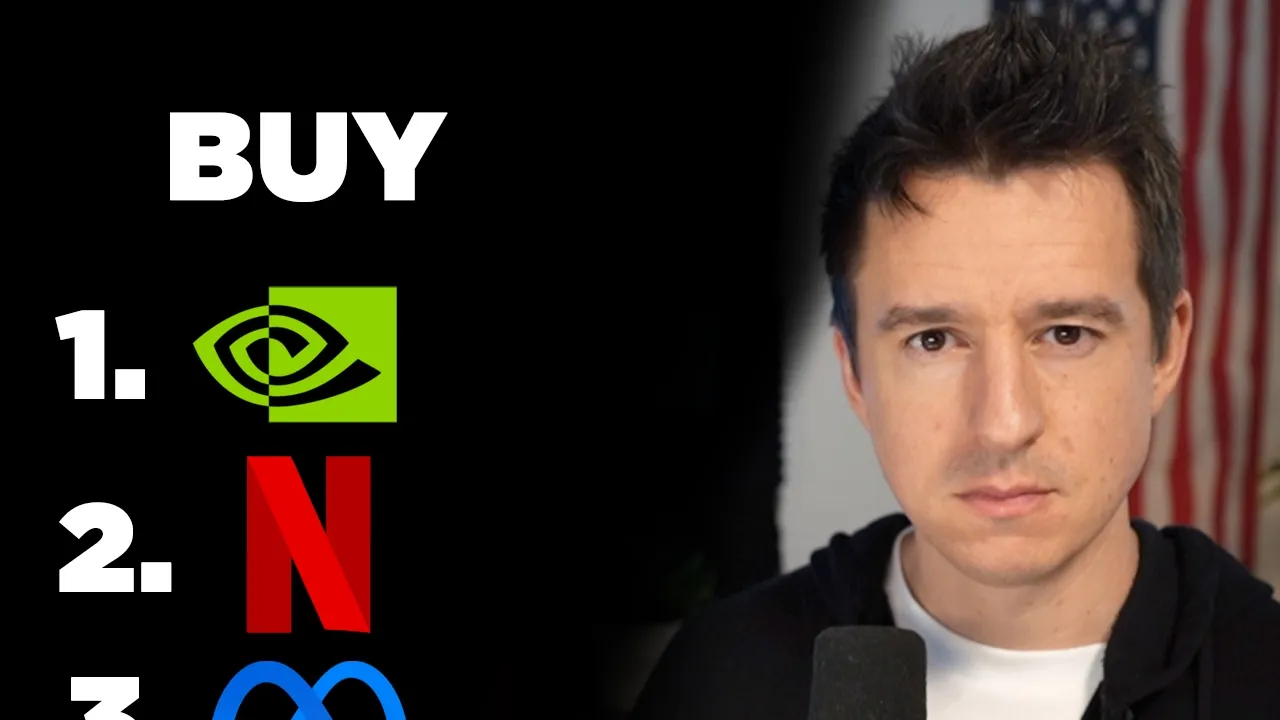
…makes the company more attractive than it seems and healthier than it seems. At $60 per share, this company is trading at a low valuation, one in the mid- teens. So, we have like maybe a 16 Ford PE ratio. very healthy free cash flow yield. Overall, a great company that I think is worth buying. Now, the next one that I believe is really good value today and an opportunity remains Meta. This is another one in my portfolio. In late March, Meta went through a big dip and it quickly recovered back to above 650. Then the stock traded …
Overall, a great company that I think is worth buying.
AI-extracted context
At $60 per share, this company is trading at a low valuation, one in the mid- teens. So, we have like maybe a 16 Ford PE ratio. very healthy free cash flow yield. Overall, a great company that I think is worth buying. Now, the next one that I believe is really good value today and an opportunity remains Meta.
…t likely has. The scandal is real. It does have an impact on Jensen, on shareholders. It does have an impact on regulation and influence and all the rest of it, but the stock is also down 22%. Much of that has been priced in at this point. So, I believe that right now is a good time to buy Nvidia. I think this is a good time to take advantage of it if you've been looking for an opportunity. Now, the reason in particular that I'm not buying Nvidia is simply because of portfolio management. And my portfolio is already very concentrated into this entire industry. For example, I have Amazon which is in the AI industry. I have Met…
So, I believe that right now is a good time to buy Nvidia. I think this is a good time to take advantage of it if you've been looking for an opportunity.
AI-extracted context
The big question is, has the stock fallen disproportionate to the fundamentals? And I believe in this case it likely has. The scandal is real. It does have an impact on Jensen, on shareholders. It does have an impact on regulation and influence and all the rest of it, but the stock is also down 22%. Much of that has been priced in at this point. So, I believe that right now is a good time to buy Nvidia. I think this is a good time to take advantage of it if you've been looking for an opportunity. Now, the reason in particular that I'm not buying Nvidia is simply because of portfolio management.
Full Transcript
Welcome back everyone. Today on the Joseph Carlson show, as the market looked like it was just about to start falling and there's momentum to the downside, we had Coreweave, one of the NeoCloud, report its earnings and it said not today. Not on its watch. It is up 19% and it even basically said in this earnings that Democrats are not going to stop the cloud buildout. Nobody can stop it. It is inevitable. We have other companies like Nebus Group, NBIS going up 17% as well. These cloud companies are lifting the market, causing the NASDAQ to now move back into the green. And while all this volatility is going on, there are companies right now that are opportunities for investors. I plan on highlighting five or six that I believe are worth looking at today. So, we'll be going over each of these companies that are in a big dip. And then, of course, we have more news to get into. Costco just declared a massive $30 per share dividend. That is like a 3% yield in a single dividend. We'll be looking at that. Then we have Steve Eisman who did a video that was a big takedown on the AI buildout. In it, he addresses Meta in particular and he highlights Meta's sneaky offbalance sheet debt. This is something that's painted as a little bit of a trick by Meta. Steve Eisman goes into the problems behind it and I have some disagreements. So, I'll be addressing those disagreements in this episode as well. And then we have the fail of the week, which in this case is the Wall Street Journalist reporter interviewing the CEO of Cake2 Interactive, the company that owns Rockstar Games, asking one of the craziest and dumbest questions that I've heard a reporter ever ask. We'll be looking at that clip at the end of this episode. So, we have a ton to cover in this episode. If you like this type of content, you want to see more of it, you can try out qual.com. Not only does it give you full access to a stock analysis platform that's getting better by the day, it also gives you access to the exclusive library of content where I come out with new episodes like these ones every single week except they're just longer and more in-depth. We do deep dives and AMAs and market updates and all sorts of stuff. So, if you like this type of stuff, you can try that out risk-f free at qual.com. Now, to start things off today, before looking at the companies that I think are buys, I want to quickly go over a market update. and that is that the Neoclouds, these are the companies that are epitomizing the AI movement. They're really the ones that if you wanted to be the most exposed to the AI movement, you'd buy these companies. They are doing well. And in fact, Cororeweave, one of the Neocloud CEOs, said that the new political reality after midterms won't slow the buildout. He directly addresses this whole idea that the new changes in Congress and Democrat control is not going to impact their company as much as investors are concerned about. Quote, "We do not anticipate any impact from the seismic regulatory shift that's occurred." We believe that what has occurred is a statement around how you build. We want to build responsibly. Cororeeve went on to paint a very glowing outlook, saying that they're going to continue building at basically the same speed that they have before. that the changes in Congress aren't going to do anything. And that's where there's some disagreement. For example, JP Morgan Asset Management wrote in a report that it's not really the projects next year that will be impacted. Democrats can't really stop projects that have already started and they've already been signed. All the contract and paperwork is already done, but the projects beyond 2028 are the most exposed. They quote face greater uncertainty around permitting, power, availability, and financing. The company said it still anticipates 1.85 85 gawatt of active power by the end of 2026. Now it's targeting 37 billion to 39 billion in fullear capital expenditures, implying a 155% growth in the middle of the range. So investors are looking at this and they're pretty happy about the response. They're not slowing down, but they also want to build responsibly. They believe that they can do so while working with the new Democrat leadership. And we have other companies like Nebus, another cloud company that has a big sympathy pop as well. All of this has raised the spirits of the market and now things are heading back into the green. And this is where we get into some companies that I think right now are potentially good buys. So, let's go ahead and go through them. I'm not going to spend too much time on these companies, but I just want to outline them as ones that I've been looking at. First of all, we have Nvidia, which I have been taking more seriously as of recent because there was a time just recently where Nvidia was trading at $240 per share. So, it was having a great year, well into the green, and it seemed like over the past month, I don't know this for sure, but it seemed like members of the street knew something was about to hit before it actually hit the public. It seemed like there's a number of people that knew about this Jensen news a little bit before it became mainstream. I don't know for sure, but that's what it feels like because the stock traded down well into the release of this big admission and scandal. It now trades at $174 per share. It's up a little bit today, but it hasn't regained anywhere near what it's lost since the scandal. And it now trades at a 12.6 Ford PE ratio. Now, these estimates are based off of good growth and good margins. So, Nvidia needs to keep growing quickly and still maintain its massive leadership in chips, which it likely will. But this is a cheap valuation. Nvidia is one of the cheaper companies in this entire ecosystem. And although I do take the scandal seriously, I think that this will have an effect on Jensen's leadership, his influence, his ability to relay things and do interviews and be influential in the sphere. I think all of that's going to be a bit dampened and more questioned and more complicated. I think there are real factors to this. The big question is, has the stock fallen disproportionate to the fundamentals? And I believe in this case it likely has. The scandal is real. It does have an impact on Jensen, on shareholders. It does have an impact on regulation and influence and all the rest of it, but the stock is also down 22%. Much of that has been priced in at this point. So, I believe that right now is a good time to buy Nvidia. I think this is a good time to take advantage of it if you've been looking for an opportunity. Now, the reason in particular that I'm not buying Nvidia is simply because of portfolio management. And my portfolio is already very concentrated into this entire industry. For example, I have Amazon which is in the AI industry. I have Meta which is doing a big part of the buildout. I have Google. I have Microsoft. I also have ASML which is very similar in its hierarchy to Nvidia. It's one step above it. So if I add in Nvidia as well and I built that to a big position, it'd be another company with a large amount of overlapping risk. So even though I think it's a good buy today for my own portfolio, I'm staying out. Now, the next company I want to highlight on a massive dip is Fair Isaac FICO. This company obviously has its own list of problems. Management has not done a good job over the past year. They made a lot of enemies with regulators. They've made themselves a target. They've done all of that. But the question becomes, has the stock fallen proportionate to the deterioration in the fundamentals or the mode? And in this case, I believe the answer is yes. It has fallen even more than proportionate. Year to date, it's fallen 55%. It was as high as $2,400 per share. So investors could not be paying any more for this company. They're bidding it to the sky. Now it trades at a fraction of that, $700 per share. FICO right now is a wait and see story. Investors are waiting to see how much market share Vanish Score actually takes. That's the big question. So if you believe that FICO will retain the majority of its moat and its market share, then the stock will likely go higher. It's likely going to go back past $1,000 per share. Investors will make good gains on it. If Vantage Score starts to take serious market share, then the stock could stay lower for a time. Now, we get into the stocks inside of my portfolio, and there's three that I believe are very attractive valuations today. I'll go over them and when I would add more shares. One of them is Uber. Uber, I believe, represents a very good combination of growth and price. So, if you're looking for highquality growth companies trading at really low valuations, Uber is one to consider. Now, my own buy in price to add more to this one is $60. If Uber gets down to $60, I will buy another $10,000 worth of Uber. So, I'm just going to hang on to this one. If it ever gets below $60 per share, I'll be buying more of it. Next up, we have Netflix. This is another one that is really close to my buyin price. When Netflix drops below $60 per share, I'm adding another $10,000 to my position because I believe it's a very compelling combination. Netflix is a subscription company with double-digit revenue growth in every region that they operate in. Yes, they have problems with engagement, but I believe those are widely misrepresented. For example, Netflix is most closely compared to YouTube, and YouTube's engagement or watch time continues to skyrocket. It continues to take over the living room TV. But there's a lot of factors left out of those engagement numbers with YouTube. For example, in my sister's house with her kids. So, I have my nieces and nephews at their home, they have TVs, some of them in their room, some of them in the living room, and they like turning on viby backgrounds. So, like a campfire or like a little scenic background that or like a rain falling in the background, and they'll leave that on for like eight hours. Now, YouTube is counting those eight hours as watch time, even though nobody's really watching it. It's just a nice viby background on the TV. And that's an increasingly popular trend. Many people just leave their TVs on and there's YouTube channels where you can stream endlessly like a rainstorm. Kind of sets a little bit of a vibe. But all of that is counted as active watch time by YouTube. It's counted as hours just like any other. Netflix is more event-based, more thrilling television. You have series and shows that people are more closely actively watching. The engagement is very different. Another example is music. Music makes up a massive portion of YouTube. The amount of watch time of people using YouTube to listen to music, having big playlists of songs on that play one after another. Most of the time, they'll just have a stale image on it. That's also counted as watch time by YouTube. Now, YouTube, of course, is very careful with their reporting. They don't break down with any granular detail, letting investors know how much of this watch time is people having on a low-fi mix in the background, just a image that plays for 6 hours a day, like a Spotify playlist. They don't break down how much of this comes from music at all or just streams in the background. For example, one third party estimate looking at these viewership numbers found that around 33% of viewership came from music. That's not even what Netflix competes with. So, a lot of people comparing YouTube engagement to Netflix are comparing apples to oranges. They are different products that measure different things, but they're being lumped into the same basket at the disadvantage of Netflix. So, I believe a lot of the analysis to the dismay of Netflix is incorrect. It's not appropriately applied, and that makes the company more attractive than it seems and healthier than it seems. At $60 per share, this company is trading at a low valuation, one in the mid- teens. So, we have like maybe a 16 Ford PE ratio. very healthy free cash flow yield. Overall, a great company that I think is worth buying. Now, the next one that I believe is really good value today and an opportunity remains Meta. This is another one in my portfolio. In late March, Meta went through a big dip and it quickly recovered back to above 650. Then the stock traded down, back up, back down, and then it had a big resurgence. This is when Muse was released. People were very enthusiastic about that. It seemed like Meta's big bet was starting to pay off with the rapid adoption of Muse. And now the stock has traded back down as investors have once again become concerned about the debt, the AI buildout, all the capex and all the funny business that Meta is doing. And that funny business, so to speak, is all of the debt and capex buildout and especially how they're accounting for that debt. Some of it being off of their balance sheet. Now, I listened to a recent segment that Steve Eisen did on Meta talking about their offbalance sheet debt. And I found myself listening through this clip and especially researching this topic more disagreeing with the conclusions and characterization that Steve Eisman was making around meta. In general, I believe he's painting out meta to be a lot more sinister and sneaky than they actually are. And I want to say this with the preface that I like Steve Eisman. This is nothing personal against Steve Eisman. I've spoken to him one-on-one multiple times now and uh we're very friendly. So I don't have anything personally against Steve Eisman. It's okay to disagree on a subject. So I want to go through his argument here of basically what he believes Meta is doing and kind of how he's portraying Meta. Let's go ahead and take a listen. The increase in leverage of the hyperscalers has fostered some financial shenanigans. In the days of Enron and the GFC, there were multiple examples of companies using offbalance sheet techniques to hide their leverage. The goal was to get the ratings agencies to believe that these offbalance sheet vehicles were not the responsibility of their creator and so the debt in the vehicle should not be counted as part of the company's leverage. The hyperscalers are starting to take a page out of that old book for their own benefit. For example, Meta is using an offbalance sheet technique to fund one of its data centers. Now Meta is not a hyperscaler. It is creating its own LLMs and Aentic AI apps. So, it is building data centers for its own use. Last year, Meta dipped its toe [music] in the world of offbalance sheet financing in order to fund a 27 billion data center in Louisiana. The data center is financed with debt, but the debt is not on Meta's balance sheet. Instead, an offbalance sheet special purpose vehicle SPV was set up called Beignet Investor LLC. SPV rolls off the tongue. Hat tip though to the name as anyone who has spent time in New Orleans knows that bees are really delicious but the financing is less appealing. Technically Meta owns only 20% of Beignet with the rest owned by Blue Owl and PIMCO. So even though Meta is building the data center [music] and has promised to rent the data center for Beignet for 20 years and bears the cost of any project delays and overruns the debt will not sit on Meta's balance sheet. That's some pretty fancy footwork that's reminiscent of bad times past [music] and doesn't pass the smell test. >> So, Eisman goes through a lot in a short amount of time there. And I want to start off by addressing this before we move on with it. Uh, the first thing is I think even the way that he introduces this topic is a bit misleading. For example, Eisman invokes Enron as the the example kind of leading into what big tech and specifically Meta is doing. Anytime someone thinks of Enron, they think of fraud, deception, lying, and trickery. That's not really fair to Meta. What Meta has done is completely different. First of all, everything that Meta has done is above board. All of it is completely public. They've handed everything over to all the appropriate uh parties, all the auditors, everybody before they've done anything. They even registered all of this with the SEC and all the commissions before doing anything. So, right off the bat, Meta is not trying to hide anything. There's no deception here. There's no fraud going on. When you look at also the special purpose vehicle, which is specifically what what he's talking about here, the reason that Enron did the SPVS was specifically to hide toxic assets that had no value and were quickly losing value. Meta is financing extremely productive assets that are worth a fortune. These are GPUs and data centers that are computing modern America. This is modern civilization that these are computing. Many of the things that Enron was trying to hide were completely underwater. They weren't making money at all. Another small difference is Enron had operating income of less than $2 billion. Meta's operating income is in the range of like $80 billion. They're not even close to each other and their economic power. Like Meta is literally one of the most profitable businesses in the world. They have very little and I would say personally no chance of solveny issues. That's why even when the creditors are looking at this, they're looking at this and saying this project actually has an A+ rating by S&P Global. looking at it thoroughly, looking at the risk associated with it. Why do they have an A+ rating on this project? Because Meta is the one backing it. And Meta has an incredibly strong financial structure. Another thing that I think is an unfair characterization is how this number $27 billion is repeated throughout this segment. We have a news article here with it at $27 billion. And that's true. The whole project is $27 billion, but remember Meta is only funding 20% of this. So what they're actually putting up is just over $5 billion. the outside investors that are building the data centers are funding the other 80% of it. So Meta is not paying for all the construction of these data centers. Meta is just paying for $5 billion or 20% ownership. They get outside funding from other investors that are very well capitalized investors. So the people that are outside of this are heavyweights. These aren't small-time investors. They're funding the 80% and then they're going to lease it out to Meta. The reason that this sits off the balance sheet of Meta is because Meta is funding 20% and they don't have control over the project. They're not the ones deciding everything. That's the people they're renting from. So, they have a contract to lease, which also gives Meta flexibility. For example, if Meta funded this project, they'd put up $5 billion plus and then they have the obligation to lease it for four years. So, that's how much they have to lease it. Meta could abandon the lease with minimal damage. They could completely exit this if they want and leave that to the investors that built the whole thing, the 80%. So this also is not that big of a commitment in whole. So they've also found a way to not expose themselves that much financially to constructing this massive project of Beignet with the rest owned by Blue Owl and Pimco. So even though Meta is building the data center and has promised to rent the data center for Benet for 20 years and bears the cost of any project delays and overruns the debt will not sit on Meta's balance sheet. >> Meta is building 20% of the data center. They're being financed 80% from outside investors. He continues on with another part of this that I want to react to. >> That's some pretty fancy footwork that's reminiscent of bad times past and doesn't pass the smell test. [music] At least not to me. Perhaps with the memory of what happened to Arthur Anderson in mind, Ernston Young met his auditor who was not totally comfortable with this Benet masterpiece of offbalance sheet financial engineering. In Meta's 202510K, Ernson Young flagged it as a quote critical audit matter [music] unquote. Now, I'm not going to quote the section from the 10K because it is quite long, boring, and written in accounting language designed to obfiscate. What I'm going to do is translate that language into plain English or at least the English that I think is what they're really saying. We at Ernston Young are very nervous about this transaction. We are really not sure at all whether this should be off balance sheet. [music] We relied on the company's description of the transaction, but we did not do any real work of our own to determine whether that what Meta said about the transaction is really accurate. After all, we want to get paid and Meta is a big [music] client. That's my slant on the accounting language. >> So, his slant on this is basically Ernest and Young labeled this as a critical matter. They didn't look into it and they said, "We're going to trust Meta and their description of this because Meta is a big client." It's a very cynical take on this. And now I realize that Steve Eisman is a very senior analyst, right? He's been in the financial world for a long period of time. He has a lot of credibility and name and reputation along with that. And I'm here just a mere mort mortal. I'm not a senior analyst, accountant. I haven't done forensic financial accounting or anything like that. But I I just don't agree again with this characterization. And I think the data, if you just look at the data, look at the data, not that it's coming from me or anyone else, just look at the actual information here. And I think a lot of it disagrees with that. My issue with this is I think it gives the impression that Meta somehow hoodwinkedked or tricked the credit rating agencies like S&P Global and Moody's that somehow they're just not looking at these special purpose vehicles that they're not looking at all at these offbalance sheet items. And that's not the case. They haven't tricked them at all. They they are looking at this as part of their overall assessment in Meta's credit rating. Meaning both S&P Global and Moody's are fully factoring in all the off-balance sheet items and exposure to them in their assessment of their credit rating. Every single detail of the deal is known. All of it is above board. They've looked over every single aspect of it. So, I don't think it's the correct picture to paint that they're tricking the credit rating agencies. The other part is he characterizes Ernest & Young as labeling this as a critical audit matter and then saying, "Ah, we know this is important, but we're just going to trust Meta because they're a big customer." Well, auditors like Ernest and Young don't label things critical audit matters to look at them less. When you label something a critical audit matter, that usually entails looking at it more, having more senior management look at it, having more experienced auditors and bigger teams look at that specific issue. It's to draw more scrutiny and light on the issue, not less. And so, they have looked at every single detail of this deal, every contract, all the paperwork. They've gone over it as an auditor should. And you don't have to trust my word on this. You can just open up the 10K and look at it. How we addressed the matter in our audit. They go through in detail how they basically looked at every aspect of this. And by the way, the average 10K for any publicly traded company has on average 1.7 critical audit matters. Meaning almost every company has at least one. Some of them have two. And around 70% of publicly traded companies have at least one critical audit matter highlighted by regulators in their 10K. So, it's not unusual for a company to have a CAM, a critical audit matter. It's actually unusual for them to not have one. That would actually potentially raise more red flags than if Meta has this one in their 10K. So, I'm personally just not worried about this at all. I don't think it's a concern in the slightest. In fact, the more that I research this topic and look at their offbalance sheet items, these SPVS, the less concern that I get. It's not a rabbit hole where you discover that Meta is doing things under secrecy and they're trying to hide things. All of this is plainly in sight. All of it is above board. It's all known by the credit rating agencies and the auditors. And Meta has more than enough financial power to be able to cover it. Now, moving on, we get to Costco. Costco just declared a $30 dividend. Now, why is that significant? Well, first of all, I'm as big of a fan of Costco as they come. Here's my position in it. I own $93,000 of Costco with $59,000 in gains. And I haven't sold much of it. I think the most that I've sold of Costco is like a,000 or $2,000 over the years. So, I've really held on to almost every share of this company. The reason that my gains make up the huge majority of my total position is because I believe I'm up around 2.7x on this stock. Everybody knows Costco is a great company, but most people really underestimate how great it is. And that has to do with their duration. Costco, I look at, is similar to like a government treasury that continues to pay you greater amounts every single year. And part of that is the yield of the company. For example, when you factor in the dividend yield of Costco, you'll most likely just look at the plain dividend yield here, 0.5%. That's not enough to get anybody really excited. But when you factor in special dividends, it paints a new story. If we look at the dividend history of Costco, this is one of the stocks where it looks like there's incorrect data. In fact, I've been emailed and customer support of Qualrum has been emailed to say, "Hey, Joseph, please correct the data. there's a random spike in the dividend history of Costco and our customer support has to friendly remind them that this is not a data issue. In fact, Costco really did pay these massive dividends. The most recent one was $15 per share. That was back in Q4 of 2023. But this dividend alone makes up for so many quarters. It's years worth of dividends. For example, this was about a full year of Costco's earnings per share put into a dividend and return back to investors. And part of the reason that Costco can do this is it's actually a very efficient business model. While Costco continues to grow their store count 20 to 30 locations per year, they do so while having excess cash. So they fund all of those new stores, not with debt, but they buy them with cash. And then afterwards, they're still so profitable that they start to stack up money on their balance sheet. So you can see this happen here. They stacked up up to around $15 billion and then Costco paid a special dividend. You'll see the same thing right here. They stacked up to around $17 billion. Then they decided to pay a dividend. But you'll notice is that Costco is getting back up to their all-time high cash balance faster and faster over time. They're back up to currently around $21 billion in cash. This is a $30 per share dividend. It's just just incredible. That will be approximately $13 billion. So even after paying this massive dividend, they have plenty to spare. Remember, they have $21 billion in cash and they have debt of around $4 billion. So, this is what I love to see. Massive profitable company taking on virtually no risk because they run excess cash the entire time. Accumulates cash so fast that they don't know what to do with it. So, they just dividend out to their shareholders. And on top of that, the stock also performs pretty well. It's up 24% year-to date. So, it's not like you're lacking in returns. In fact, over the past 5 years, Costco has outperformed the S&P 500 and the QQQ. Over the past 10 years, Costco has outperformed the S&P 500 and QQQ. So, you're getting outperformance on pure price performance, plus these massive special dividends in the mix. My strategy of simply holding this company and doing nothing continues to pay off. Now, moving on, we get to the fail of the week. You've likely been told in grade school or growing up that there's no such thing as a bad question. Well, that may be true when you're going to school, but if you're a professional Wall Street Journal reporter asking a CEO a question, there is such a thing as a bad question. And this one is spectacularly bad. This is a reporter asking this guy here a really, really dumb question. And he is the CEO of Take2 Interactive, which is the maker of Grand Theft Auto. Let's go ahead and take a listen. But >> is there a concern? I mean I I I think there is a concern that this is your big hit and that you don't have enough hits in your library. >> Uh >> can you I mean can you >> just just look at his reaction right right at the beginning of this he's like are you are you being serious? This [laughter] is a this is a real a real question. >> Big hit and that you don't have enough hits in your library. Uh, >> can you I mean can you how do you like knock that down? >> Uh, well, look, we have 15 franchises that have each sold at least 5 million units in an individual release. I think we have the best collection of owned intellectual property in the video game business. Um, and I think that's reflected in our top line, our bottom line, and our market cap. [clears throat] So, investors are concerned that Grand Theft Auto is your only big hit. How do you knock that down? And here's where he continues. >> Um, I guess the way I respond to it is like, examine the facts. I [laughter] don't I don't know. I mean, look, we have, in addition to Grand Theft Auto, we have Red Dead Redemption, a massive title. It sold over 65 million. It's in the most recent release. Red Dead Online, Grand Theft Auto Online. We have um NBA 2K, which is the second biggest sports title worldwide, the the biggest in North America, WWE 2K, Bioshock, Borderlands, Civilization, and then on the mobile side, Words with Friends, Empires and Puzzles and Poker, and hundreds of other titles. It's a pretty good story. >> His answer is perfect. He just highlights all the different assets that they own. They're pretty well diversified. They do have a lot of revenue that comes from GTA, but this is a company that makes massive hits. In fact, Take 2 maybe aside from Nintendo, I think it might might even be comparable to Nintendo, is one of the most reliably massive hit maker in the video game industry. Like there's no other company that reliably makes big hits like Take 2 does, I think, ever. I I think maybe Nintendo might be like the only other one. So, this is just the wrong question to ask. And more importantly, it highlights that reporters these days, do they do any research on the people they're interviewing? Do they do any research on the questions they're asking? If the questions even make sense. In this case, it's completely clear that she's literally not looked up the company of the CEO she's interviewing, which is a major failure. And that's why she's this week's fail of the week. That's all for this episode. See you in the next one.

Comments 0
Sign in to join the discussion.
Sign inNo comments yet. Be the first to share your thoughts!