So buying it today, I think investors are going to get some multiple expansion, and I think along with that, they'll get higher returns.
Context
...but eventually I believe the stock is going to head right back up to around a 27. So buying it today, I think investors are going to get some multiple expansion, and I think along with that, they'll get higher returns.
Full Transcript
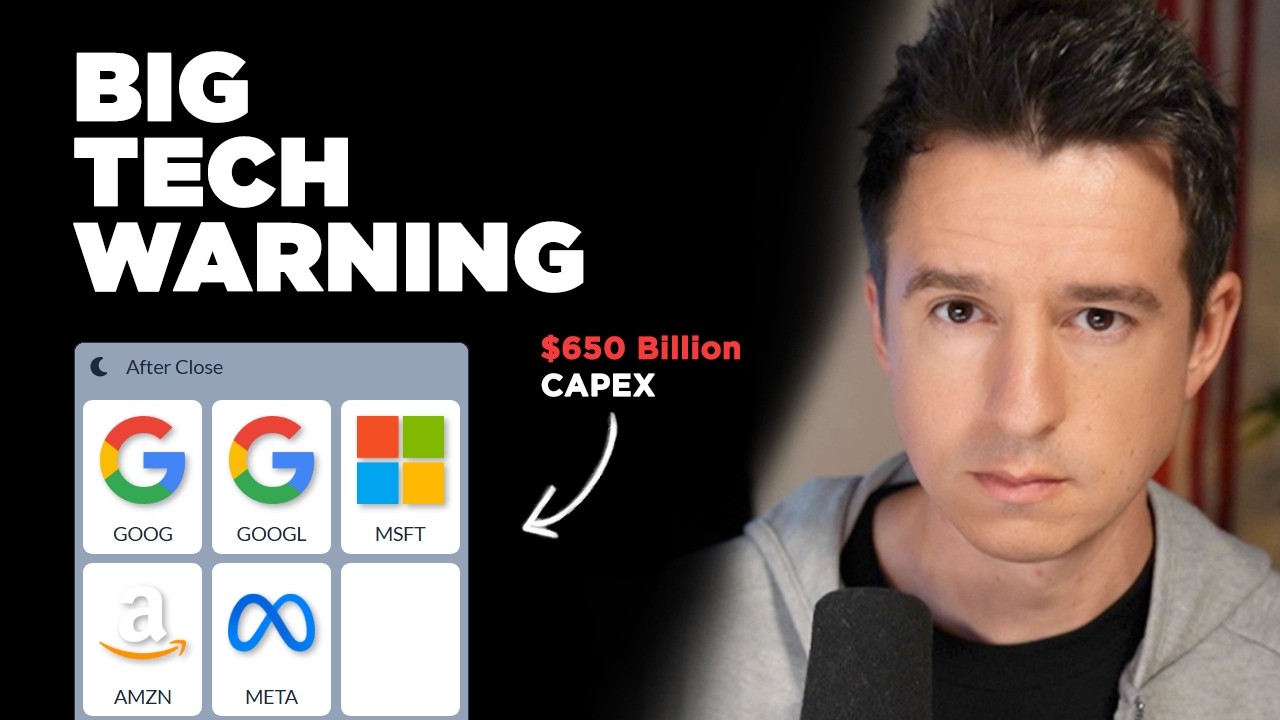
Today on the Jose Carlson show, we are starting off one of the craziest weeks that I've seen. Just tomorrow, we have companies like Spotify, S&P Global, Visa, and Robin Hood all reporting their earnings. Now, that seems like a big day in and of itself. Lots of big companies just tomorrow, but that's not even the most important day by far. In fact, getting into Wednesday, right here, we have Google, Microsoft, Amazon, and Meta all reporting their earnings on the same day after market close. That is nuts. That's going to be one of the craziest days we've seen in the market. And that's not even the end of it. Come Thursday, we also have Mastercard reporting earnings and Apple Thursday after market close. So, this is a jam-packed week. We have trillions of dollars worth of market cap all reporting their earnings within the same half hour. And we're going to be going over all of it. I'll be giving you a preview of what I'm looking for going into these earnings and the types of things that investors and especially Wall Street will be laser focused on looking at these earnings. So, I'll be giving a preview into all of that. Plus, we have some news to get to. For example, OpenAI seems to have escaped the grasp of Microsoft. They now no longer have an exclusive deal to run their services through them. We'll be looking at the implications of this. Elon Musk has sued OpenAI. This happened a while ago and that lawsuit is finally beginning and we're going to be looking at the legal implications of this, the case that Elon Musk has, as well as the defense from OpenAI. And then of course we have the fail of the week which in this case is a US soldier that used poly market to bet on the capture of Maduro. The problem is he was one of the ones involved in planning and capturing Maduro. This is a common theme that we've seen where people bet on things they're doing themselves, but this one is particularly bad. Now you may notice that I don't plug sponsors all throughout my episodes and I run very low ad volume as well. The reason why is because I've built my own business with YouTube and that is primarily through qualum.com. This is the tool that I've used every single day and it's helped me identify companies that are great compounding machines. For example, one of them that I identified using Qualrum was Texas Roadhouse. This has been one of my best investments ever and I was able to realize that by looking at the charts in the visual data illustrating the fundamentals of this company because I was able to visually see the fundamentals and see how much of a compounding machine this company was. I invested $30,000 into it and turned that into 70,000. Qualum works by having a lot of signal and no noise. And there's so many cool things that it does. For example, now you can monitor your entire watch list. It's been completely updated to show you how these companies are trading in a historical range. We also have an advanced charting tool that's incredible. You can mix and match any metric like I can look at the revenue of Meta and compare that against the stock price. We can look at the earnings calendar which we'll be using today. Transcript summaries from any companies so you can get an update on what's going on at a glance. There's a simplified discounted cash flow calculator and so much more. In fact, one of the things we just added to Qualrum is Qualrum Studio. This is a streaming library for investors. It's full of portfolio updates, deep dive analysis into companies, earnings reactions. The purpose is to give you ideas and insights into different stocks you may have not otherwise considered. Now, if you haven't tried out Qualum, luckily for you, you can try it out risk- free with a 7-day free trial. So, you can give it a spin. And if you do, I think you'll love it. We have 13,000 active members and it continues to grow every day. So try it out now at qualrum.com. Now starting off this week, we look at tomorrow on Tuesday is when the important companies start to report their earnings and one of the first ones is S&P Global. Now S&P Global is a fairly large position in my portfolio. I have it in both the passive income portfolio and the story fund. It's about a $100,000 position in the passive income portfolio with around $18,000 in gains or 25% money weighted returns. It's done all right, but not great. In fact, S&P Global was doing great until Claude came around. And as we know, Claude has ruined the party for a lot of companies, and it's done the same for S&P Global and Moody's. S&P Global has a number of businesses. They have a credit rating business, which of course is the big profitable one. They share that duopoly with Moody's, but they also have an indicy business where they control the Dow Jones indices. So, the S&P 500 is owned by S&P Global. They also have an analytics business. Now, the analytics business is providing lots of market data, company profiles, writeups, lots of analysis on businesses. S&P Global has data on commodities, on private companies, on things us public investors don't even worry about. They have so much data that they've collected that they run an analytics business. One of the interfaces to access that is called Capital IQ. It's like a Bloomberg terminal. S&P Global was growing this market intelligence business, this data business. They were doing acquisitions to bolster it and provide even more data for their clients. And then came along Claude. And Claude comes in with a plugin that seemingly does a lot of the stuff that S&P Global is selling. Claude has a plugin that has a lot of data and it can do a lot of financial analysis. So, a lot of investors became immediately concerned that S&P Global's growth path is being disrupted by Claude. In fact, you can see that in the stock price. You don't really have to guess. It's right here. And then the stock dropped by over $100 in the subsequent days. Now S&P Global is trying to get back the narrative. They're trying to paint a picture that they're not going to be disrupted by Claude. Management has said that this is a mistake. Investors are making a mistake. They said that we've ramped up buybacks. We're going to buy the stock like crazy if you guys are selling it off because they don't see the disruption that the market sees. But many investors are just saying that the management's just talking nice and Claude presents a real risk. Now with S&P Global, there is a different comparable company that already reported earnings and that company of course is Moody's. We already know that S&P Global is going to do well with its indic rating business. Moody's has shown us that. So the big question with this earnings is how well is it going to do with its market intel business. That's going to be the big thing that decides whether or not the stock trades up or down. Now next up we have Spotify. This company's reporting earnings tomorrow as well. It should be before market open. Spotify is a stock I've always admired. I think it's one of the best tech companies out of Europe. And it's truly staggering the growth that this company has. Look at the premium and adup supported users. Right now, they have almost 800 million monthly active users. Spotify is going to surpass a billion. They're going to have a billion users on their music platform. And that's a big deal. First of all, because as this number grows, the moat of Spotify becomes more and more defined. It becomes much harder to break. It's almost impossible. In fact, I'd say it's an insurmountable task today to have any type of new music service come in and just blow Spotify away and disrupt the company. I don't think it's going to happen. Big tech has been trying. Who's going to be able to put more effort and capital and has more distribution to try to compete with Spotify than the likes of Apple and Google and Amazon? No one in the world can. Yet, Spotify continues to persevere and grow. It shows how big the mo of this company actually is. It's a free music application. So many people think that it's just a commodity. It's a company that you can switch from at any time. But Spotify has shown to be incredibly sticky. When people leave the platform, they have a 70% chance of returning within 40 days. That's incredible. And I believe that it's going to continue growing. Part of the reason that Spotify traded down was because that Daniel Ek, the founder of the company, has stepped away. But I think the company's outgrown them. The moat's too wide right now. The product's too good. And there's too many people already stuck on the platform. They're not going to move away. The product remains ubiquitous. You can use it on any device, any vehicle. They make it work anywhere. They have this handoff mode that works great. And Spotify is now going into artificial intelligence, making AI playlists, AI DJs. You can put in what type of vibe you're wanting to listen to and it will just play music from that. So, they have basically every feature imaginable and it continues to get better by the day. I believe that today Spotify is a buy going into these earnings. I think they're going to be good. Now, we're still on tomorrow, just Tuesday, and this keeps going. We have Booking Holdings reporting earnings tomorrow. Booking Holdings is an incredible company and it's a super profitable company. I used to hold Booking Holdings in my portfolio. I made some money on it and decided to take the gains and simplify my holdings. The thesis for this company is that travel's always going to be around. There's always going to be a human need to go and see the world and to go to different places. And that desire won't change no matter what wars we go through, uh what economic turmoil we go through. There's always going to be travel. And you can see that illustrated here. The only time the booking holdings revenue has gone down was when there was COVID and people could not leave their homes. They also have this deep infrastructure of so many hotels all throughout Europe using their platform, which creates a a massive moat for the company. One side that is under competitive threat right now is the front end of the company, meaning the user interfaces. There's a lot of companies that are trying to become the AI layer of how you plan vacations, how you plan what to do, and how you book things. And that battle is raging right now. Booking is trying to compete. Google's trying to compete. You have Perplexity and Chat GBT all in the mix. They want you using their booking platform to plan out your vacation. And then they want to package it and give it to booking at the end of the day. And that does present a layer of disintermediation between the user and the actual service. So there is a risk going on there, but I don't believe the risk is going to show up in this earnings report. I don't believe so at all. I think this earnings report is going to be fine, and there's not going to be any signs of trouble from what I see. The type of risks that booking holding face are longtail risks. They're ones that could present themselves further down the road. Now, finally, on Tuesday, we have Robin Hood. They're going to be reporting earnings aftermarket close. And Robin Hood has been on a little bit of a roller coaster ride. This is one that I think investors need to be a bit more careful with. We have the stock going all the way up at one point to $148. Now it's currently at 84. So it's down around 40% from the peak. The massive surge in growth over the past couple of years has been by user acquisition, rapid product evolvement. Robin Hood has gone into everything imaginable from crypto to betting markets. Uh it's more than just an investment app. It's a do everything financial app. They're even trying to compete against American Express with lending and premium credit cards. So, Robin Hood is trying to become the one-stop shop for everything financial. Investors are still expecting huge growth in both revenue, net income, and user growth. If Robin Hood does not meet those targets, the stock could drop dramatically. I think that Robin Hood offers a great product. I think that the leadership is aggressively expanding. They understand their demographic, what their users want. So, I don't have any reason to be particularly bearish on this one. I think overall it's a good bet. Now, moving on from Tuesday to Wednesday, we get into literally the craziest earnings day I've ever seen. After market close this Wednesday, we have Google, Microsoft, Amazon, and Meta all reporting earnings all at the same time. Now, the exact time they drop the earnings report will probably differ by like 10 to 20 minutes maybe, but this is basically going to be all at once. We're not going to have time to really even look at these reports thoroughly by the time they're dropped. Another interesting thing about this is they're all the same type of category of companies, meaning that Google's one of the big AI capex spenders. Microsoft is another one of the big AI capex vendors. So is Amazon. So is Meta. Now, why is this so crazy that these very similar companies are reporting at the same exact time? See, typically as an investor, you have some time to diagnose and digest what's going on with the market because you have similar thematic companies that have reported before the ones that you're looking at. For example, if you're looking at American Express, you've already seen Robin Hood. Or if you're looking at Paramount, you've already seen Netflix. Or if you're looking at S&P Global, you've already seen Moody's. See, the companies that have previously reported help set the expectations that you can look at for these other companies. But in this case, we're not getting that. We're just getting the big four cap expanders all at the exact same time. So there's no leadup. There's no appetizer. There's no preview or extended trailer. We just get to go in Wednesday and see what happens. So since we can't look at any other big tech AI cap expander to get an idea of what's going to happen, we have to look at the next best thing, which is the companies that are somewhat related in the pipeline. Companies like ASML, Intel, or TSM. Those companies have already reported. And based off of their reports, you can comfortably say that big tech, these ones, they're going to raise their capex guidance. They're going to up the amount that they're spending in capex. And investors may not like that. The numbers are already a hard pill to swallow for many analysts. They're difficult to defend for these leaders, but they will continue to defend them and they will continue to raise the amount of capex they're spending. Again, we've seen that with the supply chains. Companies like ASML are saying it's going to be a great year. business is good. There's going to be more chips being made. TSM is saying the same thing. There's more demand than ever. Intel saying the same exact thing. All of them are pointing to advancements, increases, not a decline. Then you have the leaders of Google, Microsoft, Amazon, and Meta all saying that AI is a once in a-lifetime opportunity, that it's incredible, that we can't miss it, that we already have customer commitments going out for years. They're all pointing in one direction, and that is that they're at least going to spend what they have been, and they're most likely going to bump that number up. One of the things that's coming along with this increased spending is they're also looking for different places to cut costs. The Wall Street Journal recently reported an article about how these tech companies are rushing to trade their people for more chips, and some of these companies might come to regret the exchange. Microsoft and Meta Platforms are just the latest major tech companies trying to scale back their workforce in the name of artificial intelligence. Meta's latest plan will cut about 8,000 people from its workforce. Microsoft, meanwhile, is trying to trim its own headcount with a voluntary retirement program available to around 7% of its US employees. And there's other companies doing this as well, like Oracle and SNAP. And then we have this chart showing the amount of layoffs that are happening each quarter. And of course, you can see the rapid increase from Q4 of 2025 to Q1 of this year. So, this is the narrative that's been spun that artificial intelligence is causing massive amounts of job loss. In fact, these big tech companies are quite literally buying lots of AI chips while firing employees. How could it be any more clear? You are being replaced by AI. Now, this narrative that's becoming more pervasive by the day, I believe, is wrong. I believe it's just a wrong narrative. And you can see the evidence in the charts. For example, let's bring up Microsoft's employee count. You may notice a trend here. When Microsoft takes on a lot of employees in only a couple quarters, what happens afterwards is that the employee count usually goes flat or down. Okay? So, every time there's a big jump like there was in 2006, 2007, the employee account goes flat or down. There's another big jump from 2013 to 2014, Microsoft did an acquisition. They brought on a lot of new employees and the employee count went down afterwards. Then Microsoft went through a hiring spree as the company grew, but they had an abnormally large influx of new employees in 2022 right here. And wouldn't you know, like the rest of history, the employee count goes flat or down for some time. The next quarter, they actually reduce the employee count after that massive surge. And now Microsoft has announced slightly more cuts. Now again, they announced cuts of around 7,000 employees. But if we look at the total employee count, it's at 228,000, which means that this will basically be flat since their massive hiring surge in 2022. So the pattern here is quite clear. Microsoft goes through periods where they have too many employees and they take employees on too fast. And in every case that happens, the employee count is flat for some time. And the same thing is happening here. Now, Microsoft is not the only one to illustrate this pattern. We have the same thing for example with Snapchat. Snapchat hired a ton of people in 2021. The employee count went from 3,800 to 5600. And then what do you know? After a rapid increase in their employee count, it goes flat and down for some time afterwards. But in either of these cases, they're not blaming overhiring as the problem. They're saying it's AI. AI is the reason that they need fewer employees. See, from the management's perspective, there's two ways that they could frame this problem of having too many employees. One of them could be, "Oops, we hired too many people. My bad, so we have to fire you." Or the other one is that we have this new technology that's so great and so effective that now we can just do more work with fewer people. What do you think is a better story for management to tell? What do you think represents them better? What do you think's more defensible from management? that this new technology is making the company more efficient and profitable or that they just made a big mistake with overhiring in 2022. Well, obviously every manager that's needing to reduce headcount is going to blame AI. They're going to shift the blame to AI because it makes them look smart, not dumb. It makes them look like they managed the situation correctly, not incorrectly. So management has a very big incentive to blame the overhiring that's quite obvious in the charts on artificial intelligence. We can see similar patterns happen with Google. Meta, you can see the same thing. Meta was doing layoffs far before AI had any impact on productivity. Oracle's no exception. They say that they're laying off people and you can see the exact same thing. Preceding 2022, they had a massive influx of employees ever since they overhired in 2022. Now they're cooling off. So, I believe the excuses are only partially true. There's some parts of these organizations that have become more effective due to AI, but a large part of these layoffs is simply overhiring, and it follows the exact same pattern we've seen for the past decade. And I won't be surprised in a couple years when they start hiring again. Now, when we look at the biggest things that will impact these stock prices as they report at the same time, it's going to be whether or not we see actual return on the AI capex spend. It's true that Google, Amazon, Meta, and Microsoft are all increasing the amount that they're spending on capex. Investors know that and we've become aware of it. But what we need to see is continued evidence that that capex spend is paying off, the returns on investment are coming in, that revenue lines are growing, that profitability is growing within AI segments. For Google, there's a lot of ways that they can illustrate this. Google's going to illustrate that their capex is worth it by Google search growing more profitable, that the AI overviews mean more people are searching more things. They've been able to do that so far, so I have no doubts they will in this next report. We have YouTube ads. Google needs to show that they're using artificial intelligence to make YouTube a better product, that shorts are better monetized, just like Meta is doing with their short form video, that YouTube's able to continue winning on the television against the likes of Netflix. They are so far the biggest TV streaming company in the world and YouTube should continue to grow. They also are going to of course show off that they're gaining more subscriptions. I think YouTube will continue to grow in their market share of subscriptions. There's so many people signing up for YouTube memberships, YouTube Premium. They're going to make a fortune off of that. We also have Google Cloud, which is going to be the biggest thing that investors look at. Google Cloud today is growing so fast, and I'm so bullish on this business line. I I mean it's incredible. And I've been pointing out Google Cloud every single quarter for like years now. It's astonishing to look at the growth of. Just look at these numbers. It's growing by 35%. Every single quarter it grows more. And while it's growing, while that's happening, the margins are continuing to march up now to 30%. These margins are going to get up to like 50% over time. Google's backlog is also growing exponentially. This, for example, looks like a data error or a mistake. It's not. This is accurate. Google's backlog is now at 240 billion. On top of that, I think we'll get some bonuses with Google. I think they're going to report good things for the robo taxi network, which is Whimo. They have the biggest one, the most successful one today. It's fully operational in so many different territories, and it continues to grow. And I think that we'll see some interesting updates with that as well. Right now, I believe that Google is a fantastic company. I believe it's going to keep winning. I haven't sold a single share, but the price does reflect a more premium company today. So, what I'm hoping for with Google is the earnings report to make the stock stay relatively flat or just move a couple percentage points. Then we have Microsoft dropping the report again at the exact same time. Microsoft's trading at 425. So, the stock dropped a lot. It's been recovering a little bit here. So, Microsoft traded up to 540. Times were good. It seemed unbreakable. And then they had a bit of a barrage of bad news that claude was now actually threatening the Microsoft Office suite. On top of the cloud risk that Microsoft is dealing with, there's also the cloud business. While Azure originally got its start by migrating all these companies, all the Fortune 500 companies from on premise to the cloud and that gave them a natural competitive advantage against the likes of Google and uh Amazon. They've also run into some issues. For example, Microsoft is more reliant on one company which is Open AI. OpenAI just recently broke ties with Microsoft. They're no longer the exclusive provider of their models. We already have Andy Jasse tweeting out, "Very interesting announcement from OpenAI this morning. We're excited to make OpenAI's models available directly to customers on Bedrock in the coming weeks alongside the upcoming stateful runtime environment. With this, builders will have even more choice to pick the right model for the right job. So, Amazon is basically now distributing one thing that Microsoft had exclusive. But then we also just have the cloud business itself. But then you also have Google cloud which even though it's smaller than Microsoft in total volume or the revenue that it generates, I believe it's a superior cloud because Google has invested more time and money into their cloud. For example, they own their own AI models. They have Gemini and DeepMind. Microsoft doesn't. Google also has way more vertical integration with their TPUs. Microsoft technically has their own chips, but they're nowhere near as evolved or mature as Google's. Google has been decades ahead of Microsoft in developing these. So, the technology is behind Google, not Microsoft. And while Microsoft is relying on leveraging its core suite of products to force people to use their services, I don't believe that's as strong of a pull as having just a better comprehensive vertically integrated cloud. So, I think that Microsoft obviously is super powerful. I'm bullish on the company, but as I'm invested in both of these companies, you'll see that the position sizing shows what I'm bullish on. I have Google as a 15% position. It's massive. It's a $112,000 gainer. So, it's up right now 114%. And then I have Microsoft as a 6.5% position, $33,000 in the green, a 57% gainer. So, I like Microsoft. I have it as a core holding, but I'm just not quite as bullish on it as I am Google. The valuation has also represented this view. For example, Microsoft previously and almost always has traded at a higher PE ratio on a forward basis than Google. So, Microsoft would be at a 30p, a 35. Google would be at a 25. Now, Google's trading at a higher PE ratio than Microsoft. Google's the one with the 30PE. So, we're seeing this dynamic playing out of the market rerating these two companies. And if I have to make a prediction, I think that Microsoft will trade around the low 20s, 22, 23 Ford PE ratio for some time, but eventually I believe the stock is going to head right back up to around a 27. So buying it today, I think investors are going to get some multiple expansion, and I think along with that, they'll get higher returns. Now, the next two reporting earnings, I could not be possibly more bullish on either of these companies. We'll start off with Amazon. With Amazon, it's currently at $262. You see the price that it's at? That's a little bit surprising, right? It seems like it just snuck up there. Amazon seemingly yesterday was at $200 per share. Now we're at 260 262. We look at this again. What happened? This all happened in like a a month. One month and Amazon's up 30.3%. That happened real fast. Wall Street is finally starting to understand the thesis for Amazon. And I believe it's just getting started. In fact, I believe even after this huge runup 30% in a month, I think that the stock is still a buy long term. Now, there may be a pullback because every time a company runs up this fast, this quickly, there's usually some type of pullback. So, I would not be surprised if on Wednesday, Amazon pulls back a little bit, that wouldn't be shocking. But if we look at Amazon overall, I think this is one of the most obvious bets in the market. Consider what Amazon's doing. This was April 9th. In his annual shareholder letter, the CEO disclosed that AWS AI services have already reached roughly $15 billion in annual revenue run rate and reiterated that Amazon plans about $200 billion in 2026 capex, much of it for AI infrastructure with substantial customer commitments already in hand. So, Wall Street's now becoming more convinced that this isn't such a risk, that Amazon really has the customers to back this up. The whole narrative of the overbuild, accidentally spending too much money on capex is going to die right before our eyes. We're going to see that narrative fizzle away. The bears will have to move on to something else because Amazon will show that every single AI factory that they build will immediately be monetized. Immediately, they'll have customers for it. Analysts will be laser focused with Amazon on how much AI revenue they're making, how many customers they have. And I believe that Andy Jasse is getting better at sharing the story. He's becoming more convincing when he talks about the incredible demands they have and how this is the right decision for the long term of the company. So I believe even as the cash flows go down that the story and the revenue will show that a brighter future awaits. Amazon has Project Kyper with their satellites. They have millions of robots and they're developing more every day. They're working on humanoid robots, self-driving vans. They have an EV fleet of vans already. They're going to raise their operating margins of their retail business over time. The profits that Amazon could generate if they wanted to, I think already could well exceed a hundred billion in free cash flow. The reason they're not doing so is because of their investments. They're investing so aggressively in capex that they're holding off on going into profit mode. For some investors, that will take too long and they'll move on to different companies. But if you wait for Amazon to actually squeeze on the profits, you're going to miss the jump up. Some of that has happened in just the past month alone. But I think there's more to come. Meta has a taller task to defend its large capex spend because unlike Amazon, Google or Microsoft, they're not leasing their cloud to other customers. Meta will have to continue proving that the AI spend is worth it, that it's making all the services all throughout their application more profitable and better for users. For example, they'll have to show that they have more video watch time, more engagement, higher ad conversion rates, more businesses listing more products because of the ease of use. I expect Meta to grow very fast this quarter. I think we're getting in the high 20s growth rate and I think that they're going to raise their guidance for their growth rate throughout the year. Meta is on fire and the amount of ways that they can optimize a business like this is virtually endless. So, I have high expectations for this company. Overall, I am bullish and invested in all four of these companies. I have very optimistic views of them and I believe overall the AI spend and enormous capex they do is well worth it. Now finally we get to Thursday where we have Apple reporting. Apple has been asleep at the wheel when it comes to AI. They just haven't done much. Some people say that's actually a great strategy because they can let everybody else waste all this money in capex and Apple can just make a lot of money not building out 100 billion infrastructures. But while that's the case that they're saving money and they're maintaining their margins and their cash flows, they also aren't going to have their own tailor made AI for their own products. So Apple is sacrificing technological advantage for their margins. On the other hand, Meta is throwing their margins in the gutter to increase their technological advantage. Each of these companies are playing different games. Apple's focused on financial engineering. Meta is focused on literal engineering, building out AI models. When we look at the two strategies, I feel more comfortable at the company that's expanding in its technological infrastructure that's not focused on today's margins, but rather focused on having the best tech stack possible. Investors in Apple want a cash flow machine, a high margin one. They don't want a company that will invest aggressively and throw its free cash flows in the gutter. So, Apple's in a completely different category. And I view it today more like a consumer staple. Now, moving on from earnings this week, we have some headlines here. One of the big pieces of news is that Elon Musk's lawsuit against OpenAI is now finally getting to court. If you haven't heard, Elon Musk has sued OpenAI and it's finally going to court. And the basis of this lawsuit is that Elon Musk helped found OpenAI. He's one of the original founders, bankrollers for it. He helped fund it on the basis that he thought it was going to be a nonprofit. So, he thought it was going to better the world. And then he says Sam Alman, Brockman, and Microsoft got their greedy hands on it and they turned it into a profit-driven company that betrayed the original mission. So that's the way that Elon Musk is portraying the situation. Now Sam Alman and the OpenAI team are saying that's not the story at all. Musk knew from the beginning that part of this was going to be for profit. He left the company after a power struggle. After he couldn't get ultimate control over OpenAI, he took off and started his own company, XAI. And then, wouldn't you know, OpenAI became vastly more successful than his own company, XAI. So, Elon Musk is just jealous and he's trying to slow us down. He's trying to put sand in the gears. And that's the way that OpenAI is portraying it. And in this case, Elon Musk may win even if the lawsuit loses. Well, legal experts uh seem to think that Elon Musk has an uphill battle uh that it's unlikely that he's going to win. That said, I would almost argue that in a lot of ways he has already won. If you look at kind of the year ahead, Elon Musk is going to uh taking SpaceX public, an IPO, kind of framing it as an AI company. Open AAI also has ambitions of going public later this year possibly. And uh he's beating them to the market. They've got this kind of cloud hanging over them, OpenAI does, and that's uh in in a lot of ways that's thanks to him. He spent the last two years really kicking up a lot of dust. uh questioning kind of Sam Alman uh the the CEO of Open AI questioning kind of his ethics uh which is not a fun thing to be doing as you go into an IPO. >> Now this columnist puts it lightly that Elon Musk has been questioning Sam Alman's ethics. He hasn't been questioning him. He's been outright saying that Sam Alman's a liar. He can't be trusted. He's a bad guy. He's a con man. Uh Elon Musk has called him every single name in the book. And this lawsuit is one more accusation claiming that he lied and he turned the company in a different direction. In essence, what Elon Musk is trying to do is to define the character of a competitor. He's trying to make Sam Alman a bad guy in the public media and doing this through any means necessary, even when it comes to a lawsuit. Sam Alman has less of a defined character in public perception than Elon Musk. So, while you could say, well, this reflects badly on Elon Musk because he's throwing out all these accusations, most people have already made up their mind on Elon Musk. Most people already have a very strong opinion of him one direction or the other. But with Sam Alman, outside of the inner circles of tech, most people don't really know him. They don't have a strongly defined opinion. And he's defining the character of Sam Alman to the public right before the company IPOs. So, a lot of the goals that you could have as a competitor have already been met. So, we have no clue how this is really going to turn out. It's anyone's best guess, but it's going to create a lot of headlines over the coming months. Now, moving on, we get to the fail of the week, which in this case is a story about a US Army soldier that decided that it was a good idea to bet on the capture of Nicholas Maduro. As we know, Nicholas Maduro was captured by Army special forces in the middle of the night. They came in with helicopters and guns ablazing. Uh they went into his room and grabbed him and his wife and flew them out of the country. And while that happened and it was an incredible military feat, I've really never seen anything quite like that, someone benefited in other ways because of this capture. One of them was a US Army Special Forces Master Sergeant. His name is Ganon Ken Van Djk, and he was quote involved in the planning and execution of Operation Absolute Resolve, which apprehended Maduro and his wife. This soldier, who was 38 years old, wagered a total of about $33,000 in 13 or so bets in the weeks leading up to the operation with the knowledge that the United States was secretly planning military action against Maduro. The bets won Van Djk nearly $410,000, the indictment alleges. Now, the way that Van Djk won this $410,000 is quite interesting because he took a lot of steps to try to pull this off without anybody else catching him. Let's go ahead and read some of the details. On December 26, he created a polyarket account and began trading on the markets related to questions about Maduro and Venezuela. All of the wagers were yes positions on contracts that said that US forces would be in Venezuela by January 31st, 2026, that Maduro would be out of office by that date, that the US would invade the country by January 31st. So, these seem like highly improbable timelines. If you didn't have advanced knowledge of this, you are none the wiser that all these things would happen, that the US would be in Venezuela, that Maduro would be out of office. But he started just wagering yes on all of this. Just randomly created a new account. This is the only thing he's wagering on, and he's wagering yes on this very fringe, very difficult to predict bet. Already, it doesn't look like a smart plan. Now, after those bets paid off, netting him nearly 12 times the amount that he wagered, Van Djk allegedly sent most of his winnings to a foreign cryptocurrency vault before depositing them into new online brokerage accounts. When news outlets reported unusual trading in the Maduro contract on Poly Market, which matched the amount of details in the indictment wagered and won by Van Djk, quote, Van Djk then took steps to conceal his identity as a trader in the Maduro and Venezuela related markets. Van Djk asked Poly Market to delete his account, falsely claiming that he had lost access to the email address to which the account had been associated. So, right after he wins the money, he transfers it away. He converts it to crypto. He contacts Poly Market and he's like, "Hey, could you wipe away my account? I totally just lost my my email address. So, go ahead and just delete that very quickly, please." In hopes that that would prevent the government from catching up. That same day, Van Djk changed the email registered to his cryptocurrency exchange account to an email address that was not subscribed to his name and which he had created on or about December 14th. This is terrible for a lot of different reasons. First of all, it's just terrible judgment. When you're highly specialized and involved in something that's proprietary information, of course, it's going to raise red flags if you sign up a new betting account and you immediately start betting on the thing that you have insider knowledge of. You don't have any type of pattern. you have no type of history. They're going to be looking at you with extra scrutiny. And then the fact that he won every single bet he made on this very specific fringe thing that not many people are betting on and 12xed his money and then immediately got off the platform. Well, it couldn't be any clearer. Poly Market must be looking at this saying that this is obviously fraud. Someone creates an account, does a fringe bet, wins a bunch of money, and then immediately asks for their account to be deleted is more than a red flag. But this is also worse in this specific situation. Van Djk is charged with unlawful use of confidential government information for personal gain, theft of non-public government information, commodities fraud, wire fraud, and engaging in monetary transactions in property derived from specific unlawful activity. And this is especially bad for him because he didn't just bet on something that he has proprietary knowledge of. He bet on a military activity, a very specialized, very long planned military activity. The planning of this Maduro operation took months. It costed millions of dollars. They rebuilt his entire home to practice invading it. The government went through painstaking efforts to make sure they got it correct, that they pulled off this operation flawlessly. And here he is gambling on it in outside markets. This could have possibly given other people information on what's going on. It could have alerted outsiders that there's going to be some type of operation in Venezuela. It could have alerted Maduro possibly to change the situation to move away. So this soldier didn't just jeopardize his own life. He didn't just jeopardize his own future. He jeopardized the entire government's operation. And this type of thing needs to be cracked down on. There needs to be harsh penalties for people betting on inside information. Both normal people in Poly Market and Koshi as well as government officials. We can already see that this is going to be a massive problem now that Koshi and Poly Market make it so that everything's a gamble, everything's a bet. So, it's unfortunate to see this soldier make this terrible decision. He'll likely end up in jail because of it. He's ruined his life because of it. And we're going to see more and more of this as these betting markets play out. And that's why it is the fail of the week. That's all for this episode. See you in the next one.

Comments 0
Sign in to join the discussion.
Sign inNo comments yet. Be the first to share your thoughts!