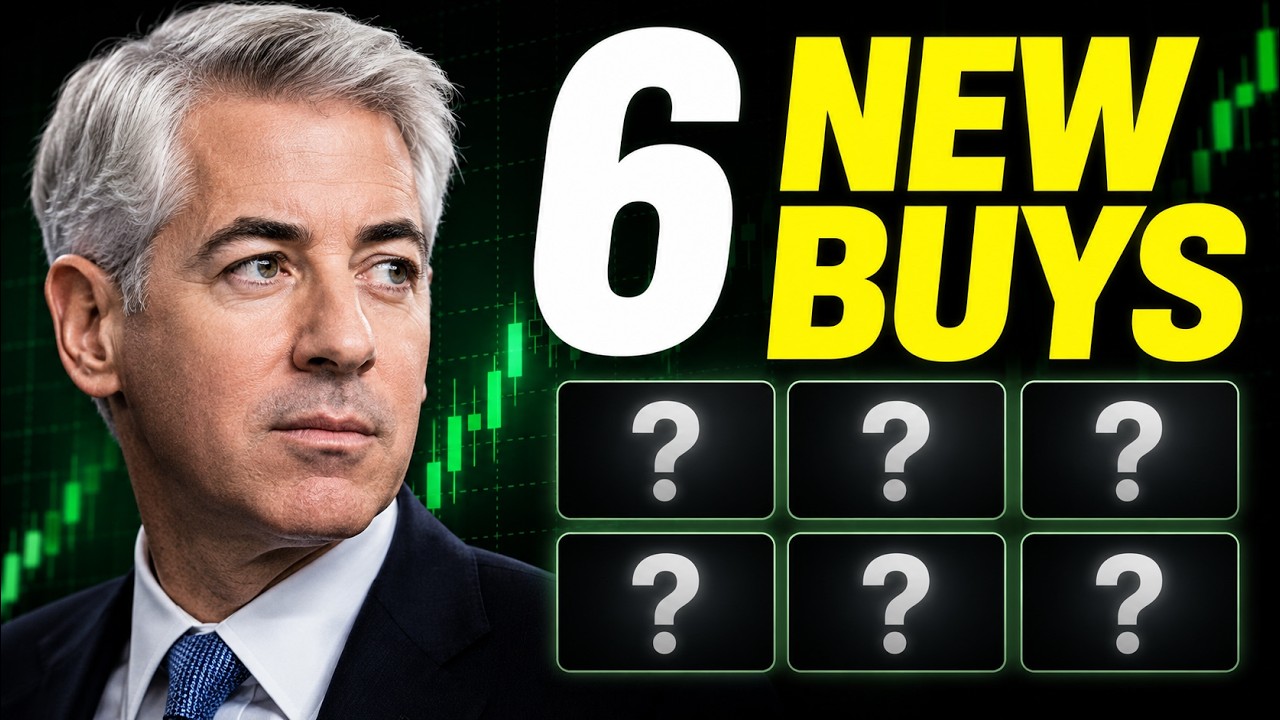
Bill Ackman Just Bought 6 Stocks — I Ranked Them

- Video return
- —
- Calls
- 6
- Buy / Sell
- 6 0
- Published
Recommendations
Entry is the asset's closing price on the publication date. Current is the last close on record.
-
Entry $78.24 13 Aug 2026Current $78.24 13 Aug 2026Result +$0.00
Number two is Netflix.
-
Entry $567.04 13 Aug 2026Current $567.04 13 Aug 2026Result +$0.00
And number one for me is Mastercard.
-
Entry $73.52 13 Aug 2026Current $73.52 13 Aug 2026Result +$0.00
At number six is Alon.
-
Entry $155.24 13 Aug 2026Current $155.24 13 Aug 2026Result +$0.00
Number five, Intercontinental Exchange.
-
Entry $365.45 13 Aug 2026Current $365.45 13 Aug 2026Result +$0.00
At number four is Visa.
-
Entry $422.67 13 Aug 2026Current $422.67 13 Aug 2026Result +$0.00
Number three is S&P Global around $410 today.
Full Transcript
Bill Aman has just revealed six brand new stock positions. But what caught my attention isn't simply the fact he's buying, it's what he's buying and what he's deliberately not chasing. Because look underneath the market this year. We can see Nvidia that's up 20%, bro up 20, AMD up more than 100%. Some parts of the AI infrastructure trade, well, they've absolutely exploded. And that divergence, well, it's also in fact continued this month. Nvidia, Micron, Brocom, Oracle, Dell, many of the infrastructure beneficiaries, they're ripping higher. Yet, Bill Aman has just gone shopping somewhere else. Persing Square says it's followed these companies for years, waiting for their prices to become disconnected from what it believes they're actually worth, and volatility has finally given them that opportunity. Now, those six companies are Netflix, Visa, Mastercard, Intercontinental Exchange, Alcon, as well as S&P Global. Many of these companies we've spoken about a lot recently where they're looking incredibly attractive and I've run my own valuation work on four of these companies and interestingly some of my numbers land remarkably close to where Wall Street sees fair value. But I don't agree with Aman equally on all six. So by the end I'm going to rank everyone from number six to number one and tell you which AMAN purchase I think offers the best risk to reward today. And before looking at the stocks individually, there's one question we need to answer. The market's near record territory. Earnings are extremely strong. AI stocks are surging. So why is a value conscious investor deploying billions of dollars now? Listen to Aman's answer because it sets up the entire portfolio. >> And and in terms of why now, it's actually a great moment to put capital to work. Um a lot of the best businesses in the world we think are trading at very attractive prices and the backdrop of a war and uncertainty and volatility. uh with some very strong economic uh undercurrens >> and that's the contradiction. Stocks can be near record highs while individual companies are simultaneously becoming cheap. Persing estimates its portfolio companies collectively trade around 19 times earnings while potentially compounding EPS around 20% over the next 3 to 5 years compared with roughly 20 times earnings and 12% estimated EPS growth for the S&P 500. And this chart is extremely important. The S&P 500's return this year, it hasn't primarily come from investors simply paying bigger and bigger multiples. According to this attribution, earnings contributed 20.3 percentage points, while P compression actually removed seven points. Dividends added another8, leaving the market up roughly 14%. So fundamentally, earnings have been doing the heavy lifting. The S&P 500 is currently expected to post four consecutive quarters of 20% plus earnings growth. That's extraordinary. But here's the problem. Those gains have been incredibly concentrated. Persing calculates that semiconductors and tech hardware and equipment were just two groups accounting for roughly 22% of the S&P market value. They've generated nearly 85% of the index gain during the first half of the year. More than 90% of S&P companies collectively contributed less than 2% and that explains what Aman thinks is happening because he believes investor attention has become obsessed with what he calls the new thing. Listen carefully to this thing about markets is people always bring their eye to the new new thing. Um and the new new thing is sort of chips and semiconductors and energy and that's where you know uh the shorter term capital is going. what tends to happen is really high quality things get left behind. Um, and the same thing really happened, you know, I was I was there in 2000, you know, in the in the in in that sort of bubble. This is, you know, this is different. I'm not saying this is um, but there's some analogies and the analogies are people got excited about internet stocks and Berkshire Hathway traded at the lowest valuation I think it ever traded at its history. As people said, okay, that's all old stuff. I think a similar thing is happening today. >> And that's the key. Aman isn't saying AI isn't real. He's saying attention has a price. When everybody looks in one direction, highquality businesses elsewhere where they can suddenly become neglected and institutional flows show just how aggressively money's rushed back towards technology. And this clip just before we get into those stocks gives you an idea of how extreme those flows have become. bespoke today talks about the beat rate for tech the highest 85.1% one of every 100 tech stocks that have reported 85 of them have beaten expectations you have had according to bank of America who watches the flows of what their institutional clients are doing tech's second biggest inflow ever so driven by hedge fund clients remember we've been talking a lot about the deg >> from hedge funds there's been a lot of deleveraging the positioning environment The field, if you will, is cleaner now. Tech saw the second biggest inflow week of all time. Money's going where they think they can get a nice reward. And while all of that money rush back into tech, Aman bought these six. So, let's see what he thinks everybody else is missing. And let's start with perhaps the most dramatic, Netflix. The stock is around $74, down 21% this year. And from his 2025 peak, the decline well has been much larger. Pushing says it opportunity emerged after Netflix fell roughly 50% from its June 25 high, taking the valuation from more than 40 times Ford earnings to around 21 times. But a falling stock isn't automatically a cheap stock. So what changed fundamentally? Well, we can see revenue last quarter reached 12.6 billion, up 13% year-over-year. Operating profit 4.2 2 billion, operating margin 33% and net profit coming in at 3.4 billion. That's not what a collapsing business looks like. Netflix's quarterly revenue, well, it continues moving higher. And this, well, it's perhaps an even more interesting chart. The share price has fallen sharply, while free cash flow per share, remains dramatically above where it sat only a few years ago. That's the kind of disconnect value investors look for. And Persing's argument is that Netflix has essentially won the streaming wars. It points to more than 325 million subscribers, substantial margin expansion from the low 20s several years ago to now sitting above 30%, much stronger free cash flow conversion, and an advertising business approaching meaningful scale. But there's also a legitimate bare case. Look at Netflix's share of US television viewing. It reached around 9% late last year and subsequently fell below 8% as we can see. Meanwhile, YouTube that's remained above Netflix as well as increasing from the same period. And then we can see YouTube's advertising revenue that continues to grow aggressively alongside Netflix's streaming revenue. So investors asking, has engagement peaked? Is YouTube taking the consumer's time? Could AI dramatically reduce the cost of creating competing content? And Aman's answer is nuanced. Persing argues investors are focusing too heavily on raw watch time rather than the value of that watch time. Live programming, for example, that can account for relatively little total viewing time while still being very valuable for subscriber acquisition and retention. And persing, it doesn't see short form video as a direct substitute for premium scripted content. And then you can see that the underlying profitability backs up part of the argument. EBIT margin that sits around 30%. Net income margin sits around 28% and extremely strong free cash flow conversion. You've also got forward revenue growth estimated 13.5% forward EBITS are 22% likewise with the EBIT and forward EPS projected around 24% long-term consensus EPS 20%. Persing itself believes earnings can compound close to 20% annually. And now look at what investors are paying around 20.7 times Ford earnings versus roughly 35.7 over the past 5 years. That is a huge derating. And based on current consensus earnings, well 2026 below 21, 2719, 202816 and by 2029 below 14. Of course, these estimates have to actually happen. But this is no longer a valuation which requires perfection. And my base DCF comes out around $96 per share against a share price today of around $74. That's pretty much sitting around 30% potential upside. And Wall Street will independently they land at roughly $94 almost exactly the same place. Now there is one important caveat. If free cash flow only compounds around 5% in my model fair value it drops towards $67. So this isn't free money. Netflix needs to execute. But if the business delivers something close to Persing's thesis, well, today's valuation becomes very interesting. For me, Netflix is firmly in the top half of these six, maybe even top two. But there's one business I slightly prefer on a riskadjusted basis, and we'll get there. Now, the next two belong together, that is Visa as well as Mastercard. Persian calls these two companies some of the highest quality businesses in the world. Capital light toll collectors sitting between billions of consumers, merchants and financial institutions. And honestly, it's difficult to disagree with the quality argument. Mastercard's EBIT that sits around 60%. EBITR margin that's above 60% and free cash flow margin that's approaching 50%. Now, Visa is arguably even more extreme. EBIT margin 67%, EBITR margin 70%, net margin above 50%. These are extraordinary economics. So why did they become interesting to Aman? Well, firstly, there were three fears as we take a look. In fact, those were essentially around stable coin disruption, agentic commerce, and proposed US regulation. Each of which he says we believe is misplaced. So Persing believes the market has overestimated all three threats. And the stable coin bear case sounds convincing. If money can travel instantly and cheaply over blockchain rails, why pay the card networks? But Visa and Mascar don't merely move money. They provide acceptance, fraud protection, identity, dispute resolution, bank connectivity, and global reliability. And right now, the operating numbers aren't showing disruption. These are the latest quarter delivered around 12 billion, up 14% year-over-year. We can in fact see payment volume up 10% year-over-year crossber 13% process transactions 10% and both credit and debit spending while they remain solid where we can also see the network still spans more than 5 billion cards. Mastercard, well, they were similly strong. Revenue reached around 9.3 billion. That was up 14% year-over-year. Adjusted operating income 5.7 billion, up 16%. Adjusted net income up 18%. Adjusted EPS coming to 21% growth. And Switch transactions increased 9% year-over-year. Cards increased 5%. And perhaps more importantly, Mastercard's value added services business grew 20%. It matters because the business is increasingly about far more than simply processing a car transaction. Persing in fact estimates value added services now represents 30% of Visa's revenue and roughly 40% at Mascard while growing substantially faster than the underlying payments business. And Aman he makes another interesting argument where in fact he says that a gent commerce might actually increase rather than decrease the usefulness of these networks. If AI agents begin transacting on our behalf, authentication, spending limits, user intent, fraud detection and recourse becomes even more important. So now let's get to the valuation. Visa, well it currently trades around 25 times Ford earnings. When we take a look against their 5-year that sits at 26.5, it is cheaper than normal, but I wouldn't necessarily say it's dramatically cheap. It is however towards the lower half of the range investors have been paying over the last decade. And if we look at the blue tunnel from Simply Safe Dividends, which highlights intrinsic fair price, well, it is right at the bottom, which would indicate a potential undervaluation signal. Zooming out to the last 5 10 years, Visa, well, it has given investors the chance like we saw this year to buy it in an undervalued level. And if you're subscribed to the weekly newsletter, well, you know, this is one alongside Mascard that we were buying during that severe undervaluation signal. As always, you can click on the pin comment below. You can sign up, read this article as well as others. We drop it on a weekly basis. Severe undervalued stocks market update. So, click the pin comment. You can sign up and read these straight away. Alongside the most recent article where we cover Meta, the three different valuation scenarios and actually the company we put fresh money into instead. Meanwhile, free cash flows move from around 8.6 billion in 2017 towards more than 20 billion today. And consensus, they expect that trajectory to continue. Now, my base ECF for Visa has it around $416 against $359. That's around 16% upside. and Wall Street. Well, $416.20 is almost bizarrely close. And my reverse DCF, well, that suggests the current price requires around 8.2% long-term free cash flow growth. That's not especially aggressive for this business. Mastercard, well, it's even more interesting to me. Around 26 times forward earnings versus a 5year of 31. And also the EV to EBIT sitting close to the lowest level around 21.7 versus a historic low around 21.2. too and at the same time you've got trading revenue which has compounded around the high teens and margins well they've actually increased. Now, for those that want to see that on the blue tunnel, we actually get an undervaluation signal as it's sitting just below the bottom end zooming out to the last 5 10 years. This one very rare to see it in such an undervalued level like we saw in 26. More often than not, if it's not in fact at a reasonable signal, investors have been happy to pay a massive premium. And the other thing to note is their earnings trajectory that remains strong. Now, my Mastercard DCF comes out around $657 against $559. That's around 18% upside. Wall Street's average was $665. Once again, very close. So, if Aman bought both, which do I personally prefer? Visa, well, it has the biggest scale and even higher margins where we can see a 14% margin of safety today, but Mascard with a fairly similar margin of safety. It's got stronger expected growth, a larger discount to its own historical valuation, and slightly greater upside in my model. So between the two, I slightly prefer Mascard. Not because Visa is weak, but because at today's prices, Mascard looks like the better combination of quality, growth, and valuation. Now we get to perhaps the most interesting AI disruption story. SMB Global stock trading around $410, down more than 21% year to date, trading in fact towards 52- week lows, 52-W week highs, sitting $580. And the valuation well it has in fact collapsed trading around 22 times Ford earnings versus a 5-year close to the 29 and Persing says it opportunity emerged after the stock fell more than 25% peaked to trough and briefly reached roughly 19 times earnings its lowest valuation in 5 years. Why? Well, artificial intelligence and you can also note quite a large disconnect between the bottom end and the share price. Again, undervaluation is noted, but this is something we've seen continually over the last few months, over the last 10 years. Well, actually incredibly rare to see this ever enter into an undervalued signal, even during that co dip in 2020. Now, we can see here investors fear products such as Capital IQ, which could be disintermediated by increasingly capable AI tools. That's a real risk. But Aman's argument is an investor focusing on the wrong portion of the business. Look in fact what SMB Global actually owns. Ratings, market intelligence, commodity and energy benchmarks, indices. It's far more diversified than a financial data terminal. Persing estimates more than 80% of companies profits comes from the ratings indices and plat benchmark franchises, businesses it sees having as extremely limited AI disruption risk and capital IQ. Persing says it represents less than 7% of total company revenue and an even smaller portion of profit. That's a huge distinction, but look at what's actually happened. Revenue is kept moving higher while the P multiple has moved sharply lower. That's exactly the kind of chart I want to see when assessing a potential mispricing. Now, we should also not pretend that everything is fine with SPGI. Forward revenue growth here is only sitting around 3%. Forward EBIT growth that's only sitting around 5.9% and forward EPS below nine. Growth grade overall sits at the D. So there is a real slowdown with the business but also we are starting from an extremely profitable base. EBIT margin that sits at 43% EBITR margin 5051 free cash flow margin sitting at 34% where their free cash flow remains near record levels. And at the same time, the companies consistently reduce the share count over time. Persing expects aggressive capital returns to remain an important part of the EPS growth story. And my base case gives around $531 against $410 today. Well, that's around 30% upside. Wall Street, well, they see $517 or approximately 26% upside. And the reverse DCF, perhaps the most interesting number, only around 5% long-term free cash flow growth. That's what's required in my model to justify today's price. And Persing believes earnings can compound in the low to mid- teens and that a normalization of the multiple could potentially produce annualized returns in the mid20s. I wouldn't simply assume that happens, but I do think the market may be pricing in more AI damage than the evidence currently justifies, and that's puts SPGI high on my list. The fifth company we have is Intercontinental Exchange, probably better known simply as ICE. And yes, among other things, this is the company that owns the New York Stock Exchange. But the crown jewel is it exchanges business, particularly energy. Persing says exchanges generates nearly 70% of ICE's earnings with Ice Brent holding roughly 90% market share as a global crude benchmark. And this is another phenomenal margin business. EBIT margin sitting at 52%, EBIT DAR margin sitting above 63, free cash flow margin sitting at 34%. where we note forward revenue growth sitting around 8% forward EPS growth that's coming in around 13% and long-term EPS projections that's also around the 13s and the valuation is where Aman stepped in around 18 times forward earnings now versus roughly 22 Persing's entry was even lower sitting around 17 times earnings after a significant multiple compression and we can see on the blue tunnel where we do get that undervaluation signal over the last 5 10 years again it's not that often that we do see this undervalued level, you'd have to go back to around 2023. And investors are worried about two things. AI disrupting part of ISIS's data business and perpetual futures potentially challenging traditional exchange products. And Persian believes both fears are overstated, particularly because institutional investors, well, they account for the overwhelming majority of ICE trading volume and demand liquidity, clearing, and risk management capabilities that are difficult to replicate. and Wall Street sees around $186 or approximately 23% upside. I understand this purchase, but I don't think I need another 10-year spreadsheet to know where I sits relative to Netflix, Mascard, and SPGI. It's a quality business at a better valuation, but for me is not the standout of the six. And finally, Alcon, probably the least familiar company in today's list. Alcon is a global eye care business spanning surgical vision, contact lenses and other opthalmology products where the most attractive part of Axman's thesis is the business model. Alcon has an installed base around 30,000 pieces of surgical equipment generating recurring demand for high margin consumables. Think razor and razor blades. Now current profitability, it is decent. EBIT Dar margin coming in at 22% free cash flow margin coming in around 12. But Persing believes operating margins, while they can eventually move from around 20% towards 25 or even more, that's where much of the thesis lives. Because honestly, the current growth data, it isn't spectacular. Forward revenue growth 6%, forward EPS growth, that's projected around 9 to 10% and forward free cash flow per share growth, well, that sits very low below 4%. So, the market isn't compressing the valuation for absolutely no reason. Still though, the shares trade around 21 times forward non-GAAP earnings versus almost 29 times on the 5year average. So they're sitting around a 28% discount. Persing's own entry multiple though that was around 18 times. And Wall Street, they see around 15% upside. And Aman has a couple of additional catalyst, margin expansion, a 1.5 billion buyback. But personally, of the six stocks today, this requires the greatest improvement from what we're seeing right now. So, I'm interested, but I'm not convinced enough to build a full DCF. Now, here's ultimately the bigger question. If AI is generating all of this earnings growth, why not simply keep buying the companies that are already winning? And importantly, I don't think today's setup is identical to 2000. On this chart, the S&P 500 is around 20 times Ford earnings versus roughly 24.8 at March 2000 peak. And again, earnings, not multiple expansion. They've been driving this year's index return. Those are important differences, but there is another side and that's demand for downside puts relative to calls has dropped back near the lows. So despite all the macro risk, investors aren't exactly paying heavily for protection. And then there's AI itself because AI being transformative and AI being overinvested are not mutually exclusive. This investor puts a distinction very clearly. >> Well, they got it. They got >> Yeah. Well, they got part of it two days ago. Uh >> and they're going to I think need a lot more of it over time, too. The amount of spending. The answer the answer is AI is going to change the world. It is going to revolutionize things. It will probably be bigger than the internet. But are we like in a bubble right now? Absolutely. Has there is there >> Okay, define bubble then. What What does that mean? Bubble means different things to different people. >> Yeah, it will be a bubble and it will probably pop. Will we probably overbuild at some point for the near term? Like probably. Will people get over excited about things? You hear big companies right now talk about like are they seeing near-term ROI? >> That's an important distinction. The technology can work. The businesses can grow and investors can still pay too much for part of the ecosystem. Which is exactly why Aman's six purchases are interesting. He's not betting that AI disappears. He's betting that while everybody fights over the obvious AI winners, the market may be discounting other durable compounders well too heavily. But at the same time, Aman isn't blindly bullish. And this clip is important because it explains what could turn ordinary volatility into something much uglier. >> And the risk there is that you know the all that supply needs to be absorbed by investors and that can cause rates to go up. So one risk to markets is rates going up. Another risk is you have a lot of very as I talked about levered players in the market which means that if there's some kind of event that comes from left field that shocks people and they panic and they sell you could see a cascading you know as as people other sellers have to sell because they borrow money. So I think the biggest risk to markets is that there are a lot of very levered players in the market and we're at risk to some kind of extrinsic shock and that stocks to go down a lot. Now, if you have an unlevered portfolio with very high quality businesses and you don't need the money tomorrow, that's fine. >> And that's why this isn't a video about blindly copying Bill Aman. Nobody knows what stocks do next week. The point is to understand what you're buying before volatility arrives. Because when the market falls, the companies you understand become opportunities. The companies you don't understand, they just become falling tickers. So, now we've seen the six. Persian expects every one of these businesses to produce strong long-term earnings growth, but I wouldn't buy them equally. Before ranking them, I want to play one final 10-second Atman clip because this is essentially the standard that I'm using. Don't invest in kind of what seems to be most exciting. Now, invest in something that you believe will withstand the test of time because the value of a business is the present value of the cash it generates over its life. >> At number six is Alon. I understand Aman's thesis. The installed base is attractive. Recurring surgical consumables are attractive. Margin expansion could create meaningful earnings growth. But right now, I see roughly 6% forward revenue growth, around 10% EPS growth, and a valuation that while much cheaper than its own history, still isn't obviously distressed. And Wall Street, while they see around 15% upside, I think it can work. But out of the six, this requires the most faith in future improvement. Number five, Intercontinental Exchange. This is where the quality steps up significantly. Dominant exchange franchises, high margins, recurring data, low teens expected earnings growth, and a valuation below its historical norm. I like ICE, but with no custom DCF for me, and less obvious upside than my highest conviction opportunities, it stays at number five. At number four is Visa. And being number four here is not criticism. This might be one of the best business on the planet. My DCF gives roughly $416. Wall Street gives roughly the same and the market price sits around $359. The question isn't quality, it's whether the valuation discount is large enough relative to the other five. For me, three are currently more interesting. And number three is S&P Global around $410 today. I DCF at 531, Wall Street around 517. And perhaps most importantly, the multiples collapsed while the underlying business hasn't. The eye concern is legitimate, but I agree with Aman. The market appears to be extrapolating disruption across far more of SPGI than is actually vulnerable today. This is one I'd be very comfortable watching closely at these levels. Number two is Netflix. This probably is the most obvious visual disconnect. The share price has fallen hard. Cash generation remains strong, margins have improved enormously and earnings expectations, well they remain high and my fair value well it comes to around $96, Wall Street at 94, current price 74. That's one of the biggest upside gaps of the group. But there is also more uncertainty, engagement, YouTube AI generated content, how much long-term growth remains. That's why despite the great upside, it comes second today. And number one for me is Mastercard. Not because it has the biggest headline upside, but because I think it currently offers the best combination of quality, durability, growth, and valuation. We're talking about the company with roughly 60% EBIT margins, extraordinary returns on capital, very little incremental costs as transactions scale, and structural exposure to the continued digitization of global commerce. transactions. While they're still increasing, cards are still increasing. Value added services are growing rapidly. The business isn't showing evidence of being structurally disrupted. Yet, the valuation is meaningfully below its 5-year norm. And on EV to EBIT, we're near the lower end since 2018. And my base case roughly $657. Wall Street sees around $665. Price today, $559. And even my lower growth scenario today, that lands pretty much at today's price. That's what I like. There is upside if Mastercard continues compounding strongly, but I don't need an absurd growth assumption just to make the current valuation work. So, out of Bill Aman's six new purchases, Mascard is the one I'd personally put at the top of the list today. And the bigger lesson here isn't to copy Bill Aman. It's that one of the best known investors in the market is finding opportunities at the exact moment everybody else while obsessing over the same handful of winners. AI, well, it may continue to dominate. Nvidia may continue to dominate. The market may continue higher. None of that changes the basic rule. Price still matters. And Aman has chosen six businesses he believes the market is currently misunderstanding. I agree strongly on some, less strongly than others. But I think the exercise itself is valuable because if I can buy an exceptional business at a price that doesn't require exceptional assumptions, that's where I want to spend my time. And right now, Mascard, that is my favorite of the six. Let me know which of Aman's six you'd buy and whether you agree with my ranking. Don't forget, as always, to sign up to the weekly newsletter by clicking on the pin comment below. Most importantly, though, have a great day. I'll see you all on the next
Comments 0
Sign in to join the discussion.
Sign inNo comments yet. Be the first to share your thoughts!