Bull v. Bear: DE Building "Agriculture Platform" Thanks to AI Growth Story

- Video return
- —
- Calls
- 2
- Buy / Sell
- 1 1
- Published
Recommendations
Entry is the asset's closing price on the publication date. Current is the last close on record.
-
Entry $580.63 19 Aug 2026Current $580.63 19 Aug 2026Result +$0.00
I looked at something in the bullish camp for Deere and company.
Context "I looked at something in the bullish camp for Deere and company. I looked at something in the diagonal family."
-
Entry $816.15 19 Aug 2026Current $816.15 19 Aug 2026Result +$0.00
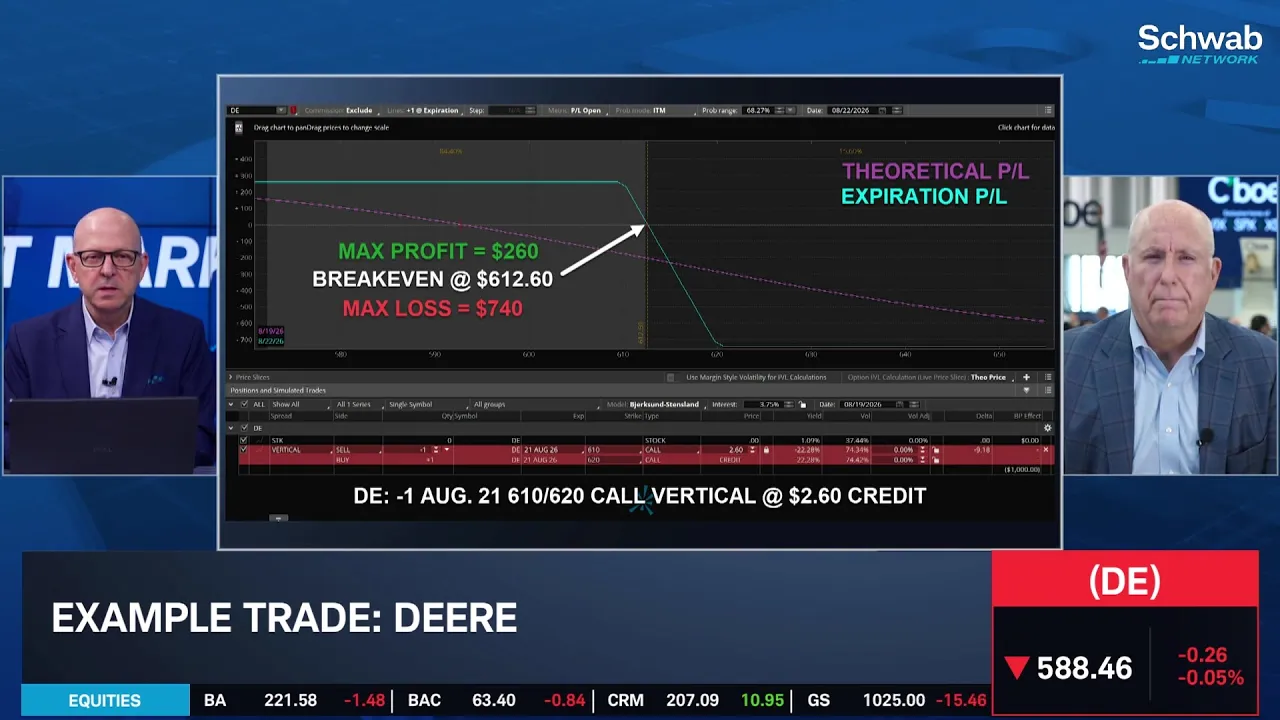
I looked at something that's bearish but neutral to bearish.
Context "I looked at something that's bearish but neutral to bearish. It gives me a little bit of cushion to the upside here."
Full Transcript
get your podcasts. Welcome back to Fast Market here on Schwab Network. Dear is not looking like a deer in headlights this year. With that stock up more than 26% year to date, outperforming the broader market. The company is no longer a story about tractors and agriculture. It is now part of the AI infrastructure theme that has made it a winner in 2026. Deere set to release its quarterly report card ahead of the open tomorrow. Here's where expectations stand. Investors are looking for earnings of $4.79 per share, which would be up slightly from a year ago. Revenue is also expected to increase nearly 10.8 billion. That would mark a roughly 4% increase from a year earlier. All right, time now for the tug of war on deer. For that, let's welcome back in our co-host Tom White and Kevin Hanks. It is bull versus bear time. So before we get to your example trades, we've got to get each of your thoughts on deer. Kev, I'll start with you. Your take. I read a great note on John Deere that says people are getting John Deere wrong. They think it's a machine company, right? You're by big green machines for agriculture, when really what it is because of AI. It's really a precision agriculture platform with 100 or 1 million machines, all connected with 500 million acres, all connected. And they think it's going to be 600 million by 2030. An AI. What is it doing? It's software. And software is what? Recurring revenue and software is 85% margins on, on, on software. And so this is a company that allows farmers to map their fields and do it with basically AI doing the planting and doing the harvesting and doing everything in the middle that we see. So, you know, this company is one of the key companies using think about it, AI, driverless, all the different things that that are, are improvements in the world we live in. They all apply to what Deere is doing with their large machines. And it's really incredible. This might be like the tip of the spear or the earliest forms of full self-driving and, and automation and AI. So, you know, this company is really incredible. The more you read about it, the more fascinated you get with it. Tom, what's your take on deer? Well, I think you take a look at the different segments within there. You mentioned the fact that they're expected to have about $10.8 billion in revenue. Well, they're split up between three, maybe four segments at this point. Kevin mentioned production and precision agriculture segment that's supposed to grow about 8%. The small agricultural and turf segment that's supposed to grow about 12% to about 3.4 billion. Construction and forestry. I think this one is key because that's at AI infrastructure build out that they're, you know, participating in along with caterpillar, where it competes a little bit, that's supposed to rise nearly 17% on a year over year basis, up to 3.57 billion. And then they've got another 1.6 billion expected for the financial services segment. Now, what are the the the you know, what are the maybe the headwinds for this company? Well, it's rising costs for farmers at this point and it's higher interest rates. How will that dent their results? Will it offset some of be offset by some of maybe the construction, you know, growth that they're seeing across the board. But Kevin's right. This has turned into an an AI story as much as much as it has a farming equipment story, just because they're using precision agriculture, not only for small farmers, but for for big corporate farms, also like caterpillar. All right, guys, let's get into the example trades. Kevin, let's start out with yours. What's your approach today? Yeah. And before I give you my trade, the the one key thing for John Deere is commodity prices. Remember when farmers have more money in their pocket, they can buy bigger equipment or replace equipment. And so commodity prices are key here. But I looked at something in the bullish camp for Deere and company. I looked at something in the diagonal family. So I went out to the August 28th. I looked at around a 50, almost a 51 implied volatility. August 21st about an 82 implied volatility. Expected move one day move about 2520 creeping up to about $26. Diana. Tom. So I looked at the buying the 295 call in the August 28th and selling the 620 call and the August 21st using that expected move that helping me with my strike selection on this diagonal. But this is one that you're looking for a one standard deviation move up towards the $620 level, different from the calendar spread as if it keeps going up and through that strike, your profitability doesn't drop off. You stay somewhat level as it goes to the upside. But Tom, this is one that plays for an upside move. It's you're spending about well, let's call it half of of the width of the strikes on this. I put it in for 1270 trading about $13 now. So it's trading slightly higher than where we looked at it. But this is looking for about a $25 move up towards that 620 strike. Tom. Yep. Taking advantage of the vol dispersion between the option series in this bullish call diagonal that Kevin brought us going out to the August 28th weekly options here. So just about nine days to expiration here by the 595 call. That's just out of the money to the upside. The stock has pulled back a little bit now under 590. But buying the 595 call in the August 28th weekly cycle, selling in the August 21st monthly cycle that expires in just a couple of days. The 620 call so bullish $25 wide call diagonal. You're paying roughly about a 1270 debit. The debit you pay on this is going to be your risk. So $1,270 per spread on it. As Kevin mentioned, you want the stock to go up about one standard deviation 25 to $30. That'll get you closer to 620. That's where you're going to have max profitability. But anything above maybe the 600 level is going to be potential profitability on this bullish call diagonal. And as Kevin mentioned, it's basically about half the width of the strikes of the call diagonal. Right. And that's because of that vol dispersion that Kevin mentioned where you're buying a lower implied volatility in the August 28th weekly options where you're buying the 595 call as opposed to what you're selling, which is a higher implied volatility in the near term. August 21st monthly options where you're selling the 620 strike call. So that dispersion lowers the entry point price. You definitely need to move to the upside on this over $10 to get into the profitability range, but because you're paying less than half the width of the diagonal of the strikes in the call diagonal, anything above maybe 600 is going to be potential profitability on this, even if it runs through 620 to the upside. Kevin, I want a little bit more passive on my example trade here. It seems like on the chart the stock is now below the 50 day simple moving average. So maybe that becomes an area of resistance. We initially saw caterpillar jump post earnings but now it's actually below where it was prior to earnings. So I looked at something that's bearish but neutral to bearish. It gives me a little bit of cushion to the upside here. And this is a really short term positioning Kev. August 21st. Monthly options that expire in two days. Sell the six 610 strike call and then buy the 620 strike call basically a short $10 wide neutral to bearish call vertical collecting roughly about 260 credits, probably trading closer to two and a half bucks right now. But the credit you collect is what you can make on this one. So $260 with about $740 in risk. So you've got a lot more risk than reward. But that's because you've got a better probability of success on this one where I don't need a move in the stock. The stock can stay right here. Stock can go lower and I can keep that credit that I collected. The stock can even go higher. But as long as it remains below that break even of $612.60, I'm going to I'm going to be profitable on this type of trade. What you don't want to happen is it to blow through there. Go above 620. That's where you got max loss on this on this type of trade. So Kevin, a little bit more passive. You've got a lot more risk than reward. But on this one I've got better probabilities of success on this neutral to bearish short call vertical. Yeah. Your short strike is still inside that expected move. And so the trade off there is the probabilities come down right. It's not as high of a probability but the premiums go up. You're collecting $2.60 somewhere around there. That's a pretty nice premium to take in. If you're remember if the stock is unchanged that's profitable. If the stock goes down that's profitable. If it goes up but only goes up slightly right underneath that 610 strike. This is profitable. So this is one that says it's going to struggle. On the upside you looked at the caterpillar comp there. And you know this is one that just takes that expected move fades a little bit on on a little bit of an aggressive posture let's call it. Yep. And you got that big cushion. We mentioned the probabilities on this one. You got a probability that that short 610 strike at expiration over the next couple of days will be out of the money of about 72%. So high probability of success probably just right at or just in within that one standard deviation move that the option market is pricing in at this point. So there you go Diane.
Comments 0
Sign in to join the discussion.
Sign inNo comments yet. Be the first to share your thoughts!