Stock number one, Jackson Financial, ticker JXN. Now, Jackson is the hero of this trade. This is the purest expression of this theme.
Context
“Here are the three I would watch. And the first one is probably my favorite. Stock number one, Jackson Financial, ticker JXN. Now, Jackson is the hero of this trade. This is the purest expression of this theme.”
Stock number two, Corebridge Financial, ticker CRBG. Now, Corebridge is the big one. This was AIG's retirement arm before they spun it off. The company pulled in $898 million of base spread income last quarter, and they're expecting 2 and 1/2 billion for the full year. But their private equity holdings have delivered nothing. But as a result, CRBG stock hasn't run as much as some of the others. It still trades below its high. So, you can pick up the stock on the cheap and collect 3% dividends while you wait for the PE stuff to get figured out.
Context
“Stock number two, Corebridge Financial, ticker CRBG. ... So, you can pick up the stock on the cheap and collect 3% dividends while you wait for the PE stuff to get figured out.”
Stock number three, Equitable Holdings, ticker EQH. Equitable gives you the spread plus an asset manager stapled on top.
Full Transcript
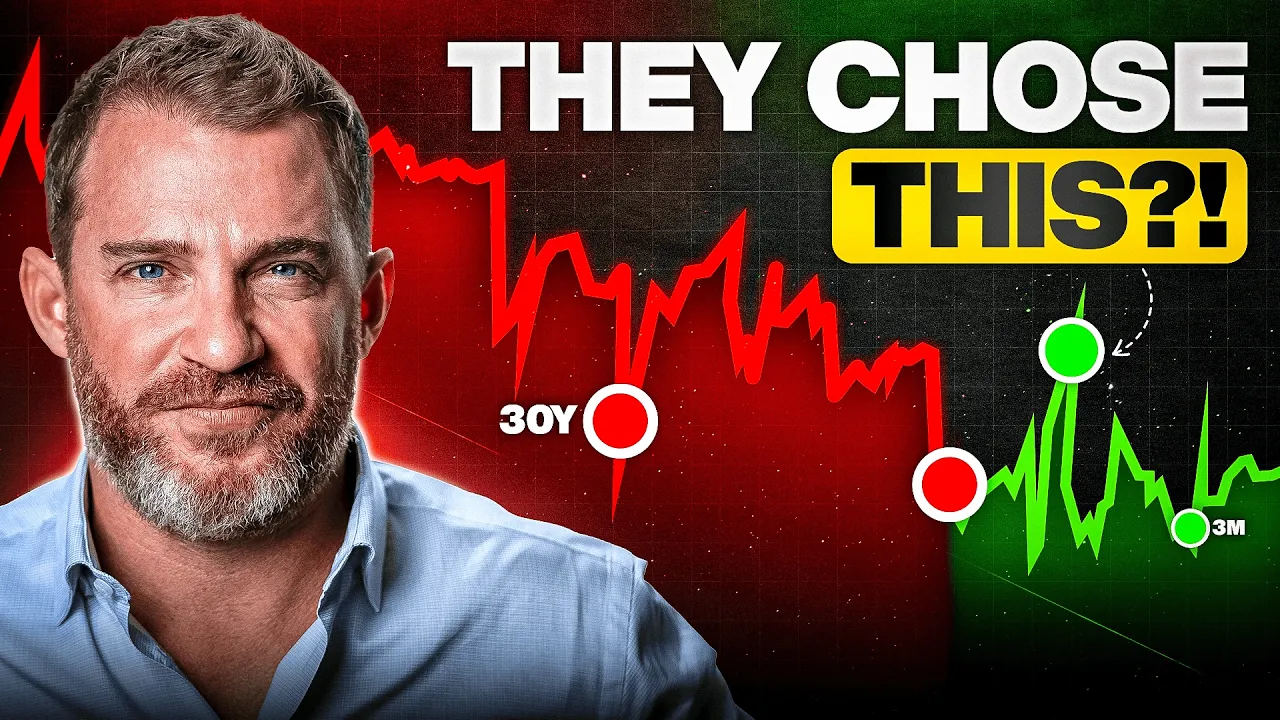
Right now, the US government can borrow money for 30 years at 5.31% or can borrow for 3 months at 3.87%. Guess which one they picked. Last Thursday, the Treasury tried to sell $25 billion worth of 30-year bonds. It went off at 5.216%, the highest interest rate on a 30-year auction since 2001, and the demand was so soft they had to hand buyers a discount to get it out the door. So, they quit trying. Uncle Sam is now funding a $2 trillion deficit with short-term paper that has to be rolled over and over and over again. It is, in essence, an adjustable-rate mortgage. And you might be running the exact same trade in your own account right now. I'll show you where. Treasury's own Advisory Committee just told them they're staring at a $1.45 trillion funding hole in 2027 and 2028. Interest on the debt now exceeds a trillion dollars a year. We spend more money paying interest on money we already spent than we do on the entire United States military. One economist described it as slowly boiling ourselves like a frog. Well, today I'm going to show you what the government just did with your money, and three companies that can actually make more money if rates stay higher. And one of them, in my opinion, is the purest way to play this entire setup. Make sure to subscribe to the channel cuz this debt situation is going to get worse, not better. And I want to make sure you are protected. Now, let me put this in terms that everybody understands. America basically chose the adjustable-rate mortgage instead of the 30-year fixed. The 30-year option costs more today, but it locks the rate. The short-term option is cheaper today, but it keeps resetting. So, if rates fall, that decision looks brilliant. But if rates stay high or move higher, the bill keeps resetting at more expensive levels, and that is the gamble. Three month paper bonds that pay in 90 days cost the government 3.87%. 30 years, I said, cost 5.31. So, borrowing short saves roughly a point and a half right now. So, Treasury gets the cheaper payment today, but that debt matures almost immediately and has to be refinanced again at whatever rate the market demands. So, they're not eliminating the debt, they're repeatedly refinancing it. And that makes the government's interest bill increasingly sensitive to where short-term rates go next. Now, here's the important part. This strategy has survived both parties. Scott Bessent spent years criticizing Janet Yellen's reliance on short-term issuance, calling it a risky gamble, focused too heavily on the short-term. Then he gets the job and kept the strategy. Now, I don't think the interesting question is whether Bessent changed his mind. I think the interesting is what he saw when he sat down at Treasury and looked at the alternative. Locking trillions of dollars in a long-term borrowing costs above 5%. Either choice carries risks. Borrow long and lock in an expensive rate for decades. Borrow short and accept refinancing risk every few months. Treasury chose the second one. And now I want to show you how you can profit from the same high rate environment that's making that decision so painful. Now, before I show you the stocks, again, if you want to trade some actually taking In fact, if you want me to teach you how to find the right stock to buy, where to buy them, the patterns identify good moves, how to know when to sell, when to get out of the market, you need to join my Black Ops trading service. It is $5 for the whole year. No strings, no renewals, no tripwires. It's five bucks. Every week for a year, you get a live hour group mentoring session with me. You'll get another session every Thursday with my analyst plus my weekly newsletter bonus reports and a bunch of other stuff. So, go ahead and click that link in the description or just go to tradewithross.com to get signed up. Now, let's talk about how this affects your account because Uncle Sam's problem is creating a very different opportunity for investors. There is $7.93 trillion sitting in money market funds in this country right now. It's an all-time record. More than 3 trillion of it is retail money, not institutions. Why is it so high? Simple. Because for the first time in years, cash actually pays something. Savers spent most of the post-financial crisis era earning nothing. Now they can earn a somewhat meaningful yield without taking any stock market risk. And for retirees, looking at stocks near record high, seeing sky-high AI valuations of companies a lot of us don't understand, and an S&P 500 dividend yield at around 1%, locking in a known rate suddenly looks attractive again. And that demand is showing up in a huge way. Last quarter, Americans bought $123.9 billion worth of annuities, the biggest quarter ever recorded. Fixed-rate deferred annuity sales alone jumped 26% in a single quarter. And this is where Uncle Sam's problem becomes our opportunity. I'm not here to sell you an annuity, okay? What interests me are the companies writing them. Annuity businesses make money on the spread, what they credit to customers versus what they can earn on the assets backing those contracts. So, imagine a customer locks in a guaranteed rate. The insurer then invest the premium across a portfolio of bonds and other assets that are designed to earn more than the amount it is promised to credit. And that's after hedging and expenses and all the other costs. And that difference, what they earn versus what they pay the person holding the annuity, that's the economics of this business. And higher rates can help because new premiums can be invested at higher yields. And older, lower yielding assets gradually roll off and into better paying securities. But, this is not automatic free money. Credit rates can rise. The quality of the bonds they buy matters. And customers can surrender their contracts. But, the companies that manage those pieces well are the ones I want to own. Right now, the annuity shops, they're in hog heaven. Because those portfolio yields, the ones they've been holding, that pay 2 and 3% a year, reprice over time. Those bonds bought years ago at very low yields have matured, and that capital now gets reinvested at today's higher rates. So, the chain here is pretty simple. Higher rates make yield products like annuities more attractive. So, the demand for annuities rise, they sell more of them. The insurance company puts more money to work at higher yields. As a result, the the good operators see bigger profits. And so, here are the three I would watch. And the first one is probably my favorite. Stock number one, Jackson Financial, ticker JXN. Now, Jackson is the hero of this trade. This is the purest expression of this theme. Last quarter, they earned a record $7.30 of profit per share. Wall Street was looking for 570. So, they beat it by 28%. Retail annuity sales are up 34% from a year ago. And their spread account value, that is the the pile of money that they earn that gap on, grew 49%. They're now earning on $44.1 billion. Their return on equity went from 12.7% to 16.3% in 12 months. And the stock pays a 2.7% dividend on top. Stock number two, Corebridge Financial, ticker CRBG. Now, Corebridge is the big one. This was AIG's retirement arm before they spun it off. The company pulled in $898 million of base spread income last quarter, and they're expecting 2 and 1/2 billion for the full year. But their private equity holdings have delivered nothing. But as a result, CRBG stock hasn't run as much as some of the others. It still trades below its high. So, you can pick up the stock on the cheap and collect 3% dividends while you wait for the PE stuff to get figured out. And stock number three, Equitable Holdings, ticker EQH. Equitable gives you the spread plus an asset manager stapled on top. So, they own AllianceBernstein. And between the two of them, they manage a whopping 1.2 trillion dollars. Now, they made 174 basis points on the spread last quarter. That's Wall Street fancy talk for they earned 1.74% interest on all the money they manage, on the annuity money, and that's theirs. That's their profit. Now, the biggest risk to annuity writers is surrender. So, if rates went from say 5% to 10%, a customer can walk out of their old contract and go buy a better one with someone else. Now, to do that, that customer has to pay a pretty hefty surrender charge. So, this slows it down a good bit, but if one of the companies has to dump bonds at a loss to pay people who are leaving, it stings. And we've seen this before, not long ago, in 2022. The Federal Reserve raised interest rates at the fastest pace in history. It triggered a bear market in stocks and in bonds. And these stocks, as a result of those forces I just mentioned, Took a temporary hit as expected. But that is bad as it gets and as you can see they quickly recovered. Now the second risk is valuation and timing. All three of these stocks have already been working. They're trading up near 52-week highs. This is not some undiscovered sleeper stock you're buying dirt cheap off the lows. But personally, I would rather buy a business whose earnings trend the market has already confirmed than to force some turnaround story. And the engine underneath this theme enormous government refinancing needs elevated yields and record demand for these guaranteed income products. This is not something that is going to disappear next quarter. So here's what I think. Interest is a cost to somebody and a revenue line to somebody else. The entire game is knowing which side of that contract you are standing on. And I believe some of the best opportunities over the next several years are going to come from the most boring corners of the market. Things that have been wildly overlooked. Mining companies, precious metals copper infrastructure insurance. Businesses that are positioned to benefit from the durable economic bottlenecks and these strong cash flow trends. Folks, don't forget to subscribe to the channel and do not forget to join my Black Ops trading service. It is five bucks. You got no excuse. I promise you get your money's worth and if you don't, I stand by my promise. Message me, give me your address, I'll send you five bucks back in the mail. But you're going to get uh an hour with me every week, my weekly newsletter in your inbox, TradingView indicators, bonus reports, even access to my team, tons of stuff. Click the link, scan the QR code, or just go to trade with thras.com to get signed up right now and I will see you in the next video.

Comments 0
Sign in to join the discussion.
Sign inNo comments yet. Be the first to share your thoughts!