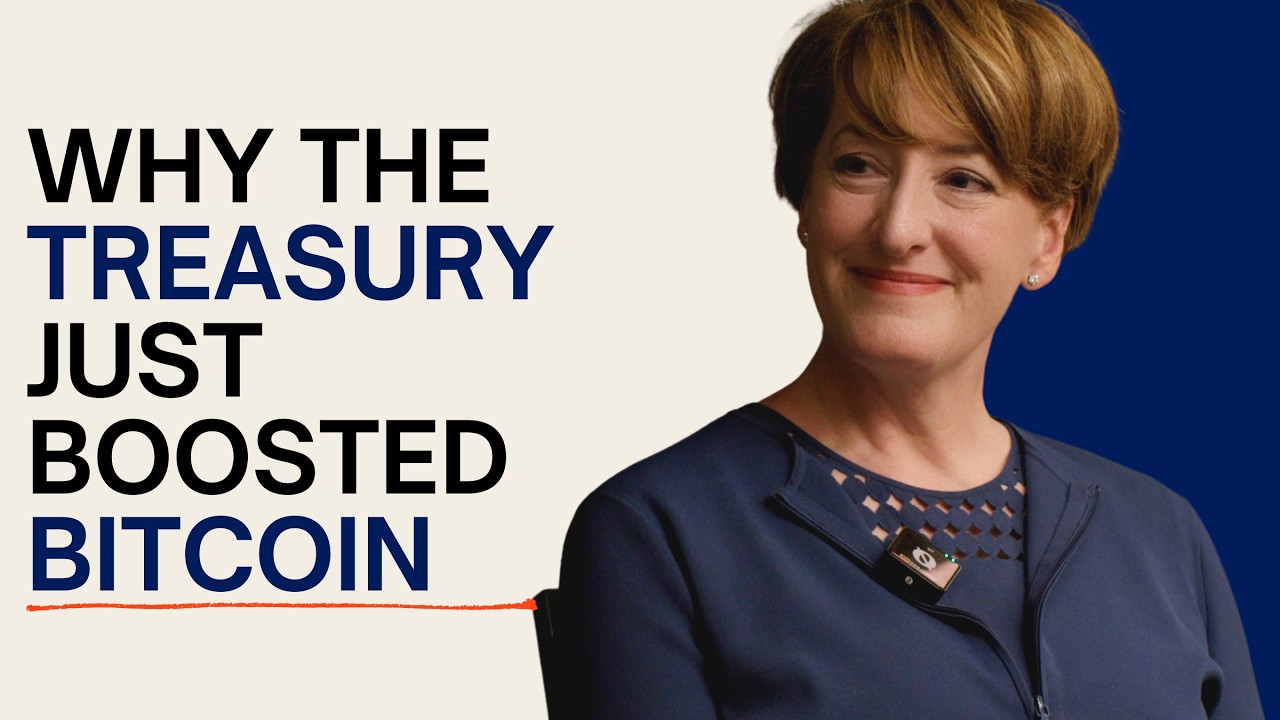
Why Bitcoin Is Surging After the Treasury’s Market Intervention: Caitlin Long

- Video return
- +1.36%
- Calls
- 1
- Buy / Sell
- 1 0
- Published
Recommendations
Entry is the asset's closing price on the publication date. Current is the last close on record.
-
Entry $77,286.00 21 Aug 2026Current $78,340.00 22 Aug 2026Result +$1,054.00
the chart charts wigglers are [laughter] are are screaming really, you know, loud buy right now
Context So, I I look at it and say, you know, we're we're sort of if you all the chart charts wigglers are [laughter] are are screaming really, you know, loud buy right now.
Full Transcript
There was a macro reason potentially for the market rally today and not just in crypto. It was basically the US Treasury kind of doing a version of yield curve control essentially saying they were that they would more than double the buyback at the long end. So 30-year Treasury at the long end of the curve. So we had a huge rally in rates and that is dollar negative and dollar negative equals risk assets go up usually and that's what happened today, I think. I've never been one that thought that the four-year cycle was dead and boy, if you look at the charts, it sure looks like there's still a four-year cycle. I don't make price predictions, but I look at that and say, "Boy, if past is prologue, it sure does look cheap." >> We're here with the founder of Custodia Bank, Caitlin Long. Caitlin, it is good to see you. >> As always and and we're in person this time. I love it. In Wyoming in my in my home state, my backyard. >> I get it now. It is beautiful. >> It is beautiful. We're in Jackson Hole, which is the adult playground of really the world, but uh certainly of Wyoming. So I'm I live seven a 7-hour drive away from here. So I love coming here, too. >> yeah, well thank you for being here and uh and it's exciting times because I feel like obviously we've been in a bear market, but now early rumblings of perhaps we've now bottomed and some exciting updates in terms of just I guess policy right now triggering some moves. >> Yes. >> Want to get your take on maybe we talk about whether or not you think we've now kind of moved into a new bull market or kind of past the bottoming process. >> Well, we're recording on the day that Bitcoin popped and we were just talking about how Ethereum has popped 20% today. Bitcoin crossed 70,000 briefly earlier today and a lot of short positions were taken out and so uh this was quite a lot I saw a lot of people using the word violent move uh to describe it and it it certainly was, although we've been around crypto and we know these things happen. So this is not uh as as uh as Brian Bishop once said, Bitcoin is doing what Bitcoin does. It just sometimes just spikes. And there was a macro reason potentially for the market rally today and not just in crypto. It was basically the US Treasury kind of doing a version of yield curve control essentially saying they're they're they announced that they would more than double the buyback at the long end, so 30-year Treasury long end of the curve. And uh so we had a huge rally in rates and that is dollar negative and dollar negative equals risk assets go up usually and that's what happened today, I think. But the White House meeting was today. You were talking you interviewed Patrick and he had said there wouldn't be a an announcement per se, but there was some expectation potentially. I by the way find it funny that the White House announced this during Scaramucci's conference. Of course, that was not a coincidence, I suspect because uh famously that President Trump and Scaramucci are not the best not besties. >> I had not read that far into it, but I like that theory. That's a good theory. >> Oh, I talked to Anthony about it and he kind of laughed and said, you know, yeah, of course he's had to pick the day of my conference to do it. He said it in good jest. >> Yes. >> But I have a feeling it was part of it, yes. >> That's pretty good. >> And that is part of the reason why the SEC Chair Atkins and CFTC Chair Selig were in DC because of this meeting. And the big announcement they made yesterday during this conference apparently Chair Atkins was planning to make it at this conference, but of course he had to stay in DC for the meeting. So >> Well, I I wanted to talk to you about that, too, because there are a couple things happening now in terms of what that might trigger, but you are right to point out I guess before we move on to kind of the Treasury and other announcements there, just kind of what you think about Bitcoin as it again, I guess this is another data point to point to anytime we're talking about rates, it's more of a rate sensitive asset than anything else that we've heard in terms of hedging against inflation. Digital gold. I mean, how do you kind of, I guess, put this into context for kind of the way that you think about Bitcoin as an asset? >> Well, gold is running, too, right? It's we've basically just seen a dollar negative announcement and, you know, the debasement trade, so to speak, assets have rallied more than average assets today. And so, that is what one would expect. Bitcoin doesn't always trade that way, as we know, but today it's trading in tandem with the debasement trade type assets, and everything's rallying. >> Yeah. >> risk assets are rallying because the dollar, you know, Treasury is is essentially saying they're going to defend interest rates, they're going to defend the long end of the bond market, and if they have to reduce value of the dollar to do it, then that that then so be it. There was also a really interesting Treasury announcement, though, I should add. That's the one that got all the coverage because it had a near-term impact and had a big market move impact. But, there's a bigger plumbing announcement that got that got announced while we were here in Jackson Hole, as well. Think it was Monday or Tuesday, that Treasury put out proposed rules for the Genius Act that gave the Treasury the authority to determine what non-US issued stablecoins would be valid in the US. So, the impact of that is that Treasury, not the Federal Reserve, basically determines what is a eurodollar. What is What do I mean by that? A little bit inside baseball here. A eurodollar is not a European dollar. A eurodollar is a dollar issued outside of the United States. Why that phrase eurodollar, euroyen, euroeuro got created, I don't know the history. It's a confusing phrase. But, all it means is basically fiat currencies that are issued outside of the home country. So, euroyuan, Uh, example, could be issued Chinese yuan issued in the United States in tokenized form, for example. The US Treasury has authority to determine whether that's possible or not. So, they will they will determine essentially what euro dollar type assets are valid in the United States. That historically has been the Fed. >> Yeah. >> And now it's going to be Treasury. It's yet another example, yet another data point of Treasury grabbing back this power from the Fed that has been at the Fed for decades. But, because the Fed is so opposed to tokenization and digital assets, it's still We just got out of a session with uh bank regulators. It It's still very negative on all on this entire technology. It's the agency that's lagging. I can point to an actual data point. All the other agencies have issued their genius act proposed rules. The Fed has not even issued theirs yet, much less finalized theirs. >> Yeah. >> There was some discussion in this earlier meeting whether the OCC would have finalized its rules before the Fed even proposes theirs. >> Interesting. >> So, tells you just how far behind they are. And so, Bessent, Secretary Bessent of the Treasury, is basically just saying, "I'm not waiting. I'm just grabbing all this. And it it definitely means more volatility for uh because the Treasury Secretary position is a presidentially appointed position, so it's going to change with presidencies. But, it also means a lot more openness to tokenization, of course, and frankly control of the plumbing of the fiat money system coming back into the Treasury Department from the Fed. That is news, and that is really big. But, it's the sort of thing that it's so it's such inside baseball. >> It is very inside baseball, but very important. And it's also something It's also something that you probably know better than than anybody else because of the way that Custodia Bank and and what you've been building has kind of gone up against the Fed, I guess it's fair to say, maybe. Uh in terms of pushing your good fight out there and and I guess maybe that's the main takeaway here is, like you said, it's if it's at Treasury, things can move a bit quicker now. >> Yes, absolutely. And and it's basically going to align with the president's policies because the Treasury Department is part of exactly, firmly pro-crypto, yes indeed. >> terms of, I guess, what that means for you, too, I guess we should we should delve into a little bit of what Custodia has been going through. >> Yes. >> And how you have been, uh you know, pushing for access. >> Mhm. >> Talk to me about the update there in terms of how things have been. >> Uh no update. Uh uh basically, nobody in the crypto industry has access. >> Yeah. >> Nobody. Um famously, Kraken got announced back in March that it had access. If you look at the publicly disclosed database, they signed their documents and officially got their access in January. But, uh the CEO of the of the subsidiary that got that access grant testified in a public hearing a few weeks ago that they have not been allowed to use it yet. So, they're sort of 8 months into what was announced to be a 12-month trial period without the ability to use it yet. That does not shock me because, unfortunately, we have just dealt with so much pushback from the Fed. I have concluded the Fed's own systems are so antiquated that this is a major reason why they've been so opposed to all of this innovation because it will reveal just how antiquated their own systems have been. >> Mhm. >> Will they eventually get there? I don't know, honestly. Um I mean >> they also don't want to, is potentially the >> Well, again, nobody has actually gotten an answer from the Fed. Why did they announce this? They announced the Kraken um master account with great fanfare and got a lot of blowback from the banks over it and then didn't turn it on. So, what gives? Honestly, nobody really knows. My best read of the situation is it could be yours, but I think it's it's just that their systems are just so backward, which is not a shock. >> Yeah. >> Right? I mean, you know, the the president has issued a executive order that the US government has to upgrade its systems to make them quantum resistant by I think 2031. Right? And one would think that the Fed was already on top of those things, but I mean, it's [laughter] I mean, it's such an opaque organization. >> I mean, being 8 months into a 12-month period is, you know, obviously only these 4 months left to kind of turn it on. So, that doesn't seem very reassuring. >> Well, again, we don't know what's really going on. It's so opaque and I would assume the next time Kevin Warsh is up on Capitol Hill that now that that news has come out that someone will ask him, "What gives? Why did you announce this and then drag your feet?" >> Well, we were talking a little bit about this yesterday in terms of what it means for decisions being made at companies when they look at this and say, "Okay, well, we've been looking at different ways to go." You and I were talking about some other narrow banks that have popped up kind of targeting state-by-state situations versus now going federally with the OCC. How does it kind of change the decision making for for companies like yours? >> Well, right now, clearly, there are a lot more applicants getting these federal bank charters, and there is a very big benefit to a federal bank charter, which is that you can do business nationwide without having to do the state-by-state licensing. So, it's pretty obvious why folks who did have state-by-state licenses, like Circle for example, had money transmission licenses and and you know, in New York for example, the BitLicense, it's pretty obvious why getting a single license from the federal regulator was going to be way better and cut their regulatory costs and hassles. But, the interesting question is will that pendulum swing back? We We were just uh a a a group large group was having a discussion with Comptroller Gould, and I asked him how Yeah, how how How are you going to cement your legacy so that your successor, if it's a Democrat in the next administration, isn't going to be able to just just come in and reverse everything that you do? >> And it seems to be a conversation that's being had across all agencies right now. >> Everybody's talking about that everywhere, right? Yes. Yes. Yes. And >> Although, I mean, I guess, you know, clarity is another piece of this that we can delve into as well, but I I guess that's the whole reason why there's such a big push right now to pass it through Congress so that this can't be undone. >> That is exactly why they want to push it through Congress. So that it because it is so hard to get legislative change. Uh because you've got to get 60 votes in the Senate for anything other than a budget. >> it is a good example to point to you in terms of even if there isn't that, that there are still kind of like these weird uh tug-of-wars happening between agencies. >> Absolutely. Yes. >> things because of the impatient behaviors that are now stacking up. Given that sounds like the Fed might be the one dragging the feet uh the most. But I guess backing up and just looking at the overall market, it is interesting to consider Bitcoin's specific overhangs that are no longer there. We've been talking about this a lot on Coinage, whether it's kind of what strategies built, and now the fears that they may continue to sell being, I think, behind us. What does Caitlin Long say about kind of where Bitcoin as an asset now finds itself in this potential, if it isn't extended rally, how strong its footing is now? >> So, I've never been one that thought that the four-year cycle was dead. And boy, if you look at the at the charts, it sure looks like a There's still a four-year cycle. Uh and this has been a big debate, of course, in the in the Bitcoin space. And we are coming to the end of what would normally be a the the bear part of the four-year cycle and starting to get ready ahead of the next halving in what would typically be a rally. So, uh there are I have always thought there are fundamental reasons why we have always always had that four-year cycle because of the way the miners have behaved. Uh, and we're starting to see that minor capitulation. There are we're seeing a lot of of of businesses that were marginal in this space shutting down. We've seen multiple exchanges shut down recently, small ones. Um, we've seen miners flip out of Bitcoin into AI if they can be competitive there or literally shut down. Which is a normal cyclical part of the bear bear cycle and we're seeing it again. So, I I look at it and say, you know, we're we're sort of if you all the chart charts wigglers are [laughter] are are screaming really, you know, loud buy right now. I don't I don't make price predictions, but I look at that and say, boy, if past is prologue, it sure does look cheap. >> Well, that's the interesting thing because I feel like maybe you're in the minority from what I've heard in terms of other people looking beyond the four-year cycle just given how institutionalized the asset has become. But, you are right to point out kind of underlying fundamentals of the network itself. So, maybe I'll just play devil's advocate around that and say, okay, Caitlin, tell me why you're so confident that the four-year cycle still exists today. >> Because minor economics still exist. I mean, the marginal miners when the price goes down can't be profitable, so they they shut down, they pull hash rate off the network. Although the hash rate because of compute has been continuing to climb, but we haven't even seen a a big dip with I'm I'm on the board for example of Cipher Digital. We've seen Cipher Iris CleanSpark to a lesser extent Marathon switch over from Bitcoin mining to to hyper to to the hyperscalers and to AI. And because they've got the power contracts, right? But, that has not had a huge impact on the Bitcoin hash rate. So, that is definitely a different dynamic I will concede, but that doesn't that doesn't mean that the individual minor isn't still facing the basic fundamental economics, which is that their power costs are high and their compute costs are high. And if the Bitcoin price is down, they can only sustain themselves for so long before they have to throw in the towel. And then typically they sell their Bitcoin when they do throw in the towel. >> Yeah. And I guess, you know, also to point out kind of what price action can do to trigger the upside cycle. You touched a little bit on it in terms of maybe shorts being caught off guard and covering there. But, how important is that piece to kind of getting to if this is a new bull cycle and the four-year cycle still holds, getting to where we go now is usually a price building on itself and powering the next leg higher. >> Well, you're taking out a lot of the shorts, right? You know, on down down days they've taken out a lot of the longs, right? Today, [laughter] they took out a lot of the shorts, right? So, again, I don't trade, so I don't pay that close attention to the technicals, but you know, I do look at historical valuation metrics like the Mayer multiple. Very few people still look at that, but that has helped pretty well. The the power law models have helped pretty well. I mean it's it does indicate that that these that past has it hasn't broken prologue so to butcher the analogy there. It does indicate that that things haven't really changed that much. Although, I will also concede because big Wall Street money is now there. They think in 12-year cycles, not four-year cycles, right? 12-month cycles, rather. They because they're publicly traded reporting public reporting companies, so they're SEC filers, so therefore they're thinking about their quarterly earnings, right? And that's what they're focused on typically is is is annual earnings. Whereas, in Bitcoin we're typically focused in these four-year cycles. >> Well, I also want to ask because of your kind of your past on Wall Street and your career there, the other big thing, and we have seen a a noticeable move higher for Ethereum, too, is tokenization really starting to take off. >> Yes. >> Um and I know you you were just talking about kind of building on Ethereum. Coinage are memberships on Ethereum as well. Um it's interesting to kind of see that trend, and I don't know if you've become more bullish on the idea of, "Okay, yeah, institutions are really betting on that theme benefiting these token prices." >> Oh, absolutely. The announcements that we've seen this just this week from the SEC and the CFTC, and then of course the Treasury we talked about earlier, are all about tokenization of assets. I still wish that we'd had we we had better tokenization options on Bitcoin for layer twos. So, they they just have taken a lot longer. Uh and you know, there are companies out there like Tether that are really really trying, um you know, to build uh on Lightning Network. >> Yep. >> It's just not quite there yet. I still am optimistic it's going to get there. So, what do you do in the meantime? It's Ethereum. Um you know, there are issues with Solana. We just had, you know, the the network outage last week that uh a lot of folks looked at that and said, "Maybe not quite ready for the big institutional money yet." >> Mhm. >> Um so, it kind of does default back to Ethereum. And so, there are there are Tom Lee is, for example, one of the famous Ethereum bulls, and his theory is big institutions, when they tokenize, they're going to pick Ethereum, and a lot of that is coming through. >> Are you seeing a lot of it in >> agree with it or not. Yeah. >> Are you seeing a lot of it in the conversations that you're hearing as well? >> Yeah. >> Yeah, because I mean, I I don't know. It's it's been interesting to watch cuz there are a lot of metrics you can look at, and maybe TVL's one of them, just kind of seeing where money's flowing on different chains. I don't know how fair those numbers might be on an apples to apples to apples >> Right. Yeah. >> Um but I think it's more important just to kind of get in the minds of asset allocators and these companies making the decisions, and I know you're closer to those conversations than I am, certainly, but that seems to be what you're hearing as well. >> Right. And I don't talk to the asset managers. I'm talking to the infrastructure providers and users, right? Uh and so in the bank world where I live, the big conversation is private blockchain versus public blockchain. And if public blockchain, which one? But a lot of banks are still very nervous about public blockchains. We've gotten them over over the hump. I mean, Hessel Network put our white paper out couple of months back and that's where the disclosure is that that that it's on Ethereum as the first blockchain. It's it's a blockchain agnostic, but the first one that was introduced is Ethereum. And we've been live since March, you know, so that captured a lot of attention in part because folks have been tokenizing on Ethereum. And so here's a bank-issued tokenized dollar on Ethereum. But the amount of work that went in to getting regulators comfortable with that, and by the way, we don't have final approval to to issue this at scale. Custodia has the approval to issue the stable coin. Our bank partner is still working with its regulators in Texas and at the Dallas Fed. And we've publicly disclosed we we have four gates we have to go through to get to a true scaled release. We're a bank, right? We can't do what a fintech does, which is just put an MVP out and call it live. No, no, no. We've had our MVP out for more than a year, but the the actual network in production went live in March, and we are now in stage two of a four-stage testing process. Everything's public. You can go out and look at the volume. You can see how the volume's gone up in our testing every single day. And one thing that you'll notice if you look at the Etherscan analytics is that we don't test on Saturdays and Sundays. So, [laughter] you'll notice it's a Monday through Friday thing. But that will change, of course, when when we get to the scaled launch, and that will be later this year in Q4. >> It is interesting. I I even for us in CoinDesk, and playing out our our second annual distribution inside Thank you very much. Yes, yes. It's It's been fun to tokenize media outlet and share ownership over it, but it's still limited by a lot of the things that you still need to do in in banking. >> Right. You've got to pay your vendors, right? >> Exactly. There's still a lot. But, it is fascinating. There are a lot of things that I love about, you know, our chats because we get to talk inside baseball. I get to see what you're seeing and how you're experimenting as well. And it is interesting because we normally only talk about Bitcoin. And now, we're also talking about Ethereum with you. >> Right. >> Which is very intriguing for me, personally. >> You know, I I a lot of folks have branded me a Bitcoin maxi, but I've talked about Ethereum a lot. If you go look at the history of the Wyoming hackathon, it was Joe Lubin who got that all started as a thank you to Wyoming, right? And so, we've embraced a lot beyond beyond Bitcoin. I happen to prefer Bitcoin, but but that does not mean that that I I've said many times, this is a free market. People can transact wherever Walk with your feet to wherever you want to go. >> Well, I think the interesting thing, too, is there's so many different elements that are still carried over from one to the other in terms of decentralization. And you touched on that a little bit in terms of why I think people are choosing Ethereum. And we certainly, look, I have no dog in this fight, anyways, but it is very >> Ethereum. >> We did. And because it was there, and you know, I think a lot of people make the same calls that we do. But, it is interesting to think about, you know, from a higher level, why you are still in this fight, why I'm still in this fight, why so many people who came into crypto through Bitcoin are here. And I guess to wrap up and zoom out, it's kind of interesting to think about what those values still are >> Yes. >> when these things are being plugged into Wall Street because it looks very different than the revolution that may have existed in prior cycles. >> Well, the early Bitcoin conferences were all about Cypherpunk ideals, right? And here we are with the suits, right? I mean, this is some of the biggest banks and biggest asset managers in the world here at Scaramucci's conference. >> you think, I guess to ask the question, that the revolution is still alive? >> Yes, of course it is because TikTok next block. >> Okay. >> So, absolutely. And the fact that Bitcoin exists and that you don't need permission to use it, that's all that you really need. And the companies like us that are putting wallet infrastructure into the core of the banking industry, are we advancing adoption? Absolutely. Because people can vote with their feet to wherever whatever is the best technology experience, whatever their needs are. They're not pigeonholed into one technology. So, just the fact that Bitcoin exists and that you don't need permission to transact with it is the revolution. I still think the most profound thing that I've heard from anyone in this space was Nick Szabo at Bitcoin 2021 in Miami >> Uh-huh. >> saying, "You don't need liquidity. You just It just needs to exist. If you are going to hold on to your savings for years, you don't really care what the daily trading volume of Bitcoin is. You just need it that one time you're going to go sell it." And so, from his perspective, he was arguing against leverage was what he was doing >> Yeah. >> because and it kind of arguing against the big big companies coming in to provide all this liquidity which requires leverage and saying, "Look, bid-offer spread getting lower is not what we're here for. We're here because there's permissionless money that you can transact in peer-to-peer." >> Yeah. >> And that still exists. And the fact that it still exists is is the revolution. >> I think it was the same conference where you were up on stage debating Sam Bankman-Fried about leverage. >> Exactly. >> That's a good throwback. >> It was it That was kind of That's the clip a lot of people play from that conference, but I go back and play Nick's clip a lot cuz to me that was really profound. He was basically saying, "You don't need the suits. The fact that the suits are here, okay, fine. Go go play with your leverage games. Go do your ETFs and your, you know, your financial engineering." I mean, I I've never asked him what he would think of strategy, but that's a lot of financial engineering, for sure. Um go go have your fun. He's not saying, "Don't do it." He's saying, "What really matters is it just it needs to exist." And if you can transact peer-to-peer, you don't care whether your that bid-offer spread is is really tight or kind of wide. >> maybe pairing the points too in terms of the revolution and what we're seeing now with price action and if we are, I think your lips to God's ears, now moving into another bull bull market cycle, the idea of, you know, Bitcoin delivering on being an asset that will continue to benefit from the government basically saying, "Look, how do we continue to help pump this bubble along?" >> I mean, look at all these. Look at we had controller gold here at this conference. Unfortunately, the SEC and CFTC folks couldn't make it last minute, but we had three US senators, the probable next senator from Wyoming also, so call that four, and and multiple representatives, and just a who's who of, you know, the investment side of the industry, the asset management side of the industry, the banking side. I mean, that was this was quite a high signal conference. It always is. Yeah. >> Yes, and >> They do a great job. >> Yes, and I think, you know, the idea of of where we go from here, a lot to take away in terms of where Bitcoin moves next. But, Caitlin, can't thank you enough. I always love these chats. These are always fun. >> Yes, me too. Thank you. >> I'm a I'm a publicly avowed Caitlin Long fan boy, so >> you. It's exciting. I'm welcome to my backyard. >> Yeah, thank [laughter] you. All right, we'll leave it there. Caitlin, thank you so much. >> Thank you.
Comments 0
Sign in to join the discussion.
Sign inNo comments yet. Be the first to share your thoughts!