I still think Micron's incredibly undervalued, so I I go there
Context
If you could only buy one stock, would you buy Nvidia or would you buy uh Micron? Oo, I I I I like them both. Um, I still think Micron's incredibly undervalued, so I I go there, but it's a really close call.
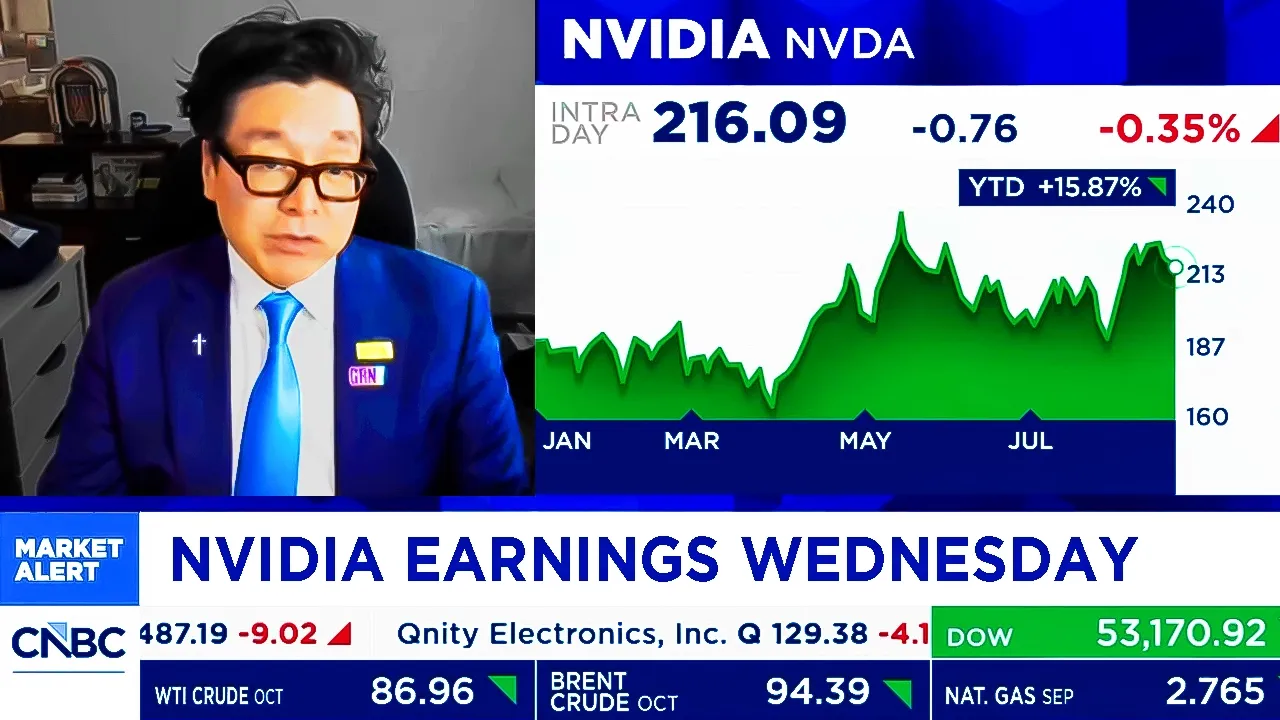
Mike, Nvidia earnings out next week. Thoughts? >> Yeah, look, the I don't want to say the whole market hinges on this, but it's pretty close. Um, Nvidia is at the center of this AI built out with the GPUs that they're making that basically enabled uh artificial intelligence to be what it's become. Um, more there's so much riding on not only their earnings, not only their guidance, but how the call goes with Jensen Wang. Uh, are they going to be able to sell chips into China? What's the price of memory going going to look like? Are they are like how is he going to raise guidance? How is he going to talk about the next 12 to 24 months and the buildout? This is a $5 trillion company, but it is trading at the cheapest valuation from a 4 P multiple standpoint it has in the last decade. I think this is going to be fireworks. I would be a buyer of this into this call and a buyer on any weakness. All right, >> we talk a lot about AI capex spending. I want a number from you. How much do you think companies will spend on data centers between now and 2030? Cumulative spending, how much? >> Yeah, that's going to be a really big number. We actually just revised our our forecast to over uh 12.7 trillion is our base case, rising to over $14 trillion on our most bullish case right now. This number has absolutely exploded. That revision happened over less than 6 months based on a combination of increased demand for AI and also the input costs that have continued to rise like memory. So it's it's been incredible. But yes, we think it could be over 14 trillion. Stuart, >> where does that money come from? Does it have to be borrowed or is it coming out of revenue? How what's the split there? >> Yeah, I mean the exact split is to be determined. We saw the recent announcements with Nvidia partnering with KKR and Blackstone and a number of others to to backs stop half a trillion dollars of spending. You have the cash flows of the hyperscalers, Google, Meta, uh, and you know, we've heard about Oracle of course spending all their cash flow. Some of these companies are spending the vast majority and then of course they're issuing debt. So the spend is there, but that's because the demand is there. So they're making the big investments and they're betting large, but they also see the demand continuing to rise. Token demand on paid tokens is up 7x just this year and we expect it to be up over more than 10x next year. >> Is it is it is that a reliable forecast though? I mean how do you know what the demand for AI is going to be uh two or three years down the road when there might be other models and other uses? I mean there might be all kinds of developments. That's a very >> Yeah, you're absolutely right. I mean look, everything is still unknown. I mean these companies are making large bets, betting the vast majority of their cash flows and future profits to be sure that they don't underinvest in this AI boom. Having said that, um we are seeing no signs across any part of the AI stack where demand is waning. It's only getting larger. New models are coming out and of course we're seeing the cost per token go down and then you'll hear Jeban's paradox Stuart which is where as the token costs go down and as compute becomes more efficient and more profitable like the next generation Nvidia compute becomes more profitable then what happens is we see token volume go up Google alone is processing I think the number they said is four quadrillion no now hold that four quadrillion tokens per month so while I said 7x is the paid token volume people using AI on say Google every day for those AI overviews, quadrillions of tokens. So, the demand's already here. >> That's extraordinary. Okay, I I've got some I got a little time left here. Uh SpaceX, uh they got an $8 billion government contract, I believe. Uh did you buy are you buying some more yet? >> Look, the way I would approach SpaceX is I think you're going to have volatility where you can play it over the long term and you can play on the option side. And the reason I think that is because I think you're going to see some ups and downs. But while the space and launching and Golden Dome that you saw is great, the real enthusiasm is the fact that they've become the most profitgenerating AI uh hyperscaler you could call it or Neocloud. They are now getting $40 million per megawatt and they're planning to spend uh stand up 10 gawatt over the next couple of years. Now Elon's always aggressive. His timelines are always very short, but he's driving about four times more revenue per megawatt than say other Neo clouds like Cororeweave, Nebus, and Iron, which I think are doing quite well themselves. So, it's an AI story now, but he's of course the only company that can also do launches and satellites, and that's why he's winning these golden dome contracts. >> Okay, real fast. You've got 20 seconds. If you could only buy one stock, would you buy Nvidia or would you buy uh Micron? Oo, I I I I like them both. Um, I still think Micron's incredibly undervalued, so I I go there, but it's a really close call. >> It's like pulling tooth to get that answer, but you'll go with my >> Sorry, that's a that's a tough That's a great question. >> Fair enough, Daniel. >> Welcome back. Got some important earnings on next week's calendar, including CRM, Crowd Strike, HPQ, but it's Nvidia on Wednesday that will likely be one of the most important catalysts of the season. Let's get to Oliver Renick at Sibo in Chicago talk about what options are saying. Hey, Oliver. Hey, Carl. The AI trade could use a lift right now, but Nvidia earnings next week are not exactly set up as an obvious bullish catalyst. The stocks had a solid year, up 3% more than the S&P 500, but trailing the chip trade by a lot. The options flows are not necessarily bearish. We do see more calls trading than puts today, but more calls are being sold than bought, and the stock fell after six of its last eight earnings reports. Right now, traders are pricing in a 5 1.5% move, but the options market routinely overestimates Nvidia's reactions with the stock moving an average 2 and a half% after earnings this past year. On the plus side, the most popular contract by volume that includes earnings is the 220 strike call expiring next Friday, where over half the premium is on the buy side at $4.75. Buying those calls is a bet the stock will rally 4.5% through next weekend. And one other thing, Nvidia options are in a pretty tight cluster. And if the stock drops into the low 200s too quickly, it could throw off market makers balance, which would heighten the potential for a big downside move. So heads up, guys. >> Uh KP, when uh when Jensen does speak next week, is the conversation going to center mostly around chip innovation and uh Fineman and Vera Rubin and all the rest or financing? I would assume that it has to do with fineman and just the next generations because that is accretive to their guidance and that's what people want to see like how are uh numbers stacking up. Yes, the the financing is going to come but those were the the $500 billion uh amount that I mentioned that's not even you know definitive and we don't even know how much money uh those six financeers Black Rockck Blackstone Goldman Sachs uh have actually raised at this point. So, I think that uh if anything, Jensen Wong is just going to change the narrative, make sure that we all don't think it's circular financing, that they're going to be at risk down the line, which was the point of this story right now, and more so focus on the actual chips that are going to be going out into the market over the next uh 3 to 6 months, and how that changes their revenue, and whether there'll be a a more than $3 billion beat, which is the market has come to expect every single quarter now for Nvidia. >> Yeah. Uh it's going to be a huge huge day. I think the earnings for this year and the earnings growth rates, those are predetermined. They're mathematical. They're coming. They're happening. And next week is just interesting, but I don't think it's a determinant of anything. And I don't think it's terribly insightful because I think we already know here and now today exactly what both of them are going to tell us. >> So Josh Brown, what do you think? >> Jenny, I [snorts] hate to say this. I'm on the complete and total other side. >> Okay. I I I understand your point. I I won't The part I'm not disputing is the pattern with Nvidia is it runs into the numbers and then people like go to bars to watch the earnings report on TV and it goes down 2%. And I totally agree with that part. >> Thank you. >> No, but but but you took it too far as you always do. Jensen Wang Jensen Wang is the AI Fed chair. You understand? He is to the earnings growth of the S&P what um Kevin Walsh is to interest rates. And I happen to think that if we just focus on the stock price reaction in Nvidia, we're missing the whole point of the exercise. We know it's going to be a spectacular report. It almost always is. We don't have the guidance, but um expected revenue of 92 billion. Just for context, this is the largest company in the world. Now, that would be a 97% year-over-year increase, not in earnings, in sales. It's insanity. I cannot believe this stock sells at a at a near market multiple. Um, the earnings will also be up 99%. But again, everyone's going to yawn. Who cares? The bigger picture though is that there are two to 300 large cap stocks where um what Nvidia has to say about 2027 and 2028 on the call next week will absolutely have an impact on. It's you're talking about dozens and dozens of hundred billion dollar plus stocks and they will trade up or down based on what the AI Fed tells us. the the backlog in the environment. >> And do you think he's going to say anything other than that the backlog is robust, the earnings are robust, that this is transformational? You think you do you think he's going to say anything negative? No. And do you think the Q3 earnings when they're reported are going to be anything but spectacular as a result? No. We already know these things. It's predetermined right now. He's not going to tell us something new. It's going to be as good as we expect. Can I just suggest that I think we're at the stage though where we don't necessarily need revelatory. We just need confirmatory. We just need to hear from him to Josh's point of what he sees >> over the next few pass take a breath. Take >> take a breath though because it confirmatory is enough. We have multiple contraction this year. We wait. We have an up stock market, but it's not as it's not as if people are extrapolating and taking multiples up for for uh the market this year. So So confirming guidance and tone is every bit as important. And I'm going to tell you right now, Dale is a $300 billion market cap. HPE is 74 billion. How did that happen? Arista Networks, you probably don't even know what it is, is a $235 billion market cap. Marbell 200 billion, Broadcom 1.7 trillion. We know Micron, we know AMD, etc. Now think about GE Vernova is a $270 billion market cap. Eaten 165 ver of a 100red billion. You cannot tell me that the that the the AI Fed and Jensen Wang is AI Fed chair that those remarks are not going to affect vast swats of the S&P 500. You can't convince me that it's a non-event cuz I know it's not. It might be for NVDA. >> I think it's going to be for everything. >> That's that's my argument. >> I think it's universally positive. I'll be here. [laughter] >> I'll rearrange my schedule. So initiates Nvidia. They obviously have some new coverage over there. Uh outperform 340 is the target. That is a 57% upside. They take Micron outperform 1300 is the target. So you're looking at lofty gains they see from here. That's 33% higher than where it opened today. Broadcom 455. That's 25% upside. And AMD outperform 550 target. That's a 17% upside. Amy, you have Broadcom, you have Nvidia. >> Yeah. >> What's your opinion here? >> Uh, look, we've we've and we've owned them for ages. So, well, we've owned Nvidia since 2014 when I joined Chvy Chase Trust. It was one of the first stocks we put in portfolio. So, we've, you know, so and I'm not overweight either of the stocks. So, um, we like them. Uh but again I think there are other more interesting weight stocks in the market at this point. They just have a very high expectations in them. There's a lot of good news. The multiples are not rich so we we still own them. Um it's just getting to that next leg and I think what Nvidia could do for the whole >> ecosystem is really prove out the end case. Not just talk about the backlog. just talk about what are the killer apps that are using AI besides coding which we all know give us examples about that really make the productivity story cuz the productivity story is still to come it hasn't played out yet >> we would not be asking that question that we are on the screen right now can momentum get its mojo back if it was a foregone conclusion that Nvidia's great earnings and commentary and guidance or whatever was a layup for for the momentum trade itself because not necessarily >> I'm just saying I don't think I don't juices it just confirms like yeah hey great >> if it if if it if it only was going to confirm it we wouldn't have to ask that question because it's not a given that trade is very much in question after a massive run a July reset >> they want to see open AI there open AI's growth is a little disappointing there's a lot of things in there >> you're you're all missing the short-term moves in this the shortterm moves >> all you're all >> all wow >> you all are missing >> okay okay >> all y'all are missing them >> in the short Yes, you have to. We're going to get the confirmation that we all expect. >> Maybe not you, Scott. Okay, [laughter] >> we're going to get the confirmation that we expect. But the reality of it is is what happens at the long end of the curve is what drives the incremental flows. If interest rates pull in, you're going to get a high beta bid and momentum's going to be fine for a bit. That's it. Period. >> I agree with you. I as you should because it's the it's the right call. It's the right call in the short. It depends on the messaging. >> Can you control with language? Yes, you can Nvidia. We have to talk about it. Um this will be the report of the week next week. Um and now the company is reportedly in talks with the South Korean ship startup. It's called Rebellions for It could be a partnership, it could be an acquisition. Um, how do you read that report that Nvidia is willing to buy the best chip so it can maintain its market share? >> Yeah, I think that's part of it. I mean, when you have the kind of financial firepower and health that Nvidia does, you want to make sure you spread your bets out. You want to make sure that you're partnering with the right people. You want to make sure that you are acquiring bolt-on and tuck in acquisitions that make sense. And you want to of course make sure that you're putting together large um you know financing arrangements like we saw earlier this week with the biggest names on Wall Street to make sure that your customers can continue to build out what is a very strong uh infrastructure layer in AI. And so I think it's just anam it's a small piece of the overall Nvidia story. The bigger piece is you know are we still seeing demand outstrip supply and AI? We are by a multiple amount. To me, it's 10 to1 in terms of demand versus supply. And Nvidia's chips, their GPUs, both in terms of training and inference, are the best in the game. And so, we still like Nvidia. Um, the story is interesting, but it's the it's not the bigger picture. >> Demand is still 10 to one at Nvidia. Wow. >> We still need to build out the infrastructure necessary so that AI can ultimately transform society and improve the bottom lines of all the companies spending the billions of dollars. But, we're going to need to be patient to see that ROI. So if you want to find the investment opportunities today, continue to focus on who's receiving the money, not who's spending the money. >> So many people like the Bank of Nvidia, if you will, making all of these deals with the PE shops and and the banks to make sure their customers have the financing to buy their chips. It just seems awfully circular. >> It is a circular financing rut, if you will. But that doesn't mean there's not going to be winners [clears throat] and losers. I think the bigger risk here is those who underspend or don't spend at all as opposed to those who may spend too much or take on too much debt to ultimately transform their bottom lines. It is a fair balancing act though and that's why you need to build a diversified portfolio not just try and pick one or two winners. >> Then there's Jensen Wong and Nvidia next week. Um I think 91 billion in revenue in the past three months is the expectation. But look, if it's not a h 100red billion, if there's not a big beat, I does Nvidia get sold? >> I don't think it matters. I think they're going to have record earnings. I think they're going to beat on revenues. They're going to beat on earnings. And they're going to guide higher once again. And the street's going to say, "Oh, hom, they continue to do this. It's not enough cuz people keep poking at this perceived AI bubble almost hoping it's going to burst." And they're wrong to do so. And Nvidia sits at the hub of that AI ecosystem. So if they're continuing to grow earnings, they're continuing to grow revenues, they're continuing to guide higher, that's good for the health of the area. >> Who's their biggest competition? >> I think it's multiple prongs right now. If you want to just focus on semiconductors, well, Broadcom is a huge, huge competitor to them, but they're also in the data center business now. In fact, last quarter over 80% of their revenues came not from chip sales, but data centers. So they are diversified. >> What about China? I mean, that's a incredible opportunity for them, but I think there's tremendous more opportunities here in the US. And the partnership that they put in place with Taiwan Semiconductor to help them build that fabrication plant in Phoenix, Arizona, and they're going to build another one is good because it ensures the production of their chips here in the US. >> You know, you're not going to hear from Nvidia again for a while after next Wednesday. And then I don't think people really think that anything from the Fed's going to happen in September or even October until you get to the midterms. That feels to me like it makes next week even more consequential for stocks. Uh I'd agree. I think it's what I'd consider a clearing event because let's take the AI story. There's been concerns about data centers and political opposition and it's caused this the trade to stall. I think it I think Jensen Hong is going to reinject a lot of confidence that look there's still this relentless demand story and it's going to be taking place regardless and similarly on the Fed. I do think the uncertainty builds between Worsh's appearances and so I think this is another chance to course calibrate. >> You you raised an interesting point. So you think what certainly appears to be growing opposition to data centers is having an impact on that trade in the stock market. it is because uh if data centers can't be built then the entire bottleneck trade doesn't look as durable. So I think that what we saw in Ohio and in Florida and and Texas and Pennsylvania which is now governors putting potential moratoriums or even voters saying it's a political issue is causing investors to pause. >> What if that doesn't change? I mean that the I'm literally looking at the one of the most recent polls right in front of me that I happened to see earlier today and the support is decreasing across all political parties. >> Yeah, I think it tells us that the AI industry, especially the labs have to start messaging that it's not doomsday. You know, I think it's a very something that they that this political issue could become a problem. But that's also why the downstream AI stocks are starting to work. The software this week did well. uh you know even the biotechs and then the cryptos because they're all downstream stocks to the AI story. >> How about that Bin? This correlation between the lack of support and decreasing support for data centers and problems in what has been an incredible trade this year. I think we're all thinking about the same kinds of names when I bring this issue up. The microns and everything else. >> Well, if you think about what goes in a data center, it doesn't all go in at once. And so I think memory can be more affected or will be more affected than than certain hardware. But I think that what happened in Texas actually where obviously I am is a really big deal that from my understanding like I get what Governor Abbott's doing. It makes a ton of sense. But now that like no one's getting through on the permitting for the most part. And so I do think that we're already seeing this log jam like 60% of capacity that was supposed to come online in 2027, Scott, has not even started to be built. And so I do think this is not a narrative. It's not a story. It's happening. And I think going into the midterms, you know, I think the Republicans are really concerned that Ohio is going to flip. Um, and that's another data center country and count or data center state. And so I think this is really important that investors really need to take a close look at this. It's not going to stop it, but I think it will definitely we could we could have some downslides as we're trying to figure out well then how do you where do you do with all this stuff that's not being able to be built yet? Is it going to get built? Where is it going to get built? So I think the market is discounting it right now. And I think that's probably not a wise idea. >> All right. I hope you're all doing well today and staying calm in this market. Friday was overall a positive day throughout much of the market. We have news about multiple Nvidia deals. First, Nvidia has entered into a strategic partnership with Cloverleaf Infrastructure and taken a minority stake in Cloverleaf. Cloverleaf specializes in finding and developing powered data center sites across the US. This echoes Nvidia's recently announced deal with SB energy. Land power and shell is increasingly becoming a key bottleneck in the AI buildout. That's a big reason why I'm bullish on iron. By the way, land power and shell are becoming increasingly important given the growing public push back against data center construction in various places around the country. Also on Friday, Bloomberg reported that Nvidia is in early stage discussions with Rebellions, which is a South Korean AI inferenceship company. The possibilities reportedly range from a technical partnership or equity investment all the way to an acquisition. Jensen Hong reportedly met with Rebellion's co-founder and CEO at Nvidia headquarters this week. This story is very interesting given that they specialize in accelerators for inference. I'm not very familiar with Rebellion's work, but it appears that they're focused on accelerators specifically for serving AI models efficiently. Rebellion's architecture appears to be closer to Nvidia structurally than Grock or Cerebras. It also appears that Rebellions has been working toward becoming a full stack inference company rather than simply selling accelerators. Inference will become increasingly important moving forward and Rebellion's architecture appears to be pursuing advantages in high utilization and performance per watt at scale. We'll have to keep an eye on this one because it seems very interesting. If Nvidia and Rebellions reach a deal of some kind, we could potentially see Rebellion's NPUs integrated into Nvidia's road map. We could see a situation in which Nvidia's GPUs handle things like training prefill and general compute while Rebellion's specialized NPUs handle portions of high volume inference and decode. In other news, StarCloud announced a $250 million extension to its funding round at a $2.3 billion valuation. TechCrunch reports that Nvidia contributed $25 million. As a reminder, StarCloud already operates an Nvidia H100 in space and they're sharing what they learn with Nvidia. The concept of orbital compute is very interesting given the abundance of energy and cooling that space offers and with a growing public push back against data center construction in the US. Orbital data centers seem even more promising from a long-term perspective. In other news, Edgewater Research says that Nvidia may have signed multi-year memory supply agreements with SKH Highix and Micron covering HBM and DRAM. This is especially relevant given the recent rumors of Nvidia using less HBM content per Ruben Ultra GPU than what market participants originally expected. As I mentioned when covering those rumors, some reports seem to indicate that we could see multiple variants of Reuben Ultra containing differing amounts of memory depending on customers needs. Of course, that's not yet confirmed by Nvidia, but that appears to be a possibility based on various reports. Also, I'll briefly mention that if memory is the limiting factor and Nvidia uses less HBM per GPU than was originally expected, then we could potentially see a scenario in which Nvidia ships more GPUs. If that happens, then HBM revenues and total bit shipments could actually end up being greater than would otherwise have been the case. Additionally, if there's less memory per GPU, then customers are going to need more GPUs to achieve the same result. In that scenario, we're actually likely to see higher HBM revenues and greater total bit shipments. Even though there would be less memory content per GPU, less HBM content per GPU does not automatically mean less HBM demand or lower total bit shipments. It's not that simple. In other news, it's been reported that SKH is considering building a new FAB in northeast Japan. SK Heinix reportedly responded to the reports by saying no decision had been made but that quote any location with a necessary infrastructure could be a potential candidate. Also, China's YMTC filed for a roughly $4.9 billion IPO in Shanghai. YMTC's perspectus included some interesting details. Q1 revenue was up nearly 5x year-over-year. Q1 net profit was already more than twice full year 2025 profit. NANSPs were 173% above the 2025 range. Gross margin was 76.8% 8% versus 35.3% in 2025. Factories were running close to full capacity and YMTC says AI cloud data center storage demand is a major driver. All of that is positive for memory investors. On the other hand, a large portion of YMTC's IPO proceeds are earmarked for production line upgrades. So, NAN capacity continues to expand. Right now, investors are nervous about additional capacity coming online and any perceived threat to memory makers pricing power. We'll see how market participants react in the days ahead. I would say that YMTC's perspectus is bittersweet for memory investors. Positive metrics that indicate the shortage is alive and well and at the same time an understanding that a large portion of proceeds will be used to expand capacity. In other news, Samsung said that 2026 shareholder returns could reach roughly $79.5 billion. That's more than five times its previous annual record. Additional buybacks and share cancellations will be determined later. This comes after SKH Heinix announced it will buy back and cancel roughly 3.3% of total shares issued. That buyback program began this past Thursday and is expected to run for three months. And this is all happening as Micron will soon be able to conduct share buybacks again. Micron is currently restricted from conducting typical share repurchases due to the chips act. But starting this December, those restrictions will ease. After that, Micron can return a considerable amount of cash to shareholders. In a Thursday interview with Jim Kramer, Micron CEO spoke about Micron's commitment to shareholder returns, saying, quote, "Of course, excess cash we will return to shareholders, and we are best positioned ever to grow the business as well as provide return to our shareholders at larger levels than before, and yes, we are committed to doing that." With that context in mind, it makes sense that both SK Heinix and Samsung would be working to increase shareholder returns as well. All of that is positive for investors in the big three memory makers. Looking ahead, we have Nvidia earnings on Wednesday, August 26th. Last I checked, consensus expectations for the quarter were revenue of $92.06 billion, EPS of $29, and gross margins of 75%. As for next quarter revenue guidance, it appears that the consensus is $14 billion, but I've noticed that multiple analysts are expecting Q3 revenue guidance closer to the range of 107 to 108 billion. Q3 gross margin guidance is expected to be in the mid70% range. Keep in mind that those are the expectations the last time I checked, so things could have changed since then. Now, I'll be completely honest with you. I expect results and guidance to be strong, but I don't know for certain how the stock will react. It's very common for Nvidia to trade higher ahead of earnings in anticipation and then to trade lower after earnings. So, that's definitely a possibility and we've seen it happen many times before. That said, the stock is arguably cheap versus the company's future growth. Regardless of how market participants react in the short term, I expect this earnings report and earnings call to reaffirm that the long-term thesis is intact. I'll be very interested to hear what leadership have to say on the earnings call regarding rumors about reduced memory content per GPU. Frontier model company's profitability, China sales, and the rollout of Vera Rubin among other topics. I'll try to provide a recap of the highlights from Nvidia's earnings and earnings call on this channel on the night of Wednesday, August 26th. So, be on the lookout for that. That video will probably be posted either late Wednesday night or early Thursday morning, depending on how long it takes to make the video. I'm expecting that video will probably take 8 hours or more to make. So, please bear with me on that. Now, in case you're new to the channel, I want to make sure that you have at least a basic understanding of the underlying long-term thesis. So, let's cover that. Now, I don't know what's going to happen in the short term, but from a long-term perspective, I am very confident that Nvidia will be worth much more in future years than it is today. When Jensen was on the Lex Freedman podcast not that long ago, he was very seriously raising the possibility of Nvidia becoming a $3 trillion revenue company in the near future. If that happens in the coming years, then it is very plausible that Nvidia could one day be worth tens of trillions of dollars in market cap. That might sound crazy, but that's what Jensen is implying when he raises the possibility of Nvidia becoming a $3 trillion revenue company. I guess the question at that point is what multiple the street will be willing to give Nvidia. I don't know the answer to that question, but I truly do think that Nvidia will be worth much more in future years than it is today based purely on the fundamental growth of the business. Based on everything I'm seeing, the world is still computed and I expect that to continue at least through the first half of calendar 2028. In a computed environment, developers will use whatever viable compute they can get their hands on. Today, there are no GPUs that are sitting dark due to a lack of demand like there was fiber sitting dark due to a lack of demand at the height of the.com bubble. Back then, companies were laying fiber in the hopes that use cases and demand would eventually show up. Today, we are seeing the complete opposite. As I've said many times, when market participants compare this AI revolution to the do-com bubble, they ignore the fact that the internet is already here this time. This means that mass adoption of the technology and new use case development at scale are immediately possible. We don't have to wait years for it to show up. It's already here. The world is compute constrained which means there is not enough supply to satisfy demand. New capacity is utilized as soon as it comes online. The hyperscalers are monetizing capacity as soon as it comes online. Each of the hyperscalers spoke about being supply constrained on their most recent earnings calls. Additionally, many of the clouds are building out into contracted demand. They're not blindly building in the hopes that demand will eventually show up. No, they're building out because they have signed contracts and in some cases significant prepayments from their paying customers. This AI revolution is fundamentally different from the dotcom bubble and 2026 will be a pivotal year for the AI industry thanks to the rapid adoption of agentic AI and the proliferation of agentic systems in the world's leading enterprises. The leading AI labs revenues are surging right now. Agentic coding and the implementation of agentic systems in large enterprises are new use cases that are increasing inference demand significantly that subsequently is increasing compute demand. The rapid adoption of agentic AI is why we're seeing an inflection in inference demand. It's why we're seeing the leading AI labs revenues surge. I wish both Anthropic and Open AI were public so the public could see the ramp in their revenues. I think the leading labs surging revenues may be the initial proof point that grabs market participants attention and causes them to realize that there will be a clear ROI on AI infrastructure. I think the leading labs surging revenues will also help assure investors of the longevity of Nvidia's growth since these labs revenues are directly tied to compute. If they had more compute, they would have greater revenues. It really is that simple. Demand is not the problem. The problem is a lack of supply to meet the demand. As I've said previously, I expect the world to be compute constrained at least through the first half of 2028, possibly longer. And so, regardless of what happens in the short term, it's important for long-term investors to remain focused on the fundamentals, maintain a long-term perspective, and remember that we are only in the early stages of aic systems being adopted at scale. This will increase compute demand significantly, and after that, the next surge in compute demand will likely be fueled by physical AI. We're no longer talking about digital agents performing digital tasks. With physical AI, we're talking about physical AI agents performing physical tasks in the real world. NVIDIA CFO has called physical AI quote a multi- trillion dollar opportunity and the next leg of growth for Nvidia. This industry will fundamentally transform society and NVIDIA has positioned themselves to benefit massively. NVIDIA sells the hardware for the data centers where the models are trained. They offer omniverse where the models are taught and tested. And Nvidia also sells the hardware that allows ondevice real-time inference through NVIDIA AGX, allowing robots to have intelligent interactions with the real world, even when they are not connected to a data center. Notice that NVIDIA is taking a holistic platform approach to physical AI, and they're embedding themselves as the underlying foundation supporting all of it. Over 2 million developers are already building on the Nvidia robotic stack, and this is not getting enough attention. As for production ramps, Blackwell Ultra has ramped quickly and remains in high demand. Reuben is on track to launch in 2026. Then we're expecting Nvidia Gro 3 LPX in the second half of 2026. Later on, we're expecting the launch of Reuben Ultra in 2027 and Fineman after that in 2028. We have a clear data center product roadmap stretching into 2028. And Jensen believes that AI infrastructure spending will reach three to$4 trillion annually by the end of the decade. That means Jensen is expecting growing AI demand and an expanding total addressable market underpinning all of this. I don't think we are anywhere near any type of bubble bursting type of event. With all of this in mind, I seriously think that Nvidia still has plenty of runway ahead of it, and I think this company will be worth substantially more in future years than it is today. At least that's my view of the situation. Quick note before I wrap up, all of the compilations on this channel are edited by Finn Vid with original structure and commentary. Occasionally, the same edits appear elsewhere on YouTube. If you're looking for the original version, it's always here on this channel. Thanks for watching, Finn Vid. I appreciate your support. Remember to stay calm in this market. Remember to maintain a long-term perspective and do not make any hasty or irrational decisions. With all of that being said, I hope you all have a great rest of the day and I'm curious to hear your thoughts about Nvidia in the comments below. Please leave a like on this video so more people will see it. And while you're down there, please consider subscribing. It's free and you can always change your mind. Thanks for watching and hopefully I'll see you in the next

Comments 0
Sign in to join the discussion.
Sign inNo comments yet. Be the first to share your thoughts!