Context
And then also good blue chip solid stocks that have a very strong balance sheet that are usually dividend payers like Johnson and Johnson or Proctor and Gamble.
Context
And then also good blue chip solid stocks that have a very strong balance sheet that are usually dividend payers like Johnson and Johnson or Proctor and Gamble.
Context
...could go into individual stocks or satellite style ETFs that are very much specialty like SMH for semiconductors or VGT for technology or WQTM for quantum computing.
Context
...could go into individual stocks or satellite style ETFs that are very much specialty like SMH for semiconductors or VGT for technology or WQTM for quantum computing.
Full Transcript
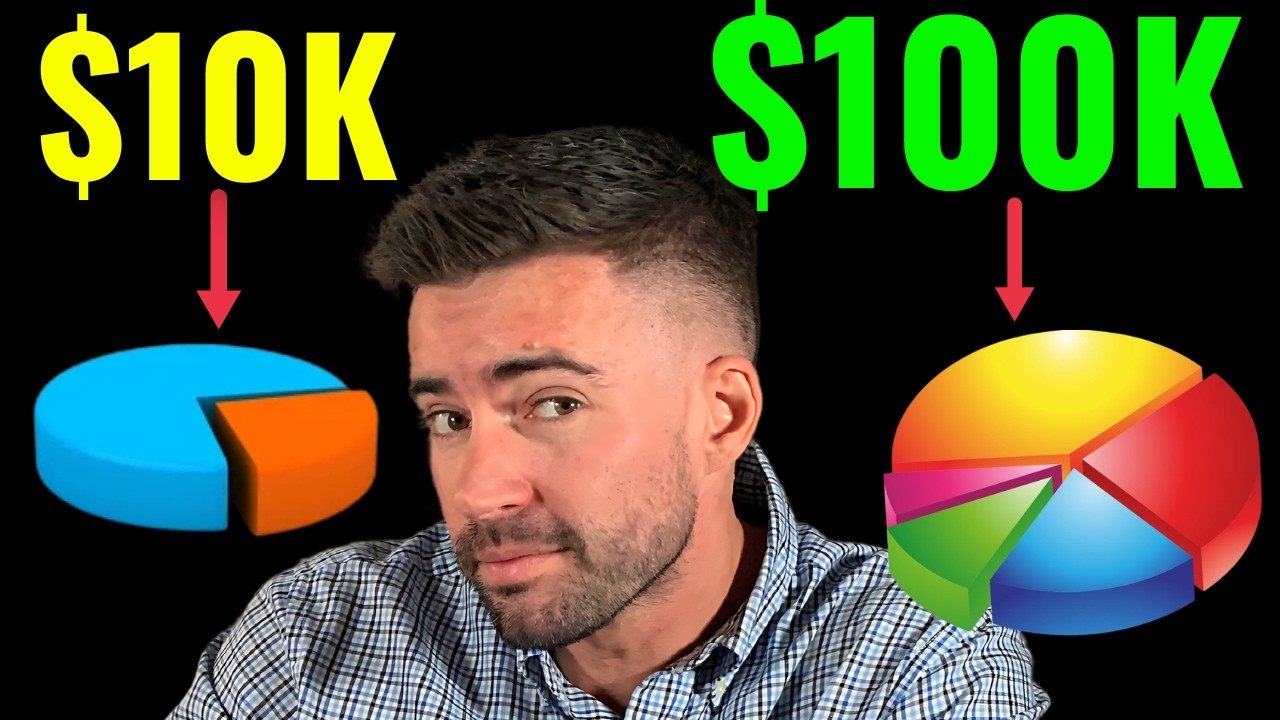
Right now, there's a lot of uncertainty in the market. It's hard to pick exactly what stock or what ETF is going to do best, especially in the next year, maybe even the next two years. But what we can do is take a second and pause. We can rethink our strategy. We can try to figure out what's going to be best for my portfolio right now. Because every single day, I'm helping my one-on-one clients. I see people with tens to hundreds of millions of dollars in their portfolio all the way down to people with tens of thousands of dollars in their portfolio. And while the scope of their questions are different, a lot of them come back to a couple of main things. And so in this video today, I'm going to be answering some very solid questions that I've seen down in my comment section, but also that I've been answering multiple times in my one-on-one sessions. things like how I would invest $10,000 today, five books I'd recommend today, preparing for a stock market crash, investing at all-time highs, or just wait for a pullback, and then Roth IRA versus brokerage account investing. So, I've picked 14 different questions that I'm sure that you have, and I'm going to answer each one in about a minute, maybe two minutes, so I'm not going to go super super deep. And so, for any of these that you'd like me to go deeper on, please comment that down in the comment section. My name is Nolan Goa. My students call me Professor G, and I made this channel to make investing simplified. Remember that all investing carries risk, so do your own research. This is not financial advice, and I'm not a financial adviser. So, the first question, if I had $10,000 versus $50,000 versus $100,000 sitting in cash, how would you invest it today? Now, this is a great question. This is one that I hear all the time. Now, if you have $10,000 versus $100,000, that's a much different scope because with $100,000, if you just earn an average of 10% per year, that then is building your portfolio with another $10,000 each and every year while you sleep. But with $10,000, that 10% isn't doing quite as much. It's adding another $1,000, which is great. We'll take it. But in my opinion, there's just two different ways to look at it. So, for the $10,000 person, at the end of the day, we need to get more invested long-term. But if we're talking about that right now, what I personally would do is I would do anything within my power to use that $10,000 to actually increase my income. Whether that's learning better skills or starting a YouTube channel or doing something where you're starting a business of some sort to where we can bring more money in, that's going to do way more for you than just figuring out what to do with the 10,000 in the stock market. If though we're talking about just putting that money into the stock market, I would just keep it very simple and just do a 100% in VU or maybe a 80% VU 20% QQQM. We just want to go something strong right out the gate and keep our taxes low if it's in a taxable brokerage. With $50,000, we're going to start diversifying a little bit. So in that we're going to do more like my four fund portfolio that I talk about which is SCHD VU the S&P 500 QQQM and SPMO with $100,000. Now we can get a little bit more fancy. I would still do that basic four fund portfolio, but also add in maybe a little international at 5 or 10% and then maybe another 10 to 15% of the rest of that 100,000 could go into individual stocks or satellite style ETFs that are very much specialty like SMH for semiconductors or VGT for technology or WQTM for quantum computing. research something very very well and when you feel like it's something that you want to just go for, that's where I would put that money. Number two, what did I learn about money from my parents or growing up? So, I get this one a lot because I do have clients that are a little bit older, closer to retirement, things like that. And so, they want to know how can they teach their kids, like how did I learn? And one big thing that my parents taught me was specifically budgeting. They were all about the Dave Ramsey envelope system, which I learned a lot from. I don't personally use today. But what I did learn was how to manage my money from a young age. My parents did give me an allowance and it was a little bit higher of an allowance than usual probably for kids that age. But what they told me was you're paying for anything. So anytime we went out to eat, I had to pay for my meal. Or anytime that I wanted a toy or I wanted a skateboard or whatever, I had to pay for that. When I wanted a car, right, when I turned 16, I couldn't afford it yet. So, I didn't have a car right at 16, but I had to work for it and realize that you do prioritize what it is that you're going to spend on. And when the money's gone, it's gone. So, it helped me to really learn about how to prioritize my spending and really where to save and eventually how to invest. Number three, what are five books any investor should read? So, the first one would absolutely be The Simple Path to Wealth by JL Collins. It's literally in the title, all about keeping it simple. And this is how you're going to stay on track. The next one is not simple and this one's called Mastering the Market Cycle by Howard Marx. Now, this one is a bit more advanced, but when you learn this, you stop freaking out about the fact that sometimes the market's up and sometimes the market's down. You start to realize that's actually a cycle. It's always up and then down and then up. And so, it really helps you have some peace of mind during the down times. It also makes you get not too excited at the top so you don't FOMO in or buy when everything's about to fall. Next would be Trillions by Robin Wigglesworth. This one is solid. It just tells you all about and has so much data showing that index funds, ETFs, mutual funds, just broad-based with low fees is the only way to invest. This will make it so that you truly understand, see the data, you're not going to beat the market. Next is the essays of Warren Buffett. This is probably my favorite read outside of the classics. You can see that he stays very consistent no matter if the market's up, the market's down, no matter if the company's doing very well or not doing very well. And long-term, he's obviously been one of the best investors ever. And you can see where it all comes from here. And last is actually not an investment book. This is called The Obstacle is the Way. highly highly recommend for anybody, but specifically those of you that might have a hard time with motivation or you might have a hard time with doing the hard thing. The whole premise of this book is not to avoid obstacles, but to go through them. And this is why I always say sometimes you win, sometimes you learn. This is why I always talk about this when I'm talking about entrepreneurship, when I'm talking about sports, and when I'm talking about investing. Sometimes it's not fun, sometimes it's hard. just keep going. Number four, should I invest more or pay off my mortgage early? This one's a tough one. For most people, I personally am going to suggest that you don't pay off the mortgage early. For the most part, you usually have an interest rate of something like 5% or below. In the stock market, if you were just to go very very basic and do the total US stock market or the S&P 500, on average, you're getting anywhere between 9 and 11% return per year. So, would you rather save 5% or would you rather gain 9 10 11%. Now, the caveat here, and because I do work with one-on-one clients and a lot of them closer to retirement age, is you're probably going to sleep better at night if you do have a mortgage paid off. Cutting down your expenses substantially in your retirement years really gives you peace of mind and makes everything feel just a little bit better. So, psychologically, if you need that to feel better, to sleep better, great. But if we're talking about purely financials, if we're talking about purely numbers, it's almost always going to be better if you take that money and just keep throwing it into something safe and sustainable with a track record like the S&P 500. Number five, is it better to lump sum invest or dollar cost average? Again, just like that last question, this one all has to center around psychology. Now, what they've actually found is literally time in the market beats timing the market. What they've found is that the earlier that you put your money in, if we're talking about 10 years from now, 20 years from now, it will have been better to just put all of it in earlier because time in the market wins. But psychologically, that's a tough thing to do. So, let's just say you have $100,000 and that's your nest egg. You want to throw that in the stock market. If you put it all in today and one month from now the stock market drops 20%. Now you're the value of your portfolio is going to be at $80,000. That's going to hurt. You're not going to feel very good. You're going to feel sick for the whole time it's down. Now on average, if we're talking about the S&P 500, it does come back and it does go to all-time highs. But during that time that it's down, it really, really hurts. And that's actually where most people lose most of their money because they can't handle that feeling. they think they're going to lose even more and then they sell out. So that's why I always recommend to people do the dollar cost average method instead because psychologically and emotionally that's just it's just too much and people usually lose too much that way. So what I say is if you do have that $100,000 instead if you were to put 10,000 in each month over the next 10 months and in our scenario you put the 10,000 in then next month it dropped 20%. Now you get to buy on a discount 20% down for the rest of your buys. Or if it keeps going down, you keep buying in at lower. It could come back up and go higher and now you're paying more. But all in all, it is psychologically easier to go that route because even if it's higher, even if the S&P 500 or whatever has gone up 10%. At least in your mind, you say, "Well, I'm glad that I bought a couple of times before it got up to this high." Number six, how can I learn more about alternative investments, specifically crypto? So, no matter what, anything that's outside of just your basic S&P 500 or even just, you know, mutual funds or even stocks that are somewhat blue chip, if you're talking about things like gold or real estate or buying businesses or crypto, the main thing to do is just really, really dive deep into research. Find one or two people that really know what they're talking about. Find a company or two that gives off good information and just load up on as much knowledge as possible before you ever make any type of buy. And speaking of that, thank you to 21 Shares for sponsoring today's video. 21 Shares sits at the intersection of traditional finance and digital assets, helping translate a rapidly evolving industry into insights people can understand. The US digital asset market continues to evolve through the launch of new investment products and expanded access to blockchain ecosystems. One thing that differentiates 21 Shares is its focus on both research and access. 21 Shares publishes ongoing market insights designed to help people better understand developments across digital assets. The insight section contains research and educational content covering Bitcoin, Ethereum, Salana, Dogecoin, and a range of other digital assets. Want to stay ahead of the curve on all things crypto and digital assets? Subscribe to the 21 Shares newsletter. You'll get market insights, product updates, and trend breakdown straight to your inbox. Follow21shares and 21Shares_US on social for accessible content, timely market commentary, and compliance aligned crypto education. 21 Shares products may not be available to all investors and are subject to regulations in your jurisdiction. This is not financial advice. All investing carries risk. Consult a licensed financial adviser before making investment decisions. Now, let's jump on to question number seven. And this is one that I've gotten pretty much every day this year. What should I actually do with my money before a stock market crash? Really good question. This is what I'm hoping that you're thinking about right now. Preparing is the only way. Just sitting there and hoping is not a strategy. So what I personally would do is make sure that you have a emergency fund of at least three months worth of living expenses, but I would hope it to be at least six months worth if you have a good stable job. If you have a family that depends on you, I would say have at least a year's worth of living expenses. And if you're in retirement, I would have at least three years worth of living expenses purely in cash off to the side in a high yield savings account, money market account, or something safer. Then also have a portion of your investments in things that are safer, too, no matter what your age is. This is why I like ETFs like SCHD or VTV or VYM. And then also good blue chip solid stocks that have a very strong balance sheet that are usually dividend payers like Johnson and Johnson or Proctor and Gamble. And then I also really like Berkshire Hathaway. If you have at least some cash off to the side in case of a big dip or in case you lose your job or something crazy happens, that's the first line of defense. The next line of defense is those safer stocks and ETFs. And then finally would be more the growth style stuff or the S&P 500 or QQQM. Number eight, when should I actually sell a stock or ETF? This one is highly dependent on your situation. I talked to people of all different types and backgrounds. And this answer varies so much. This is honestly why it's so hard to be a stock picker. It's not that hard to see that a company is a good company. Like Tesla looks like a good company. Amazon looks like a good company, but sometimes the stock just drops out of nowhere. And so when do you know when to sell? Sometimes it's hard to figure out, especially if it's down. But even when it's up a bunch, I talked to a lot of people who have heavy Nvidia or AMD or Micron or something like that that's gone up a bunch in the last year or two, and they don't know, should I sell it now? I'm going to have to pay a bunch of taxes. Is it going to keep going up? So, honestly, when to sell the ETF or the stock has to do with your situation. Like if you're retired and at the end of the day you need to figure out how to get $3,000 a month out of your portfolio, then you know that you have to sell something unless you have dividends or something like that. As far as choosing which one, you could either go with the ones that have been doing really really well and so they have a good solid margin there and you've made a bunch of money. But if we're talking about a taxable brokerage account, you're going to have to pay taxes on that gain. Now, it's going to be favorable probably as long as you've held it for long term, held it for longer than a year. But taxes do play into the equation. If you're talking about just a IRA or something like that, maybe you sell so that you get back into balance. Then you kill two birds with one stone. Let's say your growth stuff is over 40% and you only want it to be 30% of the portfolio. Then if you sell out of about 10% of that, now you get the money and it brings it back down into correct balance for you. As far as selling a speculative stock or ETF, say it's gone up a 100% in three months, maybe just have a rule for yourself. I don't do a lot of speculative buying and selling and things like that, but I know that if I bought a stock that I'm not necessarily trying to hold for the next 10 years and it went up 100%, at the very least, I would sell half of it. Take that money, be very happy to have gained that much. And now you're just playing with the house money moving forward if you want to keep it in that stock. I would then take that money and put it into things that I do believe are going to be the best thing for my portfolio, which would be anything like the S&P 500 or SCHD or QQQM, those types of things. Number nine, at what age should I start shifting from growth investments to safer investments? Now, my theory is that we should have a little bit more of a balanced approach the whole way through. I'm never going to tell somebody, "Oh, you're only 25 years old, so you should be 100% in growth. risk it all as much as possible for the next 15 years and then at that point we'll cut it back. Couple of reasons for that. I've actually worked with clients who have done that and at that point that's a huge tax hit to switch over. At that point you're also probably in the height of your career making the most money you've ever made. So your household income just goes crazy and so your taxes are nuts at that point. The other thing is kind of like that book that I showed you from before Howard Marks the market cycle. At some points growth and technology and things like that are beating the market by far, but at some points that actually drops the most. And during that time that that drops, value and very very boring style companies and even bonds to some certain extent do very well everything else is down. And so in order to keep everything sustainable and always growing, it's a good idea to have at least a portion of some of these other things. So, should you take a little bit more risk and be a little bit more aggressive, especially if you're younger, yes, absolutely. And so, if that's more the question, then what I would say is the closer that you get to needing to use that money. Now, the traditional retirement age of like 65 or whatever, sometimes I see people who are trying to retire by age 50. So if they were being very very aggressive and risky still at age like 48 and trying to retire at 50, what if the whole stock market collapses at age 49? Then you're not retiring at 50 if you're counting on that money. So it really has to do with when you believe that you're going to actually start using the money in your funds. That's when I would start a glide path of starting to cut down a little bit on growth, adding more to the safer stuff, and adding more and more as the years go on. Number 10, how much cash should I keep instead of investing? For this, it's all about your living expenses. To be honest, like I said from before, I'm very comfortable with six months or so of living expenses and a high yield savings account if you're in a very solid job and you don't necessarily need this money. Up to about a year's worth of living expenses, especially if you're the sole bread winner in the household and you have a family that's dependent on you. As far as in retirement or when you're starting to use your actual investments to live off of, I would want to have no less than 3 years worth off to the side. Number 11. Should I invest when the market's at an all-time high or wait for a pullback? As long as we're talking about solid, sustainable, long-term ETFs and mutual funds and index funds that have a very solid track record and have a very low fee. I'm just going to say dollar cost average no matter what. Rain or shine, all-time highs. This year alone, we've had more than 25 all-time highs in the S&P 500. And we're just going to continue to see that. And we've seen that over the years. Now, yes, if you have $100,000 and you wait for the perfect pullback and you put it all in at the right time and then it goes up like crazy, you will make more money that way. The problem is actually timing and knowing when is that actual bottom. Most people think it's the bottom when it's 12% down, 15% down, and then it goes down another 30% or something. So when you're dollar cost averaging, you get to put money in all the way down, continuing even at that 30% negative, whereas the other person maybe put all of their h 100,000 in when it was negative 15%. All that to say, dollar cost averaging takes the guesswork out of it and it's the best way to invest long-term, unless you have a crystal ball and you can figure all this out, and if you do, please call me up. Number 12. How many ETFs do I actually need in my portfolio? As far as need, I mean, you could probably get away with one to be honest. Warren Buffett says that for most people, they could just do 90% of their portfolio in the S&P 500 and 10% in cash or bonds. You'll probably feel a little bit more comfortable having at least three just so that you have some diversification in there. But most of my clients have something like 20, 30 different ETFs and on top of that 40 or 50 stocks as well. And those are the most stressed out clients that I've seen. They could have $10 million and they're still way more stressed out than somebody who has $2 million but has it in a very simple layout. So my answer is just keep it as simple as you can possibly handle and that's going to bring down your anxiety and let you go out and do things that you actually want to do rather than have to watch the stock market every day. Number 13. Should I buy individual stocks or just stick with ETFs? Again, I'm going to call on what I just said. If you want to actually have a life and be able to focus on something outside of the stock market, have as little individual stocks as possible and as much broad-based ETF in the portfolio as possible. Just as a reminder, my portfolio is like 90% ETF and about 10% individual stock. I get it. It's way more boring just going ETFs, but I promise you that you don't necessarily want that excitement to come from your portfolio because excitement goes both ways. It can go up a bunch and it could go down a bunch and that excitement is not fun. Number 14. Should I prioritize my 401k, Roth IRA or taxable brokerage account? Highly, highly recommend that you're prioritizing all three. I don't care how old you are. This was one of the mistakes that I made very early on. All I did was my 401k and my Roth IRA because that's what's in every single book. That's what most financial adviserss are telling people. But when I start investing at like age 18, 19, 20, there's a good chance that if I do this right, I'm going to be able to retire well before age 60 and if I can't touch my money until after 59 and a half with a 401k, traditional IRA, Roth IRA, then how am I going to bridge that gap? So, what I found was when I was about 25, 26, I started realizing I'm actually going to need to really prioritize or add to the taxable brokerage right now. even though I'm not getting the tax benefit, it's going to help me with what my actual goal is down the road. Now, absolutely, 100% the most important account that you have is the Roth IRA. And so, no matter what, I would also tell people do your best to max that out. Now, to see exactly what to invest in within the Roth IRA, I made this video with seven ETFs that would be absolutely great to be putting in the Roth IRA. You don't need all seven, like I've talked about in this video. You could just do two or three, but this is what I'd invest in. Or watch this video to keep investing simplified.

Comments 0
Sign in to join the discussion.
Sign inNo comments yet. Be the first to share your thoughts!