Battery Technology Breakthrough, but With Operational Challenges -- Enovix ENVX Stock Analysis

- Video return
- —
- Calls
- 2
- Buy / Sell
- 2 0
- Published
Recommendations
Entry is the asset's closing price on the publication date. Current is the last close on record.
-
Entry $3.38 25 Aug 2026Current $3.38 25 Aug 2026Result +$0.00
started buying it back
Context "started buying it back" / later: "So we're gonna allocate a bit more to this small bet, and we'll check back in in 2027, probably early 2027."
-
Entry $3.38 25 Aug 2026Current $3.38 25 Aug 2026Result +$0.00
So we're gonna allocate a bit more to this small bet, and we'll check back in in 2027, probably early 2027.
Full Transcript
Let's do Enovix. This is a new little publish
feature of the website. This gives you the supply chain of the
market, the sub-segment you're looking at. In this case, we're looking at specialty
energy and equipment with Enovix. On the right side, we have all of the
industry stock lists that fall under this segment, specialty energy and equipment. So there's some for power generation,
utilities, solar energy, and this one in particular that we're talking
about falls into battery technology. Enovix is working on silicon
anode lithium-ion batteries, and we'll show you a little bit more
about the chemistry of this. Nick's gonna talk about
it, of course, not me. Not my area of expertise. The anodes in this case use silicon
instead of graphite to increase energy density and increase charging speed. One of the reasons we're talking
about this is because our small bets basket, we're reviewing some of those. How are they performing? What's going on? And a number of them have sold off
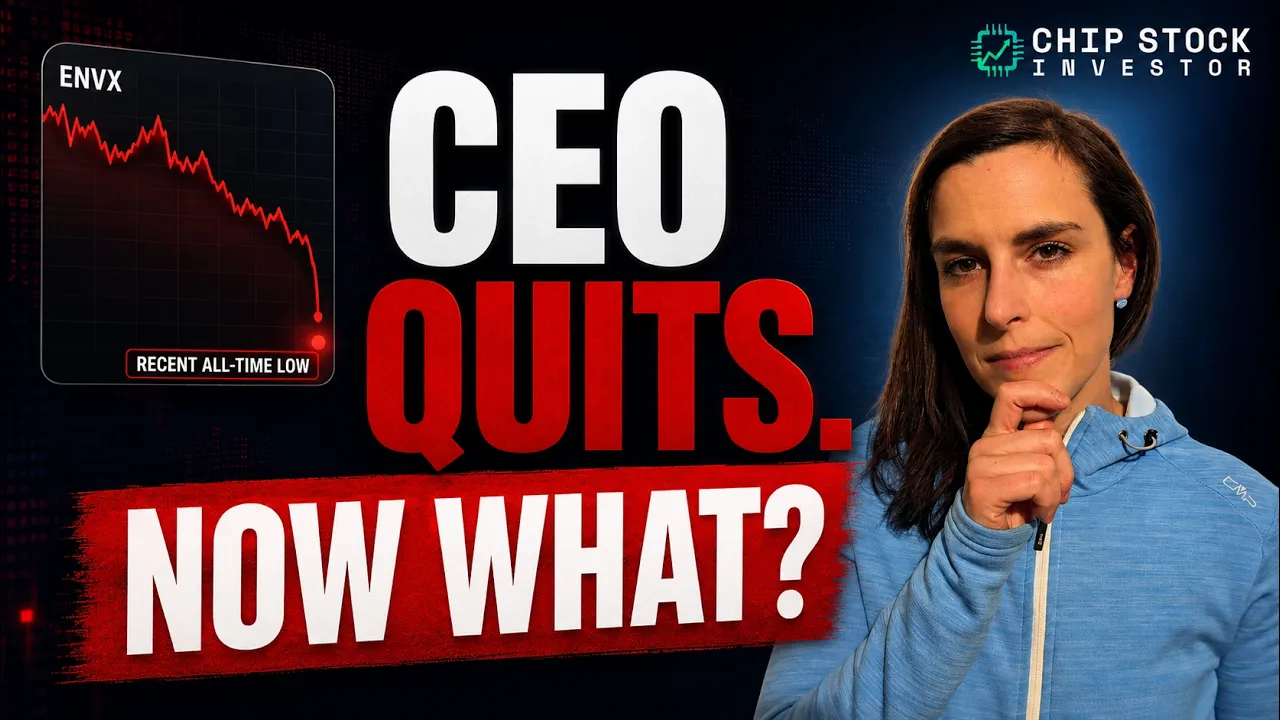
pretty hard in the last month, especially Enovix, which is down to its all-time low. It's gone downhill pretty fast, and
before all this, we locked in some good gains when we bought Enovix. Last year sometime. So we locked in those gains, but then
started buying it back, and since that point, it's not been doing a whole lot. So what happened? Yeah, and it's a very small bets basket. So at this point we're interested in
maybe increasing the size a little bit more, or at the very least back to
where it was when we repurchased again. What happened, though? We'll get to the Q2 2026 earnings report
in just a moment, because Wall Street was a little bit unhappy with some things that
were talked about in Q2 and the Q2 update. But then subsequent to that, the CEO,
Dr. Raj Talluri, very abruptly announced his departure, and then it came out
just two days ago that it was actually Kulicke & Soffa, the advanced packaging
and semiconductor packaging equipment provider, that actually poached him away. That leads to the question, if Enovix
is getting to a point where they can commercialize, or ramp up the
commercialization of this advanced battery technology, why would the CEO leave? Why'd you leave, Dr. Raj? Ah, Kulicke & Soffa. They're hot right now. It's so hot right now. Stock so hot right now. Kulicke & Soffa revenue has actually
been doubling year over year. No surprise. Advanced packaging is all the rage. And so we have talked about this actually
a couple of times in recent years. When CEOs leave, oftentimes,
why do they leave? Bigger paycheck. Bigger paycheck. Sometimes it could be just that simple. We talked about that with Lattice
CEO Jim Anderson going to Coherent. Much bigger company at the time. Now it's an even bigger company. Adobe CFO, Dan Durn left for Marvell. These companies are hot
right now, so I don't know. They can pay more. And here's an illustration of why. You'll see the Enovix financials in just
a moment, but they do at this point less than 10 million in sales each quarter. Kulicke & Soffa did 330 million in sales
last quarter, and they're profitable. He probably got offered a much
bigger paycheck, and it's in a hot segment of the market. And it's his dream job, wink. So, this is not about Kulicke & Soffa. You can actually find the advanced
packaging industry stock list on the research dashboard and
see our allocation to that. Hopefully you've been
in on that all along. That's nothing new. Let's go through the presentation
that TJ talked about. So we'll do some chemistry here. This is a cross-section of
Enovix's battery technology. Batteries have anodes and cathodes. This is where electrons and ions
will shift from one side to the other during charging and then
also during the discharge when the mobile device is using power. This is where the magic happens. Yes, where all the
chemistry magic takes place. So I'll just walk you
through these layers here. On the far left is Cu, so we're
talking about the periodic table here. That's the very thin copper layer
that is the anode current collector. And then right next to it in the dark gray
there is the actual anode, the silicon anode that Enovix has been trying to
innovate, and they've been working on this chemistry now for over a decade. In between the anode and the cathode,
that dark vertical line is the separator, and then on the right is
the lithium cobalt oxide cathode. This is why it's a lithium ion
battery, lithium in the cathode. And then on the far right is the
aluminum cathode current collector. And so what happens during this process
of electrons getting moved and then discharged, you also have lithium ions
that move back and forth between that separator, between the anode and the
cathode during charging of the battery, and then discharge of the battery. And what happens during that, Mr.
Rogers actually had a really great explanation and couple of slides
explaining what happens for investors. On the left, when they originally started
making these anodes, it was just silicon. Just diced sections of
a raw silicon wafer. And because silicon is crystal, when
you have the lithium ions moving from the cathode into the anode, it
was as few as 10 cycles the lithium would get in there into these fissures
and cause cracks and destroy the anode in as few as 10 charge cycles. Over the course of a number of years,
they developed that chemistry into silicon oxide, there in the middle, and they
were able to get it up to 500 cycles, 500 charges before the lithium would kind of
wiggle its way in there and start to cause fissures and cracks and destroy the anode. But the big thing that Rogers wanted
everybody to know that he felt everybody skipped during the Q2 earnings update
was they actually got this new chemistry, this silicon carbon composite with enough
places for the lithium to kind of go in during the energy transfer process, that
it doesn't destroy the anode anymore, and they got it up to 1,000 cycles. That's now a useful device. And their potential smartphone commercial
customer is probably the Honor smartphone company in China, is nearing the end of
product verification and qualification. They have another one that's also
qualifying, that could potentially enter commercialization next
year, and they're actually in commercialization of these batteries
right now for a smart glasses company. That's the really good news. We are now at the stage where
Enovix needs to scale up its fabrication of these batteries. So now we're at ramp-up phase. Right, and they have some facilities. Fremont, Penang, and then South Korea
for additional manufacturing assembly. The revenue base is
still very, very small. $9 million in Q2 2026. Gross margin, terrible. We've talked about this before. A 40% gross margin for a manufacturing
business is a key target. And this is on an adjusted basis. They're still a long ways off. Only have $550-ish million
on the balance sheet. So they don't have the capacity yet to
meet the orders that you see on the right, the smartphones, smart eyewear, and
this growing interest for drones as well. They have a 50,000-pack
order for the smart glasses. So all of this to say they don't
have the capacity to meet this. They're gonna have to start building
more manufacturing capacity. If you look at the financials and you
start thinking, "Okay, now they have to spend all this money. What's gonna
happen? What does that mean exactly?" We have a well-established analogy. Only fast cars in technology. But what does that
practically mean, though? Okay. So it's like a gas tank. If you're not moving, you're idling and
you're using up gas, and that's kind of what's going on right now with Enovix. They're not replenishing that gas. They're just idling. And when you're pre-revenue in R&D,
you can kind of idle for a long time. And they have been. But eventually you're gonna need to stomp
on the gas, use up some of that gas in the gas tank, and the question is, do
you have enough to get to a cruising speed, and use that gas efficiently? Can they get to manufacturing
capacity, build out all of the infrastructure that's required, ship
all of their promised batteries out? Do they have enough gas in the gas tank? Or in even simpler terms, as Elon
Musk famously said, Production hell. Was it production hell? That period where you have orders coming
in, you know there's demand, but you need to build the manufacturing capacity first. That's the period where
it's like a drag race. And then cruising speed would
be, okay, there's enough capacity online, there's enough manufacturing
online that we're self-sustaining. The fuel efficiency of the vehicle,
of the business is good, and we don't have to borrow money. And essentially, the
first shoe to drop was Q2. Super exciting. Enovix is now at that point
where it's no longer R&D phase. They have real orders. They have real commercialization of
products that they can sell to potentially the smartphone industry, smart glasses,
and aerospace and defense via drones. But oh my God! Yeah, the revenue's only 9.5 at
the midpoint for the next quarter guidance, and capital expenditures
are more than that at the midpoint. 10 million at the midpoint,
but nothing's cheap. It'll be 12. It very much may be 12. And so the market is looking at
this thinking, "Okay, now it just got real." All this time we've
been waiting in idle mode for R&D. We're stomping on the gas now, and in
true market fashion, someone always freaks out and says, "Oh, what if we don't have
enough cash until we get to scale up?" The initial revenue guidance is
a little bit light, and oh, by the way, then the CEO just left. That was the second shoe to drop. Right in the midst of all this,
the market was like a little bit worried, and then Dr. Raj leaves. Enovix now has this distraction of
having to go find a new permanent CEO. And, TJ Rogers is out there defending both
his early investment in Enovix as well as the future potential of the company. And so do they have enough
cash to get there? This is the race against the clock. This is the fast car race to capture this
new market in next gen battery technology, silicon-based anode battery technology. They've got cash in equivalence,
$476 million, an additional $74 million in longer term investments. Most of that is US treasury
investments and other bond investments. When you add in the R&D expenses plus the
higher CapEx to buy equipment and expand the fabs in Fremont and Penang, Malaysia,
they're gonna be burning, let's say about $20 million to $30 million a quarter. Do you get the sense of the problem now? The $476 million in cash in the course of
just a year or two could be significantly reduced, and the business' operations
are still in scale up mode at that point, and now you have to talk about doing
another cash raise event, either via more debt, they already have debt of over $520
million on balance, selling more stock. This is the worry that is now going on. Why would we buy something like this? This sounds like a piece of garbage. We are not supporting a good
strong bull thesis here. We wanna start with the bad news, though. Yeah. And we did. But the good news is they've
made a ton of progress. They actually have made a significant
amount of project, and I think we're both willing to bet that Mr. Rogers
can pull this off to some extent, or at least, that they'll stabilize
and get their manufacturing capacity where they need to, and be able to
ship orders and rake in that revenue. But this is a small bet. Very small bet for us. And high risk. Potentially really big
high reward, though. Especially now that the company's trading
at a 600 million market cap roughly. And on an enterprise value basis, it's
gonna decrease from there because the cash balance is going to dwindle away
until they reach free cash flow breakeven. So it's an interesting story. It's always interesting when the market
will hype up these pre-revenue R&D businesses, and then occasionally,
when one of those businesses succeeds and is like, "Hey, we have a product
that we can sell. We need to spend money," and then everybody freaks out. So we're gonna allocate a bit more
to this small bet, and we'll check back in in 2027, probably early 2027. So we'll have to reevaluate next year. But until then, we're gonna allocate
a bit more and wait and see.
Comments 0
Sign in to join the discussion.
Sign inNo comments yet. Be the first to share your thoughts!