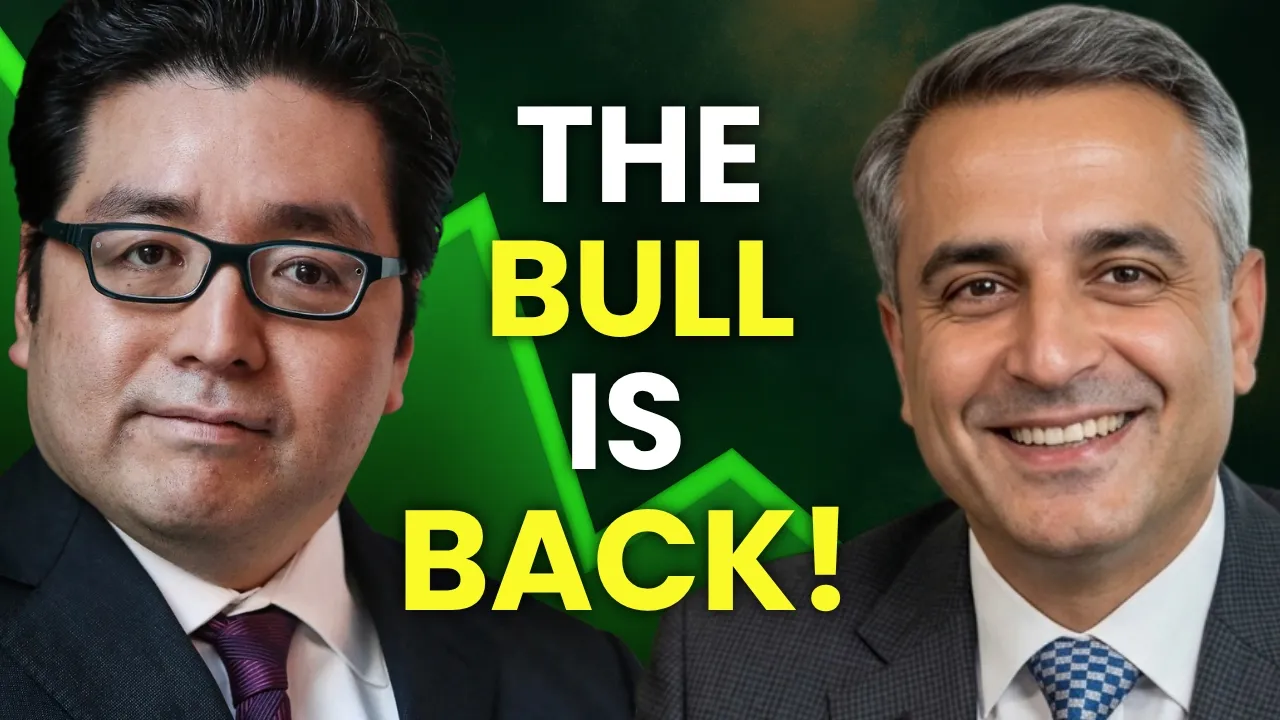
Tom Lee: Why the S&P 500 Is Heading for 8,000

- Video return
- -0.53%
- Calls
- 1
- Buy / Sell
- 1 0
- Published
Recommendations
Entry is the asset's closing price on the publication date. Current is the last close on record.
-
Entry $78,861.00 31 Aug 2026Current $78,443.00 01 Sep 2026Result −$418.00
I think you know Bitcoin could easily you know be in the six figures maybe.
Context Lee's crypto outlook: "I think you know Bitcoin could easily you know be in the six figures maybe."
Full Transcript
While most of Wall Street spends September bracing for a historical autumn pullback, one of the market's most prominent bulls is predicting a massive contrarian rally above the 8 to000 mark on the S SNP500. Tom Lee, the head of research at Fundstrat, sat down on CNBC recently to break down why mounting economic fears are actually setting the stage for a major market surprise. By the end of this video, you will know exactly why the consensus view on interest rates, corporate earnings, and cryptocurrency is likely getting caught completely offguard and how to position your portfolio for the final months of the year. Let's hear Tom Lee on CNBC. And after that, I'll give you my own reaction breakdown to what he said. >> Tom Lee and his hair. Uh, and you got it cut. It It looks We were talking about it high and tight. You decided to go with that, right? Yeah. It's good. Good that you did. He's head of re research at Fundstrat and chief investment officer Fundstrat Capital as well as a CNBC contributor. We we won't have to deal with uh where people focus on that on Twitter instead of uh instead of your calls. So that we got that going for us. Tom, August you want you thought would be very good and it was good, but it's not 8,000 on the S&P. It's not 7,800. Then September you thought there might be a convergence of the worries that that have been keeping everyone else bearish for the while you've been bullish. You think that you thought they were going to come home to roost in September and maybe have a 10% pullback. >> Yeah, that that is what I'm sort of thinking as a base case, you know, because there's a lot of crossurrens this month. Um like Joe Leavia talking about a Fed hike in September. uh the AI data center backlash and there's the seasonality issue. You know, September's a weak month, but I'm actually now thinking because of all this mounting concern, the market might surprise us to the upsides. And I think maybe September 15th, the Fed meeting is the pivot point. If the Fed doesn't cut, doesn't hike, which is our base case, I think actually the markets could rally very strong. It wouldn't be one of those situations where the credibility is is at issue and that the market actually wants a hike. The market never wants a hike, do that. >> That's right. I I think I agree with your statement earlier this morning that uh he wants to signal um credibility, but he wants the data to kind of play out. And if the data, we have the jobs report Friday and we have a CPI report in earlier in September. I I think if both are weaker, I think, you know, the market's not going to price a hike. >> This would be then sort of um re revising your call for a pretty big pretty substantial correction this year then would or are you now saying October or November when it comes? Yeah, maybe it gets pushed into October because, you know, I think the consensus view is that midterms are going to be a launch point for stocks to go higher, but maybe that's maybe October, which is normally the month of u big moves, you know, could actually be a weak month instead, >> would it? But it could be from above 8,000 then. >> Yeah. Yeah. Maybe above 8,000. Then then the lows could be not that different from where we were a couple months ago then. >> Yeah, maybe 73 74 something like that, >> which we could probably uh handle without that that we could handle without really giving that much back. But it would certainly instill a lot of fear and and loathing and and everything else from from people who think now we're going down to 6,000 or or whatever or even worse. >> Yeah, I agree. I mean, every time the market's flat for the week, people start to think it's a bare market starting, you know. So, I think people flip bearish very easily. >> They're ready for that. Uh I I know. What about um crypto in in Bitcoin? That that was weird, wasn't it? What What did you attribute the move to the meeting with executives in in the White House or or it was just ready? >> Yeah. I mean I think the way we would look at it is one I think this year crypto fundamentals have been good because we know the tokenization movements very strong. I mean Robin Hood was a breakout product launch. I mean really one of the biggest hits and Aentic AI is good for crypto but we were in the middle of that crypto winter. I do think catalysts have come together uh and actually going to really strengthen into year end because one uh crypto is the best performing macro asset in the third quarter so far. So I think September and the fourth quarter there's going to be institutional allocation to crypto. The second is you know the crypto four-year cycle basically ends next month. So I think people who've turned off crypto on their screens are going to come back. the Korean investor, which was really big in crypto. You know, they rotated into AI early this year, but we're already seeing volumes pick up in Korea. So, they're rotating back into crypto. And the final is if Clarity Act passes, which could happen this year. And if it does, I think, you know, Bitcoin and Ethereum have a huge fourth quarter. >> So, is is crypto winter over and the huge third and fourth quarter, does it make up for what we've seen over the last year and declines in Bitcoin? Yeah, I I think uh it's been a very shallow crypto winner. Um but there was a massive amount of deleveraging like October was a big step down and then earlier this year twice. So I I think very few people own crypto. That's why I think you know Bitcoin could easily you know be in the six figures maybe. >> You get the rate hike what happens >> on the crypto side. >> I mean it's going to be a good test. Um, but we already know that the long end has risen. So, if we get a hike and long yields fall, that's actually monetary easing. So, it it may have to do with how long-term yields act react to a Fed hike. >> You actually said there was going to be a a jump in crypto. I think it was last time you were on. I mean, you is this what you were talking about or even more that up to 90,000? I can't remember what you said, but you thought it was going to >> Yeah. >> take off. I think this is the beginning. >> Yeah. I think it's the first leg up because this was like a catching people off sides move in crypto. >> Yeah. >> Um I I think institutional investors are buying crypto stocks. That's really evident. Like the volumes have really jumped and that's a sign that they're betting on a big fourth quarter. And I mean, you've had I think you you were at 150 at one point on on Bitcoin. You you haven't abandon those types of numbers or or even I don't know higher than that even. >> I I think 150 is still possible. Um >> not that far off. >> Yeah. And I think that that's because the S&P also has a lot of upside into year end. You know, the 8,200 I think is still a low number. what the S&P could achieve by the end of the year given how much earnings have revised higher. You know, we're originally thinking 2027 would be 350. Now it's 415, but it could be 425 for next year earnings. >> It matched what we did this quarter, but people were at 18%, it was 30%. Was it? >> Yeah, that's right. And it's still almost 20% organic, you know, without investment gains. >> What what is the base level right now of GDP growth in in your view? as we had, you know, the import the the import u the surge kind of masked the underlying growth rate giving, you know, Democrats and others plenty of grist that we're one and a half, you know, we hear we're at one and a half%. What do you think we really are with corporate earnings that the way what we're seeing? The structural GDP looks a lot stronger than the last 20 years because we're in a positive investment cycle plus there's onshoring and then there is this sort of energy infrastructure. >> What is that 3%. >> Yeah, I think it's above three. >> You think it's above three? >> Yeah, but it doesn't have to be inflationary because wages would be sort of the inflation component and wages aren't that strong. The conversation kicked off with a light-hearted exchange about Tom Lee's hair, but host Joe Kernan wasted no time transitioning to the macro picture. Kernan brought up Lee's previous market calls, pointing out that while Lee correctly predicted a strong August, he had previously warned that September could bring a convergence of worries, these concerns, which have kept many institutional investors stubbornly bearish, were supposed to trigger a healthy pullback of around 10%. Karnan directly asked Lee if he still believes those worries are finally coming home to roost or if the landscape has shifted underneath them. Lee's response revealed a fascinating evolution in his thinking. He admitted to Kernan that a September correction was indeed his base case driven by a series of distinct headwinds. He pointed to high-profile warnings of a potential Federal Reserve rate hike, the growing investor backlash against massive artificial intelligence data center capital expenditure, and the undeniable historical reality that September is traditionally the weakest month of the year for equities. But instead of doubling down on his bearish outlook, Lee flipped the script. He explained that because these concerns have become so loud and widespread, the market is actually primed to surprise everyone to the upside. In his view, the defensive positioning of institutional investors has actually created a natural floor for equities. When every major fund manager is sitting on cash waiting to buy the dip at the bottom of a projected 10% correction, they end up front running each other. The dip never quite materializes because the buying pressure is triggered much earlier than anyone expects. Lee argued that this defensive posture is the ultimate fuel for a contrarian rally. He pointed out that cash on the sidelines remains at historic highs and as soon as the calendar flips, the fear of missing out will start to overpower the fear of a seasonal pullback. What do we make of this contrarian setup? I find this perspective incredibly compelling because it aligns with a classic market truth. The crowd is rarely right at major turning points. If everyone is positioned for disaster, the path of least resistance for stock prices is almost always upward. This debate over defensive positioning led directly to the next big macro question as Becky Quick jumped into the conversation to steer the debate toward the upcoming Federal Reserve policy meeting. Quick pressed Lee on the implications of the Fed's first rate cut in over four years. The central debate on Wall Street is no longer whether the Fed will cut, but by how much. Quick asked a crucial question. If the Fed goes big with a 50 basis point cut, does that signal a healthy preemptive strike or does it scream panic to a market that is already hyper sensitive to recession risks? It is a classic double-edged sword. A smaller cut might not be enough to ease borrowing costs, while a larger cut could validate the bear's worst fears about an economic slowdown. Lee did not hesitate to take a clear stand on this. He argued to Quick that the size of the cut matters far less than the underlying economic context. In his view, the Fed is not cutting rates because the economy is cratering. They are cutting because inflation has been successfully tamed. This distinction is everything. Historically, when the Fed cuts rates during a recession, stocks tend to struggle because corporate earnings are falling faster than borrowing costs. But when the Fed cuts rates in a non-recessionary environment, what economists call a midcycle adjustment, it is almost always rocket fuel for the stock market. Lee explained that we are firmly in the latter camp, noting that while the labor market is softening, it is normalizing rather than collapsing, and consumer spending remains remarkably resilient. Where I land on this is that the distinction between a panic cut and a normalization cut is the entire game. If the economy isn't broken, lower borrowing costs simply act as a massive liquidity injection. Having established that lower rates aren't a sign of panic, the conversation naturally shifted to the specific sectors poised to explode under this new Fed regime. Joe Kernan pushed Lee on how this macro shift would impact the forgotten stepchildren of this bull market, small cap stocks. Lee used this prompt to double down on his thesis for a massive small cap rotation. He explained to the panel that small cap companies are uniquely sensitive to interest rates because a significant portion of their debt is short-term or floating rate. When rates go down, their interest expenses drop almost instantly, flowing straight to their bottom lines. To play this, Lee highlighted the primary vehicle for this trade. The fund is the iShares Russell 2000 ETF, ticker symbol IWM. If you look at the chart of IWM, it has been consolidating in a massive multi-year base. Quick pause here, like the video, subscribe to the channel, and then let's pick this back up. My take is that Lee is absolutely spot-on regarding the mechanics of this rotation. When borrowing costs fall, the risk premium on these smaller, highly leveraged companies shrinks dramatically. It is not just about cheaper debt. It is about survival and growth potential for businesses that do not have the massive cash piles of big tech. If the Fed successfully engineers a soft landing, the valuation gap between the mega caps and the rest of the market will have to close and small caps are poised to be the biggest beneficiaries. But the hosts were not about to let Lee off the hook without addressing the elephant in the room, artificial intelligence spending. That is when Kernan pivoted the discussion to the massive capital expenditure budgets of the tech behemoths. Kernan pressed Lee hard on the massive capital expenditure budgets of the tech giants. He pointed out that companies like Microsoft, ticker symbol MSFT, and Alphabet, ticker symbol G OG L, are spending tens of billions of dollars each quarter on infrastructure. Yet, investors are starting to lose patience. They want to see real tangible revenues from these AI investments, not just promises of a distant future. Kernan directly asked Lee if the market is finally waking up to an AI bubble that is about to burst, taking the entire S&P 500 down with it. Lee's defense of the tech giants was grounded in corporate reality rather than speculative hype. He rejected Kernan's comparison to the dotcom bubble of the late 90s. Back then, telecom companies were building out fiber optic networks using borrowed money, hoping that demand would eventually materialize. Today, the companies driving the AI buildout are the most profitable enterprises in human history. Microsoft and Alphabet are funding their AI investments out of their own free cash flow, not high yield debt. Furthermore, Lee pointed out that this spending is not optional. It is a defensive necessity. If you are a mega cap tech company, you cannot afford to lose the AI race. The cost of overinvesting is a temporary hit to margins. The cost of underinvesting is complete obsolescence. Where I land on this is that the market is currently mispricing the transition speed of AI integration. We are in the infrastructure build phase, which always looks expensive and inefficient before the application layer matures. Think of it like building the transcontinental railroad. The initial laying of the tracks was incredibly capital inensive and bankruptcies were common. But once the tracks were laid, it unlocked an entire era of economic growth. Lee is arguing that we are still in the track laying phase and the companies providing the hardware like the market leader Nvidia, ticker symbol NVDA, are making real tangible profits today. That is a massive difference from the speculative shells of 2000. This defense of tech margins prompted Andrew Ross Sorcin to shift the conversation into more speculative territory, bringing up cryptocurrency. Sorcin challenged Lee on his long-standing Bitcoin bullishness, noting that Bitcoin has been stuck in a frustrating choppy range for months, failing to break out despite the launch of spot ETFs and the highly anticipated having event. Sorcin asked Lee point blank if the crypto thesis is losing its luster or if there is a real catalyst on the horizon that can reignite the digital asset space. Lee's response connected Bitcoin directly back to his broader macroeconomic thesis. He explained to Sorcin that Bitcoin is fundamentally a liquiditydriven asset. When central banks around the world are tightening monetary policy and draining liquidity from the system, risk assets of all kinds face a steep uphill battle. But we are now entering a global easing cycle. It is not just the Federal Reserve that is cutting rates. The European Central Bank, the People's Bank of China, and other major central banks are all shifting toward accommodation. Lee argued that this global wave of liquidity is the ultimate catalyst for Bitcoin. As fiat currencies are systematically devalued by lower rates, scarce digital assets become incredibly attractive to both retail and institutional allocators. He also addressed Sorcin's point about the posth having price action which has disappointed many retail investors who expected an immediate vertical spike. Lee pointed out that historically the supply shock of the having takes several months to manifest in the market. The reduction in daily minor issuance slowly starves the market of supply while demand fueled by the new spot ETFs remains steady or increases. When you combine this delayed supply squeeze with a fresh injection of global liquidity, you get the perfect recipe for a powerful year-end rally. He told the panel he remains highly confident that Bitcoin will reclaim its all-time highs and push significantly higher before the cycle peaks. What I find interesting about Lee's crypto outlook is how it mirrors his view on small caps. Both are highly sensitive to the cost of capital and global liquidity. When liquidity is tight, capital clusters in the safest, most defensive mega cap stocks. But when liquidity expands, capital flows outward to the periphery of the risk curve. Bitcoin is the ultimate liquid proxy for this risk-on behavior. If you believe the Fed is going to successfully ease rates without causing a recession, then you must also believe that risk assets like Bitcoin are going to find a very strong bid. It is all part of the same macro puzzle. Having tackled tech and crypto, the discussion shifted back to corporate America and the overall health of the S&P 500 with Joe Kernan questioning the sheer math behind Lee's soaring equity targets. Kernan brought up the target valuations that seem almost absurd to many conservative analysts. How does the market justify an S&P 500 trading at over 20 times forward earnings when economic growth is slowing down? Kernan asked Lee if his targets rely on multiple expansion, meaning investors are willing to pay more for each dollar of earnings, or if he expects corporate profits to grow fast enough to justify these price levels. Lee's answer relied on two structural pillars: corporate efficiency and demographics. He explained to Kernan that American corporations have spent the last two years cutting costs, optimizing supply chains, and integrating technology to protect their margins in a high inflation environment. Now, as inflation cools and borrowing costs drop, those lean operations are poised to generate massive operating leverage, a small increase in revenue will translate into a disproportionately large jump in earnings per share. On top of that, Lee introduced a powerful demographic argument that is often overlooked. The millennial generation, the largest demographic cohort in American history, is entering its peak earning and investing years. This creates a structural long-term bid for equities that will persist for the next decade regardless of short-term economic cycles. This demographic perspective is a crucial piece of the puzzle that many short-term traders completely miss. We often treat the stock market as a series of disconnected daily charts, but over the long term, it is driven by systemic capital flows. When tens of millions of people are simultaneously reaching the stage of life where they are saving for retirement, buying homes, and allocating capital to retirement accounts, the demand for financial assets naturally increases. This structural demand supports higher valuation multiples than we saw in previous generations. Lee is looking past the immediate noise of the next Fed meeting and focusing on the multi-year tide that is lifting all boats. This brings us back to his bold target of the S&P 500 reaching the 8 to,000 mark by the end of the decade. To many, this sounds like wild, irresponsible optimism. But when you break down the math, it becomes surprisingly realistic. To get from current levels to 8,000 over the next 5 to 6 years requires an annualized return of roughly 8 to 10%, which is right in line with the historical average of the stock market. Lee is not predicting an overnight miracle. He is simply pointing out that the structural forces of AIdriven productivity, demographic demand, and a supportive monetary policy environment mean the bull market has plenty of runway left. This long-term optimism prompted Joe Kernan to ask one final practical question for the average investor watching at home. Kernan asked Lee for his final piece of advice for the individual investor who is currently sitting on the sidelines paralyzed by the constant stream of negative headlines. With geopolitical tensions rising, a highly contentious political season, and persistent worries about a slowing economy, Kernan noted, "It is incredibly easy to find reasons not to invest." He asked how a regular investor should navigate this minefield of fear. Lee's parting advice was a masterclass in market discipline. He cautioned the panel against trying to time the exact bottom of seasonal pullbacks, noting that the opportunity cost of missing the start of a major rally is far greater than the pain of sitting through a temporary paper loss. He advised investors to focus on highquality cash generating businesses and to use any short-term volatility as an opportunity to build positions in structural growth areas. In his view, the biggest risk facing investors today is not a market crash, but the risk of being left behind as the global economy transitions into its next expansionary phase. Where I land on this is that the final months of the year are likely to prove the doubters wrong once again, demonstrating that the wall of worry is still the safest thing for a bull market to climb. Thanks for watching. If you enjoyed this one, like the video and subscribe to the channel.
Comments 0
Sign in to join the discussion.
Sign inNo comments yet. Be the first to share your thoughts!