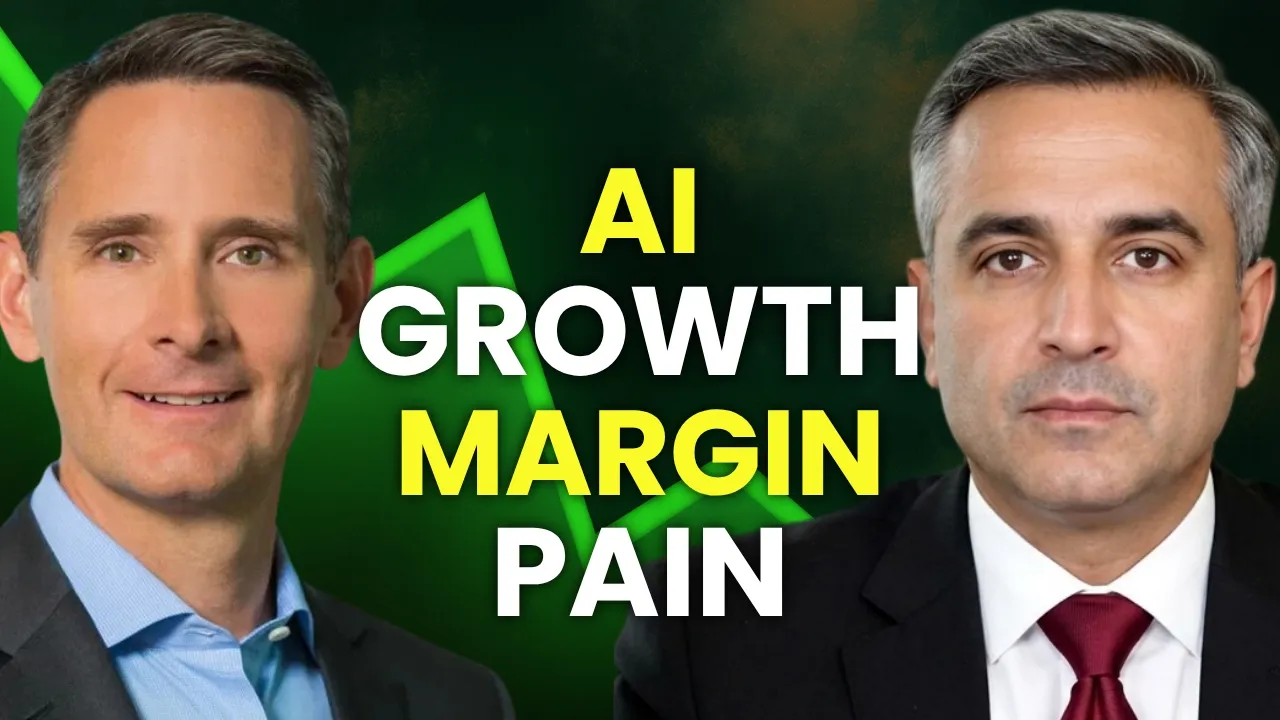
Why Marvell Stock Crashed Despite Massive AI Growth

- Video return
- —
- Calls
- 2
- Buy / Sell
- 1 1
- Published
Recommendations
Entry is the asset's closing price on the publication date. Current is the last close on record.
-
Entry $211.66 31 Aug 2026Current $211.66 31 Aug 2026Result +$0.00
It's not a name I own. It's not a name that I feel I need to own.
-
Entry $220.78 31 Aug 2026Current $220.78 31 Aug 2026Result +$0.00
I'd rather own Nvidia here at a much more attractive valuation.
Full Transcript
Marvell Technology, ticker symbol MRVL, saw its stock slide 6% during an active earnings call, despite raising next year's revenue target to $18 billion. On CNBC's Fast Money, host Melissa Lee and reporter Kristina Partsinevelos unpacked this sudden disconnect as Chief Executive Matt Murphy detailed accelerating AI data center demand. By the end of this video, you will know why Wall Street punished this massive forecast, how Marvell's custom silicon strategy interacts with Nvidia's monopoly, and what to expect from the upcoming October 6th Investor Day. >> Okay. Same message we're hearing everywhere. We know this. The AI buildout is accelerating, not cooling off. Stock still falling. Actually down 6% now. The good, CEO Matt Murphy raised the company's revenue target for next year to roughly $18 billion. You actually saw the stock turn around after hours when he said that on the call. And to roughly 50% growth next year. The engine is the data center. Again, this company makes custom chips, also does networking. Murphy says that the business is now growing more than 60% driven by the optical parts that connect AI servers and by custom chips, which he expects to more than double. Why is the stock falling though? I got asked that from a producer. I know, it's very dramatic but >> [laughter] >> Why'd you just sing that? >> I don't know. It's been a long day. It comes back to that big warrant deal with Google from last week. The one Wall Street treated as upside on top of everything else. On the call, the CEO said the revenue from that deal for next year is already baked into Marvell's numbers. It's not exactly extra. The bigger payoff, he says, comes the year after, and that's what cooled things off. Wall Street heard already included, and some of the excitement around the deal came right back out of the stock. The selloff also a case, so we've seen with a lot of these names, of high expectations. It's very owned, or I should say this has run up by 184% year-to-date into the print today, into the close, almost 30% just in the past month. Don't forget, CEO Nvidia also called it a future $1 trillion company. We'll see how long that takes. >> What Why I mean, maybe you can't answer this. Why Why would Jensen Huang want call another company a trillion dollar company? Like I know they're partners I guess, but like >> He's hyping up all of the the suppliers and stuff keeping the good relationship. He did that with the quantum names several years back at GTC talks about Nevius. He talks about Dell. He does that all the time. >> you just don't hear other companies ever talk about other companies like that. >> successful CEO? >> Well, I I guess I'm just curious. You just don't hear it. Guy Do you Do you hear this guy? >> It's interesting. >> Chevron being like, well, Exxon's a trillion dollar company. They're fantastic. >> Well, there's frenemies that happen in the tech world. It's very different. They all work together and then they also all are competing with each other. >> Coopetition? >> Frenemies. >> Did you just make that up? Coopetition? No, no. That's a thing. >> Well, I mean it goes back to that diagram that we've seen on Twitter now for the last year or so. You know, that diagram which puts again everything in the middle between Open AI and video and the circular notion nature of all these different things. So, as Christina just correctly said, it's in his best interest for all of these companies to do well, it seems like. >> Tim Seymour, your take on on Marvell? >> I think the you know, where they sit also in between the the chip makers and the hyperscalers and certainly networking and data center are hot areas and they tend to be more on the picks and the shovels than than the end you I mean, yes, it's it's part of the rotation we've seen. I I just we don't know what the multiple should be on this name. We know what it looks like in in the last trailing months. We know what the guidance is going forward. That guide was fantastic. Um It's not a name I own. It's not a name that I feel I need to own. >> Why not? >> I just don't invest in that part of the tree. I mean, it's you know, to me I I'd rather own Nvidia here at a much more attractive valuation. >> I agree with Tim. I mean, if you're looking at where Nvidia's trading given that guidance and again, you know, it's one thing to kind of start to discount and see the deceleration. I've been saying this for a while, but this is a company now that keeps beating and then raising. You know, when you consider where 20 27 calendar year was for estimates for you know, EPS and sales. I mean they just rate now it's like 70% or something like that. The one thing I'll just say about Marvell and I'll say about Jensen and you know, the investment they're making. You know, they have their three top customers both of them. It's it's Microsoft, it's Google and it's Amazon. Like they're Nvidia's three top customers and they're Marvell's three top customers. And I think what it says is that you know, Jensen don't care. He's just going to keep throwing money in around. What do we start the show? He's going to buy hugging face. He's going to buy Cool set. He's going to do all this stuff. It doesn't matter. You're just creating >> tonight's show with that? >> I think Mike >> That was Mike at the end >> That was Mike Santoli. >> Laura Laura Martin, Laura Martin the great Needham analyst who's been on this show many times, been on this network many times. Super smart. You know what she said Kristina? One every four hyperscaler investment dollars is going to Nvidia. One in every [clears throat] four. That's incredible. >> So there I guess we've come full circle as to why he can say this. He can speak positively about whoever because the money keeps going back to him. Uh for those wondering about Marvell though, another big catalyst would be October 6th their investor day that on the call right now he's mentioned it many times their long-term strategy. So perhaps they'll be sharing more details of Google and what that'll mean for the following year and maybe that would help anybody that gets in you know, tomorrow morning and with the sell-off. >> The core of Matt Murphy's message to the market was clear. The artificial intelligence build-out is accelerating rather than cooling down. To back this up, he raised Marvell's revenue target for next year to approximately 18 billion dollars which represents a staggering 50% growth rate. The primary engine behind this projection is the data center segment which is currently growing at a rate exceeding 60%. This explosive expansion is being driven by two main product lines, optical components that physically connect AI servers and custom silicon which Murphy expects to more than double in the coming year. When these figures first crossed the tape, the stock actually spiked in after-hours trading before reversing into a sharp decline. To understand why these products matter, we have to look at the physical architecture of a modern AI data center. When you string tens of thousands of GPU and Appos together to train a large language model, the bottleneck is no longer just compute power. It is communication speed. If data cannot move between servers instantly, those expensive GPU and Appos sit idle, wasting millions of dollars in electricity and compute time. Marvell specializes in the optical components, specifically digital signal processors or DSPs, that convert electrical signals into light. This optical plumbing is not just a minor hardware upgrade. It is the absolute bottleneck that determines whether a cluster of 100,000 GPU and Appos actually functions as a single giant computer or just a collection of isolated waiting processors. Marvell dominates this optical interconnect space, and as speed requirements transition from 800 gigabits per second to 1.6 terabits, their market share becomes an incredibly lucrative tollbooth. But chief executive Matt Murphy is not content just selling the pipes. He is positioning Marvell to build the actual brains of these systems through custom silicon. If you look at the capital expenditures of the world's largest cloud providers, they are spending tens of billions of dollars on Nvidia chips, but they do not want to be entirely dependent on a single supplier forever. Google, Amazon, and Meta are actively designing their own custom chips to handle specific workloads more efficiently and at a fraction of the cost of standard GPU and Appos. This is where Marvell steps in. They do not compete directly with these tech giants. Instead, they act as the design partner, taking the hyperscalers proprietary ideas and translating them into physical high-performance silicon. Murphy highlighted during the call that this custom business is set to experience an unprecedented ramp, effectively doubling its footprint in the coming quarters. It is a brilliant strategy on paper, but it comes with a major catch that has institutional investors hitting the sell button. Why would a company growing its core business by 60% see its stock price tumble? The answer lies in the harsh reality of corporate profit margins. When I went back through the financial model, the tension between volume and profitability became glaringly obvious. Historically, Marvell has been a high-margin merchant silicon provider. They designed standard chips, sold them to a wide range of customers, and enjoyed gross margins comfortably above 60%. Custom silicon, however, is a completely different animal. When you design a custom chip for a single massive customer, that customer has immense pricing power. They are ordering millions of units, and they demand a heavy volume discount. As a result, custom silicon typically carries gross margins that are significantly lower, sometimes in the low 50% range. So, as Marvell's custom silicon revenue explodes from a minor footnote to a multi-billion dollar business, it is dragging down the company's overall margin profile. Wall Street is looking at this massive $18 billion revenue target, and realizing that while the top line is growing incredibly fast, the bottom line profitability is not going to scale at the same rate. It is a classic case of high-volume, low-margin business replacing high-margin, low-volume business. If that surprised you as much as it surprised me, let me know with a like, and subscribe to the channel. During the Fast Money broadcast, Kristina Partsinevelos pointed out that this margin dilution is the central battleground for the stock. She noted that analysts were immediately scratching their heads over the gross margin guidance for the upcoming quarters, which came in softer than the most optimistic buy-side models had anticipated. On the desk, Melissa Lee pushed on the idea of whether this transition is a temporary growing pain or a permanent structural shift in Marvell's business model. And the consensus that emerged on the desk was that we are looking at a permanent structural shift. When a hardware company transitions from selling off-the-shelf merchant silicon to designing custom chips for a handful of massive clients, its financial identity fundamentally changes. In my view, the market is currently struggling to digest this new reality. Marvell is no longer a pure-play high-margin component specialist. It is is into a hybrid model, where massive revenue scale comes at the direct expense of profitability margins. This means the earnings multiples investors are willing to pay have to undergo a serious correction. If you are generating billions of dollars in new sales, but taking home fewer pennies on every single dollar, your stock simply cannot command the premium valuation it did when margins were expanding. To see how this dynamic plays out, we have to look closely at who Marvell is actually dealing with. Their primary customers for custom silicon are the hyperscalers, including Amazon, ticker symbol AMZN, and Meta Platforms, ticker symbol META. These tech giants do not just have deep pockets, they have absolute leverage in every negotiation. They know exactly what it costs to manufacture these chips, and they are not interested in letting a design partner capture all the financial upside. When Marvell wins a contract to build a custom AI accelerator, they are essentially acting as a highly specialized engineering contractor. They do the heavy lifting of physical layout, packaging, and integration, but the core intellectual property is co-owned, and the pricing is locked in at highly competitive volumes. So, does that mean the custom silicon business is a trap? Not necessarily, but it requires an unprecedented level of scale to make the math work for shareholders. Furthermore, we have to consider the supply chain complexity. Marvell does not own its own fabrication plants. They are fabless, which means they rely on external foundries like Taiwan Semiconductor Manufacturing Company, ticker symbol TSM, to actually build these custom chips. In a world where advanced packaging capacity is incredibly tight, Marvell has to secure production allocation years in advance. If TSM raises its wafer prices, or if packaging bottlenecks limit shipments, Marvell is caught in the middle. They cannot easily pass those cost increases onto giant customers who have ironclad multi-year contracts. This supply chain vulnerability adds another layer of risk to the custom silicon ramp, making the margin profile even more fragile. This is where the comparison to Broadcom, ticker symbol AVGO, becomes highly instructive. Broadcom is the undisputed heavyweight champion of the custom silicon space, largely due to its partnership building custom tensor processing units for Alphabet, ticker symbol Google. Yet, despite doing massive custom volume, Broadcom has managed to maintain spectacular gross margins near 70%. How do they do it? The secret lies in scale and proprietary technology. Broadcom has integrated its own market-leading intellectual property, particularly in switching and routing, directly into those custom chips, making their designs completely irreplaceable. Marvell, by contrast, is still early in this cycle. They are aggressively buying market share and investing heavily in research and development to catch up. Until Marvell can build that same kind of proprietary moat around its custom designs, they will continue to suffer from margin dilution. But, we cannot look at Marvell through a single lens, because their business has a second, incredibly powerful engine. While custom silicon is dragging margins down, the optical interconnect business is doing the exact opposite. This is the crown jewel of Marvell's portfolio, and it is where they hold an almost monopolistic grip. Every single AI cluster requires optical transceivers to connect GPU and oppo's S over long distances, and inside those transceivers are Marvell's digital signal processors. As the industry transitions from 800 gigabit connections to next generation 1.6 terabit standards, Marvell's average selling prices are set to jump significantly. This is high-margin, highly proprietary merchant silicon at its finest. Think of it this way. If custom silicon is the high-volume, low-margin engine driving top-line growth, optics is the high-margin booster keeping the bottom line afloat. The multi-billion dollar question is which engine will pull harder in the coming quarters? During the broadcast, the traders debated whether the immediate post-earnings sell-off was an overreaction or a long-overdue reality check. The stock had run up incredibly hard heading into the print, priced for absolute perfection. When management laid out guidance that showed margins flattening rather than expanding, the speculative premium vanished. It is a pattern we are seeing play out across the entire semiconductor space. Investors are no longer satisfied with general artificial intelligence hype or vague promises of future revenue. They want to see that revenue flow directly to the bottom line, and they want to see margins expand alongside top-line growth. What this earnings report proved is that not all AI revenue is created equal. A dollar of custom silicon revenue simply does not carry the same weight as a dollar of proprietary optical silicon, and the market is finally starting to price in that distinction. So, where does that leave us? If you are looking at Marvell, the key is to watch the product mix over the next 12 months. If their optical business can scale fast enough to offset the margin drag of their custom pipeline, the stock has a clear path to recovery. But if custom silicon dominates their revenue mix without a corresponding rise in pricing power, they risk becoming a high-volume, low-margin utility for tech giants. The era of buying any stock with an AI story and expecting it to go up forever is officially over. Now, it is all about execution, margin preservation, and finding the companies that actually own the underlying intellectual property. Marvell has a seat at the table, but they still have to prove they can turn massive volume into massive profits. Thanks for hanging out with me on this one. If you think someone else should see it, send it their way, and like the video and subscribe to the channel. See you next time.
Comments 0
Sign in to join the discussion.
Sign inNo comments yet. Be the first to share your thoughts!