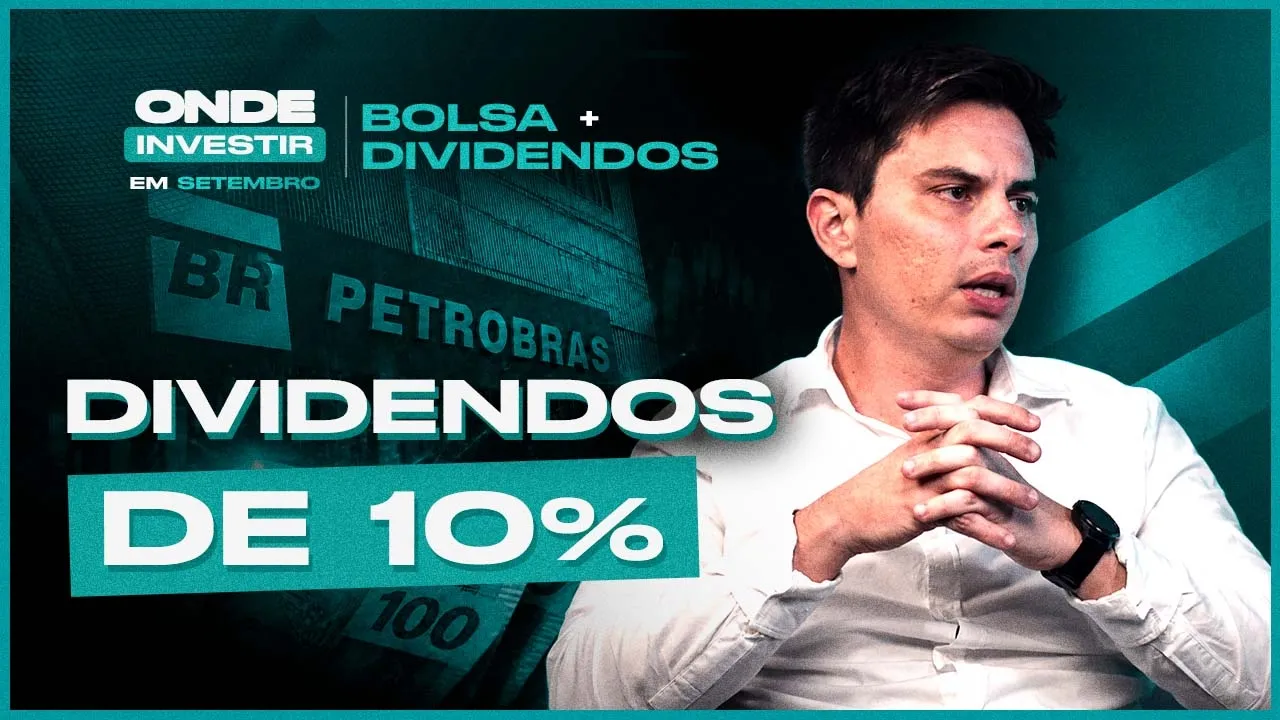
Petrobras ainda vale a pena mesmo sem petróleo nas máximas?

- Video return
- —
- Calls
- 2
- Buy / Sell
- 2 0
- Published
Recommendations
Entry is the asset's closing price on the publication date. Current is the last close on record.
-
Entry R$51.15 08 Sep 2026Current R$51.15 08 Sep 2026Result +R$0.00vs. index +0.0% BOVA11 +0.0% over the same days
one that we are adding to our portfolio this month is Porto
AI-extracted context “Oh, one that we are adding to our portfolio this month is Porto, right?”
-
Entry R$48.09 08 Sep 2026Current R$48.09 08 Sep 2026Result +R$0.00vs. index +0.0% BOVA11 +0.0% over the same days
Petrobras and Porto are in the dividend portfolio for September
AI-extracted context “Well, you saw that Petrobras and Porto are in the dividend portfolio for September...”
Full Transcript
We have reached the second block of " Where to Invest in September," and we're here to talk about the Brazilian stock market and good dividend stocks with Rui Hungria. How are you, Rui? How are you, Paula? It’s always a pleasure to be here. The pleasure is ours. So, let's talk first about the cases we saw in August regarding bankruptcy filings, which brought extra concern to Brazilian investors. Rui, tell us a bit about how investors can protect themselves from a surprise bankruptcy filing, and what numbers or trends are you looking at, considering the movements we've seen in the Brazilian stock market? Yeah, that’s a really great question. I understand that it draws the investor's attention to a point that is sometimes a bit confusing, but when news pops up like, "Oh, such and such company filed for bankruptcy," it seems like a surprise, like something that wasn't on the radar, right? And often, it's already on the radar, right? For us, who look at companies every day, we understand that some companies are at a slightly higher level of debt, and in a situation where you have a period of high interest rates for a long time, that can end up getting worse. So, these things don't just happen out of nowhere. What we are seeing is that interest rates have been at very high levels for a long time. Now we are also seeing a slowdown in economic activity, and these things combined with balance sheets that were already stressed, let's say, for some time, ended up culminating in these bankruptcy situations. So, it's important for investors to understand that just because two, three, ten, or a few companies started showing bankruptcy filings...It doesn't mean that all the companies listed there will show these difficulties. There are many companies listed on the stock exchange that are not presenting this type of risk, right ? So it's important for investors to always be very selective and understand what they are investing in, where they are putting their money, right? Now, we also saw the Ibovespa in a very strong downward movement and then, right after , an upward movement. We ended up finishing August more or less at break-even. What caused these big movements? Can we expect a bit more volatility with the election? What can we expect now, keeping September in mind, which is a month before the elections? Anyone looking at the Ibovespa's performance at the end of the month would think nothing happened, right? You look at it at the end of the month and see a small variation. But the truth is that those following it day-by-day suffered a little, and then were happy too with the recovery here on the stock market. Exactly. So the market dropped over 6% in the middle of the month, then recovered. The beginning of the month was marked by fiscal concerns. We had some foreign banks downgrading the Brazilian market, right? In other words , they were either long and moved to neutral, or were neutral and recommended selling Brazilian stocks, largely due to fiscal concerns and the approaching elections, which always bring a period of higher volatility, right? And also geopolitical issues that aren't resolved yet and end up bringing that kind of impact too, along with inflation worries, right? However, from mid-August onwards, we began to see a certain recovery. A bit of it due to help from the United States, or actually, a worsening outlook for the United States, right? Because we started to have some concern there regarding debt, rising debt. That ends up causing fear for those who have money invested there. They end up seeing other regions as an alternative to not be so exposed to this debt issue in the United States. And Brazil ends up gaining relatively; it's not the only country that ends up gaining relatively from this. We saw other assets, like gold, Bitcoin, and the Ibovespa ended up benefiting a bit. So, I think Brazilian stocks ended up being helped toward the middle of the month, somewhat due to this relative worsening of sentiment regarding the United States. This helped improve investment flows a little as well. So, I think this dynamic of a month start pressured by those issues, like fiscal downgrades, and in this second part being helped a bit more, more due to a relative view here than Brazil having actually improved, right? If you could choose about three characteristics, let's put it this way, of a company, when you look to see if it belongs in an investor's portfolio, what would they be? Well, Paulo, looking at three immediate characteristics that I think an investor should always focus on, first is cash flow generation, right? if this company generates cash or if it needs heavy investment, if a good portion of these investments ends up impacting dividend distribution, for example, that's why I really like looking at cash generation. Second, the debt, right? Companies that have controlled debt. Why? First, because of the issue of bankruptcy filings we mentioned, and that can end up becoming a snowball effect. Second, because we are still at a very high interest rate level, and high debt ends up resulting in higher interest payments for companies. And that also dries up dividend payments, right? And another characteristic I like to look at is trying, at least in this more difficult macro moment, to focus on companies that are leaders in their sectors, that have a good brand, that can manage. We always say that: there are market moments where no company will be able to significantly improve its results, right? There are market moments where no company will be able to present a brilliant result. But , if in relative terms it can present much better results than its competitors, it will not only manage to weather this difficult moment, but it will emerge stronger, likely with more market share, much better than its competitors. So, I think focusing on these market-leading companies also helps, right? And what companies can you tell us about today? Oh, one that we are adding to our portfolio this month is Porto, right? Porto is a company that has diversified its business a lot in recent years. In the past, it was basically an auto insurance company. A market it dominates, very resilient, but which also has slightly more limited growth. And it saw room to grow in other avenues, but not just to grow, to grow with high profitability. So, both the banking segment, which has a series of synergies with other arms of the business, and the health segment too, right? And more recently here, the services segment. So, it's a very diversified company with high profitability and, in our view, with management that looks very much at the long term, and we understand that it has great value for shareholders while still paying interesting dividends, right? That's what we want, right? Dividends for the investors. Exactly. And speaking of the best, the companies that manage to stand out, I have to bring up Petrobras, which is benefiting from high oil prices, also reported good second-quarter results and is, you know, one of the favorites for dividend distribution. Ooh, I wanted you to talk a bit about this specific Petrobras case, but also talk a little about your dividend portfolio. Uh, the investor, looking at this, let's say, good result from Petrobras, but it's also very tied to an issue we can't guarantee, it's not recurring regarding the oil price. How to gauge everything, how are you balancing these points to receive good dividends, in the case of the portfolio ? Right? Yeah, that's a good question. And just to clarify, when I say that Petrobras is in the portfolio because we expect dividends, it's not because we expect oil to go above $, actually, that's even a view; if that happens, it will help the company, but in our calculations, we use an oil curve closer to 70, which is below current levels. And we understand that if you have a resolution to the war, this reduction in fears of supply disruption , you should have oil prices lower than they are today. And that is what we put into our model. And even so, we reach a dividend yield in the double digits, talking here about 10, 11%, so even considering a more conservative level, we still have a dividend yield that is among the highest on the Brazilian stock exchange. Of course, it's possible that we have some kind of event here that makes oil rise even more than the levels it has been trading at in recent weeks. We don't take that for granted and we don't need that to make money with dividends from Petrobras, right? So basically, this is our thesis for Petrobras, a company that continues to show very good operational evolution, hitting production records. It is greatly helped by the Pre-salt, which has enormous productivity and helps a lot with production costs to improve margins. Also a good moment for the refining segment. And then, obviously, also helped by an oil price here that obviously helps at these levels, but we don't need them to be that high to receive dividends, do we? So I think it’s a thesis that combines a good operational moment, attractive valuation, and high dividends. And we also believe there could be some positive volatility here due to the elections. Well, you saw that Petrobras and Porto are in the dividend portfolio for September, but to check out everything in full, the report and recommendations , just head to Empiricus Mais. The link is right here in the video description.
Comments 0
Sign in to join the discussion.
Sign inNo comments yet. Be the first to share your thoughts!