…uce and talk about the power side. other chips, other critical components. So, again, it doesn't make any sense, but what what does make sense? Buying stocks that are growing earnings at triple digit rates for eight times forward earnings. So, I'm a buyer of Micron today. I don't know what everyone else is thinking, why they're not backing up the truck here, but I see nothing but positive signs here. Okay. >> All right. So, I I mentioned Micron, right? Uh or the beginning of the week, I said it's the most i…
So, I'm a buyer of Micron today.
AI-extracted context
So, again, it doesn't make any sense, but what what does make sense? Buying stocks that are growing earnings at triple digit rates for eight times forward earnings. So, I'm a buyer of Micron today. I don't know what everyone else is thinking, why they're not backing up the truck here, but I see nothing but positive signs here.
…nuts that the stock still sells for six times next year's earnings estimates. Weird. So, I like a huge buyback here. It could help Micron shareholders tremendously. But that's not why I stood there at our 1020 morning meeting club members, now buy it. Buy this dip. I did it because the story, as great as it was when we visited in August, had gotten even better. may be much better just a few weeks later as customers know they'd better lock up chips as soon as possible or else. The end of Micron's rele…
now buy it. Buy this dip.
AI-extracted context
Every time there's a new contract, the company becomes less cyclical and more secular given its newfound consistency. It's nuts that the stock still sells for six times next year's earnings estimates. Weird. So, I like a huge buyback here. It could help Micron shareholders tremendously. But that's not why I stood there at our 1020 morning meeting club members, now buy it. Buy this dip. I did it because the story, as great as it was when we visited in August, had gotten even better.
…ta's Muse and how quickly it's been. You start adding up all those data points and yeah, I I absolutely think that this 40% correction in so many of the AI names over the past several uh well not weeks but months admittedly cuz I own them. Um I think it's over and I think you need to buy them. >> If you want to establish a part of your portfolio which deals with AI, >> I would go with Micron, Microsoft, Nvidia. >> Yeah. >> If I've got those three, I've got the AI deal covered. >> Yes. And we could add to that um Applied Digital which uh operates data centers. Coreweave which rents AI capacity from uh Applied Digital. We could add Marll technology…
Um I think it's over and I think you need to buy them. >> If you want to establish a part of your portfolio which deals with AI, >> I would go with Micron, Microsoft, Nvidia.
AI-extracted context
You start adding up all those data points and yeah, I I absolutely think that this 40% correction in so many of the AI names over the past several uh well not weeks but months admittedly cuz I own them. Um I think it's over and I think you need to buy them. >> If you want to establish a part of your portfolio which deals with AI, >> I would go with Micron, Microsoft, Nvidia. >> Yeah.
…ta's Muse and how quickly it's been. You start adding up all those data points and yeah, I I absolutely think that this 40% correction in so many of the AI names over the past several uh well not weeks but months admittedly cuz I own them. Um I think it's over and I think you need to buy them. >> If you want to establish a part of your portfolio which deals with AI, >> I would go with Micron, Microsoft, Nvidia. >> Yeah. >> If I've got those three, I've got the AI deal covered. >> Yes. And we could add to that um Applied Digital which uh operates data centers. Coreweave which rents AI capacity from uh Applied Digital. We could add Marll technology…
Um I think it's over and I think you need to buy them. >> If you want to establish a part of your portfolio which deals with AI, >> I would go with Micron, Microsoft, Nvidia.
AI-extracted context
You start adding up all those data points and yeah, I I absolutely think that this 40% correction in so many of the AI names over the past several uh well not weeks but months admittedly cuz I own them. Um I think it's over and I think you need to buy them. >> If you want to establish a part of your portfolio which deals with AI, >> I would go with Micron, Microsoft, Nvidia. >> Yeah.
…ta's Muse and how quickly it's been. You start adding up all those data points and yeah, I I absolutely think that this 40% correction in so many of the AI names over the past several uh well not weeks but months admittedly cuz I own them. Um I think it's over and I think you need to buy them. >> If you want to establish a part of your portfolio which deals with AI, >> I would go with Micron, Microsoft, Nvidia. >> Yeah. >> If I've got those three, I've got the AI deal covered. >> Yes. And we could add to that um Applied Digital which uh operates data centers. Coreweave which rents AI capacity from uh Applied Digital. We could add Marll technology…
Um I think it's over and I think you need to buy them. >> If you want to establish a part of your portfolio which deals with AI, >> I would go with Micron, Microsoft, Nvidia.
AI-extracted context
You start adding up all those data points and yeah, I I absolutely think that this 40% correction in so many of the AI names over the past several uh well not weeks but months admittedly cuz I own them. Um I think it's over and I think you need to buy them. >> If you want to establish a part of your portfolio which deals with AI, >> I would go with Micron, Microsoft, Nvidia. >> Yeah.
Full Transcript
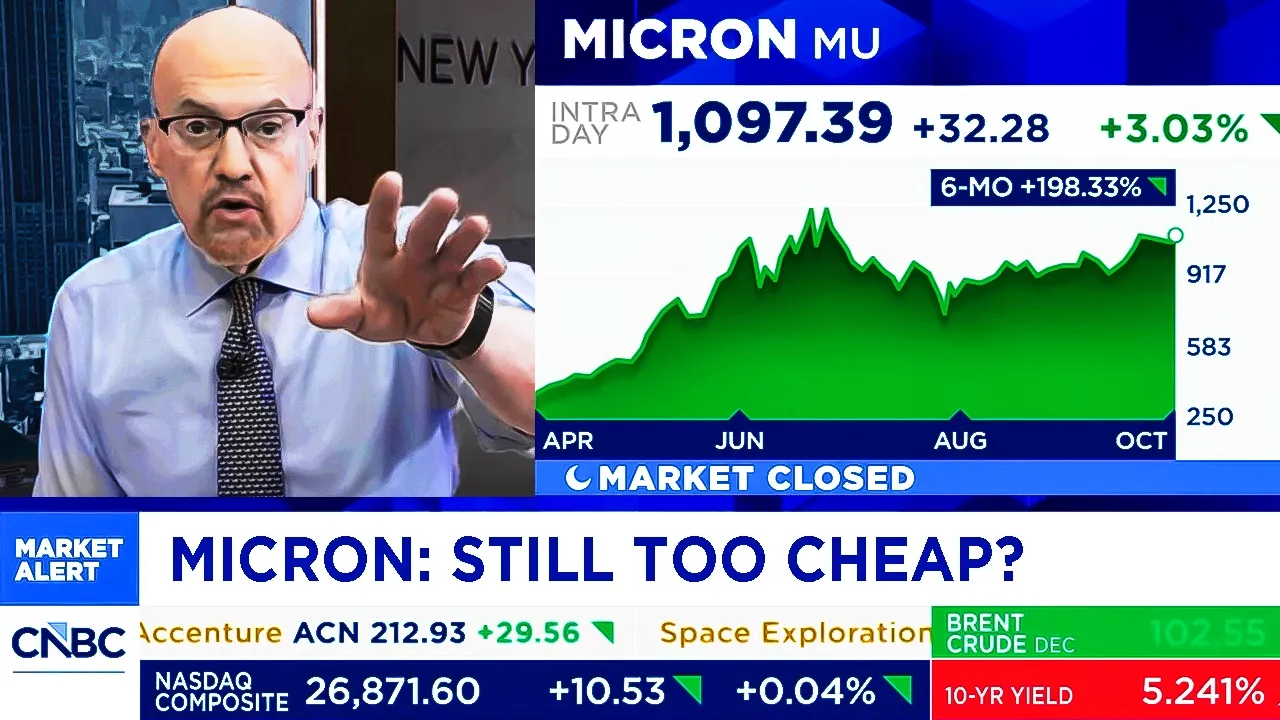
And I watched the sickening decline in Micron. I said to myself, I care more about Korea. If Korea's up, they'll buy Micron. And Korea was up. So, they will buy Micron. >> Yeah. And nice little flag on the Nikke, too. As we said, up 3.3 overnight. >> Yeah. No, I mean, look, we're we're markets that basically are right now because Micron is big, but not as big as SKHX and not as big as Samsung. If they if they put their stocks go up, what they're saying basically is we're all in the same boat. >> Yeah. Uh and what Sanjay I wish he had been but Sanjay is not promotional at all but I would have said if I were Sanjay look we are choosing how much we're going to sell forward. Maybe we sell 30% forward in 2030 because we think 2030 is going to be so much higher. Let's just let it roll. So you have to understand that the long-term agreements that they have are really not are a floor to what they can earn. And a lot of people I think think they're a ceiling and that's a misread. And the fact that he gave the employees more which is something he did not talk about when I was there. Yeah. >> Uh is not a reason to sell this stock. >> Yeah. Yeah. That's you you do tie it to the the gross margin number and this employee comp. >> What is it supposed to have? Gross margins of 100%. It's unheard of. I remember when Andy Grove once told me I said he was at 64%. I said how come you can't do 70%. And he said well if you studied then get back to it. >> Yes. >> Micron terrific performance. I mean very strong performance in their earnings report. Yes. Does that mean uh the AI correction uh is is kind of done? >> Oh, absolutely. This stock should not be down today. It's crazy. It's trading at six times earnings. Six times. The S&P trades at 21 times. Yeah. Six times current earnings. >> Six times uh forward earnings based upon the guidance they gave us yesterday. And by the way, the growth is 450%. Yeah. >> So when you think about it, why would you buy the S&P 500 at 20 or 21 times earnings with 30 to 50% growth when you can buy Micron for six times earnings with 400 to 450% growth? But yes, I do think that um you start adding up all the all the the the bells that have been ringing from Micron guiding up and saying uh we can't make enough of these DRAM chips to Microsoft saying we're going to triple our data center capacity uh over the next um several years to uh the roll out of Meta's Muse and how quickly it's been. You start adding up all those data points and yeah, I I absolutely think that this 40% correction in so many of the AI names over the past several uh well not weeks but months admittedly cuz I own them. Um I think it's over and I think you need to buy them. >> If you want to establish a part of your portfolio which deals with AI, >> I would go with Micron, Microsoft, Nvidia. >> Yeah. >> If I've got those three, I've got the AI deal covered. >> Yes. And we could add to that um Applied Digital which uh operates data centers. Coreweave which rents AI capacity from uh Applied Digital. We could add Marll technology which uh makes the semiconductors that enable all of the data to be manipulated. I mean we could keep going Stuart but yes I think you know it's a whole ecosystem and that's the point. >> I want to play I want to be invested in the leaders of it. >> Yeah. >> Oh yeah. Well the ones you named uh what was it? What' you say? Uh Micron, Nvidia and Meta. >> Microsoft. Yeah, I'll chuck me in as well. >> If you Yeah, if you only owned those three, you would be very well served. >> Uh, look, I want to talk Micron for a second. We got this blowout report from them yesterday. I mean, I It was a blowout report. Okay, it's down today, but is the Micron earnings report strong enough to keep the whole AI rally going? >> Yes. And I'm going to steal the line from Ryan Spring there. Nothing makes sense in the markets either when it comes to AI. Because if you look at it, every single number here is irrefutable proof that AI has strong demand, not just this year, not just next year, but into 2030. I mean, the thing that stood out to me the most in Micron's report is that over a third of their revenue is already guaranteed for the year of 2030. So, anyone worrying about demand waning, we have at least four years more of this supply shock, supply crunch happening in the memory side of the market. That's before we introduce and talk about the power side. other chips, other critical components. So, again, it doesn't make any sense, but what what does make sense? Buying stocks that are growing earnings at triple digit rates for eight times forward earnings. So, I'm a buyer of Micron today. I don't know what everyone else is thinking, why they're not backing up the truck here, but I see nothing but positive signs here. Okay. >> All right. So, I I mentioned Micron, right? Uh or the beginning of the week, I said it's the most important earnings release of the week. And you know what? Maybe even earning season to be honest with you. It seemed antilimactic when it opened this morning, but you know, if there was a lot, if this number was had any hair on it, this stock would be down double digits, maybe even a lot more, and everyone would be saying the AI trade is unwinding. That's how critical it was. In the meantime, you know, I can tell you, I saw a banner on the financial channel today that said management missed on the margin guidance. They should have added an asterric that they're paying out massive bonuses to every single employee. The manufacturing that they're doing this quarter is for inventory. and they said this will be the lowest um the lowest margin. 86% will be the lowest for the fiscal year which is this first quarter. Meanwhile, every firm on Wall Street has either reiterated their buy on it. Some have actually even raise their targets on this thing. Uh a couple of them I know raised their targets. Now my next guest has been pounding the table on this stock for a long time. Let's bring in Futurum Group their chief market strategist Shai Balor. Shai congratulations my man. I I love when you find these names and you stick with it. Let me ask you on a scale of one to 10, how would you rate the print, the release from last night, and the guidance? >> I would I would give it a strong nine. And the reason it's not a 10 is I do think there is somewhat of truth to what the bears are saying that there is a little fear on this might be a peak pricing because the majority of the beat this cycle was DAM pricing was going up and then high teen sequentially. We also had nan pricing up around 30%. So those clearly showed that these kind of increases on the earnings was actually due to pricing and that can can't continue forever. However, everyone's focused on the small little detail, but we got a lot of evidence yesterday that the memory shortage is actually going to become tighter before it gets better. Management is telling us that 2027 2028 is going to be more constrained than 2026. Uh more than 75% of next year's output is already committed. Customers are talking beyond 2030. And most of the new clean room capacity Micron's spending on today, like you just mentioned, it doesn't provide meaningful production until late 2028. So if the market's valuing Micron at six times earnings, saying this year's peak demand, then they're flat out saying the management is lying. And I really don't believe that's the case. >> So you you've given us a stock a lot. In fact, back in January, you're up 120% on that. The top target that I saw today was uh we got Melas now 2,200. Where do you see a stock possibly going from here? >> I think it's going to be a $1,500 stock. Uh, you might even say, I brought you in as the raising bull. You sound a little weak there, my man. We have 1,500 >> in in a matter of in a matter of months, but I think long term, I think you're seeing the rate of price increases slowing down, but you're also seeing how demand is just exceeding all expectations, and you're going to continue seeing Micron goting revenue quarter after quarter. Then eventually the bare argument is going to kind of fade out in the background and you're going to see uh Micron essentially growing their earnings like 40 50% for years and all of a sudden it's going to get that rerating towards 8 to 10 times. So I do believe like I saw 2200 if you give me a one-year target like why not 2500 this deserves. >> There you go. That's a shore I fell in love with. Okay. So Micron you've given us twice this year. I think the last time you here was like 700 bucks and January is even lower than that. you're up over 100%. But it's still trading at a 6 and a half four PE ratio. What are you telling people who say, should I buy now? >> You know, it's interesting. Your last guest, I think, nailed it. You know, because it's six and a half times. It is trading as if this is peak earnings. And I think there is structurally a real demand change here. I mean, he pointed out capacity, you know, will not be on until before the end of 27. Also, all the contracts they're talking about long-term 3 to 5 years out. in 2030 fully 35% of their contracts are locked in. That is visible high revenue. Plus, just a little little plus here is in December, you know, they will be there's some uh government restrictions. They'll be able to buy back some stock. And so that announcement is coming. But I think the demand is huge. There are structural issues in terms of being able to bring up capacity. So I think he's right. >> We got less than a minute to go. Now you did put in your note that semies remain your highest conviction, right? And I know you love the semis. made a ton of money in them. One thing I'm seeing with a lot of these charts, they keep they they haven't broken out. You know, whether it's this one, Meta, Microni, Nvidia, they haven't broken out. What is it? Do you get to a point if they can't break out where they give up? Here's the thing. At this current moment in time, I think they're a coiled spring. I see this, yes, into some resistance. We can draw that line, but you've got a nice fourmon base of support. And again, sentiment and positioning are still off sides at the hands of that costly July unwind of semis and momentum. And Charles, we're going into the best two months of the year for semiconductors, which are October and November. So to me, I see a four month base breakout in the >> base here and the next move up. You'd think this line would be irrelevant >> going into the best time of year for semis and markets more broadly with sentiment and positioning off sides. That's a place I want to be. But specifically about uh Micron Micron not well, it turned around actually. This is pretty interesting. It had such a banger of an earnings report after the bell yesterday. Unbelievable moves here and yet the stock initially was down due to a slightly light report on the margin outlook. So are you that worried when you see that kind of margin outlook? >> Yeah, take it just take it one step further and say what's Micron's multiple and Micron's trading at a multiple that's below the multiple for the S&P 500 which is you know trading at a 19 multiple. while it's up, you know, it's a three bagger so far this year on a year-to-day basis, they they're actually producing the revenues and earnings to drive that. So, if there was any disappointment in the conference call, it was because they paid their employees and that took a ding out of their margins a bit. But their their outlook, the contracts they have and and just the need for the kind of compute that the power that they're making, that simple DRAM, the CPU business in the in the data uh storage world, we just have flipped that on its head. We just can't produce enough. And clearly the demand's outstripping supply. I think Micron's a winner here. >> Yeah. Can you believe today alone it's had a $92 swing from trough to peak. >> It's crazy. >> Not for not for the faint of heart, right? >> So give me a sense overall about Micron because I don't want to ignore that. Micron came out with unbelievable numbers and the big question is how much better can it get from here. So we saw it stumble a little bit in the beginning of the session. It has turned around. It is now up 30 points to,095. How much better does it get, Brian? >> Yeah, we we think that it can it can continue to get better. Um, you know, the AI infrastructure trade broadly has not had a great uh a great quarter um here in the third quarter. I think part of that is higher interest rates. Part of that's um some uncertainty around the election. But why why we like a micron and specifically infrastructure broadly and micro micron I think is evidence of this is essentially you know historically they produce memory which has been a commodity but they are increasingly signing take or pay or long-term contracts with their strategic customers which to us indicates that you're taking something that was a commodity and it's becoming so much more at a premium that it's going to be more infrastructure-l like. So these these high levels of cash flow that they're earning this year are going to be extended uh not only this year next but even beyond that. >> I've been thinking too many people let the action in a stock tell them the story even if it's the wrong story. Last night Micron one of the largest semiconductor companies in the world reported a phenomenal quarter. We honored for the travel trust and it was much much better than what we were looking for. Jeff Marks wrote a terrific note last night for investing club members detailing the results. But what happened? THE STOCK GOT HAMMERED IMMEDIATELY. That was wrong. Let me break down the basics. Micron did 54.23 billion in revenue when Wall Street expected just a little more than $51 billion. They earned $3342 per share, up 1,02% year-over-year. Analysts were expected just 31.61. 31. That's a huge beat. Demand for the high bandwidth memory chips, the ones that belong in the data center, is insane. These chips are in such short supply that customers have been trying to sign strategic consumer agreements with Micron that would last the next few years lest they be shut out of the incredibly important components if the shortage continues. They can't afford to be without high bandwidth memory. It's an amazing statement for a company that used to live or die by the day-to-day vicissitudes of DRAM pricing. Now they can lock customers up for years because their best chips are so scarce. Cyclical to secular. My favorite kind of redo. So if everything's terrific, why in the world did Micron stock go down last night and then open down today and stay down for an hour? A lot of people saw that action and assumed that there was got to be a problem with the quarter even if there wasn't. The truth is the sellers didn't know what they were doing. Ostensibly, micron trades on gross margins. If the gross bars show any degradation, it's usually because there's too much competition and pricing IS ABOUT TO COLLAPSE. BUT THIS TIME, the degradation came from a decision made by CEO Sandre Morotra to compensate his team a little bit higher than people expected. I thought it was a sound gesture. I saw it with my own eyes. We went out to Boise Micron headquarters in August in the sight of a that's a sight of a huge new fab to make chips. And some of the workers told me they were going six days a week, long days. And while they were genuinely cheerful about it, they definitely deserve the bonus. Still, the playbook says what you sell Micro Most margin spook followers bold. Second issue, the buyback. Micron's earnings were huge and the price earnings multiple is shrinking. When that happens, a company can either say, "Darn it, I wish it were higher." Or it can take its cash and put it to work buying its cheapest asset, the shares in the company itself. Because Micron took chips money from the federal government, it has to wait till December 9 before it can buy back stock handover fist. can't frontr run that. I was one of several people who begged for details on the potential size of the buyback when I interviewed Sanjay this very morning on squawk on the street but I had no luck. I think Micron like Apple like Nvidia knows that it owns its own stock isn't getting its due because people are so worried about a data center slowdown. Me I know that when I was out there in August Micron had 16 long-term contracts to provide DIAs. Now it does 26 one month. Every time there's a new contract, the company becomes less cyclical and more secular given its newfound consistency. It's nuts that the stock still sells for six times next year's earnings estimates. Weird. So, I like a huge buyback here. It could help Micron shareholders tremendously. But that's not why I stood there at our 1020 morning meeting club members, now buy it. Buy this dip. I did it because the story, as great as it was when we visited in August, had gotten even better. may be much better just a few weeks later as customers know they'd better lock up chips as soon as possible or else. The end of Micron's relentless boom and bus cycle has arrived at last. That means the stock can still be bought. But maybe more important, it can't afford to be sold. If you want to short this thing knowing that Micron will be able to buy back its own stock aggressively come December, I think you're digging your own grave. Why don't I send you an invitation to your funeral? >> All right. All right, I hope you're all doing well today and staying calm in this market. Thursday was overall a positive day throughout much of the market as we saw yields move lower intraday. We also got some Fed commentary implying that there is no urgency to raise rates. On Thursday, Reuters reported that some banks and credit investors are questioning how much long-term collateral value Nvidia GPUs will retain and that some lenders want Nvidia to provide stronger guarantees than what Nvidia originally contemplated. This is related to the $500 billion in independent third-party capital that Jensen announced alongside six of Wall Street's top financeers back in August. According to Reuters, three unnamed banking sources who were not part of the original financing group said Nvidia may need to offer guarantees on all of its deals, or they may have to be backed by a revenue stream from investment grade customers to cover the debt. One source told Reuters that tens of billions of dollars of loan deals in the pipeline are likely to have strong guarantees and contracts. These deals are secured by Nvidia's chips and backed by both customer contracts and Nvidia's underlying guarantees. Another source told Reuters that some structures being explored would potentially give lenders guarantees. Despite the concerns, Reutder sources said that there's high demand to finance the deals. One source said that there isn't enough historical data for lenders to confidently underwrite long-term residual value based on GPUs. An S&P global ratings director told Reuters, quote, Nvidia would imply that the GPUs work well north of 5 years, and that actually has been proven to be true thus far. He added by saying, quote, "We take a conservative view of the value of those chips." Another source told Reuters, quote, "Banks typically underwrite GPUs over a three to fouryear depreciation schedule. That is different than Nvidia, which argues top tier GPUs can earn revenue for a decade." So, put simply, some banks and credit investors are questioning the useful life and depreciation schedules for Nvidia GPUs. Nvidia published a blog post on Thursday addressing these very concerns, saying that Nvidia AI factories are productive, durable, and funible. In that blog post, Nvidia mentions that three key things shape AI factory returns. First, there's earning capacity, which is what the factory could earn a year if it sold every token it can produce. Second, there's useful life, which is how long the facto's AI hardware keeps earning. And third, there's the demand for the tokens that the AI factory produces. In order for AI factories to generate favorable returns, there must be strength in all three of these areas. They are not independent of each other. And Nvidia's AI factories are engineered to maximize all three. They deliver the highest throughput per megawatt and the lowest cost per token which maximizes their earning capacity. They're also durable with long useful lives. Nvidia's GPUs and systems keep earning years after they ship and they're funible. Nvidia's platform is flexible, constantly adapting as software changes and their AI factories run every type of AI across every phase of the AI life cycle and in every cloud. Nvidia's platform can run any workload in any cloud and Nvidia has the largest install base globally. All of that deepens and broadens the demand they can serve. Since Nvidia's platform is fungeable. If a customer isn't able to pay for compute capacity for some reason, then that capacity can simply be resold to another customer who can step in and put that capacity to use. That's a major benefit of having a flexible platform that can run any workload. Nvidia also mentioned that Core Weave recently contracted a 100 capacity out of 2029. Nvidia's a 100 launched in 2020. And I would also add that Oracle said on their recent earnings call that they renewed or resold capacity at a 20% premium to prior contracts and most of those GPUs were four years or older. In the blog post, Nvidia mentions that over the years, every major operator has extended the depreciation schedule on its servers. As I said repeatedly during the Michael Bur drama of late 2025, the hyperscalers are not extending the useful life of GPUs in order to artificially boost earnings as the Bears incorrectly pontificated. Rather, these companies simply came to the realization that the hardware would be useful for longer than what they originally anticipated. This is due to a few factors. First, the world is compute constrained and developers want the lowest cost per token possible. Second, Nvidia constantly improves older generation hardware through software optimizations, which extends useful life. And third, there are multiple use cases for the hardware, which lines up with what Nvidia is saying about fungibility. So, all of that essentially lines up with what Nvidia is saying in their Thursday blog post. Nvidia also shared a slide in their investor presentation earlier this week illustrating that Nvidia's AI infrastructure retains value beyond accelerated depreciation schedules. Remember that many of the well-known bears were arguing that these GPUs should be depreciated over 3 years. As I have said numerous times, these GPUs do not simply turn to dust after 3 years. The vast majority of them still work after 3 years and there are multiple use cases for the hardware. In other words, they keep earning money beyond 3 years. As it relates to Nvidia's GPUs being used as collateral, some bankers and credit investors are cautious because they do not yet think that there is enough evidence to prove the depreciation claims that Nvidia has made. That's fine. More data will become available as time goes on. At the same time, it's worth considering that there does not yet appear to be credible evidence that would disprove Nvidia's depreciation claims either. In fact, the actual evidence that we do have today appears to be supportive of the claim that Nvidia GPUs will remain useful for much longer than the skeptics originally thought. And in the future with disagregated inference, I would not be surprised if we see GPUs that have a useful life beyond 10 years. I know that might sound crazy, but that's the reality of what we're looking at. With disagregated inference, you can essentially mix and match different accelerators with the older GPUs and optimize for various workloads, making those GPUs useful for longer. That goes to what I was saying before about Nvidia's platform being flexible and the fact that there are multiple use cases for the hardware. These GPUs do not depreciate in the same way that a car depreciates the second you drive it off the lot. We're not a car. We are not a car. Now, let's cover some more news. Amazon announced that it is raising reserved GPU pricing by 15% starting on October 7th. You may remember that they raised prices by about 20% back in July. And now we have another 15% price increase. P4D is Nvidius 100, which launched in 2020. Yes, AWS is about to raise pricing for 6-year-old GPU by another 15% and they made that decision based on supply and demand. In other words, the demand is very strong and far outpaces the available supply. That also bodess well for the other hyperscalers NeoClouds and Nvidia. As a reminder, all three of the major CSPs posted accelerating cloud revenue growth and expanding cloud operating margins on their most recent earnings reports. In other news, the FT published a report saying that Tencent has signed a 5-year lease with Oracle worth about $7 billion to access about 100,000 advanced AI chips that are not allowed in China. These are most likely advanced NVIDIA GPUs. The chips are housed in Oracle data centers across Southeast Asia. Now, I will say that the Financial Times has a good track record of accurately reporting on Nvidia China rumors. It's important to understand that while there are export controls on the sale of Nvidia's leading edge accelerators to China, Chinese companies are still allowed to access Nvidia GPUs in clouds outside of China. About half of the world's AI developers live in China. The platforms developers build on are the platforms that will ultimately succeed, and it's in the United States strategic best interest that those developers continue building on the American tech stack. The alternative scenario would be that China accelerates the development of its own domestic tech stack and then proceeds to export that tech stack around the globe and take market share away from American companies in future years. Again, it's in the United States strategic best interest that developers in China continue building on the American tech stack. In other news, we got export data for the month of September from South Korea's Ministry of Trade showing semiconductor exports up 263% year-over-year and up about 29% month- over-month. Contract prices also appear to be maintaining their upward trend, showing modest month-over-month increases. Put simply, memory demand continued to increase, export volumes expanded, and contract prices continued rising. That drove semiconductor exports above $60 billion for the first time. It's important to note that that increase was not solely due to greater volumes, but also due to increases in memory prices. Now, in case you missed Wednesday night's video, I'm once again going to cover Micron earnings because we learned a lot of important details and I want to make sure we're all on the same page moving forward. Let's start with the highlights and then I'll cover the earnings call after that. Micron reported Q4 revenue of $54.23 billion versus $51.4 billion expected. Adjusted EPS was $3342 versus $31.72 expected and non-GAAP gross margin was 87% versus roughly 86.2% expected. As for next quarter guidance, Micron guided revenue at $61.5 billion versus $57.4 billion expected. adjusted EPS at $38.15 versus $3547 expected in Q1 non-GAAP gross margin at $86.25% versus roughly 87.5% expected. Also, Micron's capex during the quarter was 10.77 billion and they guided next quarter capex at 11.5 billion. Now, let's cover the earnings call. I'm just going to rapid fire important points that stood out to me. Micron expects memory supply to be much tighter in fiscal 2027 and fiscal 2028 than in 2026. Micron has signed a total of 26 seas, which is up from the 16 seas Micron announced on its last earnings call. Micron expects seas to cover over 35% of revenue through 2030. 3/4s of the estimated revenue has a defined pricing framework, a majority of which have pricing bands with floor and ceiling prices. The remaining fourth has pricing negotiated periodically based on market prices. Micron said they now have some SCAS that extend into 2031. Micron CEO said physical AI can become a significant driver of memory demand by the end of this decade. As for the future outlook, Micron expects memory and storage supply demand conditions to be much tighter in calendar 2027 and 2028 than in 2026. Micron expects industry nanbit shipments to grow in the low 20% range in calendar 2026. Micron expects its own nan supply to grow less than the industry in calendar 2026. As for DRAM, Micron expects calendar 2026 industry bit shipments to grow in the mid 20% range. Micron expects its own DRM bit shipments to grow in line with the industry. Micron expects industry bit shipments to grow in the low 20% range in calendar 2027 and 2028. And Micron expects industry HBM bit shipments to grow faster than conventional DRAM through calendar 2028. Given the strong demand trends they're seeing, Micron does not have line of sight to when supply and demand will return a balance. Micron announced that their RPO is approximately $150 billion. That backlog number only includes SCAS with determined pricing frameworks and it's calculated using committed volumes and minimum pricing. Micron says that the $150 billion RPO is inherently conservative and they expect actual revenue to well exceed the associated RPO. All of Micron's SCAS have take or pay volumes. This next point is important for investors. Micron expects to increase capital return from December 9th and expects to return 100% of excess cash to shareholders over time. Micron expects fiscal 2027 to be another record year with sequential revenue growth each quarter. Micron expects fiscal Q1, so the current quarter, to be the floor for gross margins in fiscal 2027, and they expect higher gross margins beyond fiscal Q1 with more moderate memory price increases. Micron expects capex in fiscal Q1 to be 1.5 billion and to be $25 billion in the first half of fiscal 2027. Micron expects capex to be higher in the second half of fiscal 2027. Micron thinks free cash flow strength is more durable, saying that we will see free cash flow significantly higher than what was reported in fiscal Q4. That's important since Micron said they plan to return 100% of excess cash to shareholders. Micron CEO said they expect memory supply to be tighter in calendar 2028 than in 2026 even as new clean room capacity ramps. That is a very important detail as it relates to memory makers pricing power for 2027. More than 75% of Micron's output is already committed. That is between both SEA and nonsea customers. And Micron is already having conversations with customers about 2028. Micron leadership were also asked about Nvidia potentially despecking products due to the shortage and higher prices. Nvidia was not mentioned by name, but it was abundantly obvious that both the analyst asking the question and Micron leadership were referring to Nvidia given the recent rumors about Nvidia potentially despecking Ruben Ultra. Micron CEO made the point that HBM is growing faster than conventional DRAM. He also pointed out that customers reducing memory content growth is done to allow them to ship more units. That lines up with what I've been saying in recent months about the Nvidia Ruben Ultra DSpecing rumors. Micron CEO also pointed out that AI platforms need more and faster memory due to growing context concurrency and larger model sizes. In other words, AI platforms like Invidious need more and faster memory to deliver the maximum capabilities and potential. Overall, I would say that these were very strong results. The only slight quibble would be that next quarter gross margin guidance was lower than expected and sequentially lower than the reported Q4 gross margin. But there's a very specific reason for that. On the earnings call, Micron CFO clarified that in Q4, Micron increased fiscal 2026 compensation for every global team member. Most of the manufacturing related portion of that compensation was capitalized into inventory in Q4 rather than immediately hitting Q4 gross margin when that higher cost inventory is sold in Q1. The cost flows through COGS and reduces Q1 gross margin. Micron CFO specifically said that incentive compensation was the big driver of the Q1 gross margin outlook. So, this is not a case of gross margins peaking. Not at all. It's just a cost timing effect from compensation. In fact, Micron leadership indicated that they expect Q1 to be the floor for gross margin in fiscal 2027 with margins increasing afterward. So again, these were overall solid results. It's also helpful to hear leadership say that memory and storage supply demand conditions will be tighter in calendar 2028 than in 2026. Last quarter, they indicated that they expected supply to remain tight beyond calendar 2027. And now they're saying they expect the tightness to be greater in calendar 2028 than it is today. It's also notable that Micron CEO expects the tightness to persist even as new clean room capacity ramps in 2028. That is a notable detail and it bodess well for the duration of memory makers pricing power. Look, I don't know what the stock will do in the short term, but I would say that this earnings report and earnings call reinforces that the thesis is intact. In the short term, we do need to keep an eye on the Micron Taiwan labor union situation because one of the unions is scheduled to hold a strike authorization vote October 1st through October 3rd and then voting is scheduled at a second location from October 4th through October 6th. So, we may get the results of that vote sometime around October 6th or 7th. In order for a strike to be authorized, more than half of union membership must vote in favor of it. Taiwan is Micron's main manufacturing hub, and so we do need to pay attention to this just in case. If a strike is declared, that would most likely have a negative impact on the stock. That said, I do think the situation will eventually be resolved. Also, recent reports have indicated that Micron will announce more details about employee compensation sometime in October. Looking ahead, we will likely get Samsung's preliminary earnings guidance sometime in early October. and then Jensen Huang is scheduled to deliver a GTC keynote at GTC Berlin on October 21st. Now, in case you're new to the channel, I want to make sure that you have at least a basic understanding of the underlying long-term thesis. So, let's cover that. Now, I don't know what's going to happen in the short term, but from a long-term perspective, I am very confident that Nvidia will be worth much more in future years than it is today. When Jensen was on the Lex Freedman podcast not that long ago, he was very seriously raising the possibility of Nvidia becoming a $3 trillion revenue company in the near future. If that happens in the coming years, then it is very plausible that Nvidia could one day be worth tens of trillions of dollars in market cap. That might sound crazy, but that's what Jensen is implying when he raises the possibility of Nvidia becoming a $3 trillion revenue company. I guess the question at that point is what multiple the street will be willing to give Nvidia. I don't know the answer to that question, but I truly do think that Nvidia will be worth much more in future years than it is today based purely on the fundamental growth of the business. Based on everything I'm seeing, the world is still compute constrained and I expect that to continue at least through calendar 2028. In a computed environment, developers will use whatever viable compute they can get their hands on. Today, there are no GPUs that are sitting dark due to a lack of demand, like there was fiber sitting dark due to a lack of demand at the height of the dotcom bubble. Back then, companies were laying fiber in the hopes that use cases and demand would eventually show up. Today, we are seeing the complete opposite. As I've said many times, when market participants compare this AI revolution to the dotcom bubble, they ignore the fact that the internet is already here this time. This means that mass adoption of the technology and new use case development at scale are immediately possible. We don't have to wait years for it to show up. It's already here. The world is compute constrained, which means there is not enough supply to satisfy demand. New capacity is utilized as soon as it comes online. The hyperscalers are monetizing capacity as soon as it comes online. Each of the hyperscalers spoke about being supply constrained on their most recent earnings calls. Additionally, many of the clouds are building out into contracted demand. They're not blindly building in the hopes that demand will eventually show up. No, they're building out because they have signed contracts and in some cases significant prepayments from their paying customers. This AI revolution is fundamentally different from the dotcom bubble. And 2026 will be a pivotal year for the AI industry thanks to the rapid adoption of Agentic AI and the proliferation of Agentic systems in the world's leading enterprises. The leading AI labs revenues are surging right now. Agentic coding and the implementation of agentic systems in large enterprises are new use cases that are increasing inference demand significantly that subsequently is increasing compute demand. The rapid adoption of Agentic AI is why we're seeing an inflection in inference demand. It's why we're seeing the leading AI labs revenues surge. I wish both anthropic and open AI were public so the public could see the ramp in their revenues. I think the leading labs surging revenues may be the initial proof point that grabs market participants attention and causes them to realize that there will be a clear ROI on AI infrastructure. I think the leading labs surging revenues will also help assure investors of the longevity of Nvidia's growth since these labs revenues are directly tied to compute. If they had more compute, they would have greater revenues. It really is that simple. Demand is not the problem. The problem is a lack of supply to meet the demand. As I've said previously, I expect the world to be compute constrained at least through calendar 2028, possibly longer. And so regardless of what happens in the short term, it's important for long-term investors to remain focused on the fundamentals, maintain a long-term perspective, and remember that we are only in the early stages of Agenic systems being adopted at scale. This will increase compute demand significantly. And after that, the next surge in compute demand will likely be fueled by physical AI. We're no longer talking about digital agents performing digital tasks. With physical AI, we're talking about physical AI agents performing physical tasks in the real world. Nvidia CFO has called physical AI quote a multi-t trillion dollar opportunity and the next leg of growth for Nvidia. This industry will fundamentally transform society and Nvidia has positioned themselves to benefit massively. Nvidia sells the hardware for the data centers where the models are trained. They offer omniverse where the models are taught and tested and Nvidia also sells the hardware that allows ondevice real-time inference through NVIDIA AGX allowing robots to have intelligent interactions with the real world even when they are not connected to a data center. Notice that Nvidia is taking a holistic platform approach to physical AI and they're embedding themselves as the underlying foundation supporting all of it. Over three million developers are already building on the Nvidia robotic stack and this is not getting enough attention. As for production ramps, Blackwell Ultra has ramped and remains in high demand. Vera Rubin is rolling out to customers. Nvidia Gro 3 LPX is in full production. Later on, we're expecting the launch of Reuben Ultra in 2027 and Fineman after that in 2028. We have a clear data center product roadmap stretching into 2028. And Jensen believes that AI infrastructure spinning will reach 3 to 4 trillion annually by the end of the decade. That means Jensen is expecting growing AI demand and an expanding total addressable market underpinning all of this. I don't think we are anywhere near any type of bubble bursting type of event. With all of this in mind, I seriously think that Nvidia still has plenty of runway ahead of it and I think this company will be worth substantially more in future years than it is today. At least that's my view of the situation. A quick note before I wrap up. All of the compilations on this channel are edited by Finn Vid with original structure and commentary. Occasionally, the same edits appear elsewhere on YouTube. If you're looking for the original version, it's always here on this channel. Thanks for watching, Finn Vid. I appreciate your support. Remember to stay calm in this market. Remember to maintain a long-term perspective and do not make any hasty or irrational decisions. With all of that being said, I hope you all have a great rest of the day, and I'm curious to hear your thoughts about Nvidia in the comments below. Please leave a like on this video so more people will see it. And while you're down there, please consider subscribing. It's free and you can always change your mind.

Comments 0
Sign in to join the discussion.
Sign inNo comments yet. Be the first to share your thoughts!