…e talked about as sort of risks and challenges, I think those are mitigants to there actually being a bubbles. Are you buying more Nvidia? >> Nvidia is a name uh that we would be adding today. Uh we are buying XLK this morning at the open. We are also buying QQQ. Look, these names on the MAG 7, some of these names have actually they're still over the 50-day moving average. They're just having a little bit of a correction in a bullish trend. Other areas you want to be a little bit cautious on that h…
We are also buying QQQ.
AI-extracted context
Y >> and the things that you've talked about as sort of risks and challenges, I think those are mitigants to there actually being a bubbles. Are you buying more Nvidia? >> Nvidia is a name uh that we would be adding today. Uh we are buying XLK this morning at the open. We are also buying QQQ. Look, these names on the MAG 7, some of these names have actually they're still over the 50-day moving average.
…re using what we provide them uh immediately and they want more. >> Y >> and the things that you've talked about as sort of risks and challenges, I think those are mitigants to there actually being a bubbles. Are you buying more Nvidia? >> Nvidia is a name uh that we would be adding today. Uh we are buying XLK this morning at the open. We are also buying QQQ. Look, these names on the MAG 7, some of these names have actually they're still over the 50-day moving average. They're just having a little bit of a correction in a bu…
Nvidia is a name uh that we would be adding today.
AI-extracted context
Y >> and the things that you've talked about as sort of risks and challenges, I think those are mitigants to there actually being a bubbles. Are you buying more Nvidia? >> Nvidia is a name uh that we would be adding today. Uh we are buying XLK this morning at the open. We are also buying QQQ. Look, these names on the MAG 7, some of these names have actually they're still over the 50-day moving average.
Full Transcript
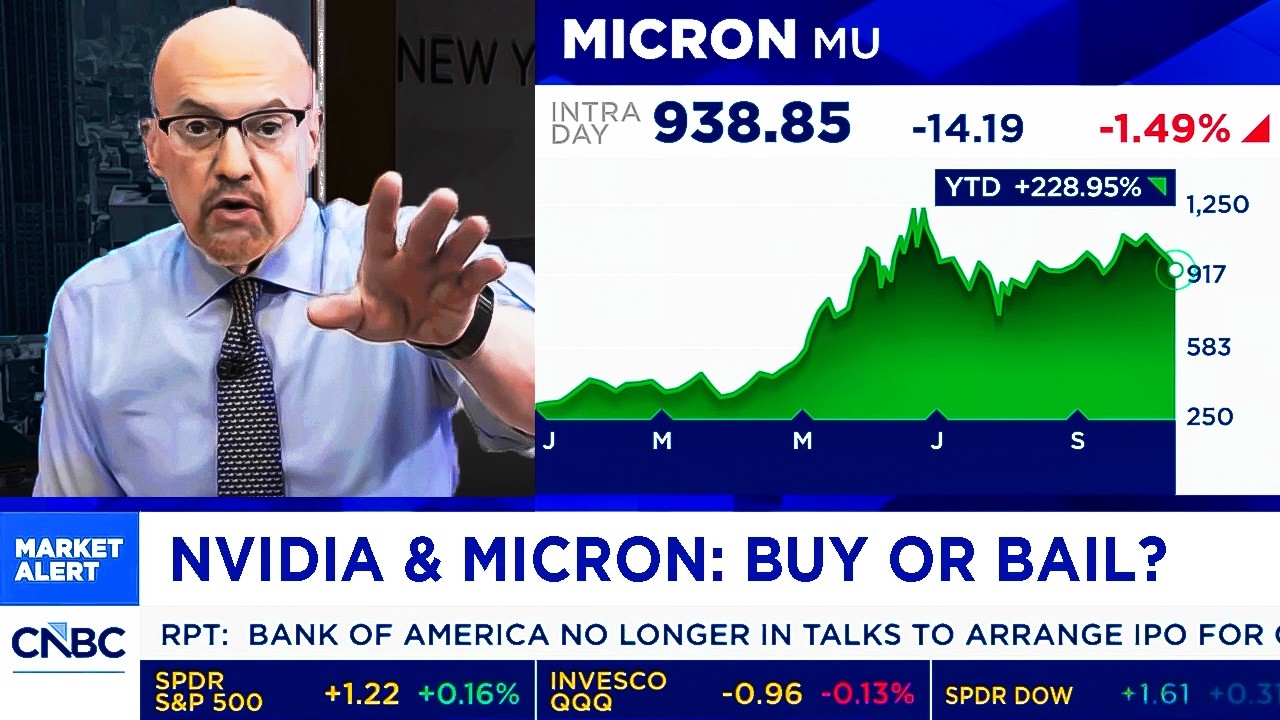
And meantime, memory stocks and chip makers under pressure this week after a Chinese chipmaker unveiled a new server memory design raising competition concerns. Joining us right now is an analyst who covers the industry, Kevin Cassidy from Rosenblat Securities. And and Kevin, this stuff is pretty down in the weeds. It matters because we saw Micron, SK High, Samsung all kind of sell off on this news yesterday. I want to have you describe this architecture, how it's different, how it could potentially be more efficient, and then ultimately why you think the market is getting this wrong right now with the sell-off. So, go ahead, jump in. >> Yeah, sure. Thanks, Becky, and thanks for having me on this morning. Uh, yeah, it does get into the weeds. It's about how to make a die size of a DRAM smaller so you can make more DRAM per wafer and reduce the price. Um so the line widths or the the uh feature size of the um architectural design has been 6F for quite a few years and that's high volume production. Samsung Highix and Micron in volume production with probably better than 90% yields. uh the the all these companies have been researching how do we go to the next level down and that's 4F squared as they talk about where the four is your architectural how you lay out the chip and then the F is the process node but that gets squared so the the large companies as I mentioned they are all going for smaller geometries making it smaller process node and they're about three maybe four generations ahead of the Chinese and the Chinese are trying to go with the the architectural change because they really don't have a choice of shrinking uh the process node u and are when you get a square of a number >> I'm sorry >> I'm sorry go ahead >> am I getting too deep into the that just different ways of making a smaller >> d sound right and making it smaller doing the architecture there's a chance it works but your point is they didn't give enough information or enough uh proof that this has been successful at this point for you to get real worried about this at this point >> that's right they say they'll be in production at the end of this year. We don't know what that means. You can make a handful of devices and say you're in production, but you know, the demand in the market is outstripping supply by a lot. And uh we don't think this is going to swing the supply demand uh equation at all. >> And that's been the big issue with a lot of these stocks is it's been a feast or famine cycle for forever with these DRAM companies, with any of the storage that goes through. Um your point is that this is different this time around and the stocks are not trading to reflect that that there is real demand here. Why don't you explain why this time is different? >> Yeah, in the past you know first of all the uh supply we always followed the supply side. The supply was uh went on fairly quickly say two years and maybe it cost $2 billion to build a new fab. Nowadays it's 3 to 5 years and it's $10 billion. Uh and again in the past the demand came from PCs and handsets where price was the uh biggest factor. Uh now it's in the AI and in hypers scale data centers where the more DRAM you put in the better your models work. Uh so there's a real demand and a real payoff and they're willing to pay the higher price. >> As a result you see the selloff. You know SKH Highex is off by 3% Micron down one and a half%. There were some big moves yesterday in these stocks. You think that the market is getting this wrong? What do what do you what do you tell investors to do here? >> Yeah. When you see the uh PE ratios at five to seven times forward earnings, that's very cheap. We use 10 times as kind of a medium uh through cycle uh valuation. Uh and yeah, what we think they're getting wrong is the predictability of the market now with it being in the data centers. These data centers have to plan their buildouts 5 years in advance. You know, as they talk about land, power, shell, you need to have all that in line and and have the DRAM come in. So, this is why they're willing to put out long-term agreements for 3 to 5 years because they know they're going to need those DRAM. In the past, PCs and handsets maybe had visibility for 3 months at best. So, uh this market and 50% of the market is going into the data centers now. And that that's a huge difference in the overall view of what the demand is. >> Why does it take uh 3 to 5 years now and 10 billion dollars to do this versus what it was just a couple of years ago with two billion a couple of years? >> Well, when you're getting down to these geometries of 10 nanometer, you can't have a speck of dust anywhere in the building. And uh there's also all types of regulations about how much water and how clean the water has to be coming out. So there's there's environmental concerns and uh it's just getting harder and harder to do. It's um they're they're targeting and maybe you saw ASML's reports this morning, their equipment uh looking at 1.4 nanometer products are uh being sold out already out into 2028 and 2029 >> and forget everything that we've particularly SKIX which is toxic. What does that thing do? Cuz that thing goes down. Someone asked me what does SK Hex do? I said it's easy. It goes down. >> Yeah. Uh Cosby's down 14 of 17 weeks. >> Do you know that I that >> you still do you still look at that before you come in and then you know what we're going to do? >> Do you want to see my Cosby? I have a Cosby sheet that is made up that literally shows you how there's literally no chance that Tech rallies >> on days when Cosby Cosby sheet. >> Yeah, we're back to 6K over there. >> Yeah, >> I know. No, look, they were crazy over there. I mean like there, you know, they had the bars that where there was all the betting and stuff and you could you could bet on every single hoop. No, that's Robin Hood. Um, but I really just think that what I see is is that we are linked to SKH Heinix and as long as that's the case and Hinx was down badly, then it didn't matter what ASML did. I got the ASML earnings. It's like why bother? >> This was a great quarterback. >> They raised guidance for the third time this year. >> Yeah, >> it was very strong. But it doesn't matter because SKH Highness was down. I I I know people think I'm making this up. It is not. It's like an al is an algorithm. You I don't know whether James Thes sit there and you say, "You know what? Elon Musk comes out and says Micron has been reasonable regarding future memory prices while others have been extortionate, which is something today's customers won't forget." I said, "Hey, maybe this is going to MOVE MICRON UP." NO, MICRON'S SKHEX. >> What about ASML though against you mentioned it as well? >> What do you want? Oh, look at this breaker. Chili's not SK Hayek. Could go higher. Chili's great margin. Five bucks. >> Wow. I'm getting started early. >> The American people. The American people are winners. >> Our producers want us to get to the financials. I don't know. How do you feel about it? Are you going to veto big moves? Look at this. Do we have like a camera here? We used to have a handheld thing here. This is the Cosby's big moves. I can't find a there's like one instance July 8th >> where >> where the mic where where the estimates went up if the cost went down was lower July 8th I don't know why that was >> that's a good find >> what was that all about >> that's a very good find >> that was the August 3rd uh cost was down 5% and the SMH was up 0.91 so I've got three instances in >> so there is a linkage between the movement in the Cosby and the SMH which of course then has a lot of >> thank you broader implications that's what I'm here for to state the obvious. That's all I ever do. >> I don't know that who I did the work. Cosby, never mind. I thought this was just positive and I bothered to do it. >> Well, Citadel had a nice note yesterday. The growth in Q3 earnings, 36% is Micron and Nvidia. >> Top. That's what we're supposed to say. I've been People have been telling me top in Nvidia since it was at $3, moving up from two. I guess they were right. >> It's Well, it's not a It's not a call on Nvidia. That's a call on the No, but Nvidia is trading with SKH Highix now. It doesn't matter. Nvidia was up a dollar and a quarter at 4:00 and then it ended up being a down at 615 when we figured out that SKH Highix was down and Nvidia started turning down. >> And you know what I said to myself? >> All I know is nuts. >> ASML's talking about semiconductor manufacturers saying that demand's going to remain strong well into 2030 with equipment purchases. yesterday, Michael Dell saying the same thing to me during the interview that we had as well about, you know, yeah, any number of concerns, but demand is just through the roof. We can't even >> Okay, so satisfy. >> So perhaps the empirical data that ASML says and Dale gave you should trump the crazy wild drunken trading and SKH. But right now SKH is more important. Look at ASML. I saw that I said that's even better than Mike Rod. But it's happening on a day when SK Hinx is down. Do you understand how ridiculous this market has become? >> Well, do you understand what you're saying? What that sounds like when you talk about how ridiculous this market has become. So, what am I supposed to do with that if I'm a viewer listening to you Jim? >> Say that maybe we should be listening to Michael Dell. Maybe this is an opportunity now that all these firms have, you know, the Salesforce is getting upgraded 100 points later. >> You want to listen to Michael Dell cuz I can play a yesterday. >> No, I'm saying that perhaps we listen to people who know, recognize that the market has to RBC has turned hard against tech and maybe say, you know what, I don't know. Hardware is not bad. We just heard >> Well, you're mentioning Lori of RBC who does downgrade tech today, right? >> Look, Lori has a splash. This is a nice splash. Okay. In the end, after they come down, I want to look at them again. I know that the Korean market was wild and crazy for some time and I'm just saying David that maybe the Cosby's big moves makes no sense and we should be looking for opportunity. But right now the ALGO says >> maybe Paul Tudtor Jones is right about flows and maybe mutual funds buying has stopped as of the end of of September because rates are 5.3%. >> He said not till 27. We were supposed to party until 27. >> You got that wrong. >> Yeah. You were so busy doing that Dell interview. >> No, by the way. All right. You want some positives? Take a listen on Michael Dell talk about all the things coming at him and how he sees the the world right now. >> All right. >> I think all these things are concerns, right? You know, maybe maybe it's regulation, maybe it's capital, maybe we don't have enough memory chips, >> maybe some some of all the above. But what we see right now is uh a lot of those are being addressed and there's incredible demand and we're still at the beginning of the scurve of this. I mean any cycle for technology is sort of a combination of you know excesses and um you know uh incredible opportunity and skepticism all at the same time and this is all in the mix. One of the benefits of having lived a while is having seen it before and you have as well. Do you think this is a bubble? >> I don't think there's enough supply for it to be a bubble, right? And what we see from our customers is they're using what we provide them uh immediately and they want more. >> Y >> and the things that you've talked about as sort of risks and challenges, I think those are mitigants to there actually being a bubbles. Are you buying more Nvidia? >> Nvidia is a name uh that we would be adding today. Uh we are buying XLK this morning at the open. We are also buying QQQ. Look, these names on the MAG 7, some of these names have actually they're still over the 50-day moving average. They're just having a little bit of a correction in a bullish trend. Other areas you want to be a little bit cautious on that have broke the 50-day. Uh but again, we've seen this story before this year. And our thesis is the market's going to finish at new highs by the end of this year. So we're looking at this September October time period as an opportunity to position for that because you're not going to get the S&P to go over 8,000 in our humble opinion without tech leading the way. So we're still betting that this bull market still has legs for the rest of this year. And now's the time to be buying when there's a lot of fear as long as you got the right risk tolerance. Exactly. We want to come over to you. You own Nvidia. Any concerns about the chip trade in general? >> I own Nvidia. I own Taiwan Semi which is a much bigger position for me uh than Nvidia, but it's the same play essentially. Uh yeah, of course there are concerns. Are the stocks telling you that the capex cycle is peaked? Uh because the stocks typically discount peaks a year ahead of time. Now peak doesn't mean a decline in in spending and not necessarily it could be. It means a plateauing in spending. So if you're not continuing to see the growth in the spending on that means the capex going into the semis then you know valuations will be reset even further. So look I don't know what it means. We have seen this carrier's point multiple times during the cycle. Right now I'm still sticking with Taiwan semi as one of my largest positions and also holding on to Nvidia. Nvidia does give me a little pause though because the market seems to be at that point over the last whatever year of not rewarding the company that everything's assumed that they're going to continue to grow and even though the multiples compressed quite a bit as earnings and revenues have grown it's still not getting rewarded. We saw a minor rally after after this recent quarter but in the scope of things and relative to a Taiwan semi it's really been a punk performer. You know, I I want to point out ASML. They actually came out saying that they're getting order interest through 2030 stock actually not moving a lot. But Liz, I want to come over to you. They're so critical for the chip supply chain. If this company is saying they're getting orders for the next four years, is this much to do about nothing and maybe just a healthy pullback that Cara was calling for when it comes to chips? >> Yeah, I mean there haven't been fundamental deterioration factors that have come in yet. And the real concern, and this was partially to Car's point, the real concern would be if demand actually slowed and we started to see it in the fundamentals, the revenue growth of some of these companies. But the reality is that markets have been trading on shortterm news headlines, whether company specific, rate specific. I think it makes a lot of sense that long duration stocks like semiconductors would be under pressure on a day when yields are rising. Markets have been trading on some of those short-term headlines, but the fundamentals for these companies are very long-term. We're looking at 3 to 5 years into the future. A lot of these are committed out that far, and we're still in a year where they couldn't produce enough stuff to fulfill demand, right? That's not over. So, I think at this point, it's difficult to get really all that bearish on the semiconductor complex, but the way that they're trading, is it easy to get emotional about it and look at it and wonder if everything is over? Sure. I mean, I think we're all doing that a little bit and you don't want to look at a chart later and say, "Oh, I should have known." Right? But in a time when it feels like things are falling really sharply, that's rarely the right time to run for the door. >> Okay, a lot going on. So, let me give you my take first and foremost. We'll talk about the CPI and all that other stuff later in the show, but let's face it. This is all about NASDAQ, that core trade, right? The curious case of the rerating of the hottest trade in history in history, right? Why is super intelligence value proposition? Why is that value proposition that we all know somehow still sending stocks lower instead of higher? So, a couple of days ago, Morgan Stanley pointed something out about the history of cycles versus super cycles. And essentially, uh what they're saying is like at some point, even if it's a super cycle, it comes to an end. And so, at the end, it's still cyclical and reward is harder to come by. In other words, the longer this goes along, the harder it is for these stocks to go up. Now, this makes sense. So the question is how far are we along in this trade uh in a buildout of all this and I think we got a long way to go. Take data center demand for instance. Okay, under construction we've got 45 gawatts under construction planned without moratoriums 231 gawatts. We are still 102 gawatts short. This is what we need folks. This is what we need to power the the the super intelligence revolution in this country. Even with what's planned and under construction, we're far apart. What does this mean in terms of money? Well, this is from May. Upfront cost for these uh data centers. So, one gigawatt. One gawatt. Remember, look at this number. We're talking 378. One gawatt can be 38 billion to 60 billion. The numbers are mindboggling. So, we know about the growth rate, right? With these hyperscalers. The growth rate has been exponential. This is where we've been, right? Just gone off the chains. Just completely crazy crazy stuff. And yeah, we're going to probably peak out right around here. But look where we're peing at $1.6 trillion. By the way, this is till 20 32. So we're here and we're saying, should we be ending a a rally? Should the rally act like we're here instead of here? This is the nonsense, right? This is what's going on right now, which is great if you have the money to buy these dips, which I always try to encourage people to do at the right time. So, the naysayers though, they're out there, they're on their soap box. And one of the things they've been pointing to is return on investment. They say it's just not going to be enough. The SI trade, that ship has been steady, but few things have come up, including the story I told you. It was the first thing I talked about on Monday morning. This cloud company out of Australia had to scratch their IPO. Then the Journal picked up on the story yesterday and all of a sudden credit default swaps have gone through the roof. Through the roof. I mean this is really crazy stuff and none none of them hit harder than the Neocloud names particularly cororeweave. I want to bring a Milk Road AI analyst Melvin Matthew. Melvin. So here's the thing. We've got Nvidia and Cororeweave. That's a critical relationship. Nvidia put a lot of money into Core Weef. Coreweave in return buys their GPUs. We understand that. On this side, you've got the customers. Uh Microsoft, OpenAI, Meta, they've got cash. They're going to keep buying. The big question seems to be on this side, right? This is the problem right now. People are worried about the lenders, the ability to repay the lenders. What are you telling folks who are saying, "Hey, coreweave credit default swaps have gone through the roof and people are worried they just won't have enough money when it's time to refinance this debt." >> Yeah. So, I think the issue right now is pretty simple, right? The competition for yield grow yield is growing as interest rates continue to rise globally and today's CPI report is a example of that, right? Like inflation came in hotter than expected and the 10-year Treasury yield is now around 5.24%. So when investors can earn attractive yields from you know government bonds with significantly less rest they're going to naturally going to ask you know higher demand for companies like Corv right so what I have to say is I think this is all bunch of not nonsense I don't want to say I think they will eventually figure it out they have huge backlogs right now over hundred billion dollars and they can use Nvidia as a backs stop to finance these debt as well and also you have to understand that Jensen doesn't want these neoclouds going down because Jensen is using these neoclouds to fight fight against hyperscalers because they are building their custom chips. They're they're fighting Jensen uh as of right now. So Jensen needs these neoclouds to succeed. >> So Melvin, okay, 2.58 billion in revenue. That's up 100%. That's part of the story. That number is going to keep growing. You mentioned right there the backlog, 104 billion backlog, but the debt, right? The debt on the balance sheet, 35 billion. And you're saying, "Okay, yeah, you got competition now from from treasuries. You got competition from other corporate uh offerings out there, but you're still feeling pretty good about this." The co-founder of Cororeweave um uh made a statement to the Financial Times about maybe going to insurance companies, right? They're sitting on trillions of dollars. Did that smack of desperation to you or is that the legitimate place maybe they can find the next round of funding? >> I think they're looking for next round of funding. I I think it makes sense for them to go that route because you have to understand they're looking to trap uh tap into trillions of dollars, you know, managed by life insurance companies to help finance his AI infrastructure, right? I think the biggest competitive advantage for these companies like might eventually be able to access cheap capital, not just their ability to like secure GPUs and build out these data centers. So I think that it's smart for them to go that route because you have to understand they can use these GPUs to get u lending against it and this uh and we all know these GPUs are six years have a appreciation cycle now and it's and I've seen projections of these even going um higher. So I think this is a smart move by Kore. >> Okay so let's talk about annual bond issuance in general. These are just your top five names right? I mean it was 50 billion 40 billion all of a sudden of course we took off last year 93 billion 132 billion just through July 11% of all investment grade uh demand are you concerned at all about demand being able to you know them being able to continue to raise money in the debt market yes that is a that is one of my worries right now I think the problem right now that why the stock is selling off is because investors are worried about dilution because that's going to be their alternative alternative thing if if they can't raise capital at the bond market at you know good rates and I I think this is the example of why stocks like iron has lag basically all of this year because of dilution concerns so I think I am as a shareholder I am a little bit worried when it comes to dilution so >> but not with the big names though not with the now with the the just the smaller names are concerned the big names no problem right anyone would throw money at them anytime any kind of money they need let's talk about the other major story Memory China, Elon. Okay, so we had this story coming out to China, CXMT. They're going to, you know, do this, they're going to do that, this threat. Uh, you say the selloff in memory stocks, this is a couple of days ago, makes absolutely no sense. And everyone chimes in, including Elon Musk, and Elon Musk says, "Well, when China figures out how to manufacture a product, their ability to scale is often greater than the rest of the world. And we saw this with lithium and solar, yada yada." But then maybe Elon's had a change of heart because all of a sudden he's he's saying Micron's being reasonable. You say Elon is literally telling you to buy Micron. This is a crazy 20 48 hours for you, Melvin. >> Yeah. Yeah, it has been. I I think it all started with the CFMT fund that came out. If you if you don't know what what they announced, it's basically they uh they announced a progress on a technology called 4F2 F2D RAM which they plan to you know um release it by 2026 and it this basically allows in investors to fit more memor fit more memory cells into the same amount of space uh potentially making memory production more efficient and reducing manufacturing costs. But I think what you have to understand this is DDR5. This is has nothing to do with high bandwidth memory. high bandwidth memory. China won't be able to produce it for many many years. So >> that's where the industry is going. Those are where the margins are. I've been hitting that the last two days. But let's I got a two minutes to go with Microsoft like Nvidia. I know also I'm going to go straight to Micron because I think that's one of the stocks in focus. They had this amazing earnings report. Stock did well for 24 hours and then here it's just beat a hasty retreat. It's down a lot. Uh, and so it's frustrating because it's perhaps the cheapest stock in the market right now with the most upside potential. So, it's always a headscratcher. Why it goes down like this from time to time? >> I think it's headline risk. This whole memory issue on China is really overstated. Number two is the capacity that is being added within the memory industry is pretty substantial, but so is demand. I mean, I listened to the Micron call last last quarter and they can't meet demand through the end of the decade. So if you look at the pricing leverage that uh this company has, it's uncanny. I mean DRAM is up triple digits. Uh they're at gross margins of 87%. The knock on this name is it just can't get any better. Well, I think you've got prolonged strength. The other thing is on the balance sheet. This is one of the worst balance sheets intact four years ago. Now it's pristine. They only have 9 billion in in uh debt uh and 33 billion of quarterly free cash flow. >> They're going to have one of the strongest balance sheets in tech. In fact, uh we do this analysis on free cash flow every quarter. They're in the top five on free cash flow generation. So, where my clients are looking at this right now on the institutional side is they don't want to catch a falling knife until it hits the ground and stops spinning. uh as as as that falling knife does stop spinning, I guarantee you they're going to revisit this name. >> Good stuff, Ted. Great work. Really great work. Thank you very much. >> All right, I hope you're all doing well today and staying calm in this market. Wednesday was a rough day in the market and especially for tech due to multiple reasons. We got a hotter than expected CPI print Wednesday morning as market participants worry about potential future Fed rate hikes. We got strong earnings from ASML Wednesday morning with very positive guidance and forward-looking commentary. ASML once again raised its 2026 guidance. Management expects its planned equipment production capacity to be insufficient to meet customer demand through 2028, and customers are discussing orders for 2029 and 2030. All of that bodess well for AI demand and the continuation of the AI buildout. But ASML's earnings and commentary were overshadowed by other events in the market. What really spooked the market on Wednesday was Core Weeb's bond situation. I'll be straight forward with you in saying that this situation is not good. And at the same time, I do think that many people are leaving out important context when discussing the situation online. So, let's talk about it. Coreweee's unsecured bonds maturing in 2032 traded below 80 cents on the dollar, which is commonly considered to be a warning threshold for distressed debt. Yields surged. Corw's 9.625% bonds due in 2032 are now yielding over 15% versus roughly 13.4% earlier this month. That is indicative of a significant deterioration in credit market sentiment. Again, this is not good and it has implications beyond just core. But now, let's talk about some important context that I think many people are missing. Importantly, yields above 15% do not mean that Cororeweave is suddenly paying 15% interest on all its existing debt. Core's fixed coupon bonds continue carrying their contractual interest rates. But those elevated yields suggest that investors would demand substantially more compensation to lend Core additional money on comparable unsecured terms. I'll also mention that Core's 2031 unsecure bonds are also yielding roughly 15%. Now, the 2031 bonds and the 2032 bonds that are getting a lot of attention collectively represent about 10% of Core Weaves estimated outstanding debt. That's nothing to sneeze at, but it is important to keep things in perspective. It's also important to mention that there's a big difference between distressed bond pricing and evidence that a company cannot meet its upcoming obligations. Many are pointing to Core Weeav's very large backlog, which is important to keep in mind. That said, it's also important to consider that in order to capitalize on that backlog, Core Weave needs to fund its buildout, and it is primarily funding its buildout through debt at this point. Now, my honest opinion is that this is not a good situation. And at the same time, I do think this will be resolved. Some of you may remember me talking about Core Weeave in the past when I've spoken about Iron. While I have nothing against Coreeave, I said repeatedly in past videos that I prefer iron because of their vertical integration and because their debt situation is very different from Core Weeaves. That said, that does not mean that I'm bearish on Core Weave. I actually think Coree has a lot of growth ahead of it despite the nervousness we're seeing in the market. You also have to consider the importance of core weave to Nvidia both from a customer diversification standpoint and also given Nvidia's investments in core. I very seriously doubt that Nvidia would allow Core Weave to falter and so it's worth considering the possibility of Nvidia stepping in as a last resort if necessary. The core situation is also important for the broader ecosystem as it has implications for those companies access to capital an environment where access to capital becomes tighter. It's especially important to be selective in the companies that we choose to own. Put simply, I'm personally not invested in Core Weave and the company's dead situation is a big reason for that. At the same time, I'm not bearish on Core Weeave and I think they have a lot of growth ahead of them. I expect this situation will eventually be resolved. I noticed the FT published a story about Core Weeve wanting to tap capital managed by insurance companies. If Coree could obtain investment grade ratings on more of its secured financing, insurance companies could provide substantially cheaper capital than investors are currently demanding for unsecure bonds. Coreweave is also reportedly examining Nvidia's $500 billion financing initiative that Jensen Hong announced alongside six of Wall Street's top financiers back in August. And so again, I get the concerns and this situation is not ideal. And at the same time, although I don't own a position in Corweave, I do think some of the concerns are slightly overblown. I expect that the situation will eventually be resolved. In other news, the FT published a story Wednesday evening saying that Anthropic's revenue reached 16.8 billion in Q3, which is up roughly 46% sequentially. Anthropic reportedly told investors it achieved an 11% operating margin and was cash flow positive during Q3. Anthropic reportedly generated about $1.70 in revenue for every dollar it spent on compute. If we were to annualize Q3 revenue, that would be approximately 67 billion, but that is not the same as Anthropic September exit revenue run rate. Many AI stocks traded lower during after hours Wednesday evening after the FT story was published. That's likely because Anthropics reported Q3 revenue growth of 46% sequentially is a deceleration from Q2's sequential revenue growth of 143%. A quarter-over-arter deceleration in revenue growth ahead of a $2 trillion IPO as access to capital is getting tighter. That's not an ideal setup in the short term, which is likely why we saw a negative reaction to the news Wednesday evening. That said, it is important to keep the proper context in mind. Anthropics reported quarterly revenue is more than 3.5x what it was just two quarters ago. So, I get the negative short-term sentiment due to the expected timing of Anthropic's upcoming IPO. But at the same time, let's not miss the forest for the trees here. Right now, the market is very nervous with elevated yields, higher oil prices, the upcoming election, access to capital getting tighter, worries about Anthropic's upcoming IPO, and so forth. Because of that nervousness, recent news stories plagued by inaccurate media framing, such as the OpenAI revenue story, the CXM news that was overstated without proper context, Broadcom CEO Hawkan's recent comments about investors that were blatantly taken out of context by multiple media outlets. All of those stories have exacerbated the downward price action on a nervous tape ahead of an important election. During these moments, it's important to slow down, keep the long-term picture in view, and not miss the forest for the trees. This too shall pass. In the meantime, we as investors can be selective in the companies we choose to own. Focus on high-quality companies with improving fundamentals and add to positions in great companies in a responsible manner during a time of weakness. I'm not a financial adviser and I'm not telling you what to do. I'm just sharing some news, my opinions, and some thoughts that I think may be helpful to consider. With the proper mindset of a long-term investor, it's possible to actually look forward to selloffs as potential buying opportunities rather than dreading sell-offs and panicking when they happen. Unfortunately, sell-offs are inevitable in the market. But sell-offs are not the time to panic. As I often say, remember to stay calm in this market. Remember to maintain a long-term perspective and do not make any hasty or irrational decisions. This is not the time to panic. This is the time to determine which companies we want to own moving forward and to determine what the right strategy is in light of the opportunities before us. Proper position sizing is extremely important. It is usually not a good idea to go all in on a stock all at one time. You don't have to buy an entire position all at one time, and you don't have to exit an entire position all at one time. It's also important to not own a position in any one company or sector that is so large that it causes you to get scared and make irrational decisions during sell-offs. Sell-offs are inevitable. If you need help with your unique situation, consider reaching out to a certified financial professional who can help you with your unique circumstance. Looking ahead, Jensen Hong is scheduled to deliver a GTC keynote at GTC Berlin on Wednesday, October 21st, starting at 11:00 a.m. Central European Summer Time. For those of us in the US, that's October 21st starting at 5:00 a.m. Eastern, 2:00 a.m. Pacific. Now, in case you're new to the channel, I want to make sure that you have at least a basic understanding of the underlying long-term thesis. So, let's cover that now. I don't know what's going to happen in the short term, but from a long-term perspective, I am very confident that Nvidia will be worth much more in future years than it is today. When Jensen was on the Lex Freedman podcast not that long ago, he was very seriously raising the possibility of Nvidia becoming a $3 trillion revenue company in the near future. If that happens in the coming years, then it is very plausible that Nvidia could one day be worth tens of trillions of dollars in market cap. That might sound crazy, but that's what Jensen is implying when he raises the possibility of Nvidia becoming a $3 trillion revenue company. I guess the question at that point is what multiple the street will be willing to give Nvidia. I don't know the answer to that question, but I truly do think that Nvidia will be worth much more in future years than it is today based purely on the fundamental growth of the business. Based on everything I'm seeing, the world is still computed and I expect that to continue at least through calendar 2028. In a computed environment, developers will use whatever viable compute they can get their hands on. Today, there are no GPUs that are sitting dark due to a lack of demand. Like there was fiber sitting dark due to a lack of demand at the height of the dotcom bubble. Back then, companies were laying fiber in the hopes that use cases and demand would eventually show up. Today, we are seeing the complete opposite. As I've said many times, when market participants compare this AI revolution to the dot bubble, they ignore the fact that the internet is already here this time. This means that mass adoption of the technology and new use case development at scale are immediately possible. We don't have to wait years for it to show up. It's already here. The world is compute constrained which means there is not enough supply to satisfy demand. New capacity is utilized as soon as it comes online. The hyperscalers are monetizing capacity as soon as it comes online. Each of the hyperscalers spoke about being supply constrained on their most recent earnings calls. Additionally, many of the clouds are building out into contracted demand. They're not blindly building in the hopes that demand will eventually show up. No, they're building out because they have signed contracts and in some cases significant prepayments from their paying customers. This AI revolution is fundamentally different from the dotcom bubble and 2026 will be a pivotal year for the AI industry thanks to the rapid adoption of agentic AI and the proliferation of agentic systems in the world's leading enterprises. The leading AI labs revenues are surging right now. Agentic coding and the implementation of agentic systems in large enterprises are new use cases that are increasing inference demand significantly that subsequently is increasing compute demand. The rapid adoption of agentic AI is why we're seeing an inflection in inference demand. It's why we're seeing the leading AI labs revenues surge. I wish both Anthropic and Open AI were public so the public could see the ramp in their revenues. I think the leading labs surging revenues may be the initial proof point that grabs market participants attention and causes them to realize that there will be a clear ROI on AI infrastructure. I think the leading labs surging revenues will also help assure investors of the longevity of Nvidia's growth since these labs revenues are directly tied to compute. If they had more compute, they would have greater revenues. It really is that simple. Demand is not the problem. The problem is a lack of supply to meet the demand. As I've said previously, I expect the world to be compute constrained at least through calendar 2028, possibly longer. And so, regardless of what happens in the short term, it's important for long-term investors to remain focused on the fundamentals, maintain a long-term perspective, and remember that we are only in the early stages of aic systems being adopted at scale. This will increase compute demand significantly, and after that, the next surge in compute demand will likely be fueled by physical AI. We're no longer talking about digital agents performing digital tasks. With physical AI, we're talking about physical AI agents performing physical tasks in the real world. NVIDIA CFO has called physical AI quote a multi- trillion dollar opportunity and the next leg of growth for Nvidia. This industry will fundamentally transform society and NVIDIA has positioned themselves to benefit massively. NVIDIA sells the hardware for the data centers where the models are trained. They offer omniverse where the models are taught and tested. And Nvidia also sells the hardware that allows ondevice real-time inference through NVIDIA AGX, allowing robots to have intelligent interactions with the real world, even when they are not connected to a data center. Notice that Nvidia is taking a holistic platform approach to physical AI, and they're embedding themselves as the underlying foundation supporting all of it. Over 3 million developers are already building on the Nvidia robotic stack, and this is not getting enough attention. As for production ramps, Blackwell Ultra has ramped and remains in high demand. Vera Rubin is rolling out to customers. Nvidia Gro 3 LPX is in full production. Later on, we're expecting the launch of Reuben Ultra in 2027 and Fineman after that in 2028. We have a clear data center product roadmap stretching into 2028. And Jensen believes that AI infrastructure spinning will reach three to 4 trillion annually by the end of the decade. That means Jensen is expecting growing AI demand and an expanding total addressable market underpinning all of this. I don't think we are anywhere near any type of bubble bursting type of event. With all of this in mind, I seriously think that Nvidia still has plenty of runway ahead of it. And I think this company will be worth substantially more in future years than it is today. At least that's my view of the situation. Quick note before I wrap up. All of the compilations on this channel are edited by Finn Vid with original structure and commentary. Occasionally, the same edits appear elsewhere on YouTube. If you're looking for the original version, it's always here on this channel. Thanks for watching Finn Vid. I appreciate your support. Remember to stay calm in this market. Remember to maintain a long-term perspective and do not make any hasty or irrational decisions. With all of that being said, I hope you all have a great rest of the day. And I'm curious to hear your thoughts about Nvidia in the comments below. Please leave a like on this video so more people will see it. And while you're down there, please consider subscribing. It's free and you can always change your mind. Thanks for watching and hopefully I'll see you in the next

Comments 0
Sign in to join the discussion.
Sign inNo comments yet. Be the first to share your thoughts!