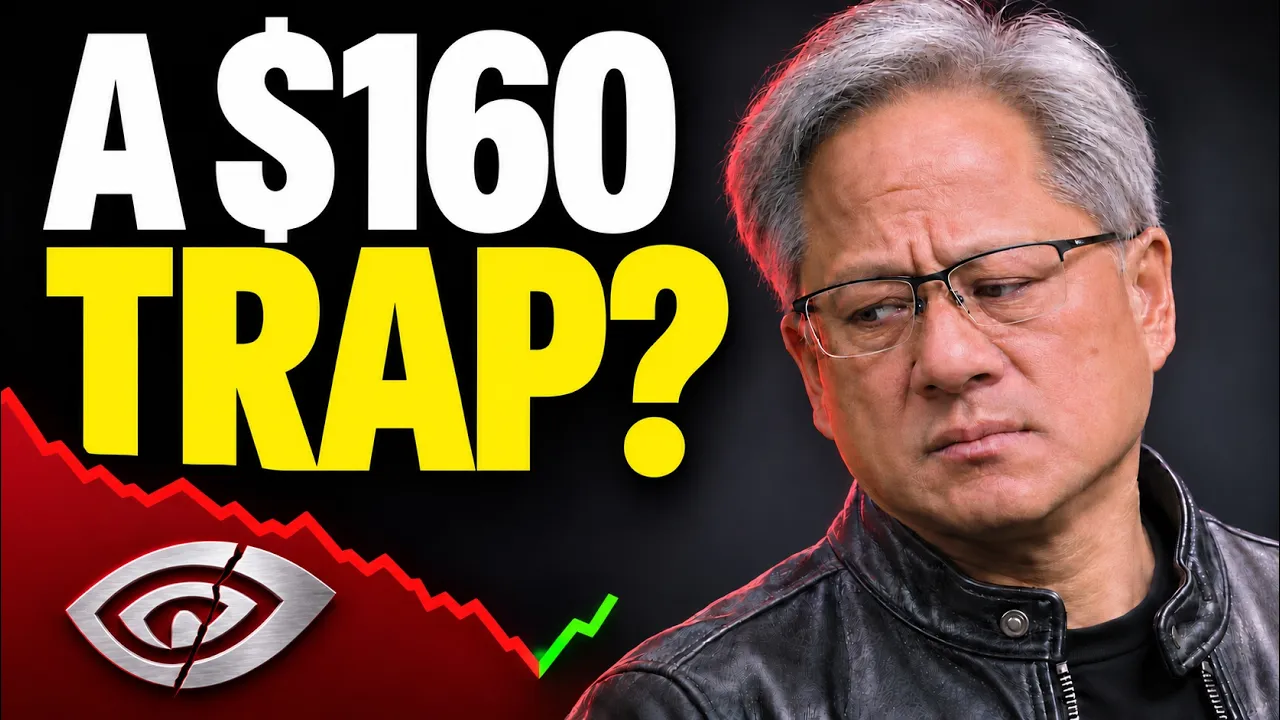
Don’t Buy the Nvidia Dip Just Because Sales Doubled

- Video return
- -16.85%
- Calls
- 1
- Buy / Sell
- 1 0
- Published
Recommendations
Entry is the asset's closing price on the publication date. Current is the last close on record.
-
Entry $150.96 18 Nov 2026Current $125.53 20 Nov 2026Result −$25.43vs. index −11.3% SPY −5.5% over the same days
Cite this call Watch source segment (1330s) *
Surrounding source transcript
…price. The assumption I keep coming back is how much cash Nvidia can actually generate by FY30. A much weaker part there. It would change my answer. So where does that leave me? At around $160 based on the numbers I've just walked through, Nvidia is in a buy territory for me. I start with a small position and build it in stages. The reason is the line right here. In fact, with 20% less free cash flow and 10% growth after FY20, I still get to $212. The first thing I'd watch from here is how next quarter's margins actually come in. Then I check whether the recovery …
Nvidia is in a buy territory for me. I start with a small position and build it in stages.
AI-extracted context So where does that leave me? At around $160 based on the numbers I've just walked through, Nvidia is in a buy territory for me. I start with a small position and build it in stages. The reason is the line right here.
Full Transcript
Nvidia just doubled its revenue and raised its growth outlook. And on the same earnings call, the board made it clear that they've got no plans to bring Jensen Wang back as CEO. Interestingly, as well, earlier in the day, Jensen said that he would be willing to return if the board felt it was in the company's best interest. You can see that in his own statement here. Then Nvidia raised next year's growth outlook. If you run that number of off the midpoint of the latest guidance, you get to around $741 billion of revenue. And what I've done today is cut my cash flow forecast by 20%. That took about $65 off my estimate. Let's see how far it falls again if growth ends up slowing. And one number, it jumped out at me. Nvidia finished the quarter with $81 billion in receivables. We're going to look at why that rose. First, here's what the board actually said about Jensen. >> Nvidia board unanimously accepted his resignation and does not intend to reinstate Jensen as CEO. >> Now, that was Harvey Jones, Nvidia's chair. Colette Crest is running the business as interim CEO while the board searches for a permanent successor. So, I'm valuing the company on the assumption that she and the team have to deliver. And the first reaction we had from the earnings, it was positive. Nvidia's also up in the pre-market. Corweave, Nebius, and Iron, they're also all up higher. This was a relief move across a group of stocks. And if we look at semis on the morning screen, Nvidia, Brocom, Micron, and AMD, they're all green. Investors have taken the outlook as a sign that spending on AI infrastructure could still be very strong. But look what happens when we switch to the one-mon picture. Nvidia is still down around 26%. That's the difference in time frame that we're dealing with. one green morning after a pretty brutal month. Now, if we use the 52- week high as the starting point, Nvidia is still around the third below. That's why I'm more interested in where it trades today than calling the recovery. Now, shares closed around $155 yesterday. We can see in the morning session trading around 160. And keep that number in mind when we stress test what the business today is actually worth. And let's start with what the company actually reported. The first thing I want to get straight is where the growth came from. At this scale, the answer has to show up in the data center numbers. Revenue, well, it came in at $116 billion. That's up $13% year-over-year and 20% from the previous quarter. That's nearly $20 billion added in just one quarter. And here's the comparison that I like. Nvidia beat its own revenue guidance midpoint by 7.3%. That's a bigger beat than the previous quarters 5.7. So what exactly drove it management? Well, as we can see here, in fact, they say that Vera Ribbon added nearly $20 billion quarteron quarter. The new platform is in production and generating sales. The question for the next print is how much more of it can Nvidia ship and the data center business is it $108 billion on its own? That's up 110% year-over-year. I mean, just look at that bar on the far right. and data center that was around 93% of group revenue. Edge computing that was the other $8.2 billion. If your view on AI infrastructure spending changes, that one segment is going to move your own Nvidia model. And then if we look on the left hand side first, Hyperscala went from around $35 billion to 60 billion in one year. these large cloud platforms, they're still buying a lot more from Nvidia infrastructure than what they were just 12 months ago. And this chart looks like the opposite story until you look at what it's measuring. Hyperscaler went from nearly 69% of data center revenue to about 56%. That's the share of the segment. And the explanation is in the lighter blue bars. AI clouds industrial enterprise, they went from about 16 billion to 47.5 billion. That's more than 30 billion of extra quarterly sales year one year. So the hyperscalers, they grew around 71% and the other group nearly tripled. Both can be true at once. It changes the question that I ask about growth. Who's funding the next wave of buyers? And the income statement very clearly, it shows us why the market is paying attention to these sales. On around 116 billion of revenue, Nvidia made about 78 billion in operating profit. That's roughly 2/3 of sales. And you've got the gross margin telling us how much is left once the product costs come out on the adjusted numbers. It was 74.9% up from 73.5 a year ago. And then you look at the operating line adjusted operating expenses. As we can see here, that rose 52% revenue well as we said earlier that was up 103%. So at least in this quarter sales they grew fast enough for operating profit to more than double and that got you to $268 cents of adjusted earnings per share against $1.27 last year. That's 111% growth. The gap numbers on the left that was $2.70. Now we look at the cash. Nvidia reported $43.8 billion in free cash flow up from 22.1 billion a year ago. That's the figure I care more about when we get to the valuation and cash flow. That was about 67% of reported profit this quarter, up from 36% last quarter. That's a big improvement. You can see the quartertoarter swings in the gap between the bars. And Nvidia reported returning 28.1 billion to shareholders in the quarter. That's about 64% of reported free cash flow. The green stack here includes both the buybacks as well as the cash dividends. And look at their total cash. It's sitting around 98 billion. A strong quarter for cash generation. It can still leave a slightly lower closing balance. So when I run the DCF, I essentially start with what the operations can produce. Then I look at the balance sheet in the valuation and the cash coming from the business. That's the far bigger moving part than any single quarters distribution. I mean, look at the strip bar at the end. That's Nvidia's 130 billion revenue midpoint for Q4. It's above what analysts expected and it's the figure I'm going to use to work out this year's sales. But check the footnote at the bottom. This quarter has one additional week. You should see more revenue from having more time to ship product. So be careful treating the full step up as an acceleration here. So start with the 116 billion that we just saw. 130 billion would be about 12% more sequentially. That's the growth you get from comparing the two headline quarterly totals. And for the extra week point, think about it this way. You're comparing a 14week quarter with a 13week quarter. I want to hear about shipments, capacity, and customers before assuming the pace improved as much as the total suggests. Now, follow the margin line. Nvidia's reported gross margin. It came in at 74.8%. The diamond off to the right is the guide midpoint for the next quarter. That's the direction that I want to watch. And the Q4 guide putting both reported and adjusted gross margin at 71 to 72%. At the midpoint, that's a drop of a little over 3 percentage points. So sales, they can rise while the margin falls. Then look at the operating expenses row. Nvidia spent 8.8 billion on the adjusted basis last quarter. The Q4 outlook puts it at 10.7 billion including the effects of the longer quarter and transition related costs. Now I will also say management they already flagged the Q4 margin range last quarter. On this call crest said they expected a recover to 72 to 73% in FY28. That's the recovery I check against the actual results. And add up the first three quarters in the FY27 column and you get roughly $294 billion. That gives us the starting point for putting the new outlook on a fullear basis. And then put the 130 billion Q4 midpoint and you get around 424 billion for this fiscal year. That gives us a number for the base that Crest was talking about. So Crest now expects roughly 75% revenue growth next fiscal year, up from 70. Apply it to the highest starting point and you get around 741 billion. That's the math behind the strip bar. And Crest now expects roughly 75% revenue growth. And just look at the difference in scale when Nvidia gets a big forecast upgrade. Now we're talking about tens of billions of dollars. The company's revenue, it used to move by just that much over several years. And the cash flow estimates are asking for a lot as well at the four quarters from April 27 through January 28 on this chart. And the estimates comes around $335 billion. My number for that year is 230 billion. I want you to remember the gap between those two numbers because that's what I'll be testing. How much cash can Nvidia actually get out of all of those sales? Now, the earnings estimates, they do give you another way to see the expectations. We can see around $16 per share for Jan 2028, and that's up from 966 the year before. Now, currently, what we're seeing for Nvidia is a forward P that's sitting below 13. I mean that's significantly lower than the five average of 35 for which when we look at the blue tunnel from simply safe dividends massive massive disconnect again closer to zero than it is the bottom of the blue tunnel fair value intrinsic price. I mean this one's been trading in a severely undervalued level pretty much since the beginning of 2025. Now we also have a survey from the Bank of America. 52% of respondents thought an AI hyperscaler would announce a cabex cut within 6 months. In September, only a minority thought that would happen. Think about how far apart those expectations are. The outlook implies more than 300 billion of additional annual revenue for Nvidia. To get there, a lot of infrastructure has to come online and somebody needs to fund it. Now, the survey asks if at least one hyperscala cuts. That's quite a specific question. My followup as an Nvidia shareholder would be where the money is getting cut and how much of that was actually headed for Nvidia. Hyperscaler sales were about 56% of data center this quarter still makes the group spending very important. You've also got the rest of the segment growing quickly. So there are several places to look for changes. This chart shows why all of this is important to the wider market. Nvidia accounts for about a quarter of the expected earnings growth in the S&P 500 in 2027. That's just one company and you can see a similar change in expectations for semiconductors. Generally, earlier forecast kept looking for growth to slow sooner than the latest forecast does. I'd still use a range for how fast this fades in my own model. So, let's get into what could go wrong. There's a difference between having a product customers want and being able to execute this plan through a leadership change. The earnings release, it gives Crest some breathing room. And this report from the information brings up two alternatives for customers, AMD and Google. As an investor, I'll be watching where customers start to put the next dollar of spending. They've got more choices there. The question I'd ask is whether big cloud customers are planning around Nvidia for the next wave of capacity. They can use Nvidia hardware and still build an alternatives. Amazon, that's a good example of that. Well, you know, I have deep respect for for Jensen and I have deep respect for Nvidia and they've been um very significant partners for Amazon for a long time and they will be for as long as I can foresee. And >> now in this interview, Jasse also talks about Amazon's own tranium chips. So, a cloud company, it can keep buying Nvidia hardware while moving some workloads onto its own chips. Google that's also pursuing the option. And a change in the hyperscaler percentage by itself is not going to tell you if Nvidia's lost the customer. We just saw that group grow in dollars. I'd look for weaker orders or weaker pricing before reaching that conclusion. Now, the risk that you won't find in an earnings chart. The Wall Street Journal report that the SEC is looking at whether Nvidia's disclosures misled investors. The papers described it as a civil investigation. And then we've got the Financial Times separately reporting that Nvidia booked around $104 billion through its Singapore subsidiary in the period. That's a large number. The words I pay close attention to are booked through. We then have the information also reporting that Nvidia sales team introduced Alibaba to Alice Wang before the export restrictions took effect in 2022. What matters for this valuation is what comes out of that scrutiny. And just back to the Singapore number for a second, the FT they say Nvidia switched from using customer billing addresses to customer headquarters sales booked through an invoicing hub. It can ultimately destined for customers all over the world. And here's the piece that we can put straight into the forecast. The footnote says the Q4 outlook excludes China data center compute. That's what the guidance assumes. I'd use that wording if you're comparing it with prior quarters. Now, if the investigation or the rules end up affecting how Nvidia can serve customers through other markets, I'd want to come back to the model. Right now, I can put a lower cash flow scenario beside my base. And the chair confirmed the leadership decision. Crest then gave investors an outlook they could measure. My question is how quickly she and the rest of the team can make the numbers while allocating capital through this transition. And you've also got a separate risk here that's got nothing to do with the co search. If the big buyers start pulling back on infrastructure spending, they can move their purchases around pretty quickly. Nvidia has to secure supply in advance. And this is the chart I would spend a moment on. Look at how far the latest bar has moved above the rest. That is Nvidia putting more capacity in place ahead of the sales that it expects. >> Uh Nvidia commitments rose to $390 billion in the third quarter from $279 billion in the second quarter. So that's $390 billion of purchase commitments at quarter end. This chart divides that by one quarter revenue gets 3.37 times. The denominator is one quarter which matters here. So if customers keep asking for more than Nvidia can produce. Securing capacity is valuable. You can ship into a bigger market and you already have suppliers lined up. That's the upside of moving first here. Now take the other side of it. If customers delay a build or a financing round falls through, the order timing can change. I'd want to see what the supply agreements say about the timing and the flexibility of payments. And you can see the other part in this reaction from Core Wee, Nebus, and Iron. Those are businesses where investors care a great deal about getting new capacity funded and keeping it busy once it's built. And Nvidia, it now carries around $65.5 billion of non-marketable securities. Look at how quickly the balance has climbed. Those stakes give Nvidia exposure to the companies it backs and they're harder to sell quickly. Now receivables is reached $81 billion and day sales outstanding rose from 60 to 64. Nvidia, they point to the timing of Reuben shipments and longer payment terms for some customers. I'd watch whether those days keep on rising. And we can see inventory that also rose by just over $8 billion to nearly 40 billion. Nvidia says it's building stock for the Reuben ramp. From here, I'd watch how quickly that inventory turns into sales and then into cash. And that's why I don't just take these rising bars and keep extrapolating them. The estimate for the January 2028 quarter is nearly hundred billion. That would take real execution from here. So, here's the model without a 20% cut. We've got here the annual free cash flow forecast. These four numbers, they matter a lot because the later years, they're growing off the initial path. But also, hold that thought and look at the estimate chart one more time. The four forecast bars for fiscal 28, they add up to $335 billion. Those are the strip bars ending in January 28. In my base case, I've put $230 billion for the same year. That's about 31% below the estimate chart. So I've already left a big gap there before running the extra stress. And you can also compare my assumptions with the scale of the revenue outlook. The final bar is roughly 741 billion of sales. For me, the question is how much of that flows to free cash? My base part then goes from 230 billion to 280 billion and then 320 by FY20. That's a big step up in just 2 years. Now, a few points of gross margin on hundreds of billions of sales start to matter very quickly. And then there's still operating spending and working capital between the headline margin and the cash flow that I use in the model. Now, you can see that I use a discount rate of 9%. It's how I bring future cash flows back to today. I then use 3% for perpetual growth. After this detailed forecast with base assumptions, the spreadsheet gets to $327. That's the starting estimate that I'm going to put through the stress test. But before getting carried away with this number, let's just look at the far right column here. About 69% of the operating value in the base case. It comes from the terminal value. The later cash flows, they're doing all of the heavy lifting. Now, here's the same forecast with a 20% cut taken out of free cash flow. The FY28 figure, it then falls to 184 billion. At FY30, it comes down to 256 billion. Keep the reported figure in mind while we do that. Nvidia generated nearly $44 billion of free cash flow just last quarter. The stress test changes my annual forecast path. The quarterly result is already in the books. And you can see I've already applied the cut to the full FY27 line. It takes it from 170 billion to 136. It frontloads quite a bit of the pressure. Now doing all of this it gets me to a value of $261 compared with around $160 although the price could be very volatile today that indicates around 64% upside that is using the middle case of 15%. So if we look at it from a margin of safety perspective it's indicating today around 39%. And now this is the one that I really wanted to know. Even after the cutting 20% free cash flow from 27 to 2030, what would happen if we lowered the growth rate from 15% down to the lower end at 10%. Well, we can see it gets to $212. That's talking around 33% upside. And that is the figure here that I'd use as my cautious reference point. Now, put today's price so far around $160 next to that. The gap to 212 is $52 a share. In percentage terms, the low growth stress case, it comes out about a third above the price I'm working with. And then at the other end, 20% growth, we can see here from FY31 onwards, it gives a value of 323 is useful for seeing the sensitivity. The number that changed my decision that sits at the lower end. Now, here's the Wall Street screen for context. Their average target comes to $260. estimates though they go all the way from 130 low end up to 450. And it's interesting to see that they're average. It happens to land near my middle stress case. The reason I care more about doing it myself is that I can actually tell you what's underneath my number and exactly which assumption I change. And there's one more cross check I like here. The earnings table. It's got 54 analysts on the Jan 20 estimate. Just five in fact for 2030. It gives you an idea of how much thinner the later estimates are. Now I give the nearerterm outlooks and weight then use my own assumptions as I go further out. This chart tells me what management sees for next year. I still have to decide what happens beyond that. Now let's flip the whole question around. Say the price in the model is right. Instead of asking what my growth assumption is worth, what growth would make the stock worth $160? Now keep your eyes on the first four columns here of the stress case. The model first assumes Nvidia goes from 136 billion of annual free cash flow to 256 billion. Remember how that compares with the styling plan? I'd originally put 320 billion in that year. Even after taking 80% of that, the model is still starting from a very substantial cash flow figure. the reverse DCF. Well, we can see it needs 3.3% annual cash flow growth from FY31 to 36 once Nvidia reaches the stressed FY 2030 figure. Now, the gap between today's quarterly cash generation and future estimates they still need to close. A low implied growth rate later, it only helps if the early cash flow shows up, that's what I'm underwriting at the price. So, when I ask whether the market is too pessimistic, I boil it down to one number. Can this business get to around 256 billion of annual free cash flow by FY30? Even through the transition, the purchase commitments come back in here. Securing supply can help Nvidia hit that path if customers keep turning up. If demand slips, I take another look at how fast the company can turn inventory into cash. Now, the haircut, it still leaves my fair value above today's price. The assumption I keep coming back is how much cash Nvidia can actually generate by FY30. A much weaker part there. It would change my answer. So where does that leave me? At around $160 based on the numbers I've just walked through, Nvidia is in a buy territory for me. I start with a small position and build it in stages. The reason is the line right here. In fact, with 20% less free cash flow and 10% growth after FY20, I still get to $212. The first thing I'd watch from here is how next quarter's margins actually come in. Then I check whether the recovery Crest is expecting in FY28 starts to show up. If it slips, I want to know exactly why. The second thing is what happens to the two data center groups. If Hypers scale keeps growing and newer customers can fund their capacity, that supports the case. If one of those starts to weaken, then I'd revisit the forecast. And third, I want to see collection keep pace with sales. If day sales outstanding keeps moving higher for several quarters, I would revisit how much cash I expect Nvidia to generate along that forecasted path. And the regulatory question, that's still very, very important. A development that materially changes what Nvidia can sell or to whom. That's something I put back into the cash flow model. That's what would get me to look again at the price that I would pay. So, the leadership decision and the earnings gave us two things to work with. A company that has to deliver through a change at the top and a business that's still pointing to a huge year for growth. Let me know though what you would put in the model. Would you take 20% of cash flow or would you take more? I'm particularly interested in what you think Nvidia can generate by FY30 and exactly why. If you enjoy today's episode, smash the like button, hype, subscribe, hit the bell button so you're aware of future episodes. And don't forget, you can click on the pin comment below, sign up, and read our weekly articles where we cover undervalued stocks and what's going on in the market. More importantly, though, have a great day. I'll see you all on the next
Comments 0
Sign in to join the discussion.
Sign inNo comments yet. Be the first to share your thoughts!