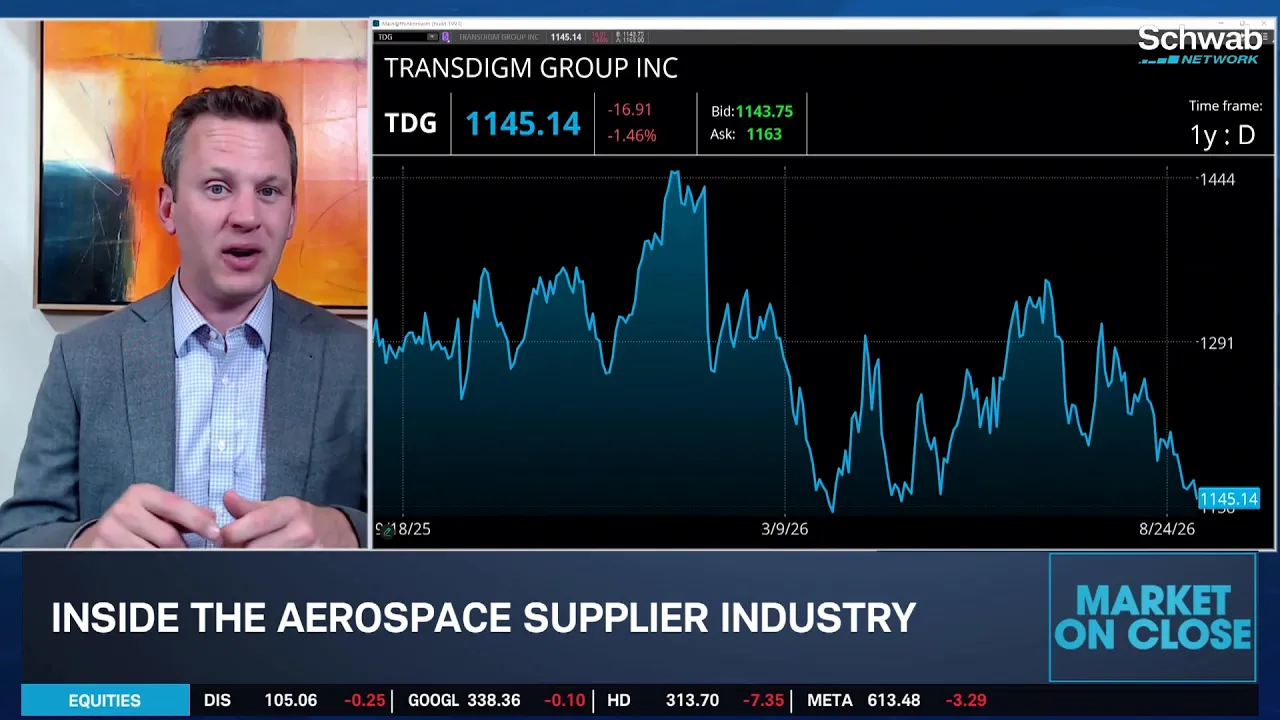
… stock recently, which I think is an important indicator for shareholders. In the past, when Transdigm has bought back their stock, it's been because it's attractively valued and the stock has done very well over the following year or two. We're in one of those periods right now where the company is buying back the stock, and I think it's a compelling buy for investors today. And Jed, the other area I know you like is AI infrastructure. I was just talking to George Tillis about Orion Energy Systems, a small lighting company that's benefiting from the build out right now. So who do you like here in data centers …
We're in one of those periods right now where the company is buying back the stock, and I think it's a compelling buy for investors today.
AI-extracted context
In the past, when Transdigm has bought back their stock, it's been because it's attractively valued and the stock has done very well over the following year or two. We're in one of those periods right now where the company is buying back the stock, and I think it's a compelling buy for investors today. And Jed, the other area I know you like is AI infrastructure.
Full Transcript
back to market on close. I'm Marley Kayden here in our Chicago headquarters to discuss three standout industries in the current environment. Let's welcome in our next guest. Joining us, Jed Ellenbrook, portfolio manager at Argent Capital Management. Jed, great to have you on. Where are you seeing opportunity right now in the market? Hey, great to be with you today. I think one area where there's opportunity are the cloud computing giants. Microsoft, Amazon and Google, I think are all pretty compelling stocks. Those valuations have drifted down over the last year. Investors you know, it seems like we rotate between thinking these companies are AI winners one month. And then you look six months later investor sentiment has turned quite a bit. But all the while these companies are demonstrating accelerating revenue growth. Their valuations are becoming more appealing, as I said, and the margin compression that investors feared related to AI a couple of years ago has not come to pass. Margins are actually going up at Amazon and at Google. And so as we look at these names, I mean, they're developing their own chips. How important is custom silicon to the long term economics of AI for Microsoft, Amazon and Google? Exceptionally important. These companies are handling lots and lots of workloads within their data centers for customers. Some of those workloads are, you know, very, very demanding. And they require the top performing Nvidia chips. Others are more erode or standard and perform very well being, you know, being used through their custom chips, which are a little bit more specialized and a little bit less kind of general purpose oriented and capable. So a mix of both is very, very important for all three companies. And the other benefit of the custom chips is, you know, they're designed in-house. And so they carry a, you know, higher, higher margin profile. And that's one of the key reasons why you see Amazon and Google's margins performing so well. Microsoft's Chip program is earlier in its in its deployment and its maturation process. And we will expect margin improvement to come from that over the next couple of years as they get it more widely deployed. And Jed, one of the interesting points in your thesis is that these companies benefit whether the winning models are open source or closed source. There's been a lot of discussion around this, especially with Nvidia's acquisition of Hugging Face. Explain that to me. Yeah. The, you know, OpenAI and anthropic, obviously two private companies that have the leading closed source models. Investors are very excited about those companies. One of the risk factors is that, you know, open source models, which are far cheaper and easier to customize, kind of encroach on or catch up to the capabilities of closed models. We've seen a little bit of that over the last six months. The most capable OpenAI and anthropic models in the market, you know, the open source models have been kind of closing ground, you would say. But the cloud computing giants Google Amazon Microsoft they generate revenues via usage and consumption on their on their cloud computing platforms, and they charge less, you know, per per task to use an open source model versus closed. But there are lots of additional services like security and database, etc. that go along with the use of open source models. So the profitability of the two is really pretty similar for these big data center operators. So they are very happy to shift customers to the cheaper, more customized open source products. All right, another area you like is aerospace. And I want to walk through this one because it's struggled recently. I mean I'm just looking at the ITA ETF right now down more than 10% over the last month and year to date it's only up 3%. So how are you looking at aerospace here. And what's the market getting wrong. Yeah the market is very focused on number one the war in Iraq and the Iraq. I meant to say Iran, sorry, the impact of oil prices from the war with Iran, and then also the increase in Boeing's production rate. Both of those are risk factors for aerospace aftermarket businesses like Transdigm, GE, Heico, and others. We think those stocks are increasingly attractive. Their valuations have become more appealing as this year has gone on and those stocks have underperformed. They're not underperforming because earnings estimates are going down. They're not underperforming because, you know, their their financial results are weak or because their revenues are declining. The opposite is true. In all of those cases. Investors are just fearful that higher oil prices are going to lead airlines to to cut their flight schedules, which means less demand for aftermarket services the likes these companies provide. And then the other one, Boeing increasing their production rate. More new airplanes means less wear and tear on the old ones, perhaps. I think what investors are missing, though, is that all of the airplanes are being used today. And the new airplanes that Boeing is delivering, that that higher production rate is going to go in service of new routes and new new flight tracks for the various airline companies around the world. So I think that demand for aftermarket services is durable. I think these companies are going to keep growing and growing at an above GDP rate. And they also have pricing power because the aerospace industry, you know, has significant regulations on a part by part basis. And it's pretty difficult for airlines to toggle from one to another. So I think the outlook for these businesses is appealing. I think the valuation has gotten even more attractive. And several of these companies are really allocating capital in a shareholder friendly manner. GE completed or announced a decent sized acquisition today of a key supplier Transdigm has been acquiring over the last couple of years, including in the last few months. And the same is true for Heico as well. And Transdigm is in that that aftermarket business group that you were just highlighting there. What specifically do you like about them, either in their fundamental or technical setup? Yeah. First of all, the business is growing double digits organically. Second, their margin has been increasing lately. So so profits growing even faster than revenue. Third, valuation has come down. The stock has underperformed materially in the last year. And the stock today trades at an attractive valuation. And the company's capital allocation process is very shareholder friendly. If they're unable to find appealing acquisition candidates, they either pay special dividends to shareholders or they buy back the stock. They've actually been buying back the stock recently, which I think is an important indicator for shareholders. In the past, when Transdigm has bought back their stock, it's been because it's attractively valued and the stock has done very well over the following year or two. We're in one of those periods right now where the company is buying back the stock, and I think it's a compelling buy for investors today. And Jed, the other area I know you like is AI infrastructure. I was just talking to George Tillis about Orion Energy Systems, a small lighting company that's benefiting from the build out right now. So who do you like here in data centers and the infrastructure play? Yeah, we think that investing with the most high quality established companies is a good way to go at this point in the AI infrastructure build out. You know, we're in year 3 or 4 of what we think is going to be a long cycle, but there will be ups and downs and digestion periods within this build out. And so companies like Nvidia, Broadcom, Eaton on the electrical equipment side is appealing. You know, I think Applied Materials is another semi cap equipment company that we like too. So there are a bunch of of really outstanding data center CapEx beneficiaries. A lot of those stocks have underperformed over the last couple of months. You know, after the all time rally that we experienced in the second quarter. And I think that we're kind of seeing a bottoming out in that process now. I think the the introduction of OpenAI's Astra model last week has kind of shifted the market's focus. You know, we're kind of back. It feels like we're entering that environment again that we experienced in the second quarter where data center CapEx beneficiary stocks were doing well, and software stocks and other kind of like SaaS, apocalypse fear disruption companies, a lot of the intermediary brokerage companies and commercial real estate and insurance. Thomson Reuters You know, those types of companies that really suffered in the second quarter are again, weakening. And I suspect we'll probably see that continue here for a while as we build up to Anthropic's IPO in a month or two. And Jed, you you said you like the quality names here. So who falls in that category? Yeah. For us that's Nvidia Broadcom Applied Materials Eaton, Amazon Google Microsoft meta a whole bunch of companies a whole a whole bunch of big names there that have had mixed performance today. At least as I'm looking across the board. We've got some red on the screen. But perhaps as you think the trade may be turning higher here. Jed, always appreciate you joining the show. Great to

Comments 0
Sign in to join the discussion.
Sign inNo comments yet. Be the first to share your thoughts!