…m of money, it hasn't changed. The monetary policy hasn't changed. Bitcoin has remained this perfectly scarce permissionless monetary network. Yet the price as of right now has kind of been lagging over the last 5 years from the last peak. So I think you want to buy highquality assets when the market may not necessarily be appreciating those high quality assets. I think Bitcoin is a prime example right now. Um two is this concept of digital credit which Michael Sailor at Strategy has obviously pioneered. We're doing it at Strive. I really do think digital credit and this concept is a really important inflection point for Bitcoin. I think of B…
So I think you want to buy highquality assets when the market may not necessarily be appreciating those high quality assets. I think Bitcoin is a prime example right now.
AI-extracted context
Bitcoin has remained this perfectly scarce permissionless monetary network. Yet the price as of right now has kind of been lagging over the last 5 years from the last peak. So I think you want to buy highquality assets when the market may not necessarily be appreciating those high quality assets. I think Bitcoin is a prime example right now. Um two is this concept of digital credit which Michael Sailor at Strategy has obviously pioneered.
Full Transcript
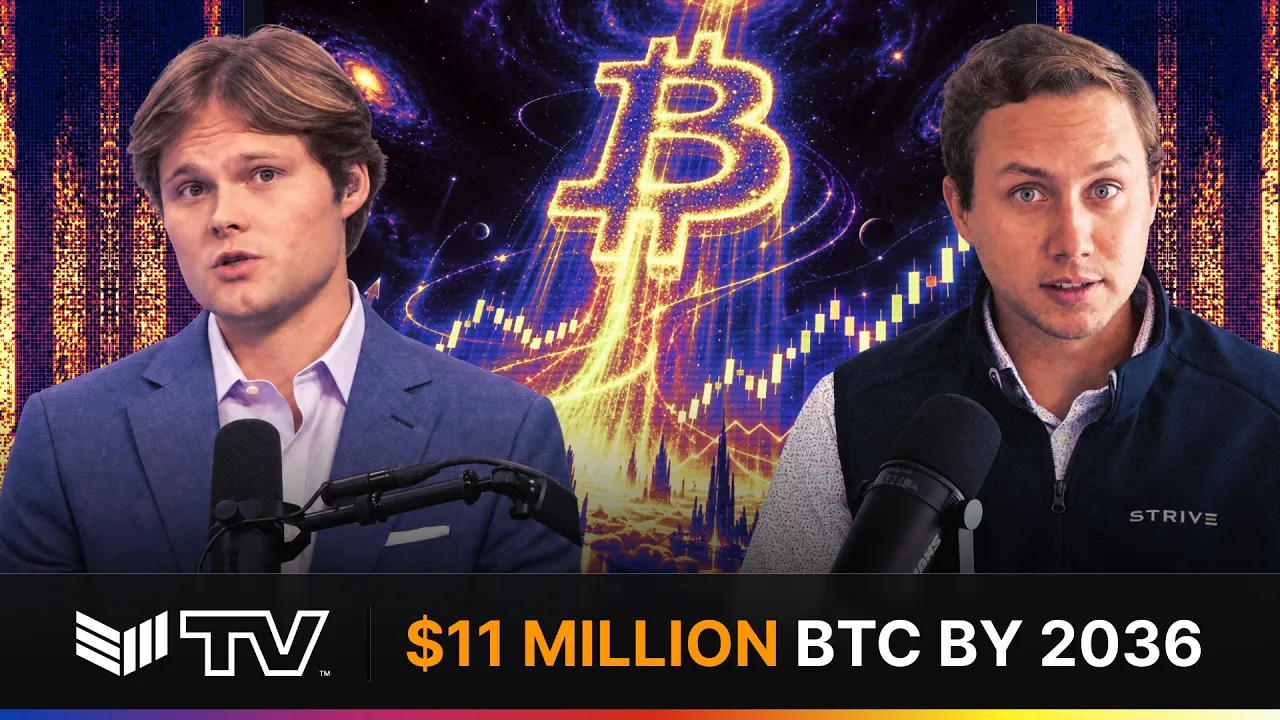
Joining us now on the show is Joe Bernett, VP of Bit Bitcoin strategy at Strive, a longtime Bitcoin bull, who's also written about what happens to money and markets as AI becomes more powerful. So Joe, we'll get into that in just a second, but first, let's talk Bitcoin here. You recently tweeted that you've never been more bullish on Bitcoin. So what's driving that conviction right now? >> Yeah. Hey guys, thanks for having me on the show. You guys have done an incredible job over the last couple days, so this has been quite exciting. But thanks for having me on. Yeah. Why am I so bullish right now on Bitcoin? I think there are three key reasons why now I'm more bullish probably than I ever have been before. One is where we're at in the current Bitcoin cycle. So I think back to 2021, you know, 5 years ago at this point, Bitcoin peaked just shy of $70,000 per Bitcoin. Today we are just north of $70,000 per Bitcoin. Over that time and over Bitcoin's existence, the characteristics of Bitcoin being this better form of money, it hasn't changed. The monetary policy hasn't changed. Bitcoin has remained this perfectly scarce permissionless monetary network. Yet the price as of right now has kind of been lagging over the last 5 years from the last peak. So I think you want to buy highquality assets when the market may not necessarily be appreciating those high quality assets. I think Bitcoin is a prime example right now. Um two is this concept of digital credit which Michael Sailor at Strategy has obviously pioneered. We're doing it at Strive. I really do think digital credit and this concept is a really important inflection point for Bitcoin. I think of Bitcoin as this very long durations savings technology. You know, you need a five 10year time horizon. So, you have to have that low time preference as an individual. You have to be able to tolerate the very extreme short-term volatility that you see in Bitcoin almost on a daily basis. And you have to have the conviction to hold through that volatility during pretty extreme dark bare markets. And not many people even have that long time horizon. And not many people, even if they do have that long time horizon, can grasp that Bitcoin actually is this superior monetary technology because the volatility kind of confuses them and it kind of clouds the signal to some extent. And so I think digital credit kind of creates this new unique product that's obviously powered by these large Bitcoin balance sheets and it pays a relatively high yield. It pays on a fairly regular cadence. At Strive, we pioneer daily dividends and it creates this like new unique product that is actually appealing to a wider range of investors and it doesn't require you to think on a 5 10 year time horizon. And then the third reason that I think, you know, I'm I'm incredibly bullish on Bitcoin right now is the declining volatility. So if you look back, you know, to the 2017 cycle, it started around early to mid 2016. And if you go back and look at historical Bitcoin volatility during that time, it had pretty much reached an all-time low for that time. Bitcoin had gone through a pretty extensive bare market. It was kind of boring. Uh, and that's kind of what's happening right now where Bitcoin has gone through a pretty substantial bare market. You know, we've peaked in October of last year. So, we're almost a year into this and Bitcoin's kind of just been boring and kind of going sideways for much of this year. And I think that declining volatility actually can help attract capital. So for instance, if you go and and look at strategies like digital credit calculator that they have in their website, as Bitcoin's volatility declines, the risk on stretch actually should decline as well. And it actually makes digital credit more attractive. or for people that use their Bitcoin as collateral to borrow dollars against and deploy that capital into something else, it makes it safer to borrow capital against Bitcoin because you're not worried that Bitcoin's going to experience an 80 or 90% draw down. And so I think that those three reasons line up for a possibly pretty explosive Bitcoin bull market over the coming, you know, months to years. Now Joe, you mentioned the preferred perpetual equities and Strive arguably has the best in the game right now. You've kept the engine hot. You've kept it running and you've accumulated quite a bit of Bitcoin during this bare market. That brings me to your position at Strive. You know, your role is the lead of Bitcoin strategy, right? You're the director of Bitcoin strategy. What does that exactly entail? You know, how are you involved day-to-day in shaping decisions and strategy at Strive? and and what do you have to calculate and think about when you look at the market every day? >> Yeah, absolutely. So, I view my role at Strive as doing anything possible to increase Bitcoin per share over time. That can be a wide range of of different things. And so, no single day is the same. Um, you know, a typical day could be something if we're active in capital markets and actively buying Bitcoin. there's some normal day-to-day operations that I help with that that need to to be done. Uh in addition, it can be other capital markets activities that we're exploring uh to ultimately help increase Bitcoin per share. Any sort of Bitcoin native opportunities that we're exploring to help increase Bitcoin per share. And then with all of this, how do we help message what we're doing to our investors and the Bitcoin community broadly as well? Um, so that can be working on investor presentations, uh, speaking at, you know, conferences or events, uh, and doing all sorts of things to try to clearly articulate what we're doing at Strive and why it should be interesting to you if you are interested in Bitcoin or if you've been a Bitcoin skeptic for for quite some time. So, every day is different. Um, but it's it's it's a great company to work at. We're a pretty flat organization, pretty small organization uh as well. So, we don't we don't have too many people on this team. >> So, for investors watching who want Bitcoin exposure, what's your pitch to them? Why should they buy a treasury company instead of just buying Bitcoin itself? What can the treasury model offer that holding the asset directly can't? Yeah, it's a great question and first I think it's important to note that treasury companies whether it's strategy strive or anyone else it doesn't replace cold storage Bitcoin. This is all built on Bitcoin and Bitcoin is what makes all of this possible. I think they're just new unique products that appeal to different investors. So for instance, Strategy and Strive are constantly referred to as amplified Bitcoin. So for instance, we can borrow capital today at 13% by issuing SATA which is our perpetual preferred equity into the market and because we think the Kar of Bitcoin over the next 5 years or so up until 2030 uh is going to be greater than 13% possibly 30 to 50 or even higher over over the coming you know five five years or so uh we're willing to make that trade and therefore the Bitcoin that we acquire at the 13% % cost of capital. If it appreciates more than that 13%, we create create this amplified Bitcoin position that could actually outperform Bitcoin over that time period. Of course, that works both ways. Amplified Bitcoin amplifies the upside and the downside. So again, the short term of Bitcoin is extremely volatile and if you are, you know, worried about where Bitcoin's going to be a month from now, uh, six months from now, we don't necessarily know and no one necessar necessarily knows. And so you have to be able to tolerate the extreme volatility of Bitcoin and amplified Bitcoin the the volatility is a is a whole another level. So that's a you know you have to be able to tolerate that and you have to have that long time horizon. Digital credit which is you know still part of Strive right this concept of perpetual preferred equity. SATA is what we issue pays a 13% annual yield uh and the dividends are paid every business day. And so that's a less volatile uh product that's still powered by a large Bitcoin balance sheet and it's kind of effectively a senior trunch of Bitcoin. So if you don't want that extreme volatility of Bitcoin and you want some regular income, then digital credit is kind of the new product that kind of appears appeals to this uh segment of investors. Now Joe, a little while a couple months I believe it was, you put out an article I found really interesting uh about the singularity and everyone is familiar with the singularity and and you know the moment that machines become smarter than humans. Um and you know everyone kind of has general ideas of how that might change the world but you have interesting ideas on on what that means for Bitcoin. Could you walk us through that idea a little bit? >> Yeah, absolutely. So this is an article that I have pinned to the the top of my ex profile. Uh it's an interesting concept. So like the general thesis is that intelligence is an input cost to virtually everything whether that's basic goods and services or even our financial assets and savings technologies that we use today like gold, real estate, equities or or fixed income. And the general idea is intelligence is becoming cheaper and cheaper. And therefore, intelligence can possibly make us dramatically more productive and more efficient as a society when it comes to producing oil or these basic goods and services. And that increased efficiency could actually make the real cost of producing oil and basic goods and services significantly cheaper than it historically has been at least in real terms. Of course, in dollar terms it might keep going up because that's how the system is designed and how it works. But in real terms, perhaps measured in a perfectly scarce form of money, maybe all of these basic goods and services could become cheaper over time. But I don't think that that necessarily stops there. I think that the same concept actually applies to our store values that we use today. For instance, intelligence, if it becomes abundant and clear, could make it easier and more efficient to mine more gold that we haven't been able to mine before. Maybe it's gold near the bottom of the ocean. Maybe it's gold in certain parts of the earth that we've not been able to reach due to certain limit technological limitations or whatever else. And then on top of that, you have real estate, right? Um you you may have seen videos of people 3D printing houses. Uh and of course to build a house, you have input costs which are can be wood and a bunch of other uh raw materials. If intelligence makes it easier to build these raw material or to to find and source these raw materials and then to ultimately put them all together to build a house or an apartment building or an office building or whatnot, well, that could lower the cost of production to actually build real estate. And if the price of real estate is very high relative to the cost of production, then this could be something that kind of weighs on the price of real estate. And so when you take all of that context together and you put Bitcoin as this new perfectly scarce form of money next to it, you can kind of see that, okay, well, if intelligence is becoming cheaper and cheaper and more abundant, and we're able to create an abundance of all of these things, Bitcoin is the one unique monetary tool that no matter how much time, energy, or resources are poured into creating more Bitcoin, we're never going to be able to mine more than 21 million. Bitcoin. And I think that's a really big idea as we head into this world of abundance that it seems to be clear that we're certainly trending towards Bitcoin being the kind of opposite of abundance, the scarcity new tool that can help us measure what's actually being produced out in the world. And Bitcoin could be the one good long remaining store of value. >> And what about on our way there, right? I mean, obviously Bitcoin probably won't just teleport there, you know. How do you think Bitcoin will be traded and kind of interpreted by the markets um while we're still in this kind of capex buildout cycle of AI and the innovation on that side? >> Yeah, it's a great question. I mean, arguably, you know, people have been arguing that this AI capex cycle has kind of attracted liquidity away from Bitcoin. And I think that that's possibly somewhat true, right? Uh, Bitcoin kind of did decouple from NASDAQ towards the end of 2025 and early 2026 and not in in the way that many Bitcoiners would have uh preferred, of course, as Bitcoin went down and and tech and AI and Nvidia continued to to do quite well. Um, but I don't think that that's going to last forever. I think the same concept will ultimately apply to companies as well. So I think of Nvidia being this $5 trillion company. Effectively, that's a massive economic bounty on how can you design and create GPUs more efficiently than Nvidia. Uh and so no company lasts forever. I actually I was earlier I was listening to Mark Yusco on your call where he actually talked about um certain companies if you look over the next 30 years 80% of companies in a particular index may not even exist anymore. They may have gone bankrupt or gotten acquired or whatnot. And so there's constant turnover and storing value in AI companies. And so this AI capex, you know, cycle that we've kind of seen, it can work for some time, but it's kind of irresponsible to think that it will work forever. And once it stops working and capital kind of wants something else and realizes that the profits aren't necessarily going to be as good as the the market thought it was or the profits aren't going to last as long as the market thought it would, then the market is going to search for somewhere else to store that capital. And if there isn't a very obvious next investment capex buildout, then I suspect that a lot of that capital could just flow straight into Bitcoin. Joe, I think of all the Bitcoin forecasts I've seen, yours might be the most aggressive. You're calling for $11 million per Bitcoin by 2036. How do we get there? >> Yeah, it's a great question. So, with that analysis, I looked at total global wealth today and I looked at what total global wealth could be 10 years from now. So, right now, total global wealth can be about$1 quadrillion dollars or $1,000 trillion. If you assume that total global wealth continues growing at around 7% per year, which is perfectly in line with historical precedent, then that would mean by 2036, total global wealth would be around two quadrillion dollars or $2,000 trillion. Right now, Bitcoin is a tiny tiny portion of global wealth. Today, Bitcoin's, you know, $1.5 trillion asset. I think because of the dynamics that I've outlined earlier and how AI is creating abundance of wealth and prosperity and uh even an abundance of the things that we're using to store our wealth today. Bitcoin is this new possibly incredibly superior savings technology that now exists. And I think that it's not completely unreasonable for Bitcoin to maybe inch toward a 10 or 12% share of total global wealth by 2036. So that would be around a 200 to$220 trillion Bitcoin market cap, which would have be which would be around the the 1 million or so per Bitcoin. And I don't think that that necessarily requires a collapse in the US dollar or any sort of extreme circumstances per se. I would still expect real estate to be worth more than Bitcoin in that case. Would still expect US equities to be worth more than Bitcoin in that case and possibly even gold. Uh it could be about maybe around the same as Bitcoin in that case or maybe Bitcoin would have just surpassed gold. But that's really not requiring that much change in the world today for Bitcoin to become that large. And I think part of why that's kind of interesting is that Bitcoin is still so early today in 2026. I mean, this is a tiny little asset class. We're on the verge of this huge AI productivity explosion, and I think Bitcoin is primed for potentially pretty good decade. >> Now, Joe, let's wrap bringing it back into the short uh short term here. We know your long-term predictions and and your thoughts about the future. very short term. We have the FOMC meeting today with a rates announcement. As a as a analyst, as a strategist, what are you looking for heading into this meeting? What's your expectations and and what do you think the potential impact will be on the markets and and what kind of reaction are you looking for? >> Yeah, I mean it's going to be interesting to see what happens. Of course, it seems like markets at this point are projecting a rate hike. I mean from looking less at the shorter end of the curve and more of the longer duration 10 year you know past 5% I think this morning it was slightly lower than 4%. It seems like we're obviously in a very tricky situation for the US government where effectively they can kind of let rates continue to rise is maybe where they should be. But of course, we have Secretary of Treasury Scott Bessant, you know, working on buying back uh uh treasuries to kind of slowly potentially accelerate the devaluation of the dollar. And so yeah, I mean I think at this point I I kind of align with like Lyn Alden's perspective of this train has no breaks. The Fed can raise rates, the Fed can lower rates, but I think at the end of the day that the the US debt is so high relative to GDP and that the US deficit is so high relative to GDP as well that this is mainly a fiscally dominant economy where it's more of what the federal government is doing that's driving inflation rather than the Federal Reserve moving around interest rates on the shorter end of the curve. So, I think that it's it's interesting, but ultimately I don't think it necessarily matters that much. The thesis for Bitcoin doesn't change whether they hike rates, they lower rates, or they keep rates the same. The dollar is designed to debase for ever by design. Uh, and Bitcoin's there by design to to not be debased. >> Joe Bernett, Bitcoin strategy lead at Strive. Thanks so much. Really great stuff from you today. Thank you

Comments 0
Sign in to join the discussion.
Sign inNo comments yet. Be the first to share your thoughts!