…t is growth capex. Growth capex allows a company to increase its economic mode, its revenue, its income, and its cash flow in the future. So people who are short-term minded, oh my god, they're spending so much money. Sell, get out. Right? But if you're long-term minded like me, we see it as an opportunity to take advantage of the short-term volatility to accumulate these businesses to generate significant more profits in the future. So, let me give you an analogy. So, let's imagine there's a guy who, let's say, he earns a salary of um $5,000 a month. So, that's his cash inflow. And let's say he has to spend on stuff, his um monthly expenses, and he spends, let's say, …
But if you're long-term minded like me, we see it as an opportunity to take advantage of the short-term volatility to accumulate these businesses to generate significant more profits in the future.
AI-extracted context
So people who are short-term minded, oh my god, they're spending so much money. Sell, get out. Right? But if you're long-term minded like me, we see it as an opportunity to take advantage of the short-term volatility to accumulate these businesses to generate significant more profits in the future. So, let me give you an analogy. So, let's imagine there's a guy who, let's say, he earns a salary of um $5,000 a month.
Full Transcript
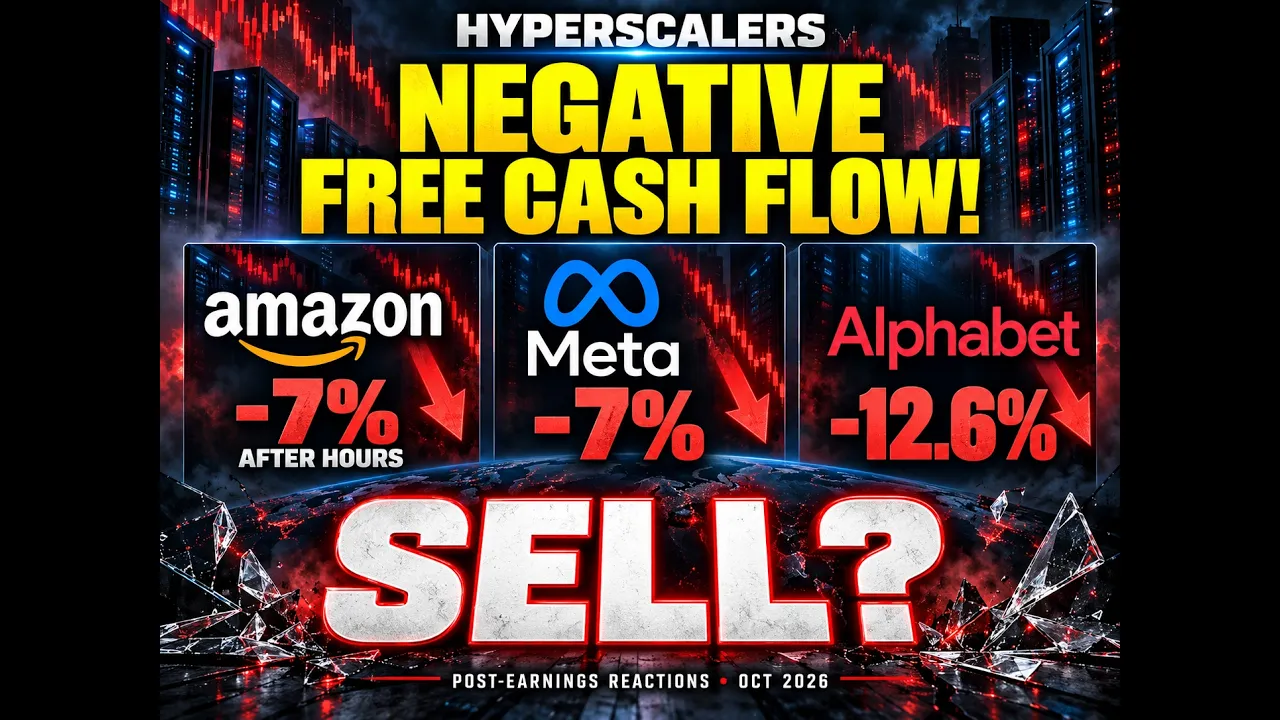
In the most recent earnings report, hyperscalers like your Amazon, your Meta Platforms, and your Alphabet or Google reported negative free cash flow. And some investors are freaking out and say, "Oh my god, they're going to die and selling them off." So, what should we do as intelligent investors? How do we value these companies? And are they still worth investing in? Let's find out more in this video. We are currently in the middle of the quarter three earning season and so far it hasn't been kind to many of the hyperscalers that I own. So for example, Alphabet that owns Google and YouTube down 13% after it reported earnings. Meta Platforms that reported a few days ago down 7% after earnings. Uh in fact it was down 12% and then it rebounded but it's still down 7%. and Amazon down 7.8% uh yesterday after earnings. So why are they all selling off? Well, there are many reasons which I'm going to cover in this video, but the main reason that's freaking investors out is that their free cash flow is negative as you can see over here. So what does that mean? So free cash flow basically means how much cash they are generating from their business called cash from operations minus the capital expenditure capex what's left that's the free cash flow. So ordinarily we want a great business to have positive free cash flow that's growing right but the free cash flow is negative. So is it something to be worried about? Well the answer to me is no and I'll explain why in a short while. But let's look at what's great about these companies. Number one topline growth. I look at revenue growth and it's growing very well. You can see uh Alphabet, Google up 25%, revenue growth, man up 26%, Amazon X, foreign exchange uh changes is up 13%. Next operating income growth. So I like to look at operating income uh not net income because net income can be distorted by nonoperating expenses and income like for example mergers, acquisitions and so and so forth. I like to look at operating income, right? So operating income also doing very well. Google uh growing 30%. Now you may see hey mad matter is down 37%. Why that is a oneoff issue because they paid a big well not big actually a small fine to settle their uh social media addiction lawsuit if you recall. Right? So if you remove that they actually grew 11% in terms of operating income. Amazon growing 61% in terms of operating income. Now what's more important is the operating cash flow growth. So you can see Google's operating cash flow grew at 19% uh year on year uh sorry last 12 months. Meta grew 24% last 12 months. Amazon grew 29% last 12 months. In terms of quarter three year Meta is up 9% Amazon up 19%. So, some people are concerned that hey, Google's operating cash flow in quarter 3 is down 13%. Again, I'm not concerned because this negative number came for for from two one-off reasons. Number one, because of the EU fine. You know, the these these companies get get fined all the time, right? So they they paid the fine in quarter three and their cash from operations turned negative for this quarter because of inventory buildup before their TPU sales. Now what's TPU? As you guys know, Amazon and Google are now selling semiconductors. In a way, they're competing with Nvidia, right? So Google's AI chips they're selling are called TPUs. Now before they sell the TPU uh they have to put it in their inventory and inventory causes a negative to the cash flow because cash is stuck in the inventory later when they sell it to the customers the cash will come in in 2027. So because of this inventory buildup and the EU fine, it caused their operating cash flow to go negative for this quarter. And it's something I'm totally not concerned about because it's not that the business is not doing well. Business is doing very well because of inventory timing and that stupid fine it turned negative. Now let me talk about the main concern that investors have which is the free cash flow turn negative. Now why am I not concerned at all? Let me explain it with uh some drawings. So first of all free cash flow is equal to the operating cash flow operating cash flow minus capital expenditure. Right? So this is the formula for free cash flow. Now when a free cash flow turns negative there are two reasons why. If free cash turns negative because the operating cash flow is declining that is bad. That's a bad thing. So those are companies where they're generating less and less cash for their businesses. We don't want to invest in them. We want to get out of them. Right? However, in the case of Amazon and Meta and Microsoft and Google, their operating cash flow is growing very well. So they're generating more cash from their business, right? So this is going up. But why is their free cash flow going down is because their capex has gone up recently. Why has their capex gone up? Because they're investing billions and billions building these data centers to solidify their leadership in the AI revolution. So because this has gone up, it caused this to go down temporarily. Now is it a good or bad thing for a company to invest a lot in capex? It depends. There are two kinds of capex. The first is called maintenance capex and the second is what we call growth capex. So if a company has to spend more and more on maintenance capex like for example an airline business they have to spend a lot of money to repair the airplanes to replace the old airplanes with new airplanes. That's called maintenance capex that sucks up the cash flow. That is bad. That's why I don't invest in airlines because they keep spending so much money just to maintain their current business. But if a company spends on growth capex, which means they invest in data centers or they invest in new factories, new markets, that's a good thing because growth capex will cause what? Will cause their operating cash flow to increase even more in the future and that will cause the free cash flow to increase even more in the future. So in the case of the hyperscalers, it is not maintenance capex. It is growth capex. Growth capex allows a company to increase its economic mode, its revenue, its income, and its cash flow in the future. So people who are short-term minded, oh my god, they're spending so much money. Sell, get out. Right? But if you're long-term minded like me, we see it as an opportunity to take advantage of the short-term volatility to accumulate these businesses to generate significant more profits in the future. So, let me give you an analogy. So, let's imagine there's a guy who, let's say, he earns a salary of um $5,000 a month. So, that's his cash inflow. And let's say he has to spend on stuff, his um monthly expenses, and he spends, let's say, $4,000 on transportation, on food, on entertainment. So, he's able to save $1,000 a month. What is this? This is in a way his free cash flow. Now, imagine this guy is very ambitious. He said, "I'm not happy earning 5,000 a month. I want to eventually earn 10,000, 20,000, 100,000, you know, a million a month. What would he do? He would have to invest in himself. He would have to uh spend on capex, right? So, he'll take lots of courses. He'll he'll take an investing course to learn to invest and to trade options, for example. He would uh take a leadership course. He'll take an AI course. He may get a a master's degree, whatever it is, right? So, he spends all this money upgrading himself. That's called capex. So, let's imagine that he spends uh you know $2,000 on himself upgrading every month. And to uh finance it, he takes some loans from the bank to in order to finance all these causes. What happens to his free cash flow? His free cash flow will now become uh minus $1,000. And you may say, "Oh my god, he's now losing $1,000 a month." Right? So again, question is, is this a good thing or bad thing? It depends on how you see it. If you're his girlfriend and you say, "Oh, he can't spend his money on me anymore. He can't bring me to nice places. He's a broke mother, right? I'm going to leave him." Right? So you leave the guy and find a guy who can spend on you and you miss out on his future gains or his future increase in income. But then he gets a new girlfriend who understands that he's investing in himself and in the future he makes what? you know, a million dollars a year, $10 million a year, uh, and then she would, the second girlfriend would benefit from it. Now, of course, if you're a lady listening to this, switch it around, okay? Turn around the the genders. Okay? Now, this is what happened to me. So, when I was younger, my girlfriends were complaining, oh, I don't spend enough time with them. I don't spend so much money on them because I was investing myself. I took lots of courses on NLP, on investing. I read lots of books. I spend more money on books and courses that I than I did on my earlier girlfriends. And they left me. They call me a broke mother, right? But today I make what? Six, seven million a year. And who benefits? My wife because she's an intelligent investor. Now, of course, the negative free cash flow is not the only concern that cause investors to sell off these hyperscalers. There are few other concerns that I'd like to address right now. Now remember, when you own a a stock, a business, and the share price falls because certain fundamentals have declined, the question you got to ask is, is the decline cyclical? Is it a short-term temporary issue or is it a long-term structural issue that will persist? So, if it's a temporary cyclical issue, then no need to panic. Hold the shares and in fact buy more at a bigger discount. But if it's a long-term structural issue which means the economic mode is deteriorating then that's a reason to sell the stock. Okay. So that's an important question cyclical or structural. So let's look at what are the concerns and fears. So let's start with Alphabet or Google. So there are again some other concerns. First concern was that earnings per share fell 26% and missed the analyst estimates. So what happened? Was it temporary or something that's affecting the long-term business performance? Right? And the answer it is totally a one-off temporary issue. The reason their earnings per share fell is because of unrealized marktomarket loss on Google's investment in Space X. If you exclude that, their operating income actually rose 30%. Okay, so that's not a concern. Number two, their operating cash flow fell 13% for the quarter. I already explained it earlier on because of the EU fine and because of the inventory buildup of their TPU AI chips before they sell them and the cash comes in. Again, this is a one-off cyclical issue. No concern at all. Now the third issue is that their search as you know Google uh traditionally they make money on search advertising when you search for things online and you get all those um search results and you click on the sponsored links that's how Google makes money right so their search growth was initially growing at 17%. And in this quarter they reported 12%. And so there's a deceleration in their search growth and people are freaking out say, "Oh my god, that means that their search business is dying, is being cannibalized by their AI results, which are not being monetized as well. And that's why, oh my god, you're going to die. They're going to get killed and selling them off." Right? So here's the fact. The fact is that before AI started their search growth was actually between minus2% on certain quarters to 13% on certain quarters. That's the range before AI started. All right. Now, when AI began and Google launched their AI overviews and their AI mode, which we all use today, their search growth grew from minus2 to 13% range, grew to 17% in quarter 4 last year, 19% in quarter 1 this year, and 17% in quarter two this year. And quarter 3, it slowed back to 12%. Now, is that a bad thing? No. Because at 12% it is still at the upper range of where it was before AI started. Okay? So, the selloff doesn't make any sense. And the reason why their search growth decelerated uh to 12% this quarter, there are three reasons. The main reason is because of the the rebound in the US dollar causing them to earn less when they convert euros and pounds back to US dollar. So it was an FX uh short-term issue, right? The second issue is because some of the AP pack retail advertisers pulled back after the EU scrapped their import exemption and media spend normalized after an unusually strong June loaded with World Cup matches. The third reason, which is the smallest reason, is because AI mode queries are growing fast and currently monetizes at a lower rate than classical search results. So, it's a monetization lag. And it's the same thing that happened when Google shifted from uh desktop to mobile many years ago. So, if you really scrutinize all these issues, you can see that there are no signs of a declining business. The business is growing, doing very well. revenue up 25% their 13th straight quarter of double digit growth Google cloud up 103% where their margins are up 23% to 36% and their search at 12% growth is the highest in 5 years so uh is it a dying business is it a declining business well you make your decision to me nope there's nothing wrong with this business at all now next question is what are the shares worth the intrinsic value let me show you how I calculate the intrinsic value of uh Google and then later Meta and then Amazon. Okay. So before I show you the intrinsic value calculation, let me show you once again uh the uh operating cash flow and the free cash flow. So over here you can see that for Google or Alphabet what's happening revenue is growing very very nicely, right? So that's revenue. Operating income growing very very nicely as well. And operating cash flow in orange is growing very nicely as well. The thing that has dropped is the free cash flow. Can you see the free cash flow over here? Let me use a different color. Yep. So the one in dark black, you can see that is growing and then it dropped here. So this is freaking people out. the drop in the um in the free cash flow. So like I explained the reason the free cash flow drop is not because the operating cash flow drop. Operating cash doing very well is because the capital expenditure has gone up significantly because of growth capex. Okay. Now how do we calculate the intrinsic value of of this stock? So normally to calculate intrinsic value we have to project the current free cash flow over the next 20 years and then we discount it to present value. Right? But if you do that with the current free cash flow you get a very low number because the current free cash flow is artificially depressed by the high capex. So to calculate a fair intrinsic value, what must we do? We cannot use the latest free cash flow. We has we have to use what is called a normalized free cash flow. So let me explain what that means and you can actually do this yourself once you understand this. Uh so let me just show you the numbers here. Let's go to the cash flow statement. Okay, there we are. So over here you can see that this is the operating cash flow. And you can see it's been growing, growing growing growing growing growing. Right? And the capex capital expenditure here, you can see it has been growing as well. Okay? So if you take the operating cash flow, this minus this, you will get the free cash flow which is now very low because of the high capex. So to calculate the normalized free cash flow, what I do is this. I take the latest cash from operations which is this one. This is the cash flow from operations. I take this and I minus the average capex of the last 5 years. So 1 2 3 4 5. This is the last 5 years right? 31 billion 32 billion 52 billion 91 billion and 132 billion. So I take these five numbers add it together divide by five to get the average capex of the last 5 years. So when I take the current cash from operations minus the 5year average I get the normalized free cash flow. So this is the number that I use to value the business. Now I've already done the calculation and uh what's the answer? The answer is the normalized free cash flow. The normalized free cash flow is for Google is 117 651 million or $17 billion. So we will use this in the intrinsic value calculator. So to do that, let me show you where it is. Go to the intrinsic value calculator here. And again, you can see if you scroll down and we're going to use free cash flow. Oops, not this one. Free cash flow. You can see that if you project the latest free cash flow which is artificially low, you get a very low intrinsic value which is unrealistic. Right? We need to normalize the free cash flow. So we will put in the normalized free cash flow which is 117 651. This will be more realistic. Okay. And you can see the growth rate that is used to project the business is based on the consensus analyst estimates provided by facts which is 18% growth the next 5 years and then long-term 16% growth over here. Now you can take those numbers but for me uh I'm usually more conservative where in growth year 6 to 10 I do not take anything more than 15%. I will cap it at 15%. So, I'm going to cap it at 15% here. And then I'm going to calculate based on this normalized free cash flow and this lower growth rate. Calculate. Tada. What do I get? I get an intrinsic value of about $370. There you go. Now, if this is too much work for you, you say, I just want a shortcut. Very simple. You can just look at the oracle value that comes up with a very similar number by normalizing the free cash flow and adjusting the growth rates which is over here. There we are there. So the oracle value is 377 which is oh roughly about 370 roughly about there and at current share price of 283 it is about 24% undervalued. So great company undervalued. Does it mean that the share price will go up tomorrow? The moment Adam announces this, the price will go up to 370 and beyond. Of course not. All right. So, this tells you what the shares are worth. It doesn't mean the price will get there tomorrow. The price can still go lower because in the short term, the price is driven by not logic, not fundamentals, but driven by emotions and manipulation and all kinds of things that happen in the market. But what it does tell me is that in the long run, uh, Google will continue growing and growing and growing and it's worth 370, which means it's going to go back to 370 and higher over time. When that will happen, I've got no idea. Could be next week, could be next month, could be next year, I don't know, right? But in the short term, the price is going down because of manipulation and fear. And of course, it could go lower. All right? So that's why what's important is to identify support levels. If you look at a chart of Google here, you can notice I've identified these are the um these are the uh technical support levels. And recently you can see the price uh you know wave up, wave down, wave up, wave down, wave up, wave down, wave up, wave down, wave up, wave down, wave up, wave down. So is currently approaching this support level over here. 274 is a strong support. So if it hits here, this could be a level to add shares because a support level basically means that historically uh there has been more demand than supply to reverse the price up at this support level. So it could bounce back up here. But if it breaks this support, then of course you have another very strong support at 243. Okay? And that's why when I add shares, I never go all in at one level because you can never pick the absolute bottom, but I add in trenches. I add slowly in trenches over time. I dollar cost average in until I've got a full position and then I don't add anymore. Let's very quickly look at the other two stocks, the other two hyperscalers, right? So, Meta. So, Meta dropped as well, dropped 12% but has since rebounded, but is down 7% from earnings. Again, what's the fear? Uh again, besides the negative free cash flow, which I've addressed, the other fear is that operating income fell 37% and they missed their earnings per share uh guidance, if you will, right? But why? Why did it happen? Okay, it's because of their uh lawsuit settlement. They were sued for the uh teen mental health uh addiction trial if you guys recall and they were supposed to be fined like a billion dollars but in the end they paid a small amount a small slap on the wrist of uh about 9.89 billion charge. So if you take that away then their operating income actually went up 11%. So again is this cyclical or is it structural? It's cyclical. It's a one-off thing that will not recur. Okay. The other concern is that Meta is raising money by selling shares. So people think, "Oh my god, this going to dilute my shares." So they panic and they sell. Okay. Now, why are they raising money? Again, to finance their capex growth. So they're financing it using debt and some equity. So how much are they raising? They are raising 37.5 billion in equity. So when a company sells shares to raise money, does it dilute the shareholders? It does. But the question is, how much does it dilute it by? And number two, in the long run, will this capital grow the pie even more? The answer is I think it'll grow the pie even more. So I'm not too concerned. But the actual dilution, if you do the mathematics, is a 2.4% share dilution of current shareholders. So logically the share price should drop 2.4%. Right? But it dropped 12%. All right? So the market tends to overreact to bad news. And so if you take advantage of the overreaction, that's how you get good deals in the market. All right? If you look at the underlying business, you can see it's doing very well. Just like Alphabet, revenue up 26%, third straight quarter uh above 25%, ad revenue grow at 25%. And they're guiding their quarter 4 revenue at 73 to 76 billion. Ad impressions grew 10%, price per ad grew 14%, which is a sign of very strong pricing power and a very strong economic mode. And the daily active people, which means 3.64 64 billion people use Facebook, Instagram or WhatsApp daily, up 3%. So again, is it a dying business? Is it a declining business? You make your decision. To me, it's a business that's getting stronger and more and more dominant, especially now that they've launched their recent Muse AI agent that has become very, very popular. The number one downloaded app in the US and now just came to Singapore and playing with it now. So again, you can calculate the intrinsic value by doing the same thing I showed you earlier on. Uh calculating the normalized free cash flow, taking the current cash from operations minus the 5year average capex, that should give you a normalized free cash flow of of $79 billion. So, if you put in $79 billion into the intrinsic value calculator and you project it at the uh growth rates, you get roughly about $1,000 to about $1,200 intrinsic value. That's right. But you can see that the oracle value actually is more conservative and shows a valuation of $900. So, this is actually very very conservative using a much lower growth rate than what people are using. And even at the very conservative valuation, uh, goo, sorry, not Google, Meta is 31% undervalued. Again, like I said, does it mean that Meta will shoot to $900 and $1,000 tomorrow? Of course not. Right? Short-term, it can still go lower. You can never predict the shortterm, but long run, you know, it's going to keep growing and growing, growing, and it's worth at least 900 to$1,000 plus dollars, right? And if you look at the chart again, you can see it's been chopping around over here. Very strong support at the 150 green line 150 on the weekly time frame. Right? So you can see a wave up, bounce, bounce, bounce. It looks like it could be bouncing here, but if not, it could bounce here and then likely it's going to go back higher by the end of the year. I can't predict 100%. But that's just my guess. Finally, let's take a look at Amazon. Again, besides the negative free cash flow, which I've explained earlier on, the other two fears people have about Amazon that caused a sell-off was that their earnings per share fell year on year and their revenue mis expectations and their ad revenue slowed to 12%. So again, what actually happened? Is it a cyclical issue or a structural long-term issue that is affecting the business economic mode? First, the reason the earnings per share fell uh from last year to this year is because last year 2025 quarter 3, the profit was unusually artificially propped up by a 9% sorry a $9 billion gain on Amazon stake in Anthropic, which you know owns Claude, which is going IPO this year. So last year there was a one-time gain of $9 billion. This year there's no gain. So it caused that drop. Again, if you take that out of the equation, this year, Amazon's operating income is actually up 61%. So, it was distorted because of their stake in anthropic. So, again, it's a one-time issue that is not nothing to do with the actual business of Amazon. Okay. Second, why did their revenue miss expectations? Because their Prime Day, which they sell the most, uh move from quarter 3 this year uh to quarter two. And if you don't include this shift, their growth would have been 4% higher in fact. And there was also an FX cost of.9 billion because of the stronger US dollar in the last 3 months. So again, is it a cyclical issue? Yes, it's a timing issue and their forward guidance already shows a strong rebound in revenue and earnings per share. uh if you look at the underlying business metrics they are Amazon web services grew 39% the fastest in 5 years and management is guiding over 40% growth in 2027 and 2028 the backlog is growing their operating income up 61% operating margin 13.9% the highest in Amazon's history and for quarter 4 they are guiding sales growth of 12 to 16% and operating income of 28.5 to 33.5 billion which is much higher than what was expected. So again to me this is not a declining business. It's in fact a business that's getting even more profitable and even more dominant. Now if you calculate Amazon's intrinsic value and again I've shown you how to do it. Uh it is about $233 intrinsic value. There we are. Oracle value 233 exactly uh over here as you can see. So um it announced yesterday. So the market is pricing in a 6.8% drop today. Uh whether it will drop I don't know but if it drops to 226 uh that will be at the first support level. You can see there a pretty strong support level 226 and that would make it slightly undervalued. All right you can see again um you know wave up wave down wave up wave down wave up wave down. These are small waves and wave up big wave down wave up wave down wave up wave down wave up big wave down wave up wave down. You can see these waves are very very uh predictable right? So wave up wave down. So if you ask me to guess it would probably uh wave down to the first support level and bounce all the way back up again. You know I can't 100% predict but I'm just guessing that this will be a pretty strong support before the year end rally. Remember, we are currently in phase one of the AI revolution. We're going we are going to go into phase two next year and subsequently phase three. I'll talk a lot more about this during the Black Market X event coming up in November. But to give you a bit of an idea what I'll be talking about of the many things I'll talk about is in phase one, the enablers are the ones that are going to have the highest profit. So enablers are like your AMD, your Nvidia, uh in other words, your semiconductors and AI power producers. They will capture most of the profits. But in phase one, it is the hyperscalers that are spending on capex that will be squeezed by lower free cash flow, squeezed by depreciation. But in phase two once the capex growth decelerates which means the hyperscalers spend less on capex you will see that the semiconductors and the AI power producers they may decelerate from there but then the hyperscala cloud and AI revenue will compound on a bigger installed base and then finally in phase three which is 2029 beyond you find that the companies in healthcare consumer discretion professionary and industrials which are called the adopters will have the highest margin expansion. So it's all about knowing how to position your portfolio to capture the highest value in all three phases. I'll go into greater detail in the upcoming live Black Market X webinars in November and I look forward to seeing you there. We'll give you more details in a while how you can enroll in these live webinars called Black Market X. So, with that, thank you for listening to this pretty long webinar. I hope it's been useful and as always, may the markets be with you and let's get ready for the year end rally. If you want to catch my latest videos, click on the subscribe button right now. Click on the bell so you get instant notifications once I upload my latest video. If you want to check out my online courses, go on to piranhaprofits.com where you're going to learn how to invest and how to trade the financial markets and create an income from all around the world. If you want to join my live Wealth Academy program, go on to wealthacademy global.com and find out more about how you can learn investing and trading live online. This is Adam Coup and may the markets be with

Comments 0
Sign in to join the discussion.
Sign inNo comments yet. Be the first to share your thoughts!