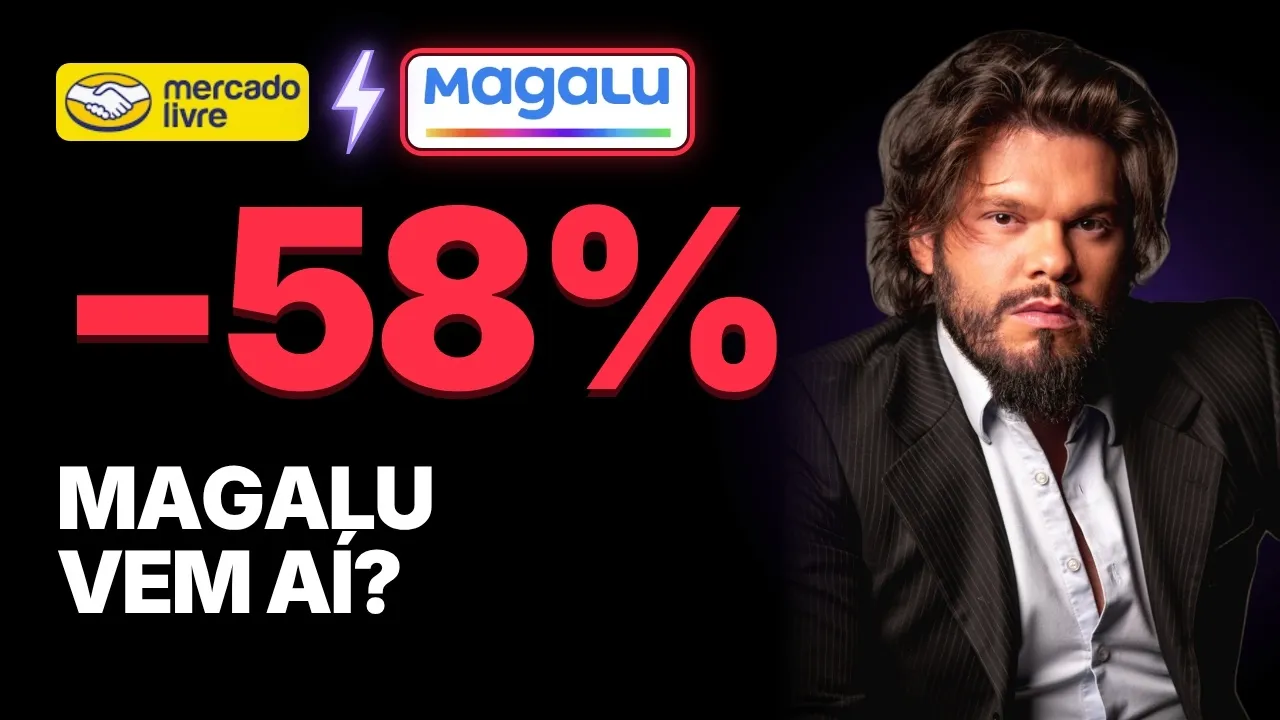
MERCADO LIVRE é a nova MAGALU? 🎢 Caiu 12% no balanço, mas cresce 45%

- Video return
- -8.14%
- Calls
- 1
- Buy / Sell
- 1 0
- Published
Recommendations
Entry is the asset's closing price on the publication date. Current is the last close on record.
-
Entry $1,475.09 12 Nov 2026Current $1,355.00 20 Nov 2026Result −$120.09vs. index +0.7% SPY −8.9% over the same days
Cite this call Watch source segment (445s) *
Surrounding source transcript
… R $ 0.20 per share in 2025 to R $ 0.70 per share in 2027. On the other hand, Mercado Livre is expensive, but it’s expensive because it grows 45%a year. And round six is the Inside view, so what do our analysts say regarding Mercado Livre? We have a buy recommendation and a 37.5 %upside potential, while Magalu has a downside, actually a neutral recommendation, and a 21.2%downside. The fair price for Magalu would be R $ 6.00 and the stock is currently above the ceiling price of 5.40. So on one hand, you have Mercado Livre below its …
We have a buy recommendation and a 37.5 %upside potential
AI-extracted context And round six is the Inside view, so what do our analysts say regarding Mercado Livre? We have a buy recommendation and a 37.5 %upside potential, while Magalu has a downside, actually a neutral recommendation, and a 21.2%downside. The fair price for Magalu would be R $ 6.00 and the stock is currently above the ceiling price of 5.40.
Full Transcript
What’s up, you retail-loving rocket riders. How are you doing? Man, I'm back on the channel here. I'm putting out videos every single day, so check if you're subscribed. Go check it out, because YouTube isn't delivering my videos. See if you're still subscribed, and click that bell icon. Besides activating the notifications, click on "all," because every time companies release their results, I'll be here with Inside's recommendation and explaining a bit more about the companies. And today we're going to talk about Magalu, which surprised everyone in the last two days, going up more than 30%, and I almost spilled the beans, because if you asked me about Magalu a while ago , I’d say, oh, you want to know which is the new Magalu? Because now I don't use bad language anymore, since I'm a little lamb of Jehovah and I also don't want to get canceled by YouTube again. So I decided to set up a clash here between these two giant retailers, namely Mercado Livre, or MELI34, and Magalu. Remembering that we are in Black Friday , we have the Black of all Blacks, 90% off. Let my team take care of your portfolios. And let's film the screen for this picturesque duel. So, what happened? On the day Mercado Livre released its earnings, look, it dropped 12%the next day. And Magalu in the last two days went up 30%. When you see one thing turning green and another turning red, what impression does it give? That the one turning green is getting good or less bad, and vice versa. But we have to try to bring everything to the same base to compare, because Mercado Livre is worth 66 times more than Magalu. Even so, the giant's stock here, Mercado Livre, dropped 12%on the day of the earnings report because margins shrank. Magalu, on the other hand, is this rollercoaster you can see here, this massive mess. It went up 66%between the first and second round of voting and melted 58%in a single day after the election result, and this week it has already recovered 30%in two trading sessions, with signs that sales have started growing again. And for this video, I’ve separated a picturesque six-round duel. As you can see here, look, if you look, Mercado Livre is doing better, because, at the end of the day, it is a better company. They’ve already achieved absurd economies of scale, but there's an interesting point worth noting before we get to the rounds: part of Magalu's turnaround comes from selling their own inventory on Mercado Livre, Amazon, and Shopee, with delivery handled by Magalog . According to Insight, these channels provide a higher contribution margin than Magalu's own channels when they spend on paid media. In other words, one rival in this duel is helping the other recover. So, Mercado Livre is helping Magalu dig themselves out of a hole. And in the first round, which is growth , who is selling more? Mercado Livre took this one. So, there’s no contest here. Mercado Livre grew 45%in one year . That would be 41%excluding the currency effect, since the dollar skyrocketed, with commerce up 47%and Mercado Pago up 42%. We’ll talk more about these financial arms that both companies have later on. Brazil is the biggest market, with 6 billion dollars in revenue here alone, which is 56%of the total, and there were 867 million items sold in the quarter. Out of those 867 million, at least 100,000 were me. I’m a huge fan of Mercado Livre. On the other hand, Magalu shrank. E-commerce, which accounts for two-thirds of sales, fell nearly 10%, partly by choice. So the company cut sales with negative margins and reduced paid media spending. But what held things up, believe it or not, were the physical stores. And we’ll talk a bit more about that shortly. In round two, which is profitability— who turns sales into profit—Mercado Livre won here too. They have a 4.2%net margin, and Magalu recently turned positive here, meaning they’ve only had a positive net margin for a short time, at just 0.2%. They had an adjusted profit of 13.9 million reais and an accounting loss of 10.7 million. So Mercado Livre gave up margin on purpose because they offered free shipping for smaller purchases, opened 13 new distribution centers in one year , and issued a lot of new credit, which requires provisioning for losses—the defaults—before receiving interest. Even so, they made the equivalent of 2.5 billion reais in profit for the quarter . Magalu maintained its EBITDA margin, which is operating profit divided by revenue, at 7.9%, but almost nothing reaches the shareholder because financial expenses consume practically all of the operating result due to high interest rates. They had a tiny profit of 13.9 million in a company that sells 9 billion reais per quarter, so that gives us this meager margin of 0.2 percent. And in round three, we talk about their financial arm, meaning the bank they have in-house. So here, Mercado Pago, the financial arm of Mercado Livre, wins; it has an 18 billion dollar credit portfolio, while on the other hand, if you add up Luiza Cred and Magalu Pay, Magalu has a credit portfolio of 20.7 billion reais. So Mercado Pago has become a real bank. The credit portfolio is five times larger than Magalu's, and the payment volume has surpassed 100 billion dollars per quarter. But the risk is growing credit too fast in Latin America, since we are big defaulters. On the other hand, Magalu’s financial arm is still small, but it is profitable and Luiza Cred's delinquency is falling , so "make the L" and everything will work out. In round four, we think about momentum, meaning who is turning the game around right now. And here, Magalu wins. If you look at this chart I put here, the turnaround in sales in September and October, measuring growth against the previous year, look at the physical stores booming. So this round goes to Magalu, because Casas Bahia filed for bankruptcy protection in August and closed about 300 stores. And Magalu already has those stores stocked and is able to capture that demand without investing anything extra. Physical store growth accelerated from eight to 16%in October, and in e-commerce with own inventory, the turnaround came with marketplace partnerships. It fell 12%until August, but rose 5%in September and 14%in October, and that is what made the stock rise 30%in two days . But our team has a warning here: one month is not enough to confirm a trend, and part of the gain depends on the weakness of competitors. So there was this gain here coming from Casas Bahia, which went down the drain, but you can't take credit away from Magalu; they were well-positioned with those stores. Now let's talk about price, and here we had to bend the rules a bit to compare the two companies, but Magalu is cheaper . So according to projections, Magalu is much cheaper, less than 11 times 2027 earnings, so here we had to work with estimates, and it’s worth half its book value on the stock market. So if you look here, the P/B ratio is at 0.56, meaning it is deeply discounted, but there's a catch because, based on the profit it delivers today, it costs 114 times earnings because it barely makes a profit. So the Magalu thesis depends entirely on profit, going from R $ 0.20 per share in 2025 to R $ 0.70 per share in 2027. On the other hand, Mercado Livre is expensive, but it’s expensive because it grows 45%a year. And round six is the Inside view, so what do our analysts say regarding Mercado Livre? We have a buy recommendation and a 37.5 %upside potential, while Magalu has a downside, actually a neutral recommendation, and a 21.2%downside. The fair price for Magalu would be R $ 6.00 and the stock is currently above the ceiling price of 5.40. So on one hand, you have Mercado Livre below its ceiling price, trading at the moment I’m making this video at 1,500 bucks per share, and remember you can buy the BDR here on the Brazilian stock exchange, and this upside potential for a company that already delivers excellent results would make it much more worthwhile to be a Mercado Livre shareholder. So for Inside, the Mercado Livre thesis here is that between commerce, logistics , and financial services, all of this integrated supports the long-term growth thesis in Latin America. The challenge is to convert scale into profitability; recovering margins, and maturing the credit and advertising portfolio will be decisive. And regarding Magalu, execution has improved , but the multiples already bake in a relevant part of the recovery and high interest rates continue to eat into results. After a 30%rise in two days, the stock passed Inside’s fair price, so the final score ended four to two for Mercado Livre, because Mercado Livre won on growth, on profitability, and on the financial arm—that is, having the bank in-house. And Magalu won on momentum and won on price. And the point of attention here is the extreme volatility, so you need a strong stomach, especially to invest in Magalu, which fell 58%in one day and rose 30%in two. Mercado Livre, on the other hand, is traded in dollars, so whoever buys the BDR already takes on the exchange rate risk, but the worst dollar is always the one you don't have yet. Mercado Livre is in our BDR portfolio, which is doing very well. And that’s it for this video. A kiss to your hearts and let’s go make some money. I’m out.
Comments 0
Sign in to join the discussion.
Sign inNo comments yet. Be the first to share your thoughts!