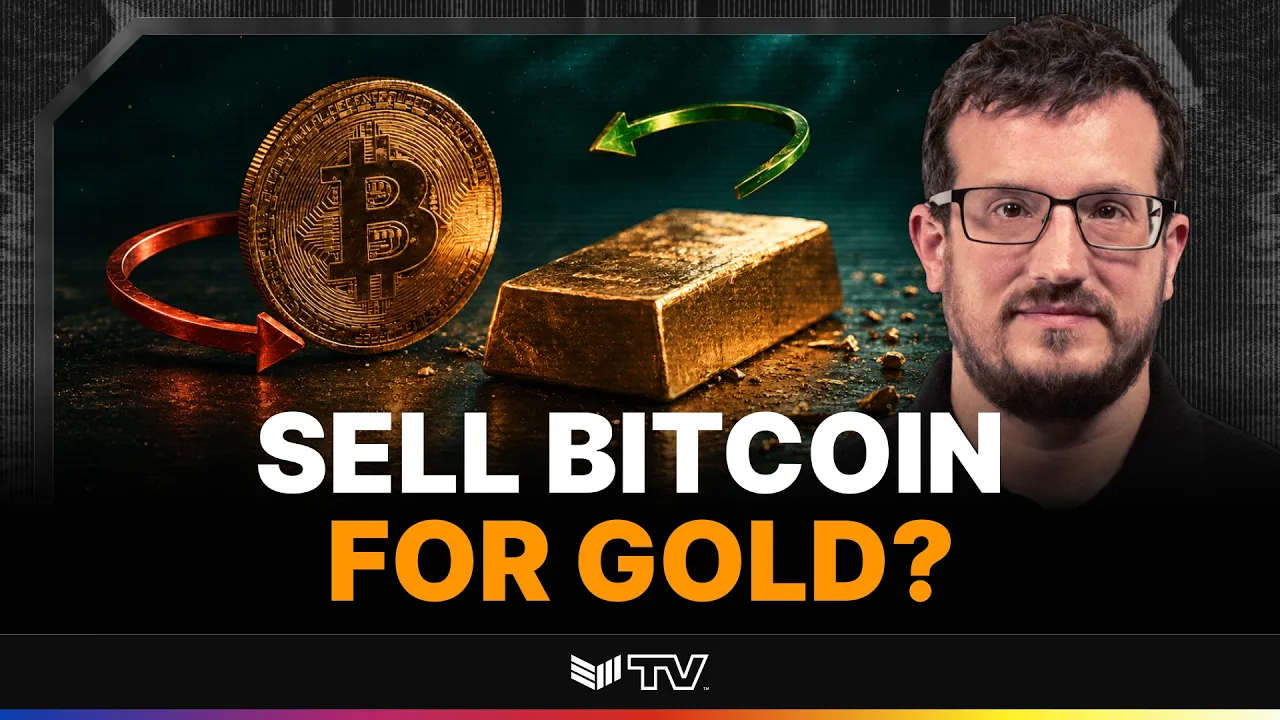
Simon Dixon: What It Would Take for Me to Sell My Bitcoin for Gold

- Video return
- -11.63%
- Calls
- 1
- Buy / Sell
- 1 0
- Published
Recommendations
Entry is the asset's closing price on the publication date. Current is the last close on record.
-
Entry $68,168.00 12 Nov 2026Current $60,237.00 22 Nov 2026Result −$7,931.00vs. index — BTC is the benchmark here — there is no excess to measure
Cite this call Watch source segment (492s) *
Surrounding source transcript
…our key is a resistance against the centralizing forces. And in terms of what's happening in the Western Hemisphere, um you need to protect yourself through owning assets. Now, Bitcoin over the last 5 years hasn't been very exciting. Um so all you can do is continue to increase your position in Bitcoin on a longerterm time frame. Dollar cost average. Um, and I think over the long term as part of your portfolio, um, it will be an important part of all of those trades in uncertainty when none of us can predict what it looks like next. >> You believe in Bitcoin, so why would you ever sell…
all you can do is continue to increase your position in Bitcoin on a longerterm time frame. Dollar cost average.
AI-extracted context Now, Bitcoin over the last 5 years hasn't been very exciting. Um so all you can do is continue to increase your position in Bitcoin on a longerterm time frame. Dollar cost average. Um, and I think over the long term as part of your portfolio, um, it will be an important part of all of those trades in uncertainty when none of us can predict what it looks like next.
Full Transcript
Well, there's a lot for Bitcoiners to weigh right now. From hot inflation and rising rates to big blank to big banks planning stable coins of their own. Joining us now to break it all down is Simon Dixon, the CEO and co-founder of Bank to the Future. Welcome in, Simon. Thanks for joining us. >> Okay, thanks for having me. >> So, we were just talking to Peter Schiff on the show, uh, notable gold bug. He was telling everyone to sell their Bitcoin and buy gold with it instead. I know your premise is much different. You've been in Bitcoin since 2011, but I think it was the the coin stories pod you recently went on and said there are some situations where you would sell your your Bitcoin and buy gold instead. So, can you take us through those situations and how close we are to getting there? >> Yeah, sure. So, um look, Bitcoin since I've been involved has done three things incredibly well. One is it it gives you the ability to earn your own money. Um you can hold it in self custody. Second is it allows you to spend that money in self custody peer-to-peer. Um you can without any government in in the middle. Um and thirdly, it has a fixed supply of 21 million which gives it this um you know hedge against long-term debasement trade. Um and if any of those three things are ever called into question then I'd immediately sell all my Bitcoin and buy gold. Um and so to me the battle of Bitcoin is not Bitcoin success. Clearly, we're on a we're on a trajectory that we've never seen before with institutional adoption. But what are the costs of that institutional adoption? Do we end up with all the custodians owning all the Bitcoin? Do we end up with significant lobby power over developers? Do we end up with Wall Street having all of the mining companies as public companies? Um and then when we try to fork, does that mean that node operators aren't able to resist against some of the companies that are more centralizing through treasury companies and various other things? So that is the battle. That's what I'm monitoring. Um and adoption really isn't the thing that uh that that that I call into question at the moment. And Simon, the October inflation came in hotter than expected and as a result, the 10-year Treasury briefly went back up to 5%. Fed Governor Christopher Waller says a half point hike should be considered in December. Um, you know, many people say that's not nearly enough. Um, you know, what do you think the Fed's, you know, rate path looks like from here? Uh, and what should Bitcoiners be expecting? Yeah. Well, throughout the whole 15 years I've been involved in Bitcoin, sometimes Bitcoin is a function of M2 money supply. Other times it's a function of the technology trade and then other times it's the debasement trade and it's in line with gold. Clearly, right now we're kind of in the technology phase where we're having, you know, this AI correction cycle. Um and as a result of um the national debt, the bond market stress and severe money printing um and M2 money supply increase, we're getting the knock-on effects of inflation both on the demand side and the supply side uh with the war as well. So, I'd expect um this inflation is kind of offset by some of the productivity increases in artificial intelligence, but higher energy prices um as well as the potential of demand destruction might be the only thing that could lead to um a disinflationary impact. But right now, the CPI came in hotter. I think the bond markets and the markets are telling us is pretty much locked in that we'll get a half a point increase in December. Um and until there is any impact on inflation, uh you can expect that to be uh where it goes. Now, if that makes some wider correction in the market, we all know that the that they're not going to let the AI trade fail, you know, that can only lead to any type if it if it needs the capital, then it will always be bailed out and the Fed will pump in and do some QE because that's the only trade. >> Yeah, I agree with your take on on Bitcoin. And I think the data backs up your your statements there on on the Bitcoin correlation, especially relative to M2 at times, the Fed at times, uh the technology trade largely uh the majority of the time probably. Um but for for the just general market participants here, I because you you think about macro quite a bit. I I really want to get your your take on if you think higher for longer can solve this. I mean we know that Besson has been kind of doing this green span replica uh game game game plan in a sense here and and we see AI can um you know um facing some stress and at the same time is inflation remaining very sticky and actually increasing um so is higher for longer the answer or or how how do they start to actually get some results? >> Yeah, it's the it's it's the only trade. Um and if that leads to crisis, then QE um is the only thing you can do. Um you know, we're in the fiscal dominant cycle, which means Republican, Democrat, midterm election, Trump, Congress, whatever, uh they need to print money and they need to spend more money. Uh because stocks are being propped up by excessive military spending, technology investment with the AI trade, um and also financialization and securitization at the financial institutions um and banks. So, uh, fiscal dominance means that this continues for as long as the average cost on the US national debt is lower than the growth rate. And what we're seeing right now is that we may have a risk to the growth rate because it's fully the AI trade, but also an increasing in the cost of the debt. And if those numbers go wrong, then you get a significant increase in deficit. Um and then you need an increased opportunity for intervention at the Federal Reserve level. >> So basically it's like uh we're playing roulette with the world economy, right? either goes swimmingly well and you know we have this sort of Elon Musk super abundance with AI and robotics being deflationary and the cost of goods go near zero or you know uh they can't stomach what what what the the fiscal dominance is going to force and we'd have this sort of financial crisis and then eventually have to come in with the QE um and in an environment like this that's such a coin toss and no one knows the future um you know what are your expectations, right? Do you think ultimately this succeeds or or do you think all roads lead to this uh you know ultimate QE? And what would that mean for Bitcoin in either scenario? >> Yeah. So, you you got a few things going on here. one one of the major trends is that across China and the private corporate technical industrial complex I call them the big 10 tech companies you know they're building a global AI um technocratic control grid whatever you want to call it um that's happening that's a global trend on the geopolitical side we tend to be moving towards multipolarity where US dominance is not being able to exert influence where it used to straight up moves Iran um and continual war that's happening across the Russia Ukraine side that's driving the world into multipolar nodes with the the rise of China. Then in the western hemisphere you've got the fiscal dominance trade which is the K-shaped economy and that drives into wealth inequality. Those that own assets benefit the rich get richer the poor get poorer that you were covering and all of those trends are happening all at one time. So you got a global trend with technology. You got multiple nodes in the geopolitical environment and in the western hemisphere you've got a K-shaped economy that is driving severe wealth inequality and transfer of wealth up to the ownership layer. In terms of Bitcoin, Bitcoin is a function of all of those. Um if you're in a multipolar world, then Bitcoin is able to play where there's multiple currencies. in terms of a technology play, you owning your key is a resistance against the centralizing forces. And in terms of what's happening in the Western Hemisphere, um you need to protect yourself through owning assets. Now, Bitcoin over the last 5 years hasn't been very exciting. Um so all you can do is continue to increase your position in Bitcoin on a longerterm time frame. Dollar cost average. Um, and I think over the long term as part of your portfolio, um, it will be an important part of all of those trades in uncertainty when none of us can predict what it looks like next. >> You believe in Bitcoin, so why would you ever sell it? Life happens. An emergency expense, a new home purchase, or a great business opportunity. With Salt, you can access the power of your Bitcoin without selling. Now with rates starting at 7 12%. The original Bitcoin back lender. No collateral losses, no rehypothecation since 2016. Get your exclusive offer at saltlanding.com/bmtv. You know, we talk about um political volatility. We just saw the situation play out in Paraguay last week where regulators seized UNO banks. 3 million customers had their accounts frozen. What should sabers understand about who really owns their money in a bank account and how does Bitcoin solve this? >> Yeah. Well, um, most people should think of Bitcoin as an IOU, fiat currency that has credit risk attached to it and counterparty risk. Um, most people think that the money at a bank is just somebody else's savings. No, it's um collateral and the money doesn't exist. And if everyone wants their money, then you can't access the money because it is in fact a digital currency already. Um and so in Paraguay what we've seen is that through mass corruption um there has been um siphoning off of severe money that's led to closure of pension. Um we had a bit of this in in UK under Liz Trust where the pension market broke um and there was a regime change with the Bank of England um and then they came in and they um you know uh they they bailed it out essentially. But in Paraguay, you tend to get sucked up into larger financial institutions on the global financial markets. Um, or you get some kind of IMF. But essentially, the end result is that consumers can man can create civil unrest. That civil unrest can be weaponized in order to issue more debt um in and bail out the banking system, which concentrates wealth upwards into larger financial powers and transnational companies. So it's subordinating to the government. The president get their cor their their corrupt money and the people that are protesting right now sadly become useful idiots for power in a police and surveillance state with technology. So the answer is that you need money outside the system, money you can own, money you can spend without permission um and money that has a fixed supply which is Bitcoin's trade. Just if you hold it with a custodian or you have a treasury company or you borrow against it, now you're in the same Bitcoin financial industrial complex as you were with the bank. >> And Simon, you mentioned how how dangerous it is becoming around the world to have money inside the system. You know, you look at some of the chaos happening in Europe. You look at France's economy, for example. Um, you know, it seems like there's less and less places where you would want to be inside the system. Uh, presumably, uh, still the US. Uh what's your estimation? What countries if you had to be in the system right now uh would you be okay with with their financial setup at the moment? >> Uh well to me money at a bank is simply your function of how much money do you need in order to not sell your assets. Your your savings should be an asset. Um and to me a significant amount of it should be outside the system. Um obviously if you've got your stock portfolio and various other things then you're playing that market. Uh but in terms of how much money you should have in a bank, um right now the credit risk of stable coins back by treasuries might be more attractive relative to the credit risk of various banks. So at the end of the day, if you're going to be using a bank, you got to use the too big to fail because you need the guarantee of the Fed. um and the Fed is still the almighty balance sheet backed by the Treasury markets which while many foreign central banks are selling those in exchange for gold, there's still nothing more liquid than the US Treasury market. And as long as that liquidity exists, the game must go on and the Fed must intervene and the K-shaped economy continues. >> And Simon, just I want to double tap on that idea of banks buying gold. Um, you know, central banks have added 321 tons of gold this past quarter, up 42% from just a year ago, uh, according to the the World Gold Council. And so, even throughout that, gold fell nearly 3% after Tuesday's hot inflation report. You know, in a world that's increasingly online, you see all of the geopolitical leaders, you see all the major institutions saying the future is tokenized. It is onchain. Whether it's equities, whether it's commodities and resources, everything is going digital. you have this decrease in the ability to trust each other when you're performing trade uh as you alluded to with kind of this uh biodal system being set up. Um so why still no Bitcoin? Just walk us through that game theory. It seems like to the Bitcoiner that would be the obvious play here, but they're just buying mass amounts of gold and at least yet to be announced perhaps not happening. Are any sort of Bitcoin buys? Yeah, there's been zero adoption of Bitcoin at the central banking level. They've been increasing their gold purchases. And when the price there was that big runup that obviously meant that gold became a larger market cap reserve asset than US treasuries for many of the foreign central banks. So it is still a global reserve asset at the central banking level. Now we've seen governments, you know, kind of intervene. We've got Iran that was using I think they were doing a lot of Bitcoin mining. UAE, they had a lot of Bitcoin mining. El Salva had the Bitcoin strategic reserve strategy. Um it looks like the American strategy is just confiscating Bitcoin from criminals and networks are doing more and more hacks. Um so that seems to be the US strategy in terms of Bitcoin strategic reserves. But to me, Bitcoin has always been about the individual. Um, and so as long as the central banks stay out of Bitcoin, I'm happy. Um, when they start to actually accumulate more and more Bitcoin, that's a centralizing force. Um, and that's something that can happen is to be for me, it's not that's not adoption. Adoption to me is is people running their own nodes, people holding their own Bitcoin, and people transacting peer-to-peer. Um, not being held up within the centralizing forces. And when people are trying to exit the system, there's still a cyber security risk. Just last week, Binance warned that there's a newly published iPhone flaw that it could expose seed phrases to malicious apps. So, how are you evaluating the risks? And is there um any type of of setup you trust and recommend for Bitcoin holders? >> Yeah, the the best setup, and again, I would never talk about how I secure Bitcoin. Um, but actually the way the Bitcoin was designed is still the best setup. Uh, which is Bitcoin core running your own node, which is code that doesn't require a hardware wallet on a laptop with multi- signature. Now, I know that that's a bunch of gobbledegoop and jargon to most people, but here's the reality. Setting up an asset protection structure for your traditional portfolio with offshore trust structures or whatever you may be, um, asset protection is a complicated thing. So if this is going to be part of your long-term portfolio then getting a trusted setup is a journey everyone needs and as we have said everything with artificial intelligence and the centralizing forces on the financial side are moving towards you giving up the key. Um, and so really in an AI dominated world, owning your data, owning your keys, owning your finance, owning everything. Um, your social media data is the way you survive these centralizing forces that are happening ahead. And so, yes, we've had issues with hardware wallets. Um, we've had issues with data breaches that are leading to wrench attacks. It's a scary game, but we're going into a scary world. Um, and uh, there's, you know, we've got large exchange hacks. um we've got bank hacks um we've got um you know lack of security on generating keys so as I said the journey of actually how Bitcoin was originally designed where you run your own node run Bitcoin core and do it on a laptop is actually the setup that has never been compromised. Now, Simon, before you go, we we've we've talked a lot today about the financialization of Bitcoin, which should be expected with any maturing uh asset, but you know, another thing I'd really like your thoughts on is, you know, moving away from that secondary use of Bitcoin back to that primary use, which is peer-to-peer uh monetary network. So, what do we need to do better as Bitcoiners to try to spur this along? Right? It seems like, you know, everyone's doing these, you know, financialization, um, you know, business models or rappers around Bitcoin, but very few people outside of, you know, people like Square are doing a pretty good job. Um, are really focusing on on Bitcoin as money and and payments. >> Yeah. Um, most people are still using the median of exchange and we not got much Bitcoin circulating. Um, look, most Bitcoin is still in self-custody, about 70% of it. 30% is in centralizing courses. So, we still have um, you know, the majority in self-custody, now a bunch of those wallets have never moved. And you could analyze that data yourself. Um, but um, the most important thing is that if everybody gives their keys to BlackRock and Black Rockck gives their keys to Coinbase and everybody owns a treasury company in a 401k, then Bitcoin fails. Um, and so you have to be a do your part if you want to be involved in Bitcoin. Um, which is enforce the rules by running nodes, self-custody your Bitcoin, which gives you the pleasure of being able to verify your own transactions, massive privacy benefits, massive counterparty uh risk benefits, and you should have a percentage of your Bitcoin that you circulate. um you spend, you invest um and you contribute to people that maybe you know I I was able to I wasn't able to send any money to feed children in Gaza, but I was able to send them Bitcoin and and how do we get there, right? You know, why do people do that? How do we convince people to do that? Is there anything that can be done? Is it a cultural shift that needs to occur so that people are actually looking to to do this like they did for for years in the past? Um, usually humans firstly most people won't. It's just reality. We're not going to change the human psychology. Most people will look for the easy option. Most people won't invest time in asset protection. Um, so we need to work within the confines of reality. Um, but most people they act only when it's too late and disaster. Um, so you know, I remember the early days of Bitcoin adoption were 2013 bailins. Um, and so when these disasters tend to happen, people start to sadly only prepare once it's too late. Um, so it's the natural cycle of human psychology, and I don't see Bitcoin being able to change that. >> Simon Dixon, CEO and co-founder of Bank to the Future. Thanks so much for joining us. It was great having you. >> Thanks for having me.
Comments 0
Sign in to join the discussion.
Sign inNo comments yet. Be the first to share your thoughts!