… also most likely potentially change. The volume most likely will become higher, which then will shrink down the bid-ask spread width, meaning that you'll probably get a better premium if you were to sell covered calls later in the future. Now, if you're someone who is heavily into selling covered calls, you want to create a position on SPY and, you know, use these options strategies, then yeah, I would say just go for SPY because you are going to get that much higher premium, which will oftentimes compensate for the higher expense ratio here. So, going back to my $1 million investing road map, if you are a complete beginner, I've worked with a lot of people where they share with me that they have SPY, IVV, SPYM, VOO, and even FXAIX all in their portfolio. And then the first que…
Now, if you're someone who is heavily into selling covered calls, you want to create a position on SPY and, you know, use these options strategies, then yeah, I would say just go for SPY because you are going to get that much higher premium, which will oftentimes compensate for the higher expense ratio here.
AI-extracted context
Now, if you're someone who is heavily into selling covered calls, you want to create a position on SPY and, you know, use these options strategies, then yeah, I would say just go for SPY because you are going to get that much higher premium, which will oftentimes compensate for the higher expense ratio here. So, going back to my $1 million investing road map, if you are a complete beginner, I've worked with a lot of people where they share with me that they have SPY, IVV, SPYM, VOO, and even FXAIX all in their portfolio.
Full Transcript
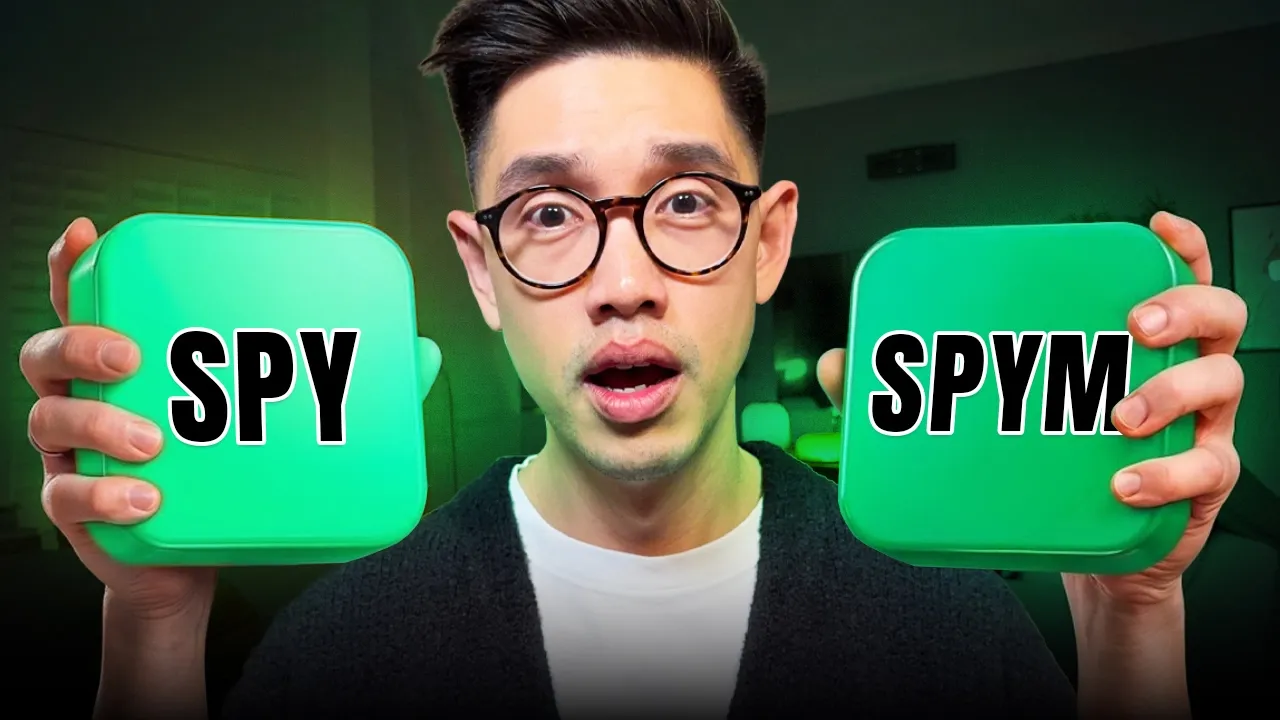
So, you're a beginner investor, and you're trying to figure out if you should invest in either SPY or SPYM because you want to diversify and not just invest in individual companies right now. You want to invest in the broad S&P 500. So, in this video, I'm going to go through some similarities between both ETFs, and of course, the main differences because if you invest in the wrong thing, especially if you're a beginner, it's going to cause some inefficiencies later in your investing journey. I'm basically going to go through the pros and cons for each ETF, and by the end of this video, you're going to have 100% clarity which one is actually best for you. So, first, I'm going to go to Yahoo Finance, and I'm going to take a look at SPY. Now, SPY is one of those OG ETFs that have been around for a very long time. Again, it tracks the S&P 500, the top 500 companies in the United States like Alphabet, Google, Amazon, Home Depot, Nvidia, Microsoft, so on and so forth. The very first difference is the share price. So, one share of this ETF, currently for SPY, is around $777. However, if I go over to SPYM, you can see that one share is actually around $91.50. Now, right off the bat, you're most likely thinking then you should probably just invest in SPYM because it's cheaper in price. But, this is actually the wrong way to think about it because if you were to say put $10,000 into SPY and $10,000 worth of money into SPYM, I'm going to tell you right now, mathematically, if you were to let both ETFs grow for the next 10, 20, 30 years, you're essentially going to end up result in the same amount of gains towards the end. The reason is because SPY and SPYM, they track essentially all the same companies with the same ratios. So, for example, if I go back to Yahoo Finance and click on the left right here where it says holdings, and then I scroll down, you can see that Nvidia takes up around 7.5% of this fund, Apple around 7%, Microsoft around 5.36%, Amazon around 4%, and Alphabet Google around 3.24%. Similarly, if I were to take a look at SPYM, even though it doesn't show the actual holdings on Yahoo Finance, but if I were to go to SSGA.com and take a look, the holdings and the companies are essentially the same thing. Nvidia is around what, 8%? Apple around 6%, Microsoft around 5%, Amazon around 3.9%. These percentages are essentially the same thing. There's just a little bit of a delay in data, but again, both ETFs hold the same exact companies and the weight, the ratios are essentially the same thing. And if you're someone who says, "Wait a minute, then why invest in SPY? Why not SPYM?" Because again, the share price is higher for SPY. Remember, it's 2026, 2027 right now. There's this thing called fractional shares, so that instead, if you really want to invest in SPY, you actually don't have to buy one full share. You can buy half a share or 1/10 of a share. So, if you were to buy 1/10 of a share, the price of 1/10 of a share would be around $77.76, which is, of course, going to be cheaper than SPYM, which is currently at around $91.94. Now, the second main difference here is the expense ratio. For SPY, the expense ratio is around 0.09% by at the time of this recording. And if I go over to SPYM, the expense ratio is actually, even though it doesn't say it here on Yahoo Finance, it's 0.02%. And if I take a look at SPYM, you can see that the expense ratio is 0.02%, which is way lower than SPY. So, what does this mean? Well, if you were to invest in SPY, you would pay 9 cents for every $100 per year by holding on to this share right here. Or, if you were to invest in SPYM, you would only pay 2 cents for every $100 invested into SPYM. This might not sound like a huge amount of money, but if you were to hold on to a lot of shares, and if you were to compound it over the next, say, 10, 20, 30, 40 years or so, then yeah, that spread, that difference, is going to be pretty wide. So, again, this is why we always want to choose an expense ratio that is generally lower. So, so far, I would say that if you are someone who wants to just invest for the long term, SPYM is actually the better pick, in my opinion, because, again, yes, it has a lower cost per share, which, again, it doesn't really matter because you can buy fractional shares, but at the same time, if you take a look at the expense ratio, this is why I would invest in SPYM over SPY, because the expense ratio is only 0.02%. However, you might be thinking, then why is there SPY? Like, what's the benefit of investing in SPY? Now, if you're someone like me, and you like to sell cover calls, or maybe cash-secured puts, you're in the options world, and you want to generate that monthly income or that quarterly income, then SPY is, most likely, I would say, is the better choice. And the main reason is because SPY has higher liquidity, higher trading volume, meaning that to get in and out of SPY, it's relatively cheaper because of the bid-ask spread is often times smaller. And if we talk about selling options, selling cover calls, SPY generally will give you a better price because it's more, I would say, more popular in the marketplace, where people really want to trade SPY. And if we take a look at SPYM, you'll see that not that many people, compared to SPY, really want to trade SPYM, which means that if you were to sell cover calls against SPYM, the premiums that you get are generally lower. So, if I go to Thinkorswim's paper trading platform, this is from Charles Schwab, and I just type in SPYM here, and I open up the option chain. You can see that there's really just 1 2 3 4 5 6 6 expiration dates that you can choose from. On top of that, if I were to choose something like the September 18th expiration and take a look at the option chain and see the different strike prices here, you can see that there aren't that many different options that you can choose from compared to SPY, which I'll share in a little bit. And take a look at the volume. The volume here for the $92 strike is only 40, and the volume for the 93 strike is only 19, which meaning that there's really only 19 people trading SPYM's contract at that strike price all over the world. But, if I were to type in SPY and take a look at the option chain here, you can see that there is a bigger list of expiration dates here. So, instead of six, there's like 1 2 3 4 5 6 7. I mean, I can't count everything, but you get the idea. It goes all the way up to December 15th, 2028, or around 855 days into the future. And you can also see that in the beginning expiration dates, there are daily expiration dates, which is very rare for ETFs or stocks to have. Generally, a lot of ETFs have expiration dates that are weekly or monthly, but for SPY, it's daily. And if I were to open one up, I'll just choose a random one here, like maybe the August 31st one. Again, you can see how many different options, how many different strike prices you can choose. And if you take a look at the volume here, like again, I just chose a random one. Look at the $778 strike price. The volume is 255. And if you take a look at the $780 strike price, the volume is around 1,730, meaning again, there are 1,732 contracts that are just going in and out all over the world right now. And again, I don't want to complicate the mathematics of it all, but if you were to just sit down and punch in numbers into your calculator, you'll see that the premiums that you get are relatively much higher compared to SPYM. So, the premiums for the $778 contract here, if you were to sell a covered call just right out of the money, it's around $815 that you can collect. And if I were to compare this to SPYM and just take a look at this 36-day expiration, again, just right out of the money, then that is what? Around $120 for the covered call contract. And I understand that the share price for SPY is much higher than SPYM, but if you were to do an apples-to-apples ratio here, generally, again, SPY's premium is much higher compared to SPYM. Okay, so, let's boil everything down to an actual decision for yourself. So, which one is actually best for you? Is it SPY or SPYM? So, first, I would invest in SPYM if you are a long-term investor. You don't really care about selling covered calls or cash-secured puts, doing any of that, hedging your portfolio, generating income, then that's totally okay. Then I would just go for SPYM because, again, the share price, it is cheaper per share, which doesn't really matter because you can buy fractional shares, and the expense ratio is much lower. And I would also say that in terms of the share price, because SPYM's share price is much lower, in the future, if you do decide to sell covered calls, then, yeah, it's going to be easier to accumulate 100 shares. Because, again, from all my other videos, you probably already know that you need 100 shares or multiples of 100 shares to sell covered calls. And you cannot just sell a covered call on SPY if you only have like one share or two shares. Again, in order to sell covered calls, you need to have 100 shares. So, if you think about buying 100 shares of SPY, 100 * $777, that's $77,000 of capital that you need to sell this covered call. Compared to if you were to sell a covered call on SPYM, even though you don't get that much premium compared to SPY, this will only take up what, $9,100. And I would say that maybe with popularity increasing over time and more people invest in SPYM, the volume and the bid-ask spread are going to also most likely potentially change. The volume most likely will become higher, which then will shrink down the bid-ask spread width, meaning that you'll probably get a better premium if you were to sell covered calls later in the future. Now, if you're someone who is heavily into selling covered calls, you want to create a position on SPY and, you know, use these options strategies, then yeah, I would say just go for SPY because you are going to get that much higher premium, which will oftentimes compensate for the higher expense ratio here. So, going back to my $1 million investing road map, if you are a complete beginner, I've worked with a lot of people where they share with me that they have SPY, IVV, SPYM, VOO, and even FXAIX all in their portfolio. And then the first question I always ask is, why? And oftentimes they'll say, "Well, Steve, it's because I'm diversifying myself." But I'm going to tell you right now, if you were to invest in all five of these S&P 500 funds, you're actually just having a lot of overlap and it just causes a lot of complexity in your portfolio later on because, again, all of these funds do the same thing. They all track the S&P 500. So, if you take a look at your portfolio right now and you see that you have all of these or like three of these or four of these S&P 500 funds in your portfolio, you might want to consider maybe reallocating some of your funds and just putting everything into just one or two of these ETFs depending on the purpose of what you want to do with these ETFs. Now, if you want to get my $1 million investing road map, see the differences and the comparisons amongst all of these ETFs along with the tech and growth fund ETF comparisons, high dividend paying fund comparisons, you can download everything down below. Everything is free in the $1 million investing roadmap. And if you're someone who wants to learn more about covered calls, generating that monthly passive income with these options strategies like covered calls, cash secured puts, along with other strategies, income strategies too, because of course you have a larger sum of money, more than 50 or $100,000, and you don't want to wait the next 10, 20, 30 years until your portfolio grows and then you'll pull out your money, then you can download my free investing roadmap here. And if you say that you have more than 50 or $100,000, I will invite you to my 5-day investing challenge and I'll give you all the resources to the trainings on how to sell covered calls and cash secured puts. I hope this video brings a little bit more clarity between SPY and SPYM. Let me know in the comments which one that you're investing in or maybe you're investing in some other S&P 500 fund altogether, maybe like IVV or FXAIX. And also let me know if there are any other topics, questions that you have about stock market investing. I will read some of the comment sections maybe later this week or next week and I'll try to make a video about whatever topic it is that you recommend. All right, that's pretty much it. Thanks for watching and I will see you in the next video.

Comments 0
Sign in to join the discussion.
Sign inNo comments yet. Be the first to share your thoughts!