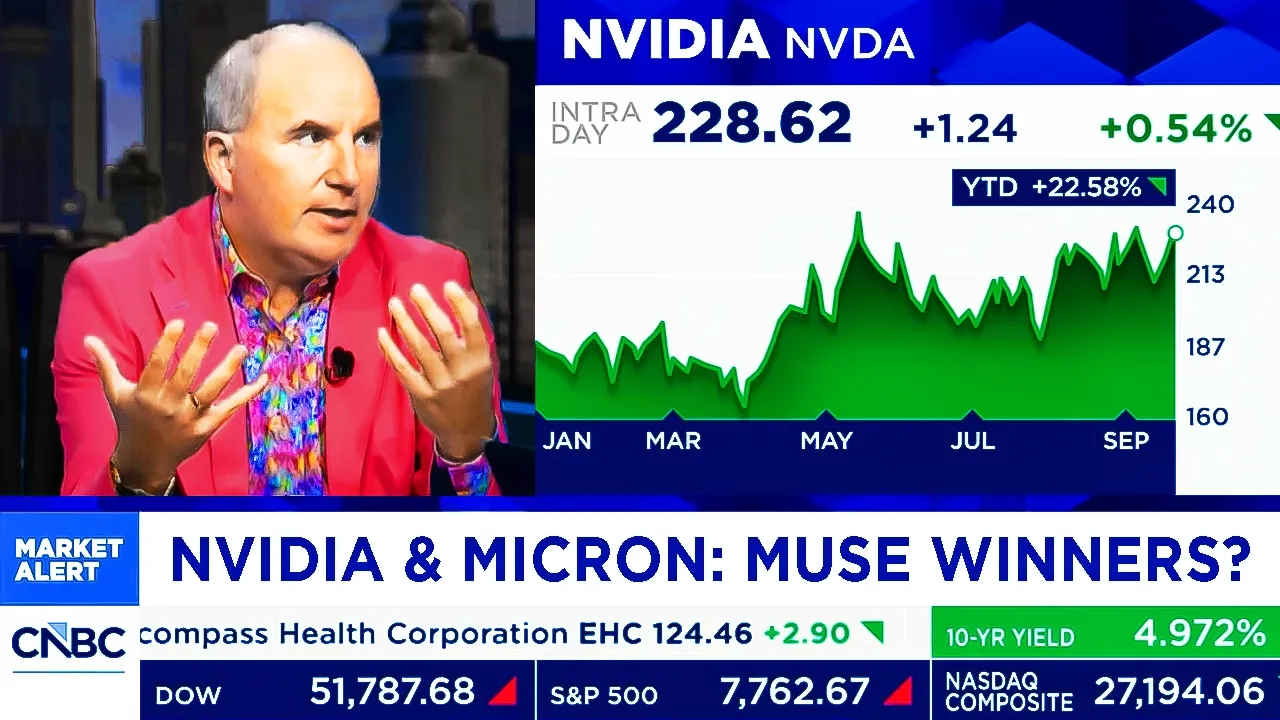
The News Today On NVIDIA Stock, Micron Stock, Meta Muse, AI Demand - NVDA Update

- Video return
- —
- Calls
- 2
- Buy / Sell
- 2 0
- Published
Recommendations
Entry is the asset's closing price on the publication date. Current is the last close on record.
-
Entry $1,096.16 22 Sep 2026Current $1,096.16 22 Sep 2026Result +$0.00vs. index +0.0% SPY +0.0% over the same days
Cite this call Watch source segment (230s) *
Surrounding source transcript
…en. But look at lately. So maybe it took him a while. They introduced this new product two weeks ago to the day today. Okay, stocks up 22% since that moment. Numbers go up as Josh said, price targets go up because they continue to do that. Micron, I did it yesterday, but why fight it, >> right? Did it Yes. Two days in a row, final trade. >> All right, I'll see you on the bell. The >> How much how impactful do you think that Muse is? >> I mean, I think it's a game changer because the reality is that I think investors, they discounted Zuckerberg and Meta in terms of the tens…
Micron, I did it yesterday, but why fight it, >> right? Did it Yes. Two days in a row, final trade.
-
Entry $228.87 22 Sep 2026Current $228.87 22 Sep 2026Result +$0.00vs. index +0.0% SPY +0.0% over the same days
Cite this call Watch source segment (713s) *
Surrounding source transcript
…ext year the forecast is for over 70%. So again, they're still a leader in the space. We still want to be involved with them. Again, the market's starting to spread out a little bit, but you can't forget about Nvidia. >> Of course not. Um, it's a it's a mustave at 229 the share. Now, >> you run a lot of funds and tech's a big part of all that. What do you make of this resurgence? So, NASDAQ record high. Okay. Mag 7 coming off its second straight backto-back uh highs since its inception in April of 2023. What's it …
it's a it's a mustave at 229 the share.
AI-extracted context Of course not. Um, it's a it's a mustave at 229 the share. Now,
Full Transcript
Look at Micron. That happens to be Mike Murphy's second stock pick of the day. You like a little shall we say volatility, don't you? >> Well, when it's to the up. >> It's all over the place. >> All all over the place. Yes. But mostly up and to the right. So I I think we talk about AI, we talk about the demand for chips. But people have said Micron has gone up too much or or Micron's too expensive over $1,000. Micron's now valued at 1.2 trillion. Yes to all of those, but there is a demand for their chips that you can't get these. There's not an unlimited supply of them. So, they have supply demand in in their corner and they still trade relatively cheap. Call it roughly 10 times next year's earnings. So, if you look from a value standpoint, yes, there there is a lot of volatility in the stock. It trades kind of a proxy for AI or the AI trade. But ultimately, will they sell more chips next quarter and the quarter after that? I think the answer is easy. Yes. >> He likes Michael and sports fans. He does. All right. Thanks, Mike. >> We have this massive counter trend move now where three stocks, the only three that really matter for this move that we're talking about, Apple, Meta, and Nvidia have simultaneously undergone this narrative shift. The narrative shift on Nvidia is it's boring. I guess 98% earnings growth is boring. Well, that's back now at the highs, probably about to break out, and people got a little bit of a wakeup call. The narrative on Meta is they they spent 200 billion with a B on AI with nothing to show for it. Not so much anymore. The number one uh product in the app store and it's free and it's in WhatsApp and it's in um Facebook and it's being utilized by everybody. out of the out of the blue, you're seeing analysts go from 20 times earnings next year to 25. And oh, by the way, they're taking their numbers up cuz if there's nobody on the planet better at monetizing AI than Meta. Wow, that's a big shift. Look at Apple. Apple doesn't understand AI. Apple's behind. Apple just fired their AI chief. They're never going to figure it out. They're never going to CATCH UP. DOESN'T MATTER. They're going to be the gateway for a billion consumers to touch any AI product that you want to come up with. Look at that narrative shift. Look what's happening in the stock. So, the broadening trade was fun. That was then. This is now we're back to the earnings growth winners. Just real quick, let me give you a number on there. the MAG 7 um blended expected operating earnings as a as a percentage of everything that we think is coming is so big that it's almost become the entire story. The S&P 500's blended forward operating margin is 17%. And nearly half of that is going to come from the Mag 7s. If you strip that out, it goes to 14.5%. The forward PE on the Mac 7 is 23 times earnings. not wildly egregiously overvalued when you understand how critical these stocks are to 2027. >> Back to early February, remember when we sat down with Jensen Wong, Super Bowl? >> One of the lasting quotes that I remember him telling us in the day or two before the Super Bowl in his backyard, nobody does AI like Meta. Maybe a little bit of a paraphrase, but I don't think so. Pretty much a direct quote. Nobody does AI like Meta. Um, maybe we're finally realizing how nobody does AI like Meta, at least in terms of what Jensen Wongs think has been a rocky road since then. But look at lately. So maybe it took him a while. They introduced this new product two weeks ago to the day today. Okay, stocks up 22% since that moment. Numbers go up as Josh said, price targets go up because they continue to do that. Micron, I did it yesterday, but why fight it, >> right? Did it Yes. Two days in a row, final trade. >> All right, I'll see you on the bell. The >> How much how impactful do you think that Muse is? >> I mean, I think it's a game changer because the reality is that I think investors, they discounted Zuckerberg and Meta in terms of the tens of billions that they were spending, you know, in terms of capbacks. They didn't see the results. Now look at it. I mean, this is something when you have when you have three and a half billion users to tap into. It's not just going to be open AI and anthropic. And I think this just shows this is an AI arms race and you when you count some of these companies out whether it's Apple, whether it's Meta, look what happens cuz they have the resources and they have the installed base and I think investors they discounted what you know what Zuckerberg and Meta could do here. >> I wonder this is my my little Kelly hypothesis. What do you think about this? the consumer having finally kind of a an a cute maybe exciting way to use AI. I mean, people already use it, don't get me wrong, but a new way to save money on tickets or just experiment with different ways of kind of putting their agents out there in the world. Could this inlect demand for AI and for the supply chain for for kind of the agenda supply chain and even kind of diminish some of those concerns around data centers and the larger angst about it? Yeah, for this is for the average consumer and I think it's many where you know they weren't ready to go down the anthropic claw path. This is one they're already used to the platform. I mean think about how many Instagram how many Facebook how many users that you ultimately have and now they tap into that. And I think when you combine subscription cheaper cost with a product, anyone that's seen Muse is, you know, it's the reason it's top of the charts in terms of app store because of what it could produce and it just keeps coming down to the value more and more. It's going to be less in the model. It's going to be more in the data. It's and when you goes back to what Anthropic and Daario did going back to a few weeks ago in terms of the essay the view was okay we get to the top floor now it's time to actually have regulatory you whether regulatory capture pull the ladder up now Meta and Zuckerberg like not so fast >> I would also add Alexander Wang it has a little bit of must energy around him in terms of you follow him on X and he's irreverent and he's funny and I I Wonder I I'm amazed and impressed that Meta lets him get away with just being who he is and and and but the way he's resharing posts and talking about its logo and everything else. That is powerful marketing. And again, here's somebody who's not Mark Zuckerberg that people who wonder who's the guy behind this app. They can go, "Oh, it's oh, it's this guy." You know, he's he's funny. I get him. He seems he doesn't seem like a threat. He doesn't seem like an AI overlord who's out here with some scary doomsday story. >> Yeah. I think it's almost the anti, you know, relative to some of those others. He's a special one. And I think it goes back to the acquisition, it goes back to also a lot of the culture because when you go back to whether it's what we've seen at Google, whether it's what we're seeing at Meta, you need entrepreneurship culture under these big companies and even going back to what Turnis and Apple are trying to do, you cannot just count them out when you have that user base and those resources. And I think it just shows, look, we are still in the third inning of this AI revolution and this is an arms race. This is going to be more of a Game of Thrones whether it's what we see with Amazon, Amuse, and some of the battles going on. This is just the beginning because of the trillions of dollars going to be spent. >> You and I remember well when OpenClaw first debuted and what a huge inflection that was for the AI supply chain, especially those in kind of that, you know, I'm a simple person. The CPU supply chain is how I think about it, right? >> As I understand it, technically speaking, Muse is kind of like a cute little wrapper on OpenClaw. So if OpenClaw did that for enterprise users and Muse does this for consumers, what does that mean for all of the stocks, you know, from Intel to AMD to you tell me, I mean, who else is implicated here? >> Get the popcorn out. And I think it speaks what you're seeing with AMD, what you're seeing with the chip stocks. I think it just goes back to our view like this is going to be a multi-year tech bull market and we don't have equilibrium probably till 2028, 2029 from a chip perspective. you start to get the masses in. Remember that we're only at the enterprise in terms on the AI trade. Consumers come in. It goes to our point. I mean, you're 15% through what's going to be the true spend over the coming years. And that's why I think the bears that are in hibernation mode, they don't see that in the spreadsheets. And that's why I think these stocks will continue to move higher and the AI trade spreads to the second, third, fourth derivatives. I think that's really what's happened in the market. Can you articulate what that second, third, fourth derivative is? Is it a derivative we've seen before or is it a new one? And if does the success of Muse come at the expense of others like an open AI which again I you know I don't want to pile on them. I'm just talking about where is the consumer now if they're going to migrate or is there enough bandwidth for this thing to kind of go without taking share from anybody else? >> Well, it's a huge benefit for ultimately Apple because Apple really is they're going to be the toll collector on the consumer AI highway. But then you think as it all spreads on the enterprise. Look at software. SAS apocalypse was a fictional narrative. Yeah, there was some headwinds for definitely software companies, but look at cyber security. Look what's happening when you look at ultimately what I think Service Now and Salesforce, but especially what we see on the infrastructure side and look all these companies Adobe into included. They're trying to figure out how they're ultimately going to make sure that this is not business mile threat. That's going to be more acquisitions. So, you would bet on them on those lagards. >> I think the lagards definitely have a lot of more wood to chop, but they're going to do acquisitions. They're not just going to say, "Game over. We're done." And I think that's why when you count Med, you count Apple out now. Look what these stocks are doing. Because when you have the install bases and the resources and the engineers, you could be late, but with an install base like that, you're going to be a winner. And I think that's what's playing out right now. >> And you're right. you Sam le and others have said you know don't set the narrative too soon here it's going to change so many different times I guess just a quick last comment on this then as it relates to the IPOs and all the rest of it what is the ripple effect I mean we Friday was supposed to be a barrage of bad news it was supposed to be anthropics not here yet there's more now it's Gemini with AI safety where does where does that conversation go >> look I think this is going to be you're going to see a barrage you're going to see many IPOs because I think ultimately it shows to what's happening in terms of the demand as the demand spreads whether it's meta whether it's Apple it shows that the AI spend is just starting >> the IPOs we've pulled this week which were more on kind of the energy side I guess you could call it but still >> I think that's also more second third fourth derivatives and maybe some sensitivity to what's happened with data centers and midterms and what's ultimately going to happen but our view is I think bark will ultimately be worse in the bite as it plays out and even if 10 to 15% of data centers get shut down or don't ultimately get locked you're still going to have a massive multiplier for every dollar spent on capbacks. There's a $56 multiply across the rest of tech. It is hard to bet against that. But again, a lot of the bears, they've called 10 of the last two downturns. So, they'll continue to kind of trying to poke holes here. >> Hi. Um, let's start with Nvidia. Some investors, especially today, are worried about Nvidia's decreasing valuation. And it's hard to imagine that with the numbers that they put out. But can AI and robotics happen without Nvidia? >> No, they're the leader of it. They started a couple years ago and when everybody thinks of AI, they think of Nvidia. They're still the kingpin there. And we think they're going to continue to grow. Part of the reason the valuation's gone down so much is because their growth rates remain so high. This year they're growing over 100%. Next year the forecast is for over 70%. So again, they're still a leader in the space. We still want to be involved with them. Again, the market's starting to spread out a little bit, but you can't forget about Nvidia. >> Of course not. Um, it's a it's a mustave at 229 the share. Now, >> you run a lot of funds and tech's a big part of all that. What do you make of this resurgence? So, NASDAQ record high. Okay. Mag 7 coming off its second straight backto-back uh highs since its inception in April of 2023. What's it mean? Um well it means that probably the last time I was on here I talked about how Nvidia couldn't stay at a 10 multiple forever. Um what you were seeing is that a lot of the multiples were getting compressed and they were effectively coil springs. And some of this is that reversion to um a more normalized multiple even if it's not a fair multiple for them right now. And if you think about what has happened over the last few months um you know we started to believe in agents. We need more demand. We need more tokens. we don't have enough tokens and therefore you're seeing the entire supply chain get incredibly stretched and that means more pricing power for the entire supply chain and that's becoming more obvious now >> the big picture is the earnings for the MAG7 are growing faster than the market ex the mag 7 institutional investors are either underweight because they don't have an edge or because they have 525 rules and as we've talked about for months it hurts them when they outperform in an uptape I think what you said there that's interesting is that I think there's a scenario they can kind of outperform in both an up and a downtape and most of the other part other part parts of the market. It's very clear which one you want. >> You mean the risk on while while playing defense? >> I think there's there's a scenario where a lot of the the mag seven names are I I call it graded because I don't understand why Broadcom isn't in there. But they can outperform maybe uh some of them in either direction. Obviously, in a big semicelloff, you're not going to see Broadcom uh in video work. But I do think that these stocks um are just going to grow their gross profit dollars way faster than the broader market. And so if you look out 12 months, they're just not going to be uh that much cheaper. I mean, Encore talked about Nvidia trading at 10 times forward earnings out in the future. Well, if you kind of look at how fast Nvidia is going to grow or frankly the whole tech sector, um earnings are probably be 50% higher in 18 to 24 months. I I doubt that sector is going to be commensurately cheaper. So the the north star is still tech's going to outperform. >> All right, I hope you're all doing well today and staying calm in this market. Tuesday was a mixed day in the market as we saw oil move lower as tensions in the Middle East appear to be easing at least in the short term. We also saw notable red action in financials on Tuesday likely due to the yield curve flattening. Some reports are also claiming that Meta's MMU is rekindling fears that AI may disrupt parts of wealth management. Tuesday was overall a positive day for chip stocks which is likely a continuation of what we saw Monday on the success of MetaMuse. I'll share more about that in a moment. We have an update to the situation involving Micron's Taiwan labor unions. Let me briefly recap some important context and then I'll share the update. There are two different labor unions involved in the situation. The first union met with Micron this past Friday. Reports indicated that the discussions were constructive and another mediation was scheduled for October 22nd. So that's positive. Then the other labor union met with Micron this past Monday. Reports following that meeting indicated that mediation was unsuccessful and that the union would move toward a formal strike authorization vote. In order for a strike to be authorized, more than half of the union's membership must vote in favor of it. Now, with that context in mind, on Tuesday, we learned that the strike authorization vote is scheduled to happen sometime in early October. We also learned that during Monday's negotiations, Micron representatives said that Micron had formulated a bonus plan, but could not disclose it until it receives board approval in early October. Additionally, the labor union indicated in a press release that the fail mediation on Monday did not mark the end of negotiations and that Micron still has an opportunity to negotiate with the two unions on equal terms. So, that is where things stand as of now. So, we are unlikely to get the results of a strike authorization vote until sometime after Micron earnings on September 30th. I do wonder if that contributed to Micron's positive price action on Tuesday, as Micron stock typically trades higher ahead of earnings. The labor union situation has likely been weighing on the stock in recent weeks and dampen the runup in the stock that we would usually expect ahead of earnings. Taiwan is Micron's main manufacturing hub, and so we do need to keep an eye on this situation just in case. If a strike is announced, that would most likely be a short-term negative for the stock. That said, even if a strike happens, I do expect the situation will eventually be resolved. In other news, Trendfors raised its 2027 HBM pricing forecast on tight supply and a richer HBM4 mix. They expect eight high HBM stacks to lead 2027 shipments as they reduce stack and system costs, as well as e supply and yield constraints versus taller stacks. Interestingly, fewer dies per stack means eight high can carry a higher price per bit than 12 high. As I've said many times, with recent rumors about Nvidia's Ruben Ultra potentially containing less HBM content than was originally expected, do not automatically assume that that means less memory demand, less pricing power, or less total HBM revenues. It's not that simple. If memory is the limiting factor, less memory content per GPU could allow Nvidia to sell more GPUs. That could ultimately lead to greater total HBM revenues. Additionally, shorter HBM stack heights result in better yields, which is positive for memory makers. Shorter stack heights could also result in a higher price per bit which is also positive for memory makers. In other news, the AI race is heating up again. Following the recent success of Meta's Muse, Anthropic announced Opus 5.5 on Tuesday. Anthropic announced that token pricing is roughly 20% lower than Opus 5 and Anthropic test show that at default settings it will cost 40% less than Opus 5 on typical workloads. Anthropic also raised usage limits. And they said Sonnet 5.5 and Haiku 5.5 are both coming in the next few weeks with improvements to performance efficiency and safety. And in less than two hours after Anthropic's announcement, OpenAI announced the release of GPT6 Soul and GPT6 Luna. In that same announcement, OpenAI also announced major price cuts. GPT6 is $2 per million input and $10 per million output. GPT6 Luna is 10 cents per million input and 50 cents per million output. So roughly a 50% reduction compared to GPT 5.6 promotional pricing. As I've explained many times on this channel, lower token costs ultimately lead to greater usage. And this is not the same as oil during the shale revolution or railroads. As I've explained in more detail in past videos, it is not a mistake that Nvidia is driving token costs lower with each new generation architecture. They're doing this intentionally because they stand to benefit greatly from it. As token costs move lower as a result of both new generation architectures and efficiency improvements at the model layer. That's positive for the Frontier model company's margins. To be clear, these companies are already generating very profitable tokens today. It's just that they're choosing to reinvest most of that back into their businesses and offering greater usage to users because right now, profitability is not their main objective. For the current moment, the Frontier model companies are focused on growing as fast as possible and capturing as much market share as possible. Those are their priorities at this current stage. Additionally, as token costs go lower, model companies will be able to serve more demand. They'll be able to offer greater usage to customers as well as serve more capable models to more customers. In other words, lower token costs ultimately result in greater usage throughout the ecosystem. We saw this prove undeniably true in August thanks to Open Routers experiment. Ignore the reason for the price cuts during that experiment because it's irrelevant to the discussion at hand. Open routers experiment showed very clearly that when you lower token costs, usage skyrockets. Greater usage means more AI workloads. More use cases getting unlocked, some of which are very valuable, by the way. Greater usage means greater cloud demand. and ultimately it leads to greater compute demand. Whether you're generating open- source tokens or closed source frontier tokens, you need the necessary infrastructure to generate the tokens. Nvidia sells that infrastructure. Nvidia stands to benefit greatly from lower token costs. I also want to briefly reiterate a couple things I've said about MetaMuse and about the recent calls to pace the frontier. First, I don't expect the calls to pace the frontier to have any meaningfully negative impact on total AI infrastructure spending. There's not enough compute available today to serve all of the demand for the current frontier models. We should also see new use cases unlocked even at the current frontier of intelligence. New use cases drive greater usage, token demand, and compute demand. Even if the model companies slow the release of frontier models, which I seriously question by the way, but even if they do that, you still have growing usage and inference demand, enterprise deployments, sovereigns, cyber security, and so on. That's not going away anytime soon, even if there's a pacing of the frontier. And with frontier model companies placing a greater focus on things like safety alignment and testing moving forward, they're going to need many billions of dollars worth of additional compute for those purposes. And so again, I don't expect the recent calls to pace the frontier to have any meaningfully negative impact on total AI infrastructure spending anytime soon. I also question the motives of the recent calls to pace the frontier as I've discussed over the past couple weeks. We know there's a very real public push back against data center construction in the US and the speculative dumerism is not helpful in that regard. Now, something that I think could be helpful in calming the doomerism and improving the public's perception of the AI buildout is Meta's Muse and other consumerf facing apps like it. Meta's Muse is the main reason why we saw AI hardware stocks rally Monday and Tuesday. The app reached number one on the app store. User reviews are overwhelmingly positive. It calms market participants fears about medicine and ROI on their massive AI infrastructure investments and I really do think Muse has the potential to improve the public perception of the AI buildout which has important implications for the entire AI ecosystem, not just Meta. As I said in Monday night's video, I get a lot of comments on these videos from people who have not yet used AI to do something productive. And because of that, they incorrectly assume that there are no real use cases for AI. Those of us who have actually used the technology for real world productive use cases know that that assumption is incorrect. I remember years ago, I was skeptical about the AI buildout until I used AI for a real tangible productive use case for the first time. After that happened for the first time, I got it and I was able to envision new use cases that would come in the future as the technology improved. Now, with that context in mind, I understand a skepticism that many people have about AI because I know that most of them haven't used it for something productive yet. I think MetaMuse is going to cause a lot of people who have never used AI productively yet to have their first moment where they actually use the technology for something useful and they think to themselves, "Wow, I get it now." So, that's what those AI people were talking about. Now, multiply that phenomenon across what I think will eventually be millions of people. And you can understand that this has major implications regarding the public's perception of AI and the public backlash against data center buildout. I do think the positive price action in stocks like Meta Apple Nvidia AMD Intel Micron and others on the news of Musa success is largely warranted. You now have a very visible proof point that strengthens the case that Meta will see an ROI on their AI investments. That's positive for Nvidia, Micron, SK, Heinix, and the broader AI ecosystem. Looking ahead, we have Micron earnings on September 30th after market close. And then Jensen is scheduled to speak again at GTC Berlin on October 21st. Now, in case you're new to the channel, I want to make sure that you have at least a basic understanding of the underlying long-term thesis. So, let's cover that. Now, I don't know what's going to happen in the short term, but from a long-term perspective, I am very confident that Nvidia will be worth much more in future years than it is today. When Jensen was on the Lex Freedman podcast not that long ago, he was very seriously raising the possibility of Nvidia becoming a $3 trillion revenue company in the near future. If that happens in the coming years, then it is very plausible that Nvidia could one day be worth tens of trillions of dollars in market cap. That might sound crazy, but that's what Jensen is implying when he raises the possibility of Nvidia becoming a $3 trillion revenue company. I guess the question at that point is what multiple the street will be willing to give Nvidia. I don't know the answer to that question, but I truly do think that Nvidia will be worth much more in future years than it is today based purely on the fundamental growth of the business. Based on everything I'm seeing, the world is still computed and I expect that to continue at least through the first half of calendar 2028. In a computed environment, developers will use whatever viable compute they can get their hands on. Today, there are no GPUs that are sitting dark due to a lack of demand. Like there was fiber sitting dark due to a lack of demand at the height of the dotcom bubble. Back then, companies were laying fiber in the hopes that use cases and demand would eventually show up. Today, we are seeing the complete opposite. As I've said many times, when market participants compare this AI revolution to the dotcom bubble, they ignore the fact that the internet is already here this time. This means that mass adoption of the technology and new use case development at scale are immediately possible. We don't have to wait years for it to show up. It's already here. The world is compute constrained which means there is not enough supply to satisfy demand. New capacity is utilized as soon as it comes online. The hyperscalers are monetizing capacity as soon as it comes online. Each of the hyperscalers spoke about being supply constrained on their most recent earnings calls. Additionally, many of the clouds are building out into contracted demand. They're not blindly building in the hopes that demand will eventually show up. No, they're building out because they have signed contracts and in some cases significant prepayments from their paying customers. This AI revolution is fundamentally different from the do-com bubble and 2026 will be a pivotal year for the AI industry thanks to the rapid adoption of agentic AI and the proliferation of agentic systems in the world's leading enterprises. The leading AI labs revenues are surging right now. Agentic coding and the implementation of agentic systems in large enterprises are new use cases that are increasing inference demand significantly that subsequently is increasing compute demand. The rapid adoption of agentic AI is why we're seeing an inflection in inference demand. It's why we're seeing the leading AI labs revenues surge. I wish both Anthropic and Open AI were public so the public could see the ramp in their revenues. I think the leading labs surging revenues may be the initial proof point that grabs market participants attention and causes them to realize that there will be a clear ROI on AI infrastructure. I think the leading labs surging revenues will also help assure investors of the longevity of Nvidia's growth since these labs revenues are directly tied to compute. If they had more compute, they would have greater revenues. It really is that simple. Demand is not the problem. The problem is a lack of supply to meet the demand. As I've said previously, I expect the world to be compute constrained at least through the first half of 2028, possibly longer. And so regardless of what happens in the short term, it's important for long-term investors to remain focused on the fundamentals, maintain a long-term perspective, and remember that we are only in the early stages of aic systems being adopted at scale. This will increase compute demand significantly, and after that, the next surge in compute demand will likely be fueled by physical AI. We're no longer talking about digital agents performing digital tasks. With physical AI, we're talking about physical AI agents performing physical tasks in the real world. NVIDIA CFO has called physical AI quote, "A multi- trillion dollar opportunity and the next leg of growth for Nvidia. This industry will fundamentally transform society and Nvidia has positioned themselves to benefit massively. NVIDIA sells the hardware for the data centers where the models are trained. They offer omniverse where the models are taught and tested. And Nvidia also sells the hardware that allows ondevice real-time inference through NVIDIA AGX, allowing robots to have intelligent interactions with the real world, even when they are not connected to a data center. Notice that Nvidia is taking a holistic platform approach to physical AI, and they're embedding themselves as the underlying foundation supporting all of it. Over 3 million developers are already building on the Nvidia robotic stack, and this is not getting enough attention. As for production ramps, Blackwell Ultra has ramped and remains in high demand. Vera Rubin is rolling out to customers. Nvidia Gro 3 LPX is in full production. Later on, we're expecting the launch of Reuben Ultra in 2027 and Fineman after that in 2028. We have a clear data center product roadmap stretching into 2028. And Jensen believes that AI infrastructure spending will reach 3 to4 trillion annually by the end of the decade. That means Jensen is expecting growing AI demand and an expanding total addressable market underpinning all of this. I don't think we are anywhere near any type of bubble bursting type of event. With all of this in mind, I seriously think that Nvidia still has plenty of runway ahead of it. And I think this company will be worth substantially more in future years than it is today. At least that's my view of the situation. Quick note before I wrap up. All of the compilations on this channel are edited by Finn Vid with original structure and commentary. Occasionally the same edits appear elsewhere on YouTube. If you're looking for the original version, it's always here on this channel. Thanks for watching Finnvid. I appreciate your support. Remember to stay calm in this market. Remember to maintain a long-term perspective and do not make any hasty or irrational decisions. With all of that being said, I hope you all have a great rest of the day and I'm curious to hear your thoughts about Nvidia in the comments below. Please leave a like on this video so more people will see it. And while you're down there, please consider subscribing. It's free and you can always change your mind. Thanks for watching and hopefully I'll see you in the next
Comments 0
Sign in to join the discussion.
Sign inNo comments yet. Be the first to share your thoughts!