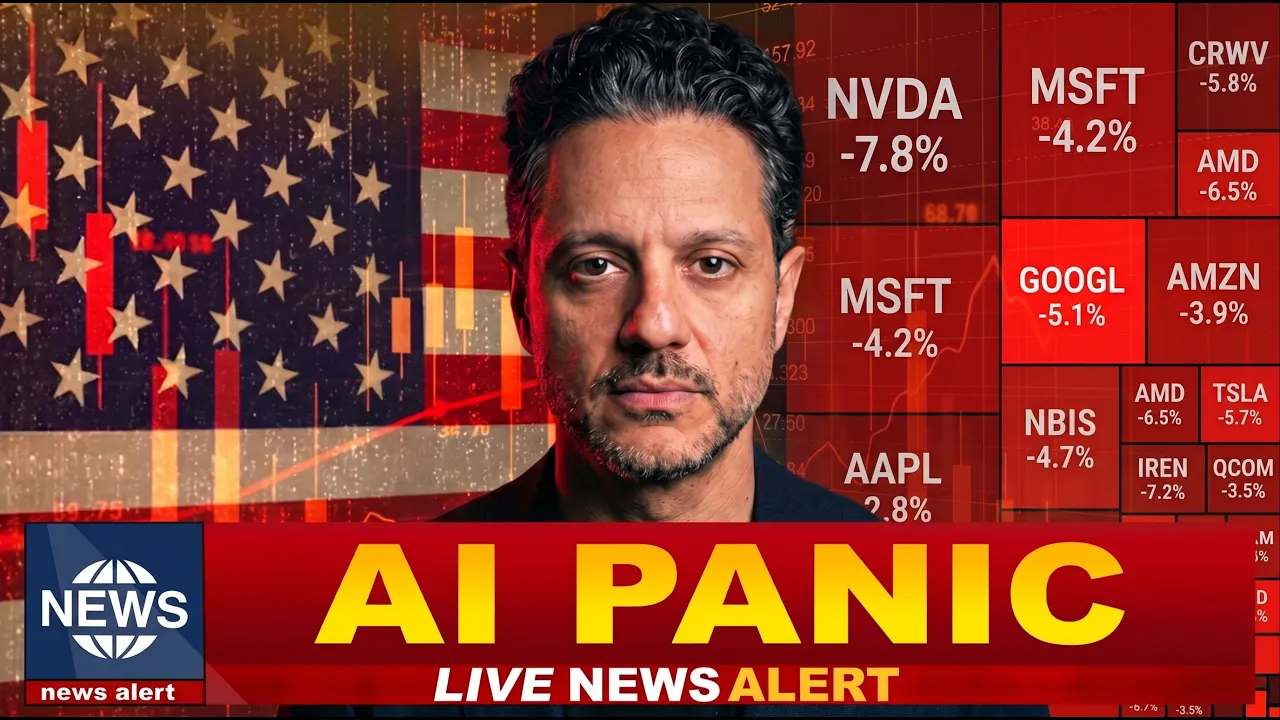
What the HELL Just Happened to the Stock Market?

- Video return
- —
- Calls
- 1
- Buy / Sell
- 1 0
- Published
Recommendations
Entry is the asset's closing price on the publication date. Current is the last close on record.
-
Entry $250.00 18 Oct 2026Current $250.00 16 Oct 2026Result +$0.00vs. index +0.0% SPY +0.0% over the same days
Cite this call Watch source segment (937s) *
Surrounding source transcript
…hat tech could have a little bit more dropping to do, but SOXL here below 100 with this full unwind from 300. I definitely don't mind picking chips up here. Google is still coiling. As I said last week, this has not really moved in months. Same as Amazon. I think this is a decent buy here. I am starting to look at Dell once again as it's down in a bare market 24% from highs. And if last week I said that there was an opportunity a asymmetrical shot at investing in consumer staples and that same asymmetric bet did not exist in…
Same as Amazon. I think this is a decent buy here.
AI-extracted context Google is still coiling. As I said last week, this has not really moved in months. Same as Amazon. I think this is a decent buy here. I am starting to look at Dell once again as it's down in a bare market 24% from highs.
Full Transcript
This is the worst thing to ever happen to the stock market. At least if you listen to everyone on X, that is what you'll think. And we are getting a Black Monday, a limit down all because the S&P 500 had its first minus 1% day in over 50 trading days. In this video, we're going to go over what happened last week with the Nasdaq down almost 6% last week, the S&P 500 down 1.95% last week. But more importantly, beneath the surface, as we've said all year long, this is a tough market because there are constant rotations going on. And the rest of the S&P 500 sectors that were beaten up. So, staples, energy, healthc care, materials, they all did really well last week. and tech was back to tanking. So, we're going to talk about what happened last week, why it happened last week, what are the red flags that the market is really reacting to here, and then we'll get into the discussion around data center financing, which is part of that, what's coming in the next few weeks so that you can know what to do with your portfolio. Obviously, big tech earnings on the horizon. and we'll talk about how the market is super undervalued right now, which means that there are likely areas that we can potentially position in or start to think about positioning in once this midterm volatility is over. And oh yeah, we are in a midterm year. Did people forget about that? Did people forget that we always have a premidterm volatility around September, October? Come on, you guys have been around this channel. You know this stuff. Back in August, I tweeted this out talking about the September October volatility, not just in in midterm years, but every single year. This is every single year in the last 10 years, showing the VIX spikes and where it gets to by the time October rolls around. So, sit back, relax, keep your underwear on, and let's get right into it. Last week the S the NASDAQ fell almost 6% Russell fell 3% S&B down almost 2% the Dow was flat at 67% the VIX shot up to 22 and I want to remind you of something before we continue further when the VIX goes higher your returns in the stock market are typically much higher if you buy the fear that is more on that later now the rotation that we talked about the last few weeks has flipped once again so what was the narrative that we disced discussed in last week's video that tech aside from things like Meta, Amazon, uh Google, but most of tech was not an asymmetric bet and the asymmetric bet was actually in things like consumer staples, energy, healthcare, etc. Well, now those stocks are back to rallying and tech is getting hammered. And that is just referencing tech that is in the S&P 500. So all of the big tech, if you take a look at all of the tech that that is outside of the S&P 500, so you take a look at some of the optic stocks, you take a look at some of the uh data center stocks, these had their worst period in 2026. And then if we look at the Korean index, the Korean index itself was also down almost to the lows that we saw back in July, which means that memory was also down almost to the lows that we saw back in July. So let's go over what happened first before we jump into what is potentially going to happen in the coming weeks. But the market pulled back because of first of all, in my opinion, hot inflation. Again, something that we talked about in the last video that if inflation comes in much hotter than expected, then that is going to then reignite the fears that the Fed might raise rates once again. And inflation did come in hot. Inflation CPI came in at 3.7% versus 3.6 expected, up from 3.4% in just August. PPI was atrocious, plus 1.3% for the month. You know what the estimate was? 6%. That is the biggest monthly jump since March of 2022. And if you take a look at the rate hike for October, October looks like it still will be a pause, but December the the chance of a rate hike for December has never been higher at 77%. Next, the AI credit stress. So, Coreweave's some of Core Weeav's notes because you know that companies have bonds as well. Bonds don't just refer to treasuries. Some of Coree's bond yields shot up to 15%. And if you take a look at Coree CDS, CDS is credit default swaps. It's basically insurance if Coree defaults on its loans. So the ins, think of it as the insurance on Coreweave loans got up to the highest percentage ever or the highest level ever. Same thing with Oracle and same thing with SpaceX. Now, we'll talk about why that is a little bit more in a second. Anthropic's chip financing. So, Financial Times reported that Anthropic is offering Blackstone a yield above 10% on a piece of a $60 billion debt package. So, Anthropic, the company that is looking to go public soon, is looking for a $60 billion debt package and wants to offer Blackstone 10% on that. I mean 10% we're dealing in junk bond territory for a company that hasn't even IPOed yet. Obviously there's still the everpresent geopolitical and and oil fears. Really the only fear here is that oil continues to spike or stays elevated thereby putting stress on all other parts of the economy and raising inflation even beyond the core inflation. Um seasonality we talked about premidterm years. This is always a seasonal time before the midterms. We are getting rumors that there are some hedge fund blowups, but nothing confirmed yet. But we do know that a lot of hedge funds did dump their AI stocks last week. There is Chinese memory competition, which is part of the reason why uh Korean memory stocks are tanking because this discussion is heating up. In my opinion, this is like a deepseek moment for memory. Remember, deepseeek was supposed to take over US AI. And then to round out the week, there was talk of an Anthropic growth slowdown where Anthropic told investors that it made $16.8 billion in Q3 and the market read that as disappointing growth even though it was up from 11.6 billion in the previous quarter. They said that that growth from quarter to quarter was slower than the previous quarter to quarter growth. And before we go any further, we do obviously have to talk about debt center debt center data center financing. I mean this is definitely a real risk. Companies like Cororeweave, Iron, Nebus, yes, they are really fun to hold when they are rallying. They are fun to trade. They're great in my opinion for short or midterm trades. But if there's any part of the AI bubble or the AI boom that I'm uncomfortable with, it's this this this overexaggeration of leverage. It seems that these loan amounts are astronomical and fantastical and companies as we just saw, Anthropic is willing to give Blackstone 10% yield on those loans. If you look at a company like Cororeweave, I mean we've talked about this before, but Coree is running a,000% debt to equity here, its net debt is 45 billion with negative free cash flows. Yes, its revenue and its backlog are the only things that are keeping the stock price afloat. But if that's the only thing keeping your stock price afloat and you have to continue borrowing money to fulfill that backlog, right? Because backlog are is just consists of contracts that they have to fulfill. It's not unlocked revenue and that revenue will unlock once they fulfill that backlog. But if they are if if they have to keep taking out loans in order to meet those obligations, then that company is subject to a real risk when the macroe economics of yields especially starts to go against you, right? The company can have uh a huge backlog. The company can have extreme demand. But that company is also now subject to a credit event if yields continue to go up because of external macroeconomic factors. That has nothing to do with the company's fundamentals. It's it has to do with the company's uh cost of capital. So as I wrote here, 35 billion of additional financing is required to fund commitments that it has already made and that's not even the what they have to do to acquire new business. That's just for commitments that they already made. So there is a real conflict here between the demand for compute which is real and is ongoing and doesn't seem to slow down especially if you look at ASML and TSM earnings and how the deals to build that compute are structured financially. You know at some point these companies that are taking out so much debt whether it's a coreweave whether it's an anthropic or open AI at some point that is going that's a house of cards that is going to fall. they are taking out more debt than they can afford to pay. It's not like a company like Meta or Alphabet taking out debt where you know that they generate more cash every quarter than most countries do on an annual basis. So, in my opinion, that's a a real risk that that cannot be discounted. And even though it's great to trade them in the current market, if you're someone that is structuring your portfolio and you don't have an appetite for risk and you don't have a lot of time to retirement, these are are risks that you have to calculate and make sure that it it's attuned with your investing profile. All right, what's coming in the next few weeks? We have FOMC October 28th. As we said, the Fed is likely to just hold rates here, but December is the biggest risk. And right now, the Fed is reacting to extremely hot PPI and CPI. Mega cap earnings, we have Tesla October 20 21st, Microsoft and Alphabet October 28th. We have Meta in October 28th, I believe, and Amazon October 29th. Apple November 2nd, AMD November 3rd, Nvidia November 17th, Broadcom and Oracle December 9th. And obviously what we need to see from these companies is a continued to keep the hype going is a continued desire to spend money. But we also want to see these companies road maps for how they are going to monetize AI. whether it's Meta with Muse or Google or Alphabet with its new uh program with its with its new frontier model Argon. We also have the Treasury refunding on November 4th. We want to see if Scott Besson is going to put his money where his mouth is and completely cancel the 20-year Treasury in hopes of bringing the long-term yields down for the US government. Now, why I think in my opinion this is a seasonal pullback. Valuations have already reset. If you look at technology forward PE, this is the lowest level that we've seen in a very long time and well below its average. The 5-year average for tech is 25x. The 10-year average is 23x. So, I think between now and mega cap earning season, which is in within the next couple of weeks, we're going to really get a sense for how undervalued or how valued tech is, depending on whether it meets its obligations and raises guidance. This is the one that's crazy to me. Nvidia's forward PE right now is sitting below 20. This is the lowest valuation that we've seen since 2016. I think the price of Nvidia split adjusted was like $2 in 2016 and Nvidia's down 12% from all-time highs. This is one in my opinion that is now a no-brainer, but more on that later. Fact set has the S&P 500 earnings growing 29.6% in Q3. We'll see if we get a third straight quarter of above 25% growth for the S&P 500. Another reason that I think last week was a clearing event is that hedge funds just sold almost 2 years of net AI buying in one week and we are going to get the capex numbers in the next couple of weeks. But if the capex numbers stand then there is a obviously a shortage in all AI components but especially in things like memory. JP Morgan sees a shortage of memory of about 20% this year, 19% next year, and 15% in 2028. And I think the Chinese memory press release is just FUD in my opinion. And also, in terms of seasonality, we are in a midterm year. October tends to be the best month in a midterm year. Obviously, right now, as of the time of this recording, it's October 18th, and things don't look so hot. And I do take seasonality data with a grain of salt. But in my opinion, the volatility that we are seeing, as I said, is part of seasonality. And also, yields look like they have peaked. So, if you take a look at the 10-year yield, we hit the 2007 highs, and we almost fell below 5% on Thursday. This same exact thing happened, by the way, in 2018, which was Trump's first midterm year, where yields topped out in October of 2018 before tanking. And then, obviously, in 2020, we had CO, so that doesn't count. But here's how I'm positioning in my opinion. When the VIX spikes like it did last last week, I am definitely looking once again for asymmetric opportunities on that spike. And tech once again very different from the picture that we talked about last week. Tech right now does seem just within a week because of all the unwinding, there are some really great opportunities here. Now, I don't think we're out of the woods just yet because based on a study that I ran, the last 44 OPEXs, and last Friday was an options expiration day, the last 44, the low of OPEX was taken out at some point. And if OPEX was a red day like it was last Friday, then that the that OPEX low usually gets taken out within a week or less. So, I'm not going to be rushing into swing trades here. I don't think that this is a swing trade environment. I don't mind buying stocks here, especially ones with asymmetrical opportunities and values. But swing trades, in my opinion, are still not a go here. And obviously, when I'm ready to swing trade again, I will send those out in the Traveling Trader Academy as every single swing trade that I take gets sent out here. So, I do think dollar cost averaging in tech here is not a bad idea. We may see more unwinding. As I said, that low of opex typically typically gets taken out on QQQ, which means that tech could have a little bit more dropping to do, but SOXL here below 100 with this full unwind from 300. I definitely don't mind picking chips up here. Google is still coiling. As I said last week, this has not really moved in months. Same as Amazon. I think this is a decent buy here. I am starting to look at Dell once again as it's down in a bare market 24% from highs. And if last week I said that there was an opportunity a asymmetrical shot at investing in consumer staples and that same asymmetric bet did not exist in tech because tech had already run. Well, now it has flipped. So things like consumer staples, like uh healthcare, I think these things now have run up too much to actually engage with and I will need to see a drop in these once again. But as an index, I think the Dow is well positioned here. and stocks that are that really were getting hammered by the 10-year yield, such as Home Depot, such as McDonald's, depending on whether the company fits your investing profile or not. I think that these are at major demand levels in the same way that consumer stable stocks such as Walmart, such as Costco also bounced off of their major demand levels. So, as always, I will send out all of my buys in the Traveling Trader Academy as well. And here are just some things that would not that would change my mind. Maybe not change my mind, but would make me more cautious. A surprise hike on October 28th. I don't think that this is likely, but certainly if it happened, I think it would change things just like with hot inflation. I didn't expect that to I I didn't have a opinion one way or another, but the fact that hot inflation came out now, you see how the market reacted. Um, hyperscalers cutting capex for 2027. They are still expected to spend $750 billion. If they start cutting back capex, I think that will be really good for the hyperscalers. It will be bad for overall AI. I think that could cause a market crashing event. Now, the credit stress spreading to investment grade credit, there aren't any real signs of that happening yet. And although high yield spreads are rising, they are not even as high as they were earlier this year when the Iran war kicked off. But if this continues higher past that 3.5 level, this high yield spread, I will start to get worried. If the 10-year turns around and starts breaking above its high at 5.3, that will also send an alarm signal uh to that will also send an alarm signal to me to really start thinking about being risk off. And I just want to remind you, as I've been saying, I sound like a broken clock right now. If we do get a correction, which we we are very close to that in at least some sectors, this doesn't even require a correction. This is just saying that every midterm year 12 months after the election, the average gain for the S&P 500 is 16.6 and in a lot of cases was much more than that. Even in 2022 when we had a bare market 12 months after the election was plus 8.3%. So, I will keep a lookout for VIX spikes. I will keep a lookout for stocks that I want to own and I will definitely be looking to accumulate the fear during this stage within the next couple of weeks. I personally don't anticipate earnings to be anything but tremendous. And you can see that 84% of the companies so far in the S&P 500 have reported a positive EPS surprise. So, I personally don't expect this to not continue. I'm not an Nostradamus. Obviously, anything can happen, but those are just my expectations for now. As always, I will be sending out every swing and every piece of analysis, as well as every long-term stock that I end up buying. And I go live every single morning at market open in the Discord. So, if you want to join, make sure that you click the link below. Come join thousands of traders. Right now, we have 25,237 members in the Discord. Make sure that you are one of them. If you care about your portfolio and you want to watch me trade live every single morning, subscribe to this channel. Hit that notification bell. Stay safe out there, traders.
Comments 0
Sign in to join the discussion.
Sign inNo comments yet. Be the first to share your thoughts!