… $2 billion investment and similar purchase commitments. And these companies produce optical technologies that move enormous amounts of data between AI processors. Again, these optical tech companies could be the next big supply shortages. Nvidia sees it and is investing, and I'd be buying both of these as well. Nvidia also invested 2 billion and partnered with Marll Technology to MRVL to integrate its custom AI processors into the NVLink ecosystem. Now, this is a smart strategic move for Nvidia as it brings some of that AI chip competition into i…
Nvidia sees it and is investing, and I'd be buying both of these as well.
Contexte extrait par IA
Coherent isn't alone in Nvidia's focus in this. Lummentum, ticker LIT, received a separate $2 billion investment and similar purchase commitments. And these companies produce optical technologies that move enormous amounts of data between AI processors. Again, these optical tech companies could be the next big supply shortages. Nvidia sees it and is investing, and I'd be buying both of these as well. Nvidia also invested 2 billion and partnered with Marll Technology to MRVL to integrate its custom AI processors into the NVLink ecosystem.
… $2 billion investment and similar purchase commitments. And these companies produce optical technologies that move enormous amounts of data between AI processors. Again, these optical tech companies could be the next big supply shortages. Nvidia sees it and is investing, and I'd be buying both of these as well. Nvidia also invested 2 billion and partnered with Marll Technology to MRVL to integrate its custom AI processors into the NVLink ecosystem. Now, this is a smart strategic move for Nvidia as it brings some of that AI chip competition into i…
Nvidia sees it and is investing, and I'd be buying both of these as well.
Contexte extrait par IA
Coherent isn't alone in Nvidia's focus in this. Lummentum, ticker LIT, received a separate $2 billion investment and similar purchase commitments. And these companies produce optical technologies that move enormous amounts of data between AI processors. Again, these optical tech companies could be the next big supply shortages. Nvidia sees it and is investing, and I'd be buying both of these as well. Nvidia also invested 2 billion and partnered with Marll Technology to MRVL to integrate its custom AI processors into the NVLink ecosystem.
Transcription Complète
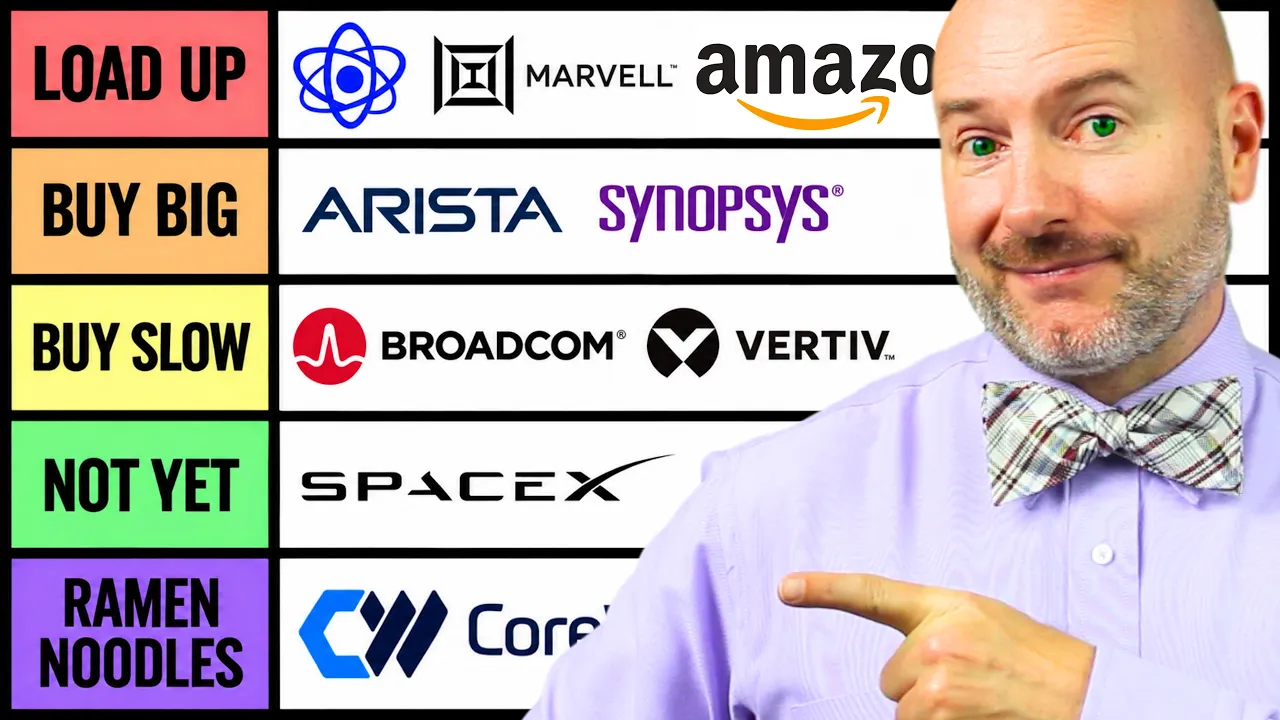
Nvidia has quietly built a $63 billion stock portfolio, guaranteed billions more in AI financing, and made itself the financial backbone of the entire AI revolution. Wall Street warns this could end disastrously, but I see something else. A road map to the next AI stocks to buy. I'm going to dig into Nvidia's investments and partnerships to uncover 18 stocks. Some I'm buying and some I would avoid completely. Nation, Nvidia isn't just selling the chips powering the AI revolution anymore. It's become the banker, the investor, the supplier, and increasingly the financial backs stop for the entire industry. And when you see how all these relationships fit together, you're going to understand why following Nvidia's money could be one of the most powerful ways to find the next AI winners. A recent Wall Street Journal investigation called this a dangerous new role for Nvidia, highlighting tens of billions of dollars investments and hundreds of billions in financial commitments and guarantees throughout the AI ecosystem. It points out that Nvidia is on the hook as a backs stop of $105 billion to an Ohio data center for OpenAI lease payments. That means if OpenAI doesn't have the money, Nvidia pays. As of late August, Nvidia has guaranteed over $230 billion in lease payments and hundreds of billions in other financial support. We're going to walk through each of these steps, show you how it changes everything for the AI boom, and more importantly, how it can show you the stocks to buy. But it starts with Nvidia's enormous cash flow here, generating almost $130 billion in free cash flow over the last year. That's the cash it brings in on operations minus the investments it needs to make in its own business. Additional cash it has on hand to invest in growth or outside the business. So what's happened then? Because many of the startup companies driving this AI revolution like OpenAI, Anthropic, Cororeweave, and Nebius just don't generate enough cash from their own businesses to grow. Nvidia has decided the best use of its cash is to invest and finance these companies. We're going to look closely at each of these, but from handing over cash for an ownership stake in the company to acting as a sort of co-signer on the loans and guaranteeing those companies commitments to others, Nvidia is keeping a lot of the AI model makers, the data center builders, the hardware providers in business and growing fast. And then beyond its own cash flow, Nvidia is partnering with Apollo, Black Rockck, Goldman Sachs, and other Wall Street giants to create financing platforms to mobilize more than $500 billion in investments for AI infrastructure. It's also guaranteeing demand for some customers. Its agreement with Cororeweave initially committed Nvidia to purchase up to 6.3 billion in computing capacity that Cororee couldn't sell to its other customers. Of course, this isn't just all from the generosity of CEO Hang's heart. That growth in AI drives demand for the GPU chips, the networking, and the software that Nvidia sells. Nvidia is expected to nearly double its revenue this year to $411 billion after doubling it last year and the year before. Reaching $400 billion in revenue would be impossible if Nvidia's own customers weren't generating the cash or or then couldn't get the financing to fill that gap. With the cash investment, the financing help, the back stops from Nvidia, though these companies are pushing Nvidia's own revenue higher, converting that into cash flow, and that the company can then turn around and reinvest back into this system. Now, while the Wall Street Journal paints this as a critical risk in the AI theme, I'm going to show you next how it can actually reinforce the system and reveal the stocks to buy. But I don't want to just ignore the risks either. Here we see the journal compares this delucent technology during the dot boom. there. Lucent helped finance less creditworthy telecom customers so they could buy its equipment. When the telecom bubble collapsed, customers couldn't pay and Lucent suffered spectacular losses. That stock went from $84 a share and a $258 billion telecom Darling to just 56 cents each by 2002. By 2006, Lucent had no choice but to sell itself to Alcatel to avoid bankruptcy. Now, could Nvidia face something similar? Yeah, absolutely. It's possible. The financial dependencies are real, even if the underlying demand for AI is also real. But here's what I think investors are missing. Nvidia isn't just financing demand. It's showing us exactly where it believes that AI industry needs to grow next. Every investment, every strategic partnership, every multi-billion dollar purchase commitment. It is another clue about where the biggest opportunities, the biggest bottlenecks might be in this system. So then rather than just worrying about whether this financial machine eventually breaks, I want to follow the money. Starting with Nvidia's own investment portfolio, a portfolio of stocks, it's grown by 16fold in just the last year, adding almost $20 billion in shares of companies that could lead that AI revolution. I'll show you how to apply this, the stocks to be watching next, but you're going to recognize today's sponsor, Gamma, because I used it to help create many of the slides I'm using in this video. Gamma makes it easy to turn your ideas into presentations, websites, graphics, and social media posts. You provide the idea and Gamma builds out the structure. You have full control at every step, editing, format, information, and flow. I've used Gamma before, but this new Gamma 5 is [clears throat] a huge improvement. For this presentation, I basically just started with a rough idea. I used the microphone to talk through what I wanted to show about Nvidia becoming the center of this AI ecosystem, referenced some of the research and the notes that I'd already put together, and then let Gamma's agent take it from there. But this wasn't just taking my information and making it look pretty. Gamma actually researched the topic. It pulled in Nvidia's SEC filings, found news and analysis around its partnerships and investments, and provided cited sources so I could go back and doublech checkck the information myself. From there, it helped me organize the companies into different tiers based on how dependent they are on Nvidia. Of course, I still changed it here and there with my own analysis, moving the stocks around in the tiers, but even making those changes was easy. I could just speak right into the microphone, tell Gamma what I wanted changed, and it updated the slides immediately. And that is what surprised me most about Gamma 5. It wasn't simply creating slides from my information. The agent was helping with the research, the organization, analysis, and design while still giving me a presentation that I could make my own. Now, I've used Gamma before, and this really does make it seem like a different product. So, if you create presentations, websites, social posts, or docs for work, school, or even your own videos, check out Gamma 5 at the link below and start designing today. According to Nvidia's latest 13F filing, now remember, every big money investor, company, or hedge fund has to file these with the SEC each quarter. Here, Nvidia held just over $63 billion in shares across eight publicly traded companies at the end of June. Now, this doesn't include investments in private companies, but these aren't just speculative investments either. Hell, Nvidia isn't your typical bro investor with a Hello Kitty bandana trying to get rich. Each of these investments tells us about where Nvidia wants the AI industry to grow. Now, more importantly than these, some of the biggest stock opportunities we're going to uncover aren't even in this portfolio. They're hidden in Nvidia's partnerships that we'll look at next. But let's start here with the biggest surprise and Intel, ticker INTC. Nvidia owns nearly 215 million shares valued at almost $30 billion at this filing date. That's nearly half the reported portfolio invested in one company that that spent years struggling to compete in semiconductors. No. In fact, this one confused me at first glance because Intel with its CPU chips never really competed with Nvidia's high performance GPU chips. But here's the opportunity. Intel is trying to become a major contract manufacturer, competing with Taiwan Semiconductor. If it can successfully manufacture leading edged AI chips, these could completely change its growth. Now, Nvidia's announced partnership with Intel focuses on integrating Intel's x86 processors with Nvidia's AI architecture, not a commitment to manufacture Nvidia's GPUs. Intel Foundry ambitions remain a kind of a separate potentially enormous opportunity and a big execution risk. And that's why for right now, I think I'd pass on Intel just yet. And that investment by Nvidia does prop it up, but not convinced yet that it can manufacture the chips, which is what the stock is really depending on. Next here is SpaceX. Ticker SPCX with nearly 123 million shares valued at almost $21 billion. This might surprise a lot of you, but SpaceX isn't just about rockets and satellites. With its AI ambitions, it's becoming a massive potential consumer of computing infrastructure. And Nvidia here is positioned to benefit as SpaceX expands its AI capacity. In fact, SpaceX is reportedly seeking roughly $40 billion in financing largely to purchase Nvidia chips. That is the circularity we just talked about playing out on an extraordinary scale. Now, I updated on shares of SpaceX in our Sunday outlook video. While the stock has rebounded from its low and is now back around its IPO price, I still think it struggles for at least another month as that final lockup expirations come off early investors. Then we've got two of the clearest examples of Nvidia nurturing its own customers. Cororeweave, ticker CRWV, with 47.2 million shares worth $4.7 billion and Nebus, ticker NBIS, with a $328 million position. Now, both are building enormous AI cloud infrastructure businesses. Both require billions in capital expenditures and both face significant cash flow pressures as they expand. Oh, we've been watching these Neocloud companies including Oracle, OCL and Iron closely because these could be the real weakest links in AI companies with giant cash flow problems and committed to building out equally giant data centers. You can see here over the last year the stocks have separated with shares of Nebius holding on to its 100% gain over that year. While investors increasingly worry about these other three companies, Nvidia is also investing heavily in its suppliers. Coherent, COR, represents 7.8 million shares worth just over $3 billion. Coherent supplies optical technologies that allow enormous AI clusters to communicate at higher speeds. And here, Nvidia didn't just invest, it also committed to multi-billion dollar purchases and secured future capacity rights. That's a stronger signal than just buying the stock. I've been watching this optical technology side of the market and this is quickly becoming the next bottleneck. The ability to move that data faster than traditional copper can handle. So, this is one I would definitely be following Nvidia into. Synopsis, sticker SNPS, is another $2.1 billion position. Its semiconductor design software helps engineers develop increasingly complex chips. As AI hardware becomes more sophisticated, those design tools become increasingly valuable. Our shares of synopsis haven't blown out like a lot of these others. And the valuation is still relatively attractive here on its 37% revenue growth expected this year. Nokia ticker NK represents another $2.2 billion investment. Nvidia is working with Nokia to integrate AI computing into telecommunications networks including next generation 6G infrastructure. Now for me though, Nokia is still too much of a legacy telecom company. And that 4 to 7% annual revenue growth just isn't the kind of upside I'm looking for in these AI names. Even though we don't usually talk biotech on the channel, I did want to point out this small position in Generate Biio Medicines, an AIdriven biotech. These biotechs could hit the holy grail of drug discovery, but it's really hit or miss. So, I usually try avoiding them. Now, understand having Nvidia as an investor isn't enough to make another company a winner. And in fact, for some of these, I think it's a sign they need that support. An even bigger signal though is coming from where Nvidia is also committing its purchases, integrating its technology, and helping finance its growth. That's where the story gets even better because some of Nvidia's most important strategic partners aren't in this 13F. That's those partnerships that could reveal the opportunities investors are completely overlooking. I'm going to highlight five of those critical partnerships next. But there's also a catch here. Those same partnerships creating enormous opportunities could also expose these companies to serious risks if Nvidia pulls back on that financial support or the AI spending slows. I'm going to outline those risks more later, but let's revisit coherent ticker co which we just saw in Nvidia's portfolio as well. Here, Nvidia also committed to billions of dollars in future purchases and secured access to that optical manufacturing capacity. And Coherent isn't alone in Nvidia's focus in this. Lummentum, ticker LIT, received a separate $2 billion investment and similar purchase commitments. And these companies produce optical technologies that move enormous amounts of data between AI processors. Again, these optical tech companies could be the next big supply shortages. Nvidia sees it and is investing, and I'd be buying both of these as well. Nvidia also invested 2 billion and partnered with Marll Technology to MRVL to integrate its custom AI processors into the NVLink ecosystem. Now, this is a smart strategic move for Nvidia as it brings some of that AI chip competition into its own ecosystem rather than just having to fight to keep it out. I've been buying Marll now for a while as one of the only competitors to Broadcom, took AVGO in that accelerator segment of the market. Now, moving all the data inside a data center is one thing. Having the power to cool these AI factories is something else completely, and it is also one of the biggest bottlenecks. It can take less than a few years to put up a data center and all the hardware inside, but much much longer up to 10 years to build out the power generation and the cooling. And that's where Verive ticker VRT comes in. Nvidia and Vertive are developing next generation 800volt power systems and cooling infrastructure designed for increasingly power- hungry AI racks. GE Vernova ticker GEV is also collaborating with Nvidia in this power infrastructure theme for gigawatt scale data centers. And we couldn't talk about AI bottlenecks without Micron technology to MU. Developing high bandwidth memory for Nvidia's Vera Rubin architecture. As GPUs become more powerful, memory bandwidth becomes another critical constraint. And Micron has already pre-sold its production capacity years out in advance on that demand. But what I think is really interesting, if you look through all of these together instead of separately, as those headlines hits, you start to see a pattern. Optics, networking, memory, electricity, cooling. Nvidia is helping solve the bottlenecks that could otherwise slow down its own growth. Now, for investors, that is the signal. I like some of these companies, the stocks Nvidia is buying. But what I really like is following the problems Nvidia is spending billions of dollars to solve with these partnerships. Now, before you go buying every stock Jensen Wang touches, there is a dangerous side to this as well. Because when Nvidia invests in a company, helps it raise financing, and then sells its billions in GPUs, you have to ask how much of that demand is real, and how much is just being supported by Nvidia's own money. And as I've been talking about in prior videos, this is especially important for companies like Coreweave and Nebus and Oracle, which are spending billions of dollars building that infrastructure long before those investments generate any positive free cash flow. Remember that comparison to Lucent during the.com bubble when customers couldn't repay their financing? the whole system started unraveling. Now, I'm not predicting that happens here. AI demand is real and these investments could generate enormous returns, but there is a big difference between a company benefiting from Nvidia's growth and one that depends on Nvidia's financial support to survive. And that is where I want to turn everything we learned into an actual investing strategy, ranking 18 AI stocks by their dependence on Nvidia. Here, I want to follow the money Nvidia's investments and follow the bottlenecks in Nvidia's partnerships, but then dig into each of these which can survive the cracks in that relationship. That's because the best AI investment might not be the company Nvidia is spending the most money on. It might be the one that benefits from Nvidia's growth without needing Nvidia to keep it alive. So, let's bring everything together with these 18 stocks ranked across three levels of dependence on Nvidia. Now, I've added a few other AI theme stocks here. Some with different levels of partnerships with Nvidia as suppliers, buyers, or or even both because while almost every company in the AI industry benefits from Nvidia's growth, not all of these are going to survive if something breaks in this Nvidia relationship. Starting with tier one here, the highest dependence level. These are the companies where Nvidia's financial support or or strategic partnerships are critical, even existential. Here, Core Weave and Nebius are the biggest question marks for me. Nebia shares have performed well and investors bet it can become a dominant neocloud provider. But Cororeweave and Oracle have shown us how quickly sentiment can change when investors start questioning that enormous capital spending required. These companies are spending hundreds of billions of dollars today on infrastructure they hope will generate profits tomorrow. But I think this is where we're going to see the first cracks if the AI theme starts weakening. Intel is another one I'm avoiding for right now. Nvidia's partnerships gives it an opportunity, but I'm still not convinced Intel can compete with Taiwan semiconductor in that advanced manufacturing. Synopsis is different, though. I do like this one. Its chip design software is critical to that semiconductor industry, and its business isn't as dependent on Nvidia's financing, and I don't think the market is watching this one as closely, so valuation is still very good. Now, tier 2 here is where we start finding some of my favorite opportunities. Coherent is one I've been watching very closely. Optical technology is becoming a major bottleneck and the demand doesn't disappear if Nvidia slows its investments. Arista Networks tick tocker is also another favorite providing that networking hardware needed to connect increasingly massive AI data centers. It's a big competitor to Broadcom to AVGO. But the demand here is one that both of these can win. And Marvel is particularly interesting because its custom AI accelerators could compete directly with Nvidia GPUs, while its partnership allows Nvidia to benefit from those chips. Anyway, I like both sides of that opportunity. And Nokia, on the other hand, just doesn't offer the growth I'm looking for. Its 4 to 7% expected annual growth is is a tough sell when we're looking at the biggest AI growth stocks here. Again, SpaceX could be a good long-term investment, but with its valuation and those remaining share lockups to consider, I'd rather wait on this one or just use that money for some of the other stocks on this list. Then, tier 3 includes companies that benefit from Nvidia, but aren't financially dependent on it. These are larger companies, so might not have that tripledigit growth, but they're more stable and definitely worth a look. Broadcom is one of my favorites here. It competes with Marll and that custom AI chips, but also sells networking and other semiconductor products. I see no problem owning all three here. Broadcom, Maravel, and Arista networks, even on their competition in that networking and custom AI chips. All three of these are right in the middle of the biggest demand bottlenecks. And all of them can do very well. The safest bets here are in the cash flow monsters, Microsoft, Alphabet, and Amazon. These companies have the cash flow, the infrastructure, and the customer relationships to finance their own AI growth. They need that AI computing power, but they don't need Nvidia to write them a check. And for me, this is one of the biggest takeaways from this, that the biggest opportunities aren't necessarily the companies Nvidia owns the most shares in. They're the businesses positioned to benefit from that AI boom with or without Nvidia's financial support. Because if that financing machine ever does slow down, that's when we're going to find out which AI companies were building sustainable businesses and which were just writing Nvidia's money. Make better presentations, websites, and social posts. Check out Gamma 5 with the link in the description. And don't forget to join the Let's Talk Money community by tapping that subscribe button.

Commentaires 0
Connectez-vous pour rejoindre la discussion.
Se connecterAucun commentaire pour l'instant. Soyez le premier à partager votre avis !