Contexte
Our next guest does say this is not fundamentally changing the AI trade, which he expects to keep roaring ahead and he says stick with Nvidia and Western Digital among others.
reasonable to be bullish on memory makers like Micron and SKH for at least the next 1 to two years, possibly longer depending on what happens
Contexte
I also think it's reasonable to be bullish on memory makers like Micron and SKH for at least the next 1 to two years, possibly longer depending on what happens.
Contexte
At Deep Water, we sold Nvidia a couple months ago, big believers in all they're doing, but we just felt like this was going to be continued beats, but the stock would not be rewarded.
I seriously think that Nvidia still has plenty of runway ahead of it and I think this company will be worth substantially more in future years than it is today
Contexte
I seriously think that Nvidia still has plenty of runway ahead of it and I think this company will be worth substantially more in future years than it is today.
Transcription Complète
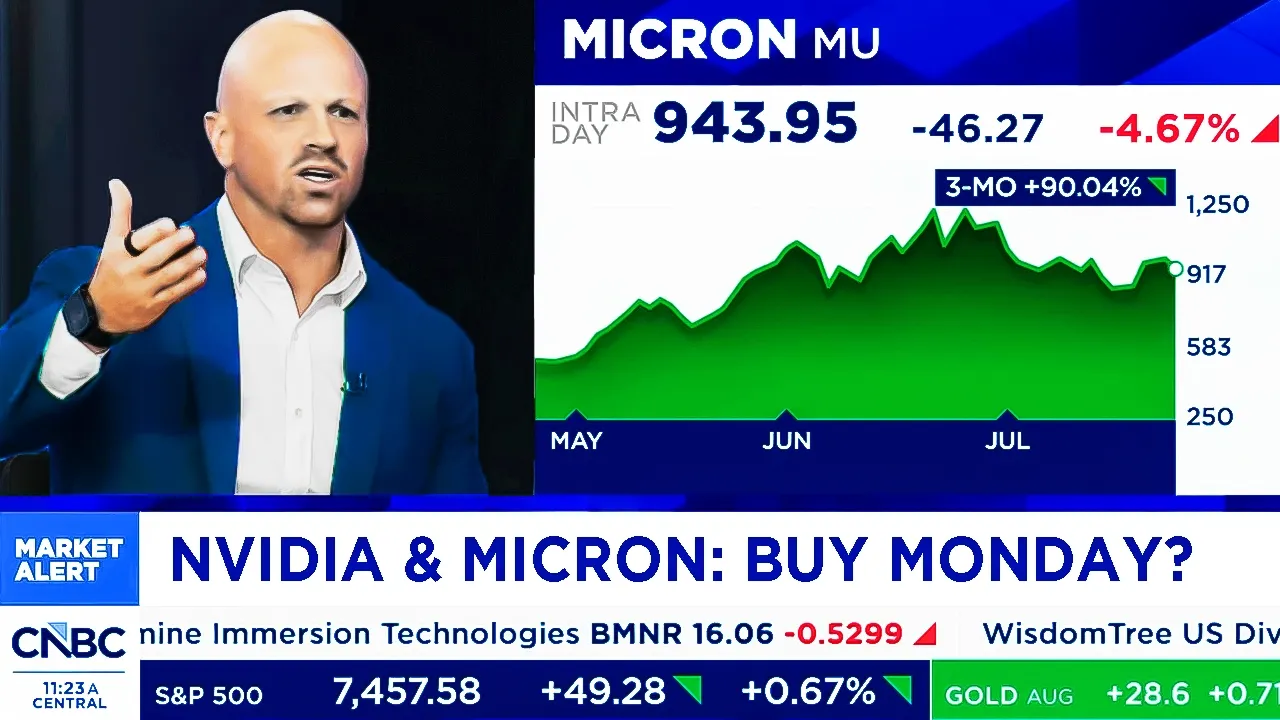
Our next guest does say this is not fundamentally changing the AI trade, which he expects to keep roaring ahead and he says stick with Nvidia and Western Digital among others. Doug Clinton is the CEO of Intelligent Alpha and a managing partner at Deep Water Asset Management. Doug, it's great to see you. Is that a version of what you think is going on here that despite the model wars and the pricing wars, at the end of the day, the demand for all the layers of infrastructure that go into this, will that will that will continue to rise? >> It was great foreshadowing, Kelly. You read my mind. Uh that is exactly what we think will happen. And if you look at what these models are doing that are coming out of China, right? They are edging up to the frontier. And I think this is really important. They're not exceeding the frontier. The US model builders are still the ones who are pushing frontier intelligence. The Chinese model builders are then sort of getting to that same level and making it a little bit cheaper. It isn't that much cheaper in many cases. And so I think the net effect of all of this is there will continue to be a lot of demand for frontier intelligence because that will be used to solve the hardest problems and then there will also be a lot of demand for these open source models that can do more average tasks and do them a little bit more cheaply as well. >> That said, I don't know if we can show that chart again with which just tells you look the point about the frontier is absolutely where we want the US models to be. No doubt there are national security implications for that among everything else. But for a lot of the users, I think they're going they're clearly gravitating towards something that's good enough. >> I think that's true. And you know what I mean? The US model builders as well also release smaller versions of their models that are very capable as well. GPT 5.6. Their top-of-the-line model sold is on the Frontier, but they have two more models, Terra and Luna, that are much more cost effective, more than 10x cheaper, their Frontier model. and still very highly competent. And so whether it comes from these open source models or even the US frontier labs offering smaller versions of their models, you'll see a lot of use cases go to these cheaper versions of AI. >> Are those so when a when a query is routed to Kimmy or Quan or whatever the model may be, does that imply less Nvidia demand, Lum demand, Pterodine, Micron, Western Digital? Are all of those less intensely used in those supply chains and the in for instance the Chinese supply chains than they are for the US models here at home? >> You know, fundamentally all of this demand comes back to compute period. Full stop. And so the question may become what does the supply look like? And we've heard for a while now that Nvidia chips will start to get into China. they're still on the frontier in what they do which is they provide the best most costefficient token generating GPUs and so I think there'll still be a lot of demand in China for that particular um technology but you think about the rest of the world as well and in many cases some of these open source models are being hosted not just in China but they're being hosted in US servers in servers in the EU and so that demand does cascade over to all of the big players that we know in the US >> so will there be a moment that the popularity of these Chinese models whether the original Deepseek one that launched that was obviously there was a big supply chain conversation around that Nvidia shares were hugely implicated of that at the time whether it's these new models so if you're a shareholder of Nvidia if you're a shareholder of Western Digital just to pick two of the names that you like here are you saying you literally don't have to worry about the introduction of these new models or if anything that you should be encouraged by it >> we're definitely more in the camp of being encouraged by And I would say as well, you think about the Kimmy K3 launch, Quen today. I don't really think that those are the proximal cause for what's been happening in the chip trade really over the last month. I think that's much more of a structural market issue where momentum I think got ahead of itself. And we've been saying since the beginning of the month at Intelligent Alpha, we use AI models to do our portfolio management. Our models had pulled back a lot in terms of our AI exposure because we had such a run. And so I think what we're dealing with right now is not necessarily the narrative of what could these models do, but more just digestion of momentum for a lot of these names in the first place. And if you bring it back to the fundamentals, to your point, Kelly, I think that what we're seeing with these open source models is actually a long-term positive, not a short-term negative. >> All right. And it was more just trading fundamentals. You think that we're kind of pushing the stocks around a lot here? And I know we'll talk more about that in a moment. And our next [snorts] guest says the recent selloff in memory creates a compelling entry point. Let's bring in the analyst Joseph Moore of Morgan Stanley. I every time Joseph I have to resist making like a [cough] more kind of every time I I so I appreciate you uh you playing along. But for the memory trade broadly, which camp are you in? The camp that says even if China's AI models are different and they have Chinese memory chips that are cheaper and their uh stack is is going to disintermediate ours that more compute is still better for memory chips in the long run. Yeah, I think memory is at the center of every methodology for AI training and inference. So, I'm very bullish. I I would say this is an unusual cycle in that you're going to get these second derivative selloffs like we saw in April, like we've seen in the last month. Uh because the the tea leaves that you're reading are a little bit different than you might see. But the true north true north here is the strength of data center and the belief in data center uh customers that memory is going to be a binding constraint on the ability to ramp AI for really multiple years. So those second derivative concerns the things that have been dragging down the stock I think to me have created an interesting entry point here. Although I just wonder about the old saying that the cure for higher prices is higher prices and so much of the gain and the earnings gain in these names has been from higher prices that at some point is there going to be another side? I know they have locked in contracts for multiple years and so on and so forth, but are the companies who have to pay these numbers just going to find another way? Is CXMT the answer? >> Yeah, it's it's a remarkable situation, right? you're going to see as much inflation in memory this year as we've seen in the price of oil and it doesn't get anywhere near the focus on a broader macro sense. You know, we're going to see something like $800 billion of memory inflation. So, it's significant and that cost has to be borne by the electronics industry, by the capital spenders. Um, but there really is no substitute from from uh high bandwidth memory and some of these central uh memories that are needed for AI. And so, I think we we'll find ways to do more with less. I would say that uh we we were we had a road show with Jensen Wong last week and he was sort of talking about that that that memory is going to stay in short supply for many years and token growth is 10x memory growth is much less than that. So we have to find ways of getting smarter about getting more tokens per gigabyte of DM and NAND uh and we will do that but I think uh you know to me this is a cycle that is noteworthy. the amplitude that we've seen so far of the cycle is noteworthy. But I think going forward it's the duration that I'm really focused on is that this could be, you know, really a three, four year situation if AI remains robust where memory remains this tight. >> Joe, I'm I'm personally a little bit pissed about this. I got to tell you because I'm the guy in the rock and roll, my little rock and roll band, the Stella Blues band that >> You're more than little. >> I I I do the I do the recording, right? And I'll tell you what I'm used to. I'm used to going out and buying a new flash drive and say, "Wait a second. 128 gigs is only 30 bucks. It used to be 80 bucks for for for 50 for for what was the one below 128?" 504. >> 64. Thank you. >> But now I go out and I was looking at a terabyte drive and a two terbte drive and a and they're like a hundred bucks or 50 bucks more than they were before. I mean, of course, they weren't all available back then. You didn't think about three and and five terabyte drives, but these are real There's real money that's coming down to the consumer. I don't think there's many people who consume as much data like this. >> All of a sudden, you're seeing it. >> You know, you you you you do a set of music on video and it's a gigabyte >> and all of a sudden that that stuff adds up. So, you're telling me, and by the way, from an economics point of view, >> memory and this tech stuff was stuff that always dragged down the index. It's not dragging down the index anymore. But Joe, just so I want to recap what you're saying, this is a multi-year event is what you're saying. >> Yeah. you're paying a tax uh when you buy that flash drive on the AI strength that we're seeing and the shortages that it creates and it's certainly creating a lot of angst in the PC smartphone businesses and the other users of these technologies. Um but when you run a 75% cumulative annual growth rate for AI spending out for multiple years, it gets bigger each year and we're still growing at a pretty fast rate. So that shortage is intensifying and I think when it when it ends, it won't be because there's more supply. won't be because of these other markets. It'll be because there's a deceleration in AI spending and that's not something that we're foreseeing anytime soon. >> Sorry, Steve. >> Daniel Newman joining me now. UBS believes that Micron will generate $400 billion in free cash flow through 2028. That's a very large amount of money. What would they do with it? >> Well, Stuart, they're going to need to build out the continued capex. All that demand is going to mean more memory. You know, I know these stories come each week. Last week it was the Kimmy K3 story from China that said, "Oh, you know, maybe we don't need so much compute and then the whole market sells off and then, you know, the experts come out and say, actually, we're going to need a whole lot more compute because of this." Micron's at the very center of this. So, you and I have had probably a dozen conversations over the last year about uh this situation. Micron can command its price. It can drive its margins, but it's going to need to reinvest. And the question is, can they build just enough that they don't create that over uh supply that has historically brought memory down? And I think they're going to be able to do it because the AI cycle is very different than historical memory boom bus cycles. >> However, at $1,000 a share, I mean, it's close to that. I mean, that's a that's a very expensive stock, isn't it, in terms of price earnings? Well, in terms of the forward PE, it's trading at under 10 now. So, it really depends what you believe. If you believe that this is a cycle that's going to go bust like they used to in the past when it was related to consumer devices, PCs, and smartphones, then yeah, you're going to be paying a lot for it. If you believe that there's going to be 10 trillion plus in capex, which is the number we have at Futurum, 10 trillion with a bullcase of closer to 12 trillion by the end of the decade, cumulative capex, the demand for memory is actually still very early. These margins are are stable and unbelievably they're going to get close to 90%. And what UBS is saying is that basically uh Micron can pile cash, you know, about 10% of the way to the moon between now in in that in that next period. So, it's pretty unbelievable and unprecedented, but that doesn't mean it's not real. >> What what's the target? What what's your target price for Micron? >> Yeah, Futurum Equities has a has a target at uh 1550 right now. Um and we do believe that based on its next quarter, those numbers could continue to go up. Look, we've never seen anything quite like this. And as I said before, Stuart, with each period of time that we continue to come around these deepseek moments, the Kimmy moment, the, you know, this is the end of the demand for compute moment that we hear come out in the media when we find out that we really are still very early in our demand for compute. And I think we're going to see that in this earning cycle, Stuart. I think we're going to see the hyperscalers are going to confirm, if not raise capex, and we will see that this boom continues. But I will say having some orderly draw downs and having some you know rallies un you know we can't go up and right all the time and so when people see a little selling and they panic I think we need to recognize that the demand is real the capex spend is real the ROI is still being proven that all these companies are going to make money on these trillions of dollars of spend and that we do need an orderly leg up not you know a straight up and to the right all the time. >> Okay. Can you tell me in 30 seconds whether China's AI program is now ahead of United States AI platforms? I mean if you if you don't have IP laws and you can take all the best innovation of the American companies and you can distill it and copy it and then offer it back to the United States at a discount then yeah I'd say they're ahead. uh allar no uh China still depends on US innovation and US investment but they are a formidable competitor and I think that we need to know that with their [singing] rules and their laws being different than ours uh we're going to have to continue to invest and continue to innovate and know that China is coming after us >> but let's begin with the rebound in semis today [music] up 5 a 12% now though still down about 13% from their June highs amid a raft of cheaper AI models and cheaper Chinese component makers our next guest says says all of these worries are misplaced. The market is listening to these words right now. Vec Aria, senior semi analyst at BFA Securities. It's great to have you here, VC. This trade is showing it still has plenty of juice, plenty of life left in it. And why do you think that this area has been too quickly taken out to the woodshed? >> Sure. Hi Kelly. Um I think tech has always been deflationary, right? Whether we look at uh the PC era, whether we look at internet, whether we look at smartphones, uh whether we look at uh cloud computing. So technology has always been deflationary. That's because there are a number of global forces that come together to drive the most efficient uh infrastructure. And I think what we are seeing right now is there was a lot of focus on uh the frontier model developers in the US and now you see the Chinese model developers uh come to the front and I think that competition can only be a very good thing uh for the enabling infrastructure uh layer. Uh so I think the fundamentals are very strong. Uh the demand environment is very strong, supply is very well stabilized, but we just came from a quarter where the semiconductor index ran up over 80%. So I think a little bit of a breather was probably to be uh expected. >> Okay. But you say the bigger [snorts] concern a lot of people have which is here come cheaper competitors whether they're from China or the one we'll talk about later in the show. Here come cheaper CXMT and these other component makers which may be you know lowerc cost producers. And we've all seen this playbook before. you know when the lowerc cost producer comes into the market it tends to set the price and displace the other. So why shouldn't holders of Micron and Western Digital and SanDisk and all of these names be a little bit worried about that? >> Sure. So let's separate uh the places where the competition is happening. the uh uh large language model layer. That's where you are seeing the competition between OpenAI, Anthropic, um right all the new Chinese open- source models and by the way there are number of open-source openweight models that are available in the US uh also including one from uh Nvidia that place is certainly getting very uh competitive but we think it actually democratizes the availability of uh that large language uh model and uh the layer but where you have real entry barriers where you have the larger competitive modes is in the semiconductor layer, right? You mentioned uh CXMT. CXMT does not produce any high bandwidth memory or any of the advanced uh NAND memory that is required uh for the AI layer. So, I think the CXMT competition that is going to come that is only only going to help alleviate the shortages that are in the low-end consumer part of the market, right? They will go after the PC market, they will go after the phone market that are not being served right now because all the capacity is moving to AI. So we don't think that competition means much start there but why wouldn't they work up the food chain in other words once you have a tow hold in this I'm not saying this is easy but obviously there's a pattern here you establish a tow hold in the market and then you ultimately climb up whether it's them or one of these other competitors going after the most lucrative area >> sure uh look anything can be done it's a matter of uh time and cost uh building a new fab once you have the technology takes uh between 2 to 3 years and costs 10 to$15 billion so even even if they had the technology today by the time they put it into practice and implementation is 3 years from now right so anything can be done and by the way it's not that uh the existing suppliers right Micron Samsung and others they're not just sitting still every year they come out with new technology and that new technology is implemented and co-designed with computing with networking so these things are not happening in isolation where somebody comes out with a cool chip and then suddenly right competitors swoop in no you have a very uh strong sense of integrated co-design activity that is going on at all the times with uh between the memory companies the networking companies and the Nvidia AMDs and broadcasts of the world and putting that entire ecosystem together I think is going to be very hard for China doesn't mean they can't innovate in specific subsets of that market they absolutely can but I think to put it all together along with all the software and developer ecosystem I think that's a very very long time uh from now >> two more quick questions for you just kind of the first on this great line that you have where you say [laughter] as we've seen more open source competition again from whichever place you say open does not mean free do you think people are kind of conflating those two things yeah I think we have seen in the past uh competition come from China in other parts of uh technology um right in EVs uh we have seen that in um you know other parts of the solar industry as an example and I think people are looking at those past examples and they're saying well if they were able to compete very effectively in those areas you know why can't a cheaper model essentially be a tip of that iceberg and essentially uh forecast you know cheaper competition to come from China but I think these are apples and oranges competing in AI requires as I mentioned co-design in 10 different things right you don't just come out with one thing at a time even look at competition within the US right a competition between an Nvidia and AMD and Broadcom and Marll and others right there is a reason why Nvidia is managing to keep 70 80% of the economics of the market because it is hard for anyone else uh to come in and duplicate Nvidia success along every one of those um you know dimensions. So for China who is by the way restricted from buying the most advanced software design tools to design their chips who is restricted from buying the most advanced semiconductor equipment. So even if they could design the chip where are they going to manufacture it right and then even if they do all that there are restrictions in terms of how their models are going to be adopted by leading enterprises. So that's why I think it's it's it's going to be a long-term [clears throat] um you know tail risk uh to this uh industry. To me the real uh thing to watch out for is not competition from China. I think that that's a lot of um you know a kind of media clickbait type of stuff. I think the real thing to watch out for is that are the US cloud players are they still able to invest in their infrastructure even with this rising cost of memory and compute and networking. To me that is the most important question competition coming from China. whatever Google says on Wednesday, whatever everybody says in their earnings reports, as long as they're continuing, you you want to see that number still go up or at least stay, is it good enough to stay steady or do you want to see it still go up? >> Uh, 100%. I I I think we have to hear directly from them uh uh that uh the benefit of their investment in this technology is resulting in token uh growth, is resulting in token demand that is going to far outpace the amount of cost that they have to put in, right? that they are able to generate ROIs. Think about what happened in the last earnings call. Yes, their capex all went up a lot, but we also saw record uh success in search, in e-commerce, uh in uh social uh engagements. I think that's what we need to see that the benefits of all uh this technology layer are acrewing by way of faster growth. I think that is the only thing that matters to investing in AI and and semiconductors. >> Absolutely. and you're kind of getting into this area and Jim Kramer was tweeting about this earlier today saying you know he he thinks and there's a huge debate about this as you know he's on the side of we must not let our companies use these Chinese models to save a few bucks this is vital national security how this divi [laughter] how would you say this debate ranks in terms of overall semi demand do we need bulcanized markets to continue to drive strong growth for all of these components or is it okay for you if we end up you know which I'd love to ask what you think you know you don't have to answer that on which side we should come down on but how are you gaming this out >> sure look my view is Kelly probably biased because I cover the enabling uh layer and for the enabling layer competition between customers is great right nobody wants to see you know just one or two customers um right having 80 or 90% of the economics of the structure right uh so I I I think my view is probably bias from that uh perspective. Of course, from a national security and other perspective, right? A certain business model might make sense. And by the way, we do see that uh restrictive uh environment when it comes to uh you know selling uh China whether it is semicap equipment right whether it is advanced memory right and so I think there are barriers in other markets um right uh at all. So to have some barriers in these markets um right is not going to be welcomed but I [clears throat] do think would be understood by uh the industry. But I think the the the bigger picture again is that the end uh end state um right the what we are optimizing for is not the best model. What we are optimizing for is the most reliable and scalable infrastructure that lowers the cost per token and expands adoption. I think that that is the end state that I think the technology industry is going for. >> And so a great rule of thumb Kelly is invest in scarcity. Invest in scarcity. There's a scarcity of memory chip. There is a scarcity of compute power. Now, doesn't mean the stocks can't get overhyped, and I think some of the the memory names got overhyped early in the year, but the big hyperscalers, they're not hyped at all. >> Yeah, we're going to talk in a moment with a couple of brilliant commodities investors, Andrew. And some of this talk about scarcity reminds me of investing in commodities, which they they might disagree, but for the average person holding commodities goes back to the eric bet in the 1980s, holding commodities over the long run is not always that profitable. And so yes, they have scarcity now, but scarcity now doesn't mean scarcity forever. >> 100%. You're absolutely right. But I don't think that will be resolved in the near future. What is the difference between oil and and uh compute power is there is a lot of oil on the ground and lo and behold we have a war but oil goes to $100 a barrel and somehow someway we get that oil out of the ground and it gets to the right people. So I I I I think that's the key difference is how long until supply will catch up to demand. You know, ultimately the dotcom bubble blew when everyone that needed a router bought a router and then supply met demand. And I just think we're not there yet. And I keep going back to what I hear from companies over and over and over. Look at some of the, you know, the software names that have missed or the large enterprise computing companies. They're missing because they're saying that spending is going towards hardware, not their products. Right now, the companies are screaming this over and over. Cali, I think >> I believe that it's real, but I would question the ROI just because on the on the possibility that compute is a that there that the output that the AI output is a commodity. >> Absolutely. I'm I'm making a bet that the the returns will come down the road for these companies. you've got very very smart people that are making this investments whether it's you know in Amazon or other big hyperscalers. So I think uh you have to invest and believe what do you believe in them or do you simply say I haven't seen the ROIC yet? I think there's an option on the sidelines mean [laughter] it should be your whole portfolio but I wouldn't throw in the towel on these stocks that you still think the AI trade is still here still here. It's still going to be powerful. This is the biggest computing shift of my lifetime of our lifetimes. [snorts] This is a massive computing wave. Um we're seeing like unbelievable AIU compute demand with coding agents, reasoning models and now this coding agent uh mega wave where open AI and enthropic are going from tens of billions of dollars of AR to hundreds of billions in the next two years. So that I think the chipmaker >> I saw today anthropic I guess last January is a billion then it was big news when it hit 10 billion. I saw today 74 billion 74 billion this is in the blink of an eye >> my contacts I talked to dozens of engineers demand is through the roof we're seeing this exponential demand for tokens and and these coding agent AI models from open AI anthropic and and now Kimmy in China the demand is just through >> where do you come down on the Kimmy controversy should should the the federal government intervene >> uh I don't think the government should regulate I mean they tend to overregulate don't really know what they're doing so I'd rather let the free market decide. And I I still think that OpenAI Anthropic are going to extend their lead in the second half of this year and into next year. Their best models they have internally even better models and the government really isn't laying them out yet. And now there's this thing called RSI recursive self improvement where I I think their lead and the acceleration of their capabilities is just going to go exponential in the next six nine months. >> So you wrote the book Nvidia way. Uh, you know, Nvidia has been a remarkable story, stock story, everything. You know, Jensen has overcome so many things. And yet, it doesn't seem like it can get out of its own way. Now, I don't know if that's his fault, though. It feels like they've got everything on the drawing board. They know what they want to do. They know the names of the next chips and the racks and everything. It feels and everyone else seems to be benefiting from it. What do you think about the stock though? I mean, it's acting pretty good. Yesterday had a pretty good intraday reversal, but the stock is stuck and a lot of people are in the stock. >> The stock has underperformed the last six to seven months year to date, right? But I find that as long as they keep putting up the numbers, the stock works itself out. Like last year, everyone complained for a while and the stock closed the year up 40% which is great. And I think over the next two three quarters as they put up numbers with this Vera Rubin product cycle, Agentic AI demand is through the roof. They dominate the AI server space because they pre-allocate and got this uh allocation of chips they need in the memory and wafer side from TSMC. They're just going to do great the next two quarters and it it's a it's a insane value right now at less than 20 times earnings. They're growing 80%. The market actually thinks that growth is going to peak soon and I don't think that at all. Like hyperscalers are up 80% in their capex. are going to go up another 40 50% next year and Nvidia is the number one market share all that money. If I'm going to keep hearing big tech come out and they're and and Nadella and Zuck um and Sundar, they're all going to keep spending and spending spending. Is that just mean, okay, you know what, >> full full pedal to the metal on the chips? As a guy, I know you like Micron, you like Nvidia. >> I don't like all the semic it's there's two types of semis right now. >> There's semis where the valuation implies that the cycle is going to go strong through 2030. That's your AMDs, your Intelss, your optical, your semicap stuff like Cerebrris. You have all these valuations that imply we have at least a 5year cycle. And then you have Micron and Nvidia where their current stock prices imply the cycle's already over. >> So if even if we had just one more year of investment, those stocks are very inexpensive. So that's we're not we're not recommending the whole semis sector. It's very uneven right now. There's a big dislocation between companies that are getting a lot of credit and Micron and Nvidia that are getting no credit. >> Can I on Micron so interesting um Gil because you used to think of that as a boom and bust commodity business. I've had analysts come on and say AI changed that. It may still be cyclical they say but the cycles are longer. Do you agree with that? >> Absolutely. And by the way everything is cyclical. Industrials are cyclical. Financials are cyclical and by the way all of semis are cyclical. CPUs are cyclical and yet AMD is trading at 50 times earnings. Intel's trading at 100 times earnings. Micron seven. >> Yeah. Remarkable, right? >> Same business. I would argue memory is even more important for AI than CPUs are. >> Mhm. >> How come, Gil? Just elaborate on that's interesting >> because it's not just storing information. It's how AI works. The more memory you have, the better the model. The more memory you have, the faster the model. The more memory you have, the more context you can put in. the bigger request you can put in with more files. >> So right now we're criminally underutilizing memory because it's so expensive, which is to say we need a lot more memory than we have right now. And there's no capacity coming online for the next 18 months. So the price of memory will continue to go up for the foreseeable future. And by the time there is new capacity, we're going to need so much more than that new capacity, the prices will probably continue to go up. So of course it's cyclical. Again, everything's cyclical. It's less cyclical than other semis. Now >> Mel brought it up. Gene, why is why does Nvidia given all the metrics you decided, why is it traded the I mean it trades it less than a market multiple and obviously a lot cheaper than to the extent it even has peers. It's peers. >> Yep. So to just frame that in on the 2027 numbers, Intel trades at 61 times and you have Nvidia trading at 17 times. AMD as a point of reference trades at 31 times. And guy, the reason is is that's that 13x number that I gave that that business that's 13 times bigger. Even though it is growing faster, when you have numbers that are just that staggering, it is almost impossible for investors to get over that we're going to see a big slowdown. At Deep Water, we sold Nvidia a couple months ago, big believers in all they're doing, but we just felt like this was going to be continued beats, but the stock would not be rewarded. And I think you're seeing that in Nvidia shares. And maybe that's what's going on with Intel here is it's still a relatively small business and and directionally has probably more room for upside. That's why you pay that higher multiple. 14A is going to be a big deal. That's a 2028 driver and you can sleep well at night as an Intel investor knowing there's a big catalyst coming a couple years down the road. >> I think long-term agreements serve as some level of commitment, but I don't think there are perfect guarantees for anything in uh in in semiconductors. But the fact of the matter is that everyone is short of supply. Uh I mean if we uh step aside and take a look at you know Google's recent earnings I believe the word they use the word uh you know constraints I think like eight or nine times on on the call. So that tells you that this buildout is for real. This buildout is happening across multiple customers you know the top five in the US along with neoclouds along with sovereign along with enterprise. So there is a very broad-based infrastructure built out and everyone wants to make sure that when they are spending these hundreds of billions of dollars of capex there is actually reliable supply to back it up. So I think whether it's Intel, whether it's Micron, I think everyone in the supply chain is benefiting from this uh longerterm uh agreement and alignment with their customers. >> And I know VC this was a moment in time but when Alphabet announced that it was raising its capex the next day we did see some of the sort of the spend beneficiaries go higher but not able to hold on to gains. Is there concern that that that these stocks will stop rising even on the back of increased capex? >> Yeah, I think it uh the scrutiny around return on investment is very natural. I think it is very justified. Um you know at the same time we are also going through this summer uh period uh you know after a quarter where the semiconductor stocks went up over 80%. So I think some give back is natural. you know, of course, we are seeing all the tensions in in the Middle East and what they are doing to interest rates and a lot more of this infrastructure is going to be funded by debt. Uh so we we understand a lot of those uh concerns, but I think it's important to realize that for the top uh hyperscalers um investing uh is critical uh for their ability to grow. Without these investments, it'll be harder for them to grow and more importantly they are going to be exposed to the disruption risk of somebody like an openthropic who are coming after a lot of those businesses along with a lot of the 60 other neoclouds who are coming after those businesses. So I think spending from the hyperscalers is both kind of offensive in nature right it's helping them grow faster create new revenue it's also defensive in nature and and we think that continues for the next uh two to three years >> all right so the AI story right particularly on the investment side and that's really sparked this big time rally really been one about bottlenecks and the opportunities they create my next guest in his firm they seem to sniff these things out long before anyone else I want to bring in now president of semi analyst Doug Olaflin and and Doug I'll start with with the thing that caught my eye this morning was CMXT. Uh the a Chinese company, they make memory. It's hot. They're going to listen to Hong Kong. I think I read 200 times oversubscribed. Yep. >> Uh and it's interesting because China uh I mean not China, although maybe it's a Freudian slip. Apple >> sort of been has been alluding to using their chips because Micron either doesn't have them or [clears throat] they're charging too much. Now CMXT is saying, "Hey, we're going to charge just as much as everybody else." What does that say for the memory trade? That sounds amazing to me. >> Yeah, I think that's correct. Uh the reality is memory between one player or another is often you can you can use either or. And even though they're a new player in the party and historically China loves to dump technology on on the west, right? Um [clears throat] the reality is demand is strong. Even with that new player, it it tells you that the demand is still far in excess of supply and that's what we continue to see. Um, a lot of the troubles I think in the memory market is just the fact or memory market stocks rather is just the fact that they're volatile. They are some of the most volatile stocks in existence. But CXMT having long-term agreements, solid pricing, and um their capacity uh a lot of people were worried about adding too much supply and flipping the whole market. They're adding a lot of supply, but we still don't think they can flip the whole thing. >> Right. Right. It was interesting. They even told Wallway to pound sand uh recently, which is like a huge thing to do. Uh, but I I guess the the big thing with that volatility is I still think there's a lot of people who don't believe that this time is different. That maybe it's a blip, but that 50-year trend of memory, you know, pricing going down, down, down, down, that this is not a new paradigm. It's just a temporary quote unquote bottleneck, and now these stocks are difficult to price. >> So, I'm I'm not going to say this time is different, but I am very supportive in the long run, right? Because one of the reasons why people are are frankly pretty um pretty kind of scared is because historically when the price uh raises start to top out then the price falls and then often you're looking at a brutal memory market cycle. We don't think that's going to happen. We think price is going to continue to increase but not at the rate that it has. It's not sustainable to say hey next year memory is going to cost five as five times as much as last year. Right? We still think a 50 to 100% price increase is pro is is possible. Um >> but that's huge for a stock trading with 6 PE. >> Exactly. 4. But these cyclicals, they get to the very low PE. And so what I think changes at some point in time, you have to look out and say, hey, these companies are so cheap and and often times if they're making enough cash, they'll start to buy back uh buy back shares. And so I think that that's what happens. The share uh the multiples tend to compress when the rate of growth and especially in pricing goes down. And so we're in that part of the cycle. And so how long and the duration is what's going to now uh dictate the future performance because if they can grow EPS at 100 200% um the socks will work. >> Yeah. I mean it's just it's mindboggling. I want I want to switch gears to another major story. Of course this is uh the open source or o you know open source um debate if you will. Uh you know a lot of people have come down taken sides on that. Uh this morning Jensen posted his first tweet. first tweet and he's supporting it. Elon Musk retweeted it. He's supporting it. >> Uh but you know before that a lot of people have been pushing back against this for a number of reasons. Where do you come in on it? By the way, what do you think about Jensen stepping in? >> So uh you know it's pretty interesting if we're talking about bottlenecks. One of the biggest bottlenecks in the world is making a really good model. So for Jensen I think he's a strategic genius. One of the things that he loves to do is effectively where he sees there's no differentiation or a place that Nvidia is not going to be able to crush their competition. He tries to commoditize the compliment. And so an open- source ecosystem means that he has a lot more power over over his biggest customers. Today there really is only two or three main customers. Uh let's say Anthropic, OpenAI, Gemini. Gemini obviously has the TPU. But um if everything is an open- source model, what you're going to see is hundreds of potential customers. And in that world, Jensen is going to be uh making bank >> on Wall Street. We call that talking your book. >> Yep. [laughter] >> Or promoting your book in >> and I do I do empathize with many of the desires for open source models. If everything becomes closed, uh you know, these are very very technologically advanced techn uh it's a big deal and having a small group of people control that historically just doesn't vibe with uh a lot of the American spirit, right? And so I I think um there's a push and a shove. I don't know if there's a right way. We are always a believer in best of breed wins and you know the same time actually and maybe this is unfair to do like Opus 5 just dropped like within the last I saw that before I came like like last 20 minutes and you know what it's a closed source it's a closed source model but it looks really good on a price to performance basis and so it's going to be this race of open source behind uh closed source ahead and how how uh much of a gap they can have is going to be the competitive advantage >> at some point you think it'll be much to do about nothing. Yeah, maybe we'll see. >> Uh before I let you go, last time you were here, we talked about Intel. Yep. >> Uh uh they reported phenomenal pop under a lot of pressure now. Same thing happened to Google. I thought that cloud number 82% Street was looking for 63%. Uh you know getting uh getting hit pretty hard. Is there is there is there a message to this market on about the fundamentals or is this really just sort of par for the course in terms of how far these companies have come? Yeah, I think it's uh a little bit I think earlier saying like you know lazy summer times, right? Um you got to remember that this is the second best start to the year for semiconductors in the history of time. 1995 is the only time that it was was better. So you have to really appreciate how far we've come. And the reality is I think it's TSMC, GEV, um you know, ASML, uh all these guys had great prints and they've all been sold. And I think on Google maybe some of the concern is that they've been selling TPUs. So that isn't a like to like on GCP or not, but if you zoom out over, you know, a week, 1 month, 3 months, you look at a phenomenal print. We're talking a business that is uh, you know, hundred billion dollars plus like this is one of the biggest, most scaled businesses in the history of time growing at that rate. That's really impressive. And in the long term, I think that'll that'll weigh out. >> There is a real correction happening. I mean, the the the real exhibit A for that would be the semiconductor group. you know, even in the cap weighted Nvidia dominated group that's down like 13%. If you look at SMH or socks, it's down way more than that. >> And [snorts] so I think we have corrected a lot of that and then we're going into earnings season. And the big stat to me is like yes, correlations are low. It's we're vulnerable to a macro risk because of that. But on the other hand, this really important semiconductor group enters this earning season with the highest um implied volatility that we've seen for any earning season outside of the GFC. To me, that's a really high hurdle for the Bears to push this significantly lower. So, I like playing those odds. I think Sims can get back into gear during earnings season and uh reverse really this momentum rotation we've been playing uh since really like mid June. All right, I hope you're all doing well today and staying calm in this market. Friday was a mixed day in the market, but it was a notable red day for many AI hardware stocks and especially for memory stocks like Micron. Let's start there. So, overnight in Korea, the Cosby had another rough session and I'm going to explain why in a moment. It's important to remember that memory makers Samsung and SK Heinix alone represent more than half of Cosby's market value and margin debt in South Korea is near record levels. So, it's a highly concentrated market with a lot of leverage which exacerbates any moves to the downside. Now, let's talk about what caused the sell-off. Stick with me here because this is a very strange situation and I'm going to cover a lot of details. So, apparently, two notes from Morgan Stanley analyst Shan Kim began circulating in Korea overnight in which Shawn turned bearish on memory stocks claiming the demand had evaporated in NAND and that it made sense to sell DRAM as well. But here's the crazy part. One of the notes was actually published in 2022 and it appears that someone edited the note to make it look as if it was a newly published note. Additionally, many media outlets began publishing stories claiming that Shaun Kim published a note on July 21st in which he said that the memory frenzy is nearing an inflection point and that prices may peak in Q4 of this year. Again, they claimed that note was published on July 21st. But according to Tim on X, Shan Kim's views on memory have not changed and his last analyst note on memory was published on July 6th, not July 21st as many media outlets claim. Also, Satrini analyst Jukcon posted on X about the note that was supposedly published on July 21st, but they ended up deleting that post because they could not vouch for the notes accuracy. Now, before I share more details about what happened on Friday, let me point out a few things from Shaun Kim's most recent analyst note on memory that he published on July 6th. To be clear, the note that I'm talking about right now is the official note. And as far as we know, it was the last note he published about memory. In that note that was published on July 6th, Kim was cautious on memory and momentum stocks in a short term, but he was not bearish on the overall memory cycle. Again, that was from his official note published on July 6th. Now, I want to address some claims from one of the notes that began circulating in Korea overnight. Again, we cannot verify that Shaun Kim actually published this note, but I'm going to address some of the claims in the note. It claimed that nan module inventories have risen to about 13 weeks. Demand has cooled and that fourth quarter nan price gains are expected to cool. It also claimed that China's CXMT is rapidly expanding capacity and that supply and demand are moving into balance. The note also made the case for taking a bearish view on DRAM as well. It also claimed that 10- cent in China has already secured 90% of its required inventory. So, those are some of the claims the note made. Let me address some of those claims. First, it's important to remember that inference demand in China is substantially less than in the US. We also have to remember that there are restrictions on the export of advanced semiconductors to China. Considering those factors, it makes sense that AIdriven memory demand in China is going to be substantially less than it is in the US where such restrictions do not exist and inference demand is skyrocketing. It's also important to remember that CXMT can't even satisfy all of the demand in China, let alone the rest of the world, because the demand is so great. In fact, on Friday, the same day that this messy situation was unfolding in the market, Reuters published a report saying that CXMT has been raising prices for months, and in some cases, they're even charging their customers higher prices than Samsung and SKH. Reuters made that claim according to multiple sources. Listen to me. CXMT would not be raising prices if demand was cooling and there was a surplus of supply. Now, regarding the notes that began circulating in Korea overnight. One of the notes is from 2022 and appears to have been altered to make it appear as though it was a new note. And as for the other note, we cannot verify its authenticity. One of the notes was supposedly published on July 21st, but Shawn Kim's last analyst note on memory was published on July 6th, not on July 21st. I'm not here to accuse anyone of anything, but I honestly think that there may be foul play involved in this situation. Additionally, while it's claimed that Morgan Stanley Shan Kim has turned bearish on memory, that stance is the complete opposite of Morgan Stanley's North America team. Just this week, they spoke about the durability of memory demand and said they think this is an attractive entry point for memory stocks. I even posted a clip of Morgan Stanley's Joseph Moore on CNBC this past week in which he spoke about his bullish stance on memory stocks. Again, we cannot verify that Morgan Stanley Shan Kim published a new note on July 21st in which he turned bearish on memory stocks. Additionally, the bearish stance in the note that is circulating right now is based on what's going on with memory demand in China. Additionally, Morgan Stanley's North America team, the team that speaks with major US hyperscalers and suppliers like Nvidia, they think that memory demand is durable and this is an attractive entry point in memory stocks. That stance is the complete opposite of what Morgan Stanley's Kim supposedly said in the notes that began circulating in Korea overnight. One note is from 2022 and appears to have been altered, and we cannot verify that Shawn Kim published the other note. This whole situation is what caused the selloff in memory stocks on Friday. Again, I think there may be foul play involved in this messy situation. I'm not accusing anyone of anything, but something appears to be very wrong with this situation. Now, with that out of the way, let's cover some news. On Friday, Jensen Hong made his first post on X by sharing a letter that Nvidia and other leading tech companies signed. The letter argues that openweight AI models are essential to maintaining US leadership in AI. The letter argues that open weights expand access to AI. Open models strengthen competition and they give customers greater control while reducing vendor locking. As I've said repeatedly in recent videos following the launch of Kimmy K3, open source models are positive for Nvidia and positive for almost every other company in the AI ecosystem. Lower token costs drive greater consumption throughout the ecosystem, which ultimately leads to greater compute demand. Additionally, open weights allow organizations to match the right model to the right job at the right cost. And so open weights are very important to both the economic sustainability and proliferation of AI throughout the economy. The letter Jensen shared also advocates expanding access to computing resources, investing in shared AI infrastructure, avoiding premature restrictions on open models and supporting strong application ecosystems so AI can be deployed broadly throughout American industry and public institutions. And so the main takeaway from this letter is that it's an industry advocacy letter against broad restrictions on openweight AI. Also on Friday, Anthropic released Claude Opus 5. As I said after Kim K3 was launched by China's moonshot AI. You better believe the competitive Chinese open source models are going to drive open AI and anthropic to innovate even faster. It is in the United States strategic best interest to not slow down the release of new frontier models from leading US labs because Chinese labs are not bound by those restrictions. And as a brief reminder regarding Anthropic, Morgan Stanley spoke with Nvidia executives earlier this month and said that Nvidia is gaining comput share with Anthropic rapidly. Morgan Stanley didn't identify Anthropic by name, but it was obvious that they were talking about Anthropic. For years, Anthropic relied heavily on custom AS6 from Amazon and Google. Jensen has said previously that the hyperscalers invested in Anthropic early on in return for Anthropic using their custom AS6 instead of Nvidia's GPUs. Anthropic really needed the money back then and Nvidia wasn't in the position to make an investment at the time. But more recently, Anthropic has started using Nvidia systems in addition to custom AS6 and Nvidia has [clears throat] gained comput share rapidly with Anthropic. And so news about another Frontier model released from Anthropic is good news for Nvidia. In other news, South Korea's president and South Korean tech executives arrived in San Francisco to meet with tech leaders. Executives from Samsung, Hyundai, and Neighbor joined Jensen Hong on a tour of Nvidia's headquarters. Jensen and SK Group's chairman along with teams from both companies met for dinner to welcome SK Group to Silicon Valley. Nvidia and SK Group announced a more than$500 billion initiative spanning large-scale data centers and next generation memory. The initiative includes a long-term partnership with SKH Highix to secure next generation memory supply for Nvidia and jointly develop HBM for training agents and physical AI. SK Telecom plans to build a 2 gawatt data center powered by Nvidia Vera Rubin with the first facility coming online in 2027. Nvidia's relationships with memory makers are very important given the constraints throughout the industry and that includes Nvidia's relationships with both Samsung and SKH. When Morgan Stanley spoke with Nvidia executives earlier this month, Nvidia said they expect the memory shortage to persist for several years. I don't think Nvidia gets enough credit for their supply chain management and locking in supply well in advance. Nvidia also announced they are launching a joint AI research lab in Seoul with the Korea Advanced Institute of Science and Technology, which is one of Asia's premier research universities. Despite the uneasiness in hardware stocks on Friday, the fundamentals remain firmly in place, and we got multiple reminders of that just this week. Alphabet and Tesla both spoke about higher capex moving forward. On the Tesla earnings call, leadership specifically thanked Micron and spoke about the memory shortage. Alphabet leadership spoke about their commitment to remaining at the frontier and the need for larger base models in order to stay at the frontier. That is positive from memory makers. Additionally, South Korea exported data indicated that memory prices moved notably higher in the first 20 days of July. The reports indicate that China's CXMT is charging premium prices from memory, which should help ease some investors fears of a potential dumping situation. As I've said for a while, CXMT cannot fulfill all the demand in China, much less the rest of the globe. Demand far outpaces supply, and I don't think investors have to worry about a dumping situation that would challenge the memory makers pricing power for multiple years. Also, this week, GM spoke on their earnings call about their partnerships with Micron and Samsung, speaking about them as multi-year partnerships, not only for supply, but also to jointly develop next generation technologies. In other words, we're not just talking about generic off-the-shelf commodities. We're now talking about new technologies that are tailored to customers unique needs and use cases. Also, this week, we got Intel earnings. On Intel's earnings call, leadership spoke about the memory shortage at length. Intel expects higher ASPs from rising memory prices to lead to some demand destruction among consumers later this year. That's not great, but it speaks to both the severity of the memory shortage and the strong pricing power that the memory makers have. Everything that I just mentioned about Alphabet, Tesla, GM, Intel, CXMT, and South Korea export data. All of that is bullish from memory makers and all of it happened just this week. And so, don't let the short-term volatility cause you to lose sight of the fundamentals because the fundamentals remain firmly in place. I expect the world to be compute constrained at least through the first half of 2028, possibly longer. I also think it's reasonable to be bullish on memory makers like Micron and SKH for at least the next 1 to two years, possibly longer depending on what happens. At the same time, we need to understand that these stocks are going to be very volatile. Therefore, these stocks are not suitable for everyone to own, and that's fine. I don't know what's going to happen in the short term, but from a long-term perspective, I am very confident that Nvidia will be worth much more in future years than it is today. When Jensen was on the Lex Freedman podcast not that long ago, he was very seriously raising the possibility of Nvidia becoming a $3 trillion revenue company in the near future. If that happens in the coming years, then it is very plausible that Nvidia could one day be worth tens of trillions of dollars in market cap. That might sound crazy, but that's what Jensen is implying when he raises the possibility of Nvidia becoming a $3 trillion revenue company. I guess the question at that point is what multiple the street will be willing to give Nvidia. I don't know the answer to that question, but I truly do think that Nvidia will be worth much more in future years than it is today based purely on the fundamental growth of the business. Based on everything I'm seeing, the world is still computed and I expect that to continue at least through the first half of calendar 2028. In a computed environment, developers will use whatever viable compute they can get their hands on. Today, there are no GPUs that are sitting dark due to a lack of demand. Like, there was fiber sitting dark due to a lack of demand at the height of the dotcom bubble. Back then, companies were laying fiber in the hopes that use cases and demand would eventually show up. Today, we are seeing the complete opposite. As I've said many times, when market participants compare this AI revolution to the dot bubble, they ignore the fact that the internet is already here this time. This means that mass adoption of the technology and new use case development at scale are immediately possible. We don't have to wait years for it to show up. It's already here. The world is compute constrained which means there is not enough supply to satisfy demand. New capacity is utilized as soon as it comes online. The hyperscalers are monetizing capacity as soon as it comes online. Each of the hyperscalers spoke about being supply constrained on their most recent earnings calls. Additionally, many of the clouds are building out into contracted demand. They're not blindly building in the hopes that demand will eventually show up. No, they're building out because they have signed contracts and in some cases significant prepayments from their paying customers. This AI revolution is fundamentally different from the dotcom bubble and 2026 will be a pivotal year for the AI industry thanks to the rapid adoption of agentic AI and the proliferation of agentic systems in the world's leading enterprises. The leading AI labs revenues are surging right now. Agentic coding and the implementation of agentic systems in large enterprises are new use cases that are increasing inference demand significantly that subsequently is increasing compute demand. The rapid adoption of agentic AI is why we're seeing an inflection in inference demand. It's why we're seeing the leading AI labs revenue surge. I wish both Anthropic and Open AAI were public so the public could see the ramp in their revenues. Anthropics ARR has surpassed 47 billion up from $9 billion just at the end of 2025. Open AI is growing rapidly as well. I think the leading labs surging revenues may be the initial proof point that grabs market participants attention and causes them to realize that there will be a clear ROI on AI infrastructure. I think the leading labs surging revenues will also help assure investors of the longevity of Nvidia's growth since these labs revenues are directly tied to compute. If they had more compute, they would have greater revenues. It really is that simple. Demand is not the problem. The problem is a lack of supply to meet the demand. As I've said previously, I expect the world to be compute constrained at least through the first half of 2028, possibly longer. And so regardless of what happens in the short term, it's important for long-term investors to remain focused on the fundamentals, maintain a long-term perspective, and remember that we are only in the early stages of aic systems being adopted at scale. This will increase compute demand significantly. And after that, the next surge in compute demand will likely be fueled by physical AI. We're no longer talking about digital agents performing digital tasks. With physical AI, we're talking about physical AI agents performing physical tasks in the real world. NVIDIA CFO has called physical AI quote a multi-t trillion dollar opportunity and the next leg of growth for Nvidia. This industry will fundamentally transform society and Nvidia has positioned themselves to benefit massively. Nvidia sells the hardware for the data centers where the models are trained. They offer omniverse where the models are taught and tested and Nvidia also sells the hardware that allows ondevice real-time inference through NVIDIA AGX allowing robots to have intelligent interactions with the real world even when they are not connected to a data center. Notice that Nvidia is taking a holistic platform approach to physical AI and they're embedding themselves as the underlying foundation supporting all of it. Over 2 million developers are already building on the Nvidia robotic stack and this is not getting enough attention. As for production ramps, Blackwell Ultra has ramped quickly and remains in high demand. Reuben is on track to launch in 2026. Then we're expecting Nvidia Gro 3 LPX in the second half of 2026. Later on, we're expecting the launch of Reuben Ultra in 2027 and Fineman after that in 2028. We have a clear data center product roadmap stretching into 2028. And Jensen believes that AI infrastructure spending will reach 3 to4 trillion annually by the end of the decade. That means Jensen is expecting growing AI demand and an expanding total addressable market underpinning all of this. I don't think we are anywhere near any type of bubble bursting type of event. With all of this in mind, I seriously think that Nvidia still has plenty of runway ahead of it and I think this company will be worth substantially more in future years than it is today. At least that's my view of the situation. Quick note before I wrap up. All of the compilations on this channel are edited by Finn Vid with original structure and commentary. Occasionally, the same edits appear elsewhere on YouTube. If you're looking for the original version, it's always here on this channel. Thanks for watching, Finn Vid. I appreciate your support. Remember to stay calm in this market. Remember to maintain a long-term perspective and do not make any hasty or irrational decisions. With all of that being said, I hope you all have a great rest of the day. And I'm curious to hear your thoughts about Nvidia in the comments below. Please leave a like on this video so more people will see it. And while you're down there, please consider subscribing. It's free and you can always change your mind.

Commentaires 0
Connectez-vous pour rejoindre la discussion.
Se connecterAucun commentaire pour l'instant. Soyez le premier à partager votre avis !