companies like coherent, which is on the optics side, all parts of, building the infrastructure on the data center, I think they'll all be beneficiaries
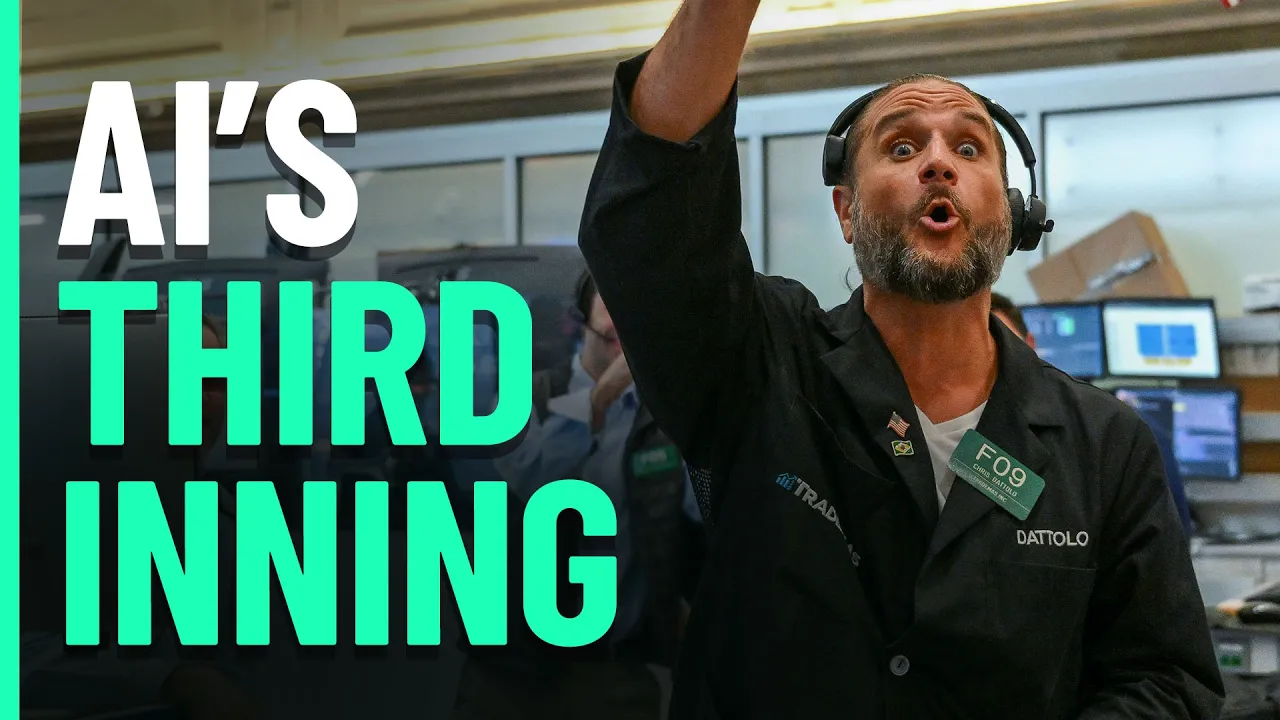
The AI trade has hit some turbulence. The Nasdaq is down more than 7% this month, as investors question whether all this AI spending will actually pay off. Joining us now is Gene Munster, managing partner, Deepwater Asset Management. Gene great to have you back. Fabulous to be back. Thank you. And it's a big week of course for tech. We'll get to that. But first you look at the selloff that we've been seeing in July especially last week and think what is this a healthy reset or something bigger. Well between the two it's the former. It's the healthy reset. And the latter would suggest that we're somehow kind of reaching past a point where most of the value has been created. And so I still believe that we're largely in the third inning of this. I still think when I talk about third inning of the AI, I think of that in terms of wealth creation, not like the technology, rollout. And it's kind of hard to believe, given what we have seen over the past three years. But to put some more context on what we have seen in the past few weeks, that down 7%, the market really is struggling with these numbers continuing to go higher. Growth rates in particular have, been much stronger than expected. And this concept that, the market kind of knows all the numbers for the Mega-cap earnings are going to be impressive, and which obviously raises the bar for next year, and instead a different ways that since last November, we've seen this dynamic where the law of large numbers has been making investors a little bit nervous about the sustainability of the trade. As the numbers get higher in the near term, it makes it harder to grow in the out year. And I think that that dynamic is really weighing on a lot of these companies. I mean, look no further than Google's cloud business. It grew at 81%. The street was looking for a 63. I mean, these are just breathtaking numbers. Just looking back, they grew in September of 25 at 34% a year ago. So, that is the bigger picture. And something else is that this market has a vibe. It's just it is more of a vibe than it is, a little bit about fundamentals. And I think that the vibe right now is people are risk off. And I think that that has a negative impact on the broader AI trade. Well what's going to get them back risk on. Because if the massive AI spending is causing some caution, what would happen if we actually saw companies cut CapEx? So it almost seems like a lose lose situation. Then. Well, the cut would definitely be a lose lose situation. I think that's exactly right. And we of course have seen from two, the other mega caps reporting with Tesla and Google and both of those raised their CapEx for this year and for next year, at least they gave commentary that suggest next year's going up. On average, that's about a 7% increase to this year's CapEx and probably around a 10 or 15% for next year. And that kind of builds the continues the narrative that all these other companies that are building into the infrastructure are going to continue to do. Well, to your point, imagine and those stocks have been penalized for that increased CapEx. It's a little bit of a mystery to me why investors, I understand the mechanics of it, that they're concerned that this will be profitless prosperity. But I do think that that mentality, the sell on the higher CapEx number, really misses the bigger point about how transformative this would be. But back to your point of if we do hear from Microsoft and Amazon and if they're going to be, you know, maintaining or cutting CapEx, I think that that probably would be viewed as a negative for the broader AI trade, at least kind of the view that if they're starting to maintain when they've been increasing, those numbers so dramatically, I just want to put that one piece in a perspective is a year ago at this time. So this is in the summer of 2025, as we looked at what the expectations were for growth, for CapEx from the for big tech companies, for 26, it was just over 20%. And it's going to end the year just over 80%. And so the my point is that if we we continue to see these numbers go higher and higher, which kind of reinforces that we're early. But if we do get to a situation where the numbers don't have these, these upside to it, I think that that could create at least a near-term air pocket for some of these companies. All right. So we have the busiest week of earnings season ahead of us. We have Microsoft, meta, Apple and Amazon all set to report what has to happen this week for investors to come away believing the AI trade is still intact? Well, two things. I mean, each of those companies has a slightly different dynamic to them. But in the case of Microsoft, they're really, fighting for really the broader half of software. And last quarter they talked about a change in some of their pricing to go towards usage based versus seat based, kind of recognizing that how people are using their tools are changing. That shift sent a shockwave through Microsoft shares. Just whenever you hear about a company kind of changing its its pricing dynamics, that is can be concerning. But I think that's going to be an important piece for investors to hear is that AI is as a being, a positive force for Microsoft's growth. Of course, we saw the IBM numbers their software business missed. It was a small mess, but it is so rare for IBM to miss their numbers. So I think that that's kind of the IBM piece. What need, what they need to see there. In terms of meta, the big question is what are they doing with their, their their proprietary model. And separately getting potentially into the cloud business? I think investors are going to want to hear more about that. That, of course, is highly likely they will do that. They've they've talked as much about that. But the question about how much CapEx, if they end up blowing up that number, my guess is that's probably negative for for meta, but that's going to be one of the big X factors beyond what the advertising number is. And of course, with Apple they hit a milestone. And the milestone was related to personalized AI and the new Siri went to beta a couple weeks ago. And the feedback so far and present company included in using it is that really is a game changer in terms of how you can get value out of your phone. And so if we look at the current growth rates for iPhone, for the September, for the the June quarter, it's 21% 18% for September and next year, the street has that going down to 7%. I suspect that even with the higher prices that, you know, Apple on average raise their price by 15% about a month ago. Even with those higher prices, I suspect that the growth rates next year will be measurably higher than where the street's at, because I do believe we're starting to enter into a consumer upgrade cycle around AI and Apple be one of those beneficiaries. So unfortunately, there's not one narrative that's going to kind of capture all three. But those are kind of the three pressure points for each of them. Which of those four companies has the most to prove this week? But the most to prove is Apple, because the general sense is that, you know, they've had this resurgence of iPhone growth over the past few quarters. As I mentioned, the growth grows from 21% in June down to 18 in September. But the key question that people are going to angle towards is how they feel about that kind of out year. The second piece is much bigger in terms of it's not as measurable like growth rates and guidance, but much bigger in terms of something to prove. Apple still has something to prove when it comes to I do they have AI chops, and I think that the significant outperformance of shares over the past three weeks has been more of an indication that investors are getting more comfortable that, in fact, they do have that confidence is based on the the new, beta. But that's going to be really the substance of, I think the company that has something to prove at Deep Water, we own apple. We own it because we believe that there is a big opportunity for a narrative shift on the company from being a laggard to something unique and I run personalized AI, and then separately, we believe that there's going to be a 2 to 4 year hardware upgrade cycle. On consumer, hardware based on what they're doing with the new Siri. Okay. Time for a quick break. As someone who talks about money and investing every single day, I'm always interested in tools that can help people get more out of their everyday spending. And that's exactly why today's sponsor, upside, caught my attention. I recently downloaded the upside app and the idea is pretty simple. It lets you earn extra cash back on things you're already buying like gas, groceries, and dining basically where all of my money goes. And honestly, I was surprised how many offers popped up nearby. Here's how it works. You open the app, you claim an offer, pay with your card like you normally would, and then get cash back quickly. And yes, it's cash back that transfers straight to your bank account, not points that expire or credits tied to one store. And if you're like me and love earning points in rewards, I also like that you can stack upside with your existing credit card and loyalty programs. The more the merrier. With more than 100,000 participating locations across the country, there may already be an offer right? Where you're already planning to stop. Upside is given $1 billion back to its users. To find out how much you can earn, download the free upside app and use promo code The Street to get an extra $0.25 back for every gallon on your first tank of gas. That's an extra $0.25 back for every gallon on your first tank of gas. Using promo code The Street, you said that you're testing out the new series and Siri is finally smart. Yeah, I mean, essentially I mean, there's four pillars that that's a good point. And we recently did a survey. This one really surprised me. Was a poll on I think we had maybe 4000 respondents. This is last week, but it was if you look at iPhone users, I think it was a third never just flat out never use Siri. I think it was 20% use it on a daily basis. But the vast majority of people still are skeptical about it. And of course, because the utility of it is is limited. What when they talk about the new Siri, there's four kind of key areas, but I just want to give an example of what is unique. When I talk about this being a game changer, essentially it allows personal contacts so you can ask it to look between your text messages and emails for a document, for example, and gives some context to the document and the people that were on the text chain. And I mean, just something very simple like that. Just being able to find something you're looking for has been a struggle. And I think that that's kind of one key area that the new Siri will, will shine in. Okay. I look forward to that because I want to use Siri, but I can't even get Siri to play a song on Spotify. I do, I do want to warn you, yes, I want to warn. If you do the data, it does have some. It's not fully polished. It takes up a little bit more battery and there's some other bugs in it. So, it's fun to see it and try it out, but I just want, people to be aware. You kind of give up on, some of the fit and finish, and the phone doesn't work as well, for example. Okay, so it sounds like you're still staying patient with Apple in anticipation of this smarter AI. But last time you were on back in late March, you said it was the second inning of the AI trade. So now we're in the third inning. But you said if you had to sell one mag seven stock, it would be Microsoft. Is Microsoft still which name you would sell out of the mag seven today, given the year to date performances of all seven? The simple answer is yes. I think that if you had to sell one, it would be Microsoft. And just to put some context on that, typically when you're believers in a theme like an AI theme and you have a company like Microsoft who has a lot going on in AI, when you see the pullback that we've seen, this year, that's usually a buying opportunity that's viewed as a buying opportunity. I believe that the stock will have kind of surges higher, but overall will be below where the market is over the next few years. And the simple reason is around what is at the core of software. Software effectively has an abstraction layer that allows humans to interact with a machine. That's really what software is. Humans don't think in terms of machine language. Of course, when it comes to AI and bots and agents, they can speak, native, native language, native computer language, and they don't need that abstraction layer. And so, my belief is companies that have long kind of, been successful at providing that interface, that abstraction layer, I think are going to struggle. It's the there'll be software companies that provide some of the infrastructure around data that I think will be very successful. But when it comes to Microsoft, I think that, you know, I wouldn't judge judge my prediction on a quarter. You could see a decent number in the stock, up 10%. But I think if you look over the next couple of years, it's going to be challenged. What are some of the software stocks you would add here? Well, when we think about the, I think there are some brands around, software where I'll just say this is that we have, an ETF, the ticker is loopy, and we have, several of those, software companies in there. But, some companies that are going to be beneficiaries in the public markets that were excited about would be like Databricks, for example. We invest in that in our venture fund. And, we're excited for that to be a public company. But I think that's a good example of, of a software company, if you want to put it in that category, that would be very successful. Okay. And also last time of year on, you basically said to stop buying the mag seven as a basket. Let's break this down, though. If someone owns the Mag seven basket right now, do they keep holding it at this point or do they take some profits, especially if we do see at, you know, a 10% increase, say, in Microsoft. The question is like what's your time horizon? And I mean the all if you kind of rewind what we talked at the beginning, there's probably more headwinds, more negative potential reaction to what's going to happen around the June quarter than positive. But I think that if you kind of take a step back and look at what these companies are ultimately doing, they're making a very big bet that we're still extremely early in AI. And if you believe that they're confident and they have the infrastructure to pursue this, I think that they will continue to do well. I think what AI is going to do with not only the digital economy, but the physical economy is going to be, much bigger than, kind of what we can comprehend today. And I think these companies are going to be beneficiaries. That said, not all of them are created equal. I mean, we own, as I mentioned, we own Apple, we own Google and deep water. I personally own Tesla. So I think that there are certain pockets that are there. And I'd also kind of bring in like space-x into this fold too, like this is one that has historically been considered, kind of one of the key companies, but it definitely is. And this one is training purely on fear about what's going to happen with these lock ups in the next 3 to 12 months. It has nothing to do with the fundamentals and the opportunity around the business and so that's a company that I believe can go lower in the near term, is it's hard to gauge when people's anxiety is going to start to recede on these upcoming lockups, but eventually, once the lockups hit, usually that's when the stocks start to rally. And so I'm most optimistic about what SpaceX is doing. We also see Tesla down 30% year to date. And you recently raised the odds. I saw an ex of Tesla and SpaceX coming together from 80% to 90%. So if I'm putting new money to work today, should I buy Tesla or SpaceX this? Well, I think it's 90%. It might take a year or two. And I talked about that up, with SpaceX. I think the shares rally, once we get very close to once the lockup happens, and that's going to be starting in the next three months. And so I think you can see that revision. I think it's probably best just in space in this case. But yes, I think that the probability has increased. I think it's this has been a pretty well traveled rumor, since the SpaceX IPO, but really stood out for me. The reason why I bumped up my odds was on the earnings call. They let that question in about whether it makes sense for these two companies to come together. Elon answered the question and the legal team answered it kind of stepped in. And then Elon took the mic back to elaborate on all the other goodness that can happen between the two. And so I think just overall, they're going to come together. It's going to be, really an AI powerhouse. When you think about what they're doing physically and what tests on them, what SpaceX is doing with vertical and. Okay, so Gene, if this still is early innings here, the third inning for the next winners. Well the big ones that we don't know about I'd say this is that these all these companies we're talking about are good. The big ones are good companies. Most of them are good companies to own for the long haul. Seem Microsoft, with the exception of Microsoft, the, I think there's going to be a new class of companies that are going to be really impactful. I mean, if you look at I mentioned Databricks earlier, I think that the core model companies have, will be highly successful IPOs, that, of course, beat anthropic and OpenAI. I hope he's like, Andrew, what they're doing in defense tech I think is, my I don't know when they're going to go public. They've, they've for the last couple years they've talked about going public soon in the next couple of years. But I think that those are kind of the companies that I think are going to be really exciting. So it's the space, it's Android, it's data bricks. Anthropic OpenAI or even for the OpenAI in that category. So what's the kind of bigger picture is that this leadership that we're talking about right now has really been in place for the last 15 years, actually. And I think that when we kind of fast forward a year from now, I think we could have just, you know, two or 3 or 4 new companies that are, are going to be very impactful and really exciting for investors. Now. If you could only own one of those for the next 12 months, which one is it? Well, on the I would be Andrew on the private side, I mean, because, you know, they will go public eventually here and next year or two. And I just think what they're doing is so unique and how do you value I mean, you know, people think of this as like a defense robotics and AI company. But at the end of the day, this is the future of defense. Is that the future of, of war? And how do you value, like peace? I mean, there's, some very high level. It's a very recurring business too. I think that that that detail gets lost on the Andrew story for those who don't follow. And it's the last valuation was, close to $100 billion, but still relatively small compared to these other companies. But, you know, they have a business where they sell these AI drones. And, you know, you got to imagine that if you're, the U.S government or one of the allies and you've got a drone that's three years old, you probably want to replace it just like your phone. And so there's there's a powerful kind of upgrade piece that's built into their story. Okay. And just to kind of summarize, before we get into rapid fire, you basically would say that of the mag seven, the only one you wouldn't be comfortable adding here is Microsoft. Microsoft. That's right. Yep. I would own and I'd throw Space-x into that group. I think that's a good one. Known long term. Gene. There are a bunch of winners too that have had down months. I'm taking a look. Corning SanDisk Marvell Intel Lam. Micron arm all down 20% or quite a bit more. And then names like Palantir that has actually had a good month but is down double digits year to date. Do any of those names look attractive to you right now? I think they do. I think on the memory side, for example, is still a big opportunity. We, of course, saw this breathtaking IPO in China on a memory company, the KCS company. And ultimately, I think that there is more room to go with memory. Just to put some perspective on that, if you look at micron for example, in the December quarter, they added one new customer for a five year duration. That's the first customer they ever had. And then on a march quarter, they added seven customers. So when you see that kind of jump going from an unheard of concept of a company, a memory adding a five year plus large customer, similarly Intel increase the number of long term contracts that they've had. I think they added five in the June quarter. Typically, they don't have customers that lock up for multi-year. And so I think, specifically on, micron on the memory side is a big opportunity. I think other companies kind of on the infrastructure side of which is on the cooling side, and companies like coherent, which is on the optics side, all parts of, building the infrastructure on the data center, I think they'll all be beneficiaries and really capitalize on that third Indian approach. So just to sum it up for us, then, how do we figure out which names are ultimately going to be the long term winners and which will be the losers? Well, I think that the, you know, the biggest piece is there is going to be a rising tide here and you have to make a decision. The software part of that rising tide or not. And so that influences a big piece of what we're doing. We talked about that earlier. But when you think about kind of the long term winners I think that, we're still at a place where custom silicon companies like Marvell and Micron are continue to, I think, going to have another few years of better than expected growth. And I think those shares will be rewarded. And then I think you think about the kind of the big infrastructure players, companies like SpaceX and Tesla, Apple with kind of a rerating of the multiple higher based on AI competence. I see those as some of the biggest opportunities over the next 2 to 5 years. Okay. All right. I think this is a great time to pivot to our rapid fire round of this or that. Quick questions, quick answers. No hedging. You've played before. Are you ready Gene I'm ready. Let's do it. All right. Here we go. Tech selloff cause for concern or temporary shakeout. Temporary shakeout. By any dips or wait for lower. Wait for lower. Tech stock on steepest sale. Right now. Space. One tech stock you'd avoid. That's not Microsoft. Not Microsoft. Salesforce. High spending panic or opportunity? Big opportunity. Bigger bet memory stocks or hyperscalers? Hyperscalers. Best AI infrastructure play that isn't Nvidia space. Alphabet or Tesla. Tesla. Meta or Microsoft. Meta. Palantir or Oracle. Palantir IBM dip. Opportunity or trap. Value trap. Open AI or anthropic. Open AI. Open AI or space X. Space X. If you could only buy one here. Space X or Tesla. Space X. Apple's next product moment. Hardware or software? Software with the new Siri. Best positioned mag seven. Name for the next 12 months. Apple. Bigger opportunity robotics or autonomous vehicles. Timeless vehicles. Best private AI company to own right now Andrew. And then the big question is how do you own it? You know, in the private market. Finish these sentences. This AI cycle ends when? 2028. Okay. So basically when two years pass. Oh, okay. Yeah. When I say that the cycle ends, when we start to see, across the board, diminishing margins, I mean, that's going to be kind of the catalyst, but I still think we got we're two years away, two plus years away from that. I'd get worried about tech if. China took over Taiwan. The next leg up in this market needs what is. Accelerating growth outside of Meta and Google. And I'd know the AI trade is in a bubble if. We're trading at 100 times earnings. Gene Munster I always appreciate you joining us and playing along. Thanks so much. Yeah. Thank you. And we'll catch you next time. If you enjoyed this straight talk check out my full interview with George C. He says the market is at a major pivot point and lays out exactly where investors should be putting money to work next.

Commentaires 0
Connectez-vous pour rejoindre la discussion.
Se connecterAucun commentaire pour l'instant. Soyez le premier à partager votre avis !