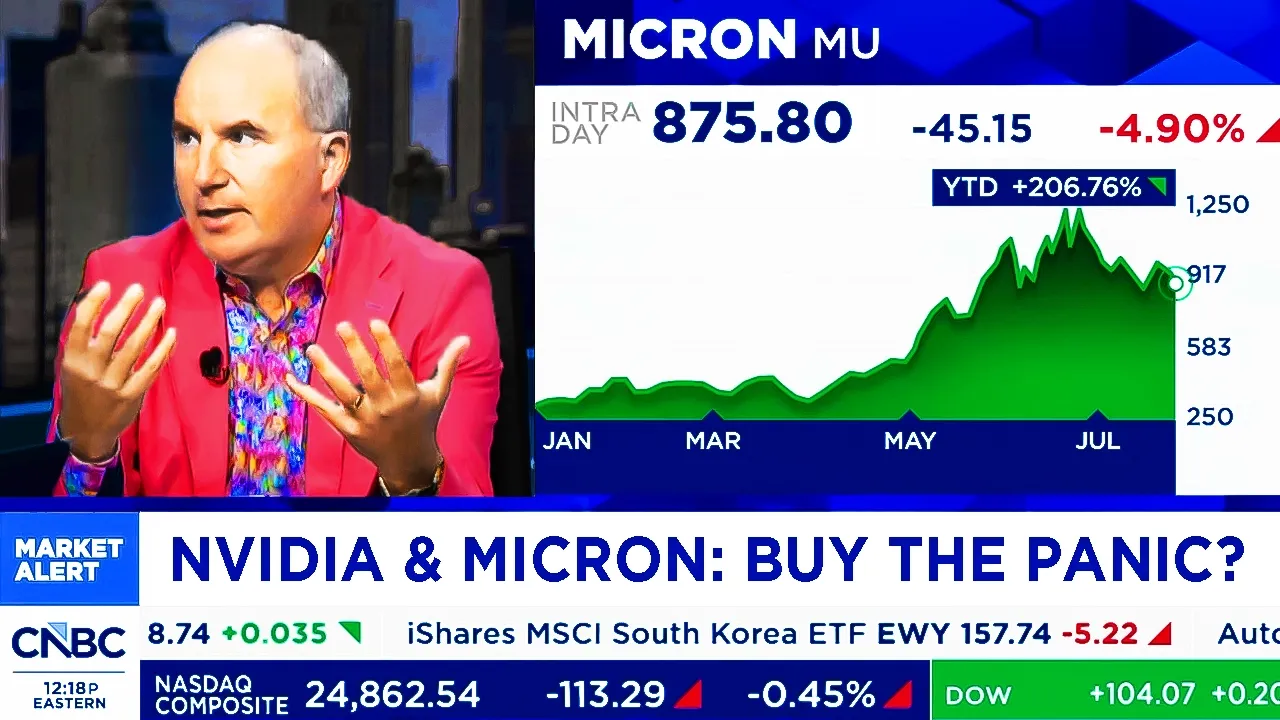
CNBC & Fox Today On NVIDIA Stock, Micron Stock, CXMT, SK Hynix Stock - NVDA Update

- Rendement de la vidéo
- -2,08%
- Appels
- 1
- Achat / Vente
- 1 0
- Publié
Recommandations
L'entrée est le cours de clôture de l'actif à la date de publication. Le cours actuel est la dernière clôture enregistrée.
-
Entrée $900,20 27 juil 2026Actuel $858,03 07 août 2026Résultat −$42,17
You would be a buyer of Micron and the Korean names.
Contexte So then having said that, you're bullish. You would be a buyer of Micron and the Korean names.
Transcription Complète
I mean what has been outperforming in particular this month has been Nvidia. We got a lot of news from them over the weekend too over the weekend too both in terms of this deal with SKHEX to secure memory and then also reports surfacing that they're going to backs stop open AAI in this Ohio data center that SoftBank is involved in. >> Look I think it's all at the epicenter is Jensen and Nvidia because I think Jensen has just such an understanding of open AI is the center of it. It's going to be a capex arms race and right now like they're they're essentially planning stakes if you think about SK to what you see on compute to what you're going to see across the board in terms of memory and the whole buildout because the reality is is that there's one chip in the world fueling the AI revolution and that's Nvidia. And I think the one thing that's really been, you know, very important is that if you look at some of the memory stocks that have sort of gone up and maybe obviously taken a little bit of a breather, Nvidia and just the rest of the semifood chain, that's where you want to see demand. I think you saw it in Intel to some extent, but the hyperscalers, that's the validation for investors going into the second half of the year. You continue to see the use cases, you see the spending, that's really ultimately front and center. Okay. Um, Nvidia, I mean, the the other piece of this with Nvidia is um, and and you're starting to hear the steady drum beat of uh, narrative emerge that it is becoming the central bank of AI. And when you talk about circular spending, they're kind of the apex of it. How do you respond to that? >> I mean, I would just view it that when you think about what Nvidia is seeing, demand to supply today is 12 to1 for their chips. physical AI hasn't even started to play out. So yeah, you call them a central bank call you some of the words about circular financing. The reality is Morgan only we're only 15% through what the broader spending is going to be in terms of AI >> 15% >> 15%. And I think Nvidia look Jensen the reason he's godfather of AI because the reality is he sees what's around the corner. You see what's happening in Asia. You see what's happening globally. I think they'll make those bets. Now, even though investors might fret about it relative to the spending, that speaks to our view. You just see more and more validation from those that are seeing the enterprise demand, whether it's Nvidia, whether it's Palanteer, whether it's Alphabet, what we'll see this week. That's what investors should be focused on. >> All right, I know I got to wrap this up. I just got to go back to this 15% number. I mean, are markets going to be able to support this? We see what's happening with CDS and everything else on the credit side right now. I think it's still these are called small white knuckle moments but market's going to digest it because the reality is is that the it's a true fourth industrial revolution and the enterprise use case is further validated that's the key especially when it comes even on the consumer side with alph with alphabet what they're seeing as well as Apple >> you know we were asking the question earlier today what would happen if some of those big hyperscalers actually cut their capex how would the market react to that >> I think the market would go straight down. I >> I think so too. To me, it's it's your damned if you do, damned if you don't situation almost. >> I mean, in the end of the day, it all boils down in a sense to Nvidia. Nvidia, I think when they reported last quarter, had 85% revenue growth. So, if the hyperscalers cut, it wouldn't be 85%. And you know, maybe that would be healthy for the long term, but I think the market would go straight down on that news. >> There's the front page story today in the Wall Street Journal that says Nvidia's in talks to back Open AI on a $250 billion financing basically for for a data hub, right? >> Um that could wind up costing half a trillion dollars um in the long run on some of these things. Nvidia has been involved with backing a lot of these deals. If you ask Jensen Wong why, he would say because they are looking for the bottlenecks that are preventing AI from moving forward and they want to make sure they clear those bottlenecks. It's a sound strategy, but what do you think as as somebody who watches the markets in terms of what this means? >> Look, I have questions about the health of anthropic and open AAI long term. I mean this is great for Nvidia long term but you know Enthropic and Open AI the cost of their models is about five times more than Chinese models. So I think one of the one of the one of the bottlenecks is what's the future health of anthropic and open AI in the face of models that are much cheaper. I don't know the answer to that question but I don't think anybody else does either. >> Why are Chinese models so much cheaper? Oh, because they're open source and anthropic and open AI are closed source and for whatever reason the the the closed source models are just much more expensive. >> So what do you do overall? It's more complicated but you wouldn't necessarily short this market at this point would >> I would not. >> All the and all the memory companies including this latest entrance from China that is now a public company. >> Oh my god. SK H Jinx since you I mean SKH Highix you've been out since SK >> Highix. SK H High Jinx. Yeah, >> Hi Jinx. I'm sorry I keep getting it wrong. I keep saying I I keep Whatever. >> Um there's the CDS. There's what we're talking what I'm talking about. CXM. >> Oh, that's a good game. >> That's a pretty nice. >> Did Goldman give you a call on that? >> No. >> No, that's what we want Goldman to give us. >> Yeah. Um >> what? Nothing. Let's get to Nvidia and open AI. >> There you go. What you do about that? Because I know you spent some time thinking about that this morning. It's a again we're talking about a journal story here but >> I know people involved as well. The numbers may go up. In fact, uh the story is about this guarantee essentially says to OpenAI or to those that OpenAI would be leasing a data center from in this case in Ohio 10 gigawatts largest data center complex of all time. >> Um that will be there if in fact you worry that somehow they won't be right Jim. Well, yeah. Well, because it's 50 billion per gigawatt. HOW DID THAT HAPPEN? It's 50 billion per g. >> It's 50 billion per gigawatt. 1.4 gawatts that I saw in Michigan is only around 50 a little over 50 billion. So, >> a small facility 1.4. >> But I mean, we did >> interesting. This is on government uh government property, Carl, which I is interesting to note in Ohio, >> which is, by the way, the most favorable state in the union to do business. Now we know >> that may be where you need to site a lot of data centers now to avoid you know a lot of the local potential position right >> but why is Nvidia why was Nvidia up so much initially and now barely up do you think that's because the vendor financing component which is no longer by the way hit >> now the vendor price will be down >> the the circularity people just right in front of you >> although in this case they are what I've said is a back stop and by the way why not for the not for the actual easily be 350 you can just keep going with the numbers. >> But again, it gets to this point of it's insatiable the demand for compute conceivably at least amongst those who are providing the services to corporate America that apparently it doesn't want. In March of 2026, Nvidia talked about the possibility that the spending could be over at least until they come public. Here's a little I got a quote that I'm calling for right now. Call for you know that part in the TV which you see that perhaps people didn't realize open AAI they got to come public. >> Look at this. I mean I look I totally believe in this. They're going to invest 30 billion. That's of course a very small number but open >> well that was I remember right. I remember that quote from him >> from the company 30 soft bank obviously is one of OpenAI's largest investors. They are behind this Ohio data center project. Soft bank power >> soft bank um again on you know on government cited on on government land but have to >> you got to power I mean you got to provide that's >> right that gas >> 10 gawatt gas can happen >> get the GEV get the Gnova turbines >> yes >> you got it >> all right >> you do that >> is the $500 billion that will be spent on this data center over time and again remember when you build the data center and it's called it's called a powered shell. That's just one number. We've shared that number a lot with you. Then you got to put all the stuff in it. >> And that's where we double what you spend usually to build it. Is it all going to pay off, Jim? >> By the way, have you guys seen spreads of like nominal versus real capex and what these companies are getting for their money because of where rates are, where inflation is. I mean, this is where the deficit starting to come into play. >> Yes. And I I think that again going back to that uh very quizzical Google call uh Google cloud is doing great just crazy. So you have to say okay well Google that works but the other side the actual power the actual the actual compute uh that you're selling say to others or that you're using we haven't figured out the return on that yet David or whether there will be a return which is if there's not a return then I'm sorry I'm I'm not going to buy this stock I'm going to find I'm going to find something else that works in tech >> and again I would note one of the interesting things about this story this morning around the Nvidia potential backs stop for open AI as it pursues this biggest data center in history in Ohio at least with 10 gigawatts is that it would be on government land and the commerce secretary's been very involved in that Japanese commitment to spend money here that was part of the trade deal as a part of it as well but there's no doubt that there's a national security overlay to everything in AI and the government is going to only get more involved as we we would expect the job apocalypse that that narrative has been ebing a great deal. The journal story today saying hiring is starting to actually come back a bit at certain companies even in technology related areas. We'll see if that continues. >> But aren't you concerned? I mean, look, you start the day and people, this is what again what happened on Friday. You read about Nvidia and you realize, well, look, they can have the first national back to Nvidia. They got one of the greatest balance sheets. They can do this top out. They're going to get a huge amount of business. They're going to get business instead of Broadcom. They're going to get business instead of of AMD. And then it starts at 20960 at 4:30. Now look at it. 205. This is my problem with me. >> Yes. This is why your patience had ran out in the last few weeks. >> I just find myself defending a company I really like. I believe in it. But it now has to be the quarter. I think it it's the quarter has to be great because intraquarter David look at this. They're financing a lot of business and people keep saying it's lucid. It is not lucid. They have the balance sheet to do it. Lucent is not Lucent. >> Lucent, not Lucent. No, Lucent. >> Remember, Lucent is where Severs, wasn't they? They filmed that at Lucen headquarters. >> Um, you're talking about, right, the old circular financing in terms of vendor financing from what was once the most widely held stock was Lucen cuz remember it was a spin-off from the old AT&T law. >> The difference is that Lucen had no balance sheet. Invid the best balance sheet in the world. >> No, I agree. And by the way, a backs stop is just that. They're not necessarily going to even be called on, but it does help the borrowing costs >> potentially for open. >> You know, I can sit here and say, you know what, it's terrific. And people at home are saying, well, why isn't the stock up? >> And the stock is the ultimate barometer. >> Something else that did get more attention lately is something I was talking about a long time ago, which is also these capital leases are not counted as capex where you have a meta. remember and Hyperion being the ultimate tenant but it and it's all for them but it's not even capex on their balance sheet so the capex continues to be understated >> right one of the more complicated parts of all of this data center stuff is this new open model situation or open model and that's being driven by Nvidia uh where they can all all the different hyperscalers and other big companies can use cheaper uh Chinese models to instead of using say an anthropic model No, I happen to think Anthropic is this is a stupid course of thought. Anthropic is a businessto business unbelievable coding company. You would not sell it on it if it were public. But what's happening is is that that's one thing that I think people are saying, wait a second, we got to be aware now of the open models and maybe not care as much as I thought about cyber security maybe keeping the uh >> that doesn't that explain some of the price action in in crowd? does and I know that Crowd and Palatoto both Crowd was one of the original signers. So I think that the cyber security companies do very well. I also want to say at this point, look, I know Nvidia is going down. I am still own it, don't trade it. I think it's absurd, but I understand. I think people feel like they're going to have to go into those back stops. They have the best balance sheet of any company in the world. If they want to use it that way, I think they can make it work, particularly because the government is also a kind of subtle backstopper in all of this. our government, this government. Yes. Because they don't want China to win. It's important. Let's forget this is geopolitical too. Very heavily geopolitical. The second thing that disturbs me is you look at the semiconductor index which has been sort of the tip of the spear. And don't forget the semi-index was up over 100% at its peak on June 22nd. Now it's down now it's up less than 60% as of today. And you know this morning they were up about a percent and then people started to I think digest a little bit more of gee why is Nvidia having to backs stop $250 billion of lease for open AI. Then you look at CXMT which today has 8% market share but they've talked about doubling revenues this year and in the DRAM space. And then finally you go wow China can ship a lithography tool which by the way that's been out there for a while. Yeah, >> but now you got semis down about I think four or 5% um when I came on and so all of that should make you worry that this selloff isn't over yet. Not to mention the reaction to Google last week or Tesla. >> Yeah, that's ASML's come up a couple of times this morning. I don't know. I'm not a I'm not a chart technician, Dan, but uh a chart of the SMH. I mean, there's a lot of chatter about Head and Shoulders and the rest. What do you make of that? Yeah, I don't I don't really focus on technical analysis that much. What I'm focused on is something very simple. In March, you had companies trying to token maximize. You had Meta with, you know, leaderboards for token maximization. You go into the month of June, you had companies like Coinbase saying, "Hey, we're routing queries to cheaper models. We've cut our AI spend by nearly 50%." And so that's the part that I'm looking at and saying, "Okay, how long does this last?" I think it's a speed bump. I, you know, put out a note on June 20th saying, "Hey, I think we're in for a speed bump due to this token minimization." And by the way, these speed bumps can get to be really vicious. You go back to 1995, semis were down over 50%. um starting in late se uh I think September October 95 you had another draw down of about 50% starting in late 1997 the semi-index finished up 850% from the end of '94 to its peak so the speed bumps look like the end of the world until they're not. I think that's what this is because the other side of this is you had the formalization of open claw so agentic AI really became a thing at the end of January I don't think you've seen the full impact of that in 5 months right so that requires 10 to 100 times more tokens and that's working underneath all of this stuff of token minimization that you have going on right now >> right so let's start uh like with some of the big news here recently right last night this big IPO uh CMXT 212 times overs subscribed. Uh you know uh there were three players that you know for a long time felt like they had this to themselves right Micron uh Highix and Samsung. Now you've got this Chinese back player. I think the Chinese government one way or the other has almost 40%. And and I talked earlier in the show about this. Are we eventually going to see the same playbook where they undercut you know with the pricing and and t just take market share already? Think about this. Apple is is lobbying the White House to use their chips. >> I absolutely don't think CXMT is a threat at all. And I've written about it. I'll tell you why. One is they are three cadence behind where the technology for Micron and SKHX which are the two main leaders in this memory um you know wars. Uh their yield is 25% which means they weigh 75% of the die. They're three cadence behind. Their pricing is 30% higher. Their HBM output is way lower than Micron and Skhinx. So I don't think they have any competitive uh moat with these former ones. On top of it, China's own internal demand >> cannot be fulfilled by CXMT. So I think the memory trade stays within uh SKH, Samsung and Micron continuing forward and expand. >> So So then having said that, you're bullish. You would be a buyer of Micron and the Korean names. >> Absolutely. I would be a buyer today and I would continue to be a buyer. Uh my target for Micron year end and even January 2027 is around 1,200 uh which is quite a bit you know potential higher from here. I see micro I see the the ROI that Google last week presented their 80% growth in cloud right and they have a backlog of 500 billion then last week also we learned about Kimmy K3 what Kim K3 said is open source models are going to be in the future mix what that means is cheaper tokens more tokens more usage more agents which just means more memory because the context window gets bigger we already know There is more memory per GPU which went from what 96 GB to now 300 GB there is no end to memory usage and we haven't even gone to autos and physical AI >> right so that's it that's what we want to know because you know on the street people tend to use momentum charts guessing uh very few understand the engineering and and I love that's where you come from it gives me a certain amount of calm to understand that part of the story because that doesn't go away overnight. >> All right, I hope you're all doing well today and staying calm in this market. Today was a mixed day throughout the market with a notable divergence among tech stocks. Many tech hardware stocks traded notably lower while many software stocks traded higher. That divergence is even more evident when looking at a heat map of the NASDAQ 100. There are multiple reasons for Monday's selloff in semiconductor stocks. There are three main stories. One that's specific to Nvidia, one that's specific to memory makers, and a third story that's relevant to both Nvidia and the memory makers. Let's start with the Nvidia news. Overnight, the Wall Street Journal published a report claiming that Nvidia is in talks with OpenAI to provide the company with a roughly $250 billion backs stop as part of a data center project in Ohio that's being developed by a subsidiary of SoftBank. According to the Wall Street Journal, the project is 10 gawatt and could cost more than $500 billion. I'm going to interject for a brief moment and say that if fully built, the 10 gawatt project would almost certainly cost more than $500 billion. While a 1 gawatt data center costs $50 to $60 billion today, that number is going to rise closer to the range of $80 to $100 billion per gigawatt based on Jins Huan's comments at GTC Taipei in early June. Anyway, back to the story. Earlier reporting in June suggested that OpenAI would control the compute inside the facility under a 20-year lease. And the $250 billion guarantee from Nvidia covers the data center lease and debt financing, but would not cover the NVIDIA hardware inside the data center. The report claims that Nvidia is also discussing financing OpenAI's chip purchases up to $350 billion. The first phase of the project is expected to be finished in 2028 with around 800 megawatts of power. And that brings me to a very important point on this story. Even if the report is correct, we're talking about potential financing over the course of many years. If the first 800 megawatt phase is operational in 2028, that's only 8% of the total project. And it's going to be many years before the entire 10 gawatt is fully built and operational. We're not talking about Nvidia handing over $250 billion all at once. It would be deployed across multiple financing vehicles and project phases over the course of many years. And so I do think the market's reaction to this piece of news is an overreaction. Let's keep things in the proper perspective. I think this piece of news had a greater effect on market sentiment than it did on anything fundamental. Some market participants saw this piece of news and immediately assumed that something's wrong with OpenAI. I view it very differently. The leading labs revenues are surging and their revenues are directly tied to comput. If they had more compute, they would have greater revenues. It really is that simple. Demand is not the problem. The problem is a lack of supply to meet the demand. I wouldn't be surprised if OpenAI's ARR surpasses 100 billion at some point within 2 years. And with each new generation architecture from Nvidia, OpenAI's margins should improve as token costs come down. And so, I do think the concerns about OpenAI spending commitments are somewhat overdone, much like those same concerns were overdone in late 2025. The second piece of news that contributed to Monday's chip selloff is that overnight in China, Memory Maker CXMT had a blockbuster IPO, rising more than 400% on its first trading day. After that move, the company is worth nearly $500 billion in market cap, and they raised at least $8.6 billion from the IPO. Market participants expect CXMT to use a large portion of that capital to expand memory capacity. Many market participants are worried about a potential dumping situation in which CXMT floods the market with cheap memory that would challenge the pricing power of the big three memory makers. It's important to remember that just last week, according to multiple sources, Reuters reported that CXMT has been raising prices for months and even charging some customers more than Samsung and SKH. CXMT would not be raising prices if there was a surplus of supply. Additionally, CXMT is not able to fully satisfy the demand in China, much less the rest of the world because the demand far exceeds supply and so I do think the market's reaction to this news on Monday was somewhat overdone. And now, let's cover the third piece of news that caused both memory makers and Nvidia to trade lower on Monday. This is the big one in my opinion. On Monday morning, The Information published a story claiming that an unnamed stateback company in China has begun manufacturing domestically developed immersion deep ultraviolet lithography systems. Systems that were previously almost entirely supplied by ASML. ASML traded notably lower on Monday because of this story. Now, I want to provide a disclaimer in saying that this has been an unreliable source in the past regarding Nvidia China rumors. And so, I don't know if this story is true or not. I'm just bringing it to your attention so that you're aware of it. I also think this story is the main reason why memory stocks traded notably lower Monday morning. According to the story, the unnamed company plans to produce five DUV machines in 2026 and 20 machines in 2027. Initial recipients are expected to include memory maker CXMT, which just IPOed in China and SMIC. Now, given the expected production volumes of five machines in 2026 and 20 machines in 2027, the headline of this story appears to be somewhat sensationalized when it says that China begins quote mass production. The production numbers in the article seem to contradict the use of the phrase mass production in the headline. The story also claims that China is in the prototype stage of developing a domestic EUV machine. Again, I don't know if the story is true or not, but even if it's true, considering the relatively small expected production numbers and the need for additional reliability testing. I think the market really overreacted to this story Monday morning by selling off memory stocks and other names like Nvidia. I also think the selling an ASML stock was very overdone on Monday. While EUV machines are not allowed to be sold in China, ASML does sell a lot of DUV systems in China. And the unnamed company in the information story is expected to produce fewer DUV systems in all of 2027 than what ASML sold in China just in Q2 of this year. And so again, I think the market's reaction was really overdone. Let's keep things in the proper perspective. I would also be careful about assuming that the yield from domestically produced DUV systems in China will automatically be comparable with systems from ASML, as that is unlikely to be the case. Overall, I think the market overreacted to these three news stories on Monday. Also, over the weekend, supply chain reporting indicated that NAN price increases have begun moderating. It's important to note that this does not suggest prices collapsing, but simply moderating. Reports characterize the market as moving toward a high price plateau rather than beginning a new NAND down cycle. This news also contributed to the sell-off in memory stocks on Monday. Now, let's cover some more news. On Monday, Nvidia and Safe Super Intelligence announced a long-term partnership to rapidly accelerate SSI strategic growth. Nvidia announced they've invested in SSI, but they did not disclose the amount. According to Reuters, Nvidia invested $5 billion. We don't fully know what SSI has been working on, but Nvidia entered into this partnership with SSI after obtaining rare access into the company's closely guarded research. SSI was founded by former OpenAI chief scientist Ilasuits Kev. Considering his history and past work, this could potentially turn out to be something very big in the future. Also, over the weekend, Jensen Hang spoke with Bloomberg. I'll just mention a few points that stuck out to me. Jensen said that the semiconductor industry is probably going to have to be 10 times larger than it is today over the next decade or so. Jensen said that we're constrained throughout the supply chain. Jensen said these constraints are why he thinks we're going to continue to build out in a throttled way for a decade. Jensen said, quote, "I think we have the ability as an industry to double each year, but we're going to have a hard time growing much faster than that." Did you catch that? Doubling each year. If Jensen is saying that the industry has the ability to double each year, what effect do you think that's going to have on Nvidia's business? As I keep saying in these videos, the total addressable market is growing in the double digits percentage annually. The Pi is growing at a strong clip. This is not the time for Nvidia investors to worry about market share. Jensen also spoke about SKH Highix and the importance of memory, saying, quote, "We're going to be purchasing memories from them for many years to come. In order to build a trillion dollars worth of Vera Rubin systems, you're going to have to buy a lot of system memories to go with it." Jensen also made an interesting point about open models, saying that running an open model is not automatically cheaper. organizations pay for infrastructure fine-tuning, maintenance, evaluations, and guard rails. The main advantage with open models is control and customization. He indicated that in the future, both open and closed models will be very important. Looking ahead, we have more hypers scale earnings with Meta and Microsoft earnings scheduled for July 29th and Amazon earnings scheduled for July 30th. Overall, I'm expecting each of the hypers scale companies to provide strong guidance and commentary regarding capex this earning season. As for Meta, I'm expecting them to announce strong capex guidance. I know there was a bunch of hoopla on July 1st after Bloomberg reported that Meta was developing plans for a cloud business. Some days after that report, Zuckerberg clarified that they do not have excess compute. It's just that some of the deals are very attractive and Meta could charge a premium if they rented out a portion of their capacity given the constraints throughout the industry. Meta also recently announced they're expanding their Hyperion data center in Louisiana from 2 gawatt up to 5 gawatt. Last earning season, Meta CFO said that they continue to underestimate their compute needs even as they've been ramping capacity significantly. Plus, Meta Super Intelligence Labs just recently launched Muse Image, Muse Video, Muse 1.1, and a new model API. Meta is not dropping out of the AI race anytime soon, and I expect their capex guidance to be strong. As for Amazon, I'm also expecting strong commentary and guidance regarding capex. Amazon CEO Andy Jasse spoke at length last earnings season about Amazon having very high confidence that they will monetize the capacity they're bringing online. As a reminder, AWS is monetizing new capacity as soon as it comes online. Last earning season, Jasse said, quote, "The faster AWS grows, the more short-term capex will spend." And then on July 1st, AWS raised GPU rental prices by 20%. And they made that decision based on supply and demand. In other words, demand is very strong and outpacing available supply. As Jasse said last earning season, the faster AWS grows, the more they will spend on capex. AWS is clearly growing and so I expect strong capex guidance from Amazon. Now, let's talk about Microsoft because I think this is the most interesting of the four this earning season. I want to remind you of a few things. First, Microsoft will be reporting results for the end of their fiscal year. And so, they're likely to provide commentary on the earnings call regarding capex over the next 12 months. This is going to be a very important earnings call for the entire AI ecosystem. As a reminder, last earnings call, Microsoft guided fiscal Q4 capex at $40 billion. They also told us that for calendar 2026, they expect to spend $190 billion. Again, that's for the calendar year. And so calendar 2026 would include the third and fourth quarters of fiscal 2026 as well as the first two quarters of fiscal 2027. And so if Q3 capex was 31.9 billion and let's just assume Q4 is 40 billion as Microsoft guided that leaves $118.1 billion that Microsoft intends to spend in just the first two quarters of fiscal 2027. That would be an average of roughly $59 billion per quarter, much higher than their capex so far. What's the reason for that increase? There are two reasons. First, Microsoft is investing heavily in additional capacity for their cloud business. And secondly, Microsoft stated earlier this year that they want to have their own state-of-the-art models in-house by 2027, and they're going to need a lot of capacity to do it. As I said repeatedly ahead of Microsoft's last earnings report, I thought their capex guidance was going to be notably higher than what many market participants were expecting. That turned out to be correct. Now, I'll be completely honest, I don't know what they're going to say on the earnings call regarding capex over the next 12 months for fiscal 2027. If I had to guess, given the fact that they need additional capacity to compete on cloud, they need to have enough capacity to train their own state-of-the-art models and also what we're seeing in rising component costs, especially in memory. I think we're likely to get strong next quarter capex guidance. But I just want you to know that market participants main focus as it relates to capex is what Microsoft will say about capex over the next 12 months in fiscal 2027. That is what will likely have an impact on the stocks of companies like Nvidia, Micron, SK, Heinix, the Neoclouds, and many others. There's some important nuance in Microsoft's AI strategy. And so, we need to listen in to the earnings call to get a better understanding of what's going on. If I could only listen to one earnings call from the four major hypers scale companies this earning season, I would choose Microsoft's. What they say about capex over the next 12 months will likely determine how tech hardware stocks trade the next day. Overall, I'm expecting all four of the major hypers scale companies to report strong capex guidance and important commentary regarding AI monetization this earning season. I don't know what's going to happen in the short term, but from a long-term perspective, I am very confident that Nvidia will be worth much more in future years than it is today. When Jensen was on the Lex Freedman podcast not that long ago, he was very seriously raising the possibility of Nvidia becoming a $3 trillion revenue company in the near future. If that happens in the coming years, then it is very plausible that Nvidia could one day be worth tens of trillions of dollars in market cap. That might sound crazy, but that's what Jensen is implying when he raises the possibility of Nvidia becoming a $3 trillion revenue company. I guess the question at that point is what multiple the street will be willing to give Nvidia. I don't know the answer to that question, but I truly do think that Nvidia will be worth much more in future years than it is today based purely on the fundamental growth of the business. Based on everything I'm seeing, the world is still computed and I expect that to continue at least through the first half of calendar 2028. In a computed environment, developers will use whatever viable compute they can get their hands on. Today, there are no GPUs that are sitting dark due to a lack of demand. Like there was fiber sitting dark due to a lack of demand at the height of the.com bubble. Back then, companies were laying fiber in the hopes that use cases and demand would eventually show up. Today, we are seeing the complete opposite. As I've said many times, when market participants compare this AI revolution to the do-com bubble, they ignore the fact that the internet is already here this time. This means that mass adoption of the technology and new use case development at scale are immediately possible. We don't have to wait years for it to show up. It's already here. The world is compute constrained which means there is not enough supply to satisfy demand. New capacity is utilized as soon as it comes online. The hyperscalers are monetizing capacity as soon as it comes online. Each of the hyperscalers spoke about being supply constrained on their most recent earnings calls. Additionally, many of the clouds are building out into contracted demand. They're not blindly building in the hopes that demand will eventually show up. No, they're building out because they have signed contracts and in some cases significant prepayments from their paying customers. This AI revolution is fundamentally different from the.com bubble and 2026 will be a pivotal year for the AI industry. Thanks to the rapid adoption of Agentic AI and the proliferation of Agentic systems in the world's leading enterprises. The leading AI labs revenues are surging right now. Aentic coding and the implementation of Agentic systems in large enterprises are new use cases that are increasing inference demand significantly that subsequently is increasing compute demand. The rapid adoption of Agenic AI is why we're seeing an inflection in inference demand. It's why we're seeing the leading AI labs revenue surge. I wish both Anthropic and Open AI were public so the public could see the ramp in their revenues. Anthropic ARR has surpassed 47 billion, up from $9 billion just at the end of 2025. Open AAI is growing rapidly as well. I think the leading labs surging revenues may be the initial proof point that grabs market participants attention and causes them to realize that there will be a clear ROI on AI infrastructure. I think the leading labs surging revenues will also help assure investors of the longevity of Nvidia's growth since these labs revenues are directly tied to compute. If they had more compute, they would have greater revenues. It really is that simple. Demand is not the problem. The problem is a lack of supply to meet the demand. As I've said previously, I expect the world to be compute constrained at least through the first half of 2028, possibly longer. And so regardless of what happens in the short term, it's important for long-term investors to remain focused on the fundamentals, maintain a long-term perspective, and remember that we are only in the early stages of aenic systems being adopted at scale. This will increase compute demand significantly. And after that, the next surge in compute demand will likely be fueled by physical AI. We're no longer talking about digital agents performing digital tasks. With physical AI, we're talking about physical AI agents performing physical tasks in the real world. NVIDIA CFO has called physical AI quote a multi- trillion dollar opportunity and the next leg of growth for NVIDIA. This industry will fundamentally transform society and Nvidia has positioned themselves to benefit massively. NVIDIA sells the hardware for the data centers where the models are trained. They offer omniverse where the models are taught and tested and Nvidia also sells the hardware that allows ondevice real-time inference through Nvidia AGX allowing robots to have intelligent interactions with the real world even when they are not connected to a data center. Notice that Nvidia is taking a holistic platform approach to physical AI and they're embedding themselves as the underlying foundation supporting all of it. Over two million developers are already building on the NVIDIA robotic stack and this is not getting enough attention. As for production ramps, Blackwell Ultra has ramped quickly and remains in high demand. Reuben is on track to launch in 2026. Then we're expecting Nvidia Gro 3 LPX in the second half of 2026. Later on, we're expecting the launch of Reuben Ultra in 2027 and Fineman after that in 2028. We have a clear data center product roadmap stretching into 2028. And Jensen believes that AI infrastructure spending will reach 3 to4 trillion annually by the end of the decade. That means Jensen is expecting growing AI demand and an expanding total addressable market underpinning all of this. I don't think we are anywhere near any type of bubble bursting type of event. With all of this in mind, I seriously think that Nvidia still has plenty of runway ahead of it and I think this company will be worth substantially more in future years than it is today. At least that's my view of the situation. Quick note before I wrap up. All of the compilations on this channel are edited by Finn Vid with original structure and commentary. Occasionally, the same edits appear elsewhere on YouTube. If you're looking for the original version, it's always here on this channel. Thanks for watching, Finn Vid. I appreciate your support. Remember to stay calm in this market. Remember to maintain a long-term perspective and do not make any hasty or irrational decisions. With all of that being said, I hope you all have a great rest of the day. And I'm curious to hear your thoughts about Nvidia in the comments below. Please leave a like on this video so more people will see it. And while you're down there, please consider subscribing. It's free and you can always change your mind.
Commentaires 0
Connectez-vous pour rejoindre la discussion.
Se connecterAucun commentaire pour l'instant. Soyez le premier à partager votre avis !