Contexte
“But I've been through many boom and bust cycles with these companies, and the stocks always start coming down well before the business deteriorates. You can't see what's going to happen. That's what I always say, though. You have to sell the parabolic moves.”
Contexte
“But I've been through many boom and bust cycles with these companies, and the stocks always start coming down well before the business deteriorates. You can't see what's going to happen. That's what I always say, though. You have to sell the parabolic moves.”
Contexte
“But I've been through many boom and bust cycles with these companies, and the stocks always start coming down well before the business deteriorates. You can't see what's going to happen. That's what I always say, though. You have to sell the parabolic moves.”
Transcription Complète
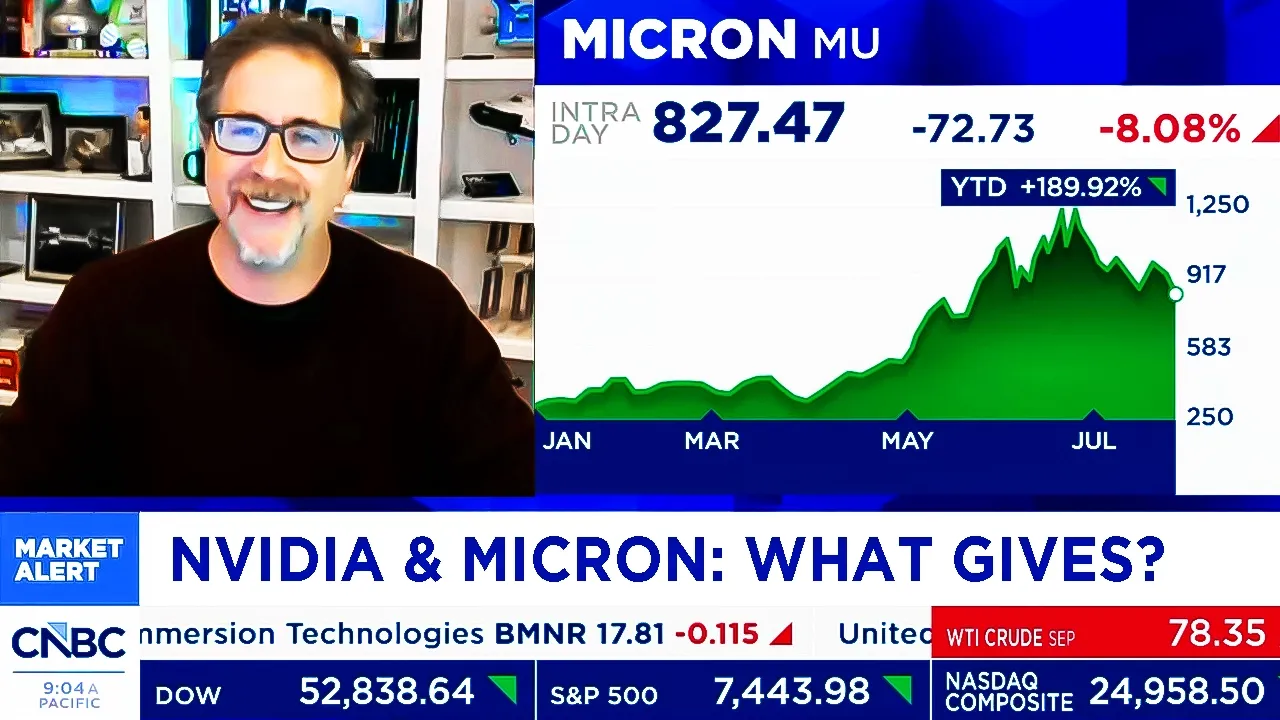
I mean, to me, this feels a a lot like more than just a positioning shift. It feels like we priced in 10 years of returns by May. And I'm wondering now if it's going to take 10 years for the stocks to get back to those high water marks. >> Oh, first, thanks for having me on the program. I remember 3 months ago during the last earning season, all of these names would would open up uh up 5 10% and they would close up 10 to 20%. So this current uh earning season is very different. I don't think there are investors out there that are looking for bargain um stocks. Bargain hunting. I think they're going to wait till late summer. At the same time, there is so much noise. There is a C CXMT that has come public creates noise. There is an anxiety over uh China's ability to make memory chips. At the end of the day, I think in my humble opinion, the biggest uh variable the the biggest question mark is if commodity memory prices are beginning to plateau, >> is it going to go sideways or is it going to roll over like the past 30 years? Okay, I think there is enough of a demand to help commodity prices to go sideways and not rolling over. But this is very much debatable and subjective. >> So, let me ask I want to make sure everyone is following this. You're you're you're saying your biggest question right now and the one hanging over this trade is are commodity memory prices starting to plateau and can they plateau or are they going to follow history of the past 30 years and collapse? What exact data points are you watching to try to figure that answer out? >> When you look at the consumer electronics, the the memory budget has gone up due to higher prices, due to memory inflation. I think we're beginning to reach a ceiling. Um just look at the headline over the past six weeks when Tim Cook is out there talking about higher cost of memory. He he's enough he's got enough volume to do something and I think that's a leading indicator. And I look at the the the companies in the supply chain they're also talking about their inability to pass on that incremental cost associated with uh consumer electronics. So this is the and then I make a conclusion that commodity prices are beginning to plateau. Now looking into [clears throat] next year uh AI is diversifying the mix and how these companies are going to be able to have a a mix with a reasonable margin would make a difference. But but to make a longer story short commodity prices beginning to plateau as to where we go from here is going to be the big uh variable. >> Yes. And I know you literally have to do finish this interview in like 50 seconds and go. So, so I appreciate you coming out, especially because as a memory guy, you're acknowledging the anxiety that's in the market. You're not glossing over it. You're not just repeating this line about the prices and contracts being fixed for years. So, what should investors do about it? Should they get out of this trade? Should they wait for these to become value stocks while the heat-seeking momentum missile goes elsewhere? >> Look, if you own memory stock, hold on to it. I think but you look at compared to 3 months ago these stocks are still outperforming. Of course over the past month these these names have given up a lot of gains. If you haven't if you don't have an exposure I think you're going to have better pricing uh floor over the next month or two and I think investors will come back to this space let's say late summer which is very typical. So, u if if if you don't have exposure, wait, u I think you're going to get better pricing and I think looking into next year, uh I think everything is going to play out the work out, but it's just going to be a hand-to-hand comeback. The easy money is made now. We're just going to have to be very patient and very methodical. >> Very uh clear. I hope I hope our writers at do are listening because I want them to write up these headlines. Um you say better entry points are coming. If you own, you know, hold on to it, but if you're if you're looking to buy it, maybe wait. This has been a vicious uh correction. >> But we're watching chip stocks continuing to sell off. The sock semis ETF is having its worst month since December 2002. It's been a whole generation since then. Joining me now to discuss Bernstein, Stacy Rasg. Stacy, what gives? >> 2002 was even before my time and I've been doing this for a while now. I mean, it's a it's a long time to see the chips retreating this way. >> Yeah. You have to remember like they they had a phenomenal run into this and and I know everybody, >> you know, gets concerned we're down. I think the socks is down 25% or so off of its peak. But it's up well over 50% almost 60% year to date. Up almost 100% year-over-year. And I I almost feel like if we've gotten here like monotonically, like smoothly, like everybody would feel fine. But that's wishful thinking. It never happens like that. We always overshoot and undershoot. Where I still get a little bit of comfort though is is the fundamentals I I think still look fine. And in fact, if you look at the move year to date, it's all earnings or or like even more than 100% earnings. I think with the stocks up almost 60, earnings are up almost 100% year to date. The multiples are down 20. So the the stocks are materially cheaper today than they were in the beginning of the year. Um so far this has been an earnings driven rally. Again, we overshot a some and we'll probably undershoot as as as well, but the fundamentals, like I said, I I think still feel okay. We'll we'll see if the sentiment like can kind of get back into the swing of things, but the fundamentals still look good. >> I really think it's amazing if you can get great investing advice and your word of the day in the same conversation. So, I'm I'm a fan. When we talk about what's to come, NXP has earnings this afternoon. What are you expecting? Yeah. So, um, they do report actually I think the call's at 4:30 Eastern tonight. Um, and they're more like they're like an analog mix signal kind of play. So, they actually don't have a ton of data center. It's sort of like low singledigit percentage of there. They're much more dominated by auto and industrial, particularly auto. Uh, so what we'll be watching for here is is is the auto trends. Auto's been a little squishy the last few quarters. Um, NXP actually did see some strength last quarter. Some of their other peers did not. We've seen other peers though start to report so far this quarter and auto seemed a little bit better and NXP [clears throat] may be a a more direct read on that given their concentration there. So that's that's one of the major things I think we'll be watching there as well as the continued trajectory on the broader industrial recovery that we've also been in. >> And and what about KA Corp that also has uh earnings to come. >> They are also reported and and look Semicap is one of these other areas. Semigap is the the the companies that make the tools that make equipment and KAC is is one of those. And Semigap is another one that had a massive run and they're all well off the peak. Although they're they've actually even out outperformed um uh semis year to date. Most most of those guys are up oh I don't I don't know anywhere between you know 60 and close to 90% year to date. So so they're still having a pretty strong run. Um I think semicap was one of the bottlenecks that people were playing although I feel like it's more structural than some of the others. if if the data center buildout trajectory that everybody's looking at is going to happen over the next several years, we clearly need a lot more chips and and and therefore a lot more tools and I think investors have really become enamored of of the space because it's pretty clear that um equipment spending has to rise as we go forward. The big question in the near term is is the availability of of what's called the clean rooms. Like before you can ship a semiconductor manufacturing tool, you have to have somewhere to put it and and and the customers have been full. I mean, their their factories are full and so they're all building clean rooms and that takes some time to get that on. So, it'll be interesting to see how much KLA and their peers can upside in the near term given the need to finish building those facilities. So, I'll be listening more, not as much for the near-term stuff, but more about the commentary into 27 and beyond and any kind of comfort they can give us that this this rally in in spending that we're seeing is is is truly sustainable. >> Stacy, good to see you. Thank you for the insight. Appreciate that. So when we're talking about how I mean there there was all this movement into chips, Nvidia was the darling for so long and now it's this is a group that's held in a lot of portfolios. How are you playing it Ed? >> Well, I I think this is going to turn out to be a buying opportunity. I don't think this is a bursting of a stock market bubble. Quite quite the opposite. I think we're taking a lot of air out of the trade, a lot of the hype out of the trade and then at some point here it's going to stabilize and the news is going to be fundamentally good which is this is not going down on any big disappointment on on earnings. It's it's going down on a headline basically that China is about to manu be able to manufacture some of these chips the way ASML has been able to do but it's it's questionable whether they will be able to do that. Are there are there different differentiators in the chip names? >> Yeah, I mean of course I you can take memory chips separately, right? And and we know that those have broken down recently too. I think a lot of this is the breakdown in momentum that's happened in the last few weeks and as you open that door on the other side of momentum, which is always the warning as momentum is rising and carrying everything higher is that it goes just as fast if not faster on the downside. And we're experiencing that right now on a day like today where you've got in the infoch sector in the S&P a third of the sector either up or down by 6% or more. Those are huge swings on a daily basis. And that says to me that this is not over yet. So I still think that there's more downside before we stabilize. But I agree with Ed. This is not an indication that there's a bubble bursting. I think this is also a reaction to the fact that the slope of the line on the upside was so steep and we had this multiple expansion and enthusiasm and FOMO and everybody chasing the same trade trying to find that next big winner that now we've got you know we had some weak hands in that trade and people are getting spooked and I think in this market it's an unforgiving tape in the sense that when you have names that are moving so quickly and so much on very little news it's difficult to find that next darling. We've seen a huge part of the NASDAQ and watched the S&P pivot hard in the last year as orders started ramping up for the data centers pivot in a beautiful way. But there are many parts of the data center. The parts that most excited people were actually the parts that were in short supply. That's right in just well let's just say they were scarce and I'm talking about memory and storage from Seagate, Western Digital, SanDisk and Micron. There were shortages in all these these companies historically have been very boom and very bust when it's very boom there's big shortage when it's very bust there's a surfet when AI exploded on the scene and the data center caught fire we had to fill those data centers with servers and servers are packed with memory and storage those big four companies plus SKH highix which now trades here not just in Korea and Samsung in Korea very quickly got huge pricing power because they literally weren't enough chips to go around and by the way SKH highix and Samsung are much better than much bigger than our companies not much better but much bigger Um, so what's happened to these companies? They've been able to raise prices and raise prices and raise prices with abandoned and it's caused a lot of things to be a little more expensive than you and I like. That allowed though for some of the greatest runs I've ever seen in stocks. Listen to these. Western Digital went from $70 $70 a year ago to $799. And June, Micros $101 a year ago and then it folded to $1,255. See, it went from $152 to $1,145. And Sandis made the biggest move of all, galloping from $42 to $2,354. Those moves are incredible. I call them lifetime gains, at least if you took them. But every one of these stocks peaked in June. Western Digital's now fallen from 799 to 463. Micron255 to 820. Seagate 1145 to 747. and Sandis, well, it's tumbled from 2,354 to $1,96. And those are colossal losses. [screaming] [crying] What triggered them? And the answer is elusive. Prices for their wares haven't come down at all. Some of them are still going up all the time. But I've been through many boom and bust cycles with these companies, and the stocks always start coming down well before the business deteriorates. You can't see what's going to happen. That's what I always say, though. You have to sell the parabolic moves. More on this later, that these shortages trigger because parabolic moves always end. The stocks just anticipate that ending. In other words, the stocks fall first and then the numbers go down. My best guess. Remember, there are two Korean companies that are the biggest memory makers. I just talked about it. But maybe the Chinese, which are struggling with memory pricing, have managed to produce more chips than we know. And some of the producers in Eur Asia can therefore switch to China. Producers in Europe switch to China. Maybe they're about to place fewer orders with the Koreans, busting the shortage. And that would also explain why Apple, big buyer of memory, saw its stock hit an all-time high today. Not a conspiracy theory, just a conjecture. Now, we are going to get a real chance to see if these disc drive memory stocks can reignite because Seagate reported a very nice upside price this very evening and it is trading higher after the close about 50 points higher than where the trading ended at four. But here's the thing. These stocks all traded higher initially after they reported already. We need to watch see like a hawk to see tomorrow if the money can flow back to the company's stock. If it can, we could be in a reprieve mode. If it can't, let's just say, well, they all trade together. Many of those who sold these stocks to take capital gains will keep redeploying the capital away from the kind of tech that's f found in the data center, though, and we saw that all day today. Now, they certainly aren't selling because of a lack of demand for data centers. The demand's ferocious. We just found out today that Met and Black Rockck are getting together to build a 14 billion dollar data center. Every day we get huge deals. Like every day, I'm not kidding. This weekend we got we had hundreds of billions of dollars of these of these deals. Exactly like them. No, they're selling because they're afraid of the whole group. They're concerned that the big buyers of this data center equipment will slow their spending or stick to their current budgets in part because they saw how sellers swarmed out of Alphabet stock when it raised its capital budget to get even bigger in the data center. They saw the stock of Alphabet raise. They start they saw Alphabet raise its capex budget which was initially going to be 180 190 billion up to 195 billion to 205 billion this the stock then dropped 7% on that news and lost $275 billion in market cap just on that news let's see it raised its spend by about 15 billion in the midpoint and then shed $200 billion now stocks recovered a bit since then but the point remains perhaps more important anyone who participated in Alphabet on The secondary got crushed as the stock went from $355 to $330 with a pit stop as low as $318. And now Alph has negative free cash flow. So the data center stocks once so prized now seemed dicey. I expect that the tech buyers will try to mount a rally off of Seagate's good number this evening. I don't know if it's going to last. >> All right, I hope you're all doing well today and staying calm in this market. Today was another mixed day in a market with many software stocks trading higher while many tech hardware stocks and stocks of companies associated with the data center buildout traded notably lower. Much like Monday's session, the divergence among tech stocks on Tuesday is even more visible when looking at a heat map of the NASDAQ 100. Nvidia initially traded lower in the morning but recovered from the lows of the day before market close. I'm going to cover today's news, but really quick, let me provide some context for Monday because it's directly relevant to the news I'm about to cover. On Monday, market participants began selling off many tech hardware stocks in what I believe was an overreaction to multiple news stories that I covered in Monday night's video. One of those stories was a report published by the Wall Street Journal Sunday night claiming that Nvidia is in talks with OpenAI to guarantee $250 billion in financing for a data center project in Ohio. As I mentioned in Monday night's video, the project is 10 gawatt. The first phase of 800 megawatts is expected to be finished in 2028. That is only 8% of the total project's power and it's not even expected to be finished until 2028. The $250 billion would be a guarantee supporting a series of financing vehicles over the project's buildout, not an immediate cash investment by Nvidia. We're not talking about Nvidia handing over a check worth $250 billion to Open AI all at once. Nvidia would effectively lend its creditworthiness to the transaction, allowing the developer to raise debt on better terms, then it could base solely on OpenAI's lack of an investment grade credit rating. This would essentially serve as a credit back stop if OpenAI or the financing vehicles were unable to meet the covered obligations. That does not mean that OpenAI will default. It's simply a credit back stop. Additionally, we've yet to receive confirmation as to whether the report is true or not. But market participants don't care about any of that. They immediately assumed something's wrong with Open AI and decided to sell off Nvidia and other tech hardware stocks on Monday. And now with that context in mind, let's cover Tuesday's news. On Tuesday, the Financial Times published a report with the headline, "Nvidia behind $50 billion lease on Texas data center that will use its chips." You can imagine how bad that headline sounds to the unknowing reader after what the Wall Street Journal just reported about Nvidia in Open AI Sunday. But the details of the article reveal something much less concerning than what the headline implies. The FT says that Nvidia is leasing Hut 8's 1 gawatt campus in Texas with initial 15-year contracts worth about $20 billion. Yes, $20 billion spread out over 15 years. And then there is a renewal option after the 15 years that if exercised would bring the total amount to roughly $50 billion. Again, that's over the course of 30 years. $50 billion spread out over 30 years is less than $2 billion per year. That is nothing for Nvidia. As a brief reminder, Nvidia designs chips and systems, but they do not manufacture those products. Nvidia also needs a lot of compute capacity for their own internal workloads. Back in late 2025, there was a bunch of panic among market participants after it was reported that Nvidia would be renting capacity from Core Weave. Some market participants began crying circular financing while failing to understand what was actually happening. Jensen later told us at CES in January that Nvidia had built up a massive amount of DGS capacity in order to develop open-source models that drive the entire industry forward. Then at GTC in March, Jensen reiterated that Nvidia is committed to being the leader in open-source models. As I've explained in previous videos, Nvidia being the leader in open source should lead to a very favorable situation in which many popular AI applications are built upon Nvidia's own models. Additionally, open models drive greater consumption throughout the ecosystem. Greater consumption results in greater compute demand. And of course, Nvidia sells the compute. But notice this. In order for all of that to happen, Nvidia needs a lot of compute capacity to train and serve their models. And remember, they do not manufacture their products. And so, if Nvidia needs access to a large amount of compute, it makes sense for Nvidia to simply rent that capacity from other companies. That way, Nvidia doesn't have to deal with the additional risk and headache of securing land and power, constructing data centers, dealing with local governments, and so on. Instead, Nvidia can just let other companies deal with those things while Nvidia simply rents the capacity they need for their own internal workloads. That's not circular financing. It's simply good business and strategy on Nvidia's part. The FT claims that Nvidia intends to rent capacity from HUD and given that it's less than $2 billion per year. This is nothing to be concerned about despite the sensationalized headline. In other news, Jensen Huang met with lawmakers and the commerce secretary on Tuesday. Jensen spoke about the importance of open- source and openweight AI, Nvidia's plan investments in the US and US leadership in AI. Now, I want to address some things regarding memory stocks. I want to remind you of what I said Monday night about the information story claiming that an unnamed stateback company in China is mass- prodducing immersion DUV systems. This in combination with CXMT's successful IPO in China on Monday is a big reason for the sell-off in memory stocks this week. In my opinion, this is a sensationalized headline and the market severely overreacted to it. ASML already sells immersion DUV systems in China. The unnamed company in the report is expected to produce five machines in 2026 and 20 machines in 2027. ASML shipped more DUV systems than that to China in just Q2 alone. The phrase mass production in the headline appears to contradict the details of the article and the market overreacted. Additionally, we need to be careful about assuming that domestically sourced DUV systems in China are automatically going to have yields that are comparable to ASML systems as that is unlikely to be the case. But regardless of the nuance, this story along with others has led memory stocks to trade lower. And that brings me to a very important point. A lot of the price action we've seen in memory stocks over the past month has been driven by headlines and sentiment as market participants are nervous about additional supply coming online that would challenge the memory makers pricing power. Listen what I said about this back on July 8th. But for right now, especially considering the run that memory stocks have had this year, many market participants are extra sensitive to any news or speculation that they perceive as being a threat to the memory makers pricing power. And so anytime you get a headline or a rumor about additional supply coming online, memory stocks get hammered, even if that new supply doesn't come online for multiple years. Unfortunately, you're going to see some outlets capitalize on that nervous sentiment by publishing stories they cannot prove. Stories that will cause short-term price swings and knee-jerk reactions in the market. My honest opinion is that the recent action in many tech hardware stocks is just short-term noise. The fundamentals remain firmly in place despite the nervousness in the market. That is exactly what we're seeing today. Market participants are extra nervous regarding memory stocks because the memory business has been cyclical for decades. And so a headline or a rumor is enough to knock these stocks lower in the short term. Even if those rumors or headlines are not entirely accurate. Another unfortunate reality that I've mentioned in recent videos is that because memory has been cyclical for decades, we're in a lose-lose situation when it comes to market sentiment regarding memory makers earnings. If memory makers report great results, their stocks get punished because some market participants assume that we must be at the peak of the cycle since the results are so good. Consider what happened with Samsung recently when they reported operating profit up more than 1,800% year-over-year. The stock traded lower on that news because of what I just mentioned. And on the other hand, if expectations run too hot and memory makers miss those lofty expectations, you're going to have some market participants who assume that the cycle has already peaked and that it's starting to roll over even if the fundamentals remain firmly in place. It's unfortunate, but that's where we find ourselves right now as it relates to market sentiment regarding the memory makers. And that brings me to SK Heinix earnings. This is what caused SKH Heinix, Micron, and other related stocks to drop suddenly in after hours trading on Tuesday. SK Heinix reported earnings in South Korea Wednesday morning. So that's Tuesday evening for those of us in the United States. And SKH results fell short of high expectations. Revenue missed consensus by about 5.6%. Operating profit missed by about 5.5% and operating margin came in in line with expectations. So the miss on revenue and operating profit caused the stock to drop about 10% in after hours when the results were released. At the same time, it's important to consider that although they missed expectations, revenue was up 257% year-over-year and operating profit increased 557% year-over-year. You can also see the growth quarter over quarter in the graphic from SKH Heinix. SKHix also shared that mass shipments of HBM4 began in Q2. Customer demand continues to exceed available supply. Both DRAM and NAN pricing increased significantly quarter over-arter and SKHEX has finalized long-term agreements with roughly 10 customers. In a press release, SKH Heinix also spoke about expanding capacity that in combination with the miss on consensus expectations contributed to memory stocks trading lower when the report was released. SK Heinix also said in the press release that the momentum in memory demand is expected to persist. So overall results were strong even though they did fall short of consensus expectations. Now it's important to remember what is driving memory demand and therefore driving the memory makaker's pricing power. Memory cycles of the past were heavily dependent on in demand from consumers. As a result, the business was highly cyclical. Today, the in demand is primarily coming from large businesses. Hyperscalers, AI labs, neoclouds, enterprises, and sovereigns provide much more durable demand than consumers. And so, when trying to answer the question of how long the memory makers pricing power will persist, we need to consider the demand signals that we're seeing. And based on what we can see today, in demand appears to remain strong. Alphabet just reported Google Cloud revenue up 82% year-over-year, which indicates strong enterprise AI demand. Intel just told us on their earnings call that they expect some demand destruction among consumers later this year due to high memory prices. That's another indication that the shortage is severe ultimately because of the demand from AI. The leading labs revenues are surging thanks largely to the rapid adoption of Agentic AI and the proliferation of Agentic AI in the world's leading enterprises. The revenues of leading labs like Open AI and Anthropic are directly tied to compute. Their demand continues to exceed their supply of compute. Therefore, if they had more compute, they would have greater revenues. AWS just raised GPU rental prices by 20% on July 1st due to strong demand. IBM recently released preliminary earnings results early. They did that because the results were worse than expected. IBM CEO explained that a big reason for the preliminary earnings release was that large customers abruptly shifted their budgets toward hardware such as servers, memory, and storage. In late June, CXMT in China has reportedly been raising prices for months as demand exceeds supply. GM recently spoke on their earnings call about the importance of their partnerships with memory makers Samsung and Micron. Alphabet CEO said they're committed to remaining at the frontier and they will need larger base models to do it. That ultimately means more memory will be needed. Elon Musk specifically thanked Micron on the Tesla earnings call and spoke about memory prices being high and I could keep going. The point is that based on what I can see today in demand from hyperscalers, AI labs, neoclouds, enterprises, and sovereigns continues to increase. Memory demand also continues to increase. And so will the memory makers pricing power diminish at some point? Yes, it likely will at some point. But I don't think it's this year. And I'm not convinced that it's next year either. Based on what I can see today, I expect the world to be compute constrained at least through the first half of 2028, possibly longer. Especially so considering that we haven't even seen physical AI ramp at scale yet. I also think based on what I can see today that it's reasonable to be bullish on memory makers like Micron and SKHix at least through most of 2027, possibly longer depending on what happens. As time goes on and more information becomes available, I will have to adjust my view. Whether that means shortening or extending my expected time horizon. I don't know what the future holds and I could always be wrong. I'll have to adjust my view as time goes on. Looking ahead, we have more hypers scale earnings with Meta and Microsoft earnings scheduled for July 29th and Amazon earnings scheduled for July 30th. Overall, I'm expecting each of the hypers scale companies to provide strong guidance and commentary regarding capex this earning season. As for Meta, I'm expecting them to announce strong capex guidance. I know there was a bunch of hoopla on July 1st after Bloomberg reported that Meta was developing plans for cloud business. Some days after that report, Zuckerberg clarified that they do not have excess compute. It's just that some of the deals are very attractive and Meta could charge a premium if they rented out a portion of their capacity given the constraints throughout the industry. Meta also recently announced they're expanding their Hyperion data center in Louisiana from 2 GW up to 5 gawatt. Last earning season, Meta CFO said that they continue to underestimate their compute needs even as they've been ramping capacity significantly. Plus, Meta Super Intelligence Labs just recently launched Muse Image, Muse Video, Muse 1.1, and a new model API. Meta is not dropping out of the AI race anytime soon. and I expect their capex guidance to be strong. As for Amazon, I'm also expecting strong commentary and guidance regarding capex. Amazon CEO Andy Jasse spoke at length last earning season about Amazon having very high confidence that they will monetize the capacity they're bringing online. As a reminder, AWS is monetizing new capacity as soon as it comes online. Last earning season, Jasse said, quote, "The faster AWS grows, the more short-term capex will spend." And then on July 1st, AWS raised GPU rental prices by 20%. And they made that decision based on supply and demand. In other words, demand is very strong and outpacing available supply. As Jasse said last earning season, the faster AWS grows, the more they will spend on capex. AWS is clearly growing. And so, I expect strong capex guidance from Amazon. Now, let's talk about Microsoft because I think this is the most interesting of the four this earning season. I want to remind you of a few things. First, Microsoft will be reporting results for the end of their fiscal year. And so, they're likely to provide commentary on the earnings call regarding capex over the next 12 months. This is going to be a very important earnings call for the entire AI ecosystem. As a reminder, last earnings call, Microsoft guided fiscal Q4 capex at $40 billion. They also told us that for calendar 2026, they expect to spend $190 billion. Again, that's for the calendar year. And so, calendar 2026 would include the third and fourth quarters of fiscal 2026, as well as the first two quarters of fiscal 2027. And so if Q3 capex was 31.9 billion and let's just assume Q4 is $40 billion as Microsoft guided, that leaves $118.1 billion that Microsoft intends to spend in just the first two quarters of fiscal 2027. That would be an average of roughly $59 billion per quarter, much higher than their capex so far. What's the reason for that increase? There are two reasons. First, Microsoft is investing heavily in additional capacity for their cloud business. And secondly, Microsoft stated earlier this year that they want to have their own state-of-the-art models inhouse by 2027. and they're going to need a lot of capacity to do it. As I said repeatedly ahead of Microsoft's last earnings report, I thought their capex guidance was going to be notably higher than what many market participants were expecting. That turned out to be correct. Now, I'll be completely honest. I don't know what they're going to say on the earnings call regarding capex over the next 12 months for fiscal 2027. If I had to guess, given the fact that they need additional capacity to compete on cloud, they need to have enough capacity to train their own state-of-the-art models and also what we're seeing in rising component costs, especially in memory. I think we're likely to get strong next quarter capex guidance. But I just want you to know that market participants main focus as it relates to capex is what Microsoft will say about capex over the next 12 months in fiscal 2027. That is what will likely have an impact on the stocks of companies like Nvidia, Micron, SKH, the Neoclouds, and many others. There's some important nuance in Microsoft's AI strategy. And so we need to listen in to the earnings call to get a better understanding of what's going on. If I could only listen to one earnings call from the four major hypers scale companies this earning season, I would choose Microsoft's. What they say about capex over the next 12 months will likely determine how tech hardware stocks trade the next day. Overall, I'm expecting all four of the major hypers scale companies to report strong capex guidance and important commentary regarding AI monetization this earning season. I don't know what's going to happen in the short term, but from a long-term perspective, I am very confident that Nvidia will be worth much more in future years than it is today. When Jensen was on the Lex Freedman podcast not that long ago, he was very seriously raising the possibility of Nvidia becoming a $3 trillion revenue company in the near future. If that happens in the coming years, then it is very plausible that Nvidia could one day be worth tens of trillions of dollars in market cap. That might sound crazy, but that's what Jensen is implying when he raises the possibility of Nvidia becoming a $3 trillion revenue company. I guess the question at that point is what multiple the street will be willing to give Nvidia. I don't know the answer to that question, but I truly do think that Nvidia will be worth much more in future years than it is today based purely on the fundamental growth of the business. Based on everything I'm seeing, the world is still compute constrained and I expect that to continue at least through the first half of calendar 2028. In a computed environment, developers will use whatever viable compute they can get their hands on. Today, there are no GPUs that are sitting dark due to a lack of demand, like there was fiber sitting dark due to a lack of demand at the height of the.com bubble. Back then, companies were laying fiber in the hopes that use cases and demand would eventually show up. Today, we are seeing the complete opposite. As I've said many times, when market participants compare this AI revolution to the dotcom bubble, they ignore the fact that the internet is already here this time. This means that mass adoption of the technology and new use case development at scale are immediately possible. We don't have to wait years for it to show up. It's already here. The world is compute constrained, which means there is not enough supply to satisfy demand. New capacity is utilized as soon as it comes online. The hyperscalers are monetizing capacity as soon as it comes online. Each of the hyperscalers spoke about being supply constrained on their most recent earnings calls. Additionally, many of the clouds are building out into contracted demand. They're not blindly building in the hopes that demand will eventually show up. No, they're building out because they have signed contracts and in some cases significant prepayments from their paying customers. This AI revolution is fundamentally different from the do-com bubble. And 2026 will be a pivotal year for the AI industry thanks to the rapid adoption of Agentic AI and the proliferation of Agentic systems in the world's leading enterprises. The leading AI labs revenues are surging right now. Agentic coding and the implementation of Agentic systems in large enterprises are new use cases that are increasing inference demand significantly that subsequently is increasing compute demand. The rapid adoption of Agenic AI is why we're seeing an inflection in inference demand. It's why we're seeing the leading AI labs revenue surge. I wish both Anthropic and Open AI were public so the public could see the ramp in their revenues. Anthropic ARR has surpassed $47 billion, up from $9 billion just at the end of 2025. Open AI is growing rapidly as well. I think the leading labs surging revenues may be the initial proof point that grabs market participants attention and causes them to realize that there will be a clear ROI on AI infrastructure. I think the leading labs surging revenues will also help assure investors of the longevity of Nvidia's growth since these labs revenues are directly tied to compute. If they had more compute, they would have greater revenues. It really is that simple. Demand is not the problem. The problem is a lack of supply to meet the demand. As I've said previously, I expect the world to be compute constrained at least through the first half of 2028, possibly longer. And so, regardless of what happens in the short term, it's important for long-term investors to remain focused on the fundamentals, maintain a long-term perspective, and remember that we are only in the early stages of aic systems being adopted at scale. This will increase compute demand significantly, and after that, the next surge in compute demand will likely be fueled by physical AI. We're no longer talking about digital agents performing digital tasks. With physical AI, we're talking about physical AI agents performing physical tasks in the real world. NVIDIA CFO has called physical AI, quote, a multi- trillion dollar opportunity and the next leg of growth for NVIDIA. This industry will fundamentally transform society and Nvidia has positioned themselves to benefit massively. NVIDIA sells the hardware for the data centers where the models are trained. They offer omniverse where the models are taught and tested. And Nvidia also sells the hardware that allows ondevice real-time inference through Nvidia AGX, allowing robots to have intelligent interactions with the real world even when they are not connected to a data center. Notice that Nvidia is taking a holistic platform approach to physical AI and they're embedding themselves as the underlying foundation supporting all of it. Over 2 million developers are already building on the NVIDIA robotic stack and this is not getting enough attention. As for production ramps, Blackwell Ultra has ramped quickly and remains in high demand. Reuben is on track to launch in 2026. Then we're expecting Nvidia Gro 3 LPX in the second half of 2026. Later on, we're expecting the launch of Reuben Ultra in 2027 and Fineman after that in 2028. We have a clear data center product roadmap stretching into 2028. And Jensen believes that AI infrastructure spinning will reach three to$4 trillion annually by the end of the decade. That means Jensen is expecting growing AI demand and an expanding total addressable market underpinning all of this. I don't think we are anywhere near any type of bubble bursting type of event. With all of this in mind, I seriously think that Nvidia still has plenty of runway ahead of it, and I think this company will be worth substantially more in future years than it is today. At least that's my view of the situation. Quick note before I wrap up, all of the compilations on this channel are edited by Finn Vid with original structure and commentary. Occasionally, the same edits appear elsewhere on YouTube. If you're looking for the original version, it's always here on this channel. Thanks for watching, Finn Vid. I appreciate your support. Remember to stay calm in this market. Remember to maintain a long-term perspective and do not make any hasty or irrational decisions. With all of that being said, I hope you all have a great rest of the day and I'm curious to hear your thoughts about Nvidia in the comments below. Please leave a like on this video so more people will see it. And while you're down there, please consider subscribing. It's free and you can always change your mind. Thanks for watching and hopefully I'll see you in the next

Commentaires 0
Connectez-vous pour rejoindre la discussion.
Se connecterAucun commentaire pour l'instant. Soyez le premier à partager votre avis !