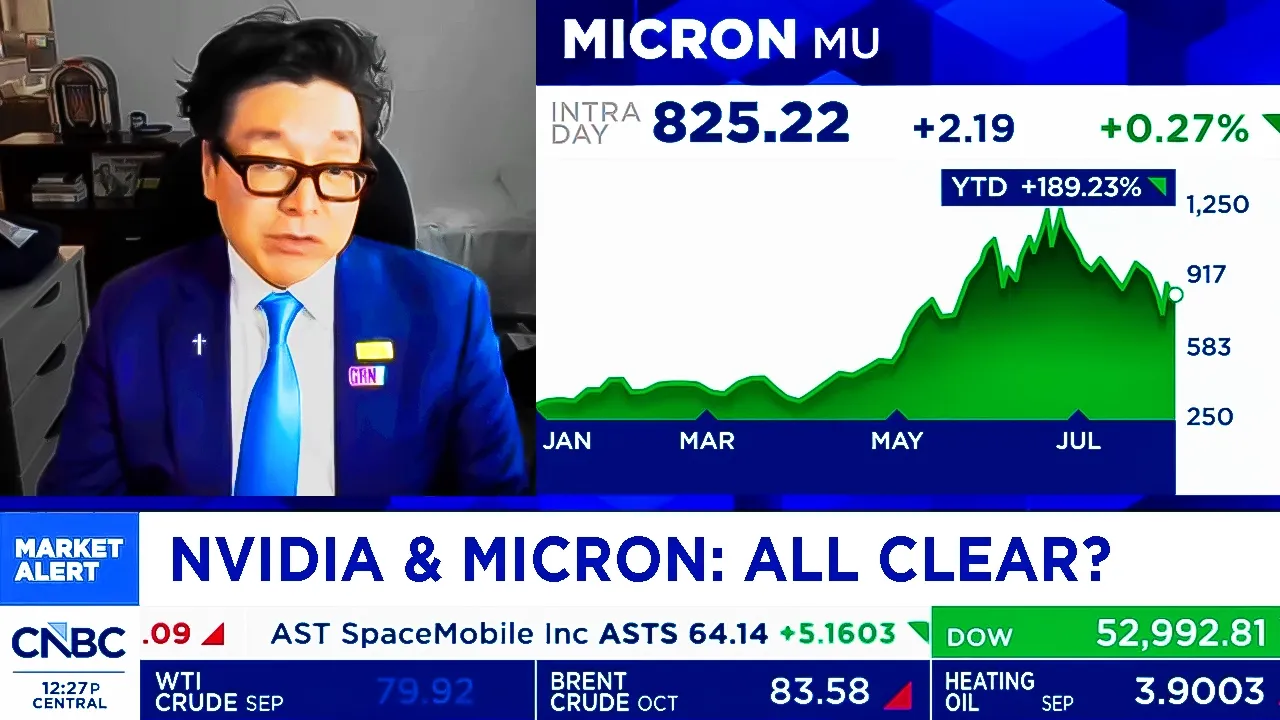
CNBC, Fox, Bloomberg Today On NVIDIA Stock, Micron Stock, SK Hynix Stock - NVDA Update

- Rendement de la vidéo
- +2,45%
- Appels
- 4
- Achat / Vente
- 2 2
- Publié
Recommandations
L'entrée est le cours de clôture de l'actif à la date de publication. Le cours actuel est la dernière clôture enregistrée.
-
Entrée $829,50 03 août 2026Actuel $858,03 07 août 2026Résultat +$28,53
I think it's reasonable to be bullish on memory makers like Micron and SKH Heinix at least through most of 2027, possibly longer.
-
Entrée $206,64 03 août 2026Actuel $223,78 07 août 2026Résultat +$17,14
I am very confident that Nvidia will be worth much more in future years than it is today.
-
Entrée $487,65 03 août 2026Actuel $502,97 07 août 2026Résultat −$15,32
We did see them take profits in Microsoft last week.
-
Entrée $590,24 03 août 2026Actuel $592,90 07 août 2026Résultat −$2,66
We did see them take profits in Meadow last week.
Transcription Complète
Hey Tom, I I just want to ask you what you think of the Liupold Ashen Brunner situation and the idea that he was highly leveraged four times had to unwind this stuff. How much of that played into what you were just talking about with [clears throat] South Korea and the panic that happened there? How much of that was because he was selling that portfolio at the same time? >> Uh I think it was a big factor. Um because as you know Korea is basically two c two companies Samsung and Highix. So it's memory and semis. >> Um he of course had a very large following. So not only was his leverage on his $45 billion, let's say it was leveraged 150 billion, >> but there was a lot of money piggybacking on his trade. So I think in some ways uh you know the unwind and even last week was due to a lot of funds being aware that he might have been in trouble. Do >> you think it's even big? I mean, when you say all the copycats, is that another 150 billion or is that 500 billion of copycats? >> I I think everyone's smaller. I mean, I think this was a clearing event last week. >> You mentioned something, Dom. You still think that Open AI and Enthropic are going to be the beneficiaries perhaps of some of the areas where SpaceX wants to get involved. I wonder if some of the developments over in China and sort of the preeminence of the open-source models is undermining some of [clears throat] the prospects for the likes of OpenAI and Anthropic and if we're seeing the financial benefit increasingly consolidated to the hyperscalers and to perhaps a lesser extent in the future in semiconductors. How do you take that narrative? Where do you take that? >> Absolutely. Well, first of off, I think you rais a really good point. Open source is like wonderful for the chip stocks, right? Nvidia in many ways is the absolute king of open source. These these models are are are extremely large, right? The Kimmy K3 model out of Moonshot, 2.7 trillion parameters. They recommend that you use 64 different accelerators to run it. So I think open source is an unequivocal good for the chip companies. Now the question is what does open source do for frontier economics? And what we've actually seen is the cost curve at the leading edge, right? Like if you look at the difference of cost per million tokens of say Kimmy K3 versus GBT uh soul it it's actually increasing right and if you look at cost per task per task per completion it's very strong for for chat GBT but I think there's so many things that go into it rather than just cost economics of the tokens right it's applications it's distribution it's actually performance right what's the difference between an average lawyer and the best lawyer in the world you know 20 30 40x I think that's true for the frontier models as well. It's very it's very hard to price incremental intelligence but I think incremental intelligence is extremely high. The other thing you mentioned is ROIC for the hyperscalers. I do think the hyperscalers have a place of delivering these open source models to enterprises all around the world. And I think what we've seen this earning season is a resounding resounding endorsement of high ROIC on this investment. Right? Satcha Nadella tweeting and uh the Morgan Stanley piece citing 30% ROIC's Jasse talking about on their call that for the shortest shortest life cycle stuff the data center chips and the network and the servicing that that they get payback in two to three years and that the useful life is 5 to six years and and then finally we've seen accelerating growth out of all the hyperscalers AWS 37% Microsoft Azure 43% Google cloud 82% %. I think these guys are going to keep spending and I actually think we may actually see accelerating capex growth next year. >> Yes, Duncan. >> Uh Mike Ron, not really a friend of Apple. You they've had Sandre Bro has had a uh a match in times with with with him, but I I do point out David that I think overall Apple sales will not be hurt that much and I do think the Telos will pick up a little more than people think. But the guidance was so negative they really give Apple little leeway. give the new coil over to Leroy. >> You think so? So yeah, a little running room there to >> Yeah, cuz that's a that's an underpromised situation if they're ever >> had been of course one of the best performance of the year amongst the Mag 7 amongst the big you know Alphabet gave him a nice windfall. >> Speaking of uh other biggest market cap company and it is the leader again Nvidia your dear Nvidia Nvidia Nvidia's career right now and they trade together. I don't know if that's right that they should trade together, but Nvidia did have a better move on Friday than uh some of the others. Uh David, Nvidia is going to when Nvidia reports on the 26, we'll find out. I think there are a lot of people who feel like Nvidia has to cut his price and that's what's been lurking the whole time. Like they're too expensive versus the other guys. And I know that uh that certainly Andy Jasse would tell you that he's got better chips. Uh and if Andy Jass has better chips, I think people feel like wait a second, they have to cut numbers. I don't think I think they have tons of demand and that's not a good narrative, but it's the one that the bears have been saying. Okay, >> there's still an immense faith in buying dips. We've saw we saw them buying the dip the whole way down pretty much throughout the the situational awareness unwind. We did we didn't see them selling a lot into the rally. We actually saw some of them take this as an event that was a signal to buy more. Uh we did see them take profits in Microsoft last week. We did see them take profits in Meadow last week, but they also continue to love leveraged ETFs. You'd think that the situational awareness thing might might wake people up, but no, this tells you the balance between sort of greed and fear and this is being perceived as an opportunity to load up more. So, we saw people buying uh triple levered socks L. We saw them buying triple triple TQQQ. We saw them buying double levered Micron and SanDisk ADRs. Oh, boy. >> Triple levered Korea K. >> Speaking of Korea, I want to come back to that. How long are we going to start taking our how much, you know, are we going to take our lead from Korea, which was down over 5% again, but the Cosby, you know, we can't remember where we're leading the show with what the Cosby did, but we have been recently. I wonder when that ends. >> It it ends when it ends when we when we fall out of love with semiconductors. I mean, the the the DRAM ETF reset the mindset for the markets to a large extent. It was you we we can now look back at this and say it was the DRAM ETF which was in many ways arguably the most successful ETF launch ever got people it's a very thin it's very narrow ETF Korea being very big parts of it then you of course had the situational awareness leveraging up four to one in these stocks and so we have no choice but to take our lead from this until you know until the market again moves on from semis being the sector that drives the bus we have the semis and software seeing a huge bounce while the mag continued to rupture as a group and today the memory names are leading the declines. Travis Prrentice is CIO of the informed momentum company. He's joining us in today's opening exchange. Travis, it's good to see you. And how would you describe what's going on with this trade here and the markets more broadly? >> Yeah, it definitely was a rough uh July uh for the broader AI trade, most notably uh like you said, semiconductors and memory stocks. Um it's too early to say whether I think the juryy's still out whether this is a change in narrative or just a correction. Uh but certainly there was some damage done to the trade and it's going to take some time to heal as far as uh the technical damage and the trends are concerned. When you see damage done to the trade, is it the kind of damage that makes you want to come in and snap up these stocks because they're, you know, way off the highs or the kind that makes you question whether the in, you know, we're moving on in the in the same way that we kind of had the Nvidia moment. It's it's holding its own, don't get me wrong, but the market kind of moves on. Is it moving on from the memory trade? >> Uh, it's tough to tell now. I think right now it's not time to be a hero. I think the trade is definitely flashing a caution signal, some flashing yellow lights perhaps. Um, but I think right now it's time to manage risk, uh, monitor these trends and be open to wherever the trend either reasserts itself in terms of the memory and semiconductor or actually new leadership. But I also think what's interesting within the broader AI trade is not every company leveraged to AI is having a rough time. In fact, we see a very strong confluence of both price momentum and fundamental momentum in the in the AI trade that's leveraged to the rise of AI agendic traffic whether it be security stock PaloAlto. >> Let's say that again because this is important. You're seeing the strongest part of the AI trade for fundamentals and technicals in the AI agentic trade and and keep continue. >> Yeah, sure. Certainly. I think it's time to look at stocks, you know, from a stock-by stock perspective. And certainly at the inform momentum company, we're looking at single stock trend and we're looking at the idiosyncratic nature of what's driving both their price trend and their fundamental trend. So the intersection of both those things. And so within the AI trade, you have companies that are levered to the rise of agent traffic. So things like security uh networking uh so a company like a cloudflare a PaloAlto or a crowd strike those companies that are levered to the broader adoption of AI we're seeing very strong trends even throughout July and into August today as you see >> this is fascinating I just want to make sure that I understand and what else it would imply. So you're seeing strong momentum in agent traffic and the trades and companies. So I I'm thinking now about you know back in the internet we just took it for granted that it was humans using it. Now agents are using the internet and and what's happening as a result for the security names for networking. Are there other areas implicated here? >> Um yeah I think there's going to be other areas and that's why you need to be open to where trends emerge and persist but if you think about the rise of traffic with agents think of them as digital assistance. Um but they all need to be credentialed. Security is obviously very important and then obviously the traffic that it creates needs to be optimized in the network. So there will be a tremendous amount of opportunity as AI kind of diffuses across industries. And I think that's one thing we saw from the quarterly reports is just how many different companies in very different industries are embracing the power of AI and harnessing the power of AI to do their business better either cut costs or actually create uh revenue acceleration um and embracing this technology. So I do think though that look it's time to kind of look at the market in terms of a market of stocks rather than a stock market. And so um right now I think we just look look at the market observe and be open to wherever either the leadership asserts itself again within the same trade or it goes outside of of kind of what we've been used to this year so far. >> Quick last question Gil. We've talked a lot about your [snorts] positivity on the memory kind of economics for a long time, but what do you think about the trade? Are you becoming a little bit more cautious? I know we're going to hear from Western Digital, I think SanDisk this week. They're under pressure today. CXMT may be looking at a second plan and a buildout in China. >> Nothing fundamentally has gotten worse. In fact, fundamentally, the story for Micron has gotten a lot better. We just had all the large customers acknowledge that memory prices are going to continue to go up and that they need long-term contracts just to make sure that they have some sort of hedge. So Micron is the only chip company that has these long-term contracts. So their fundamental situation's gotten better. Now what's [clears throat] happening in the in the stock market has to do with more with situational awareness and Korean retail traders and things like that. But from a fundamental perspective, the story for Micron has gotten a lot better in the last couple of weeks. >> All right. All right. Well, Micron is under the microscope. Shares of the memory chip falling over the last week as the company battles steep composition from Chinese rival Chong Shin. You know that that's the ticker CXMT that we've been talking about in the last week. Now, that's memory technology. It's weighing building another plant in Beijing after its IPO valued it at nearly $500 billion sending some micron investors out the door. But our countdown closer says that every pullback in semiconductor stocks is a buying opportunity. Dryen Pence CIO at Pence Capital Management joins us now with the chips on the dips play. All right. Why should I not be worried about Micron? Because the key issue here is AI has moved from proof of from proof of concept into rapid adoption. And when you take a look at Micron, it is one of the few companies that really is generating the the chips that are needed, the memory that's needed. There's not enough memory out there. And so you have the hyperscalers spending a tremendous amount of money to try to keep up with the sensational demand. And Micron is at the choke point of it. And they're going to continue to have a lot of demand for what they're doing. >> Okay. So all the critics say Micron goes through this cycle every four years. It's always a supply and a demand shortage. This is cyclical. It happens all the time. Is this time different? >> This time I think is different in that you have a a big pullback in the stock of course, >> but you have this massive movement in earnings. I like it when E grows faster than P and the earnings are growing a lot faster than the price. And I think that this is a thing to look at across this entire sector. So that's >> when this was a $1,200 stock, every analyst said it's going to,500, 2,000, 2500. Where do you see this stock going? >> I think it's very hard to put a price on that because the underlying question is is how much AI adoption are we going to have? I think it can go significantly higher, but exactly where it's it's hard to say. 56% of the companies in America now have an AI account. >> Yeah. and and they're beginning to buy more and more, but they're they're they're just scratching the surface at this point. Yet AI is increasing labor productivity. You increase labor productivity, you increase profit margins, and that's going to increase demand for this going through. >> When you say AI, everyone in this country thinks Nvidia, but the stock has been like a blah relative to like the chip makers, the stocks index that's up 70, 80% even with the massive pullback. How do you get excited still about Nvidia? >> Because it it is like again we look for companies at choke points. When you take a look at it in Nvidia right now it's at like a 21 PE but its earnings are growing at 46%. Okay. >> So when you take a look at earnings growing that fast over the next two years and going forward I think that you're just going to see this tremendous amount of money. You're seeing that the hyperscalers are spending it. >> Y >> and people like Nvidia are getting it. Take a look at the free cash flow. It's tremendous. And so we think of these things going forward. So >> what about circular financing? Nvidia's invested in this data center and in return they're giving this d this invidia chips and compute and it's all this one big circle and it's musical chairs. When the music stops someone's going to get left behind. Do you not worry about that? >> I don't worry about it quite so much. >> Okay. >> And the reason why is the overall demand is so high. I think we have a long time to go before you run into that. Okay. >> And there's not that many players here. You've got only four or five suppliers to all the hyperscalers. And so there's just not that many that many folks. No one's pulling chairs away right now. >> Okay. >> Right. >> Not yet. >> Not yet. And I but I think that when the the point of the matter is is we just had this heavy heavy demand and very few suppliers. So I think this is this theme has several years to run. >> Okay. >> And that's why we say buy chips on the dips. If if if market if market's going to be volatile, let's take advantage of volatility, not be its victim. >> All right, I hope you're all doing well today and staying calm in this market. Today was overall a positive day for much of the market as tensions in the Middle East appear to have eased at least for the short term. Oil and Treasury yields both moved lower following the sharp rise in yields we've seen over the past couple of weeks. Reuters is reporting that China's CXMT is considering building a second fab in Beijing and is in financing talks with a tech manufacturing hub backed by the local government. According to sources, it's unclear what the planned capacity and total investment for the new fab will be. This news comes after CXMT's recent IPO in China in which they raised at least $8.6 billion. Market participants were expecting CXMT to use the majority of that capital to expand capacity. It's also being reported that CXMT is nearing completion of LPDDR6 validation. That's primarily relevant to products like smartphones, PCs, and other low power devices. The development suggests that CXMT is narrowing the technology gap with the big three memory makers in more advanced conventional DRAM. Those two pieces of news, especially the one about the new FAB in Beijing, is why Micron initially opened lower Monday morning. I don't mean to sound like a broken record, but right now market participants are extra sensitive to any news or rumor that indicates additional memory supply coming online, even if that additional capacity won't be operational for a while. Due to the historical cyclicality of the memory business, market participants are extra nervous when it comes to new supply that could potentially threaten the memory makers pricing power. Also on Monday, we learned that Moody's has upgraded SKH Heinix issuer and senior unsecured ratings to A3 and that the outlook remains stable. Moody's expects SKH will sustain strong profitability and cash flow generation over the next 12 to 18 months. Moody's expects earnings and cash flow to grow significantly over that time frame. In other news, I'll briefly mention a story I saw about AMD reaching parody with Nvidia among some NeoClouds with a headline saying, quote, "AMD is onetoone with Nvidia in many Neoclouds." But then you read the article and you find this nugget, quote, "At least two providers are standing up 10,000 GPUs from each provider side by side, at least two." The details of the article appear to be somewhat at odds with the sensationalized nature of the headline. Don't get me wrong, I have nothing against AMD and I think they have a large opportunity in front of them. As I've said many times on this channel, this is not zero sum. The world is compute constrained, which means there's already enough room in the market for multiple chipmakers to succeed. And on top of that, the total addressable market is growing in the double- digits percentage annually. Now is not the time for Nvidia investors to be worrying about market share. On that note, the author interviewed an executive from Vast Data who said, quote, "Everybody is constrained right now. The gap has widened in the last 12 months, not converged." Looking ahead, we have some important earnings reports this week with AMD reporting results on Tuesday, August 4th after market close and both SanDisk and Western Digital scheduled to report earnings on Wednesday, August 5th. Results and commentary from both SanDisk and Western Digital on Wednesday will likely have an impact on stocks like Micron and SKHix, so be prepared for that. I don't know how the market will react to those two earnings reports, but as I've said in recent weeks, we're unfortunately in a lose-lose situation in the short term when it comes to sentiment regarding memory makers earnings due to the historical cyclicality of the memory business. If memory makers report very strong earnings, some market participants will assume that the cycle must be peaking because the results are so strong. And on the other hand, if expectations run too hot and memory makers slightly miss those lofty expectations, some market participants will assume that the peak of the cycle is behind us and that the cycle is starting to roll over. It's unfortunate, but that's where we are when it comes to market sentiment regarding memory makers earnings. We'll see what happens Wednesday. Personally, I'd rather own something like a Micron or SKH versus SanDisk, but that's just my personal preference and I have nothing against SanDisk. That said, the market's reaction to SanDisk earnings will almost certainly impact how Micron and SKH Heinik's trade in the short term, so be prepared for that just in case. Also, over the weekend, Nick Dorsey posted online saying, quote, I heard from a trusted source that Anthropics ARR as of mid July was $80 billion. And then that post was quoted by Brad Gersonner of Alimter Capital, who is an investor in Anthropic. He did not refute Nick's claim. As a reminder, Anthropics ARR was roughly $9 billion at the end of 2025. And then they announced that their ARR surpassed $47 billion in May of this year. So if Nick Source is correct, then Anthropic is approaching a 10x in ARR in less than one year. That is incredible. Of course, we need to wait for official confirmation from Anthropic. I've noticed many of the pessimistic voices have recently shifted their talking points again. Previously, the narrative was that AI is a bubble with no real return. Then their talking points shifted to say that ARR is not revenues. And then we got hyperscaler earnings in which each of the three major CSPs reported accelerating cloud revenue growth and expanding cloud operating margins. And now those same pessimistic voices have once again shifted their talking points. Now they're complaining that the returns from AI are concentrated among just a few hyperscalers that are too heavily dependent upon the two frontier labs, OpenAI and Anthropic, and that those two labs are unprofitably burning through cash. Listen to me. I think we're likely going to see the frontier model company's margins improve over time. It's important to remember that with new generation architecture from Nvidia, token costs are reduced by X factors. Now, yes, newer systems have a higher upfront cost and rental costs for newer generation hardware are usually higher than the rental cost of the previous generation. That said, you also have to consider that with each new generation architecture, the cost per token is significantly better than the generation before it. I expect that we will gradually see the frontier model company's margins improve as we see both increasing adoption among enterprises sovereigns and consumers as well as new generation architectures that will substantially reduce cost per token and deliver substantially greater throughput. As that process unfolds, I think the overly pessimistic voices who assume that AI would deliver no return will once again change their talking point to something else. Perhaps they'll start questioning the duration of the demand or pointing to industry bottlenecks as they try to sell you on their paid newsletters. Don't get me wrong, I think Frontier Company's profitability is an important topic of discussion. At the same time, I do think there's an unreasonable amount of scrutiny that is placed on the topic by the same unreasonably pessimistic voices who have been wrong about the AI buildout for the last 3 years. Again, new use cases, increasing adoption, new generation architectures, and lower token costs should help gradually improve Frontier Company's margins. It's an important topic of discussion. I just think that many of the fears are overblown. In other news, it's being reported that the big three memory makers DRAM and HBM capacity is now sold out through the entirety of 2027 ahead of schedule. According to the report, as major production capacity is gradually allocated in 2027, the final prices of DRAM and NAND will only be determined closer to the actual shipment date. Industry insiders believe that persistently high memory prices will become the norm in the future. The overall tight supply and cost pressures on end users are unlikely to ease in the short term. I continue to expect the world to be compute constrained at least through the first half of 2028, possibly longer. I also think it's reasonable to be bullish on memory makers like Micron and SKH Heinix at least through most of 2027, possibly longer depending on what happens. I think most open-minded investors can look ahead and understand that physical AI ramping at scale will have a major impact on compute demand in the years ahead. In my mind, when considering how long the world will be compute constrained, the question is when will physical AI ramp at scale and really start taking off? I think sometime between 2028 and 2030 is likely. Now, a big reason why I haven't yet extended my time frame for how long I expect the world to be compute constrained is because I'm still not entirely sure whether there will be a short-term air pocket in compute demand and between the current drivers of compute demand and when physical AI really starts taking off. The timing of that handoff from one demand driver to the next is what I'm not fully certain about yet. That said, considering the rapid adoption of agenic AI, agenic inference, enterprise deployments, and also consumer AI, which I think is still in its infancy, I think it is plausible that we could reach a point where physical AI is ramping at scale without there being a short-term air pocket in compute demand before that ramp really starts going. I think it's plausible. We'll have to see what happens in the days ahead. As time goes on and we gradually gain greater visibility into the future, I will have to adjust my time horizon for how long I expect the world to be compute constrained and how long I think it's reasonable to be bullish on memory makers. whether that means extending those time frames or shortening them. But in the meantime, based on what I can see today, I think the world is likely to be compute constrained at least through the first half of 2028. And I think it's reasonable to be bullish on memory makers like Micron and SKH, at least for most of 2027. I don't know what's going to happen in the short term, but from a long-term perspective, I am very confident that Nvidia will be worth much more in future years than it is today. When Jensen was on the Lex Freedman podcast not that long ago, he was very seriously raising the possibility of Nvidia becoming a $3 trillion revenue company in the near future. If that happens in the coming years, then it is very plausible that Nvidia could one day be worth tens of trillions of dollars in market cap. That might sound crazy, but that's what Jensen is implying when he raises the possibility of Nvidia becoming a $3 trillion revenue company. I guess the question at that point is what multiple the street will be willing to give Nvidia. I don't know the answer to that question, but I truly do think that Nvidia will be worth much more in future years than it is today based purely on the fundamental growth of the business. Based on everything I'm seeing, the world is still computed and I expect that to continue at least through the first half of calendar 2028. In a computed environment, developers will use whatever viable compute they can get their hands on. Today, there are no GPUs that are sitting dark due to a lack of demand. Like there was fiber sitting dark due to a lack of demand at the height of the dot bubble. Back then, companies were laying fiber in the hopes that use cases and demand would eventually show up. Today, we are seeing the complete opposite. As I've said many times, when market participants compare this AI revolution to the do-com bubble, they ignore the fact that the internet is already here this time. This means that mass adoption of the technology and new use case development at scale are immediately possible. We don't have to wait years for it to show up. It's already here. The world is compute constrained, which means there is not enough supply to satisfy demand. New capacity is utilized as soon as it comes online. The hyperscalers are monetizing capacity as soon as it comes online. Each of the hyperscalers spoke about being supply constrained on their most recent earnings calls. Additionally, many of the clouds are building out into contracted demand. They're not blindly building in the hopes that demand will eventually show up. No, they're building out because they have signed contracts and in some cases significant prepayments from their paying customers. This AI revolution is fundamentally different from the dotcom bubble. And 2026 will be a pivotal year for the AI industry thanks to the rapid adoption of Agentic AI and the proliferation of Agentic systems in the world's leading enterprises. The leading AI labs revenues are surging right now. Agentic coding and the implementation of Agentic systems in large enterprises are new use cases that are increasing inference demand significantly that subsequently is increasing compute demand. The rapid adoption of Agentic AI is why we're seeing an inflection in inference demand. It's why we're seeing the leading AI labs revenues surge. I wish both Anthropic and Open AAI were public so the public could see the ramp in their revenues. Anthropic ARR has surpassed 47 billion up from $9 billion just at the end of 2025. Open AAI is growing rapidly as well. I think the leading labs surging revenues may be the initial proof point that grabs market participants attention and causes them to realize that there will be a clear ROI on AI infrastructure. I think the leading labs surging revenues will also help assure investors of the longevity of Nvidia's growth since these labs revenues are directly tied to compute. If they had more compute, they would have greater revenues. It really is that simple. Demand is not the problem. The problem is a lack of supply to meet the demand. As I've said previously, I expect the world to be compute constrained at least through the first half of 2028, possibly longer. And so regardless of what happens in the short term, it's important for long-term investors to remain focused on the fundamentals, maintain a long-term perspective, and remember that we are only in the early stages of aic systems being adopted at scale. This will increase compute demand significantly. And after that, the next surge in compute demand will likely be fueled by physical AI. We're no longer talking about digital agents performing digital tasks. With physical AI, we're talking about physical AI agents performing physical tasks in the real world. NVIDIA CFO has called physical AI quote a multi-t trillion dollar opportunity and the next leg of growth for Nvidia. This industry will fundamentally transform society and Nvidia has positioned themselves to benefit massively. Nvidia sells the hardware for the data centers where the models are trained. They offer omniverse where the models are taught and tested and Nvidia also sells the hardware that allows ondevice real-time inference through Nvidia AGX allowing robots to have intelligent interactions with the real world even when they are not connected to a data center. Notice that Nvidia is taking a holistic platform approach to physical AI and they're embedding themselves as the underlying foundation supporting all of it. Over 2 million developers are already building on the Nvidia robotic stack and this is not getting enough attention. As for production ramps, Blackwell Ultra has ramped quickly and remains in high demand. Reuben is on track to launch in 2026. Then we're expecting Nvidia Gro 3 LPX in the second half of 2026. Later on, we're expecting the launch of Reuben Ultra in 2027 and Fineman after that in 2028. We have a clear data center product roadmap stretching into 2028. And Jensen believes that AI infrastructure spending will reach 3 to4 trillion annually by the end of the decade. That means Jensen is expecting growing AI demand and an expanding total addressable market underpinning all of this. I don't think we are anywhere near any type of bubble bursting type of event. With all of this in mind, I seriously think that Nvidia still has plenty of runway ahead of it and I think this company will be worth substantially more in future years than it is today. At least that's my view of the situation. Quick note before I wrap up. All of the compilations on this channel are edited by Finn Vid with original structure and commentary. Occasionally, the same edits appear elsewhere on YouTube. If you're looking for the original version, it's always here on this channel. Thanks for watching, Finn Vid. I appreciate your support. Remember to stay calm in this market. Remember to maintain a long-term perspective and do not make any hasty or irrational decisions. With all of that being said, I hope you all have a great rest of the day. And I'm curious to hear your thoughts about Nvidia in the comments below. Please leave a like on this video so more people will see it. And while you're down there, please consider subscribing. It's free and you can always change your mind.
Commentaires 0
Connectez-vous pour rejoindre la discussion.
Se connecterAucun commentaire pour l'instant. Soyez le premier à partager votre avis !