if you think purely in terms of a shift in in the demand coming from AI, then I think there can be a case made that you should be investing in Micron in spite of your worries about cycles and earnings.
I truly do think that Nvidia will be worth much more in future years than it is today based purely on the fundamental growth of the business.
Contexte
Based on everything I'm seeing, the world is still compute constrained and I expect that to continue at least through the first half of calendar 2028. ... I truly do think that Nvidia will be worth much more in future years than it is today based purely on the fundamental growth of the business.
Transcription Complète
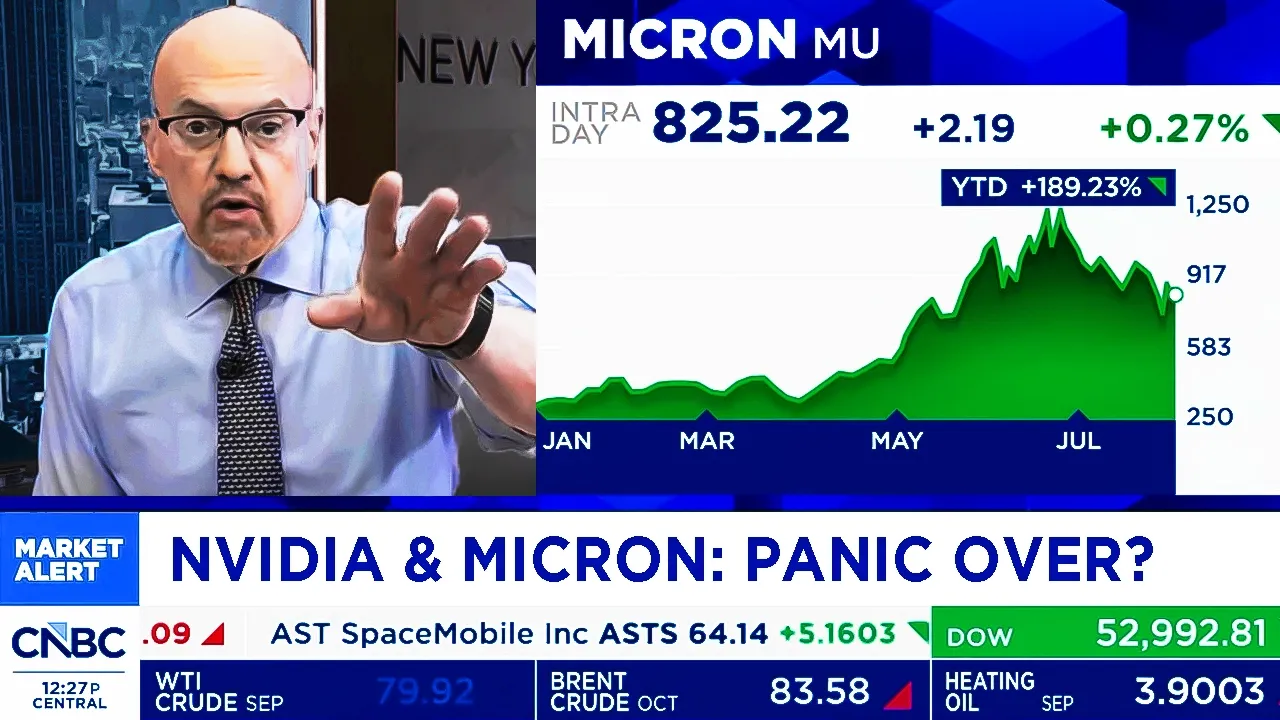
But the chips just can't decide which direction they want to go in. What is the market struggling to price right now? >> Yeah, thanks for having me on. So so yeah, when you look at the chip sector volatility over the last few weeks, I mean the core question you kind of have to ask is is the volatility being driven by technical kind of momentum based profit taking or has there been an actual structural shift in the fundamental AI spend story. So if you look at the data, the fundamental story hasn't changed at all. In fact, it was actually just reinforced by the recent earning prints out of these hyperscalers. So just looking at the numbers, Amazon just raised its CapEx guide by like $20 billion. And they actually stated that even at this level, they don't have enough CapEx capacity to meet the AI demand. Same story out of Alphabet. And so the the cash is absolutely still flowing into the infrastructure. The volatility we're seeing is kind of purely macro noise in our view. It's really being driven by headline anxiety over Chinese memory players like CM XT and also driven by just simple fear over how fast these stocks have run up. So this isn't a broken cycle or demand problem. The demand is absolutely still there. It's kind of a classic temporary overreaction where the market is confusing technical consolidation with actual fundamental decay. >> And Steven, I'd love to get your thoughts here on on how you're looking at this recent volatility. Are they similar to Joe's? >> I think so. I think we're not seeing any fall off in demand whatsoever. In fact, the the companies that are producing these chips are producing as many as they possibly can and the demand is still voracious on the other side. I do think that what we're seeing is the the almost the penalty for good behavior where you've you've had a phenomenal run and what that has taught us all is that these these companies are able to produce. It seems like the news is only uh The news is only really allowed to be good. And so I think the companies are delivering on solid good news, but that raises expectations each cycle. So, I think what I'm seeing is the the demand is there. We are starting to see the monetization of AI that that supports some of those capex arguments. And what I'm really looking for is the migration of demand from those hyperscalers, from those frontier labs into the enterprise over the next year or two. That's where you're going to see the continued really explosion of demand for AI as we as we try to supply it from a very complicated semiconductor industry. >> Are we going to be higher on the semi trade, the tech trade in 12 months? Of course we are. Earnings are growing more than 50%. I think 60% of tech earnings from now through the end of '27 Sorry, 60% of S&P earnings are going to come from tech growth. 60% of growth. So, how can the market hold in unless you continue to get the spending? It can't. So, I like semis. I like the mag seven or great eight. And I continue to think they'll be out-performers >> from here. >> Okay, so it's interesting that you say May of '23 as as the moment, right? When when Nvidia did what it did and here we are, >> [snorts] >> you know, getting later in in '26. So, we're three years beyond the bump that this market and this group got based on that. >> Yeah. >> I'm wondering if you can make a similar statement and or timeline about when Micron sort of blew the doors off everybody with their own, you know, earnings projections and where that market is. And we're like 12 months not even past that. So, does that portend the kind of runway that this gentleman was talking about that Nvidia delivered to this whole trade? >> I mean, Micron will grow earnings by a thousand percent this quarter. A thousand percent. So, it likely is the peak in earnings growth. And I think the big question is will the peak in the growth rate in earnings correlate to the peak in the stock? Meaning, will the stock market care about the second derivative? If you see the earnings growth growth rate slow, but they're still growing earnings at, let's say, 200% will you see more multiple compression? It's hard to see more multiple compression when the stock is trading in the single digits right now, which just means that a lot of the volatility will come from that debate about how long this cycle will in truly last. >> you think? >> Well, Scott, listen, I think you identify a very important point. Micron only broke out a year ago. It's not like this is some multi-year advance. We've had a very severe correction in one of the leading stocks. At one point last week, you were down to 0% of the semis above their 50-day moving average. When you're in a long-term uptrend, that generally gets you in the vicinity or in the ballpark of some type of tradeable low. We'll see how they respond out of this. I think the last couple days have been encouraging, but isn't the bigger picture here when parts of the market correct and money rotates elsewhere, doesn't it tell us that money does not want to leave the asset class of equities. We have yet to find an interest rate that's high enough to really be competitive >> to draw money out of equities. >> for any extended period of time. It may It may scare you for a minute, but here we are again. Now we're talking about lower yields. >> Yeah, it's got and I think that's what's important to remember about some prior bubble-like environments, whether it was Nikkei in '89 or Nasdaq in '99, you had bond yields exploding higher with equities in both those periods. I don't think we're in that environment yet. It's going to take a five-plus handle on US 10-year yields, I think, to truly be competitive. Um, maybe it's in front of it, maybe it's not, but we haven't seen it yet. >> I think Micron doubles from here in the next 18 months. >> And this is former guy who literally you made your living looking at these stocks for years and years and years. >> Yeah, it's just it it that phrase it's almost like we're told you're not allowed to say it's different this time. It's like you're you're joking to say it. And and my response back to this it's already way different. Like you're already wrong if you were bearish the whole time. The thing already was a trillion market cap. So, it rolls over and then all the people who missed it say I was right. It's cyclical. It's different. They're the capacity isn't coming online till 2028. It's already largely accounted for. They're going to have big bigger percentage of the compute than they ever had before. It's a consolidated market that that that's I think Micron guided to the numbers are astronomical as Chris said. I mean they guided to 50 billion in revenue at 86% gross margin this quarter. This this is not like it's your your your father's Ford, like it's a different it's a different animal. So I think when you look back, I mean Chris made a good point. >> Look at that. It's like less than six times forward according to >> I I think it trades at 10 to 11 times peak and the question is how long does it stay at peak and how fast is it a road? But Chris's point is is good, right? A year ago the analysts had a cumulative 6 billion free cash flow for this year and next year fiscally for Micron. It's now closer to 300 billion. >> we don't know the order of magnitude is the issue here. >> You know, we we don't know and we're learning as we go and we've done it every incremental step of the way how to quantify what this AI buildout is is going to look like. We we justifiably justifiably have been wrong along the way cuz how could you know? The analysts have no choice but to get caught up because how would you know? >> Last year this time people thought that CapEx for 2026 would be flat and now it's up 90% from the hyperscalers and so that's why we've seen such a huge rally in these semiconductors because they've been receiving all of these CapEx dollars. I think the question is is there a lot more room for upside? The street expects 20 30% growth for hyperscaler CapEx in 2027, but if the market keeps pushing back on raising CapEx forecast, could we see those numbers be too high? And that would be the one thing that would challenge the semi trade. >> How do you judge a Micron for example as as we say that you know the dean of valuation? I mean so what do we show the forward valuation? It's like five or six six times earnings and we had somebody that I was speaking with earlier before we got to this segment suggesting that it is it actually is different this time that the earnings momentum that a Micron for example has is so extraordinary that you can't judge these kinds of chips and chip names as you would have throughout history sinking thinking that it's so cyclical that it it's different. How how would you assess that? >> I mean, I think it's been the battle between history and and the the the AI share that's gone on for the last few years. History in in chips has always been that earnings go up and earnings go down that you got to price it on some normalized version of earnings. The the optimism in Micron say, you know, that's not true anymore because this demand is not a cyclical demand. It's a secular shift in demand. So, I think if somebody makes a bullish case for Micron, I'm willing to listen. I think it's still a richly priced stock, but I think in terms of you know, if you think about normalized earnings. But, if you think purely in terms of a shift in in the demand coming from AI, then I think there can be a case made that you should be investing in Micron in spite of your worries about cycles and earnings. >> Your memory stocks. >> Yes. >> It's all about as Karen Finerman would say, it's all about the setup into earnings. And I got to tell you, this is the best the best setup you've seen for these memory names in quite some time. Now, if you don't think that the Chinese competition is a big deal, I do, but if you don't think so, then you got to say these numbers going to be spectacular, which I think we all agree they will and these stocks going to rally in the same way that we've seen Microsoft and Amazon rally. So, I think for the first time in a while you can actually make a case that the setup into earnings for these names is extraordinary. With that said, you see how quickly, I mean, Sandisk lost almost 50% of its value in a month. I mean, look at what Micron has done as well. So, these stocks can go down as well. But, if you think that listen, if you think the competition isn't a thing, if you think the numbers going to be great, and if you think the setup is good, which I do by the way, then you got to buy these names with both hands. >> you think competition is a thing? I mean, it's not a thing. >> it's a thing. It is a thing. >> also. [clears throat] >> Yeah, yeah. So, it is coming to a theater near you. They used to say, was it that Jeff Bezos guy of the Amazon? >> Yes. >> Your margins are my opportunity. Remember that saying? >> Yes. Mhm. >> So, I mean, look at the margins that these people are enjoying. I mean, it's just a matter of time before competition comes. Now, we've had people come on Fast Money, which appears in about 11 minutes and 30 seconds, that have said, "Listen, it's a two to three-year project to get these places up and running." Which I agree, but things happen very quickly now, and you're seeing on the outskirts how important competition could be to these stock prices. >> Let's get Carter. How are you feeling about Nvidia? >> Well, so you in a way your cake and eat it, too. So, the great one, let's call it that, cuz that's what it has been for so long, has been the one that has not participated for the better part of 18 months. And so, do you go for the high flyers that crashed, down 30, 40, 50% that can give you the ricochet, or do you favor something like this, which was always the premium supreme name that has been a laggard, a dullard for the past 18 months. My preference is to pick Nvidia if one were doing that choice. >> I think that is the first time that the word dullard has been used on Fast. But it is a It is a fine word that should be used more often. >> Carter gives us a lot of a lot of good vernacular in terms. >> Yes, and calls, by the way. >> Yes. Yes. >> Is there a theme that can be applied to all of these big moves that we've seen lately? You can say that the earning story has come through, and that, you know, Microsoft and Amazon have shown that you can spend and there's a pathway to profitability, and that clears a way for the likes of an Alphabet and Google, etc. Or you can say, on a valuation basis, relative to the other parts of the AI trade, these these stocks were relatively cheaper, and lump Nvidia in there, and now we're seeing money go back there. >> Yeah, I don't know if there's a Well, >> And the folks of the momentum kind of higher beta >> for me is this continued sort of, again, the volatility in single stocks that I have not seen since we've been started do the show. And these are not small biotech stocks. I mean, these are significant companies and now it's been going on for a couple months. So that to me is the overriding theme. But what appears to be going on now is people look at Microsoft to Tim's point says I I we we don't want to be behind the eight ball here. They've clearly figured it out. There's there's an there's sort of a re-emergence of growth here and we don't want to get caught waiting for it to come back to us. So that's why the chase is on. >> As Carter just pointed out correctly, now you have two huge gaps in the chart on the downside in Mr. Softy. >> All right. As Jassy put it, quote, "At this level of spend and hire, we have clear line of sight to strong financial returns." End quote. All of the money he's putting toward the data center may not be even enough to capitalize on the opportunity. Even at the astronomical amount of 220 billion dollars in capital expenditures, up from 200 billion previously. Jassy says, quote, "We will not have enough capacity to meet all the demand we have in 2026. And I believe this dynamic will also be true in 2027, too. In fact, the demand we already have for 2028 is striking." >> Halls of pleasure. >> Holy cow. That word striking changed a lot of people's minds. That's to the statement that Amazon Web Services could be a trillion-dollar business now that it's augmented by AI. Trillion dollars. I know that many investors have been befuddled by Amazon's seemingly reckless decision to spend itself into having negative cash flow. But you have to remember that this is not the first time Jassy's had to spend more than Amazon took in initially in order to hit it big. Before replacing founder Jeff Bezos as CEO in 2021, Jassy led the creation of Amazon Web Services, their cloud infrastructure division that's so lucrative. The cloud unit has now become Amazon's most profitable business, far surpassing Amazon Prime. Jassy thinks that the battle for returns from AI will come faster than returns from the web services business did. Amazing. We sometimes forget how many years Amazon spent losing money in order to achieve its dominant position. Jassy knows from experience that Amazon has to go out on a limb periodically to keep the crowd. This is the limb that must be revisited. One more beneficiary, even as Amazon makes its own chips for the data center, did mention its partnership with Nvidia. That plus chatter that there's very strong demand for Nvidia's chips. I I didn't know that was revelatory. Led the stock of the biggest company in the world to an almost $6 gain or 2.93% and that puts it back above the $5 trillion market cap level. Apple itself? Well, these hyperscalers have bid up the price of some of the most common chips to heights that Apple said will hurt sales going forward. But that's a bigger discussion than I can go over here. And it's one that I think actually could keep a little on Apple stock for some time unless a new source of chips gets revealed that I can't think of. The bottom [snorts] line, thanks to Amazon and yes, to a lesser extent Microsoft, the AI data center trade is back on because we finally know how these investments will actually help the hyperscalers make money. For me, it's in Jassy we trust and we should thank him for explaining why spending hundreds of billions of dollars may be a pittance versus what shareholders can make holding on to his stock and perhaps the others, too. >> All right, I hope you're all doing well today and staying calm in this market. Today was overall a positive day for much of the market as tensions in the Middle East appear to have eased at least for the short term. Oil and treasury yields both move lower following the sharp rise in yields we've seen over the past couple of weeks. Reuters is reporting that China's CXMT is considering building a second fab in Beijing and is in financing talks with a tech manufacturing hub backed by the local government, according to sources. It's unclear what the planned capacity and total investment for the new fab will be. This news comes after CXMT's recent IPO in China in which they raised at least 8.6 billion dollars. Market participants were expecting CXMT to use the majority of that capital to expand capacity. It's also being reported that CXMT is nearing completion of LPDDR6 validation. That's primarily relevant to products like smartphones, PCs, and other low-power devices. The development suggests that CXMT is narrowing the technology gap with the big three memory makers in more advanced conventional DRAM. Those two pieces of news, especially the one about the new fab in Beijing, is why Micron initially opened lower Monday morning. I don't mean to sound like a broken record, but right now market participants are extra sensitive to any news or rumor that indicates additional memory supply coming online, even if that additional capacity won't be operational for a while. Due to the historical cyclicality of the memory business, market participants are extra nervous when it comes to new supply that could potentially threaten the memory makers' pricing power. Also on Monday, we learned that Moody's has upgraded SK Hynix issuer and senior unsecured ratings to A3, and that the outlook remains stable. Moody's expects SK Hynix will sustain strong profitability and cash flow generation over the next 12 to 18 months. Moody's expects earnings and cash flow to grow significantly over that timeframe. In other news, I'll briefly mention a story I saw about AMD reaching parity with Nvidia among some neo clouds with a headline saying quote, "AMD is one-to-one with Nvidia in many neo clouds." But then you read the article and you find this nugget, quote, "At least two providers are standing up 10,000 GPUs from each provider side-by-side. At least two." The details of the article appear to be somewhat at odds with the sensationalized nature of the headline. Don't get me wrong, I have nothing against AMD and I think they have a large opportunity in front of them. As I've said many times on this channel, this is not zero-sum. The world is compute constrained, which means there's already enough room in a market for multiple chip makers to succeed. And on top of that, the total addressable market is growing in the double-digits percentage annually. Now is not the time for Nvidia investors to be worrying about market share. On that note, the author interviewed an executive from Vast Data who said quote, "Everybody has constraints right now. The gap has widened in the last 12 months, not converged." Looking ahead, we have some important earnings reports this week with AMD reporting results on Tuesday, August 4th after market close, and both SanDisk and Western Digital scheduled to report earnings on Wednesday, August 5th. Results and commentary from both like Micron and SK Hynix. So, be prepared for that. I don't know how the market will react to those two earnings reports, but as I've said in recent weeks, we're unfortunately in a lose-lose situation in the short term when it comes to sentiment regarding memory makers earnings due to the historical cyclicality of the memory business. If memory makers report very strong earnings, some market participants will assume that the cycle must be peaking because the results are so strong. And on the other hand, if expectations run too hot and memory makers slightly miss those lofty expectations, some market participants will assume that the peak of the cycle is behind us and that the cycle is starting to roll over. It's unfortunate, but that's where we are when it comes to market sentiment regarding memory makers earnings. We'll see what happens Wednesday. Personally, I'd rather own something like a Micron or SK Hynix versus that's just my personal preference and I have nothing against That said, the market's reaction to will almost certainly impact how Micron and SK Hynix trade in the short term. So, be prepared for that just in case. Also, over the weekend, Nick Dorsey posted online saying, "Quote, I heard from a trusted source that Anthropic's ARR as of mid-July was $80 billion." And then that post was quoted by Brad Gerstner of Altimeter Capital who is an investor in Anthropic. He did not refute Nick's claim. As a reminder, Anthropic's ARR was roughly $9 billion at the end of 2025 and then they announced that their ARR surpassed $47 billion in May of this year. So, if Nick's source is correct, then Anthropic is approaching a 10x in ARR in less than 1 year. That is incredible. Of course, we need to wait for official confirmation from Anthropic. I've noticed many of the pessimistic voices have recently shifted their talking points again. Previously, the narrative was that AI is a bubble with no real return. Then their talking points shifted to say that ARR is not revenues. And then we got hyperscaler earnings in which each of the three major CSPs reported accelerating cloud revenue growth and expanding cloud operating margins. And now, those same pessimistic voices have once again shifted their talking points. Now, they're complaining that the returns from AI are concentrated among just a few hyperscalers that are too heavily dependent upon the two frontier labs, OpenAI and Anthropic, and that those two labs are unprofitably burning through cash. Listen to me. I think we're likely going to see the frontier model companies margins improve over time. It's important to remember that with new generation architectures from Nvidia, token costs are reduced by X factors. Now, yes, newer systems have a higher upfront cost, and rental costs for newer generation hardware are usually higher than the rental costs of the previous generation. That said, you also have to consider that with each new generation architecture, the cost per token is significantly better than the generation before it. I expect that we will gradually see the frontier model companies margins improve as we see both increasing adoption among enterprises, sovereigns, and consumers, as well as new generation architectures that will substantially reduce cost per token and deliver substantially greater throughput. As that process unfolds, I think the overly pessimistic voices who assumed that AI would deliver no return will once again change their talking points to something else. Perhaps they'll start questioning the duration of the demand, or pointing to industry bottlenecks as they try to sell you on their paid newsletters. Don't get me wrong. I think frontier companies profitability is an important topic of discussion. At the same time, I do think there's an unreasonable amount of scrutiny that is placed on the topic by the same unreasonably pessimistic voices who have been wrong about the AI buildout for the last 3 years. Again, new use cases, increasing adoption, new generation architectures, and lower token costs should help gradually improve frontier companies margins. It's an important topic of discussion. I just think that many of the fears are overblown. In other news, it's being reported that the big three memory makers DRAM and HBM capacity is now sold out through the entirety of 2027 ahead of schedule, according to the report. As major production capacity is gradually allocated in 2027, the final prices of DRAM and NAND will only be determined closer to the actual shipment date. Industry insiders believe that persistently high memory prices will become the norm in the future. The overall tight supply and cost pressures on end users are unlikely to ease in the short term. I continue to expect the world to be compute constrained at least through the first half of 2028, possibly longer. I also think it's reasonable to be bullish on memory makers like Micron and SK Hynix, at least through most of 2027, possibly longer, depending on what happens. I think most open-minded investors can look ahead and understand that physical AI ramping at scale will have a major impact on compute demand in the years ahead. In my mind, when considering how long the world will be compute constrained, the question is, when will physical AI ramp at scale and really start taking off? I think sometime between 2028 and 2030 is likely. Now, a big reason why I haven't yet extended my time frame for how long I expect the world to be compute constrained is because I'm still not entirely sure whether there will be a short-term air pocket in compute demand in between the current drivers of compute demand and when physical AI really starts taking off. The timing of that handoff from one demand driver to the next is what I'm not fully certain about yet. That said, considering the rapid adoption of a genic AI, a genic inference, enterprise deployments, and also consumer AI, which I think is still in its infancy, I think it is plausible that we could reach a point where physical AI is ramping at scale without there being a short-term air pocket in compute demand before that ramp really starts going. I think it's plausible. We'll have to see what happens in the days ahead. As time goes on and we gradually gain greater visibility into the future, I will have to adjust my time horizon for how long I expect the world to be compute constrained and how long I think it's reasonable to be bullish on memory makers, whether that means extending those time frames or shortening them. But in the meantime, based on what I can see today, I think the world is likely to be compute constrained at least through the first half of 2028 and I think it's reasonable to be bullish on memory makers like Micron and SK Hynix, at least for most of 2027. I don't know what's going to happen in the short term. But from a long-term perspective, I am very confident that Nvidia will be worth much more in future years than it is today. When Jensen was on the Lex Fridman podcast not that long ago, he was very seriously raising the possibility of Nvidia becoming a three trillion-dollar revenue company in the near future. If that happens in the coming years, then it is very plausible that Nvidia could one day be worth tens of trillions of dollars in market cap. That might sound crazy, but that's what Jensen is implying when he raises the possibility of Nvidia becoming a three trillion-dollar revenue company. I guess the question at that point is what multiple the street will be willing to give Nvidia. I don't know the answer to that question, but I truly do think that Nvidia will be worth much more in future years than it is today based purely on the fundamental growth of the business. Based on everything I'm seeing, the world is still compute constrained and I expect that to continue at least through the first half of calendar 2028. In a compute constrained environment, developers will use whatever viable compute they can get their hands on. Today, there are no GPUs that are sitting dark due to a lack of demand like there was fiber sitting dark due to a lack of demand at the height of the dot-com bubble. Back then, companies were laying fiber in the hopes that use cases and demand would eventually show up. Today, we are seeing the complete opposite. As I've said many times, when market participants compare this AI revolution to the dot-com bubble, they ignore the fact that the internet is already here this time. This means that mass adoption of the technology and new use case development at scale are immediately possible. We don't have to wait years for it to show up. It's already here. The world is compute constrained, which means there is not enough supply to satisfy demand. New capacity is utilized as soon as it comes online. The hyperscalers are monetizing capacity as soon as it comes online. Each of the hyperscalers spoke about being supply constrained on their most recent earnings calls. Additionally, many of the clouds are building out into contracted demand. They're not blindly building in the hopes that demand will eventually show up. No, they're building out because they have signed contracts and in some cases significant prepayments from their paying customers. This AI revolution is fundamentally different from the dot-com bubble. And 2026 will be a pivotal year for the AI industry thanks to the rapid adoption of agentic AI proliferation of agentic systems in the world's leading enterprises. The leading AI labs revenues are surging right now. Agentic coding and the implementation of agentic systems in large enterprises are new use cases that are increasing inference demand significantly. That subsequently is increasing compute demand. The rapid adoption of agentic AI is why we're seeing an inflection in inference demand. It's why we're seeing the leading AI labs revenue surge. I wish both Anthropic and OpenAI were public so the public could see the ramp in their revenues. Anthropic's ARR has surpassed $47 billion up from $9 billion just at the end of 2025. OpenAI is growing rapidly as well. I think the leading labs surging revenues may be the initial proof point that grabs market participants' attention and causes them to realize that there will be a clear ROI on AI infrastructure. I think the leading labs surging revenues will also help assure investors of the longevity of Nvidia's growth since these labs' revenues are directly tied to compute. If they had more compute, they would have greater revenues. It really is that simple. Demand is not the problem. The problem is a lack of supply to meet the demand. As I've said previously, I expect the world to be compute constrained at least through the first half of 2028, possibly longer. And so, regardless of what happens in the short term, it's important for long-term investors to remain focused on the fundamentals, maintain a long-term perspective, and remember that we are only in the early stages of a genic systems being adopted at scale. This will increase compute demand significantly. And after that, the next surge in compute demand will likely be fueled by physical AI. We're no longer talking about digital agents performing digital tasks. With physical AI, we're talking about physical AI agents performing physical tasks in the real world. Nvidia's CFO has called physical AI, quote, "a multi-trillion-dollar opportunity and the next leg of growth for Nvidia." This industry will fundamentally transform society, and Nvidia has positioned themselves to benefit massively. Nvidia sells the hardware for the data centers where the models are trained. They offer Omniverse where the models are taught and tested. And Nvidia also sells the hardware that allows on-device real-time inference through Nvidia AGX, allowing robots to have intelligent interactions with the real world even when they're not connected to a data center. Notice that Nvidia is taking a holistic platform approach to physical AI, and they're embedding themselves as the underlying foundation supporting all of it. Over 2 million developers are already building on the Nvidia robotic stack, and this is not getting enough attention. As for production ramps, Blackwell Ultra has ramped quickly and remains in high demand. Rubin is on track to launch in 2026. Then we're expecting Nvidia Grock 3 LPX in the second half of 2026. Later on, we're expecting the launch of Rubin Ultra in 2027, and Feynman after that in 2028. We have a clear data center product roadmap stretching into 2028 and Jensen believes that AI infrastructure spinning will reach three to four trillion dollars annually by the end of the decade. That means Jensen is expecting growing AI demand and an expanding total addressable market underpinning all of this. I don't think we are anywhere near any type of bubble bursting type of event. With all of this in mind, I seriously think that Nvidia still has plenty of runway ahead of it. And I think this company will be worth substantially more in future years than it is today. At least that's my view of the situation. Quick note before I wrap up. All of the compilations on this channel are edited by Finvid with original structure and commentary. Occasionally, the same edits appear elsewhere on YouTube. If you're looking for the original version, it's always here on this channel. Thanks for watching Finvid. I appreciate your support. Remember to stay calm in this market. Remember to maintain a long-term perspective and do not make any hasty or irrational decisions. With all of that being said, I hope you all have a great rest of the day and I'm curious to hear your thoughts about Nvidia in the comments below. Please leave a like on this video so more people will see it. And while you're down there, please consider subscribing. It's free and you can always change your mind. Thanks for watching and hopefully I'll see you in the next video.

Commentaires 0
Connectez-vous pour rejoindre la discussion.
Se connecterAucun commentaire pour l'instant. Soyez le premier à partager votre avis !