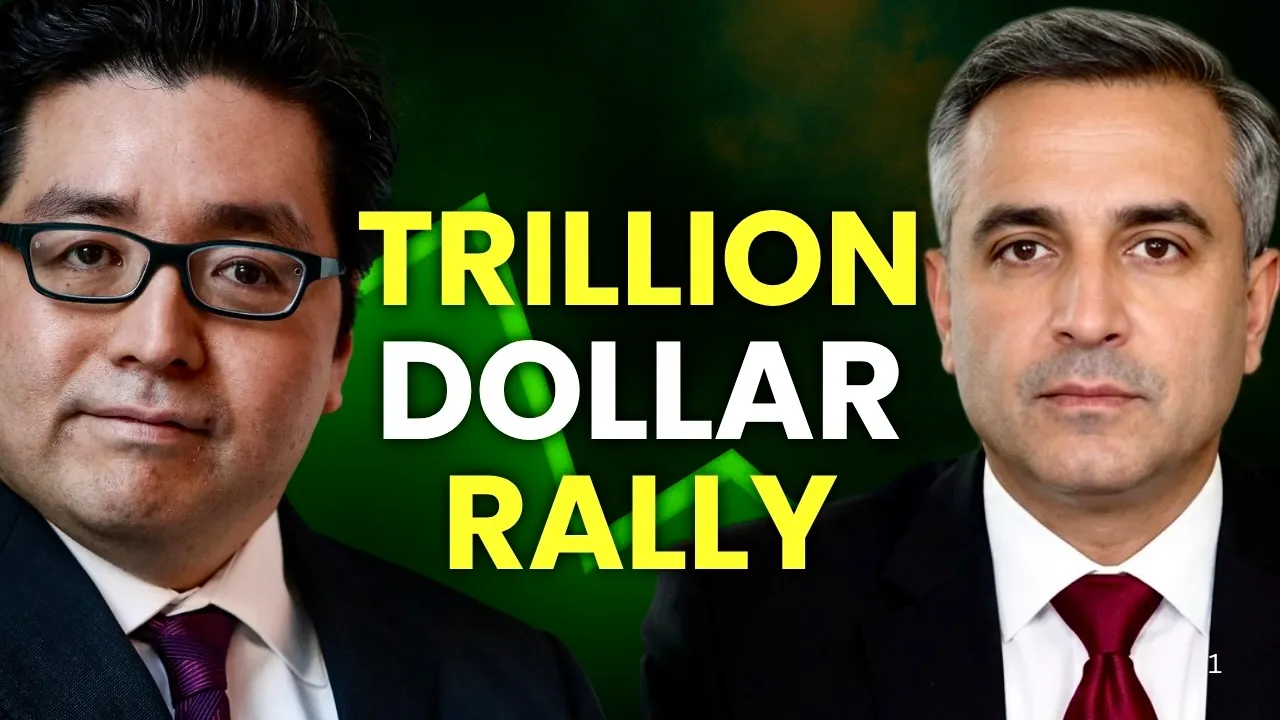
Tom Lee: "2027 Could Be One of the Best Years for Stocks" (3 AI Stocks to Buy Market Clams Down)

- Rendement de la vidéo
- -3,08%
- Appels
- 3
- Achat / Vente
- 3 0
- Publié
Recommandations
L'entrée est le cours de clôture de l'actif à la date de publication. Le cours actuel est la dernière clôture enregistrée.
-
Entrée $375,35 04 août 2026Actuel $354,62 07 août 2026Résultat −$20,73
The first stock is Alphabet, ticker symbol G O O G.
-
Entrée $892,67 04 août 2026Actuel $858,03 07 août 2026Résultat −$34,64
The second stock on the list is Micron Technology, ticker symbol MU.
-
Entrée $225,74 04 août 2026Actuel $182,54 07 août 2026Résultat −$43,20
The third and final stock on the list is Nebias Group, ticker symbol NBIS.
Transcription Complète
Tom Lee of Fundstrat believes 2027 could be one of the best years for stocks and in his latest CNBC interview, he explains why he thinks the market could rebound, why he's still bullish despite recent volatility, and what investors may be overlooking. In this video, I'll first play Tom Lee's CNBC interview in full without interruption. After that, I'll break down his comments, share my own reaction and perspective, and then we'll dive into an in-depth analysis of three AI stocks to buy as the market margin unwind calms down. Let's hear what Tom Lee has to say. >> Tom Lee's here, head of research at Fundstrat, chief investment officer of Fundstrat Capital, as well as a CNBC contributor. It's August 3rd. I'm glad to have you here and I'm glad to have you here at 6:00 a.m. Just to get your comments. I thought in July, last time you were on, you shook me because you said that we could have, before ending the year, much higher. That we could have a What was the drawdown? You said I could have gotten to a six handle on the S&P based on the numbers you were talking about. >> Yeah, something don't feel like a bear market, you know, 10% kind of drawdown. >> That's what you thought. It was not a good month in in for July, and you said that it was even for what you were expecting, it was not as positive as you were thinking, but it The averages didn't do that. They There was a day where the Dow went down 1250. Who knows what's going You know, that was an AI unwind for that hedge fund to to explain it. Doesn't matter what caused it. It did get down what, 7200? Nowhere near six. >> No. >> Or maybe 73. How low did I I'm just off the top of my head. Is that enough now? >> Uh well, you know, I think August is a month to recover what how June and July have been sort of flat months, but earnings have Earnings assessments have gone up a lot. So, the stock market's kind of a coiled spring, and then we had a huge deleveraging as you're talking about because of the AI unwinding Korea's policy makers panicking. So I think the markets could actually rebound strongly this month. Like maybe we get to 7,800. >> This month to 7,800? >> Yeah, for the S&P. >> Is that forecast for the 10% drawdown still intact at this point? >> Yes, it is. Yeah, so >> Can't you get take that off the table? Just Will you do it for me? Say it doesn't have to No, kidding. Um so we get to 7,800 and maybe a 10% drawdown and then close the year above 8,000. >> Yes. Yeah, I think because as we start to look at 2027, there's a lot of the clouds that are heading this year kind of lift. You know, the SpaceX unlock will be behind us and the market testing of the new Fed will be behind us. So I think and then of course there's already been a leverage unwind. So I think 2027 could be one of the best years for the stock market. >> And you think part of the uh positive sentiment this month is going to be um cooler inflation data. >> Why? >> Yes. Why? >> Oil's back up. >> Yeah, oil's up and you know, we still have the tariffs working through. So those are hitting the CPI numbers, but the real driver of inflation historically has been housing and wages. And housing has really disinflated. You know, we've had 3 months now of declining home prices. So you're taking out one of the biggest weights for inflation. And then I think wage inflation is really muted. I mean, we'll find out this Friday. >> Hey Tom, I I just want to ask you what you think of the Leopold Aschenbrenner situation and the idea that he was highly leveraged four times, had that unwind this stuff. How much of that played into what you were just talking about with South Korea and the panic that happened there? How much of that was because he was selling that portfolio at the same time? >> I think it was a a big factor. Um because as you know, Korea is basically two two companies, Samsung and Hynix. So, it's memory and semis. Um he, of course, had a very large following. So, not only was his leverage on his $45 billion, let's say it was levered to 150 billion, but there was a lot of money piggybacking on his trade. So, I think in some ways uh you know, the unwind and even last week was due to a lot of funds being aware that he might have been in trouble. >> One of the most interesting things about this interview is that Tom Lee doesn't try to walk back one of his more controversial predictions. If you've been following him recently, you'll remember that he previously warned that the market could experience what feels like a bear market before the end of the year. Specifically, he talked about the possibility of roughly a 10% correction in the S&P 500. Now, after seeing the market stabilize instead of collapsing, the interviewer naturally asks him whether he wants to abandon that forecast. Many analysts would probably take that opportunity to quietly change their outlook after the market proves them wrong in the short term. Tom Lee does the exact opposite. He doubles down. That immediately caught my attention because whether you agree with him or not, consistency matters. He's not changing his view simply because prices moved differently over the last few weeks. Instead, he's separating the short term from the longer term. I actually think that's an important lesson for investors. Markets rarely move in straight lines. Just because one prediction doesn't immediately play out doesn't necessarily mean the underlying reasoning has disappeared. Sometimes the timing changes while the broader thesis remains intact. One thing that investors often struggle with is expecting every forecast to happen immediately. In reality, markets constantly adjust to new information. A prediction can still be valid even if it arrives months later than expected. Tom's argument is that the conditions that could eventually produce a correction are still there, even though the market has been more resilient than many expected. But here's where things become really interesting. Despite maintaining that bearish warning, he also says August could actually become a very strong recovery month. At first glance, those two ideas sound completely contradictory. How can you expect a strong rally while simultaneously expecting a sizable correction later? His explanation is centered around earnings. Tom points out that while June and July were relatively flat months for stocks, corporate earnings estimates continued moving higher. In other words, businesses are actually becoming more profitable, even though stock prices haven't fully reflected that improvement. He describes the market as being like a coiled spring. I actually like that analogy. Imagine compressing a spring tighter and tighter. The longer it stays compressed while positive fundamentals continue improving underneath the surface, the greater the potential move once investors begin pricing in those stronger fundamentals. Whether that move ultimately happens is another question, but the concept itself makes sense. Markets don't always respond immediately to improving earnings. Sometimes investors become distracted by headlines, geopolitical events, interest rate fears, or short-term trading activity. Eventually, though, earnings tend to matter. And that has been true throughout market history. One thing I would add here is that earnings growth is one of the healthiest reasons for a market to rise. It's very different from a rally that's driven purely by speculation or excitement. When profits actually improve, companies have more cash, stronger balance sheets, and greater ability to invest in future growth. That doesn't eliminate risk, but it certainly provides a much stronger foundation. Tom also discusses one of the biggest themes affecting markets recently, which is the AI trade. He argues that a large portion of the recent weakness wasn't caused by deteriorating business fundamentals at all. Instead, he believes it resulted from a massive deleveraging event. That's an important distinction. Sometimes stocks fall because companies are performing poorly. Other times stocks fall simply because investors are forced to sell. Those are two completely different situations. Forced selling often has very little to do with whether a company is actually becoming more valuable. It has more to do with liquidity. When leveraged investors suddenly need to reduce risk, they sell what they can, not necessarily what they want to. That creates temporary downward pressure that can pull down even high-quality companies. I think this is something retail investors often underestimate. Not every sell-off is based on deteriorating fundamentals. Sometimes markets simply become victims of positioning. Tom believes that's exactly what happened during this recent AI unwind. According to him, heavy leverage combined with widespread positioning around AI created a chain reaction once selling began. As leverage started coming out of the system, prices fell rapidly. Then other investors were forced to sell as well. That's how these unwinds often snowball. The interesting part is that Tom actually views this as positive for future market performance. Why? Because once excessive leverage has already been removed from the system, one of the major sources of future selling pressure disappears. In other words, if investors have already been forced to reduce risk, there are fewer forced sellers left. That's one reason he believes the market has room to recover. Personally, I think that's a reasonable point. Markets tend to become healthier after excess leverage gets flushed out. We've seen that pattern repeat itself many times over decades. After speculative excesses unwind, stronger investors gradually step back in. Of course, that doesn't guarantee an immediate rally, but it often creates a more stable environment than what existed before. Tom even suggests the S&P 500 could climb toward 7,800 during August. That's obviously an aggressive forecast, and investors should always remember that even respected market strategists don't predict the future with certainty. Nobody knows exactly what the market will do over the next few weeks, but what matters more is understanding the reasoning behind the forecast rather than focusing only on the number itself. He isn't saying prices should rise simply because he wants them to. He's connecting higher earnings expectations, reduced leverage, and improving macroeconomic conditions into one broader investment thesis. Whether investors agree with that thesis is ultimately their own decision. Another part of the interview that stood out to me was his long-term outlook. Tom says that after any potential correction later this year, he expects the market to finish above 8,000 before eventually entering what he believes could become one of the strongest years for stocks in 2027. That's an incredibly optimistic outlook. His reasoning revolves around uncertainty gradually disappearing. He mentioned several major clouds that investors have been dealing with. Markets dislike uncertainty. When investors don't know how interest rates will evolve, how monetary policy will change, or how broader economic conditions will stabilize, they often demand a discount before buying stocks. Once those unknowns become clearer, valuations often improve. That's something we've seen repeatedly throughout history. Markets usually begin recovering before the economy actually feels perfect. In fact, stock markets often bottom months before economic headlines begin improving. That's because markets are always looking forward. Tom believes many of today's uncertainties will simply become yesterday's headlines by 2027. If that happens, investors may be willing to pay higher multiples for quality businesses. Now, I think this is where investors should remain balanced. Optimism is valuable. Blind optimism isn't. Just because uncertainty declines doesn't automatically guarantee strong returns. Unexpected events always happen. Geopolitical risks can emerge. Economic data can surprise everyone. Corporate earnings can disappoint. So, while it's encouraging to hear a bullish long-term case, I always think it's healthier for investors to prepare for multiple outcomes rather than assuming only one path is possible. The next major topic Tom discusses is inflation. This is another area where I found his comments particularly interesting. Many investors continue worrying that higher oil prices and tariffs could keep inflation elevated. Those concerns are certainly valid. Higher energy prices eventually work their way through transportation manufacturing and consumer goods. Tariffs can also increase costs for businesses. But Tom argues that the biggest drivers of inflation historically haven't actually been oil or tariffs. He points to housing and wages. According to him, housing inflation appears to be easing as home prices have declined for several consecutive months. If housing continues cooling, one of the largest components of inflation begins losing momentum. At the same time, wage inflation also appears relatively contained. That's important because wage growth has a tendency to become self-reinforcing. Higher wages lead to higher business costs. Businesses raise prices. Workers demand even higher wages. That cycle can become difficult to stop. If wage pressures remain moderate while housing cools, inflation may continue moving in the right direction despite some lingering pressure from oil or tariffs. Personally, I think investors should continue paying close attention to inflation data over the coming months. Inflation has been one of the biggest drivers of market sentiment over the past several years. Every major inflation report has the potential to shift expectations around interest rates, and interest rate expectations influence almost every asset class. So, while Tom is optimistic here, I still believe this is one area where incoming economic data will matter far more than anyone's forecast. Toward the end of the interview, the discussion shifts toward one specific event that may have accelerated the recent AI sell-off. The interviewer asks Tom about reports surrounding Leopold Aschenbrenner and the possibility that his highly leveraged positions contributed to the broader market unwind. Tom believes this played a significant role. His explanation highlights something that many investors overlook. Markets aren't driven only by individual decisions. They're driven by networks of investors who often follow one another into the same trades. When a highly influential investor builds a massive position, many others frequently imitate that strategy. That creates concentrated exposure across the market. Then, if that original investor suddenly has to reduce leverage or liquidate positions, everyone else holding similar trades begins feeling the pressure almost simultaneously. Tom specifically mentioned South Korea because of its heavy concentration in major semiconductor companies. When AI-related positions started unwinding, those markets became particularly vulnerable. Again, this comes back to leverage. Leverage amplifies both gains and losses. During rising markets, it can make returns look extraordinary. During falling markets, it accelerates selling much faster than fundamentals alone would justify. That's one reason why periods of excessive leverage often end with sharp but temporary declines. Overall, I think Tom Lee delivered a balanced message despite sounding very bullish. He isn't saying markets will move higher every single week. He's acknowledging that volatility remains possible. He's acknowledging that corrections can still happen. But he's also reminding investors that improving earnings, cooling inflation, reduced leverage, and fading uncertainty could eventually become much stronger forces than today's short-term fears. Whether his exact price targets prove correct is something only time will answer. But the broader lesson from this interview is one that I think every investor should remember. Short-term market movements often dominate the headlines, but long-term wealth is usually built by understanding the bigger picture rather than reacting to every daily swing. Now, let's dive in and talk about the three stocks that could be positioned to benefit the most if Tom Lee's bullish outlook begins to play out. The first stock is Alphabet, ticker symbol G O O G. When most investors think about Alphabet, they immediately think about internet search. That business remains enormously important, but I actually believe investors sometimes underestimate how much Alphabet has quietly transformed itself into one of the most diversified artificial intelligence companies in the world. Artificial intelligence is no longer just one product inside Alphabet. It is becoming embedded throughout almost every major business the company operates. That gives Alphabet something extremely valuable. Instead of relying on a single AI product to justify its valuation, the company benefits from AI adoption across multiple billion-dollar businesses simultaneously. That creates diversification while also allowing each business segment to strengthen the others. Perhaps the biggest competitive advantage is its cloud platform. As businesses increasingly build AI applications, deploy intelligent software, automate workflows, and improve cybersecurity, they need enormous computing infrastructure to support those workloads. Alphabet has become one of the companies providing that infrastructure. Its cloud platform has evolved into much more than simple data storage. Companies are now using it to train artificial intelligence models, develop AI agents capable of handling increasingly complex tasks, and deploy advanced security solutions powered by machine learning. Demand has accelerated dramatically. During the most recent quarter, Alphabet reported that AI-focused services surged by 82% compared to the previous year. That is an extraordinary growth rate for a business of this size. Even more impressive is that cloud is no longer carrying the company by itself. Alphabet reported overall revenue growth of 24% year-over-year during the second quarter. For a company already generating hundreds of billions of dollars in annual revenue, maintaining growth above 20% is extremely difficult. That tells us something important. Demand isn't isolated. Multiple parts of Alphabet's business are performing well simultaneously. Google continues expanding its leadership position across online services. YouTube continues attracting advertisers and viewers around the world. Meanwhile, artificial intelligence is becoming an additional growth engine layered on top of these already dominant businesses. One thing I particularly like about Alphabet is that investors are not simply buying today's earnings. They're also buying optionality. Optionality is one of the most powerful concepts in investing because it refers to future businesses that may become enormous long before Wall Street fully appreciates their value. Alphabet has several of these opportunities. Take Gemini, for example. The Gemini application has already reached roughly 950 million monthly active users. Think about that for a moment. Very few products in the world ever reach anything close to 1 billion active users. That enormous audience gives Alphabet a tremendous opportunity to improve monetization over time through premium services, enterprise solutions, and deeper integration across its existing ecosystem. As artificial intelligence becomes more useful in daily life, Gemini could become one of the primary interfaces millions of people use to interact with technology. Then there is another business that I think still receives surprisingly little attention considering its long-term potential. Waymo. Autonomous driving has often been discussed as something that always seems years away, but the reality today looks very different from just a few years ago. Waymo vehicles are already transporting passengers across multiple American cities. The technology is improving. Operations continue expanding. Consumer familiarity is growing. Most importantly, Alphabet has built years of real-world driving experience that creates a significant competitive advantage. Artificial intelligence becomes smarter by learning from enormous amounts of real-world data. Waymo has accumulated exactly that. Every mile driven improves the system. Every successful trip adds more valuable information. That creates a feedback loop that becomes increasingly difficult for competitors to replicate. Industry researchers expect the autonomous vehicle market to grow at roughly a 20% annual rate through 2033. If that forecast proves anywhere close to accurate, Alphabet has positioned itself near the front of what could become one of the largest transportation transformations in decades. I also think investors sometimes forget just how financially strong Alphabet really is. Unlike many companies chasing AI opportunities, Alphabet doesn't need to gamble its future. It generates enormous cash flow from mature businesses while simultaneously investing billions into artificial intelligence research. That combination allows management to think years ahead rather than focusing only on the next quarterly earnings report. Financial flexibility is one of the greatest competitive advantages any company can possess. It allows continued innovation even during periods when markets become nervous. Ironically, the recent margin-driven sell-off may have created opportunities precisely because investors temporarily focused on fear instead of fundamentals. When leverage forces investors to liquidate positions, even exceptional companies often get sold alongside weaker businesses. That doesn't necessarily mean the business itself has changed. From my perspective, Alphabet remains one of the strongest long-term AI businesses because it isn't dependent on one product, one customer, or one trend. Artificial intelligence strengthens nearly every major division inside the company. Cloud computing continues accelerating. Consumer AI adoption continues growing. Autonomous driving keeps making progress. Digital advertising remains highly profitable. Those multiple engines working together create a level of resilience that very few companies can match. That doesn't mean the stock will move higher every week. Short-term volatility is always possible. But when I look several years into the future, rather than several weeks, I continue seeing multiple powerful growth drivers working simultaneously. And as the recent margin unwind gradually works its way through the market, businesses with improving fundamentals often become some of the biggest beneficiaries once investors begin focusing on earnings again instead of forced selling. The second stock on the list is Micron Technology, ticker symbol MU. If Alphabet represents the software backbone of the AI revolution, then Micron represents one of the essential hardware building blocks that makes the entire industry possible. Every major AI model, whether it is generating text, creating images, analyzing data, or powering enterprise applications, relies on enormous amounts of memory. As AI models become larger and more sophisticated, they require dramatically more high-performance memory to process information quickly and efficiently. That places Micron in an incredibly important position. The company has established itself as one of the world's leading providers of advanced memory chips, and right now demand for those chips continues to grow as AI infrastructure spending expands across the technology industry. One thing I find particularly interesting about Micron is that the market often treats memory companies as highly cyclical businesses. Historically, that criticism has been fair. Memory prices have gone through periods of boom and bust for decades. During periods of oversupply, prices would fall sharply, profits would shrink, and investors would quickly lose confidence. Then the cycle would reverse. Demand would recover, inventories would tighten, and earnings would surge again. That pattern caused many investors to avoid memory stocks altogether, but I think the AI era is beginning to change that narrative. Artificial intelligence is creating a much more durable source of demand than many previous technology cycles. Companies are not buying memory chips simply because consumers want new smartphones or personal computers. They are building AI infrastructure that they expect to operate for years. Every new AI data center requires enormous amounts of high-bandwidth memory to keep powerful processors supplied with data fast enough to perform complex calculations. Without advanced memory, even the most powerful AI hardware cannot reach its full potential. That makes Micron much more than just another semiconductor company. It has become a critical supplier to one of the fastest-growing technology trends in the world. The recent market correction, however, has pushed Micron's valuation to levels that I think deserve serious attention. The stock now trades at a forward price-to-earnings ratio of roughly 5.6. Take a moment to think about how unusual that is. You rarely find a technology company benefiting directly from one of the biggest investment cycles in decades trading at such a low valuation. Normally, companies delivering explosive growth command premium multiples because investors are willing to pay more for future earnings. Micron currently offers something different. You have rapid business growth combined with a valuation that looks more like a slow-growing industrial company than an AI leader. That disconnect is exactly what value investors spend years searching for. Of course, low valuations alone never make a stock attractive. Sometimes a stock looks cheap because its business is deteriorating. That is why fundamentals matter far more than valuation by itself. Fortunately for Micron investors, the operating performance tells a much stronger story. The company's revenue has increased more than fourfold compared to the same period a year ago. That kind of growth is extraordinary for a company of Micron's size. Management has also guided investors toward more than 20% sequential revenue growth for the upcoming fiscal 2026 fourth quarter. Think about what that means. The company is not simply reporting strong historical results. Management is telling investors that demand remains strong enough to support another meaningful step higher in revenue. That suggests AI-related demand continues building rather than slowing. Another development that I believe deserves much more attention is Micron's ability to secure multi-year customer agreements. This may sound like a small detail, but I actually think it could become one of the company's biggest competitive advantages over the next several years. Long-term supply agreements create something investors value enormously, visibility. When management knows a significant portion of future production has already been committed to customers, forecasting revenue becomes much easier. That reduces uncertainty. It also lowers the risk of the severe inventory swings that memory companies have experienced in previous cycles. Instead of constantly wondering whether demand will suddenly disappear, investors now have greater confidence that future production already has committed buyers waiting. I think that fundamentally changes part of the investment thesis. The fear surrounding Micron has always been that the memory cycle eventually turns negative. That concern has not completely disappeared. No technology business is immune from changing market conditions, but long-term contracts significantly reduce that risk compared to previous generations of the industry. Another reason I continue watching Micron closely is because artificial intelligence infrastructure spending still appears to be in its early stages. Many businesses are only beginning to integrate AI into daily operations. Governments continue investing in domestic computing capacity. Enterprises are expanding their cloud capabilities. Developers continue building larger AI models that require even greater computing power. Every one of those trends ultimately increases demand for advanced memory. That gives Micron multiple long-term growth drivers instead of relying on a single customer or product launch. I also think the recent margin unwind has caused many investors to overlook just how healthy Micron's business actually remains. When leveraged investors receive margin calls, they often sell whatever positions they own that have generated gains or still maintain liquidity. The market rarely distinguishes between companies with weakening businesses and companies whose shares simply become available because someone else is forced to liquidate. That is exactly why periods like this can create opportunities. If the recent decline had been driven by collapsing demand for memory chips, shrinking revenue, or deteriorating financial results, I would be much more cautious, but that is not what the numbers are showing. Revenue continues expanding rapidly. Customer demand remains strong. Management continues projecting meaningful growth. Long-term agreements provide additional stability. Meanwhile, the valuation has compressed to one of the lowest levels anywhere in the technology sector. Personally, I think that combination is difficult to ignore. Now, that does not mean Micron is without risk. Technology evolves quickly. Competition always exists. Execution matters. Future demand can change. Investors should never assume any company is guaranteed to succeed simply because it participates in artificial intelligence. But, when I evaluate Micron today, I see a company that appears to have far stronger fundamentals than its current valuation suggests. That mismatch between improving business performance and cautious investor sentiment is often where some of the most attractive long-term investment opportunities begin. As the margin unwind continues fading into the background and investors shift their attention back toward earnings, cash flow, and future growth, Micron could find itself receiving the recognition that its financial performance has already been earning. This video is brought to you by Value Stocks Investing Master Course. If you're looking to grow your wealth by investing in solid undervalued stocks, but not sure where to start, I created the Value Stocks Investing Master Course to teach you how to identify great companies, make smart investment decisions, and build a portfolio that lasts. Click the link in the description and pinned comments to get the course today and take control of your financial future. The third and final stock on the list is Nebias Group, ticker symbol NBIS. Out of the three companies we're discussing today, Nebius is probably the least familiar to many investors, but in my opinion, it may also be the company that best illustrates why understanding the reason behind a market sell-off is just as important as understanding the business itself. Unlike many companies that fall because investors suddenly lose confidence in their long-term prospects, Nebius found itself caught in one of the largest margin-driven liquidations during the recent AI correction. Before margin calls forced the liquidation of Leopold Aschenbrenner's hedge fund, Nebius represented a little more than 40% of his entire portfolio. That means when his highly leveraged positions had to be sold, Nebius naturally experienced much heavier selling pressure than many other AI companies. The important question investors should ask is this: Did Nebius decline because its business suddenly became weaker, or did it decline because one large shareholder had no choice but to sell? Those are two completely different situations. If the underlying business continues improving while the stock price falls because of forced liquidation, long-term investors may actually be looking at an opportunity rather than a warning sign. That is exactly why Nebius deserves a much closer look. The company operates what is commonly referred to as a neo cloud business. Instead of simply offering traditional cloud computing services, Nebius focuses heavily on providing specialized AI computing infrastructure. As artificial intelligence models become larger and more computationally demanding, businesses need access to enormous amounts of graphics processing power, networking capacity, storage, and data center infrastructure. Building that infrastructure internally would require billions of dollars and years of development. Nebius provides that capability through its cloud platform, allowing customers to rapidly scale AI workloads without building everything themselves. That positions the company in one of the fastest-growing areas of the artificial intelligence economy. One of the biggest signs that the market is beginning to recognize Nebius's capabilities is the quality of the customers choosing to work with the company. Nebius has secured a five-year agreement valued at approximately $27 billion. That type of long-term commitment says a great deal about the confidence customers have in the company's infrastructure and execution. Large technology contracts are rarely awarded based on marketing alone. Customers evaluate reliability, scalability, performance, security, and the ability to support future growth. Winning a contract of that size demonstrates that Nebius has built infrastructure capable of competing at the highest level. The financial results are beginning to reflect that momentum. First quarter sales reached approximately $399 million. That represents an incredible 684% increase compared to the same period last year. Numbers like that immediately grab investors' attention, but what interests me even more is where that growth is coming from. Nebius generates much of its business through annual recurring revenue. Recurring revenue is incredibly valuable because it creates visibility into future financial performance. Instead of constantly chasing one-time transactions, the company builds long-term customer relationships that generate revenue year after year. Businesses built around recurring revenue often become more predictable as they mature. That predictability can eventually justify higher valuations because investors have greater confidence in future cash flows. Management believes this growth story is still in stages. The company expects revenue to reach as much as $3.4 billion this year. That would represent another enormous leap forward. Even more impressive is management's expectation that annual recurring revenue could finish the year between $7 billion and $9 billion. If those targets are achieved, it would suggest demand for AI infrastructure continues accelerating despite all the recent market volatility. Another metric that caught my my involves contracted power capacity. Artificial intelligence ultimately depends on computing power. Computing power depends on electricity. Without sufficient power, data centers cannot expand no matter how strong customer demand becomes. Nebius now expects to finish the year with more than 4 gigawatts of contracted power. Earlier projections had been closer to 3 gigawatts. That increase tells us something very important. Management is seeing enough customer demand to justify securing significantly more infrastructure than originally planned. Companies do not commit billions of dollars to additional capacity unless they believe customers will need it. To me, that growing power pipeline is one of the strongest indicators that management remains extremely confident about future demand. I also think Nebius highlights an important investing principle that often gets overlooked during periods of market fear. Sometimes investors spend so much time watching stock prices that they stop watching the business. The stock price may fall 20 or 30%. Meanwhile, customers continue signing contracts. Revenue continues growing. Management continues expanding operations. Competitive advantages continue strengthening. In those situations, the business and the stock price temporarily move in opposite directions. Eventually, those two usually reconnect. The challenge for investors is having enough conviction to separate temporary market emotion from long-term business performance. Now, Nebius is certainly not the safest company on today's list. Unlike Alphabet, it does not have decades of operating history across multiple mature businesses. Unlike Micron, it does not already generate the same scale of earnings. Nebius is still building. That means investors should naturally expect higher volatility. Execution risk remains. Expansion requires capital. Competition will continue increasing as artificial intelligence infrastructure becomes more important. But higher risk can sometimes come with higher potential reward. If management executes successfully, continues building new data centers, expands its customer base, and converts its growing annual recurring revenue into sustainable profitability, today's business could look dramatically different several years from now. That is why I believe Nebius may appeal most to investors with longer investment horizons who are comfortable accepting greater short-term volatility in exchange for potentially greater long-term upside. Looking across all three companies, I think there is an interesting pattern. Each one benefits from artificial intelligence in a different way. Alphabet provides the software ecosystem and AI platforms businesses increasingly depend on. Micron supplies the advanced memory technology that powers AI computing. Nebius delivers specialized cloud infrastructure and computing capacity that allows AI models to operate at scale. None of these businesses rely on exactly the same revenue driver. That diversification across different layers of the AI ecosystem is one reason I find this group particularly interesting. The recent market correction reminded investors that leverage can temporarily distort prices. Margin calls forced investors to liquidate positions regardless of whether the underlying businesses were getting stronger or weaker. Fortunately, forced selling eventually ends. Business fundamentals continue evolving long after liquidation pressure disappears. If the recent AI sell-off was primarily driven by a margin unwind instead of deteriorating fundamentals, then investors may eventually begin focusing once again on the companies that continue delivering growing revenue, expanding customer demand, and improving long-term competitive positions. Of course, no investment is guaranteed to succeed. Markets will remain volatile. Economic conditions can change. Competition will always exist. That is why diversification patience and disciplined research remain some of the most valuable tools any investor can have. For me, Alphabet, Micron, and Nebius each represent different ways to participate in what still appears to be one of the biggest technology transformations of our generation. The question is not whether artificial intelligence will continue changing industries. The question is which businesses are best positioned to benefit as that transformation continues unfolding over the next decade. If you want exclusive stock tips, in-depth analysis, real-time trade alerts, and free investing guides, join the Stocks Galore Patreon today and take your investing game to the next level. Our members get full in-depth analysis on most of the stocks mentioned here. Head over to patreon.com/stocksgalore and become part of our growing community of smart investors. Link is in the description. Now, I'd love to hear from you. Which company do you believe has the strongest long-term competitive advantage, Alphabet, Micron, or Nebius? Let me know your thoughts in the comments and tell us which one you believe has the greatest potential over the next 5 to 10 years. Do not forget to like the video, share your thoughts in the comments, and subscribe so you do not miss the next important investing update. Thanks for watching, and I will see you in the next one.
Commentaires 0
Connectez-vous pour rejoindre la discussion.
Se connecterAucun commentaire pour l'instant. Soyez le premier à partager votre avis !