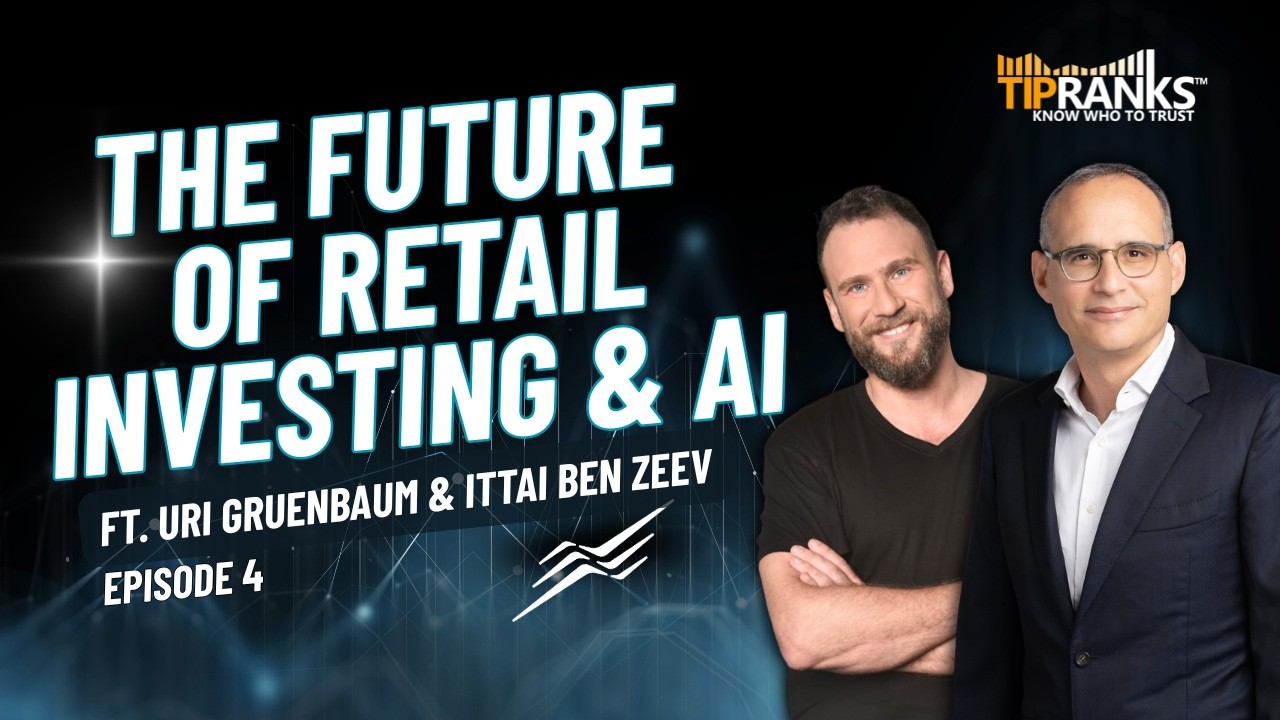
Future of Retail Investing & AI: Inside the Tel Aviv Stock Exchange's Rapid Growth | Eps. 4

- Rendement de la vidéo
- —
- Appels
- 1
- Achat / Vente
- 1 0
- Publié
Recommandations
L'entrée est le cours de clôture de l'actif à la date de publication. Le cours actuel est la dernière clôture enregistrée.
-
Entrée $861,00 10 août 2026Actuel $861,00 10 août 2026Résultat +$0,00
I went out and I and I I sold a bit of my I bet and bought a bit of micron.
Transcription Complète
Hey everyone, it is Julie here with Tip Ranks and welcome back to another episode of the future of retail investing and AI. Today we are exploring how AI is reshaping investing from stock research to how exchanges themselves operate. I am once again joined by our own tip rank CEO Uri Grumbbomb who is seeing firsthand how AI analysts are taking on work once reserved for sellside analysts. And we are joined by Atai Ben Ziv. He is the CEO of the Tel Aviv Stock Exchange which is one of the fastest growing stock exchange even through some challenging times in the past three years. They are building the infrastructure to keep up as AI reshapes trading itself. So two very different vantage points on the same AI shift. Gentlemen, thank you so much for joining me today. >> Thank you Julie. >> Thank you. >> Now I want to start off with the big picture as we are in the biggest shifts in investing basically since the internet. AI is changing how investors research stocks, how companies communicate, and even how the markets operate. So, when we look at today's investing landscape compared to just a few years ago, what has changed the most in your opinions? >> Well, you know, from a retail investor uh point of view, I think what really changed is the process of how they make investment decisions. And so if we look at uh 20 years ago uh you know when Erade went up and was the first uh electronic broker uh the real challenge was that users didn't have access to information right they they'd read the newspapers and see what's interesting and what's not then there was a shift on the 10 years after uh let's say from 2010 where there was too much information uh you had all these yellow finances all the news all the you know bloggers social media everything exploded and I think now with AI and with chat uh available to everyone and and and including data. The way people approach investing, how they ask questions and how they make decisions have significantly changed in the last three years. Uh there are still challenges. The challenge today is what to ask uh not what to buy. Uh so I think that would be you know what we see on tip rates. >> Yeah. I I want to add that you know we see a huge behavioral shift in the way the young generation actually is demanding to have an accessible data. It's completely different that what we saw 10 and even 5 years ago. You know, part of it is the social media and also the fact that, you know, the the young generation, he wants to be accountable for his decision power and he you see it across various segments of the way operates and behaves and also of course when he wants to invest. And this is one of the challenges for exchanges that you have to step away from your comfort zone and you have to make sure that you make the right changes to make all of the info that you have much more accessible so people can get it and understand it straight away. So, so that's actually interesting. Uh, it everybody knows that Israel is a world innovation center and you know many big tech companies uh go out of here and I'm sure that most of our users are interested to learn about opportunities and diversification of their portfolio. So, so what is a Tel Aviv stock exchange doing to make uh investments uh more accessible and information more accessible to uh the average investor? >> Right. So, you know, funny enough, even though, you know, Israel is loaded with lots of fintex and promising fintex and innovation, plenty of them have decided to do their operation outside of Israel and not in Israel itself. And part of what we went through in the past decade was actually to tell people, look, you know, we have a very strong economy. We have actually all of the ingredients that we need in terms of companies, in terms of institutional money, retail money, but what we had to change was actually the market structure and the distribution channels. And after many years that we had very few Israeli brokers in the past few years, on top of seeing thousands of new retail accounts that have been open, we've seen new members coming to the exchange. we see now more competition you know with respect to the banks and the brokers facing the retail and we see more and more interest from outside of Israel. what we did in order to make sure that the infrastructure is ready, you know, we minimize the minimum trade to buy an equity and to buy a bond because in Israel, as opposed to most places in the world, bonds are being traded as equities. We don't have an OTC market. It's being traded as equity. We look at all of the data packages and we made sure that you can have actually free data. Uh we actually going up now with an application in Hebrew and in English for everybody that you can get real time data for free and you can get also smart money that you can see on a daily basis you know institutionals, international investors and retail which were the stocks that they bought and which were the stocks that they sold and we made a lot of campaign and events like Young Money and other stuff that we are doing on the media. to make to be very visible in front of the Israeli population because everybody in Israel his pension is part of the Tel Aiv stock exchange and on top on on top of it they invest money. So we see a growing demand for information and more complexity in products and I think that we are in Israel relatively speaking in the early stage of this cycle going forward but but but but even so if you look at social media uh investors are going to talk about Micronia Palunteer you have like a few trending stocks and so let's say an average investors does want to um be a part of the Israel economy like what what do they do? Where do they go? How do they find their next investment? >> Well, you know, this is one we are keen on finding uh international brokers that will be active in our market because it will help the get to to to get you know the world outside. We've seen that based on the last uh two three years the way that our leading indices have performed showing you know good returns clearly it attracts you know more investors but this is one of the reasons that I was saying before that we are relatively in the early stage of the cycle because the large western exchanges that everybody knows went through deutilization 25 30 years ago we became a for-profit company only 9 years ago. So there are still things that need that we are not fully deployed as we want to do and as you grow your your business every business you need to take time for people to digest you know the roll out of your services and your products bear in mind also that historically many Israeli companies were reporting in Hebrew and we started to use through AI uh translation that now investors worldwide can see the 125 largest Israeli companies their reports in English and to make more emphasize on IR of public companies organized for some of our clients the CEOs taking them to London and New York to meet international clients. So we've been very active in various um areas of promoting basically what we are doing and again when you invest in the Israeli economy it's part of investing in the public companies that trade on taste. So I saw somewhere uh that Bill Aman uh who is I think uh you know probably the most popular investor in the world right now. He wrote that he himself invested in the Tel Aviv stock exchange and it's the best investments that he's ever done. H how did you get to meet him like he's a legend? Well, Bill Aman bought 5% of the outstanding equity of the exchange in January 2024. It was only a few months after the war of seven October broke out. We actually hired Jeff to do us a roach show because we had a portion close to 20% that still the Israeli banks who originally were the owner of the exchange they had to sell it because of the deutilization process and like you know you go on a road show you meet all kind of investors. So we we met Bill as well and you know throughout the meeting he completely understood you know the the advantages or of the market of the evolution of the Israeli capital markets and you know when you run a public company clearly you want your investors to be happy sometimes it's work the better way sometimes it's not we have also volatility in the market >> but I think that uh we still have plenty of things to do and accomplish and to get more international investors more active in the Israeli capital market. >> Now, a big part of that as well, you guys just moved to a 5-day Monday to Friday trading week at the start of 2026 to align with the global markets. So, what was the the business case behind that and has it changed who's trading and when? What's the impact you've seen? Yeah. Well, actually, you know, we had discussions about that, you know, for many years, but I think that a couple of years ago, we've reached a situation where also Bank of Israel and the Israeli Securities Authority together with us understood that this is the right timing to show the world that it's important, it's actually vital for the Israeli economy to walk through global standards. Uh we've been hearing for years from global investors, you know, we want you to work Monday to Friday. It was a very complicated operational move because we had to do it with all of the bank and the clearing house members. Uh it actually went up the day we planned it to be which was January this year. And I think that nobody anticipated the success that we saw since then. We've seen a huge huge jump in in trading. Actually the ADV during Fridays uh is more than 4 billion shekels only in a 4 hours trading day where in January throughout uh excuse me on Sunday throughout 2025 the ADV was only 1 something billion shekel >> and more importantly we've seen a big increase in the international investors percentage Friday compared to Sunday if we if on Sunday it was around 10 to 12% we've seen through Fridays the international reach even 40% out of the total the day so I think it's a very important factor and I think it signal that more and more international investors wants to be more active whether it's on the trading on the data on the index and this is part of of the story of the growth of our economy >> one of The things I I see quite often recently among brokers, but I also think I saw that on NASDAQ is that brokers are now moving to 245 or 247 depending if it's equities or CFDs and what asset. Is that something that you're seeing as well? And if so, what are your thoughts on that? And how relevant is it to the Tel Aviv stock exchange? >> Yeah. Well, actually, I don't know if this move will be a positive move as many exchanges think so. There are some issues in terms of operational in terms of you know institutions and mutual fund in terms of closing day and other stuff. We don't have any plans to do something like that in the foreseeable future in Israel. H there are certain things that it's good to see other markets how they operate and then if it's successful you know you can adopt it. H also you know traders they want to keep their balances between work life etc. >> Do they >> I don't >> some of them some of them you know they maybe they say a to someone in particular and b to someone else but uh it's not a it's not an easy transformation to work actually 245 or 246. So so we'll see about it. >> Now especially with TA being growing so much over these recent years. I'm curious because a lot of investors think of a stock exchange simply as the place that stocks trade, but these exchanges are increasingly becoming tech companies, data companies, innovation hubs. So, how have you guys seen the role of a stock exchange evolve over these recent years? >> You you you're very right. I think that uh you know, one of our advantages is that we started late. So, we still see a lot of organic growth in all of the areas that we operate. Erh whereas when you look at the large exchanges you know some of the reason they did a lot of M&A and took various strategic position was that they they needed to show future growth on top of what they do. Uh we are an exchange that we actually own and operate a cash cleaning house a derivatives cleanhouse. We have actually we are a multi-asset because we have bonds being traded as equity, government bonds and corporate bonds and we also have a derivatives market of futures and options. Uh we have our collocation, our data and we also own and operate our index uh operations. So we actually have everything uh that we need. H but part of the evolution of the Israeli market, we still see plenty of growth coming in. Part of what we do is that we need to make sure that we continue to bring our clients, whether it's companies or institutional clients or retail, the level of services and products that they expect uh to receive. And as the retail become more and more complicated, we may we need to make sure that the infrastructure is fast enough and we up to date and we really understand our client needs. And I think this is part of the challenges from the past of being just an historic marketplace to be a vibrant marketplace that people can can easily move funds from one exchange to another. And this is actually part of what is hectic and very fun because you have to be up to date all the time. So you're saying that because you uh the television stock exchange is relatively new at least as a for a for-profit uh company uh the there is still a lot of growth potential on the organic activities >> but at the same time you have become a multi-billion dollar fintech enterprise. Are you not tempted to grow by M&As as well? When you look at the New York Stock Exchange and NASDAQ it feels like that's half of what they're doing. >> H not in the moment. I think that you know we have any everything that we need and when a company has a you know solid organic growth ahead of us you know >> lose focus. >> Exactly. Exactly. So this is not part of our our agenda. >> Okay. Good to know. >> Now also in recent years uh independent trading platforms have exploded in popularity in Israel and especially from the younger investors and as we see this AI assisted trading kind of come more into play. Is that changing what you guys have had to to build for or how you approach that? >> Well, I think that you know it changes the way that the traditional banks look at look at the retail because they understand that you know if in the old days people could have kept keep the money in the bank for 30 40 years and not change it. Now it's different and people look at you know the fees that they pay for trading which in in Israel is still not as cheap as other western markets in the world. So they have to make adjustments. Uh for us basically you know we are happy that we have also new IPOs because it's important when you have a vibrant market that you also have new companies that come to the exchange and people can learn about new companies that they couldn't invest before. Also because of the diversification of our economy actually when you look at our 550 companies which trade their equities you can find almost any segment that you even dream about. So we have a great variety of companies which is also very important and I think part of the competition and the fact that we see more and more platforms aiming to become an exchange member because they understand that it's here to stay and the young generation as opposed to by generation they want to create when they 20 plus passive income. They say like you know we host events and we hear them saying like we want the money to work for us and not the other way around and that's a different mentality. It's a completely different perception and it means that I think that over time like you know good companies that pay regular dividend people certain investors young investors will look at them people because a lot of Israelis are very tech oriented they have a better understanding of tech companies how to operate so I think we will continue to see in the next few years a lot of changes and this is you know also why as an exchange we have to be very cautious in the changes that we do over time. So after October 7th, it it felt like uh you know the economy in Israel is in a real risk. Uh and then you know a year ago there was Iran Israel where you expected you know the Israel economy to be in a risk again and you actually saw the volatility in the US markets but during that time the Tel Aviv stock chain just kept going up and and and I don't understand the rationale behind it. Do you have any idea how is that possible that the markets kept going up and the volumes just became bigger when you had missiles flying over the country? >> Yeah, of course. Because you know perception wise when you know we were talking before about exchanges 5 10 20 years ago. So 3 four years ago people were looking at Israel saying oh you know that's that's a risky neighborhood if something happens between Iran and Israel you know what will happen in to Israel etc. And I remember a couple of years ago in New York talking with an American investor telling him look you know if something happens with Iran I bet that your portfolio in New York will be much more volatile in your portfolio in Israel because we are used to it. This is part of the way we live it. Our economy, our employees, our companies. This is part of our life unfortunately. But that's the case. And I think in most places of the world, there was some kind of illusion that yes, we like globalization. It's important, but the risks that are associated with are not part of our portfolio. And everybody understand that this is over. You know Russia Ukraine implication show the world that everybody is connected everybody everything is embedded and this is part of the risk premium changing from various parts of the world and as an investors that you have a dollar to invest and you look at different markets you see Israel a democracy a rich country very strong fundamentals people that know how to deliver and and and a people that actually no matter what you throw at them, they know how to deliver. So I think in a way >> in a way Israel is more strategic position in the world because of what happened in the past few years. It doesn't mean that there are not things that needs to be corrected in Israel like many other countries in the world. But sometimes people forget that it's not an absolute question, but it's a relative question. >> But but it's also probably related to the fact that there are quite a few uh defense tech uh companies listed in the Tel Aviv exchange. They performed very well or is that just uh >> not only know 10 years ago we didn't have renewable energy in Israel and we have you know 10 years ago we didn't have independency in our gas. So you know Israel compared to many othermemes countries in the world you will see that the way we are independent is much better than many other countries in the world and it's not because of a specific segment. Uh so I mean you you can also tell more stories about it but bottom line uh this is something when you put your sentiment aside you see that you have strong fundamentals of the economy here. So you know th this podcast is around the future of retail investing in AI but I find this discussion so fascinating that I I have a few uh I'll ask you know one more question and then we'll move back to uh AI if that's uh that's okay >> and by the part of this discussion relates to AI because if people no matter where they sit in the world will use AI and see like you know GDP growth of Europe versus Israel then they see the numbers in Israel. So AI can really help in getting important facts to people all over the world. >> Right. So so earlier this year you got Palo Alto Networks which I believe is the biggest cyber company in the world today. >> Yep. >> Less than Tel Aviv exchange and I know of another uh huge successful company that's on its way or at least you know uh their CEO sounds very positive about it. How how do you convince them to you know go to the Middle East to a small country and you know choose Z as their home? >> Well, I think Pelo Alto it's it's a different example than many of the Israeli tech companies because with respect to Pelo Alto the management and the board were very um I would say smart and people that understand the value. They have acquired Cyber which is an Israeli company that actually traded in New York. They didn't trade it on TA. They saw they saw the performance and what what is going on in taste in in the last few years. They wanted to signal the Israeli market, the Israeli capital markets, the tech ecosystem, their linkage and the way they view their vote of confidence in all of the employees that they hire from various M&A transaction they did and they got you know massive positive PR post what they did and now they're part of our indices and they get additional flow additional visibility which actually was a free option for them to gain. And you know, funny enough, you know, we had plenty of conversation with Israeli CEOs and none of them did it. But the fact that Peloto did it actually symbolize many of them, you know, why why we are not doing that. So now the discussions are look, >> you know, different with some of the other Israeli tech companies. >> But but you expect a few other uh uh giants to join this year as well or in the next uh let's say 18 months. Look, there is no giant like Pelo Alto. When you look at all of the, you know, we have good Israeli good companies, but none of them is even close. >> Yeah. To the market cap of Pelo Alto. I think that, you know, over time it makes sense that more Israeli companies will use the the dual listing. We do have actually also a barrier that companies that have a dual class shares cannot do the dual listing. uh the ISA tried to push it and to change the law. It almost went through but eventually it didn't and we hope in a few months once we have a new government and a new parliament you know to change this rule and then there are few potential candidates that will be allegible to do the dual listing. I think that you know it makes a lot of sense for the Israeli tech to be fully presented in taste indices and by the way when we pitch to various investors worldwide to investor our indices once you're part of our indices you will benefit you know the demand over time >> interesting so so back to the main topic of uh of the podcast which is the future of retail investing and AI Hi. One of the bigger trends that we hear today is tokenization around the world. Uh we usually hear that in the context of a broker that now allows uh tokenization which allows to do many things including a 247 trading but also list uh private companies. So suddenly you can get access to anthropic or you know SpaceX before the IPO and others. Is that something that the Tel Aviv stock exchange is looking at? Is that a potential risk? Is that more of an opportunity? and and how do you see that trend in general? >> Yeah, well, I think it's a very interesting trend and we carefully are looking at it. I I would say that this is the type of things that you know we'd rather see other markets the way they cope with it also in terms of regulation before we decide to enter this space because you know as a a critical financial infrastructure of a country you have to be very cautious when you bring new innovation even even if it creates a lot of excitement. So I think this is one of the things that are interesting but we still don't know if we're going to enter this space or not. >> Another thing on the AI front, I'd be curious which each of you see as like a big risk that you worry about as traders become more reliant and AI becomes the default way that they are doing their research and making trades. What risks do you see arising from that? >> Well, well, you know, from my point of view, I think that relying on AI is dangerous. It's good to use it as a co-pilot as a second source something that you can ask questions but I think first of all you know LLMs are evolving rapidly. uh so you you can ask a question today and ask you know open AI the same question in two months and you will get completely different answers and and so it's one thing to ask to get data even ask you know for simple portfolio analysis and insights but I it feels that the world is going into agentic trading meaning that almost all the trade is done automatically through an you know a cloud agent and I think that's that is really risky and there's going to be a lot of uh um issues that will uh arise after you know soon enough um and it's going to be I think a one twoyear process before we really understand how the next 10 years are going to look like. We're now in a transition phase and the worst thing that you can do is rely on technology that's still evolvable. >> Yep. And also the cyber risk which is also which is always a valid risk >> but that is a risk that users have today like you can use uh cyber attacks to get into someone's accounts you don't need to do to leverage AI for that >> right but once you get comfortable leveraging and you know having faith in your AI you know what happens if you have cyber within the AI >> you know >> yeah that that's a risk for brokers probably because uh many of them are now enabling uh agentic trading, not in Israel yet, but uh I know that in the US it's a it's already a thing. >> Now, another thing that always uh sticks in my brain when I think about this is the fact that, you know, markets work because people people disagree. They view a stock differently. Different investors are interpreting the same information differently whether they're buying or selling. So, if millions of investors begin using similar AI models, going to the same source for their information and their trade ideas, are the markets going to become more efficient or could they actually become more fragile if people are getting a lot of the same recommendations? Basically, >> it's a good question. You know, when I remember when we started tip ranks, it was on the notion that we will find the top analysts and users can simply follow them and ignore all the other advice. And I remember the feedback we would used to get which seems so silly you know retrospectively is that but if you find the best analyst and everybody will follow him then you know it's a sum zero game and no one else will but but it doesn't work like that. The market is so segmented and and it's so big that there's never going to be like a one solution for everyone. uh it's enough that Claude and Jiminy or I don't know Open AI or Brock or whatever would disagree and it will already start something. But long-term investors many times just invest in brands that they like that they appreciate. I have an account at JP Morgan Chase. I will add JP Morgan Chase to my account. Uh so so I don't see uh I don't see any scenario where we all hold the exact same portfolio and uh no one is selling. Well, I sure hope that that will be the case. Someone told me that like you know like people are using you know the they as like their own shrink basically and you get like telmade advice what to do. So it will be similar in terms of investing and this is why it will never be the case that everybody will do the same. I guess that nobody knows you know the real answer. Well, no one is answered, but but I feel uh I have no doubt that it's going to be segmented and people are going to make different decisions just for the sake of arguing who did a better investment. I think you know it's really going to we're never going to be at a place where like so let's say you have Bloomberg, right? Every institutional investors has a Bloomberg, right? You have 350,000 terminals. They're are looking they're all looking at the same information at the same news. uh same data but every one of them are making very different investment decisions. So >> now the other thing that always comes into question here is the regulation that comes into play with with AI and investing. So is there something that you each wish regulators would understand before they come out with like the next set of rules? My experience is that regulations simply move very slowly and you know until they figure out how to regulate AI there's going to be something new like most of them are still stuck understanding what to do with social media which is already 20 years old >> and so if I had to make a wish I would wish that regulators would use AI to move faster and to make uh uh decisions um yeah I think that's uh you know that would be the best thing for every investor around the Yeah. And give clarity basically. >> Yeah. Very fair. >> But the other side I I I can also understand them like these are very serious decisions that they need to make. They need to protect investors and and how do you do that when you don't when the technology is moving so quickly and you don't really understand it. Like it's not that they're hiring very smart people but these are not you know scientists that understand where it's going and what would be the future uh implications of this technology >> right but sometimes but sometime you know as as as any corporate who is facing a market you never know how the market will look three five years from now so you you try certain things and if you see that you know you're mistaken or whatever you do stop loss and you change it. If you look at regulation, you know, all over the world, you know, you you can't have 100%, you know, shooting percentage. So, you can start doing stuff and you can always change over time. >> Right. So, so >> is also a possibility. >> So, so let's say crypto regulators didn't really figure it out, >> right? >> But crypto is uh no one knows how the future of crypto would look like, but we're already getting a good understanding of how it can be used. tokens and and cryptocurrencies and others. Still, it's complicated to regulate it. Now, you have AI which is a 100 times more complicated and the impact that it would have on our society is 100 times bigger. So, I can understand why they don't know even where to start, >> right? But think that I don't know like in the US without mentioning mentioning any names, okay? You know, people talked about a few years ago when you had some, you know, big crypto names. Let's say now one big AI name buys one of the large exchanges, then the regulation has to face what am I doing now? And it may happen right? >> Yeah. They're going to buy all the exchanges eventually >> based on the money that they're raising. >> Yeah. Uh, I would love to know as well personally how AI has changed the way you guys invest. Is there something you do in your own investing today that you didn't do at all a few years ago with AI? >> I'm going to give you an answer that's not too objective. Uh, but we have in tip rankings uh an AI analysis button. So, when you go to the smart portfolio, you click it and you get a full analysis of your portfolio. And ironically, I used it yesterday and it really gave me good insights. Like it showed me how volatile uh you know, one of my holdings is IBIT, which is an ETF that tracks Bitcoin. And uh I think I'm down like 50 or 60% on that investment. And yeah, it's hard to sell something when you know you lost money unless you're very disciplined and all that, but I'm not. uh but after I saw the analysis and it explained to me that I'm not diversified enough for instance to the semiconductor industry and I have a lot of money in crypto then it's exactly what I did. I went out and I and I I sold a bit of my I bet and bought a bit of micron. So I mean this is a real example from yesterday. Now to wrap it all up guys, I would love to hear one prediction about AI and investing that you think has a good chance of coming true even if it might sound a little crazy today. I think that robo advisor which was a technology that uh kind of the slowly died like you still have some companies doing that but I think it's going to have a huge comeback in uh 2027 when it's going to go through personalization and uh you know be a very simple agent that works with you. I think that especially in Israel that until a few years ago may a lot of the trading was actually through financial advisors and stuff like that. Israel will go through a a revolution wave with the AI and people handling their money just getting a better and deeper understanding of you know the holding mortgages and many other stuff. I think that uh three four years from now it will be completely different landscape in Israel. >> That's a lot of exciting stuff to keep an eye on. I really appreciate your insights here today, especially all the rapid growth we're seeing on the Tel Aviv Stock Exchange. It's really neat to hear that perspective. For all of our viewers, let us know in the comments how you're integrating AI into your retail trading. And if you want to learn more about Taste, we'll have links down below and of course to the Tip Rank site as well. Gentlemen, thank you so much for your time today. >> Thank you very much. Thank you, Tai.
Commentaires 0
Connectez-vous pour rejoindre la discussion.
Se connecterAucun commentaire pour l'instant. Soyez le premier à partager votre avis !