Contexte
“I have been telling you guys to stay away from AI hardware for a while now... Like, you're not finding alpha in AI hardware.” The speaker is discussing Nvidia as a key AI hardware stock in this selloff.
Contexte
“If they did, that's a big problem for the revenue that Nvidia is expected to put up or AMD or Micron or the next guy... Like, you're not finding alpha in AI hardware.”
You're not the first genius to think Micron's going to 5x from here and the PE is going to go from 6 to 30.
Contexte
“You know a lot of funds like Jane Street... You're not the first genius to think Micron's going to 5x from here and the PE is going to go from 6 to 30.”
stay away from hardware, stay away from hyperscalers.
Contexte
“SanDisk was down 9% today... Micron down 7%... Intel down 6 and a half% today... You want to stay away from hardware, stay away from hyperscalers.”
stay away from hardware, stay away from hyperscalers.
Contexte
“SanDisk was down 9% today... Micron down 7%... Intel down 6 and a half% today... You want to stay away from hardware, stay away from hyperscalers.”
Contexte
“data centers under construction that Alphabet and Meta and Microsoft and Google and Amazon are actually going to run the leases... You want to stay away from hyperscalers.”
Contexte
“data centers under construction that Alphabet and Meta and Microsoft and Google and Amazon are actually going to run the leases... You want to stay away from hyperscalers.”
Contexte
“data centers under construction that Alphabet and Meta and Microsoft and Google and Amazon are actually going to run the leases... You want to stay away from hyperscalers.”
Contexte
“data centers under construction that Alphabet and Meta and Microsoft and Google and Amazon are actually going to run the leases... You want to stay away from hyperscalers.”
Transcription Complète
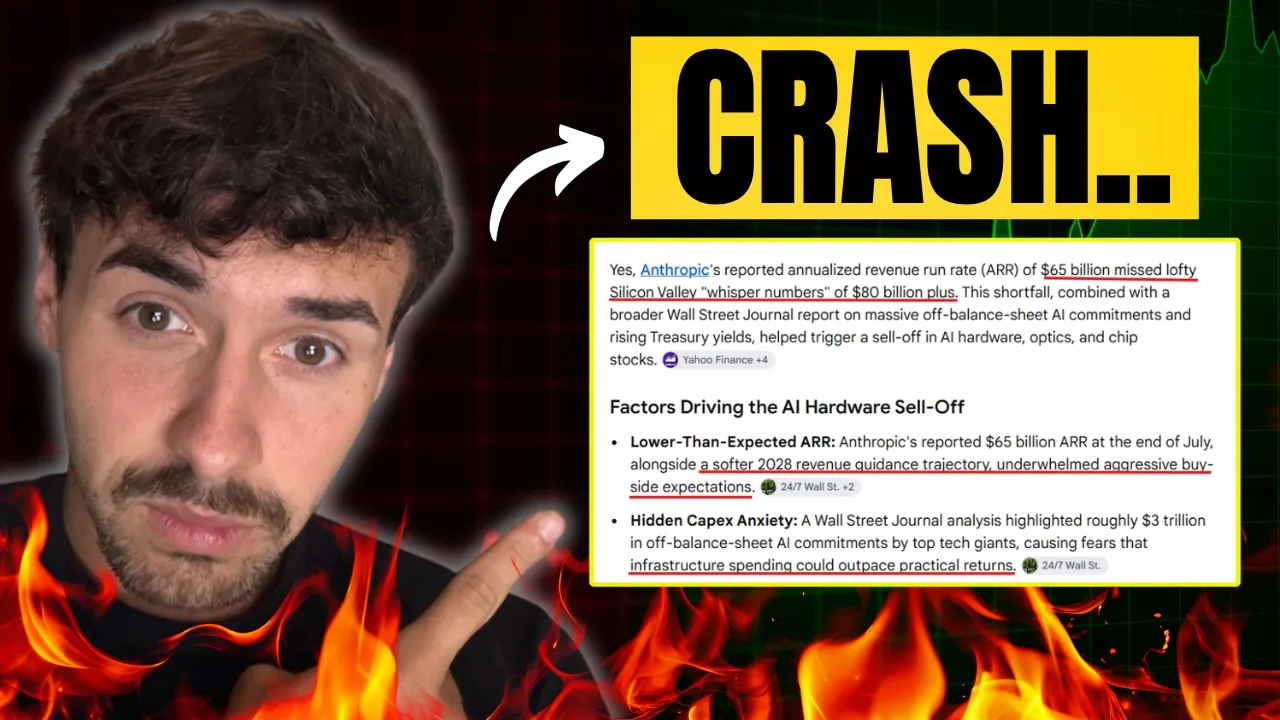
AI hardware stocks are crashing. It could get a lot worse. I will tell you why right now. So, here's the truth nobody wants to tell you. This selloff in AI hardware stocks really begun after Enthropic disclosed that they currently have an ARR of $65 billion. That's great. I mean, year-over-year, this is some of the fastest growth you've ever seen in a business, period. It is impressive. outright crazy growth. But the whisper number was $80 billion or more. So when this number came out, it was unimpressive. In fact, Enthropic updated their ARR to $65 billion, which again missed expectations, but they also offered softer 2028 revenue guidance as well. The company is now projecting 190 to 200 billion in revenue by 2028. This forecast was deemed underwhelming by buyside investors due to a significant deceleration from the company's previous faster growth trajectory. And let me just tell you this, Wall Street is a weird world. Okay, take Nvidia for an example. If Nvidia grows revenue 100% year-over-year, if they just double the business and then the next year it grows 80%. Wall Street goes, "Oh my gosh, we got a problem." Right? Growth is going to slow from a percent basis as the number gets larger. So, Enthropic had this hyper growth, thousands of percents of growth because they were starting at a small base. Well, when you have FOMO and crazy expectations around a stock or a sector group, in this case, Anthropic and AI hardware, even really impressive numbers are not going to be good enough nine out of 10en times. And that's why I tell you guys on this channel to stay away from FOMO every chance you can. I don't care how good the story is, don't buy into the Now, on top of that, the Wall Street Journal highlighted roughly three trillion in offbalance sheet AI commitments by top tech giants, causing fears that infrastructure spending could outpace practical returns. So mix that with enthropic basically missing most estimates for current ARR and people are like whoa hyperscalers they're overspending. They could cut some contracts. In reality they kind of can't because the whole house of cards is built on these future expected contracts. But if they did, that's a big problem for the revenue that Nvidia is expected to put up or AMD or Micron or the next guy. And we talked about this yesterday, but if you look at hyperscalers and their current debt, it's only about $356 billion. Their current lease liabilities at $248 billion. That looks very manageable. But when you look at offbalance sheet commitments, you have leases that have not yet started of 94 billion. That is almost four times larger than their current lease liabilities. What does that mean? That means data centers under construction that Alphabet and Meta and Microsoft and Google and Amazon are actually going to run the leases they're going to pay for, but the data centers are not fully built yet. So, it's not happening. So, over the next year or two, these lease liabilities are going to go from 248 billion to a definitive 1.25 25 billion 1.2 billion or so. This number is going to balloon. That's going to eat into profitability of hyperscalers. At the same time, if Enthropic is missing the estimates for their growth and they're one of the biggest customers of compute, you can see how the fears are building. You also have on this side over here purchase commitments of 1.52 trillion. This is basically like OpenAI, right? Open AAI and Oracle. Oracle gets a lot of bad rap because like 60% of their future commitments are OpenAI, right? That is a purchase commitment. Open AI says, "Yep, we're going to give you $200 billion in the next five years or whatever." people start to question, could some of those contracts be cut if the growth of AI is just not fast enough? This is the real reason why AI hardware stocks are selling off and it is ugly out there. SanDisk was down 9% today, down another 1% here in after hours. You take a look at Micron, you know, Micron down 7%, down another half of 1% here in after hours. If you look at something like Intel, Intel down 6 and a half% today, down another half of 1% in after hours. You look at Coreeave down 12% today. Coreweave down 12%. And this is really highlighting something. Coreweave and Nebius because if some of those purchase commitments and leases are cancelled, these are the companies that are going to take most of the hit. Like Nvidia is going to survive no matter what. Micron is going to survive no matter what, but Nebius and Cororeweave and some of these companies that have high debt structures that are reliant on these contracts being fulfilled, they're the ones that are going to take all the smoke from a business perspective. Like, it's going to hurt them a lot more than it's going to hurt Nvidia if the contracts did fall through. Now, I think investors are getting a little ahead of themselves. I think they're getting a little scared here. But again, it feeds back into the points that I've been making on this channel for a long time. You want to stay away from AI hardware. You're not the first genius to think Micron's going to 5x from here and the PE is going to go from 6 to 30. Everyone thinks that or knows that or whatnot. Like you're not finding alpha in AI hardware. I will also tell you that you know a lot of funds like Jane Street Jane Street lost$ 15 billion dollars trading in the month of July in the past 10 years guess how many months they have lost money in in the last 120 months they have lost money in one month and that was in July co these banking fears everything that's happened in the last 10 years Jane Street has made money every month last month they lost $15 billion Why hardware? Everyone's leveraged to the same trade. Right now, it's about getting out of that trade from a Wall Street perspective. They're not rushing back in. Now unfortunately there is so much leverage and the concentration of indexes are so large and catered towards AI hardware semiconductors and hyperscalers that if they have a problem like Wall Street thinks they have a problem right now it's going to drag down the index quite a bit. But again as we seen today that does not mean that everything's going to do poorly. Software did really well today. Apple did really well today. financials and smaller communication services and areas of cyclicals and healthcare and consumer defensives and nonAI industrials did really well. So this this is not like a call even if we have a crash that oh my gosh everything's destroyed. No, it's going to be concentrated in AI hardware and hyperscalers if we do go down that path. And look, I don't know exactly when the selling is going to stop. I do know Nvidia earnings next week. That's going to be a major catalyst because it always is. Nvidia is going to potentially put some of these worries to bed. They're going to have good things to say or god forbid Nvidia does poorly on earnings or issues a weak guidance, something that's very much not Nvidia like and the the problem is going to get a lot worse. Again, I have been telling you guys to stay away from AI hardware for a [snorts] while now. You know, I predicted the initial crash that we had like a month and a half ago. I just think the expectations are so high that again, even when you get good news, it's not good enough. And you might need to see some actual fear in AI hardware stocks before expectations reset enough to actually make money in those stocks again. And I don't know if that means they have to fall 50% from highs or 20% or or what that ultimately means, but at least until Nvidia earnings, there's going to be some pressure on these areas. Now, interestingly enough, the AI hardware troubles are also feeding into 30year treasuries. So, you can see today you hit a new 52- week high for 30-year treasuries today. Now, after the high, you actually fell throughout the day today. And part of that had to do, I think, with the better thanex expected export and import numbers. They were deeply negative this morning, which shows inflation's not really a problem right now. 10-year Treasury yields rolled over. The entire yield curve came down following that. But the recent rise in 30-year treasuries, I think, does have to do partially with the AI hardware trade. And even more so in the last, you know, couple of days, ever since the Wall Street Journal report came out about this offbalance sheet, you know, debt essentially or lease obligations and purchase commitments came out, I think it's heavily correlated to the 30-year Treasury. And let me tell you why. Um, from a government's perspective, right? What 30-year treasuries, that's a long-term treasury, 10, 20 year, 30-year especially. What is that really? Like why does the yield go up on a 30-year Treasury? It goes up based on risk of default, right? If the yield goes up, that's basically saying investors think the US government is at more risk of defaulting long term. Well, here's the catch. AI hardware stocks, the companies that are going into massive amounts of debt, like Google's has like a trillion dollars worth of total debt and commitments at this point, like 900, almost a trillion dollars. If AI didn't pay off, do you think the government could just let Google fail? No. Right? What if all of these companies needed bailouts? that would the United States government financial, you know, perspective. Now, that's not a guarantee. That's not even likely, right? But you're pricing in some of that risk in long-term Treasury yields in 30-year bonds. You are absolutely pricing in the risk that the government will need to issue more debt in the future to fund bailouts. That's what's happening. Now, the probability of that's like minimal. That's less than 5%. But again, you don't have to have a 100% probability to price things in a little bit. Even a 1% probability of massive defaults, government bailouts are going to raise Treasury yields. So, that's one of the things that is contributing to this rise in 30-year bonds, right? 30-year bonds are rising faster than 10-year bonds because people aren't as concerned with the next 10 years. That's more based on what the Fed's doing, economy's doing, inflation's doing. 30-year bonds, though, that's more based on how this AI story is going to play out. And that is also something that Wall Street does not want to tell you. I haven't seen anyone talk about that, but the rise in 30-year bonds is actually pricing in a higher chance of government bailouts long term. Because what the f do you think is going to happen if Google cuts back on their AI investments with all of those commitments and all of that debt or it doesn't pay off, you're going to have a depression. You're going to have bailouts left and right. So, some of that risk is being priced in. And I know some people are going to say, "Oh my gosh, no. It's inflation. It's this or it's that that's causing it." No. The last two inflation reports have been pretty damn good. 30-year bonds have really started to rise ever since late June. So, no, it has nothing to do with that. It has nothing to do with the Iran war. 30-year bonds don't care about any of that The only thing 30-year bonds care about is the long-term sustainability of the US government's fiscal position. Now, of course, we did pass $40 trillion of US government debt, and that's not helping. That's a that's a new psych, you know, psychological number, but I I think it does have to do with some of the AI, you know, FOMO and craziness going on and potential bailouts down the line. Now, do I think 30-year bonds are going to crash the market? No. I think if the Iran war ended and if things got on solid footing, the yield curve is going to, you know, stop steepening. you know, 10-year yield's going to come down, 30-year yield inevitably is going to come down. If rates come down, it's going to be easier to borrow, less of a chance of longer term default, blah blah blah. I think these things will work themselves out. I don't think this is the moment when AI companies go bust. I don't think this is the moment the bubble is popping. So, I don't really care about 30-year bonds here. Can it cause volatility? Sure. But, you know, I think the hardware trade, the actual stock reactions are your bigger worry in the near term. And I think a lot of this has to do with midterms as well because there's a lot of event risk hedging right now. There's a lot of Wall Street that's saying, "Look, we have the midterms coming up. We tend to be volatile in late August, throughout the month of September, right before a midterm. I'm going to go out and hedge my position right now. Hedge my portfolio right now." And there's a lot of that happening right now. In fact, hedge funds and institutions are the most short they have ever been on NASDAQ futures in history. Now, quite quite contrary to popular belief, when Wall Street is this short, you normally want to be bullish, right? Anytime you're this chart gets really low, it tends to be a good time to buy. And quite the opposite. When everyone's long the markets, it's usually time to take a profit or you're usually heading into a larger correction event. But this is actually a very bullish indicator, but it does highlight how much event risk hedging there is right now around the midterms and also for that matter around the Iran war. I you know there's a lot of back and forth headlines and this and that but as I reported earlier today look the Iran war I think could be coming to an end soon. I mean couple of weeks ago Donald Trump said he would be willing to walk away from the war without a nuclear deal if Iran opened the straight of Hermoose. That was a couple of weeks ago. Well, it was reported today that there was actually good news in talks with Iran, but Trump told his people to stop talking to Iran until they're ready to make a deal. Awesome. It was reported today via people in the government that Washington is going to look at reducing the amount of military pressure and and force they have in the Middle East after the war with Iran is over with. I don't think those things are a coincidence. And on top of that, we're really just waiting to see when Iran and Oman come to a deal to work out how they're going to manage traffic in the straight of Hermoose. That's step one. You get that done and I think ending the conflict could actually come pretty rapidly. And then last but not least, you also have Jackson Hole right now. And Jackson Hole that is going to be coming August 27th through the 29th. So what is that? That's not next. That's uh next Thursday. So, you know, Jackson Hole gets a really big rap because Jerome Powell in 2022, that was his moment where he said, "Look, we're going to fight inflation. We're going to have a recession most likely. People panic. Markets crash. 2022 was a really bad year, right? That's where the Jackson Hole fear comes from. I don't think Kevin Walsh is going to dramatically change things up at Jackson Hole. I don't think he's gonna go from being the guy that doesn't want to give forward guidance to saying, "Yep, we're gonna be hiking rates multiple times." Like, that's not what's gonna happen. Kevin Walsh is actually a dove in in in hawk skin, okay? He has to sound hawkish. He's the new Fed chair. He can't come out with inflation above target and say, "Yep, we don't have a problem." No, he has to gain some credibility. I think ultimately when the Iran war ends, that's when the Fed can have room to be more dovish. I don't think we're going to get anything out of Jackson Hole. So, is the stock market about to crash? I actually don't think so. I don't think your portfolio is going to crash. Let me put it to you like that. Now, if you're all in hardware or you're all in AI stocks, of course, that could happen. I mean, look at the NASDAQ recently fell 11 12% from high to low. So the NASDAQ, the triple Q is only up about 1% in the past 3 months. Whereas our portfolio in the trading community is up 97.5% in the past 3 months. Why? Because you've seen a flip-flop. AI hardware sold off. the rest of the markets rallied and a lot of the stocks that we were buying in the fear of the SAS apocalypse and cyber and cyclicals and the Iran war, a lot of those stocks came back. So, I don't think you have to have a broad market crash here. Could you have a crash in AI and hardware? Sure. Of course, great. Who cares? But just like you seen today, you're probably going to have a violent rally in the rest of the markets if that happens. Now, if you guys want to come join the trading community, that link is down below in the description of today's episode. So, yeah, I think the playbook here is actually very simple. Stay away from hardware, stay away from hyperscalers. If you're all in on the indexes, maybe t, you know, hedging could make sense. I don't think that's necessary, but it could make sense because of the waitings. I think you want to be in the new AI trade. Robotics automation AI software cyber, even cyclicals, small caps, financials, industrials. Look at the areas that did well today. I think those are the areas that are going to continue to do well. If the AI trade does continue to sell off and drag the markets down with it from an index perspective, next stop is your major moving averages. 50-day moving average at 712 um on the triple Q's. Then you have your 20-day moving average at 706. If you break below that, your 100 day moving average at 690 and then your 200 day moving average down at 650. But I don't think you have to have a massive decline. But hey, I've been wrong before. So let me know your thoughts on this down below in the comment section. and hit the like button as well as subscribe to the channel if you guys have not done so already.

Commentaires 0
Connectez-vous pour rejoindre la discussion.
Se connecterAucun commentaire pour l'instant. Soyez le premier à partager votre avis !