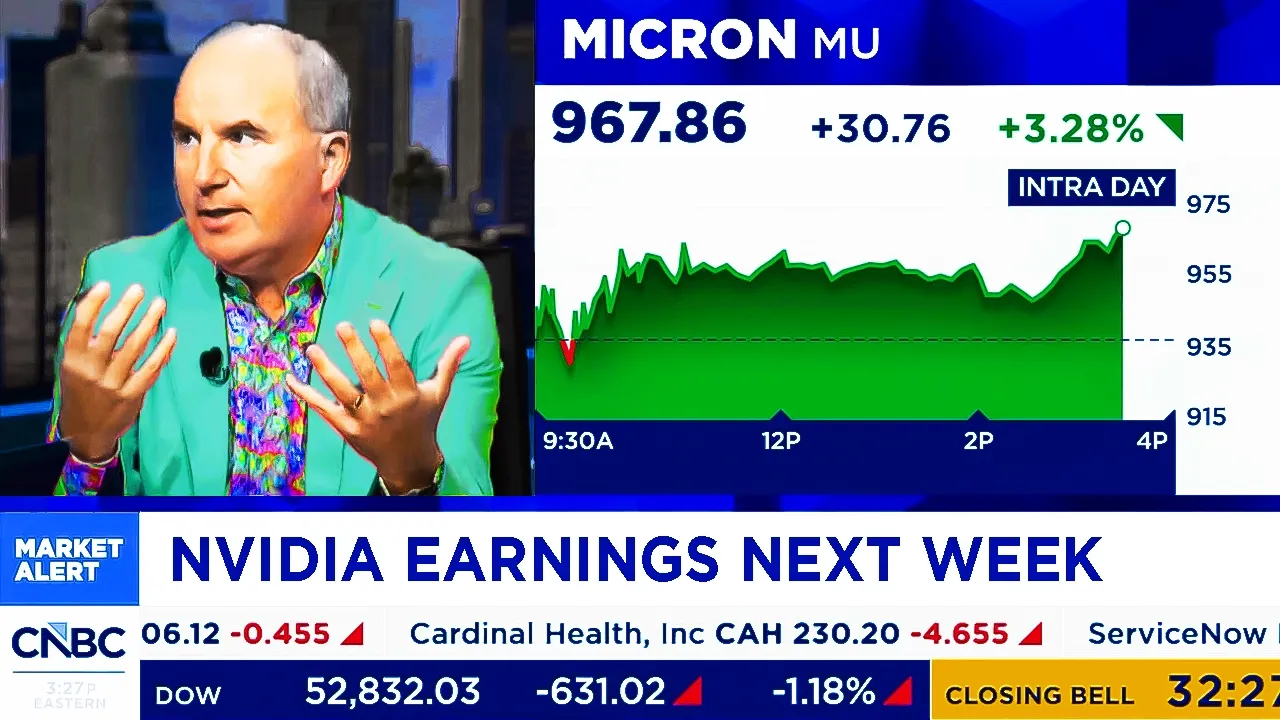
I think investors should. I think the stock is trading at 21 times earnings, growing excessive 50% a year.
Contexte
"would you buy it ahead of their earnings next week? >> I think investors should. I think the stock is trading at 21 times earnings, growing excessive 50% a year."
So, I think there's an opportunity to kind of get in at a reasonable multiple.
Contexte
"Nvidia has been left behind a little bit. So, I think there's an opportunity to kind of get in at a reasonable multiple."
Transcription Complète
Let's begin though with Jim live at Micron. Jim, busy day for you. >> Yeah, it really is. And we've got an announcement here today. Sandre Moro is the CEO of Micron where we are in Boise. He's putting together a research lab kind of thing that it's almost like a Manhattan project for memory and AI. Uh and Sanjay is going to talk about it on our show. This is a rather remarkable construction site, one of the largest in the world. And I'm glad that he that he invited us here because this is all about investing in America, manufacturing. Carl and David, it's really exciting here. >> So, we got 10 billion uh AI and memory. Tell tell us exactly what the project is. >> Sure. I mean, the idea is is that we kind of we have to have a longer range research opportunity here that this is the kind of thing used to be done at universities. It's kind of like basic research. We always did applied research at corporations, basic universities. Universities don't do too much of it anymore. They're too strapped or they they're not interested in doing it. Sanjay Roachcha wants us to be the world leader in this one particular part of the of the AI chain which is memory. Memory at least when you listen to Elon Musk he would tell you memory is now the most important thing. It used to be considered dumb. Now it's considered smart. And David, when you get this shift where you have something that was uh an afterthought that is now a lot of people think is the bottleneck, but Sanjay Maro, CEO of MCR thinks is the opportunity and you know what I all I can say is is that to see it happen is to realize that we're part of some we're really much more part of the industrial revolution. That's the fourth revolution. It's real, Carl. It's real and it's very exciting to be here. Yeah, of course interesting to note many of those universities you site have had their government funding cut for basic research. Um, but certainly think of Bell Labs for example and the incredible >> right >> uh advancements that uh that company of course Ma Bell made um many years ago with all of their scientists in New Jersey. Jim, uh, you're at the heart of the story, of course, and I'm looking forward to hearing what Sanjay has to say, both in our show and obviously a longer interview as well you're going to conduct for Mad Money later in the day. I mean, and it continues to be sort of the key in many ways, as we like to say, Jim, to this market. I think still some grappling over, you know, the run rate of revenues at anthropic andor open AI and whether in some way precages some sort of I dare I even say the word slowdown because it seems ridiculous when you think about the the needs for compute. >> Um, which you I'm sure you'll get to, Jim. But that said, it's still kind of running the show to a certain extent and you know uh in terms of the way some of these names are moving that we follow so closely in the so-called AI ecosystem. >> Well, look, I mean, we're to the point where we find out that if if Open AI had four good days, it's newsworthy or or whether they're going to do an IPO September 18th or October 22nd. We got to step away from that for a second and take the longer term view that Sanjay is really really pounding here which is the idea that look it may be you may think it's not happening fast enough and I got to tell you there's so many people out there it's so much construction I don't know how they even get this thing done there's just so many moving parts you may think that it's slow or that it's slowing but David when you're here you recognize this is just a juggernaut we're one we're one little piece Carl I think a lot of this stuff is going to end up being robotics selfdrive that's where we're going to see a lot of memory that you can't get enough memory when it comes to robots and that is not open AI. Let's just open AI. We just it's that's become a parlor game when they're going to come public. I don't want to play that game. Take something bigger. This is bigger. >> Well, wasn't it Sanjay who in the last earnings call talked about the step function in memory required from EVs or autonomous to humanoids? >> Yes, 100%. Look, we we got to Sanjay has has had to be the ambassador the uh he he the proitizer for the notion that these little chips of which by the way one of the first ones was done right here in Boise and that's why that's the legacy here that these chips are in control because the amount of memory that you need in a robot the amount of memory that you need in a data center is so huge that it was chronically underestimated and these companies didn't have enough money anyway. The only company that's really spending in this industry in our country is Micron. They're the only one. And I think it's really important to highlight them because everybody else is just giving money back to shareholders. They're I love that. I love shareholders, but this man is spending about the word dominant. >> Nvidia is giving money to everybody. >> I mean, what are you talking about? They're not giving it back to shareholders. They're like, "You got We'll back you. We'll back you. We'll back you. We'll back you. We'll back you." No. Sandis, Western Digital, Seagate have not been as uh let's say that they're more spendthrift. >> No, I video I mean how many times can you beat me up on a video spending? >> I'm not I'm not beating you up at all. I'm just making a point that they are a source of uh of capital so to speak at least in >> backing up not necessarily ever going to be used but certainly their balance sheet can be used to help finance >> endless it seems like given the free cash flow characteristics of the most profitable biggest company in the world >> that's true not disagreeing but I went out with a senior team Mike run last night David >> they did say you were grumpy back for vacation everyone that you were grumpy >> yeah we got a lot of what's wrong with the boys Sure. I know. I was a little cranky. Said, "How can you come be grumpy after vacation?" It's before you go on vacation, not after. >> I I know. What can I tell you, man? >> That was the takeway. That was the take down your grumpiness first. >> I don't I don't David, you haven't even You haven't trashed me yet on Nvidia today. Oh, no. That's right. You did 901. I think you trashed me. It was like the whole day yesterday. But Nvidia, talk about something has to stabilize. We are 6 days away from Nvidia. Six >> six days something. >> Yeah. >> What would you like me to do, Jeff? >> Yeah, we But >> I look back at earnings, you know. Can it ever be enough? Can it ever be enough from Nvidia? And what other >> No. >> No. Okay. So, that answers it. >> Well, what is he going to say? What is he going to say? It's He has to say that it's super duper great. I mean, it's a tough He's in a tough situation. Let the numbers speak for themselves. >> That's what >> they will. There's so many other questions around Nvidia as well. Of course, I mean, they continue to combat and effectively so I think the uh the charges of circular financing and how involved they are and ultimately helping to finance the demand or uh for their chips. The demand is real, but >> the question is whether you have to use your own balance sheet to help everybody else along to afford what you're doing there. Of course, as you have margins the likes of which few have ever seen. Well, look, if you're in a competitive situation, which he always has to anticipate, you do want to have companies want to be more on your team than not. I mean, with, you know, look at all the look at all the the fiber companies. He's got them locked up and and fiber's the future. Copper is the past. You want him you want Nvidia to have that everything, every inch of real estate, that data center locked up because this is these are big stakes. And I think that one of the things that's great about Jensen Wong is he plays hard ball. I think what's interpreted as being, you know, lazy Susan is really hard ball. He's saying, listen, stay away from that company. And by the way, when he didn't do it in Anthropic at the beginning, that's been the big problem. Even Anthropic is a great customer, but not as great as it should be. >> Meaning what? That they're sorry, they're short. You think they're short compute? I mean they've obviously been seeking it wherever they can possibly find it in Anthropic and you know I'm just saying increasingly >> I'm saying that Nvidia's relationship you know but Nvidia's Nvidia was slow to the anthropic engine you want to be with anthropic but you know what David you know what could change everything when Elon Musk is starting to talk about how he'll take every single thing that Nvidia makes and every single chip that Micron makes he may be the savior to the industry because he knows that when you have robots you need a lot of this stuff more than anybody body realizes >> and and he pays for it with what money >> I don't know he's he's got to merge SpaceX with pass he gets financing from that's how it works >> in part I mean listen the deals are going to keep happening there's no doubt and speaking to people who put these massive deals together the numbers of which you can hardly conceive of right when we say 50 billion 100red billion that's just going to keep happening uh whether it was Ohio already or you know I Well, you have to get used to that. >> I'm trying. >> You have to get used to the big >> I'm trying to be in the T camp. You're in the B camp. >> I'm trying to get used to the numbers. They are still hard to imagine. And we talk about it all the time, but >> the likes of this capex spending again, the likes of which we've never seen. >> None of us were alive in the 1870s. So, you know, >> do you think it Do you think it's not real? Do you think >> No, it's absolutely real. I don't think it's not real. Of course, I think it's real. And I think everybody Chinese aren't spending a lot more. Every one of these companies believes this is money well spent, money they have to spend in order to be a part of this. There's no doubt about that. I mean, you can argue that, Jim. So, Jim, >> thank you, Paul. CEO of Micron where we are in Boise. >> Great to have you. >> You know, first of all, Jim, thank you for coming here. Welcome to Boise. Micron headquarters, hub of memory innovation for America and soon as you can see in the background here to be the hub of leading edge memory manufacturing. >> Can't help but notice it frankly. >> Now amazing. >> Now uh my colleague David Faber mentioned when we were growing up we heard about this great thing called Bell Labs and it's where all the innovation was occurring and who knows what would come up maybe even a picture phone. I am with with someone right now who's starting Micron Research Labs. This is long horizon innovation. Tell me Sanjay why you're willing to spend $10 billion just on what amounts to basic research/h hope and this is going to be critically important. I'm very excited about Micron Research Labs. We are convenor and leader bringing the ecosystem together to drive the breakthroughs for the next generation of AI era. This is critically important because memory is strategic infrastructure of AI. Memory absolutely requires higher performance. AI needs greater amount of memory, faster memory, lower power memory for AI to get smarter. Memory is the intelligence. So we going to bring here through Micron research labs $10 billion investment from Micron bringing together our customers, universities, startups, ecosystem partners and of course Micron researchers and scientists to drive research in materials, semiconductors, memory, compute, how to bring them together and to drive innovation for the next era. >> I think for people at home we've got to get get them to understand they need memory. They say, "Oh, well, what is that? The Cortex? Where's that?" No. When we think memory, what we're talking about a specific type of chip that frankly had been the stepchild both to the CPU and to the GPU. CPU being the old days, Intel and AMD. Uh G GPU, of course, Jensen Wong. Why is memory uh now elevated? Why do we care so much about memory versus those other life forms that we always thought were superior? >> You know, memory is no longer a component in a system. Memory is that strategic infrastructure for AI. It's no longer a commodity. It is a high value. This is enabling value for our customers. Without memory, you cannot make AI smarter. You cannot make AI faster. You cannot scale up AI. You know AI is advancing. Lot of context is getting generated. All of that context has to be stored, has to be processed through memory. So AI is driving a whole hierarchy of memory requirements from high bandwidth memory to DRAM to SSDs and this is the exciting era for memory and critical need that all AI systems have. I would always say exciting period for the United States because you never gave up. You always thought that we could be great. We have to compete against Japan. We have to compete against Korea. And by the way, we know that SKH Samsung are incredible. Why didn't your company give up on this country? Everybody else seemed to have moved overseas. >> You know, Micron started right here in Boise nearly 50 years ago. You know, we are the innovators. We have 62,000 plus patents today. And of course, we have believed in the vision for memory. We say memory. Our vision is will accelerate intelligence to enrich life for all. You are absolutely correct that even in the deep downturn of 2023, Micron was investing in leading edge research. Today you see the benefits. We have the best technology and product portfolio in the industry. We were making investments of $10 billion in our, you know, in our R&D and capex to drive in. Well, I want people to understand that it's a $10 billion micron research lab unlike anything we we've ever had and it is going to be located here. Research lab will be located here. It will have satellite campuses around the globe where Micron has R&D operations as well. And absolutely we are going to be having groundbreaking for that next year and Micron research lab is really going to be driving America's leadership in semiconductor and memory technology. >> I believe it. I believe it. That's why we are here. And Sanja Marotcha, thank you so much. Back to you, Carl. >> So semis today are looking to snap a two-day losing streak. Memory names as we've seen are higher. Micron is SKH Highix is at least they were. Let's take a look at those. So Micron's CEO Sanjay Mahotra was on Squawk on the street earlier this morning and said this >> memory is no longer a component in a system. Memory is that strategic infrastructure for AI. >> It's no longer a commodity. It is a high value. This is enabling value for our customers. Without memory, you cannot make AI smarter. You cannot make AI faster. You cannot scale up AI. You know, AI is advancing. Lot of context is getting generated. All of that context has to be stored, has to be processed through memory. >> Okay. The line that jumped out to me the most, it's no longer a commodity. It is a high value. Is that gentleman right there suggesting that what has always been viewed as a cyclical trade should not be anymore? that it's now secular because of how valuable chips will be in the continued buildout. Because then you need to have a valuation conversation about things that were traditionally seen as priced here which have now been priced here and maybe the here is where it's supposed to be given what he just said. >> I so uh let me start by saying I'm long micron. I would add to it here with new money. So I think it's a buy. That said, I'm going to sort of tamper what he was saying a little bit. Right now, we're in a position where demand is exceeding supply by a lot. I still think this is a cyclical area, a cyclical sector, a cyclical a commodity, but this cycle is very drawn out because of the artificial intelligence buildout which is measured in trillions and going on for years. >> So then he says the guy who's running Micron says it's no longer a commodity and you're >> I can't believe he said I can't believe he said that. I mean, so fine. He's talking his book. Let let he's not being disingenuous. That's not what I'm saying. What I'm saying is this is a cycle. It's elongated more than historical. >> Um Yeah. And when that happens, of course, it feels like, hey, this is specialty. You know, I remember when like there was specialty chemicals. Like it's nothing special about it. All right. It's supply versus demand. Right now, we've got limited supply. It takes a long time for supply to come on. You've got demand not just for the artificial intelligence build out, but think about Apple who's waiting to get chips wherever it can or even, you know, more pedestrian things like >> that the long-term demand equation has been completely reset. >> It has it. He's 100% right. Here's why. Data centers have been around for a long time. I happen to spend the weekend uh in Carmel with two executives, CEOs of data center companies that'll be unnamed. They said we are in the first inning of these buildouts. The first inning. And when you did a data center years ago, it required basically one 12th of what is required in the current data center. So not only you building more, they're 12 times as big and it's going to be a longer cycle and by the time you get to the end of the cycle, you're rebuilding at the beginning. It is core infrastructure full stop. Period. Let's look at Micron's uh current forward PE guys, please, if you can put that up while while Rob is talking. Thanks. Go ahead. >> No, I just I just think that's I was shocked to hear that we are in the the first inning in some of these data center builders eyes. Okay. It's just unreal demand that they're seeing and it's visible visible demand. In some of these cases, they're building out 12 units on these campuses and they're they're in they're done with one. It's remarkable. So we >> Nvidia reports in less than a week. You like them, you like Verive and you like Corning, that's all AI. >> Those are all AI driven, but they're all a little bit different um in in the role that they play in AI. Verive and Corning are data center plays. They have different roles in the data center play. And then Nvidia is just kind of the thousand pound gorilla in the room. Um, and it hasn't done well in the last year. So, while some of its peers have really done well, I I like Marvel, but Marvel has really done well. Nvidia has been left behind a little bit. So, I think there's an opportunity to kind of get in at a reasonable multiple. Its multiple is one of it at its lowest levels in in years. So, it's an opportunity to get in at an attractive valuation at a low multiple. And I I don't think that the stock is impaired in any way. I think long-term momentum is there. This is just some breathing room for investors to take advantage of. Uh >> it's really not selling off today either. I mean it's down but not by much. Stock picks and like our last guest Shannon, you too like Nvidia. Um would you buy it ahead of their earnings next week? >> I think investors should. I think the stock is trading at 21 times earnings, growing excessive 50% a year. Um, and this is the uh, you know, the godfather of AI. It's the place you want to be. And I think that actually that might give the AI >> also the bank of AI J. >> Yeah, we're in the beginning of that. Thank God not to that can get worse. So right now it's probably still safe, but I think that's a great value play. I think what when they report in guide, it's going to bring the rest of the tech stocks upward as after this recent slump. >> Micron shares, there are 3% bouncing a bit today. The company's CEO Sanjay Mahotra was on CNBC today said this about the ongoing need for memory. >> Memory is no longer a component in a system. Memory is that strategic infrastructure for AI. >> It's no longer a commodity. It is a high value. This is enabling value for our customers. Without memory, you cannot make AI smarter. You cannot a make AI faster. You cannot scale up AI. You know AI is advancing. Lot of context is getting generated. All of that context has to be stored, has to be processed through memory. >> For more, let's welcome in Dan Ies of Yorkville Ives and Company. Good to see you. >> Yeah, great to see you. He's making the case that don't judge us as chip makers the way you've traditionally judged us because this time's different. >> Is that the message? >> And and I agree. I mean, someone like myself has been to Korea so many times, you see the changes cuz the reality is you count on one hand the amount of memory players and when it comes to the AI revolution, everything that we're seeing right now, demand the supply 15 to1. when it comes to what we see it from a memory perspective and that's why obviously Apple and it's a good example need to pay more in memory and there's just no way around it this is not cyclical this continues to be really foundational what if it's still cyclical the the duration of that cyclicality has just been elongated is is that fair or have we literally entered into a more secular time for for chips because of the level of demand and how It's not going to dissipate anytime soon. >> Yeah, it's a great point. That's a definitely like a a hot sort of debate in my opinion >> because it matters for valuations. >> No, it of course. And to me, I think it's really it's changed. It's no longer the cyclicality at one point will come back, but I don't think you have true equilibrium till late 2028, early 2029 based on the trajectory what we're seeing today. And I think that's why we're going to continue these es and flows. No different we saw with the cost being creating some of these sort of white knuckle moments. But the reality and I think it's further instituted what we've seen from the hyperscalers in terms of demand what you see on the in terms of enterprise use cases memory players it's really right now it's their world and everyone else is paying rent. >> So if we the valuation of micron for example on forward basis is like six 6 and a half 6.6 something like that. Is that where it should be? Is that cheap? I mean, how do you assess that given if if you're a true believer in what the CEO just said as an investor, then if I agree with you, what is it? What do I do? 6.7 times. >> Yeah. I think right now, I mean, investors are valuing these companies, the cyclicality, and they're basically giving no credit to what ultimately I believe is going to be the demand over the coming years. Scott, I think it's no different than what we saw like with Nvidia. You know, if if we just think over the last few months as these companies prove it, the valuation will ultimately then start to start to I think manifest and actually generate what should be less cyclicality and really more of a multi-year cycle that's going to continue play. There's no way around it because even when some say, okay, there could be Chinese memory players or there's an alternative. Korea holds the cards when it comes to memory and I think that there's no changes that I see in the future >> and and there's no implication at all for excess ordering or double or triple ordering because you can't get what you need and eventually it's going to catch up and then that's when the problem happens because people have ordered too much even if there's robust demand. >> Yeah. And that's that's been a worry. But right now, you got to get online to get those chips. And I think part of what we're seeing in terms of everything from a use case, from hyperscalers, from a demand perspective, it's just accelerating. So I don't think that we are near any sort of point of sort of over orderering or worries about inventory and then they cut back. And I think that's something where it's further validated from the hyperscalers obviously companies like Palunteer, software companies, chip makers. It's a Jenga puzzle when you put it all together. And I think more and more it's really starting to play out from a bullcase scenario. >> All right. So, you get more from the CEO tonight with Jim on Mad Money because he was the one doing the interview and the soundbite that you saw. So, you don't want to miss that. I'm not going to let you go though without asking you about Nvidia. >> Um, where are your own expectations ahead of uh an earnings print that's going to happen in now less than a week? I mean it's our view investors continue to underate underestimate the scale and scope of what Nvidia is doing. >> How how's that possible? How can they be underestimating it? >> The reason they're underestimating is that I think they are not recognizing what we see in Asia and what we see across from the hyperscalers. If you put all together Nvidia right now, you're almost giving them minimal credit for physical AI and what's really going to be the sort of next evolution of AI and and that when it comes to physical AI and their next chips and everything that they're sort of building out, investors continue to be skeptical. And I think as they prove it out, no one has a better perch than Jensen. And I think that's why so much of this tech trade next week is just so important because that really will be I think a huge sort of planning of the flag moment to show that we're not in the seventh inning. I thought we were in the third inning and you could argue we're maybe bomb of the second. >> Wow. Well, how good how good does it have to be? >> How good does has it have to be? They have to like crush expectations. >> There's got to be whisper numbers. I mean there there's whisper numbers but I think it really comes down to it's them giving expectations that numbers would be underestimated by 15 to 20% for the next 12 to 18 months >> and I think that is really where some of the boogeies are here but betting against Jensen it would be like you know those that bet against you know Tom Brady those that bet against Mahomes and others. >> I mean Brady didn't win every Super Bowl he played. >> It's a good point. All right. But he won a lot of them. >> He did got a lot of rings. Dan Ives. Thank you. All right, I hope you're all doing well today and staying calm in this market. Thursday was a rough day throughout much of the market due mainly to macro concerns. So on Wednesday, the Treasury announced that it would increase its purchases of longdated bonds which provided some temporary calm as market participants have been worried about elevated yields. And then on Thursday, yields moved higher, oil moved higher, and inflation concerns resurfaced. I noticed the 10-year moved back up to where it was before the Treasury's announcement that weighed on stocks Thursday. Micron and SKH Heinix were two notable exceptions to the red action as we got news from both companies. Let me address those news stories and then I'll cover Thursday's Nvidia news after that. So on Wednesday, SKH Heinix announced that it would buy back more than 24 million shares, so about 3.3% of total shares issued and cancel those shares. That's roughly $28.6 billion. SKH also said it intends to return over 50% of 2025 through 2027 cumulative free cash flow to shareholders. And then on Thursday, we learned that JP Morgan thinks SKH Heinix could return at least $130 billion to shareholders in 2027. That's in addition to the buyback they just announced. Also, SKH Heinix buyback program began this Thursday. Also on Thursday, Micron unveiled Micron Research Labs, a US-based Long Horizon Innovation Hub to shape the future of memory and AI. Micron plans to invest10 billion dollars in the initiative over the next decade, uniting academia, government startups, and industry to advance memory and compute breakthroughs that will define the AI era. Key research areas include critical memory technologies, advanced memory and compute architectures, packaging, and future semiconductor manufacturing. Two things really stand out to me from this announcement. First, this research hub is specifically aimed at finding breakthroughs that will drive AI forward. And second, Micron is talking about working directly with customers to co-develop new technologies. It reminds me of what GM said on their recent earnings call in which GM CEO spoke about the company's partnerships with Samsung and Micron and the fact that they would work with memory makers to co-develop new technologies. This is a very important topic when considering the cyclical versus secular and commodity versus strategic infrastructure debates. We're talking about Micron working directly with large customers to co-develop new technologies that address those customers unique and specific needs. Longterm, we're talking about new technologies developed by Micron that are woven into the product road maps of Micron's largest customers. That level of collaboration and co-development should help weaken the commodity narrative that says all the memory makers are the same and that they're all producing interchangeable products without any mode. This is a long-term initiative that should strengthen Micron's strategic position in future years. Micron anticipates breaking ground in calendar 2027 on a state-of-the-art Micron research labs facility capable of hosting hundreds of researchers. On Thursday, the information published a story claiming that Nvidia was planning to begin small volume shipments of a new China specific chip by year end. The information claimed the chip was a version of Nvidia's LPU. And then Reuters reported that Nvidia denied the report with a spokesperson saying, quote, "The reporting in the information on Nvidia's LPU is incorrect. We have no LPU sales in the China market today and no China specific LPU product in our road map." As I've said so many times on this channel, this has repeatedly been an unreliable source on Nvidia China rumors. In contrast, the Financial Times has a very good track record on accurately reporting on Nvidia China rumors. I have no affiliation with the information or the Financial Times. I'm just calling it as I see it. On Wednesday, the FT reported that China has begun allowing limited shipments of Nvidia H200s in a mainland China with both Bite Dance and Tencent receiving roughly 10,000 H200s each. Several other Chinese tech companies could soon receive similar size shipments. Regulators are allowing H200s to be deployed in Hong Kong. And Nvidia has roughly 500,000 H200 set aside largely for Chinese customers. So if restrictions do ease materially, then Nvidia is ready to go with a decent amount of H200s for Chinese customers. The recently reported shipments are small, but they do signal progress. Also, the US government is taking a 25% cut of Nvidia's China sales. That said, most analysts are not modeling any China revenue into their current models given the repeated back and forth on this topic over the past year. Any China revenue would represent additional upside for Nvidia that is currently not factored into most analyst models. Given the FT's track record of accurately reporting on Nvidia China rumors, I'm really interested to hear what Jensen and Colette have to say about China sales on the Nvidia earnings call. Looking ahead, we have Nvidia earnings on Wednesday, August 26th. Last I checked, consensus expectations for the quarter were revenue of roughly $91.93 billion, EPS of $28, and gross margins of 75%. As for next quarter revenue guidance, it appears that the consensus is $104 billion, but I've noticed that multiple analysts are expecting Q3 revenue guidance closer to the range of 107 to 108 billion. Q3 gross margin guidance is expected to be in the mid70% range. Keep in mind that those are the expectations the last time I checked, so things could have changed since then. Now, I'll be completely honest with you. I expect results and guidance to be strong, but I don't know for certain how the stock will react. It's very common for Nvidia to trade higher ahead of earnings in anticipation and then to trade lower after earnings. So, that's definitely a possibility and we've seen it happen many times before. That said, the stock is arguably cheap versus the company's future growth. Regardless of how market participants react in the short term, I expect this earnings report and earnings call to reaffirm that the long-term thesis is intact. I'll be very interested to hear what leadership have to say on the earnings call regarding rumors about reduced memory content per GPU, Frontier model company's profitability, China sales, and the rollout of Vera Rubin among other topics. I'll try to provide a recap of the highlights from Nvidia's earnings and earnings call on this channel on the night of Wednesday, August 26th. So, be on the lookout for that. That video will probably be posted either late Wednesday night or early Thursday morning, depending on how long it takes to make the video. I'm expecting that video will probably take 8 hours or more to make. So, please bear with me on that. Now, in case you're new to the channel, I want to make sure that you have at least a basic understanding of the underlying long-term thesis. So, let's cover that. Now, I don't know what's going to happen in the short term, but from a long-term perspective, I am very confident that Nvidia will be worth much more in future years than it is today. When Jensen was on the Lex Friedman podcast not that long ago, he was very seriously raising the possibility of Nvidia becoming a $3 trillion revenue company in the near future. If that happens in the coming years, then it is very plausible that Nvidia could one day be worth tens of trillions of dollars in market cap. That might sound crazy, but that's what Jensen is implying when he raises the possibility of Nvidia becoming a $3 trillion revenue company. I guess the question at that point is what multiple the street will be willing to give Nvidia. I don't know the answer to that question, but I truly do think that Nvidia will be worth much more in future years than it is today based purely on the fundamental growth of the business. Based on everything I'm seeing, the world is still computed and I expect that to continue at least through the first half of calendar 2028. In a computed environment, developers will use whatever viable compute they can get their hands on. Today, there are no GPUs that are sitting dark due to a lack of demand like there was fiber sitting dark due to a lack of demand at the height of the dotcom bubble. Back then, companies were laying fiber in the hopes that use cases and demand would eventually show up. Today, we are seeing the complete opposite. As I've said many times, when market participants compare this AI revolution to the do-com bubble, they ignore the fact that the internet is already here this time. This means that mass adoption of the technology and new use case development at scale are immediately possible. We don't have to wait years for it to show up. It's already here. The world is compute constrained which means there is not enough supply to satisfy demand. New capacity is utilized as soon as it comes online. The hyperscalers are monetizing capacity as soon as it comes online. Each of the hyperscalers spoke about being supply constrained on their most recent earnings calls. Additionally, many of the clouds are building out into contracted demand. They're not blindly building in the hopes that demand will eventually show up. No, they're building out because they have signed contracts and in some cases significant prepayments from their paying customers. This AI revolution is fundamentally different from the dotcom bubble and 2026 will be a pivotal year for the AI industry thanks to the rapid adoption of agentic AI and the proliferation of agentic systems in the world's leading enterprises. The leading AI labs revenues are surging right now. Agentic coding and the implementation of agentic systems in large enterprises are new use cases that are increasing inference demand significantly that subsequently is increasing compute demand. The rapid adoption of agentic AI is why we're seeing an inflection in inference demand. It's why we're seeing the leading AI labs revenues surge. I wish both Anthropic and Open AI were public so the public could see the ramp in their revenues. I think the leading labs surging revenues may be the initial proof point that grabs market participants attention and causes them to realize that there will be a clear ROI on AI infrastructure. I think the leading labs surging revenues will also help assure investors of the longevity of Nvidia's growth since these labs revenues are directly tied to compute. If they had more compute, they would have greater revenues. It really is that simple. Demand is not the problem. The problem is a lack of supply to meet the demand. As I've said previously, I expect the world to be compute constrained at least through the first half of 2028, possibly longer. And so, regardless of what happens in the short term, it's important for long-term investors to remain focused on the fundamentals, maintain a long-term perspective, and remember that we are only in the early stages of aic systems being adopted at scale. This will increase compute demand significantly, and after that, the next surge in compute demand will likely be fueled by physical AI. We're no longer talking about digital agents performing digital tasks. With physical AI, we're talking about physical AI agents performing physical tasks in the real world. NVIDIA CFO has called physical AI quote a multi- trillion dollar opportunity and the next leg of growth for Nvidia. This industry will fundamentally transform society and Nvidia has positioned themselves to benefit massively. Nvidia sells the hardware for the data centers where the models are trained. They offer omniverse where the models are taught and tested. And NVIDIA also sells the hardware that allows ondevice real-time inference through NVIDIA AGX, allowing robots to have intelligent interactions with the real world, even when they are not connected to a data center. Notice that NVIDIA is taking a holistic platform approach to physical AI, and they're embedding themselves as the underlying foundation supporting all of it. Over 2 million developers are already building on the Nvidia robotic stack, and this is not getting enough attention. As for production ramps, Blackwell Ultra has ramped quickly and remains in high demand. Reuben is on track to launch in 2026. Then we're expecting Nvidia Gro 3 LPX in the second half of 2026. Later on, we're expecting the launch of Reuben Ultra in 2027 and Fineman after that in 2028. We have a clear data center product roadmap stretching into 2028. And Jensen believes that AI infrastructure spending will reach three to 4 trillion annually by the end of the decade. That means Jensen is expecting growing AI demand and an expanding total addressable market underpinning all of this. I don't think we are anywhere near any type of bubble bursting type of event. With all of this in mind, I seriously think that Nvidia still has plenty of runway ahead of it, and I think this company will be worth substantially more in future years than it is today. At least that's my view of the situation. Quick note before I wrap up, all of the compilations on this channel are edited by Finn Vid with original structure and commentary. Occasionally, the same edits appear elsewhere on YouTube. If you're looking for the original version, it's always here on this channel. Thanks for watching, Finn Vid. I appreciate your support. Remember to stay calm in this market. Remember to maintain a long-term perspective and do not make any hasty or irrational decisions. With all of that being said, I hope you all have a great rest of the day and I'm curious to hear your thoughts about Nvidia in the comments below. Please leave a like on this video so more people will see it. And while you're down there, please consider subscribing. It's free and you can always change your mind. Thanks for watching and hopefully I'll see you in the next

Commentaires 0
Connectez-vous pour rejoindre la discussion.
Se connecterAucun commentaire pour l'instant. Soyez le premier à partager votre avis !