Nvidia sits in my buy full band and I want to be very clear about what that does and does not mean because this is not a stock that's fallen apart in any way and it's only a few percent off of its high. It's in a buy band because my fair value sits well above that price, not because anything broke. It's also cheaper against its own earnings than it's been through more than 80% of the last 10 years. So, in this case, yeah, I'm leaning in.
Contexte
"Nvidia sits in my buy full band and I want to be very clear about what that does and does not mean because this is not a stock that's fallen apart in any way and it's only a few percent off of its high."
He also argues the Neo clouds undercut even the hyperscalers on cost by more than 40%. So if you believe his analysis, well, Cororeweave is an obvious buy.
I mentioned I've had Core Weeb stock rated as a buy. I last updated it on July 13th, 2026. And today, after seeing the initial results from the company, I will be reiterating that buy rating.
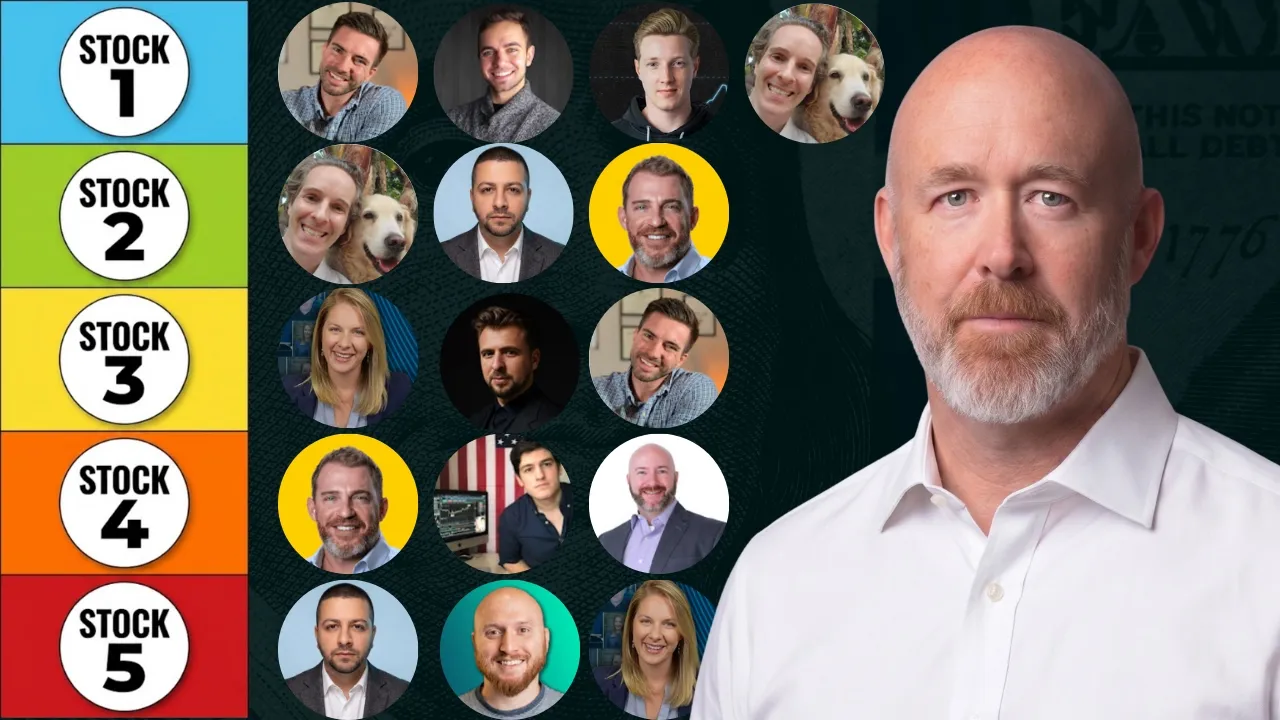
I just watched 141 stock videos over the past 11 days across 21 different channels. Okay, to be clear, I I actually skipped to the part where they actually talked about the stocks, and then I wrote them all down in a spreadsheet. In those, they they happen to tell me what they liked, what they own, and of course, what was about to explode. Across all those videos that I watched, there were only five companies that came up the most across these YouTubers. on those five companies. I'm going to cover who agrees, who disagrees, and who just has an opinion that doesn't really give you any direction. After all that, then I'm going to give you my take, plus the one thing that most of them just don't give you, which is my entry ladder or the prices I'm willing to pay. With that, every rung on that ladder gets measured against fair value. And fair value just means what I think the business is worth. That happens to be when you look at the financials and the trends instead of just the stock price. So, here you go. This is what the ladder looks like. And that bottom rung marked exit should be pretty obvious, but I'm still going to explain it. And every rung above that, I'm arguing about what the business is actually worth. And below that, I I'm just asking whether it's still the same business or or if it's just completely broken. That's why the cheapest price on that ladder in every ladder is going to be the one that I never touch because at that point, I think it's just broken. Now, just one other thing because otherwise these names of the bands, they're going to probably trip you up. Now, I buy stocks on a frequent basis because my IRA gets fed new funds each month that I happen to manage on my own. That's where I look at these ladder bands each time that I'm looking to buy new stock. And depending on any changes in the fundamentals or the technicals, the ladders get updated as new information becomes available. Now, hey, before we jump in, if you get any value from my content and the research that I provide, I'd really appreciate it if you'd consider pressing the like button so my content can continue to grow. And also just a quick reminder that I'm not a financial adviser and and this is just for educational purposes. With that said, let's go right ahead and jump in where we've got five different creators that covered one stock in particular, which is more than any other company on my list, which was surprising considering his 141 videos. And of course, in this case, they split three different ways. We'll start with Nolan at Investing Simplified. I believe the market still has this one wrong, and it's still undervalued. This one's Alphabet Google around $362 as I record this, down about 14% from its May all-time high, near $49. So, as you can tell, Nolan leans bullish. And now we're going to move on to Park. And he's worth knowing if you don't already because he's a CFA who teaches finance at Cal State and he writes for the Mly Fool. I've had Alphabet stock rated as a buy all year long. In fact, I've had it rated as a buy for several years now, and I will be reiterating that buy rating. I own Alphabet stock myself. I'm not interested in selling any of my shares at anywhere near these levels. Other than that, it's impressive because he gave a rating, holding, and a disclosure all in about 15 seconds. And he's also one of the few who actually put a figure on it since he sees $410 to $450 by the end of 2027. Now, this next person measured Google against its own past instead of against the market, which for the most part, that's the exact same thing that I do, and he came out somewhere very different. Google is selling quite a bit above its historical averages and does look like the most expensive hyperscaler in the market right now. And that is the reason why I am not buying Google or Microsoft and instead I am buying Amazon and Meta. Hyperscalers, by the way, just means the handful of companies big enough to rent out computing power at a world scale. That is Daniel Prank passing on the business that the other two are buying. And later on in that same video, he says his number out loud, a fair value of $354, which is barely above where the stock trades right now. That's why he would rather put his money in Amazon and Meta. And then Steve Eisman, who Michael Lewis wrote about in The Big Short and Steve Carell, played in the movie, doesn't hedge at all. >> Steve Eisman, an incredibly smart investor and one who is particularly talented at spotting bubbles, certainly seems to think so. So much so, he's getting out of his AI plays. >> I sold my Google. I wanted to reduce my exposure to AI. What scares me is that it's all one trade, so it better succeed. Go ahead and hold on to that phrase all one trade because I am going to come back to that at the very end. And the fifth one is Felix who I think handled this better than anybody else. He was running a live poll asking his audience where they would sell Google and people picked their spots. Then he went ahead and told them that Birkshshire Hathaway had just nearly doubled its stake that it already owned. Enough to make Alphabet one of the three biggest things that Birkshshire owns. And then he was very smart because then he asked whether that changed their answer and everybody said yes. >> Yes. Right. All the yeses. All the yeses. So your rules no longer matter. Now it becomes about what the news said and the noise of what other people are doing. Yeah. You see the danger in this. The danger in not being 100% confident. I couldn't give a hoot about who bought Google. I have an exit on this and when we break through it, I'll sell it. You have to have that automation set up and not change your mind because someone's talking about it on CNBC. >> And there it is. That's that's the one out of 141 videos. He's the only person with a level decided on before any of this even happened. And yet he still wouldn't say it out loud. Now, the whole reason that he ran that poll was to show his audience how fast a headline can talk you out of your own rule. And if you know my style, you you know that I am all about setting objective rules. So it takes emotion completely out. Now, as for me, I I'm on the positive side, too. And PRON is the reason that I went back and I I checked my own work. So on earnings, Alphabet has almost never been cheaper against itself in 10 years. But on sales, my my system puts it in the richest few% of those same 10 years. So there it is. Opposite answers. Same company, same day. My takeaway is he isn't wrong and and I'm not wrong. Alphabet keeps far more of every dollar that it sells than it used to. So measured against profit, the stock looks relatively cheap. And measured against sales, well then it looks kind of expensive. So which answer that you're going to get depends entirely on which line of the income statement that you decided to pick up. Now look at the rung sitting right underneath because that's the first one where extra money is going to go into. 50% starter just means half the size that I'm normally going to put into a name and and normal depends on the company since my biggest holdings run several percent each and the smallest are really kind of under 1%. So in that case just take half of whatever your normal is. So in this case I I lean positive on Google but long-term and only as dollar cost averaging. Now a lot of these high growth names well they require a little bit of patience. You're often waiting for a pullback before you're willing to execute. So, it's extremely important to have powder ready to go. And a lot of times that powder is just sitting there earning nothing. That's where today's sponsor, Galaxy 1, happens to fix that with Galaxy Premium Yield, which pays up to 8% on your cash. And let me put that into real numbers. $50,000 earning up to 8% comes out to $4,000 a year, and it acrus daily and it pays out every month. Now, this isn't a basic savings account. It's a private market investment note powered by Galaxy's institutional lending business. And the minimum to get started is $10,000, which is a fraction of what most private market deals ask for. And what caught my attention is the auto invest piece. Every month, that interest can go straight into stock, ETF, or crypto that you already want more of. Right now, it's open to US accredited investors, and getting verified only takes a few minutes. Sign up and get a $500 bonus for new clients. Links down in the description. This is a paid partnership with Galaxy 1. Now, this second company split two men so cleanly that they might as well have been looking at completely different businesses. >> In fact, I calculated a fair value for Nvidia stock at $300 per share. And even after today's increase at 221, you can see it's considerably undervalued. >> So, the cost of ensuring Nvidia's debt has well doubled since late May. Those two are looking at different markets. ParkV is looking at the stock. Felix is looking at what it costs to ensure Nvidia's debt, which is a real market where you buy protection against a company failing to pay what it owes. When somebody is worried that protection is almost free, and this one doubled in about 3 months on a company that's supposed to have the safest balance sheet in the business. Now, I got to give Felix some credit for where he stopped because he never called Nvidia a bad company and he really went out of his way to say so. Now, his argument is about who holds the risk when customers borrow. By his count, half a trillion dollars, nearly double Nvidia's entire annual revenue to buy chips that are potentially obsolete in just 5 years. And the lending traces back to pension funds. Now, a market beat analyst covered this, too. and and I want you to hear exactly what he hands you instead of a price. >> So, these are the events that you're going to look for if you're wanting to start a position in any of these stocks. You'll want to wait for one of these events to happen or if you're wanting to average down or even build on the position that you have now. When these events happen, they create perfect environments for you to accumulate. >> Now, the event that he means is chaos in the Korean market. And the logic, it's real because almost all of Nvidia's high bandwidth memory comes from SKH Heinix. But you you can't put an event on a ladder or set alert for one. So you end up watching a stock fall and wondering whether this is just another event or just another bad Tuesday. My own read lands at about $290. And the analyst consensus sits right on top of it at $33. My methods agree on what Nvidia is worth. where they argue is how wide to draw the bands around that number. And here they're arguing a lot more than normal, which is why these rungs are are spaced further apart than normal. Now, that bottom row exists because of what Felix showed me. If the credit market is right and this buildout gets expensive to finance, $148 is where it stops being cheap and it starts being the proverbial falling knife. Nvidia sits in my buy full band and I want to be very clear about what that does and does not mean because this is not a stock that's fallen apart in any way and it's only a few percent off of its high. It's in a buy band because my fair value sits well above that price, not because anything broke. It's also cheaper against its own earnings than it's been through more than 80% of the last 10 years. So, in this case, yeah, I'm leaning in. And I know that people in my community, they're going to be asking why I'm not buying more today. That's because it's already over 12% of my portfolio. And in my mind, that's already too heavy. For this next company, I'm going to run it backwards because one creator did something that was very close to what I've been asking for. And I want you to see where this begins to stop and be something completely different. >> Several lot. You start buying at 135, you add at 275, you add at 500. When you're finally out of this thing, you've got a massive position. And so, this is not the only way to trade stocks. But this is my goal. My goal is to buy here and buy here and buy here. I want in for the good times. I just want to catch these rallies as it pushes higher. >> That's Ross Given. And the company's Micron. I played the whole thing on purpose because the first half sounds like what we've been asking for and and the second half tells you that it doesn't quite itch that scratch. Look at which direction his numbers run. He buys at 135, then higher at 275, and then higher again at 500. And every one of those was the stock breaking out to a new high, which of course is the signal that he waits for. Those just happened to be rungs that that he climbed on the way up, not prices he was waiting for. Now, every ladder that I'm showing you runs the complete opposite direction because I've already decided the business is worth owning and I'm only deciding at what I'm willing to pay. So, when a company I like drops, his reason to buy begins to disappear, and mine just happens to get stronger. Trader versus investor. And look, you don't need my system to build one of these. All it takes is just four questions. The first is where does this sit against its own history? And of course I say that but you you also watch that hand me two completely different answers on Alphabet all in the same day and in this case you need to be your own devil's advocate. The second is what is this price already assuming? And for Micron that's a bigger number than it sounds and and I'm going to show you that in a minute. The third is am I confusing a great company with a good price? So, a bad business at a great price, it's still a bad business. Quality decides whether a company goes on my list at all. And price, well, that only decides how hard I'm willing to lean in. And the fourth is what would change my mind, which costs you absolutely nothing to ask yourself, but honestly, it can save you the most. So, there's this price where I'd start buying and a lower one where I'd stop believing the story altogether. This is a bit of an exercise, but writing down your exit line if the business breaks before you even own something is a completely different exercise from finding it while you're in the moment of losing money. Jeffrey Neil Johnson made the business case at marketbeat that Micron's capacity is contractually sold out through 2027. And this is a case where Nolan liked it, too. But listen to what he did on his way past. Be careful, though. Memory is a cyclical business. A cheap multiple at record earnings is exactly what a cycle top can look like. Now, >> this is interesting because nobody asked him to say that. He put major buy in the title and then handed you the thing that in some ways could break it. And of course, that was a short. So, here's what he didn't have time to name. Against the earnings, Micron has already banked. This stock trades at 22 times, which by most accounts isn't cheap. However, the cheap number that everybody quotes is against next year's earnings. and there it happens to be closer to six times. Those can only both be true if the market assumes Micron's profits roughly triple from here. And that's the answer to question two. And that tripling is the thing that you're actually buying. And Micron's funny because it's where my own system argued with itself. And I'd rather show you that than try to hide it. My model puts fair value near $1,450, which drops it into the deepest buy band on the whole ladder. Then the same system flagged it as richly valued against its own history and it tried to pull me back up a rung. So remember that ruler problem from Alphabet having two conflicts at once. So here it is again and it's worse because my model says the stock is cheap and its own trading history says it's expensive. So when those two begin to collide, I take the smaller bite and then that warning is what I act on rather than the row that the price the band happens to land in. Now, that bottom rung at $434 is 70% draw down from what I think that the business is worth. And on a memory company at record earnings, that is not unthinkable, which is exactly why it's written down to take emotion completely out of it. The trigger underneath all of it is the 50-day moving average at $961, which is just the average close over the last 50 trading days. Micron has slipped under it. So I keep buying on my normal schedule and I don't add a dollar beyond that until it begins to climb back over that line. Now we'll move on to the next company. In 1999, one of the most widely held stocks in America was a company called Lucent. Its customers were new telephone companies who wanted to build networks and didn't have the money. So Lucent lent it to them and it was billions of dollars. Now those customers turned around and then they bought Lucent Equipment and Lucent booked that as revenue. Sales obviously looked spectacular. Then one of them came back asking for another 90 million and at this point Lucent said no and within weeks that customer was in bankruptcy court. The demand had never really been there. The seller had been paying for it all along. That's a 25-year-old story. And one of the five creators on this board is going to reach all the way back and use that about a company that just went public last year >> to rent them itself. And that is not a customer relationship. That is a seller underwriting its own demand. The precise thing that Lucent did 25 years earlier. >> That happens to be Coreweave that he's talking about. And what he's pointing at is an AK filing where Nvidia agrees to rent back the capacity that Cororeweave can't rent to anybody else out till 2032. So when you look at Coree's demand, part of what you're looking at is the seller. >> He also argues the Neo clouds undercut even the hyperscalers on cost by more than 40%. So if you believe his analysis, well, Cororeweave is an obvious buy. >> Now just now he's talking about James Fish, an analyst at Piper Sandler. At least he told you whose number it was, which is a lot more than most people even bother with. But it's a bank's number and banks price for a very different holding period than you and I do. One other person covered this company and he's the only one who put a number on it. They had $113 fair value estimate according to my calculation and the current market price in the aftermarket hours is $104. So, it still looks, I would say, slightly undervalued or you could say fairly valued depending on the margin of safety. So, I mentioned I've had Core Weeb stock rated as a buy. I last updated it on July 13th, 2026. And today, after seeing the initial results from the company, I will be reiterating that buy rating. And in a way, he answers Given without having to ever mention it because Given says the demand was never really there. and Parkkev points at $130 billion that's already under contract. Then of course, Joseph Hog had this to say. Now, I have avoided this group because I think the smaller companies like these are going to run into cash flow problems eventually, but for now, momentum is definitely on their side. Now, if you are up on these, you might consider hedging a little as the volatility is through the roof on this theme. Telling people that you aren't buying something that's going up is a little uncomfortable and it was probably one of the truest things that anybody said about this company. And this is where I break even my own mold because this is one where I'm not going to give you a ladder at all. Now, my system produces a number for Carweave, and I'm not going to show it to you because this company has only been public for 17 months. Every ladder in this video is is built on measuring a company against its own trading history. And there just isn't enough history here to even measure against. Given says it could go to zero. My model says it's worth a lot more, and it's very optimistic. But the reality is neither of us should probably be trusted on just 17 months of information. Now, this next one is pretty interesting. Only one person on the entire list covered this next company. And for that reason, I probably should have cut it. But there's a reason why I didn't. And the reason I kept it is because it is the one place in all of those 141 videos where somebody actually did the work. They showed the number and then they handed you the reason on why he might be wrong. But overall, I calculated a fair value of the business at $120 a share. The current market price after the 7% drop today is $67. It's one of the most undervalued stocks in the market today because of that overhang of driverless car technology and the risk of how it could impact the business. That was Uber and that was Park again. And look what he did in just 20 seconds. evaluation, where the stock sits against it, and the exact thing that could honestly break it. Now, hey, just one quick note before you run the math on that clip because he recorded it on a rougher day than the one where I'm actually filming it on. The stock happens to be higher now than the price that he quotes. So, the gap up to his number is is much smaller than it sounds. And it gets interesting because driverless cars either take Uber's riders or force Uber to start buying cars itself. And a company that owns a fleet is a very different animal from one where the drivers kind of bring their own. He also revised his own free cash flow estimate down 4% on the way there out loud because the quarter came in a little bit slower than he had modeled. You almost never get to watch that because quietly updating your own model is kind of the more normal way to do it. So here's where it gets interesting. My own valuation comes back at $109 against his $120. That's two people who never saw each other's work, about $10 apart on the exact same company. So, out of everything that I watched, that's the only time that that happened. Uber also sits in the cheapest third of its own 10 years, and it throws off roughly $10 billion a year in free cash flow against a company that the market values at about 150 billion. And there's one thing that I'm not going to skip because it it kind of cuts a little bit. You see, Uber looks cheap against the profits it's already made and expensive against the profits that it's expected to make. That gap only exists if the market thinks those profits are coming down, which usually means something one time is sitting in the trailing number. So for me, I'm leaning on the cash flow here instead of the earnings. And that's a choice that I made rather than something the data just kind of handed me. And Uber of all places is where my system finally didn't argue with itself. ParkV did the work and he got a number. I I did it separately and I got nearly the same one. My ladder has this as the deepest buy band. And the risk that could break it all is the one that he told you about all by himself. That that doesn't happen very often. And when it does, I I I don't need a flashy headline to tell me that it's time. Now, here is the whole board all in one place. Every company, every position counted honestly and my own answer sitting right next to theirs. 16 positions across five companies. Only Alphabet got a real argument on both sides and a third of this board happens to be neutral, which sounds like indecision, but mostly it isn't. Felix looks to have an automated exit and doesn't care who else is buying. Prong thinks the business is fine, but he's putting his money somewhere better. Both of them know exactly what they think. It just isn't a buy or a sell. There's one name where I didn't give you a rung at all. that happens to be Corewave and I'm just standing on the side because I can't price it and standing aside is not the same thing as just holding. That company happens to be at the forefront of a trend and I think it has a lot of potential. I just can't quantify it. And then there's what I didn't really see until all five were just sitting in one place. Remember what Steve Eisman said? It's all just one trade. Four out of the five I just showed you are pretty much the same trade. chips, the clouds that they sit in, and and the models that they run. Exactly one of them stood outside of all of that. And that happened to be Uber, except the question hanging over Uber is now driverless cars, which happened to run on the same silicon that everything else is on the list. And I can show you that rather than just claim it because yeah, I have the spreadsheet. I have to say it was a little bit painful. But of the 141 videos that I watched, 76 of them touched chips, the clouds that they run in or the models on top. And and that's the rule I counted by 19 channels publishing the entire market to choose from. And more than half of everything they made came right back to the same handful of names. So if your watch list was built out of videos like this one, and part of mine was, go look at it tonight. You might not own five different companies. You might just own one bet wearing five different names. And those are very different things when the trade stops working, which some of us felt when the dips happened a couple weeks ago. And clearly that's not a knock on anybody here. It's what happens when everyone is reading the same news in the same week. And hey, I am extremely guilty of that, too. If you take one thing out of this, make it those four questions because you can run them on any stock without my system or anybody else's. It's worth your effort to write down your own answers before you actually need them because I guarantee you, you're not going to be thinking clearly on the day when it actually matters. Before we go, I just want to talk to you for a second because I want to point out that this format of a video is completely different for me. I really enjoy doing it, but it's also a lot of work. So, if you would let me know down in the comments if you got any value from this. And as always, thank you so much for watching.

Commentaires 0
Connectez-vous pour rejoindre la discussion.
Se connecterAucun commentaire pour l'instant. Soyez le premier à partager votre avis !