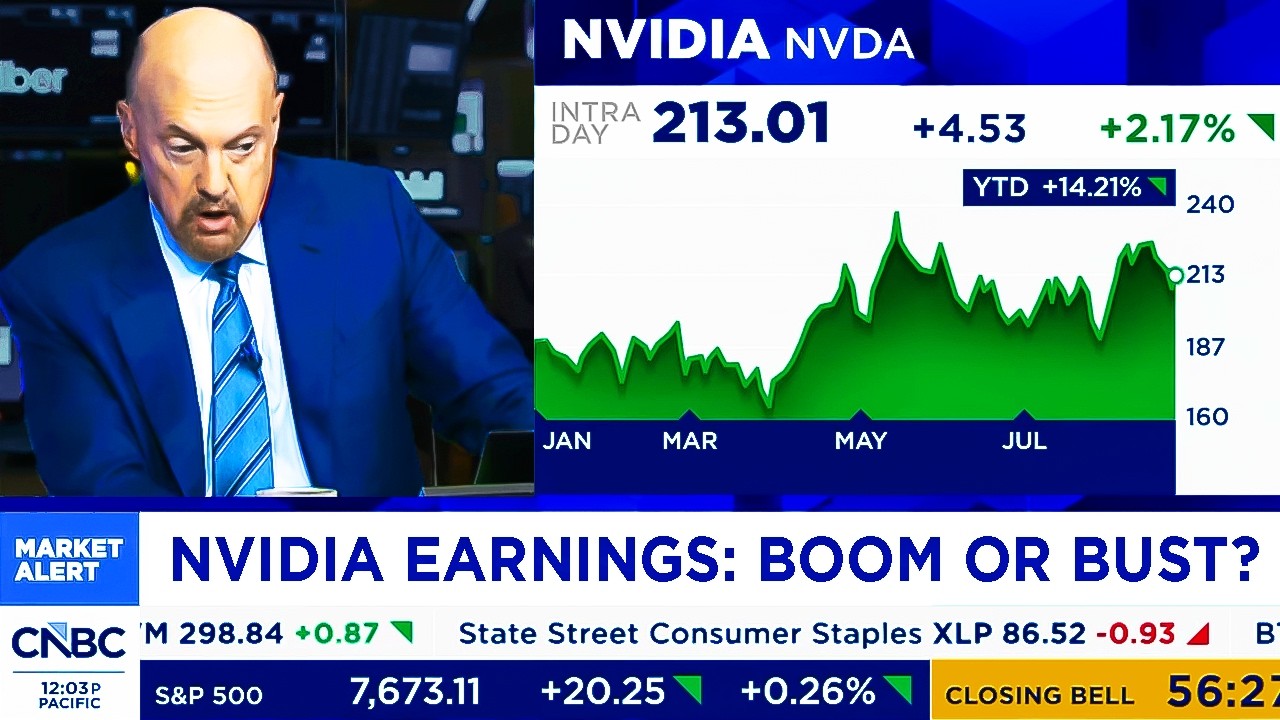
CNBC & Fox Today On NVIDIA Stock, Micron Stock Ahead of NVIDIA Earnings - NVDA Update

- Rendement de la vidéo
- +0,96%
- Appels
- 1
- Achat / Vente
- 1 0
- Publié
Recommandations
L'entrée est le cours de clôture de l'actif à la date de publication. Le cours actuel est la dernière clôture enregistrée.
-
Entrée $932,97 25 août 2026Actuel $941,94 26 août 2026Résultat +$8,97
Well, I'm not trying to love anything, but I love this stock.
Transcription Complète
Tech Jim, I know even you have been noticed uh noticing the losing streak in Nvidia going into the print. >> Yeah, look, it's not coming in hot. Now, the last couple it has come in hot and the result has been well, everybody said that's why it was up. The reason why it's up is because the numbers are good. Now, we also have a tremendous blowback cuz we all know about everything that he does. The Wall Street Journal has a bill particular today about how about everything being circular and they even mention and David I think that this is I thought of you when I read this. >> I'm glad. >> Okay, good. Um Luc, >> yes. >> When you mention Lucen, David, that's that's nuclear. So that's that's chemical warfare. It's not even nuclear. No. >> And but they say to be sure Jensen's honest. >> Yes. They they they go on to say this is not a fair comparison. so to speak, but they did actually bring it up. >> They did actually make it. By the way, you and I spent a good amount of time yesterday having a discussion around Nvidia when you brought up the fact that you'd like to see them buy back a lot of stock and I brought the fact that well they spent a lot of money doing a lot of other things right now in terms of back stops that they're providing in terms of residual guarantees in terms of sort of that overall back stop so to speak to so much of the AI spend. Whether they'll ever get hit on it is unclear, but it's not as though it doesn't exist, Jim. And it's certainly something that I would imagine will be a subject of some conversation on the company's conference call after earnings >> and it will certainly be a subject of conversation when I interview, >> right? >> Because I'm not going to sit here. I mean, Carl, this is the obvious story which is that every day you pick up uh you pick up a story of what Jensen's got invested in. The two Australians was something I didn't realize and that was kind of a all right, he's even going down the down under. I mean, what are we going to do here? But I my problem with it is is that he's up on he's up on everything. >> He's what? >> He's up on everything. >> Oh. Oh. Well, the actual equity investments they've made, they've done great on. They've done great, >> you know, on the financing stuff. I mean, obviously too early to know whether there's going to be some real liability there. >> But yeah, and of course the the overall point is you're talking about a company that's going to do what I mean 600 billion or more in revenues, right? Huge 70 plus 75% margins. we can all sort of figure out what the cash flow numbers look like. You got to do something with the money. Why not do it? Why not make sure you're >> Well, you could you're there for the ecosystem overall in terms of support. >> Well, that's what I I believe that. Now, when I was out at at Micron, it was clear that Sanjay Maro says every dime has to be used to expand expand expand. Uh now, they do have in December they can sell some stock that's uh from from the US government. You know, they've got this problem. US government can sell can well they're they're free to buy stock okay the US government will be kind of done in terms of its power over Michael and that's kept them from buying stock but I would tell you that their ethos is look we our hope is that we can catch up and you by the way there's some stories out today about the the fanciest souped up beer Rubin doesn't have as much memory and that could be because these companies aren't aren't producing enough but when I was out there I mean when you work six days a week and you work the full around the clock uh and you're trying to get the the uh chips out in the first first in the first quarter. They're doing everything they can. Everybody's doing everything they can, but you know, when you listen to Nvidia, they're they're spend a lot of money not building more chips. >> So, why is that? >> And then a lot of discussion this week about Jensen's open-source initiatives and trying to serve both parties for the time being here. >> Look, I think we've never seen anybody like Jensen. That's but there's there's no blueprint for Jensen. There's nobody who just says, "All right, I'm going to do everything." I look, a lot of people when you're out there, the fact is Jensen's humble. Rich McInim was not humble. Okay, from Lucent, if you remember that Brazilian contract contract that didn't come through, >> I remember it all well. I remember that period. And again, I think there are some similarities, but it's not a replica at all of that. >> Similar to history does rhyme. There are similarities in terms of at least >> like Mark Twain. Thank you. >> All right. Yes. >> Well, I I just I I come back and I say he has a different model. Intel's in trouble. He puts money with Intel. How did he do? He's got huge positions in so many different companies. I ask him offline. I say, "Listen, to the people there, not to him. Uh why don't you take some profits? And tomorrow I'm going to ask it online because there are so many. Why not take some chips off the table so you can have a better bank, >> right? Interestingly though, the number itself were they to sell all of their equity stakes would still not be a particularly large percentage of their market cap. No >> in any way. >> No, but in the same way I'm just saying that I don't think that the back stops are as dangerous as other people. Uh because I believe that this stuff lasts five six years. There was a personal one yesterday and squalt box was saying well I I actually I didn't know what she was saying but it seemed like that it was 3 years 5 years 7 years I don't mean that mean that I'm just saying was little maybe I'm up to maybe the word very well may be right that's why the on the $500 billion remember when this plan to securitize create a securitized market that's backed by the actual GPUs and they have a back a residual value guarantee that could be as much as 125 billion but they may never get hit on it at Because >> because GPUs, as they argue, from many years ago, are still being used at and used and paid for at a higher rate than they were when they were new. >> Yeah. And who knows more about this than the man who sat over there, Michael Entrader, who basically said, "Listen, my H100s, they're still worth a lot. >> And they're not I mean, I remember when he came public and he said, "Look, this stuff's going to last 5 years." And everyone laughed at him. >> He he was like, >> they laughed. >> He was like Carrie in the gymnasium. >> I knew you'd go there. Um David, all eyes of course will be on Nvidia tomorrow. Uh their earnings coming after the bell. Are investors expecting perfection here? What what what's the rumor? >> Yeah. Well, I think Nvidia is going to have a great quarter. We we've seen multiple great quarters out of Nvidia Street's looking for 92 billion. I want to actually see though, are we going to guide to 100 billion or more? Is 100 billion the new normal for Nvidia? If that's the case, this is very promising for Nvidia. But I also want to set our expectations. We've had good quarters the last four quarters yet Nvidia stock has traded down at four of the last quarters after earnings even though we had a good earnings report. So I think we got to be tempered but I don't think this trade is done. I don't see slowing demand until well into 2028. I think it still bodess well for Nvidia. >> All right let's get to Nvidia reporting tomorrow. That is a big one for the markets. Are are Nvidia's earnings do you think effectively a referendum on the entire AI trade? >> They they really are. uh and this quarter specifically because people want to see so we all know that Nvidia is going to do close to a hundred billion in revenue for the quarter. We know that the their margins are going to come in at north of 70%. So that's why they're valued at $5 trillion. But you know what are they doing where what's their data center business looking like right now? What's their projection out to next quarter and next year looking like? And I suspect you're going to hear positives on all fronts from Jensen Wong tomorrow. And I think it's going to be the catalyst to push. Remember, Nvidia stock is down from the last earnings report. And it hasn't moved much year to date at all. So I think when we get this report tomorrow uh from the company, you're going to see the stock start that upward trajectory again back up to the 225 230 level. Very quickly, Mike, you know, the the amount of money being spent on the infrastructure and the data centers and everything. There are investors who say, "I understand the massive investment, but when are we going to start seeing some return on that?" Is that still an issue? >> I I don't think it is because in in order you see what AI is doing and look at some of the big private AI companies like Anthropic and Open AI, you know, Anthropic is going to go public at a$ two trillion dollar valuation. You're seeing the revenue come in already. So, I don't think it's a question on whether or not we're going to see a return on it. I think it's just a question if we can build enough and build fast enough. So, there's still a lot of runway left for the AI trade. Nvidia tomorrow, stocks been down for seven straight days coming into today. It's the longest losing streak since September of 22, and it comes right on the back of one of the longest winning streaks that it had in some time. So, what's riding on this? What do we think? Well, Nvidia's next leg obviously riding on it. What about the semi-trade itself? That's probably riding on it. The hyperscalers near-term direction probably, right? So, you got a lot at stake. There's no question about that. Josh Brown, you agree with our list and do you have more things that you think are riding on this report tomorrow? So Sean and I took a look at uh exactly what you're talking about. Not just what what uh the narrative is going into the report and what's writing on it, but the reaction. And this is not a great earnings stock. It really never has been. I don't mean to say the earnings aren't great. What I mean is there's always a lot of buildup, a lot of anticipation, but most of what the stock is going to do typically in a given quarter is dictated by what their top five customers say. And we got those reports two to three weeks ago. So if you go back to Q1 of 2020, I think that's a a lot of time that we can judge. The average return for Nvidia at the close of the next trading day after reporting is plus 2%. That's not much. There are two massive reactions that are skewing that average up. Um, one of them was a 24% move in May of 2023. I think we could all agree those days are over. The next biggest one was plus 16% in February of 2024. If you strip those two out, the average return for Nvidia the day after earnings is literally flat. of the 26 reported quarters in that time frame only on 12 occasions has the stock gone up or down by 5%. So, it's really not uh I think about what the stock itself is going to do. Although I would love a post earnings rally as a long again and we talked about this last week and it was very important. >> Nvidia, Jensen Wang in particular is is the AI Fed and we absolutely need to hear um confirmation of all of the things that we think are going to go on in the next 5 months into the end of the year and in 27. and the guidance matters to hundreds maybe a thousand stocks more than it probably matters to the Nvidia share price itself. Um and I think for that reason this will be the most watched earnings report of the entire season. >> Yeah, I I just don't see how anybody is really going to disagree with that. Joe, I I thought there was an interesting story today on Nvidia's dependence on the hyperscalers faces a big test in this earnings report. That's the headline. The company's hyperrowth has been driven largely by tech hyperscalers which have purchased GPUs in bulk. But those companies are seeing their free cash flow erased as they pour money into capex, right? Everybody knows that. >> Here's the question. Can Nvidia rapidly diversify its business by providing financing options to a wider swath of customers? can't have this dependence on the hyperscalers be the you're your your your only game forever. Do they need to do that? They become the banker to the AI boom says the Wall Street Journal today putting it on dangerous ground. That's sort of the similar thing. >> Danger. >> What does that mean? >> I think it's dangerous ground. But I also think that you have to acknowledge that that prices are going to continue to rise and what Nvidia is charging is only going to move incrementally higher. So it at what point do you hit the ceiling where you see the elasticity as it relates to what demand ultimately looks like. So I I think that's one of the reasons why the valuation has cheapened so significantly because people understand this financing dynamic has an end point to it. I think that's in front of us. I think that's obvious. Um, I I just want to add I really think that this call, this earnings call on Wednesday is going to be critical for Jensen Wong to be the voice that pushes against the data center push back that we are seeing around the country. I think it is going to intensify as you move into the fall. It's an interesting statistic that was brought to my desk this morning. data center construction is now 2.5%. That is bigger than infrastructure construction in the entire country. Think about that. We are now building out data centers more than we're building out infrastructure. So I think this has to be the beginning of that conversation where he engages because to Josh's point, if he's the central figure in the AI construction, he needs to address that. He needs to address that element. Also, one other point, we'll get into this later in the show. Let's not forget we have two really important earnings reports this week. >> Marll follows on Thursday. We'll talk about that more in a little bit. >> Oh, I thought you were going to finish the thought. No, >> we'll talk about that in a little bit. We're staying on video. >> All right. Thank you. Thanks for the tease. Yes, we're going to talk about Marva. I thought you like there were more words coming. At any rate, Steph, so BFA talks about this coming report. Beaten raise expected, right? Check. Check. We agree. uh they talk about a buyback, a bigger buyback could defend EPS quality similar to what Apple did post 2012 with its own playbook, right? That I think many people view the the massive buyback that Apple initiated as somewhat of a floor under like how you can't get too negative on Apple because of the massive buyback. are always buying back their stock. You made the case yesterday with me on closing bell. I don't want a buyback. You said and you were pretty, you know, demonstrative about it. I do not want a bigger buyback. >> Well, I I don't mind a buyback. I don't mind a dividend. I don't mind a dividend increase bigger than what they did in when they initiated. I don't mind that at all. What I mind is if their growth is slowing and it's not slowing, but if the growth is slowing and then they do a buyback, that's what Apple did. their growth went from you know 20 30 40% growth down to low teens and that's when they start initiating a buyback. So if if if the growth is slowing at Nvidia, if that's the indication that we get from the company, that's the reason why that they're doing more in terms of shareholder returns. >> Your case yesterday was you want them to spend spend spend spend and spend. >> I think they will continue to spend spend spend number one. I think the fundamentals are going to be great. I think they're going to see more compute backlog higher u because we're short compute. We're short memory and hyperscalers are spending all their money capex right now on memory. So, I think you're going to see good backlogs, free cash flow. Getting back to your point, 200 billion this year, 300 billion next year. They already committed to returning 50% of their free cash flow to shareholders. So, if they make an announcement today, okay, they make an announcement. I don't think they will because they've already committed to they are going to over time. My biggest con my biggest question is if they do it, is it is it because the growth is slowing and I don't think that is the case. Wasn't Apple's grow Apple's growth wasn't really slowing when they they did buy back, didn't they? >> I mean, their their services decelerating their services business was almost in the still nent stages growing into this behemoth that it >> we do not want, >> but it's only 20 it's only 20% of their revenues right now in in terms of services to Apple. So, I mean, it's been growing, sure, but the overall growth rate has been slowing at the company for years. >> Josh said you what did you just say? You don't want a dividend? >> We do not. We No, no, no, no, no. Speaking on behalf of long-term Nvidia shareholders, we do not want increased dividends. There the the tax treatment of dividends is absurd relative to um the the tax treatment on buybacks. The tax treatment on buybacks is 1% the company pays. Dividends are double taxation, meaning Nvidia is paying the tax on earning the profit and then distributing it to us and we pay another tax. Nobody wants that. Nvidia is not going to yield 4% to the point where the dividend is going to attract a new shareholder base. So I of all of the things that they can do to me for me and I think I'm speaking on behalf of many Nvidia shareholders institutions and individuals please reinvest into robots automation get involved in space anything but paying me a.5% dividend. What am I supposed to do with that? >> What like what are we collectively going to do with that? I think the most important thing on the conference call is the the earnings path to $15 a share by 2027 and eventually getting to $20 by 2028. And what happens to gross margins in that scenario? Do they stay in the mid70s or if they decline? If they decline, the market is not going to like that. >> They talked about raising price, right? Wasn't that story yesterday? >> Right. That's why I don't think that that's the case, Scott. The reason I bought this thing is because it's 18 times earnings growing 85% with gross margins in the mid70s. Period. raise prices, defend margins. >> So, I think so. And they can raise price. That's really But I want to get a little more detail on the earnings power because my goodness, 20 $20 in earnings power in by 2028 makes this even cheaper than 18 times. >> Uh well, I I was just going to say that um everybody knows this is going to be a great quarter. What we really need to hear is what he's thinking about the third quarter and what he's thinking about next year. And if we can do a guy that's 110 billion revenue plus for Q3 that possibly could move the stock if there is something that really excites the market which has not generally been the case as Josh pointed out. Um there are many people who don't own Nvidia even close to the market weight. They might not own it. They owned it. They sold it when the when the stock was down. And there were a lot of sellers during that period when everybody's saying, "Oh, kind of it's washed up and you've got all of these lowcost suppliers and competitors. So competition is going to be a question people want to hear him discuss and what's happening? Can we get to 110 billion or higher in the third quarter? And will that maintain the gross margin because the customers are willing to pay the price?" Do you do you think that all of those things that we put on the list are genuinely what's riding on this report tomorrow evening? Obviously, if for Nvidia's next move, how could you say otherwise? But the semi trade itself hasn't been great. >> Yeah, I I think that um the semis um are a slightly different animal right here. Everybody knows that this is going to be a good report. isn't going to change what happens with other semiconductors with Micron or looking at TSM. Think about AAD all of the uh the whole universe of stocks that have been up anywhere from 50 to 500%. Is that going to change because of this Nvidia report? I I don't really think so. I think it just got overheated and tired. It's a little tired right now. It could ignite, but I I wouldn't be betting on it. >> We've been talking a lot about this. We've got Nvidia after the close tomorrow night. It's always a major story for the markets. We'll see if it moves the markets. Uh but you know, that's a pick for you. What do you say about the earnings tomorrow night? And what do you what do you want to see from Nvidia? >> Well, everyone's talking about Nvidia, so maybe I can talk about something a little bit different. I I don't think everything's fully priced in >> to Nvidia. It's been sort of boring all year. The volatility's been a little bit low. Okay. >> It's sold off seven days in a row. First time in five years. >> Mhm. But if you look at it, it's still a really good buy. It's it's way below its 5-year average on its forward PE. Its PEG ratio is still a 0.5. And so I think there's lots of upside here. The mutual funds do not own Nvidia on the positioning chart. It doesn't even register. So there's a pain possibility. If he pops and we don't have, you know, Armageddon with Jackson Hole or anything like that, I think you're looking at a really big pop here of five to 10% and it's going to be a pain game for these mutual funds. >> All right, nice tie to the Jackson Hole Symposium. Let's talk about Micron. >> Okay, >> stocks got traction. They're actually they're just opened up a new facility up in they're building a new facility upstate New York. There's expansion, there's growth. What do you say? >> Well, I'm not trying to love anything, but I love this stock. >> Okay, it's all right. stock is at a 02 on its PEG ratio, about a nine or a 10 on its forward PE. It's off 30%. It was a the market got afraid of a Chinese IPO that's not even relevant till 2028. They need the memory now. They need the chips now. There's two times demand for that stock now. I think you got 70% upside in the next 12 months. >> All right. No, no. Again, Micron has been, you know, the little beaten up and they seem to be coming back into favors. Let's talk. Josh Brown would tell you we have two Fed chairs speaking this week. The real Fed chair Kevin Wars on Friday, but the AI Fed chair Jensen Wong on Wednesday. Who matters more right now? >> You know, that's a tough question and it shouldn't be. Historically, we wouldn't even have this debate. But I think that the earnings report tomorrow from Nvidia supersede everything else this everything else that happens this week. And that's not to discount Kevin Worsh's speech on Friday because it's huge. And I think where interest rates are headed are probably more important than where earnings are going. But what Jensen Juan talks about tomorrow in that earnings report, and you said it earlier, I think the beat is a given. It's that's the price of admission. But what he says about the report, the margins, the Reuben, and really the whole ecosystem, I think to me that's more important because this market is trading on the AI trade, Scott, more so than it's trading on interest rates at the moment. >> We're not suggesting that, you know, what he says won't have a direct impact on Nvidia. Of course, it will. But the way that that stock tends to trade around its earnings, you know, in the immediate aftermath and the way that other parts of the market have traded, I just feel like it's the hundreds of other things that are potentially at stake, which carries maybe more weight in terms of what he might say and how those other things trade and then how people view the trajectory of the market from here. So I totally agree with you and I think this quarter more than ever but one of the reasons that Nvidia tends to not have this enthusiasm postreport uh I think is in they're choosing to report so late that we get a lot of the runup a lot of the anticipation from the other companies so that you're you're sort of thinking about what Nvidia is going to do because we've seen so much from it before >> and this thing's running down into the print right after this really nice rebound. This been down seven straight days heading into today. Okay, it's green now, but it hasn't looked good lately. >> Well, from a price perspective, I think you can buy it before the print, but who knows? We know the implied move tomorrow is going to probably be five or 6% one way or the other. But I'm expecting this to be a good report. And I think it all comes down to the margin, Scott. We're going to see a 70s something in terms of what their margins are. 75% or higher, the stock will move. Uh, anything in the low 70s, I think the stock will sell off, but we have been accumulating it into the rear into the print. All right, I hope you're all doing well today and staying calm in this market. Today was overall a positive day in the market. Positive at the index level and somewhat of a mixed bag beneath the surface. Oil and treasury yields both moved lower. On Tuesday, Nvidia announced Jetson Orin Nano2, a new robotics computer for entry-level AI that enables developers to build robots, delivery, and inspection drones and vision AI systems for frontier physical AI applications. The new computer delivers 2x the inference performance of its predecessor in the same form factor and consumes 40% less power at the same performance. What really stood out to me from this press release is that Nvidia provided an update on how many developers are building on the NVIDIA robotic stack. Previously, Nvidia told us that over 2 million developers were building on their robotic stack. And in this press release, Nvidia says that more than 3 million developers are building on Nvidia's robotic stack. That is a notable increase. I continue to think that many market participants are underestimating the long-term growth of Nvidia's physical AI business. Also, on Tuesday, OpenAI shared some results for their new custom ASIC named Jalapeno. We also got a piece about the chip from semi- analysis. OpenAI's inference X test showed Jalapeno delivered roughly 1.5 to 1.9x higher peak performance per what GB 200/GB 301.7 to 3.6x lower intend latency across GPT OSS 12B. Deepseek R1670B and Kimmy K 2.51T. Semi analysis says it beat every Nvidia AMD and Google Accelerator. It has tested across multiple open source models. The more concerning part for Nvidia is that Jalapeno appears competitive with Ruben. Semi analysis says Jalapeno's single token prediction throughput per megawatt exceeds Nvidia's publicly disclosed Vera Rubin results. However, on total cost of ownership, Semi analysis currently has Jalapeno and Reuben roughly headto-head. So, this isn't necessarily a case of OpenAI leaprogging Nvidia. But it is notable that this is OpenAI's first generation ASIC. OpenAI currently has engineering samples of Jalapeno in production is expected to ramp over the course of 2027. It's worth mentioning that Nvidia Vera Rubin NVL 72 production racks are rolling out to customers right now. And so OpenAI's Jalapeno is not a case of OpenAI leaprogging or catching up to Nvidia, but is notable because it's their first generation chip. Semi- analysis points out that Jalapeno uses HBM4 likely provided by Samsung. It's worth considering that OpenAI is not immune to the memory shortage or memory makers pricing power. There have recently been rumors about Nvidia's Ruben Ultra containing less memory content per GPU than what was originally expected due to the shortage. Some reports imply that Nvidia may offer multiple variants of Reuben Ultra with varying amounts of memory due to the shortage. And so I think the memory shortage and the memory maker subsequent pricing power may act as a somewhat of a limiting factor on OpenAI's ability to deploy Jalapeno at scale. OpenAI mentioned Nvidia by name in their press release saying quote meeting growing demand for AI will require more compute from every available source. We will continue to widely deploy accelerators from Nvidia and other partners for both training and inference workloads. And so Jalapeno could potentially be a challenge for Nvidia over the longer term, but likely not anytime soon. The reality is that Open AI needs more compute from wherever they can get it due to the strong demand they're seeing from customers. I know the Wall Street Journal recently reported that Open AAI had tepid results in Q2, but Open AI and other reports indicate that OpenAI's growth accelerated in Q3. Open AAI is seeing strong demand and they need more compute. that said, "I think OpenAI will face challenges deploying Jalapeno at a scale large enough to threaten Nvidia due to supply constraints and financing challenges." In a recent deal, Nvidia announced with Open AI in SB Energy for a data center campus in Ohio. Nvidia is essentially providing a $15 billion credit back stop. As part of the deal, the site will be exclusive to Nvidia hardware. I don't think Nvidia would be willing to provide similar support for other sites if those sites were to deploy both Nvidia GPUs and competing accelerators, but I could be wrong. It's also important to consider Nvidia's full stack approach. I noticed Gavin Baker made a good point on X by saying that Jalapeno will likely underperform a disagregated GPU/Trrenium plus SRAMM accelerator setup. Nvidia innovates across the entire stack and there's so much more than just a chip company. Nvidia's Vera Rubin platform consists of seven unique chips that are each revolutionary in their respective areas. I also wonder if we could see a situation in which OpenAI's Jalapeno is integrated with Nvidia systems via Envy Fusion. It's interesting that one day prior to OpenAI's Jalapeno announcement, Nvidia published a blog post about XBUS and the importance of Envink Fusion. In the blog post, Nvidia points out that building custom XBUS requires much more than designing the chip. It also requires networking, rack scale architecture, software, and a supplier ecosystem. NVLink Fusion lets hyperscalers and AI natives pair custom XPUs with Nvidia's proven AI infrastructure, reducing development complexity, accelerating time to market and lowering risk. So even if a company develops an accelerator that's better than Nvidia's GPUs on a perch chip basis for certain workloads, they can simply integrate those custom accelerators with Nvidia's platform and remain customers within the NVIDIA ecosystem. It's important to consider all of that context when digesting the OpenAI Jalapeno news. In other news, Trendforce put out a bullish piece on Memory Tuesday, saying that their latest memory industry research shows global CSPs are accelerating AI infrastructure investment. Total capex is expected to rise another 50% in 2027. And Trendforce estimates that DRAM and NAN flash combined will account for 68% of CSP's total capex in 2027. And despite the fact that some LTAs include price ceilings, Trendforce says HBM contract prices could still rise by 70 to 140% in 2027. Looking ahead, we have Nvidia earnings this Wednesday, August 26th, after market close. Last I checked, consensus expectations for the quarter are revenue of $92.3 billion, EPS of $29, and gross margins of 75%. Next quarter revenue guidance is expected to be $ 104.2 billion, but I've noticed that multiple analysts are expecting next quarter revenue guidance to be in the range of 107 to $18 billion. And Q3 gross margins are expected to be 75%. Now, I'll be completely honest with you. I expect results and guidance to be strong, but I don't know for certain how the stock will react. It's very common for Nvidia to trade higher ahead of earnings in anticipation and then to trade lower after earnings. So, that's definitely a possibility and we've seen it happen many times before. That said, the stock is arguably cheap versus the company's future growth. Regardless of how market participants react in the short term, I expect this earnings report and earnings call to reaffirm that the long-term thesis is intact. I'll be very interested to hear what leadership have to say on the earnings call regarding rumors about reduced memory content per GPU, Frontier model company's profitability, China sales, and the rollout of Vera Rubin among other topics. I'll try to provide a recap of the highlights from Nvidious earnings and earnings call on this channel on the night of Wednesday, August 26th. So, be on the lookout for that. That video will probably be posted either late Wednesday night or early Thursday morning, depending on how long it takes to make the video. I'm expecting that video will probably take 8 hours or more to make. So, please bear with me on that. Now, in case you're new to the channel, I want to make sure that you have at least a basic understanding of the underlying long-term thesis. So, let's cover that. Now, I don't know what's going to happen in the short term, but from a long-term perspective, I am very confident that Nvidia will be worth much more in future years than it is today. When Jensen was on the Lex Freedman podcast not that long ago, he was very seriously raising the possibility of Nvidia becoming a $3 trillion revenue company in the near future. If that happens in the coming years, then it is very plausible that Nvidia could one day be worth tens of trillions of dollars in market cap. That might sound crazy, but that's what Jensen is implying when he raises the possibility of Nvidia becoming a $3 trillion revenue company. I guess the question at that point is what multiple the street will be willing to give Nvidia. I don't know the answer to that question, but I truly do think that Nvidia will be worth much more in future years than it is today based purely on the fundamental growth of the business. Based on everything I'm seeing, the world is still computed and I expect that to continue at least through the first half of calendar 2028. In a computed environment, developers will use whatever viable compute they can get their hands on. Today, there are no GPUs that are sitting dark due to a lack of demand. Like there was fiber sitting dark due to a lack of demand at the height of the dotcom bubble. Back then, companies were laying fiber in the hopes that use cases and demand would eventually show up. Today, we are seeing the complete opposite. As I've said many times, when market participants compare this AI revolution to the dot bubble, they ignore the fact that the internet is already here this time. This means that mass adoption of the technology and new use case development at scale are immediately possible. We don't have to wait years for it to show up. It's already here. The world is compute constrained which means there is not enough supply to satisfy demand. New capacity is utilized as soon as it comes online. The hyperscalers are monetizing capacity as soon as it comes online. Each of the hyperscalers spoke about being supply constrained on their most recent earnings calls. Additionally, many of the clouds are building out into contracted demand. They're not blindly building in the hopes that demand will eventually show up. No, they're building out because they have signed contracts and in some cases significant prepayments from their paying customers. This AI revolution is fundamentally different from the dotcom bubble and 2026 will be a pivotal year for the AI industry thanks to the rapid adoption of agentic AI and the proliferation of agentic systems in the world's leading enterprises. The leading AI labs revenues are surging right now. Agentic coding and the implementation of agentic systems in large enterprises are new use cases that are increasing inference demand significantly that subsequently is increasing compute demand. The rapid adoption of agentic AI is why we're seeing an inflection in inference demand. It's why we're seeing the leading AI labs revenues surge. I wish both Anthropic and Open AI were public so the public could see the ramp in their revenues. I think the leading labs surging revenues may be the initial proof point that grabs market participants attention and causes them to realize that there will be a clear ROI on AI infrastructure. I think the leading labs surging revenues will also help assure investors of the longevity of Nvidia's growth since these labs revenues are directly tied to compute. If they had more compute, they would have greater revenues. It really is that simple. Demand is not the problem. The problem is a lack of supply to meet the demand. As I've said previously, I expect the world to be compute constrained at least through the first half of 2028, possibly longer. And so, regardless of what happens in the short term, it's important for long-term investors to remain focused on the fundamentals, maintain a long-term perspective, and remember that we are only in the early stages of aic systems being adopted at scale. This will increase compute demand significantly, and after that, the next surge in compute demand will likely be fueled by physical AI. We're no longer talking about digital agents performing digital tasks. With physical AI, we're talking about physical AI agents performing physical tasks in the real world. NVIDIA CFO has called physical AI quote a multi- trillion dollar opportunity and the next leg of growth for Nvidia. This industry will fundamentally transform society and Nvidia has positioned themselves to benefit massively. NVIDIA sells the hardware for the data centers where the models are trained. They offer omniverse where the models are taught and tested. And Nvidia also sells the hardware that allows ondevice real-time inference through NVIDIA AGX, allowing robots to have intelligent interactions with the real world, even when they are not connected to a data center. Notice that Nvidia is taking a holistic platform approach to physical AI, and they're embedding themselves as the underlying foundation supporting all of it. Over 3 million developers are already building on the Nvidia robotic stack, and this is not getting enough attention. As for production ramps, Blackwell Ultra has ramped and remains in high demand. Vera Rubin is rolling out to customers. Nvidia Gro 3 LPX is in full production. Later on, we're expecting the launch of Reuben Ultra in 2027 and Fineman after that in 2028. We have a clear data center product roadmap stretching into 2028. And Jensen believes that AI infrastructure spending will reach three to 4 trillion annually by the end of the decade. That means Jensen is expecting growing AI demand and an expanding total addressable market underpinning all of this. I don't think we are anywhere near any type of bubble bursting type of event. With all of this in mind, I seriously think that Nvidia still has plenty of runway ahead of it. And I think this company will be worth substantially more in future years than it is today. At least that's my view of the situation. Quick note before I wrap up. All of the compilations on this channel are edited by Finn Vid with original structure and commentary. Occasionally, the same edits appear elsewhere on YouTube. If you're looking for the original version, it's always here on this channel. Thanks for watching Finn Vid. I appreciate your support. Remember to stay calm in this market. Remember to maintain a long-term perspective and do not make any hasty or irrational decisions. With all of that being said, I hope you all have a great rest of the day. And I'm curious to hear your thoughts about Nvidia in the comments below. Please leave a like on this video so more people will see it. And while you're down there, please consider subscribing. It's free and you can always change your mind. Thanks for watching and hopefully I'll see you in the next
Commentaires 0
Connectez-vous pour rejoindre la discussion.
Se connecterAucun commentaire pour l'instant. Soyez le premier à partager votre avis !