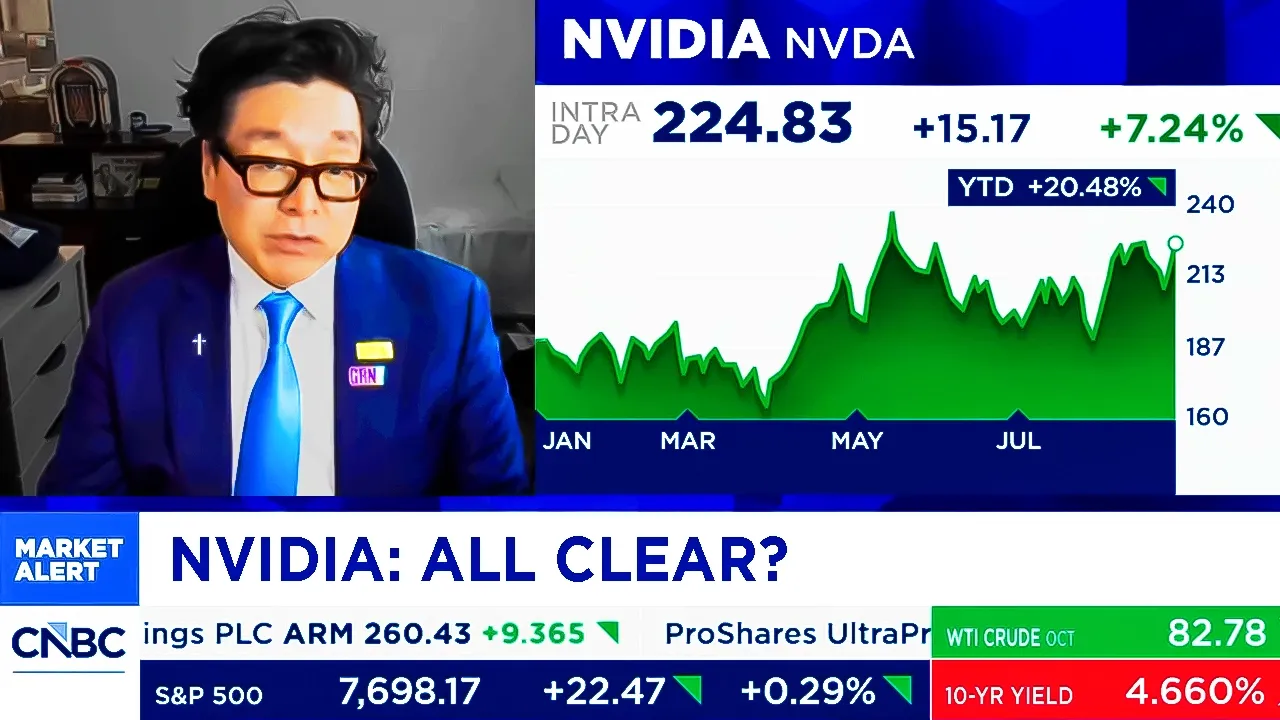
CNBC & Bloomberg On NVIDIA Stock, NVIDIA Earnings, Micron Stock - NVDA Update

- Rendement de la vidéo
- —
- Appels
- 5
- Achat / Vente
- 5 0
- Publié
Recommandations
L'entrée est le cours de clôture de l'actif à la date de publication. Le cours actuel est la dernière clôture enregistrée.
-
Entrée $217,55 28 août 2026Actuel $217,55 28 août 2026Résultat +$0,00
who has a buy rating and a $335 price target for Nvidia.
Contexte Cody, managing director and senior semiconductor analyst at benchmark, who has a buy rating and a $335 price target for Nvidia.
-
Entrée $217,55 28 août 2026Actuel $217,55 28 août 2026Résultat +$0,00
As you know, we said we liked Nvidia. We still do.
-
Entrée $217,55 28 août 2026Actuel $217,55 28 août 2026Résultat +$0,00
If it gets above 230s, I'll probably add to the position.
-
Entrée $932,86 28 août 2026Actuel $932,86 28 août 2026Résultat +$0,00
I like Micron, too.
-
Entrée $35,45 28 août 2026Actuel $35,45 28 août 2026Résultat +$0,00
I continue to be bullish on Iron and I expect to be bullish at least through calendar 2027, possibly longer depending on what happens.
Transcription Complète
Pierre Farerru has increased his 2027 earnings forecast for Nvidia following their results saying that Nvidia has a strong hand with performance ecosystem fragmented fragmenting market and financing power. Pleased to say that Pierre joins us on set. Good to see you. Thanks for stopping by. >> What do you for me? >> What do you do with that number? 70%. Not only do they usually not give that sort of guidance but giving such a large guidance that itself was supply constrained. This is like beyond beyond what you could have ever imagined, right? And so what do I do with it? I analyze it and it's in a supply constrained environment. So that means this 7% is going to be reached quarter after quarter. So if you break it uh down, it's 15% growth every quarter from like the kind of $110 billion they guided for for the next quarter. That means at the end of next year they will be on a run rate of making a trillion dollars of annualized revenues. That's a big take. This is actually something Yansen hints towards um back in March at GTC when he talked about the trillion dollar orders uh he got in so far on the Reubin and Blackwell uh systems. But given this the stellar results is there anything that was cautious to you whether it was the merger the margins the competition uh anything bring to you any caution to circular financing that they had to address when it comes to this name? >> Well um so I I think the guide they gave is supply constraint. We follow the whole supply chain. We look very closely at who's deploying what. We we do think demand is significantly above that. So the thing that could keep me nervous would be supply issues and what one of the things we discussed last night with management was you know uh this like mounting food against data centers in the US people like feeling uncomfortable with these giant data centers popping up in their communities. Uh so that's one of my concerns. Uh and then on the supply chain, I would actually say so far if you look at the track record of the supply chain at actually pushing the limit a bit further every quarter, I I do think we have very good chances that at the end of the day, Nvidia beats that 70% guide because remember it's supply constraint and when you look at your supply over the next 12 months, you're usually on the cautious side. So I wouldn't be surprised to see a tiny bit more growth next year. And when Colette Crest was was speaking to you all on the call and she was talking about the financing that they were doing, she said the majority of that is going to fixing this is going to the supply chain. Does that alleviate some of the concerns about circular financing if the goal of them of the financing is to help the supply chain and thus get that 70% look more like 100%. That's a very very good question and it alleviates some concerns but not these concerns because the reality that people who want to invest in these data centers they are like standing in line and waiting for it and you have all the hyperscalers they have trillions of dollars they can invest in these data centers but it's actually alleviating the concern of Nvidia who doesn't want to see people deploying compute depending on hyperscalers who are also developing their own chips so Nvidia says come to me invest in a data center with our technology and don't you worry about financing. We have you covered. Look at our balance sheet. Very, very smart and a very good way to protect their ecosystem. >> And speaking of the hyperscalers, when you know they're obviously projecting 70% growth next year, does this mean that they're expanding beyond the hyperscalers to other areas? >> Yes. Um but but not that much. Actually, hyperscaler capex are still growing very very fast. We do expect hyperscalers to actually burn free cash flow next year like u something around $und00 billion because their capex is probably going to approach a trillion dollars. But at the same time this financing uh headed towards what we call the neocloud. So these like smaller very agile teams who can like pull together power shell and land uh very fast together are actually representing a growing part of the market. they were maybe um uh you know uh they are now like approaching uh u 50 um more than 50% of the market and so the hyperscalers are slowly uh coming down in the mix. >> One of one of the other interesting fast facets of this ecosystem is just the price of using AI is collapsing. I mean, you you get these new models coming to market and we don't know where they've come from and they're performing nearly as well as the LLMs and they're free if not something close to free. Is there a necessary tension in the idea that the product itself that is models and AI is becoming very cheap but the cost of building the ecosystem is still very expensive with the supply constraints. >> Yes, it's a it's a good uh it's a very good question and so all this is very new but just think about a product you know very well your iPhone. Your iPhone has increased more than 2x in prices over the last 15 years, right? Uh now the cost of one transistor on the chip of your iPhone has come down by a 10,000x over that period. >> But you're having a million more transistors on your iPhone than you had 15 years ago. So the token is a new transistor. Price per token will keep coming down like very very rapidly, even faster than the transistor. But the amount of tokens you're using, there is no limit. And like Elon Musk likes to put it, there is no limit to the demand for intelligence. And as long as intelligence can deliver value, like growth in the number of token will always exceed the pace at which the customer is why Jensen Hong wants open source modeling so much because it just means more people can adopt it. >> More people can adopt it and open source means you're a smaller organization. You can't develop your own chip and he likes that. >> Let's begin though with Nvidia reporting a blockbuster quarter. Very strong guidance. Jensen Wong telling CNBC and Jim last night, there's still runway ahead for demand. Demand is super strong and incredibly it's accelerating. You know, obviously we're already a very large company, but to be able to grow continuously and now to accelerate our growth is pretty extraordinary. Now, what's happening underneath the the things that are going on? Number one is that AI is now useful. It's doing productive work and the tokens that are being generated by these AI labs are now profitable. >> Our next guest just raised his target to 400 from 315. It's not quite a street high, but it's pretty close. He says this quarter should remind Nvidia investors why they own the stock. Joining us today, Bernstein, senior analyst Stacy Rasgun's with us. Stacy, good to have you. Thanks for the time. >> Yep, good to be here. >> So, what what part of last night did you find most compelling? I I mean clearly it was the the raise to to next year. I mean we we was a pretty strong beaten raise in the near term. People expected that but I mean they're guiding 70% revenue growth for next year. For some context I think at least the sell side estimates were up 44% off of a lower base. So just a massive uh raise relative to prior expectations. Um they also got in front of some of the other worries. People have been worried that gross margins may take a bit of a hit because of memory prices and they got in front of that. they're guiding them, you know, from down to the low7s versus the mid70s. I I think it's it's it's fine. Um, you start to look at the earnings power of this company. I I I mean, numbers are clearly going up, sellside numbers went up, buy side numbers, I think importantly went up. That maybe that's something that hasn't happened in a few quarters, but that's clearly happening happening today, right? And I mean, maybe just uh take what what Jensen said, the the idea that a company that is this large could continue to to not only grow, but actually accelerate off of an already strong base. I mean, it's just something that we haven't really seen before. And it really does, I think, >> get to the the point that there the demand that we're seeing here really is real. I think these things actually are being used. The question of returns, I think, is is increasingly getting answered in in the form that there is a return on this investment. And I I was I was just really happy to finally see see it start to really come through in in in the numbers and so I was very pleased with it yesterday. >> Is there something that explains its recent underperformance on earnings? I mean was there something different this time? >> Yeah. Well, there was like like I I think importantly the the buy side is always as you know above the the the sell side. the actual investors investing in the stock, their expectations tend to be higher. And maybe you could argue for the last few quarters, they've been very strong prints, but the buy side numbers like especially into next year and beyond didn't really go up. I I think they went up and probably reasonably materially uh this time that that that is important. That is one difference. And like I said, just there's been this big question as as their their next generation platform Reuben starts to ramp, what is that ramp going to look like? Are there delays? Are there clearly no delays? You know, Reuben's ramping really really strongly and now we're starting to see the implications of that that ramp on the numbers and like the growth is clearly like showing showing through here. So that is we got some concrete evidence now, real concrete evidence that that growth is happening. >> Yeah. I mean Stacy, you mentioned the the kind of the buy side's always higher. I think if you extrapolated what the hyperscalers told us about likely spend next year, uh you got to these something similar to what Nvidia's current guidance is looking like. Um one change and I'm sure you're spending a lot of your time trying to contend with this with clients is the complexity of the story has definitely increased. Uh you mentioned the balance sheet for Nvidia is a massive competitive advantage, but it means it gets used a lot, right? They're doing all these component supply agreements and locking in orders there. They're obviously financing a huge percentage and making acquisitions of this ecosystem. So, is that something that's going to hold back the valuation because you got a $400 price target that's 10 trillion dollar market cap? >> Yeah. Yeah, it is. I mean, like we we'll see. I mean, I think using the balance sheet, it is a moat and and my my take was is it's as much of a moat as as their as their technology and and and their software and their ecosystem. Nobody else can really do the things that they're doing. I mean, they've got I think just their direct supplier agreements are close to $300 billion. And this is for things like direct to memory and wafers and that sort of thing. And so they can lock up that supply much more than any of their competitors can can. And and you need that supply to be able to sell the the product. And so that's important. And in terms of the investments in the ecosystem, you know, people people worry about they call it circularity and I'm a little more sanguine about it. Um, my view has been they're generating so much cash that I mean almost they they they don't know what to do with it and you know they're already returning a bunch and they're they're buying supply and they can't really do big M&A and what what better use of that of that cash versus to to invest in and grow the ecosystem around their products and and and I mean you have to remember they're not really writing checks for most of this of this stuff. It's it's more like they're you know they're they're lending out their credit rating in some sense. they're backstopping stuff. Um, I think the the risks around those have been pretty clearly thought out. Um, and and if they've got customers that have strong demand, they don't have >> the credit ratings and the wherewithal like to to >> have enough of a of a history that that the folks that need to put the the supply and everything in place for them are are comfortable without that. I think it's fine. I think it's fine. >> Yeah. Better to use Nvidia's balance sheet than Anthropics if you >> Yeah. And like I said, they're not writing checks for this stuff, per se. I get it. Um Stacy, just for me, I mean, you mentioned capital return or you mentioned all the cash flow and >> how do you see it in terms of dividends and buybacks? Will it only go up from here? Are they going to actually allocate even more? >> Well, I mean they they could I said more than 50% of of free cash flow, available free cash flow. By the way, all the supply commitments and everything, the cash that goes out for that, that's not available free cash flow, which which is fine. >> Um but I mean the cash flow is going to go up. So I I mean just mathematically I think the cash return has to go up even if they don't increase the percentage. And just for some context I think in our current model now next year I mean we've got to buying back $120 billion I think something like that. Um because if I don't like I've just and I've already still got even cash piling up on the balance sheet. If I don't model something like that I've got it piling up even more. And so we'll see what they do. Clearly the capacity is there. They'll they'll make the capital allocation decision on what they they want to do with it. But um yeah, I think they'll probably be returning a lot of a a lot of cash whether or not that percentage goes up or not. >> Very much. Nvidia delivered a strong sales outlook that is putting it mildly. But it did warn that margins would narrow in the coming months principally due to rising memory costs. Let's talk about the impact of that with Cody, managing director and senior semiconductor analyst at benchmark, who has a buy rating and a $335 price target for Nvidia. And what is so interesting, Bloomberian King made the point at the top of the show in the semiconductor space. If any CFO or CEO said this is what's going to happen to margins over the next six months, the stock would not go up like it did. You seem sanguin about that as well. >> Yeah, I I really was. And and initially the stock was down on that disclosure. So uh yeah, like you said, had any other company talked about a collapse of margin to 75% to 71 to 72 in two quarters um and then recovering only about another 100 basis points even after a price increase. Uh that would have been enough to uh tank the stock. But uh but uh as Carmen mentioned, that guidance for revenue really trumps everything. When they're talking about 70 to 100% increase and 70% in the bag for next year, uh that's a $300 billion annual increase. And that's 120 billion ahead of expectations. And so our numbers are going up above uh nearly 700 billion for next year from 400 billion in fiscal 27, calendar 26. uh that's taking our EPS estimates, you know, up uh nearly $3 for next year. >> Cody, what links the margin story with the revenue growth outlook story is memory, right? You know, they were pretty clear that what they would have been able to do on growth were it not for supply constraints, this business would be doubling. At the same time, the emphasis on circular financing is Nvidia saying we're just trying to help everyone get moving. Particularly Klet Crest, the CFO telling me they are helping people get supply. How did you assess all of that explanation on Nvidia as a the bank of Nvidia in the ecosystem? >> Well, I think it's Nvidia just trying to ease any bottleneck. Um, as you said that uh the memory is the biggest constraint. They have agreements now stretching out three years. Uh they've got committed nearly $300 billion in uh capital commitments uh for to ensure pricing and availability. Uh so they said that they're they're well set for their expectations for at least the next two to three years and then they're going to be working to ensure guidance capacity upside uh from that point. Um, regarding your u your other comments about circular financing and um I think one of the other big bottlenecks to the industry is just the availability of things like land power and shell and data center uh infrastructure uh and on project financing that you know that's as as critical of a capacity constraint as memory is in many cases when you have small startup projects that are just hamstrung by financing access. So if Nvidia can uh loosen that bottleneck by providing their balance sheet, it's all the better for them because it all comes back to them uh exponentially in revenue. >> Cody, on the analyst call, your your industry peers asked about custom silicon and A6 and Jensen Wong continues to be dismissive of the threat of other options for accelerators. Do you factor that in or model that in for for growth going forward? >> Yeah, we do. I think competition is a real thing that's increasing in the space. I think you've got guys like AMD that now have uh competitive stacks. You have Cerebras uh recently went public with its alternative. Uh you've got uh all the hyperscalers internal designs that are competitive. Um and uh even internal uh Nvidia silicon with its Grock acquisition uh is creating an alternative. So, but at the same time, even in the face of all this competition, Nvidia is seeing a doubling of their indication of their revenue growth. And so, even if you're seeing their market share go from say 85% to 75% or 70% uh demand is so strong across the AI complex, uh that it's continuing to push invidia well above expectations. So, you know, their their issue right now is is simply supply. It's not a a matter of demand. And that's even in the face of of increasing competition. >> Thanks for having me. >> Is it peculiar to you as well based on what happened? >> You know, one of the things I just haven't figured out yet, I've been like up two minds all day on is how much do I want to believe a company in the semiconductor industry when they have visibility on 2028. You know, I thought what I learned somewhere in the last 30 years was they don't have a ton of visibility six, nine months out. And >> that's why they've never gone this far out. They've never done that. They said that right 70% revenue growth. Street was at 44. >> So it worked >> for that name >> for that name. And I agree and you would think it would have maybe made micron go up just cuz they totally memory constrained the current conditions a little bit. So you'd think on the margin maybe I take my my micron view up and it that's not in the price today. Right. So I agree it's a little congruous. Um >> and I I just you know sure they have contracts that are five five years. Sure. They've now put in some penalties for cancellation, but they're kind of dimminimous relative to the overall. In other words, I've just I thought I learned somewhere to mistrust two-year out demand indicators. And so, >> especially in a space that is, as you know better than almost everybody is so cyclally driven. >> Yeah, this is a cyclical industry. We we're confused about the periodicity and amplitude for sure. Current conditions are great. We know they're going to roll over pretty hard eventually. So, it's like a giant game of chicken that we got to time. You know, I I was just putting um the the initial part on my weekend note I always write and I was putting that photograph from from Kevin Bacon at Foot Lewis where he's going with the tractor to the other tractor and his shoe waist gets caught. You know, I'm not 100% sure when I got to veer off here. Um and I I could see some people saying, look, I'm a little worried like it's running hot like Micron's going to do 86% gross margin in a in a in a cyclical business and this kind of tells you how hot it is. So, look, I think near-term conditions are so strong that these companies can grow through it. As you know, we said we liked Nvidia. We still do. I like Micron, too. >> You said you thought Micron was going to double. And by the way, you you just said Micron as a cyclical business. I mean, the the CEO now I I know, you know, you're going to say, well, what is he going to say talk in his book, but >> he made the point just last week with Kramer that >> maybe it's different this time. I mean, used to be a semi analyst. >> I I think it already is different. I feel like we were raised somewhere to like duck lightning bolts to say it's different this time as if you're an idiot if you say that. But like to those people I'd say look it's already different. You already missed it. It's already over a trillion market cap. Like what do you mean it's the same? I think the question is how fast is it erode? Do they really lose money in 2029 or or beyond? And I think one thing that Micron's not getting credit for is the balance sheet. So sure, I could look at a single business say I pay five times peak earnings, 11 times normalized or roughly where it trades now. But what if they run with 30% of the market cap in cash as opposed to net debt? Like shouldn't I care a little bit about the massive amount of money they're making in the next six, seven quarters? I think you should and I think they should get credit for it. The critics would say, well, but they're signaling they're going to buy back the stock and I think the stock's overvalued. So that's where they're getting I I don't think full credit for how awesome current conditions are. So you so you used to be a semiconductor analyst at Bernstein, right? You preceded Stacy Rascan, Right. Right. >> Yeah. >> So if you were sitting in that seat today as yourself, obviously not telling you what you not asking you what you think he should do, but >> would you take a look at the Nvidia report and what would you do to shares? Would you >> and the other names in the space? Would you be tempted to upgrade or or rate I mean up? They're already probably buys, but raise price targets on almost everything. >> I like semi- still. I don't think we've reached highs for the major companies here. I think Nvidia will be way higher at the end of the cycle. I still think we're three years, four months into a eight-year cycle that the market will probably discount a year or two in advance. So, I think we're headed higher over any meaningful period of time, but you just have these periods where um you have to, you know, digest news. There's there's 567, I think, levered or inverted ETFs in the in the market right now. A lot of them are triple long invid double long you know so you're just going to get a lot more volatility around these prints but ultimately I think we're still headed higher just based on the hyperscalers ability to borrow more money to fund the growth for a sustained period >> would you be how would you be assessing the data center backlash as you're looking at estimates for semiconductor companies and if you believe that it's going to be a bigger issue even than it is Now, would you be tempted, at least in the near term, would you be tempted to take some of your estimates down because you think this is that durable and existential potentially for let's just say for the next 6 months? I don't know. >> Yeah. I mean, I I guess I shouldn't be surprised, but I am a little that it's 23 states that are bringing up issues with data center construction. I always thought it would be a little note specific. I guess when I look at companies with exposure, I still see a pretty big gap. I'm not saying CAT should trade at par to micron. One seems to be at 10 111 times normalized and one at 30. >> The charts sure looked similar for a while, didn't they? >> Yeah, but they should to me be closer together. You can't argue that you're going to construct these things forever and pay a high multiple for one business and then they're massively over for the other. The truth's in between. So, one of the things we do is we tag every stock in the market. Do you have meaningful AI revenue? What bucket are you in? Are you memory and semicap? Are you vertical on edge? Are you platform? Are you, you know, data center? And I think you want to be overweight AI revenue still, but I think you have to be very careful about what pocket you're in. And I would probably sell a little bit of the longerdated businesses that require five more years of spending to make the math work. >> Okay. So, Bren, the irony of this whole thing today is that we went into Nvidia's earnings report saying that, well, this isn't really about Nvidia's stock specifically because it usually doesn't do anything on the back of an earnings report. And they blew it out, of course. And it's the dozens or hundreds of other names that we really need to be hyperfocused on after Nvidia reports. And here we find ourselves exactly the opposite. It's Nvidia which is the big winner and some of these others are more mixed. What do you make of that? >> Well, first of all, I think this is a reminder for investors, don't don't react immediately because when Colette came out on the call and said they're going to raise their guidance, that's really when the stock and overnight trading started to rip. And what you you and I have been talking about, Scott, is, you know, the stock has not been able to get over two the 230s. It actually touched 230 today and got rejected down. So, as a as a as an investor, whether I'm a trader, a long-term, it needs to get over that like low 230s for it to go higher. If it does that, I think it goes meaningfully higher, but it's not there. To me, when I asked myself as an investor, why is it not up more today? And I listened to the call, read through the financials. I will say that, you know, account receivables made up 60 66% of quarterly revenue. And for certain clients, those accounts receivables are 90 days to a year. Um, and maybe those are Google, AWS, Microsoft, but I do think the market is saying part of today's move, which is which is nice, but I feel like should be higher, is maybe a dollar of NVIDIA financed revenue is not an actual equivalent to a dollar of customer revenue. And so, I do think this skepticism that we have in general is very healthy to this this AI market. It does, I think, help limited 2021 and 1999 because we're all very skeptical. But I do think it's peculiar though that Micron IMD RAM is not up huge today cuz I think it was Colette or or Jensen that said that their commitments mainly memory are going from 119 billion to 279 billion most of which is memory yet DRAM is down today. So, I do think that was a peculiar move in the market, but I do think investors need to read those signals. These are great numbers, but why is Nvidia not up more? And so, I balance that out. If it gets above 230s, I'll probably add to the position. Well, do you do you think, Brenn, that the the market is skeptical or doesn't trust that 70% number that maybe this is viewed by the market or some investors as a as as trying too hard as an attempt to get a stock moving that hasn't been moving all that much. So you throw out a 70% growth number for 2028 suggest it could even be larger if not for supply constraints but it's so far in the distance of what a market usually looks at that it can't really put any cred into that number. Is that a play? >> Well yeah I agree with Adam. Be careful about 2028 numbers. That being said I feel like the two best CFOs are Amy Hood and Colette. And so when Colette's saying this, I'm going to I'm going to I'm going to say that well, her lens uh has been very accurate. I feel like she's conservative and so so we'll see what happens in 2028. A lot of things can change. I think that's a that's a with the data they have today. I I'm I'm going to believe what she says cuz she's she's incredible. But I do think that just the skepticism for multiple reasons is, you know, is real. >> We're back now that Nvidia earnings out of the way. What does it mean for stocks in the weeks ahead? Let's welcome in Tom Lee. He is Fund Strat's managing partner, head of research, also a CNBC contributor. It's good to have you back. >> Great to see you. >> I said at the very top of the show, it's kind of peculiar the market reaction to this today. Nvidia is having a great day, but it's kind of mixed elsewhere. What do you make of that? >> Um I I mean, I think it's a healthy market, Scott, because Nvidia had good numbers, so you want um Nvidia to go up on good news, which it did. It's having >> which it rarely does. >> Yeah. And it's rare. So it's breaking a pattern of people thinking people don't care about the earnings. It really did matter and I think that we are seeing a positive response in software which of course is on good numbers and there and those names are downstream of the AI trade. So I I think it's actually an overall healthy reaction. >> I know but the the software moves are so specifically related really to what we got from Salesforce and Crowd Strike and Opta Octa and others. I find it interesting that Meta's down. Amazon's down, Alphabet's down, AMD's down, Micron's down, Marll's down, Coral Weave's down. I wouldn't have expected that after Nvidia delivered what they did. >> Yeah. I mean, it's also possible people were using those names and not having exposure to Nvidia. So, they've got to find a source of funding if they have been underweight Nvidia. And again, I've heard it from many guests on CNBC. The thing that stands out is Nvidia's multiple is still very low. So, they've got these huge revisions. The stock hasn't kept up. Now, the PE keeps contracting. >> Yeah. So, what about the data center debate? Speaking of the midterms, that only going to grow louder as you approach election day. Now, we're still a few months away from that. >> Yeah. >> But that feels like it's at play here, too. And why the market and those specific names just haven't traded all that well lately. >> That's right. It's becoming a actually a an issue that resonates with voters and it looks like it's turned already some elections like in Ohio and then we're seeing governors in Republican states and pro data center states you know supporting a pause. So you're absolutely right it's become a political issue. I don't know if this is also maybe fueled by China, which wants the US to slow down its AI efforts, but you're right, it's it's becoming an issue, and that's probably why the downstream trades are doing better. The AI downstream trades. >> What took his company from a couple billion dollars when it was chiefly a maker of graphics chips for PCs to 5 trillion dollars, largest company on Earth, as it created devices that power artificial intelligence accelerated. Lately though, the stock's lagging and a lagging stock operates a lot of negative chatter. I mean, it just does. It creates it. Since May, the long knives have been out for Nvidia. As I said many times to you, as someone who owns both Salesforce and Nvidia for my charable trust for what seems like forever, I heard the rumors sales were slowing. The hyperscalers, the concentrated customer base had turned against them. The politics of data centers had turned costic. The big builders of them bereft. Their chips were losing value, not holding on to it. And the products, including the brand new Vera Reuben semiconductor, were late. Gross margins were shrinking. And they were doing circular deals where they'd invest in their customers in order to finance purchases uh at least more purchases of Nvidia chips. That was the wrap on this one. Incredibly negative people. Incredible. And what happened? What really worked? What really was the litany? Well, I'll tell you what you just heard WAS ENTIRELY WRONG. >> THEY KNOW NOTHING. >> Every bit of it. Hyperscalers won so much of Nvidia's bulk of business are now down to 50% of it. Sovereign buyers, Neocloud infrastructure builders getting the other 50% far less dependence on a handful of Titanic clients. The chips are lasting far longer than anyone thought. Maybe as long as 7 years because software updates keep them refreshed. Fear Rubin on time. Yes, the gross margins took a hit, but only because Nvidia decided to eat some losses from skyrocketing memory prices. Not dirt their clients. Far from running away from Nvidia by building their own chips, the hyperscalers are still embracing the king. They may be doing some stuff away from it, but Amazon Web Services plans to deploy 2 million GPUs, the kind of semi Nvidia specializes in as well as plenty of Nvidia Nvidia CPUs. Those uh supply deals, the circular ones, so many of them are working out because the investments held up or more likely increased in value. Jensen told us he wishes he'd made even bigger deals. But you got to love him. Profits expanding for his company and perhaps just as important, also expanding for the customers. The era of profitless chip buying is over. The era of humongous profits has begun. Worst case scenario, you can just rent out all that Nvidia computing power and make big money like Elon Musk did when he leased SpaceX's Nvidia Compute to Google Anthropic. Most of all, it was the thing that keep that took the stock from being down six after the close as people parsed through the earnings release to being up 10 almost the moment the call began. Nvidia projects that they can put up 70% revenue growth in the next fiscal year. Uh the stream was only looking for 45% and it could have been 100% if not for supply constraints. Remember this is the largest company in the world by market cap and they're expecting it to grow at a 70% clip. That is nothing short of astounding. Oh, and the mess over the data centers just to remind us he's not all that concerned. Taking a step back, this is America's great opportunity. This is an extraordinary opportunity. AI data centers, AI factories are generating so many jobs all across America, hundreds of thousands of jobs. They're improving communities because they're bringing a lot of tax dollars. They're bringing a lot of economy into communities. And so I I hope that people take a step back and realize that this is creating jobs. is going to re-industrialize United States. The manufacturing sector that we've lost over the last 50 years has an opportunity to come back. America, listen to that, man, please. It's amazing to me how negative people can be right down to the last minute yesterday when the stock was selling off big until we heard that 70% growth figure. More on that later in the show. And we could lament what short sellers do. I don't care. Not at all. Let them jibber jabber. Truth pull out. Here's the bottom line. The short apocalypse hedge funds got annihilated by Salesforce and Nvidia's common stocks. If you listen to me and just own these stocks and you didn't trade them, what can I say? You had a phenomenal day. Let's take calls. All right, I hope you're all doing well today and staying calm in this market. Thursday was a mixed day in the market. Many stocks in the S&P traded lower even though we were positive at the index level. Nvidia had a notably positive session following Wednesday's earnings thanks largely to the fiscal 2028 revenue guide that leadership provided on the earnings call. I'm going to cover iron earnings in a moment and I'll recap Nvidia earnings after that in case you missed Wednesday's video. But first, let me cover some important news stories about Nvidia and memory makers. So Wednesday evening, Nvidia disclosed that they significantly increase their supply commitments and they spoke about gross margin pressure in future quarters due to higher memory prices. All of that is positive from memory makers like Micron and SKHix. That said, we saw Micron trade lower during Thursday's session, likely due to a few pieces of news that I'm going to cover now. We also have to keep in mind that with Nvidia having such a strong day on Thursday, and considering that Nvidia has such a large market cap, it's likely that there was some selling pressure in Micron as a result of Nvidia's significant move higher. Many managers can only have so much exposure to semiconductors at one time. That said, we also got some news stories that weighed on Micron. First, SKH broke ground on its new HBM facility in Indiana and provided a more concrete production timeline. SKH Heinix is investing over $4 billion in a fab with mass production of next generation HBM expected to begin in the second half of 2029. There are two factors wrapped up in this announcement as it relates to Micron. First, as I've said before, market participants are nervous about any new capacity coming online due to fears about potential threats to the memory makers pricing power. And second, Micron is the only US-based producer of HBM. That status is worthy of a premium and Micron is uniquely positioned in that regard. But now with this announcement from SKH Heinix, we're talking about SK producing HBM in the US as well. In fact, SKH Heinix CEO appears to have taken aim at Micron by saying, quote, "We will become the most trusted partner in the US where top tier customers, R&D capabilities, and partners align." This announcement weighed on Micron stock Thursday. Additionally, during a webinar, Tech Insight senior vice president said that China's CXMT successfully implemented HKMG technology in its G4/16 denometerclass process and LPDD are 5X products. CXMT is also reportedly in initial production of HBM2E and sampling G4 based HBM3. Tech Insights estimates that CXMT still trails the memory leaders by roughly two generations, but the gap is narrowing. That also spooked some market participants. In other news, Politico is reporting that the administration is considering a new round of tariffs on semiconductors as well as products that contain those chips such as laptops, game consoles, and data center servers. According to the report, the commerce secretary favors a structure that ties foreign companies tariff relief to investment in US manufacturing. So if this report is true, then perhaps companies can avoid the tariffs by simply committing to manufacture product in the US similar to what Nvidia did. That said, Reuters said they were unable to confirm the report in a White House official said quote unless officially announced by the administration. Any reporting about tariffs should be regarded as baseless speculation. Also, Micron announced their next earnings date which is scheduled for September 30th. So mark your calendars for that. In other news, the information is reporting that Nvidia has agreed to buy Hugging Face for $12.9 billion. At the time of making this video, I don't know if this story is true or not. I'm just bringing it to your attention so that you're aware of it. One of Hugging Face's co-founders actually went on Bloomberg today to talk about a different topic and the host at Bloomberg asked him about the rumors to which he responded by saying that he's not going to comment on that. So, make that what you will. For those who don't know, Hugging Face is arguably the most important distribution hub for open-source AI models and data sets. We know that Nvidia is determined to be the leader in open source AI and so if this story is true then it is a big deal with very important implications. In other news, Nvidia announced they are expanding NVLink fusion with NVHBM which is a next generation high bandwidth memory technology that brings higher performance and efficiency to XPUs. It will be validated and offered by leading memory partners. Traditional HBM architectures place the memory controller on the XPU die consuming valuable silicon area that could otherwise be dedicated to compute. NVHBM is built on the same technology that Nvidia will use for future GPUs, integrating NVIDIA's custom memory controller into the HBM based die. As a reminder, Amazon's Tranium 4 will integrate Nvidia's NVLink fusion, allowing tranium chips to be used in Nvidia systems. And now Nvidia will work with Amazon's on NVHBM technology and the NVLink scaleup architecture to enhance performance and efficiency for AI workloads. This is very interesting. Whenever we hear news about a new custom ASIC from the hyperscalers or Frontier Labs, we need to remember NVLink Fusion and the fact that Nvidia innovates across the entire stack. If another company wants to use their own custom accelerator for a specific set of workloads, they can simply integrate their XBUS with Nvidia systems via NVLink Fusion and remain customers within the Nvidia ecosystem. The concerns about AS6 taking market share from Nvidia completely miss the point. The world is compute constrained, which means there's already enough room for multiple chip makers to succeed. The market is growing an extraordinarily strong clip on top of that and XBUS can be integrated with Nvidia systems via Envy Fusion which speeds up time to market and substantially reduces risk for those developing XBUS. And now let's cover Iron earnings. Let me start by saying that I was expecting this specific earnings report to be the last quote unquote bad earnings report from Iron before we see their revenue start to ramp notably. I want to emphasize that at this current stage, I'm more focused on Iron's buildout and the company's future ramp in revenues rather than their current results. I'm not bullish on Iron because of the company's current fundamentals. I'm bullish on Iron because of the company's future growth. That said, I'll briefly mention a few metrics for the quarter. Topline revenue was down sequentially, which was expected because iron is transitioning away from Bitcoin mining. Iron also reported a notable net loss of roughly $684 million for the quarter. The vast majority of that loss was from the decommissioning of Bitcoin mining hardware, which was expected. What really matters is progress on Iron's buildout, customer contracts, and AI cloud revenue. Iron's AI cloud services revenue more than doubled quarter over-arter, which is good to see. That's mainly from capacity coming online at Iron's Prince George site. You may remember that Microsoft recently accepted delivery of the Horizon 1 data center from Iron. Horizon 1 revenue is not included in these results at all. That's something to look forward to starting on Iron's next earnings report. Iron said they have $1 billion operating ARR as of August 26th. That's good news. That implies that the aircooled capacity at Prince George as well as capacity at Horizon 1 are both online operational and generating revenue. Iron share that they have $4 billion of contracted ARR for 2026 capacity. That's very important. Iron previously announced that they're targeting $4 billion in ARR by year end 2026. Prior to this report, we didn't know that all of that capacity had been contracted out to customers. That created some uncertainty among market participants. But now iron is saying that $4 billion worth of 2026 capacity is contracted which should be a relief to investors. Iron emphasized that they are being deliberate in allocating capacity to a diversified customer base across hyperscalers, enterprises, AI developers and frontier labs. In other words, they're in no rush to sign contracts and they're trying to be strategic about which customers they work with. As long as the world is compute constrained, Iron should be able to sell whatever capacity they can bring online. Demand far outpaces supply. Therefore, Iron currently has a lot of leverage in negotiations. With that in mind, it makes sense that Iron is being strategic about which deals they sign. Iron is forecasting approximately 25 to30 billion of fiscal 2027 capex. That is a lot for Iron. Iron said their capital requirements are expected to be met through existing cash and committed GPU financing/prepayments of $14 billion. Iron is also targeting additional GPU financing/prepayments of approximately $8 billion and the residual requirement is expected to be met through data center financing, operating cash flows, and corporate debt and equity. So, we could definitely see more corporate level issuance from Iron moving forward. That said, leadership made the point on the earnings call that Iron's data center portfolio is currently unencumbered, including horizons 1 through 4. That gives Iron assets against which it can raise debt. management indicated they're already having discussions about this and could finance facilities either after commissioning or potentially before commissioning. So, we could definitely see more dilution under the ATM and corporate level issuance. That said, hopefully that would be only a small portion of the capital requirement given that Iron will have more optionality as it relates to raising debt moving forward. Iron also said they have a new multi-year contract with a leading Frontier AI lab whose name they cannot disclose at this time. I thought it was odd that they didn't announce the name, but we'll probably learn more about that in the future. On the earnings call, Iron CEO shared that recent three-year contracts are pricing at greater than $20 million per megawatt of IT load, representing a roughly two-year payback, and active discussions are at roughly $25 million per megawatt of IT load. Recent customer prepayments are 45 to 55% of GPU capex, which is strong. Iron is targeting delivery of the Horizon 2 through four data centers to Microsoft in Q4 of calendar 2026. Horizon 2 is working toward commissioning with GPU installations underway and Horizons 3 and four are in the late stages of construction. Iron provided an update on their $6 billion ATM program. Iron said that as of August 14th, they had sold a total of 47,165,838 shares under the ATM for aggregate gross proceeds of $2.49 billion. So, if my math is correct, then that would mean that since the last update, Iron issued an additional 22.43 million shares and raised an additional roughly $1.43 for $3 billion through the ATM. That means roughly $3.5 billion of the original $6 billion ATM remains in use. Previously, I said that I was expecting a share price in the range of $100 to $150 per share sometime in the first half of calendar 2027. The main reason that range is so wide is because of the ATM program. $6 billion is a lot for Iron. I also have to consider the timing gap between when Iron reaches their ARR targets and when Iron actually realizes quarterly revenues that are in line with those ARR targets. Iron was aiming for $500 million in ARR by the end of Q1 of calendar 2026, which would translate to quarterly revenue of $125 million when fully realized. We have yet to see the projected run rate fully materialize in quarterly revenue, although I think that is likely to be reflected on Iron's next earnings report. That time gap is something that I need to start incorporating into the expected price range. Because of that, I'm going to have to adjust both the lower end of the expected price range as well as the upper end. I have to make that adjustment because of the time gap between when iron reaches their ARR targets and when those milestones actually translate into reported revenues. Now, with all that context in mind, I am narrowing my expected price range to the range of 90 to $120 per share sometime in the first half of calendar 2027. As iron issues more shares under the ATM, I will likely narrow that range further. And again, I had to adjust the lower end of the range because I need to start accounting for the time gap that I mentioned. That price range assumes that there isn't a market down and over the relevant time frame. It assumes that the world remains computed. It assumes that iron reaches their ARR targets on time and it assumes that there is not significant dilution beyond the $6 billion ATM. Please keep in mind that this is not guaranteed. I'm just providing a range that I think is reasonable, but there are multiple assumptions baked into the price range that I just gave and nothing is guaranteed. Determining the exact time and price is very difficult because there are many factors at play here and there are still many unknowns. And so I would rather provide a general range that I think is reasonable and gradually adjust that range over time as necessary. But regardless of the specific timing, I continue to be bullish on Iron and I expect to be bullish at least through calendar 2027, possibly longer depending on what happens. And I'll have to update my thoughts on Iron as time goes on and we gradually gain additional details. Short-term fundamentals are not great, but we expected that as iron is decommissioning their mining business and their buildout is underway. That said, for billion dollars of 2026 capacity is contracted to customers, Horizon 1 is operational and horizons 2 through 4 are on track to be delivered by year end. And so regardless of the specific timing, I do expect that Iron's share price will eventually move decently higher, even though I don't know what will happen in the short term. I continue to be bullish on Iron and I expect to be bullish through calendar 2027. Now, in case you've missed recent videos, I'm once again going to recap Nvidia earnings. Keep in mind that when I post a video on YouTube, the vast majority of my subscribers do not see it. And so, I'm going to recap Nvidia earnings again in case anyone's missed recent videos. Nvidia reported revenue of $96.2 billion versus $92.3 billion expected. Data center revenue was $89 billion versus $86.3 billion expected. Adjusted EPS was $222 versus $29 expected. And Q2 gross margin was in line with expectations at 75%. Something that I think initially spooked market participants when the report came out was that Nvidia's free cash flow decreased notably during the quarter to $21.3 billion, which is down from $48.5 billion last quarter. This appears to be due to a decrease in cash flow from operating activities, which Nvidia CFO addressed in her commentary. Cash flow from operating activities was $ 24.1 billion versus $50.3 billion a quarter ago, and a sequential decrease was driven by higher working capital adjustments and cash taxes. It's worth mentioning that Nvidia previously indicated that cash taxes would rise materially in Q2. Also, Nvidia had a significant increase in accounts receivable during the quarter, resulting in a roughly $22.35 billion negative adjustment to operating cash flow. That was by far the largest working capital drain on free cash flow during the quarter. In other words, the increase in receivables reflects revenue that had been recognized, but where the corresponding cash had not yet been collected by the end of the quarter, creating a significant temporary drag on operating cash flow. That has to do with timing. It's not anything to be concerned about. And as for next quarter, Nvidia guided revenue at $18 billion versus $ 104.2 billion expected. And Q3 gross margin is expected to be 74% versus 75% expected. We later learned on the earnings call that the slight miss on next quarter gross margin is due to higher memory prices. That slight miss is likely why the stock initially traded lower when the earnings report was released. Also, in Nvidia CFO commentary, we got this table showing Nvidia's future commitments. This is very helpful and I'm very glad that Nvidia provided this table given all the talk about circular financing that we've heard in recent weeks. I've probably heard the phrase circular financing hundreds of times over the past month. As you can see from this table, the vast majority of Nvidia's commitments are for supply and capacity so they can produce more product and grow revenues. Nvidia's investments and cloud service agreements are relatively small compared to Nvidia's commitments with suppliers. In other words, the claim that Nvidia is quote unquote funding its own growth is in denial of the actual numbers. To put it another way, Nvidia supplier commitments are substantially greater than their investments and cloud contracts. Meaning the overwhelming majority of Nvidia's demand is not being funded by their own investments. Not even close. The circular financing fears are largely overblown and the talking points are getting stale. Now, let's cover the Nvidia earnings call. Let me start by saying that this was one of the better earnings calls from Nvidia in some time. Analysts asked some great questions and both Jensen and Colette were very direct and to the point with their answers. This was a very good call in my opinion. And now but to rapidfire important points from the earnings call. Nvidia CFO started the earnings call by saying quote we expect to grow revenue by approximately 70% in fiscal 2028. That is much better than analyst consensus of roughly 44% revenue growth in fiscal 2028 and that is a supply constrained outlook. In other words, growth would be even greater if Nvidia wasn't supply constrained. Later in the call, Jensen said that Nvidia's demand is far greater than 70% but 70% is what Nvidia has high confidence that they can deliver given the supply constraints. But they will continue to work on that. Later in the call, Jensen said, quote, "We have more supply than 70%. Our demand is much higher than that." So, in other words, revenue growth should exceed 70% in fiscal 2028. But, of course, Nvidia is conservative in the guidance that they provide. And so, they're just saying 70% even though they expect growth to exceed 70%. I can't stress this enough. Going into this report, consensus was roughly 44% revenue growth in fiscal 28. And Nvidia just told us they expect 70% revenue growth in fiscal 2028. And Jensen's comments on the call indicate that growth will actually be greater than 70%. That piece of news is what caused the stock to start trading higher during the earnings call. Nvidia also announced an expansion of its partnership with AWS. AWS is deploying an additional 2 million GPUs starting this quarter through the second quarter of fiscal 2029. Nvidia's non-hyperscaler data center revenue increased 138% year-over-year to 40.3 billion. and Nvidia CFO said that non-hyperscaler customers will represent roughly half of Nvidia's data center business. Later on, Jensen reiterated that Nvidia's non-hypers scale customer segment will likely be larger than Nvidia's hypers scale customer segment. That's positive on the topic of customer concentration as Nvidia is working to reduce its dependency on hyperscalers. That said, Nvidia is still growing tremendously among the hyperscalers which have about $2 trillion worth of backlogs. According to Nvidia, Nvidia still sees about $20 billion in server CPU revenue this year and expects CPU revenue to more than double in fiscal 2028. Nvidia expects to ship rock 3 LPX in volume later this quarter. And on the topic of the Frontier Labs, leadership said Nvidia has invested nearly $50 billion in Frontier Labs. And with Nvidia's recently announced $500 billion partnership with financeers, the Frontier Labs will be able to build and assess AI infrastructure funded by long-term institutional capital at relatively attractive rates. Demand is not the problem. The Frontier Labs have incredible demand and they need more compute to serve that demand. Nvidia CFO said the Frontier Labs customer traction and usage are skyrocketing and Nvidia believes the Frontier Labs will become the largest technology companies in history. Yes, the largest technology companies in history. Nvidia CFO reminded us that Nvidia plans to return 50% or more of free cash flow to shareholders and she said that Nvidia has returned 60% of free cash flow to shareholders year to date. Regarding gross margins and rising memory prices, Nvidia CFO said, quote, "We are experiencing extreme pricing conditions in memory. The magnitude of the price increase has exceeded our prior expectations and are headed even higher into next year. As a result, we are resetting expectations today for Q3. We expect GAP and non-GAAP gross margins to be 74%. We expect margins to bottom in Q4 in the 71 to 72% range before settling at 72 to 73% in fiscal year 28. As executed, price increases take effect in Q1." So that update on gross margins moving lower is not great for Nvidia, but it does bode well for the memory makers. Nvidia is directly attributing the expected decline in gross margins to higher memory prices. It's also worth noting that Colette essentially confirmed that price increases will take effect in Q1, which is something that was recently reported by Bloomberg. Bloomberg reported server makers were raising prices for servers containing Nvidia GPUs by more than 15% due mainly to higher memory prices. Colette didn't give us a specific amount for the price increases in Q1, but she essentially confirmed that price increases are coming due to higher memory prices. Jensen was asked about OpenAI's new Jalapeno chip. And Jensen said that Nvidia is doing something very different. He said that custom XPUs are being developed that are inference specific chips for one cloud or one service. Whereas Nvidia is building an entire AI factory platform that can be used in any cloud and spans the entire AI life cycle. Nvidia CFO emphasized that a large part of Nvidia's commitments are supply commitments that are necessary to produce product. You can see in this table from Nvidia's CFO commentary that the vast majority of Nvidia's commitments are for supply and capacity, not for investments in other companies or cloud agreements. Those commitments are relatively small compared to Nvidia's commitments to secure supply so that they can produce product and grow revenue. In other words, the talking point that Nvidia is funding its own growth completely misses the point. Nvidia's investments and cloud service agreements are much less than their supply and capacity commitments. The talking point that Nvidia is funding its own growth does not add up. The vast vast majority of Nvidia's demand is not being funded by Nvidia's investments or cloud contracts. Those that repeatedly use the talking point that Nvidia is funding its own growth are in denial of the actual numbers. And on the topic of Invidious exposure related to its guarantees, they've essentially provided a $ 105 billion credit back stop to the data center campus in Ohio in partnership with SB Energy and their land power and shell guarantees for AI clouds are only $3.5 billion. That's a total of 108.5 billion. As for the $ 105 billion guarantee, Nvidia's guarantee obligations are capped at a total of $ 105 billion and become effective in phases as certain conditions are met. Nvidia's guarantee exposure declines as Open AI fulfills lease payments. The circular financing fears are largely overblown. When asked about things like AGI and recursive self-improvement, Jensen said that demand is going to inflect further. It's worth noting that Nvidia's growth is already accelerating, and Jensen expects demand to inflect even further. Overall, this was a solid earnings report with a very positive earnings call. One of the better earnings calls from Nvidia in some time in my opinion. The biggest piece of news as it relates to the stock is that Nvidia expects revenue growth of 70% in fiscal 2028, which is far greater than consensus expectations of 44% prior to this earnings report. And again, Jensen's comments on the call seem to indicate that Nvidia will likely grow revenue more than 70% in fiscal 2028, but Nvidia is conservative in the guidance they provide, and so they just guide it at 70%. Nvidia usually doesn't guide beyond one quarter, so that is also a notable change. Nvidia's expectation that gross margin will decline due to higher memory pricing is not great, but in the eyes of market participants, that appears to be more than offset by Nvidia's much better than expected fiscal 2028 revenue guide. So overall, these were solid results and a very positive earnings call. Looking ahead, Jensen is scheduled to speak at the Goldman Sachs Communicopia and Technology Conference on September 10th. And then Jensen is scheduled to speak again at GTC Berlin on October 21st. Now, in case you're new to the channel, I want to make sure that you have at least a basic understanding of the underlying long-term thesis. So, let's cover that. Now, I don't know what's going to happen in the short term, but from a long-term perspective, I am very confident that Nvidia will be worth much more in future years than it is today. When Jensen was on the Lex Freedman podcast not that long ago, he was very seriously raising the possibility of Nvidia becoming a $3 trillion revenue company in the near future. If that happens in the coming years, then it is very plausible that Nvidia could one day be worth tens of trillions of dollars in market cap. That might sound crazy, but that's what Jensen is implying when he raises the possibility of Nvidia becoming a $3 trillion revenue company. I guess the question at that point is what multiple the street will be willing to give Nvidia. I don't know the answer to that question, but I truly do think that Nvidia will be worth much more in future years than it is today based purely on the fundamental growth of the business. Based on everything I'm seeing, the world is still computed and I expect that to continue at least through the first half of calendar 2028. In a computed environment, developers will use whatever viable compute they can get their hands on. Today, there are no GPUs that are sitting dark due to a lack of demand. like there was fiber sitting dark due to a lack of demand at the height of the dotcom bubble. Back then, companies were laying fiber in the hopes that use cases and demand would eventually show up. Today, we are seeing the complete opposite. As I've said many times, when market participants compare this AI revolution to the dotcom bubble, they ignore the fact that the internet is already here this time. This means that mass adoption of the technology and new use case development at scale are immediately possible. We don't have to wait years for it to show up. It's already here. The world is compute constrained, which means there is not enough supply to satisfy demand. New capacity is utilized as soon as it comes online. The hyperscalers are monetizing capacity as soon as it comes online. Each of the hyperscalers spoke about being supply constrained on their most recent earnings calls. Additionally, many of the clouds are building out into contracted demand. They're not blindly building in the hopes that demand will eventually show up. No, they're building out because they have signed contracts and in some cases significant prepayments from their paying customers. This AI revolution is fundamentally different from the do-com bubble and 2026 will be a pivotal year for the AI industry thanks to the rapid adoption of agentic AI and the proliferation of agentic systems in the world's leading enterprises. The leading AI labs revenues are surging right now. Aentic coding and the implementation of agentic systems in large enterprises are new use cases that are increasing inference demand significantly that subsequently is increasing compute demand. The rapid adoption of agentic AI is why we're seeing an inflection in inference demand. It's why we're seeing the leading AI labs revenues surge. I wish both Anthropic and Open AI were public so the public could see the ramp in their revenues. I think the leading labs surging revenues may be the initial proof point that grabs market participants attention and causes them to realize that there will be a clear ROI on AI infrastructure. I think the leading labs surging revenues will also help assure investors of the longevity of Nvidia's growth since these labs revenues are directly tied to compute. If they had more compute, they would have greater revenues. It really is that simple. Demand is not the problem. The problem is a lack of supply to meet the demand. As I've said previously, I expect the world to be compute constrained at least through the first half of 2028, possibly longer. And so regardless of what happens in the short term, it's important for long-term investors to remain focused on the fundamentals, maintain a long-term perspective, and remember that we are only in the early stages of Aenic systems being adopted at scale. This will increase compute demand significantly, and after that, the next surge in compute demand will likely be fueled by physical AI. We're no longer talking about digital agents performing digital tasks. With physical AI, we're talking about physical AI agents performing physical tasks in the real world. NVIDIA CFO has called physical AI quote, "A multi- trillion dollar opportunity and the next leg of growth for Nvidia. This industry will fundamentally transform society and Nvidia has positioned themselves to benefit massively. NVIDIA sells the hardware for the data centers where the models are trained. They offer omniverse where the models are taught and tested. And Nvidia also sells the hardware that allows ondevice real-time inference through NVIDIA AGX, allowing robots to have intelligent interactions with the real world, even when they are not connected to a data center. Notice that Nvidia is taking a holistic platform approach to physical AI and they're embedding themselves as the underlying foundation supporting all of it. Over 3 million developers are already building on the Nvidia robotic stack, and this is not getting enough attention. As for production ramps, Blackwell Ultra has ramped and remains in high demand. Vera Rubin is rolling out to customers. Nvidia Gro 3 LPX is in full production. Later on, we're expecting the launch of Reuben Ultra in 2027 and Fineman after that in 2028. We have a clear data center product roadmap stretching into 2028. And Jensen believes that AI infrastructure spending will reach 3 to4 trillion annually by the end of the decade. That means Jensen is expecting growing AI demand and an expanding total addressable market underpinning all of this. I don't think we are anywhere near any type of bubble bursting type of event. With all of this in mind, I seriously think that Nvidia still has plenty of runway ahead of it. And I think this company will be worth substantially more in future years than it is today. At least that's my view of the situation. A quick note before I wrap up. All of the compilations on this channel are edited by Finn Vid with original structure and commentary. Occasionally the same edits appear elsewhere on YouTube. If you're looking for the original version, it's always here on this channel. Thanks for watching, Finn Vid. I appreciate your support. Remember to stay calm in this market. Remember to maintain a long-term perspective and do not make any hasty or irrational decisions. With all of that being said, I hope you all have a great rest of the day and I'm curious to hear your thoughts about Nvidia in the comments below. Please leave a like on this video so more people will see it. And while you're down there, please consider subscribing. It's free and you can always change your mind. Thanks for watching and hopefully I'll see you in the next
Commentaires 0
Connectez-vous pour rejoindre la discussion.
Se connecterAucun commentaire pour l'instant. Soyez le premier à partager votre avis !